Angel

Angel

Oh yes, I have been with them, the lost folk, the tramps, the homeless, the bag-women, all the gente perduta. I have stepped on their fingers as they sprawled on the sidewalk. I have trodden on their toes, tripped over their legs, bumped into their stiff, stumbling bodies and stepped in their wasted body fluids. I have stayed out all night, shared a pack of cigarettes, producing another pack or a bottle from the pouch beneath my wings. Such stories they tell, and they tell them in that antiquated language that I first heard hundreds of years ago. They know me now. I won’t say they trust me, but they tolerate my presence, a Jacques Cousteau voyeur, looking into the sea-depths of their despair.
            Garbed in garbage bags, thin trickles of wine and vomit slipping over their lips and cheeks, bloody bandages wound around needle wounds, they have scars at elbow and foot. I hear the warmish blood whistling its snake song through their arteries and veins but death shall have no dominion, not while I am on watch.
            I enfold myself in my wings and weep as these people, my people now, pillow their heads on bloody bandages. Their world is a world of vomit and reek, yet the edges of their shattered lives rip chunks from my hands and fingers, pluck feathers from my wings, tear holes in my heart. Needles I have seen and touched, blunt, shared between three, five, and twenty-five. Round and round, they go, slipping the thin threads of drug-dreams and tainted blood from friend to friend while the blunt points stab at bruised flesh and leathery vein until the freed blood oozes through fingers and hands clenched tight to hold and staunch.
            Night after night I have watched them searching for something just beyond their fingertips. As the late-night diners emerge from their opulent restaurants, I have seen my people fortifying shop doorways with cardboard castles. I have watched them climb inside, shut down the portcullis, and enfold themselves in the plastic that will keep them free from wind and rain. They all crave the bottle’s warmth. They fight and scratch for that which will hold them together, body and soul, that spiritual glue that binds the spirit before setting it on its drunken dreams of freedom. Kings and Queens, tumbled from their earthly thrones, they dream of the paradise they lost, yet think they can find again at the sharp point of a needle or the bottom of a bottle.
            Oh bird-on-a-wire dreams held captive in a skull-bone cage, how you yearn to grow wings, like me, to soar, to fly, to be released from the body, to at last be free …

Commentary:

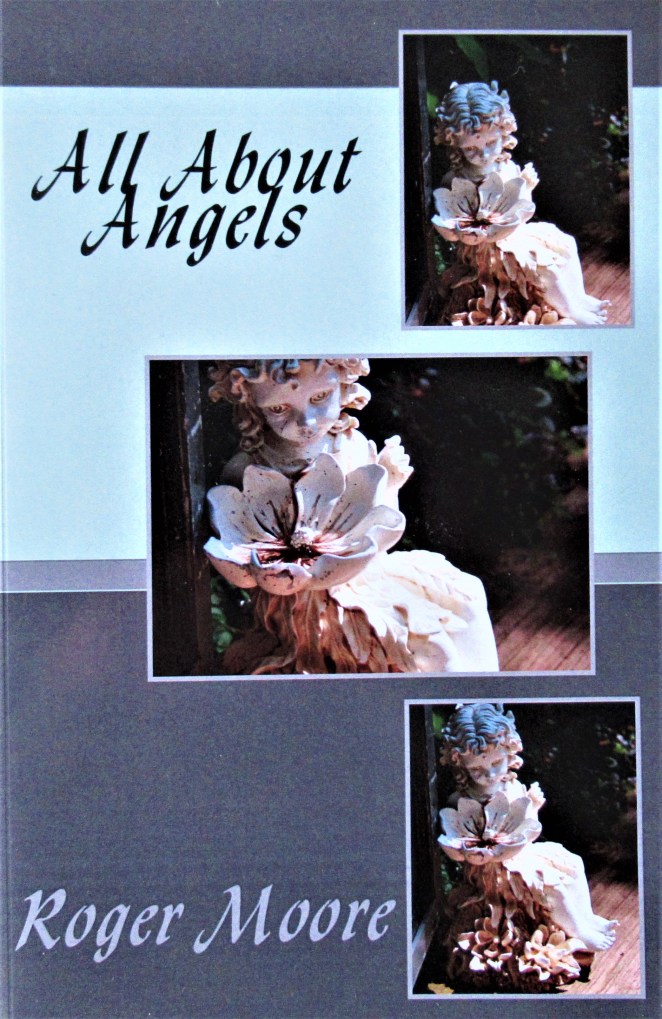
This book, All About Angels, is available online at Amazon.ca. Click on the link below to purchase the book.

All About Angels
Paperback edition

Carved in Stone 6 & 7

6

At Westbury White Horse,
I wandered among unkempt mounds,
forgotten graveyards,
ancient barrows, their secrets
buried deep underground.

I walked to the horse’s eye,
stood there, then sat on the hill’s edge
to watch the sun drown
in a river of blood that turned
the White Horse red.

Shadows encroached.
A creeping chill came over me.
I started to shiver, not with cold,
but with the icy fear that someone,
something, evil and powerful,
long dead, but risen again, lurked,
hidden in the ground mists,
that rose as I fled,
not daring to look back.

7

But that fear,
deep-seated as it was,
could not match the terror I felt
as the sun set
over Badbury Rings.

An ancient horror
reigned over that place.

Mist warriors, visible
only from the waist up,
their weapons drawn,
charged towards me.

I felt chill fingers
clutching my heart, gripping it,
and tightening their hold.
I fled from them in the half-light.

Ancient powers linger long
in spite of charms, spells,
and exorcisms.

No wonder so many ancient tribes
shattered the legs of their dead
so they could not rise up
and walk again.

Commentary:

According to Wikipedia, the Westbury White Horse or Bratton White Horse is a hill figure on the escarpment of Salisbury Plain, approximately 1.5 mi (2.4 km) east of Westbury in Wiltshire, England. Standing at the northern edge of Bratton Downs, on a steeply sloping hillside below an Iron Age hill fort, it is the oldest of eight white horses in Wiltshire. The white horse has long been revered in European mythology. In Celtic traditions, it was associated with the Otherworld, acting as a guide between the realms of the living and the dead. In many myths, the white horse represented purity, power, and the ability to traverse spiritual boundaries.

I love visiting these sites. However, they need bright sunshine and warm weather. When the light starts to fail and the day grows cold, strange feelings emanate from the ruins. Many people have commented on this phenomenon and there are reports of sightings, such as the one that I associate with my visit to Badbury Rings. I went there late one afternoon, and as the evening drew in and the air grew colder, I and my companions felt a sudden (and totally inexplicable) fear. One look, and we ran as fast as we could back to the car park, got into the car, and sped away. None of us have ever forgotten that strange experience.

Hallowe’en

Hallowe’en

1

Today is All Hallows Eve.
Tomorrow is Oaxaca’s
Day of the Dead.
The clocks change
the day after tomorrow.

Today, it’s raining,
and rain is a trick when
it forces celebrants off the streets
and town councils vote to change
the traditional date and send
young children out trick and treating
on a dry, warmer night.

But this rain, after drought,
is a Hallowe’en treat.

It brings a promise
that the aquifers will refill
that wells will not run dry,
and above all,
it brings us hope.

2

Around us, fall thrives
and watches and clocks
will soon fall back.

Trees weep for lost leaves.
Flowers that flourished
now wither and perish.

Hollyhocks topple and fall.
Bees’ Balm is abandoned
by butterflies and bees.

3

I expect time
to change with the clocks
and my body clock
will soon be out of sync
with the tick-tock chime
that denounces each hour.

Hours that used to wound
now threaten to kill.
They used to limp along,
but now they just rush by
and I, who used to run
from point to point,
now shuffle a step at a time.

But still I live in hopes to see
the clocks spring forward
once more.


Commentary:

A great poem for Hallowe’en, even if I say so myself, and I haven’t even mentioned the Blue Jays and the Los Angeles Dodgers. Oh, woe is me. Shame and scandal in my poetry.

Game Six of the World Series on Hallowe’en – wow! – well, one team will get a treat and the other will receive a very disappointing trick. I know which team I support, but I don’t know who will win this time around.

Having said that – with substantial rain after drought, everybody in my province is a winner. And who could wish for more than that?

Clepsydra 45 & 46

45

… I enter ancient rooms
     on the walls
          pale ghosts walk
               flickering shadows

why am I tongue-tied
     why do I struggle
          a fly in a spiderweb
               to make myself heard

I long for
     the freedom of flight
          for culture restored
                    for a return
                         to my own lost world

I grasp at shadows
     reaching out
          for the ones I know
                         are no longer there …

46

… how deeply time’s wounds

     have cut and carved
          through my flesh and bone

               into the embers
                    of that slow-burn fire
                         they call the heart

some days those wounds
     neither ache nor itch
          but in moments of madness
               a knife-edged finger nail
                    careless in the dark
                         opens them up

they throb again
     and begin to bleed afresh …

Commentary:

” … on the walls, pale ghosts walk flickering shadows – I grasp at shadows, reaching out for the ones I know are no longer there …” Vanity of vanities, all is vanity. For in much wisdom is much grief, and he who increases knowledge increases sorrow.

” … the embers of that slow-burn fire they call the heart … ” Pulvus eres et pulvus eris. Just another shadow on life’s wall.

Clepsydra 33

33

… but the light cannot last forever
     so where do I go
          when the door in my head
               slams shut
         
then I know
     I have lost the key
          to my mind’s labyrinth
               I struggle
                    but I realize
                         there’s no escape

Ariadne’s thread
     the one that should lead me
          out of the labyrinth
               turns into a woven web
                     trapping me
                         leading nowhere

the minotaur
     half-bull – half-man
          bellows
               stifles all thoughts

my heart turns to stone
     indigestible
          in the throat’s gorge
               or the stomach’s pit
                    and my mouth’s
                         too dry to spit

in this starless night
     when fear descends with the dark
          a guillotine slices its way
               through muscle and bone
                    to sever all hope

no glow worm
     can worm its way
          into my mind
               to enlighten the path …

Commentary:

“… the minotaur, half-bull, half-man, bellows and stifles all thoughts …” I asked Moo for a painting of a Minotaur, but he didn’t have one. So I pottered about and found this photo of Los Toros de Guisando, a pre-Roman set of sculptures, in the Province of Avila, carved by the Celts. Not exactly a Minotaur, but certainly a set of taurine images that baffle with their size, silence, and presence. Indeed, they conjure up the images of the poem’s next verse ” … stone, indigestible in the throat’s gorge or the stomach’s pit …”

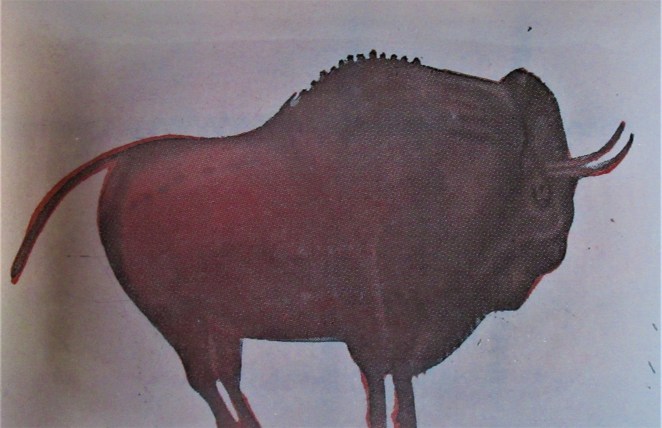
This is the cave painting, circa 5,000 BC of a bull, as found on the wall of the Caves of Altamira. Alas, he cannot bellow. Or should I say, Thank heavens, he can neither bellow nor pursue us. He stands silent on his cave wall. This photo comes from a glass ash tray my father purchased as a souvenir when we visited those caves (circa 1963-65, before they were closed to the public). Intertextuality – this bull as text and the long history of his multiple appearances. Metaphor and magic, mysterious and marvelous.

The idea that “religion is a glow-worm that glows in the darkness” is a metaphorical observation on the nature of faith. Its most famous expression comes from the German philosopher Arthur Schopenhauer. The statement suggests that religion appears most valuable and needed when people are in a state of ignorance, uncertainty, or despair.” Wikipedia – AI Generated. Our poet, that’s me, in case there are any doubts, refers back to this idea when he writes “no glow worm can worm its way into my mind to enlighten the path”. This too links back to the poetry of St. John of the Cross and his references to the dark night of the soul when hope seems lost and we despair of everything. Then we link to Goya’s etching – The Sleep of Reason – “when reason sleeps, monsters are born.”

However dark the night, someone has walked this way before us. We can follow in their footsteps and hope for the dawn. When it arrives, we can rejoice. But never forget the law of circularity, what goes round, comes round. Night will come back, the way will again be dark, but the light will always return once more. Images and symbols, metaphors and mystery, even the unspeakable can be spoken in the ways in which the ancient artists, sculptors, painters, saints, and philosophers have shown us.

Monologue

Monologue

“They broke our walls,” Mono whispered, “stone by stone.
A new church they built on the land they stole from us.
Red was its roof from a thunderstorm of blood.
The white bones of their lightning scattered us like hail.

They ripped out our tongues and commanded us to sing.
Carved mouths were ours, stuffed with grass.
Stone music forced its way through our broken teeth.

Few live who can read the melodies of our silence.
We wait for some wise man to measure our dance steps.

Pisando huevos: we walk on tiptoe across
these stepping stones of time.

Commentary:

Mono means monkey (in Spanish). Hence, monologue means monkey speaking to himself. Cute, eh? Monkey is one of the day signs in the Mixtec Codices. Lots of double meanings and rabbit holes down which the ardent reader can descend. Dig deep, my friend. Pisando huevos – literal meaning – ‘walking on eggs’ – meaning walking very carefully, on tip-toe, step by step.

Who said poetry was simple? You want it simple, there are so many simplifying factors out there. I want you to think. To think for yourself. To understand complicated language with multiple meanings. You want simplicity? Go watch a TV ad – Tide’s in, Dirt’s out. Omo adds bright, bright, brightness. The Esso sign means happy motoring. Don’ forget the Fruit Gums, mum – (said as the little boy throws a brick out of the window and it hits his mother on the head).

I’d say “wake up and smell the coffee.” But if wake means woke, I’m not the sort of bloke that accepts the meaning of wake or woke! Hereward the Wake. Robin Hood the Bloke in the Hood who Awoke- and I don’t mean the flower / flower, nor the Lincoln Green of the Lincoln Continental.

So what do I mean? I don’t know. Coded words are meaningless unless you have the meaning to the code. What code? The miscued code. And the meaningless lack of meaning in meaningless. Just like my friend who’s just been screwed, blued, and tattooed – and totally rude. Or was it scrod?

Drink up thy Tizer!

Drink up thy Tizer!

I wonder how many people actually remember Tizer, the Appetizer. It used to be sold in grocery stores and corner shops. Don’t forget the Tizer, shrieked the adverts. I hated the stuff – but others loved it. Sweet, sticky, a little bit like dynamic Lucozade – and who remembers that, I ask. The same people as had cod liver oil poured down their throats when they were little children in the United Kingdom. An old and almost forgotten generation with its own traditions. But this post is not about Tizer, it’s about cider. Good old Somerset / Zummer Zett scrumpy.

I met Scrumpy when I went to Bristol University. It was an alternate drink to beer, and many pubs sold cider, in one form or another. A pint of cider – sufficient unto the evening was a pint thereof. After a couple of months, one could manage two pints of Scrumpy. Our drinking competitions including drinking a Yard of Ale. Someone always brought one when we went on a coach trip and we always ended up in a bar, in the middle of nowhere, trying to drain our yards of ale. I remember one lad bravely trying to quaff a yard of cider – scrumpy at that. Honk city – and it had nothing to do with the geese. But it was spectacular.

My own adventures with scrumpy really started in my second year at Bristol. The boarding house I lived in stood close to the Coronation Tap, one of the best cider house in England, if not in Bristol. First night I went in there and asked for a pint of scrumpy the barman suggested I have just a half. In my best Somerset accent, I said no, I’d appreciate a full pint. The barman duly placed it before me. As he did so, the man standing next to me at the bar suddenly woke up from his meditations, poked me in the ribs with a boney finger, and announced “Ah, lad. That’ll put lead in thy pencil.” I looked over at his pint of scrumpy and saw a slice of lemon floating in it. “What’s that lemon doing there,” I asked. “I’m waiting for the cider to eat it,” the man replied. “Better for the scrumpy to eat the lemon than to eat my insides.” Another night, at the Cori Tap, I met an old gaffer who wouldn’t touch scrumpy. I asked him why not and he replied that one night he’d managed to down seventeen pints of scrumpy. “That’s a lot,” I said. “What happened?” “Oi spend three weeks in ‘orspital, in bed, doan I?” He muttered.

In my third year, Hamburg University Athletics Cub arrived by coach to participate in an athletics competition with Bristol. The Cross-Country Club became the Athletics Club, in the summer, and we specialized in distances from 400 > 800 > 1500 > 3000 > 5000 > 10,000 metres. Thirsty work on a hot summer’s day. We took the Hamburg athletes back to our apartment building and spent the Saturday night slurping scrumpy down the Tap. They slept on the floor at our place, and next morning, a Sunday, they went shopping early. When they came back to their coach, they all grinned happily at us, and waved their bottles of Tizer in farewell. I looked around and saw that they had twenty cases of those bottles stored in the bus. “Ve vill have gut trip to Hamburg, no?” I started to laugh and they all joined in, waving their bottles at me. I didn’t have the heart to tell them that Scrumpy came in barrels, not bottles, and that they had not purchased cider at the local stores. Alas, they had bought 20 cases of Tizer the Appetizer. Somehow, in translation, cider had become Tizer – oh the glories of discourse analysis and the meaning of meaning.

Clepsydra 21

Clepsydra 21

… she left me
          at the lighthouse
               rising tide
                    beach diminishing

and grew smaller
     as she walked away

I search the sand for sea-gems
     sand-dollars
          cerulean sea-glass
               rarest of all the reds

ground down
     polished
          sanded to perfection

so many worlds
     in a grain of sand
          their words going unspoken
               carried away by the sea-wind

the wind that haunts
     caves and cliffs
          hooting like a ghost train
               in a forlorn
                    tunnel of love

love lost
     love found
          an old love
               rediscovered
                    only to be lost anew

what is this thing
     called love …

Commentary:

Listen! “Can you hear the music?” “No, but I hear singing even though there’s no one there.” I know, I know, we have had this conversation before. Moo didn’t have a painting along the lines of ‘what is this thing called love’, so he dug out this one – Walking on Air – the painting, not Moo. But then, Moo’s a silly old romantic and verses and songs settle in his mind. All too often, when he walks he finds he’s ‘walking on air’! The two of us, Moo and me, have always loved that song. Great to work it into a commentary on a poem (again).

Love – what is this thing called love? And how many types of love are there? We use the word so frequently, or infrequently, if we are Mr. Grinch. But what does it mean? Love of self, love of other? And how many others can we love – I know that Minnie had a heart as big as a whale, but how many loves can fit into it? Love of father, mother, daughters , sons, brothers, sisters, cousins – how far do we go? Winning sports teams – everybody loves everyone on the team when they win they cup. That love is so much harder if they lose it – especially if there is a goat on the team, and I don’t mean greatest of all time! I mean sacrificial.

I love you with all my heart! Does that include the pacemaker and the stent? What does atrial fibrillation mean in that situation? Good questions. Neither me nor Moo have the answers. Write your answers on a postcard and send it to – where? With Canada Post on strike, you will need a team of real snails. Hitch your postcards to them. Threaten them with the salt shaker. And off they go. Snail mail is back. Or you could place them on a dog sled, hitch up the huskies and Mush, Moo, mush! Away they all go hauling the mail. Why does it always be the mail? Why can’t it be the Femail? Mail – Femail. Oh, but I love that. There, you see. We’ve just added another meaning to love. Let’s hope none of the huskies lies down to rest. That’s called a Canadian flat tire. Oh, I love that one too.

I am running out of time, space, and ideas. And that’s only one word from the poem that we’ve looked at. Oh, shame and scandal in the letter-box.

Gorilla Drives the Zoo Bus

Gorilla Drives the Zoo Bus

Gorilla drives the same zoo bus
all day, every day;
same starting time, same finishing time,
same route, same stops,
different passengers,
but every passenger the same:
faceless.
Gorilla doesn’t want to know their names.

“Please tender the exact fare!”
Not a penny less, not a penny more,
and he polices every penny.
Bus conductor and master
of every passenger’s destiny,
he opens and shuts the door,
letting passengers on and off the bus,
but only at official stops.

Every passenger has a ticket,
and he punches every ticket
with a neat, round hole.

He never makes mistakes.
He grinds, like God’s own mills,
exceedingly small.

He has spent all his life in uniform.
He has a belt and braces to hold his trousers up.
He’s always prepared for the worst.  

Ten, fifteen, twenty years:
an anonymous wife;
anonymous little babies;
at shift’s end, a pension,
and another bus.

St. Peter’s at the wheel.
He doesn’t want to know
where gorilla wants to go:
he wants to know where he’s been.

Commentary:

Moo didn’t have a painting of a gorilla driving a bus, so he offered me a painting of the passengers instead. Look carefully – you might even find a portrait of me or you in there. Who knows where Moo goes and who he sees? I certainly don’t. Remember Picasso – he used to run downstairs, out into the street, see a face he liked, and run back upstairs and paint it from memory. I wonder if Moo does the same thing. I’d ask him, but if he doesn’t want to answer the question, he just grunts. And I can imagine him grunting at that one.

Anyway, we all know and recognize the gorillas when we meet them. They are totally unimportant, have a miniscule job to do, but do it with absolute authority and the utmost perfection. Like Gorilla – “Not a penny less, not a penny more, and he polices every penny.” – “he opens and shuts the door, letting passengers on and off the bus, but only at official stops.” – “he punches every ticket with a neat, round hole.” – and probably in the exact same spot of every ticket! – “He never makes mistakes.” – and if he does, it’s the passenger who suffers, because ‘Get on, get off, who ever you may be, I am the lord of the bus,’ says he.

What will happen to us at the end of our shift? I really don’t know. And I don’t think anyone else does, either. Will St. Peter be there to greet us? (I don’t know.) Has the Zoo bus replaced the ferry over the River Styx? (I don’t know.) What will we be asked when we get there? (I don’t know.) How will we answer? (I don’t know.) Is there a little book in which all our deeds, good and bad, are written down? (I don’t know.) Are we to be divided into sheep and goats? (I don’t know.) What will poor monkey do when he is turned into a sheep or a goat? (I don’t know.)

So many questions, deep questions, packed into one small poem. Most of those questions unanswerable. But that’s one of the joys of poetry – to open a poem is to open a tin of calamares – there’s always another something or other left in the corner. Look, over there, bottom left, right at the bottom of the can, I spy with my little eye another question. ‘What is that question?’ you ask. Sorry, mate, I’m afraid I don’t know.

Clepsydra 11

Clepsydra 11

11

… gone too
     that Raggedy Ann doll
          held together
               by her patchwork heart

cross-stitched lovingly
     with needle and thread
          the sluggish drip-drip
              of her cotton blood
                    proving
                         she is still alive

neither mummified
     nor rat-and-mouse-gnawed
          in limbo perhaps
               but not dancing

asleep maybe
     dreaming in the museum’s oubliettes
          with their closed doors
               their cellars and attics
                    stuffed with memories
                         all dusty and worn

memories
     that only come alive
          at midnight
               when the full moon
                    awakens the shadows

boys and girls
     come out to play
          and walk and dance once more
               beneath liquid moonlight

the celestial lantern’s
     liquescent flame …