Clepsydra 14-15 – Clowns clowning around

Clepsydra 14-15
Clowns clowning around

14

… walking life’s walk
     grey jays in the ash tree
          fresh snow on the ground

at night
     deer track out of the woods
          moon’s dead skull
               chalking its slow path
                    westwards

snow falls
     white upon white
          whirling our world
               back to its cratered life

nothing needed
     other than moonlight on snow
          to ignite us

a white wall of water cascades
     earthwards from the moon
          waters of renewal
               waters of life
                    waters that restore us
and save us
     from the moonbeam’s slicing knife
          that amputates all life …


15

… it is scary tonight
     inside the topsy-turvy
          big-top of my circus world

carnival time
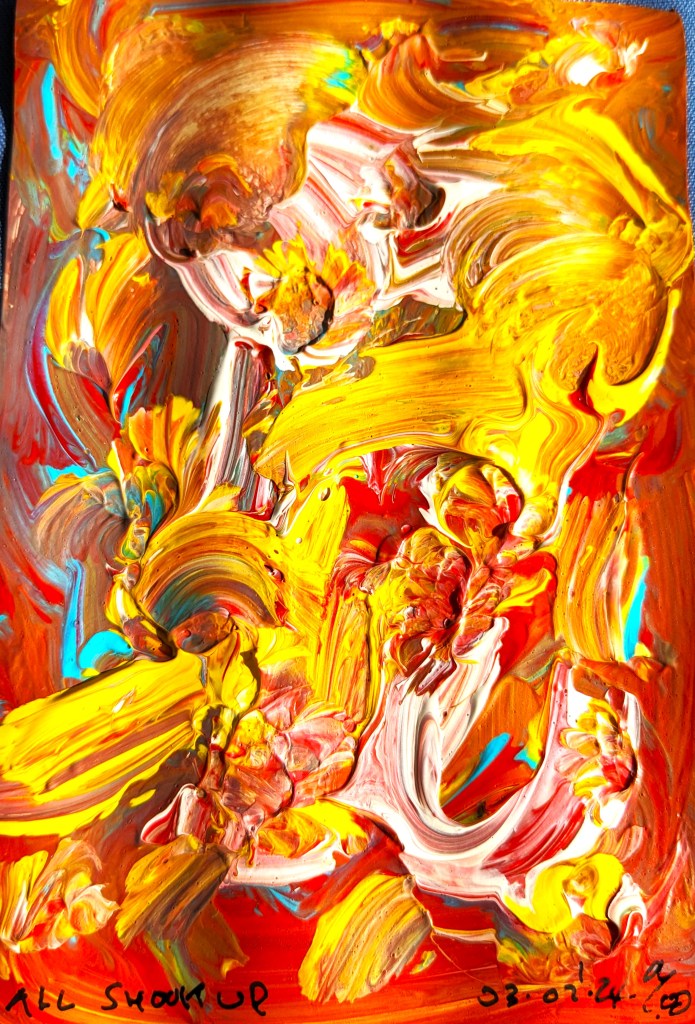
     clowns clowning around
          turning my life
               upside down

is my mind
     a spider-web
          spun by worry and doubt

I remember how
     they pushed me around
          kicked me out
               always the anonymous they

they abandoned me
     told me I was unwanted
          surplus to purpose
               forced me to exit

they told me to forget
     those amniotic waters
          that water world of comfort
               that illusion of reality
                     they had created
                          then threw me onto the street

    I left behind
          their stultified personalities
               with all their stupid rules
                    and blinkered minds
                         that stopped them
                              from seeing straight …

Clepsydra 12 & 13 – Pilgrim in this barren land …

Clepsydra 12 & 13 –
Pilgrim in this barren land …

12

… pilgrim in this barren land
     lost in my wanderings
          the wander-lust still tugging at me

in my back-pack
               dusty with memories
                    photos that only I have seen
                         sepia
                              spotted in places

only I know names and faces
     recall relationships
          a mystery to me, an outsider,
               such images haunt me
                    move me in ways
                         I do not understand

the irregular heart-beat
     of my life walks inside me
          down new corridors of time
               fresh music
                    strums my heart-strings

a heart
     a bridge a time too far
          lost I wander the woods
               searching for things
                    I know I must find
                         my lost self among them …


13

… but to find myself
     I must first lose myself,
          not in a barren land
               nor in the inner depths
                    of my suffering mind
                         nor the deeper depths
                              of another’s body

am I nothing more
     than an offering on the altar
          where nothing alters more
               than this interchange
                    eye to eye
                         mind to mind
                              body to body

will the I ever transform
     into the power of us
          together
               both of us

and are we much more
     than one plus one
          with three or four or more
               conjured from the word
                    that was from the beginning

or is all of this
     nothing more than
          the woven magic of pillow-talk …

If you were going to open up a shop, what would you sell?

1. If you were going to open up a shop, what would you sell?

That is a very hard question to answer. I think of all the material things that everyone else can think of, but I do not want to sell commonplace things – antique furniture, paintings, books, stamps, groceries – I could go on and on, but I will resist the temptation to do so.

When I lived in Santander, Spain, the local wines were sometimes called ‘sol embotellado’ / bottled sunshine. I wouldn’t want to open a wine shop, but I would love to bottle the essence of a warm sunny summer day and – why should I sell it? I wouldn’t. I would give it away, free of charge, to all the needy people, inner city boys and girls, the impoverished, those who live in the streets and sleep in doorways or under bridges at night. Oh, the joy and happiness that would come when they opened their bottle of summer sunshine and felt the warm fresh air gather around them so they could breathe it in.

But why stop there? I would also give away ‘essence of butterflies’, that special feeling that comes on the colored wings of a butterfly and combines with the joy of flowers and the gift of taking flight. How special that would be. But sell it? It is much too valuable to sell. Put a dollar, Euro, yen, rupee, or sterling price upon it, and all its powers would vanish, like fairy dreams fading away.

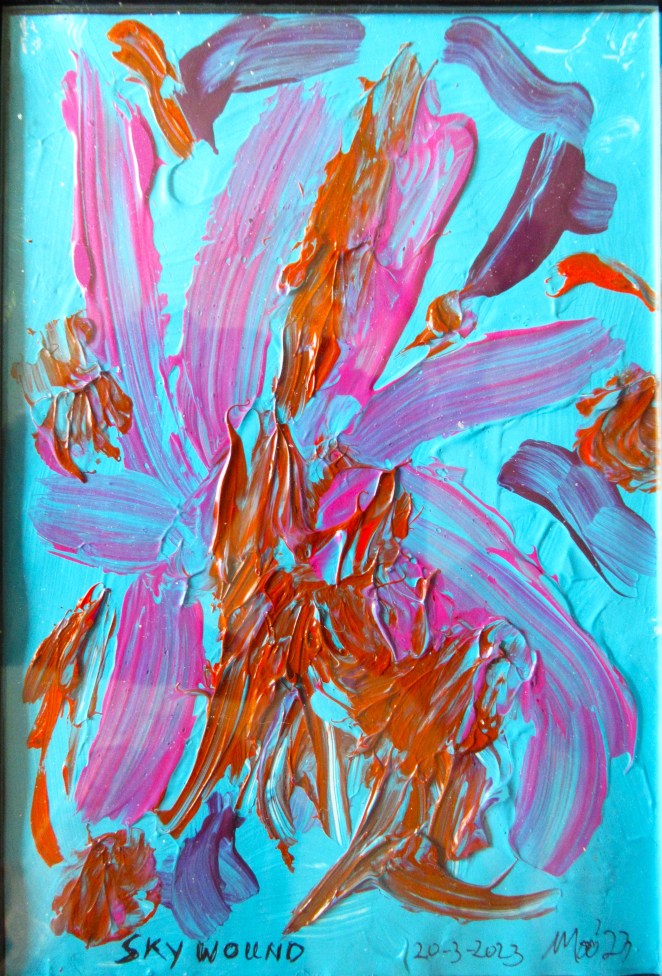
Among other things, I would also like to offer the gift of the joy of words. Colors, in the imagination of Blake, were ‘sky wounds’. What joy to take a normal word, add a second word to it and create a new verbal image – ‘sky wounds’. And what happens when the sky is wounded, you ask. Well, the wound opens, the blood pours out and ‘le soleil se couche dans son sang qui se fige’ ‘the sun sets in its own congealing blood’. Baudelaire, if I remember correctly, from Les Fleurs du Mal. What beauty in those new images. What joy in remembering and recreating them. I would bottle such gifts and give them away in my shop.

Fairy dreams – yes, I would offer them as well to those who needed them. And not the sort that fade away, but those fairy dreams that suspend us in the wondrous beauty of their ethereal light. And I would bottle hope, and self-belief, and the power to change oneself from what one is to what one is destined to be. And I would add essence of self-knowledge and powder of Davey Lamp light that would enable the seekers to seek in the darkest corners of their souls and find that elusive inner self, and bring it out from the darkness. And I would stock fragrant filaments of firefly that would also allow my customers to enlighten that darkest of nights, the dark night of the soul. And a map of hidden foot paths that would allow the wanderer to wander and never get lost.

How about an elixir of happiness and joy? A quintessence of rainbows, perhaps? Or a magic lantern that would shine out from heart and eyes and enlighten the soul friends of those lucky souls who were able to locate and enter my shop of conditioners, vital vitamins, and soul magic for all those lost and lonely people. And there, that mirror on the wall – look in it, gaze deep into your own eyes, and maybe, just maybe, you will find my shop.

And “What will your shop be called?”, you ask. Look into your heart and you may find the answer engraved therein. It will be called The Gift Shop of Hope Restored. I look forward to welcoming you when you open the door and step in.

Comment
1. The number at the beginning of this post, refers to its position in The Book of Everything. In that book, I have included 100 blog prompts (The Book of Everything) and 11 more (and a little bit extra) to give a total of 111 responses to prompts. Each one is a little bit crazy, just as this one is. But what fun to read, and write, and think slightly differently.

On Loneliness

Loneliness

58 What relationships have a positive impact on you?

I think one of my poems answers this question best. I write “one of my poems” but it is really my ‘free’ translation of one of Francisco de Quevedo’s sonnets – Retirado en la paz de estos desiertos. I have changed the poem slightly, but I am sure Don Francisco (1580-1645) will excuse Don Roger’s impoverished effort (2023).

On Loneliness
29 December 2023

Resting in the peace of these small rooms,
with few, but welcome books together,
I live in conversation with my friends,
and listen with my eyes to loving words.

Not always understood, but always there,
they influence and question my affairs,
and with contrasting points of view,
they wake me up, and make me more aware.

The wisdom of these absent friends,
some distant from me just because they’re dead,
lives on and on, thanks to the printed word.

Life flits away, the past can’t be retained.
each hour, once past, is lost and gone,
but with such friends, I’m never left alone.

And there are so many of those literary friends. I still read Rudyard Kipling and I have just finished Kim, Captains Courageous, Stalky and Co., Puck of Pook’s Hill, and Rewards and Fairies. I read these first when I was nine or ten years old, and I return to them regularly. Other friends include Garcilaso de la Vega, Fray Luis de León, St. John of the Cross, Quevedo, Góngora, Calderón, Miguel de Unamuno, Antonio Machado, various members of the Generation of 1898, the majority of the poets from the Generation of 1927… and these are just my Spanish literary friends. I have French friends, English friends, Anglo-Welsh friends, Canadian friends, Mexican friends, and, in translation, many, many more. My relationship with each of these friends has had an impact upon me.

A recent painting, by my friend Moo, is called Fiat Lux – Let There Be Light. It is reminiscent of Dylan Thomas’s poem, Light breaks where no light shines. Intertextuality – Quevedo drew inspiration from the Stoics. I drew inspiration from Quevedo. Moo drew inspiration from Dylan Thomas. The nature of creativity, and its continuing links throughout the ages, shines clearly through these wonderful associations. Long may they continue, and may others enjoy them and be influenced by them as much as I have.

Comment:
The funny thing is that I do not remember writing this blog prompt, nor do I remember having translated Quevedo’s poem into English. I wonder how many other forget-me-nots there are out there. Or, to be more precise, in my books and in my notes. A treasure trove – that’s my guess. Borges wrote of Quevedo that he was more a library than an author, and I am beginning to think that way about my self. A strange world, this, one in which the creator abandons, and then forgets, his creations. Perhaps we should change the image – not so much a library as an orphanage, and so many lost and abandoned orphans wandering around The Little World of Don Rogelio.

What brings a tear of joy to your eye?

What brings a tear of joy to your eye?

Peeling onions, of course. As my Welsh grandfather told me, years and years ago

“If, if, if,
onions climbed a cliff,
potatoes would rise
with watery eyes
if it wasn’t for if.”

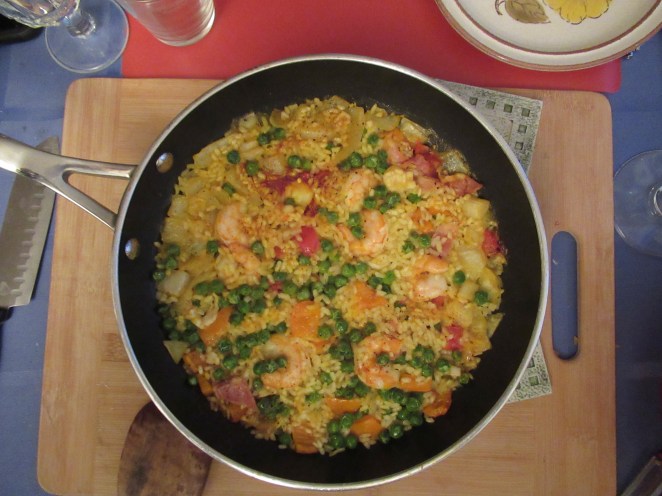
There you have it, in a nutshell, or should that be an onion skin? So, why does peeling onions bring a tear of joy to my eye? Because of the things that I make with them, of course. Where would paella be, if there were no onions in the mix? Can you imagine French Onion Soup with no onions in it? How about a Spanish Omelet / tortilla española? Okay, okay – I know some purists, especially in Galicia, say that the tortilla española should consist of egg, potato, salt, and nothing more, save a touch of olive oil, perhaps. But most of the tortillas españolas that I have enjoyed (and made) include an onion or two to blend with the potatoes. And how about salsa mexicana or salsa pico de gallo? Unthinkable without their dash of sliced onion.

So, peeling onions – that always brings a tear of joy to my eye, because I know how I am going to use them and how tasty they will be. And for those who have forgotten the hungry in this world, myself included in this particular post, do not forget Miguel Hernández and his poem Las nanas de la cebolla / The Onion Lullaby. Reading that poem and understanding its background will surely bring a tear to your eye, as it always does to mine. This time, however, it won’t be a tear of joy!

Self-Portrait

Self-Portrait

I smell. I whiff. I gloriously stink.
My arms, my feet, my crotch, reek with beauty.
This is me. I am still alive. I’m rank.
The time has come, the Walrus said, to take
a shower. I strip. I weigh. I obey.

Hot water streams. Bathroom steams up. I draw
faces on grey glass, smiling, glum. Soft soap
works its miracle turning Japanese
nylon into a rough body cloth that
rubs and cajoles all putrid dirt away.

Butterfly from its chrysalis, I step
from the shower, sniff with caution, and stench
no more. I am clean. I no longer pong. 
My body has been taken over by
perfumes no longer mine. Who am I now?

I am no more myself. I am no more
my own gorgeous underarm muscular
ripeness. I have left my odor circling
in the soap suds and drifting down the drain. 
What a pain. It will take me a week or 
more to start smelling like myself again.

Clepsydra

Clepsydra

WFNB 2025 BAILEY PRIZE: 3rd Place
Citation

Clepsydra relates a process of identity loss, as time’s passing removes the people closest to the eroding narrator. Its consistent form – the manuscript is one long poem made up of 48 sections of varying length, each of which begins and ends with an ellipsis – provides a framework in which the narrator strives to describe how their sense of self drains away, drop by drop, the way the liquid in a clepsydra (a water clock) marks the passing of time. Amazingly, the poems convey existential dread through remarkably vivid and grounded images of things like “seals basking in sunshine, / knowing themselves, being themselves, / thinking themselves safe, / kings and queens of their seal-dom, / never questioning” (19) and “…an osprey, sudden, the swoop, / turned into a stoop, water shattered, total immersion, then emerging, / lusty thrust of wings, claws clasping, / prey imprisoned” (20). Sense slides in and around the sounds of the words as well as in their dictionary meanings. In Clepsydra the author rigorously plumbs a difficult subject: the loss of subjectivity.

Exhortation

Thank you for the privilege of reading your poetry manuscript, Clepsydra. I was quite taken with all of its virtues: a meaningful concept, carried out in an impressive form which is followed both rigorously and nimbly in each section.

Introduction

     The National Museum of Wales, in Cardiff, had a working Clepsydra that fascinated me. School children could enter free, and every week day, during the school holidays, I would visit the museum and also the Clepsydra.

     I have built the structure of the Clepsydra into the verses of this book. The words flow down, from left to right, just like the waters of the Clepsydra. Sometimes they overflow the line, and sometimes they hold back, just a little. This visual construction fortifies the idea of the ebb and flow of time, water, and memories.

     I first met the poetic image of the Clepsydra in the poetry of Antonio Machado – No temas. Tú no verás caer la última gota que en la clepsidra tiembla. / Never fear. You will not see the fall of the last waterdrop that trembles in the clepsydra. I have, for better or for worse, repeated this theme throughout the poetic dialog.

     I would like to thank the judge, the poet Kathy Mac, for her comments and her excellent suggestions. I have followed most of them in this revision of the original manuscript. My thanks go to all who have read Clepsydra at one time or another.

Clepsydra

1

… time, and my own place
     not this dry museum
          filled with dust

its ghosts, running rampant,
     raging silent
          over ancient artefacts

the clepsydra dreaming
     time like its liquid
          slipping
               through clay fingers
 
runnels of water
     ebbing flowing
          continually running down

earthen-throated
     its hour glass structure
         
each terracotta bowl
     lower than the one before
   
a mini-cataract
      a constant waterfall
            second by second
                    time dwindling away…

Fall Foliage

Fall Folly Age

Fall Folly Age aka Fall Foliage is a play on words.
Thank you, Moo, my painter friend, for putting this title
on your painting and allowing me to use it for one of my book covers.

After intense heat
the garden is dusty dry.
The hollyhocks,
stressed out,
bow their heads
and tumble down.

Before the heat,
heavy rain drenched
the flowerbeds.
The yucca subsided
beneath waves of water.

One hollyhock,
regally proud,
stored so much liquid
in its flowery crown
that it bent and broke.

The mountain ash
bears a host of berries.
Bright orange,
they are already turning
to their winter shades.

I see so much stress
in the little world
I inhabit.
I no longer listen
to the news
or watch TV.

So much is beyond
my control.
Yet I can control
the radio and the TV
by turning them off.

The friends I meet
now have white hair.
Like me and my flowers,
they are dried up
and bent, held up
by sticks and canes.

My beloved and I
are growing old together.
We watch each other
with great care
wondering who
will be the first
to topple and fall.

Comment:

It has been a long, long time since I last wrote on my blog. Many things have distracted me, including editing books for friends, working on my own books, journaling, painting, and surfing the web in search of something positive to read. As for my own books, I published four this summer. Clepsydra Chronotopos I, Carved in StoneChronotopos II, Rage RageChronotopos III, and No Dominion Chronotopos IV. Maybe I will try to post on a regular basis and copy some of those poems here, in my blog.

The End of Time

The End of Time

A thin violin crying
its cat-gut heart out
in tears of sound, falling,
rhythmic raindrops,
down a grey-streaked face
tight with stress and taut with pain.

Such concentration,
such soulfulness packed
into each mindful note.

An audience of one,
I sit, head bowed, meditating
on the meaning of meaning
and the nothingness
of a being condemned
to oblivion, yet oblivious
of the how and when.

Each note a hammer-blow,
then, the piano pounding nail
after nail into this living coffin,
this body I drag through the motions
of extracting meaning
from this meaningless life.

Comment:

The End of Time is the second poem in the first sequence (Crystal Liturgy) of Septets for the End of Time. The painting, by my friend Moo, expresses his impressions of the nature of the end – but he doesn’t tell me the end of what. Certainly not of our friendship, I hope.

I am always worried by those last two lines: extracting meaning from this meaningless life as I don’t think that life is meaningless. However, there are times when it certainly feels that way. Those are the times when we need our beliefs in truth and the purity of art to survive. But how do you define them, you ask me. In all honesty, I don’t. I can’t. Art changes. What we consider to be true changes. Relativism? Yes, to a certain extent. I know what I believe. I don’t know what you believe. But I would never try to inflict or enforce my beliefs on to you. That is not how I work.

As for Moo, I don’t know how his mind works. I think he just sees things in color and shape and in the creation of movement within the stillness of a two dimensional illusion. I also think he thinks like a child. Maybe, like me, he has entered his second childhood, though I don’t really remember ever having had a first one. Oh dear – the meaning of meaning – one of the great enigmas of this wonderful world in which we live.

What is your mission?

Daily writing prompt
What is your mission?

What is your mission?

Let us begin, as usual, by asking, what do we mean by ‘mission’? Here are some examples of the meaning of mission. (a) an important assignment carried out for political, religious, or commercial purposes, typically involving travel. (b) the vocation or calling of a religious organization, especially a Christian one, to go out into the world and spread its faith. (c) any important task or duty that is assigned, allotted, or self-imposed. (d) an important goal or purpose that is accompanied by strong conviction; a calling or vocation.

I can happily dismiss (a) and (b) from the start. I do not consider an assignment to be a mission, not in my case anyway. I am not one to wander the world, good book in hand, heart on sleeve, convincing people to believe what I believe. That said, I can work with (c) and (d) because, as a life-long teacher, who was offered, at various time, an array of other jobs, I am happy to say that I was a teacher by vocation, by calling. Teaching was my mission. My mission was accomplished.

I taught, in Canada, from 1966 to 2009. Then I reached retirement age. On June 30, 2009, I was a teacher. On July 1, 2009, I was nothing. The shock was enormous. It took me a long time to recover and discover that no, my life was not over, and yes, I had many other things to do. Thankfully they all involved teaching, in one way or another. I used my teaching / research experience to sit on the editorial boards of various learned journals. I even edited a couple of them. I also translated, usually from Spanish to English, and worked with the translations of other people. I also wrote articles on teaching and on creativity.

Creativity gradually took me over. I offered workshops on prose and poetry, wrote and edited books, penned introductions for other writers, and even published some books by other people, usually my family or close friends.

There was never much money in teaching or in creative writing. I always did it for love – love of the subject, love of learning, love of the students, love of watching them grow and develop. When I work one-on-one with another writer, or with a small group of writers, that love is still there. Alas, as I grow older (much older!), I feel the ability to motivate slipping away. The will, the vocation if you like, is still there, but body and mind are growing weak, and that, my friends, is the saddest thing of all.

Dark Angel

He will come to me, the dark angel,
and will meet me face to face.

He will take all that I own,
for my wealth is only temporary:
health, wealth, possessions are all on loan.

My house, my wife, my car,
my daughter, my grand-child,
 my garden, my trees, my flowers,
my poetry, my works of art.
I use the possessive adjective
knowing full well that these things
are only on loan. I will never be able
to preserve and possess them.

I even rent this aching heart,
these ageing, migrant bones,
this death that has walked beside me,
step by step, every day
since the day that I was born.

My death alone is mine.
It belongs to nobody else.
It will be my sole possession.
It will soon be the only thing
I have ever really owned.

Comment:

Dark Angel is from my poetry book – Septets for the End of Time / Poems for the end of Time. The lead painting in today’s blog is by my friend, Moo, and he calls it Storm-Me.