Carved in Stone 59 & 60

Carved in Stone
59

St. David of Wales once said,
“Do ye the little things in life.” 

I do, and I wander
along the banks of the River Taff,
admiring how wild daffodils
flourish each spring, in Wales.

Young, I run on the beaches,
Brandy Cove, Pwll Ddu, Langland,
Caswell, Swansea Bay,
and, as I write these words,
I hear my footsteps
echoing back through time.

Baudelaire’s words ring in my mind,
“Creativity is nothing more nor less
than childhood recovered at will.”

Or, as Pablo Picasso said,
“I have spent my life
learning to see, paint,
and write again, like a child.”

And on and on I go –
child-hood, youth, maturity, age,
then back to my second childhood,
when I can recreate
that youthful world
in all its joyous beauty.

60

Does life flows through me,
like water in a clepsydra?

Does it flicker like a candle
guttering on a church altar?

Is it circular, like a sundial,
or the Roman numerals
on the face of the clock?

Am I just flesh and blood,
doomed to blossom and flourish,
then wither and perish?

Or will some small part of me
linger on, an unchained melody,
with all my memories slowly erased.

Commentary:

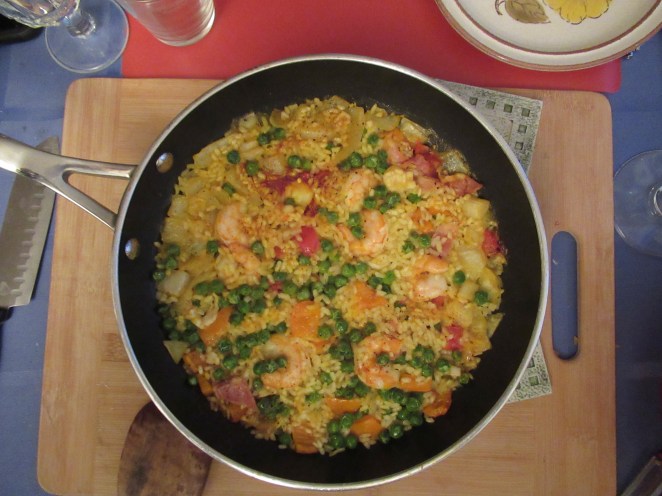
Moo’s daffodils are painted and potted, not growing wild at all. They are still the national flower of Wales and they still grow wild, in the spring, in Blackweir Gardens and beside Roath Park Lake. At least, I hope they do. I haven’t been back to check for 37 years now. Maybe things have changed, and the daffodils have gone the way of the sky lark, the cuckoo, the cowslips, and the bluebells. I wonder if the foxes still wear gloves? Let me know if you know the answer to that one. Just write “I do” on the back of the usual postcard. And you know what to do with it.

As for me, I am moving into my second childhood and, in may ways it is so much better than my first one. Here, I am free to look back on my life, to harvest my memories, to paint what I want – well, what Moo wants, anyway – and to think my own thoughts. Thank heavens Moo doesn’t think for me, though he does get his fingers covered in paint when he reads my mind and puts paintbrush to postcard, and designs his designs.

I feel very sorry for Moo. I guess he never had a childhood, so therefore, ipso facto, he can never have a second one. How much he is missing even he doesn’t know. How could he? Mysterious Moo – I like that idea. Sólo el misterio nos hace vivir, sólo el misterio. Only the mystery keeps us alive, only the mystery. And if you guessed that the author was Federico García Lorca, then you can award yourself a glow of satisfaction, for I have no prizes to hand around.

But hold on a moment, that was the title of one of Lorca’s drawings, so he was the artist, yes, but maybe not the author. Picky, picky nit-picky! Another of the joys of second childhood – annoyingly spotting the minor slips of other second-childhood thinkers – and never, never ever admit the mistakes you might, or might not make, are your own. Blame someone else. There’s always somebody out there whether to own up to your errors, especially if the price is right.

Dorset Knobs and Old Vinny

Dorset Knobs and Old Vinny

Five Lysol wipes remain in the can.
As rare as hen’s teeth or Dorset Knobs
and old Vinny, they have become precious
items sold in marked up prices online
by people who stocked up at the beginning
of the crisis on commodities they were able
to seize before rationing stepped in
and limited quantities were permitted
to each purchaser who waited patiently,
in line, to enter the super-market.

I place my leather glove on my hand
and move to the gas pump. How many people
have used it, pumping gas with bare hands,
and the metal surface retaining how many germs
who knows for how long? I cannot wear my mask
while pumping gas. Cover my face and they will
not serve me for fear I may flee without paying.
I finish pumping, open the car door, remove
my glove, put on my mask, pick up my cane,
and walk into the gas-station shop to pay.

As I limp towards the door, a man, mask-less,
holds the door open for me, his face less
than a foot from mine. “There you are, sir,”
he says, showing his teeth. “Service with a smile.”

I return to the car, remove a precious sanitizing wipe,
clean my glove, the car door handles, every spot
my gloved hand touched. Then I wipe the handle
of the gas pump and dispose of the precious wipe
in the garbage can nestled between the pumps.

Commentary:

Well, I am willing to place a bet with my favorite bookmaker, at Covey’s Print Shop, that not many of you out there know what Dorset Knobs and Old Vinny is or are. Moo has joined me in my wager and he is willing to bet that very few of you know where the line “où est le papier?” comes from. Even fewer will be able to sing the whole song! Oh dear, our world is only artificially intelligent, not really intelligent. In my teaching days I would ask the class if we were in a smart classroom. “Yes, sir,” they would reply. I’d then walk to the wall, tap it and ask it “What’s 2 + 2?” The wall never answered. I’d try again. “What’s 2 + 2?” – Silence. “Not such a smart classroom then,” I’d say to the students.

But I bet you all remember Covid, the days of taking all sorts of precautions, of wearing masks and gloves, of washing everything that came into the house, of washing hands, and not touching surfaces in public places where the unwashed may have left a winning lottery ticket with your Covid Number upon it. Oh dear, those were indeed the days. And this little poem, a golden oldie, recalls them. Let us hope they do not return. And let us doubly hope they do not return with a mutating or mutated helix of sinister proportions.

Latch-Key Kid

Latch-Key Kid

In one room in my head, I stand on a stool beside my father’s mother helping her to mix the cake she will later bake in the wood-fired oven of her black, cast-iron stove. Every time she mixes a cake, she places a small piece in a dish and bakes it just for me. As a child, I spent hours in that kitchen, watching her cook. When she boiled vegetables, she never threw out the vegetable water, but used it for boiling other vegetables or for making rich, thick, delicious gravy.

Later, with both my parents working, I became a latch-key kid. I spent all day in an otherwise empty house and cooked my own breakfast and lunch. I also prepared supper for my parents so that it would be waiting when they came home. I grew up loving to cook.

When I went abroad to spend my summers in Spain or in France, I spent as much time as possible in the kitchens, watching, listening, learning. The women always had time for a small child. Then men seldom did. Children should be seen and not heard. They just got in the way. That was the male attitude. I learned so much in those kitchens.

Later, in Santander, my landlady would place one egg, one onion, and one potato beside the stove. It didn’t matter what time I came back from a night out with the boys, my supper was there, a Spanish omelet, una tortilla Española, waiting for me to cook it. Sometimes she left me a piece of chorizo, but I preferred the omelets. I did enjoy making shapes and designs out of the chorizo – that was always fun.

Not many people knew about my cooking skills. One of my aunties always cooked for me. She told me that her husband didn’t even know how to boil an egg. The men in my family seldom cooked, except for my maternal grandfather, who learned how to fend for himself in the trenches and dug-outs during WWI. He taught me how to make stews and soups, rich and nourishing, and always better on the third day. He also told me what he put in them – and you wouldn’t want to know about what he hunted and scavenged to stay alive in those cold, dark days. Nowadays, so many of us just don’t know how lucky we are. I do know how happy and lucky I am, not to be homeless, not to be living out on the streets, dependent on soup kitchens, charity, and fighting the elements just to stay alive.

Carved in Stone 50

Carved in Stone
50

Here, in the castle of my own home,
I sit and write and patiently wait
for the enemy’s superior forces
to arrive and overwhelm me.

But death is not the enemy.
He is the friend
who has walked beside me
every day, since the day
that I was born.

I know him and I trust him,
though I am unaware
of when he will come to call
and I am ignorant of the shape
he will finally take.

Commentary:

Francisco de Quevedo, the 17th Century Spanish Neo-stoic and Metaphysical poet, wrote “the day I was born I took my first step on the path to death.” And so it is, with all of us. Sometimes we are able to choose our paths, sometimes they are forced upon us, sometimes they appear – with choices – and we make our selection and move on.

There are so many roads to travel. For Antonio Machado (Spain, Generation of 1898) there is no road. There is only a wake upon the sea – “Caminante, no hay camino, solo hay estela sobre el mar.” We must look back, to see where we have come from and where we have been. But there are many other possible paths, beside that of the sea – gravel paths, cobbled ways, log trucking roads in the Canadian Forest, cattle roads, transhumance roads, winding roads, straight Roman roads, roads that run up hill, down hill, or twist and bend following the paths of rivers.

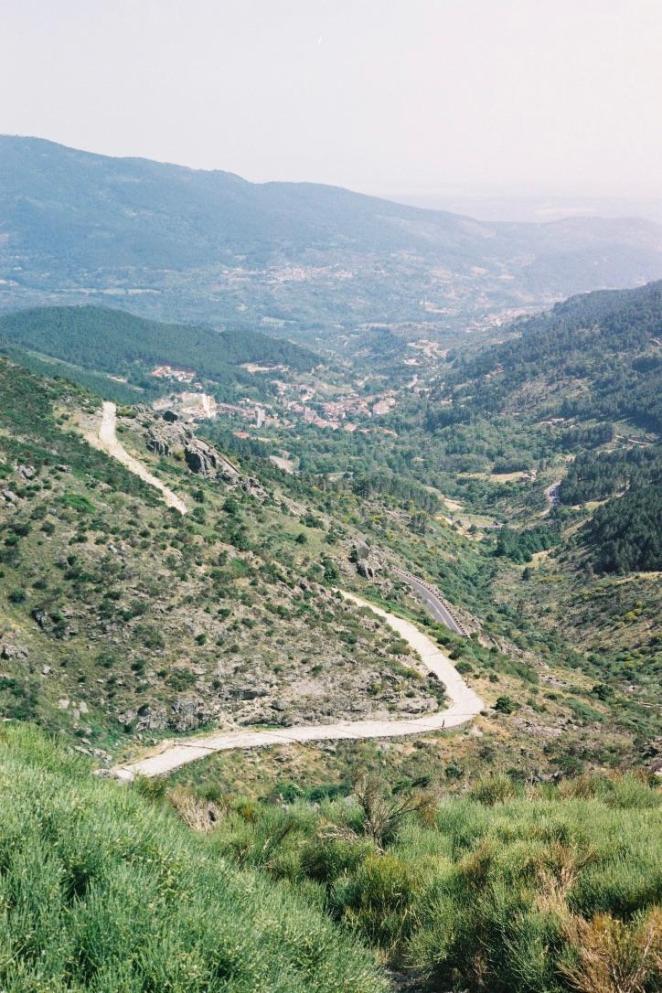
The picture above shows the old Roman Road that leads to the Puerto del Pico, in the province of Avila. It followed the contours of the hill and formed part of the Ruta de la Plata, the road that took Latin American silver from Seville to the Spanish capital in Madrid. Look carefully and you can see the modern highway that runs parallel to the old Roman road. Nowadays, that older road is used for transhumance, the movement of cattle from the valleys in the winter to the hills in the summer. The same road, the same pass, so many different uses, and the road a wake upon the path of so many lives.

Carved in Stone 43

Carved in Stone
43

Back home, in that little cul-de-sac,
the husbands are away,
working their night shifts,
while the wives are at home,
entertaining the truckers,
those long-distance drivers,
who park in that street and lodge there,
overnight, in the houses.

The children, boys and girls,
go out into the street,
climb into the trucks,
duck under the tarpaulins,
and, with all of us sworn to silence,
practice what their elders
are doing back home.

Commentary:
Monkey see, monkey do. And who knows what Monkey sees or does when the lights are turned out, darkness descends, and the honor of the blood cult takes control. Ask the animals, they will teach you. That was the motto of Bristol Zoo, where the Monkey Temple ruled, and Alfred the Gorilla and Rosie, the Elephant, were King and Queen of the beasts.

Knowledge – where does it come from? How do we attaint it? Is there a difference between knowledge, what is known, felt, and worked out for yourself, and education, when you obey orders and do what you are told to do (and how to do it). “We don’t need no education, we don’t need no thought control.” I have always loved Pink Floyd and The Wall. So many walls, so many barriers, so many things to break down in order to build them up again. Songs – Frank Sinatra – “I did it my way!” And who teaches what and to whom, underneath the tarpaulin when the lights are out? “Hey, teacher, leave those kids alone.”

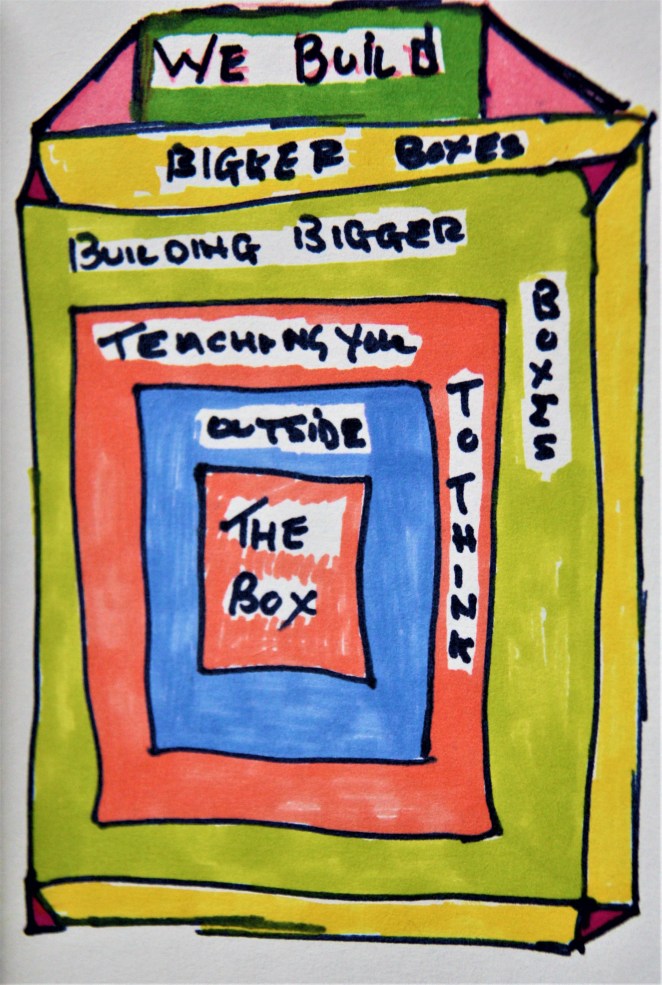
And beware of anyone who tells you that “we teach you to think outside the box.” That person will only give you a slightly bigger box, of his or her own making, inside of which you will be forced to think.

Of course, there are other ways in which we can think about education. How about this one? Filling empty heads with knowledge. How many ways are there to do this? And what is the exact content of the jug from which the knowledge will flow? And how many sows’ ears does it take to make a silk purse? “Hey, teacher, leave those kids alone.” Giddy up, Neddy I’m on my hobby horse now.

Carved in Stone 30 & 31

Carved in Stone

30

A well of beauty dwells within me,
not skin deep, but buried, arcane.

A flickering candle
tethered to an altar,
shimmers at midnight,
when the Latin mass is said,
bringing me light.

In the dark, canonical hours,
shadows move beside me
as I walk long corridors
from dormitory to a chapel
filled with heady incense.

31

I kneel, dumb-founded,
as candle flames wax and wane,
their brightness enhanced
by the midnight magic
that turns doubters into believers.

Spell and symbol, each candle a star,
shining, twinkling, in a galaxy of light,
and everywhere, the incense,
overloading my brain, releasing me
to revelations way beyond
muttered responses, mumbled words.

A world of inner darkness,
yet heart and soul soar together
up to the altar’s immortal light.

My shadow flickering
on the corridor walls,
as candle in hand, half-asleep,
I return to my cold bed
where the long, chill snake
of the bamboo cane
reminds me of tomorrow’s
flagellation.

Commentary:

Shadows on the wall or candles – with which should we start? Verbal and visual – how do they blend and knit together? Does my visual take away from your visual, or does it enhance it? To what extant does my verbal and the commentary on my verbal change the nature of your original thoughts when you re-create, within your own mind, my images, both verbal and visual?

Verbal and visual – now add the sense of smell. “The incense, overloading my brain, releasing me to revelations way beyond muttered responses, mumbled words.” And now remember that I was only six or seven years old when I experienced these things. Add the Latin mass, only half understood, the cold, damp feel of walls and wood beneath the hands. A world of inner darkness, yet heart and soul soaring together up towards the altar’s immortal light.”

My words are black print on white paper. My memories flare – an aurora borealis of senses sent crackling down the spine, in and out of the mind, tumbling the brain into a world … what sort of world? An unimaginable world. One never forgotten. One never re-recreated. One that never existed. One that never could exist. One for which the young child, six or seven years old, yearns for the rest of his life. His unsatisfied life. His unsatisfying life. His meaningless life. His absurd life.

Oh pity the poor puppy, not knowing what he has done wrong, not knowing how to put things right, always inadequate, whining and cringing at his master’s feet. And always, “that cold bed where the long, chill snake of the bamboo cane reminds me of the next day’s flagellation.”

Carved in Stone

Carved in Stone

28

The man who cannot cry
is dry indeed,
his inner space
a wasteland without rain.

Who can now walk forty days
in a desert wilderness,
without water?

Where is that crystal fountain,
with its healing streams
flowing from the rock,
its waters flowing through us,
bringing us tears of sorrow
and tears of joy.

Water and words –
they drift through me
and shadowed waves move,
shifting shape in the changing light.

29

A rising moon,
shimmers over the bay.
It reveals the path
that leads me back
to my primal waters.

Oh, salt flow of tears,
salty the waters
of the baptismal font
washing away all stain of sin.

Immersion in water,
a new start, a new life,
and all the soul-sweet eternities
of water and the word.

Commentary:

Water – such an important commodity, and filled with so much symbolism, religious and otherwise. And our bodies, on average, are composed of 60% water. We can survive for three days without water, if we are lucky. How precious it is. How much we depend on it.

The Bay of Santander, so beautiful beneath the moon. And I remember the full moon’s circle touching a rocky triangle as it rose above Peña Cabarga. Oh, the night life of the fish as they rose in the bay and basked in the moonlight. How often was I tempted to walk out along that moon path and walk the waves to Somo and Pedreña on the far side of the bay.

Immersion in water, a new start, a new life, and all the soul-sweet eternities of water and the word. Total immersion, then, not just in languages, but also in water. Where would we be without those life-long commitments, not to mention the crystal fountain whence the healing streams do flow?

Carved in Stone 27

The philosopher in search of his stone.

Carved in Stone

27

Miguel de Cervantes –
I read and re-read his words,
envious of his ability to reach out
with language that thrills me still.

I see him as a total entity,
while I see myself in pieces,
broken, unable to express
the simplest thoughts.

As I age, I sense the water
slipping from the water-clock,
the candles burning lower.

I still cannot make the mark
I want to make, for they are beyond me,
those marvelous word-worlds.

My words are mortal, his are immortal.
Mine just ink stains on a humble page,
his cast in print, but crafted to last forever.

As I bear witness to those powers,
so much greater than mine,
my eyes fill with tears.

Commentary:

They are beyond me, those marvelous word-worlds. Indeed they are. But I do not seek to create ‘a marvelous word-world’. I am happy with ‘ink stains on a humble page’. I seek to reach out and find those one or two people who accept me for what I am and find their own selves in a small corner of the tiny gardens I discover or create. Not a world, then, but a tiny corner of my own world, described, and offered to those who have eyes to see and ears to hear and hearts and minds to feel and understand.

And what is this infatuation with the poem itself? I no longer write individual poems, I write sequences of linked poems, a set of poetic narratives, if you need to find a label for what I am trying to do. Cervantes once wrote “La épica también puede escribirse en prosa.” / Epic poetry can also be written in prose. What happens if we reverse that statement and say – “A narrative sequence can also be written in poetry.” Interesting, eh?

And what is this desire to leave something, some trace of us, behind? I cannot answer that question. The answer will vary for each one of us, and for each fall wall flower perishing against the garden wall. I look at the homeless, pushing their grocery carts, head down. Their existence is as important as mine. Their desire to survive, for another day, another week, another season – and winter is coming one – is more powerful than any poet’s desire to leave a work – a magnum opus – to celebrate their lives.

And yes, my words are mortal, as I am mortal, as Miguel de Cervantes and all the great writers were mortal. Patrick Lane once told me that if poets leave one poem behind them that is remembered, they have done well. Even the greatest poets, and you can check this in the anthologies over the ages, rarely leave more than ten or a dozen memorable poems. As for me, I am happy to say that I have never had a poem included in an anthology. Not to my knowledge anyway.

And what does Magnum Opus actually mean? I leave you with the quote from Wikipedia set out above. Click on it, and find yet another way to distract, deflect, and change the direction of our lives! Given that road, who would ever want to walk it to its end?

Carved in Stone 23 & 24

Carved in Stone

23

It isn’t true that art
lives longer than life,
for all too often art and artist
are destroyed together.

Words, all words,
and words emerge
from the silence of blood,
bone, and stone, breaking
that silence the day they are born,
and the word once spoken
cannot be recalled.

24

Here, among the ruins of my life,
I have learned how to be alone,
how to sink into silence,
how to smother at birth
that world of words,
and that world, still-born,
becomes a lost world
whirled on the silent wind that fans
the unborn fires within.

I sit here
brushed by a tadpole’s solitude
as it swims through the sultry silence
of blood, bone, and stone,
into its own metamorphosis.

The wind that blows unspoken words
tugs at the spider web of my mind
twisting and untwisting
its frayed, fragmented ends.

Commentary:

The fragility of life. The single puff that turns the dandelion into a dandelion clock. The multiple puffs that dowse the candles on the birthday cake. And then, one day, there are no more candles, no more cakes, just the heart ache of multiple absences, family and friends all gone and each of us alone with our individual loneliness.

That’s when we finally turn in and seek the inner roads that lead us to ourselves. The selves that were, the selves that are, the selves that always will be. Crack the walnut – inside is the map of a brain – your brain? If it is you will have found yourself in this labyrinth. But if it is the brain of another, you must not give up, you must seek yourself, walnut after walnut.

And when you go to the library, you must check book after book, because one day, if you are lucky, you will find the book of your life and it will tell you who you were, what you are, and what you will always be.

Carved in Stone 21 & 22

21

Goodrich Castle – Civil War tore down
its curtain walls, fired its stables,
drove horses and people mad with fear,
all destroyed, a way of life, gone overnight.

I stand in the ruins of the solarium
beneath towering columns
empty now of the stained-glass
that would have kept out the rain
and retained the sun’s heat.

I imagine standing there,
speckled in sunshine,
coloured diamonds covering me.

22

I stop in the ruined quad
to sniff the air, to imagine the panic,
to smell the crackle of burning,
to hear the high-pitched screams
of dying horses, trapped in the stables.

Sometimes, at night,
fate mans the pumps of my blood,
and sends fire alarms surging
through my veins.

I do not want to die alone,
defenseless, besieged by memories
that gnaw away my remaining days,
like flames.

Commentary:

Memories burn away my remaining days, like flames. Fire controlled, stolen from the gods by Prometheus in Greek Mythology, by Zopilote, the Trickster, in Oaxacan Mythology. I will always recall those early mornings in Oaxaca, standing on the azotea (rooftop) doing my morning exercises in the half light. High above me, Zopilote slowly spiralled. His wings glowed red in the sun that had not yet penetrated to the earth below. As he descended, he brought the sun fire down with him and gifted it to humans.

Fire and flames, under control, in the candle on the table, on the birthday cake, in hearth and fireplace, a life-giving source of heat, light, and energy. Fire and flames, uncontrolled – wild fires in the woods, blazing out of control. It happened last summer. A severe drought, and the woods so dry. A lightning strike – and fire and flame soon raged, out of control. Smoke darkened the skies and the smell of burning hung around for days. So many people evacuated, moving out of their houses with three days, two days, one day’s notice. Sometimes it was so much less. Three hours, two hours, one hour … our community newsletter contained details of what to have ready to cover each of those situations. Very sobering and thought-provoking.

Back now to Goodrich Castle. The occupants trapped inside the walls with no place to go. Horses and livestock trapped in the stables, and those life giving flames now bringing death and misery. “Man hands on misery to man. It deepens like a coastal shelf. Get out as early as you can.” Hands up all of you who recognize the author of those lines, a great English poet who is possibly not as well recognized as he ought to be. I know who he is, but I’ll leave you guessing and googling! Go on, Google him. I know you want to!