Codes and Coding Where’s Home? (4) A continuing open letter to Jan Hull.
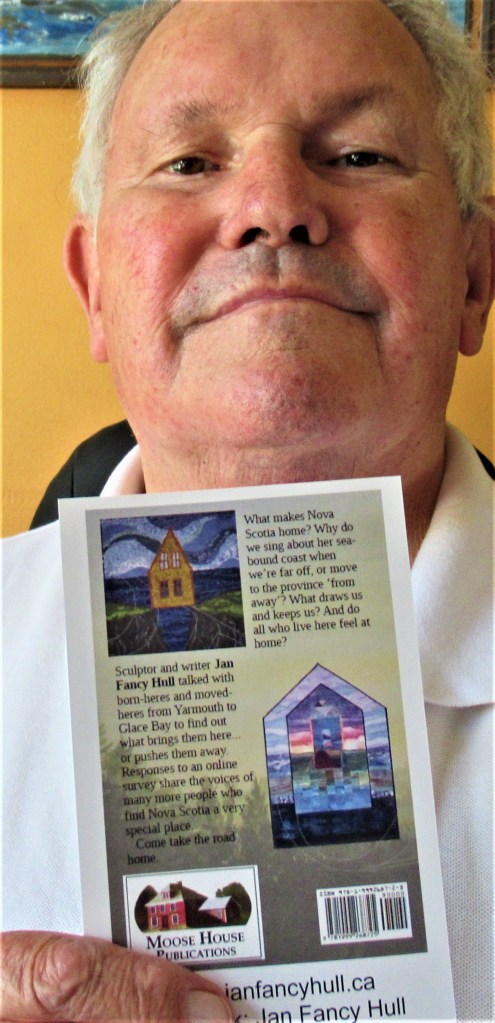
“Languages: they say that to learn another language is to gain another soul and another set of eyes through which to view the world.” I wrote these words on March 23, 2020, on the 22nd day of our Covid-19 lockdown. Why recall this article now? Because Jan Hull talks about Nova Scotian conversational language codes in her book Where’s Home? and her ideas rang a bell and tugged at my memories. CFA, for example, and CBC, and my own invention WAH. Then there are her coffee shop codes of Tim Horton’s and her Burger codes of MacDonald’s, and I mustn’t forget her other small town talking codes of former times and newly named places, must of which are bewildering to the outsider, aka CFA.
Why codes and coding? A rhetorical question, of course. But codes and coding are the basic elements through which language transfers thought, our thoughts. What is a code? Well, we know all about Morse Code and the elaborate codes through which spies from all countries communicate their needs. A code is a way of converting language, changing it, making it available to those initiated in the code and unavailable to those who have not received such initiation. Sounds simple, doesn’t it?
When I was travelling regularly to Spain for research in Spanish libraries, my first port of call was always the local barber shop. I did this for several reasons. In the first place, my Canadian haircut gave me away as a foreigner. This is the hairdresser’s code. The barber’s shop was always the centre of local gossip. Here, buzz words changed hands, politicians were discussed, all the local news was immediately available. Each of these items was a code, a code that made an insider (acceptable) versus an outsider (not to be spoken to). I remember, one summer in Madrid, not getting served in any bar or restaurant. Check haircut: okay. Check shoes: bought new Spanish pair. Check shirt, jacket, tie: all up to date. Inspect lucky customers who are being served … ah … they are all wearing a shiny brass pin showing the symbol of Madrid: El Oso y el Madroño, the bear and the strawberry tree, as seen in La Puerta del Sol.
The next bar I entered saw me sporting El Oso y el Madroño in my lapel. Qué quiere el señor? Immediate service and with a smile. These are social codes, the codes that include the winks and nudges of the upper class, the secret handshakes and foot positions, the names dropped so gently and quietly that they never shatter when they hit the floor. There are also language codes. Northrop Frye wrote The Great Code: The Bible and Literature, a study of the mythology and structure of the Bible, and it was published in 1982. In this wonderful study, Frye showed how themes and language from the bible have influenced the structure of Western Literature, particularly that written in English. Within this code, names, themes, miracles, parables, psalms form a body of common knowledge available to all readers who are christian and whose first language is English.
But there are other codes. Think Courtly Love. Think Petracharism. Petrarch’s poetry, originally written in Italian, was widely imitated throughout Europe. Italian literature, Spanish, French, English, all dip into that code, as does Shakespeare among so many others. Think the Great Chain of Being. Shakespeare is incomprehensible in places unless you unlock this particular code. Think Platonism, Neo–Platonism, Stoicism, Existentialism … okay, so all this is academic, and I do not want to lose you in a sea of academia. So think NFL, think NBA, think NHL, think baseball, think cricket, think rugby, think darts, think all of the things we manipulate on a daily basis in our lives and think how they include some people (those who know and share our codes) and exclude others (those who are unaware of them). LBW, c&b, c. A, b. B, st. A b. B, w, W, b, lb, lbw, dec., RSP … and think of the hand gestures that accompany them! You would have to be an ardent follower of the mysterious game of cricket, as I am, to immediately understand all those letters and signs.
This is a wonderful line of discussion. It follows along the lines of micro-language and macro-language. Macro-language is accessible to all who happen to speak that language. Micro-language in its multidinous forms incarnadine belongs ONLY to those who share the micro community, be it family, household, village, town, county, region … all that is closest and dearest to our micro-hearts.
When I was in Moncton (2015), at the Auberge Msgr. Henri Cormier, I spoke French on a daily basis. Being an academic and a linguist, I was fascinated by the levels of French that were spoken in that small community. Here are the levels I identified: (1) LFI, Le francais international, the central French language that I spoke and everyone understood. (2) Acadian, a beautiful language with regional variations, a different accent and rhythm, and some very different words and phrases. (3) Chiac, the mixed English-French used by the citizens of Moncton, whose wonderful poets are trying to get it established as a literary language. (4) Community French, five families from Paquetville were there and when they spoke among themselves about their home town, references, history, culture were all barriers to those who did not come from Paquetville. (5) Family Groups, and this is easy to understand, for all families have their in-jokes, their coded speech, their conversations that keep the outsider outside of the family group.
It is a fascinating study, that of coded languages, and I thank you, Jan, for re- opening it and reminding me of it.
Where’s Home (2) Part II of an open letter to Jan Hull
I ended yesterday’s letter with the words “There is a brighter side too, and I will get to that another day.” This is the day, and the brighter side is the sacredness of place. The Celtic Nations believe strongly in the sacredness of place. In the old religions we believed that places held spirits who dwelt in the rivers and streams, who lived in the trees and the orchards, who were a large part of the spirit of place and sacred space. You can still read some of this innate pantheism in The Chronicles of Narnia. Irish, Scottish, Welsh, French … we all have Celtic roots and, like the First Nations of Canada, we still believe in the sanctity of the land. This is an old tradition and a worthy one. Not all great ideas were born in Western Culture post the Industrial Revolution. Many pre-date our so called modern culture. Some should replace it.
I believe very strongly in the power of place. Sometimes, turning a corner one day, we know we are home. This is the feeling that comes so strongly through the second chapter of your book, Jan. Yes, the Maritimes (NB, NS, and PEI) are home for many people. It is indeed their One Small Corner. their querencia. What is a querencia, you ask? Well, it is the place that calls you, the place in which you want to live, the place in which you want to die. And yes, in this time of pandemic, death is on all our minds: those twin realities, sickness and death. Neither is easy. These times are not easy. But they become easier for those of us rooted in our time and our place and, like it or not, the human being, male, female, or other, must live in a dialog with their own time and place. This is the chrono- (time) -topos (place) of the Russian Philosopher, Mikhail Bakhtin.
Life is so much easier when we are in our own beloved space. When we are out of it, away from home, down the road, that is when we suffer most, Sometimes we are still able to flourish. Oftentimes, we wither and perish, like leaves on the tree. You, in your book, Where’s Home?, have offered us a glimpse of what that one small corner, the province of Nova Scotia, means to your correspondents and the ones with whom you have held dialog. We are all of us richer for that experience. Thank you, Jan, and on all our behalves, mine particularly, please thank your contributors.
And this is the good thing, to find your one small corner and to have your one small candle, then to light it, and leave it burning its sharp bright hole in the night.
Around you, the walls you constructed; inside, the reduced space, the secret garden, the Holy of Holies where roses grow and no cold wind disturbs you.
“Is it over here?” you ask: “Or over here?”
If you do not know, I cannot tell you.
But I will say this: turning a corner one day you will suddenly know that you have found a perfection that you will seek again, in vain, for the rest of your life.
Right from the address on the envelope where you gifted me a knighthood, calling me Sir Roger, I was captivated by this package.
I opened it at the Beaver Pond in Mactaquac and started to read as Clare did her daily walk, widdershins round the pond. Alas, I missed the great blue heron flying. Ditto, the osprey and the kingfisher. I heard all about them later.
Only you, Jan, only you. You are truly unique. Your words jump off the page, lean across the table to me, and offer me bread and wine. I do hope that this book is the first of many. Your words brought tears to my eyes and hope to my heart.
So many themes that touched me deeply. The loss of language and culture: in this case, French and Gaelic, in my own case Welsh, a forbidden language when I was growing up. It is only now, at an advanced age, that I have started to learn it. What memories it brings back.
The sending of indigenous children to residential schools: in my own case, starting at age six, I was sent away to a series of boarding schools and never escaped until I was 18 years old. Good-bye family and culture: hello loneliness and solitude.
The enforcement of religion, top down, with the vicious punishments that accompanied doubt, unbelief, or non-acceptance. The brutal separation from family, with the whole experience of reintegration into a now-become-foreign world, relocation, loss of roots and culture, the difficulties of not belonging to the new communities.
There is a brighter side too, and I will get to that another day. Meanwhile, congratulations on this book, Jan. May it be the first of many and a delight and revelation to all.
There I was, in dreamland, half-asleep, leaning on my cart, when this phantom drifted towards me. “Help me,” it said. “I’m hungry.”
I woke up from my dream, looked at the ghost, tall, skeletal, thin, cavernous eyes, cheekbones protruding, gaps in the teeth, grey face drawn.
“Sorry!” My reply was automatic. I looked at him again. “I only carry plastic.” The excuse limped heavily across the air between us.
I saw something in his eyes, I knew not what. As I walked away, I added one hundred pound of muscle to his frame. He had played hard.
I remembered him holding up the Maritime Cup. But I couldn’t remember his name. I pushed my cart all over the store searching for him.
At the ATM I withdrew cash I could give him. I would tell him he had dropped it. I could invite him to the snack bar, buy him a meal and more.
I could tell him to buy what he needed and meet me at the check out. I could add his purchases to my bill. I looked everywhere. Nor sight, nor sign.
One opportunity. That’s all we get. Miss it, blow the match. Grasp it, hold it tight, we’re champions.
Comment: “Am I my brother’s keeper?” “Or my sister’s?” Here and now we are living with realities that we have rarely faced before. Not everyone has kept their jobs. Some are indeed living out on the streets, helpless, homeless, panhandling, hoping. Right now they are lucky. Sunny, warm, hot … though sometimes too hot. At least it isn’t 40 below and freezing their butts off. So what do we do? Turn a blind eye? Say we are sorry? Suddenly recognize an old friend, turn quickly away before he recognizes us, and burn ever afterwards with shame?
I cannot answer for you. I can only answer for myself. I am ashamed of my slick answers, my throwaway negatives, my disguised barbs. “Go get a job.” There are no jobs, or very few anyway, Covid-19 has seen to that. “Do something useful, can’t you?” There’s very little they can do, and seemingly there’s very little can be done for them. “Go home!” They have no homes to go to.
So what are the alternatives? Love? Charity? Comprehension? Embracing their situation? Understanding? How can we understand, you and I, who sit before the computer screen, the cell phone, or the I Pad, scanning this in comfort? Think about it: there, out into the street, but for some good luck, and the grace of God, go you and I. Think about it. Now do you understand?
My body’s house has many rooms and you, my love, are present in them all. I glimpse your shadow in the mirror and your breath brushes my cheek
when I open the door. Where have you gone? I walk from room to room, but when I seek, I no longer find and nothing opens when I knock.
Afraid, sometimes, to enter a room, I am sure you are in there. I hear your footsteps on the stair. Sometimes your voice breaks the silence
when you whisper my name in the same old way. How can it be true, my love, that you have gone, that you have left me here alone? I count the hours,
the days, embracing dust motes to find no solace in salacious sunbeams and my occasional dreams.
Comment: Another golden oldie, polished, rewritten, and revised. Today is Clare’s birthday and fifty-five years ago today we got engaged, on her birthday, in Santander, Spain. I wrote this poem a couple of years ago when she was visiting our daughter and grand-daughter in Ottawa and I was left alone to look after the house. I will be including this poem in my new collection, All About Ageing … in an age of pandemic, on which I am currently working.
My vision of absence and of the bereaved wandering, lost, the house the couple once shared, is sharpened in this age of pandemic in which we live. My heart goes out to all those who have suffered short term or long term effects from the pandemic. My premonitions and visions, my memories and dreams, reach out especially to those who have lost loved ones and who live in the daily reality of that loss.
Yours are the hands that raise me up, that rescue me from dark depression, that haul me from life’s whirlpool, that clench around the jaws that bite, that save me from the claws that snatch.
Yours are the hands that move the pieces on the chess board of my days and nights, that break my breakfast eggs and bread, that bake my birthday cake and count the candles that you place and light.
You are the icing on that cake, and yours is the beauty that strips the scales from my eyes, then blinds me with light.
In one room in my head my mother’s mother sits with me on her knee at the kitchen table playing patience.
Elsewhere, I stand on a stool beside my father’s mother helping her to mix the cake she will later bake in the coal-fired oven of the black, cast iron stove.
My mother’s father sits before the television. He leans back in the chair, raises his foot so he can’t see the adverts on the screen, and puts his fingers in his ears.
My father’s father lies in bed, downstairs, in the middle room. His dog lies beside him, licking his hand. We all wait for the death that has haunted him since he was gassed in World War One.
Clare sits at the computer, following the figures that track the pandemic. I sit here watching her, humming softly to myself: “¡Qué será, será!”