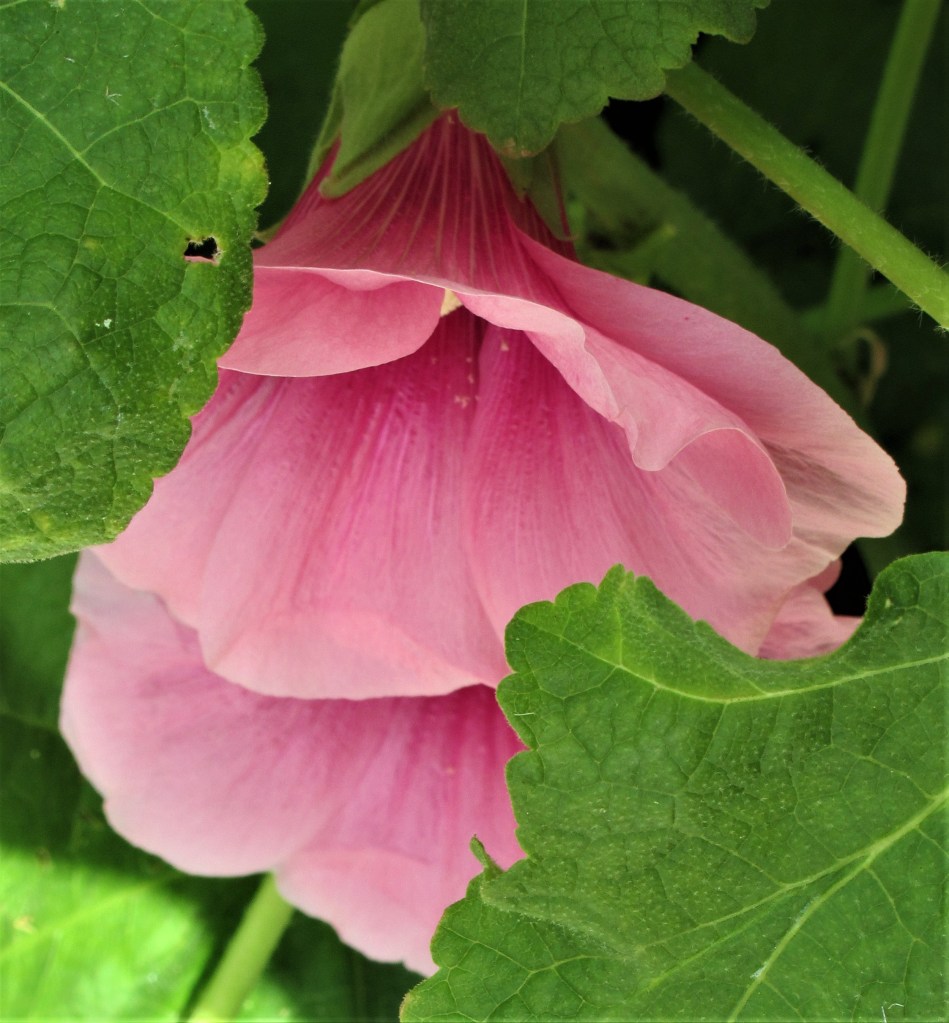
So, the holly hocks are back and this year we have some red ones to go with the lovely yellow ones that reseeded, in a different place, from last year. The red ones are very shy and are hidden away by the back steps where they are very hard to see.
I spy, with my little eye …
The red and green go well together. More a deep, blushing pink, I guess, with very dark centre. You can see the wood of the steps just behind them. I posted this yesterday, incidentally, but the computer munched it and I had to rewrite it today. It has been a slow time for me. The Corona-19 finally got to me, not in the physical sense, but mentally. As a result I have been feeling isolated, trapped, and a little bit depressed. Alas, there are many more like me suffering in today’s world. Luckily, the flowers help. As does the sunshine.
We’re back
Here are the new seeds from last year’s hollyhocks. They are similar in color, but much smaller this first season. They have also shifted location and I have been surprised at how many seedlings have sprouted and started to grow. Next year we may have a bumper crop.
Night Garden
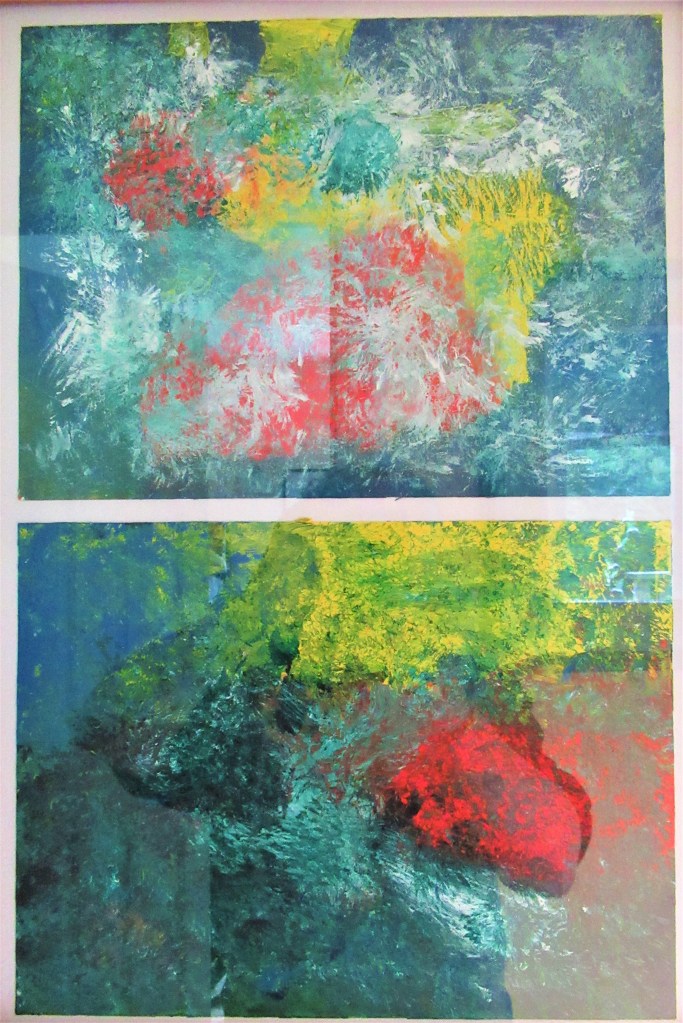
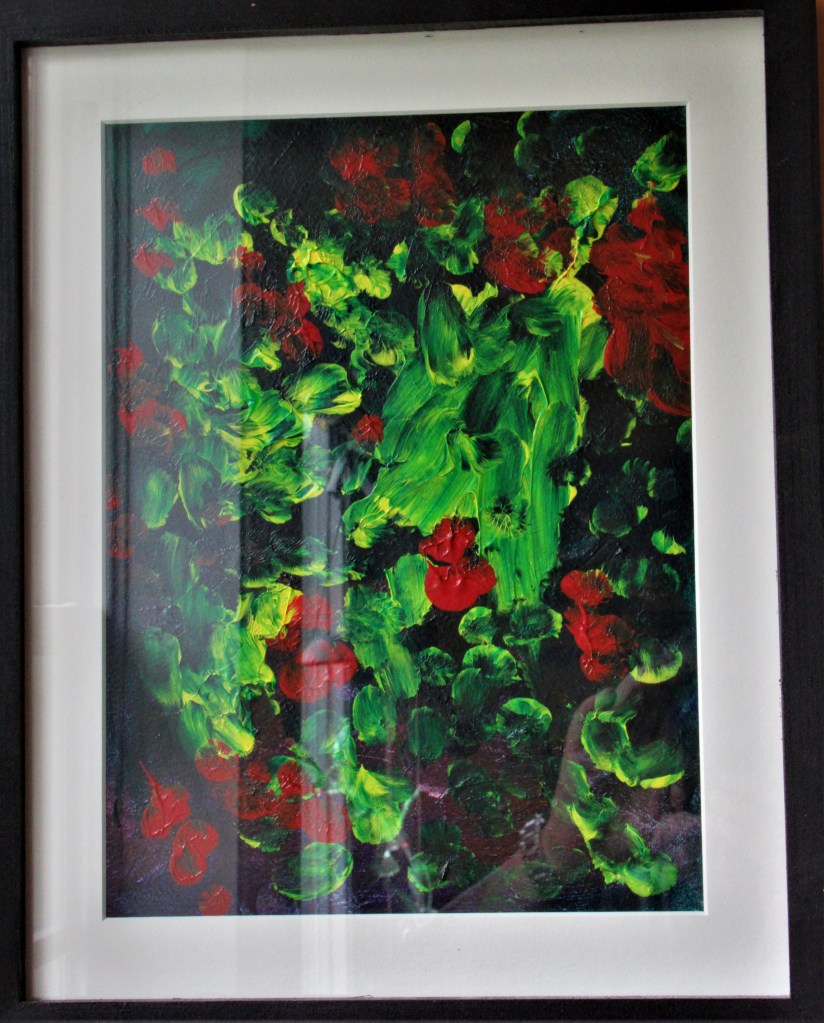
And here we have a painting of the garden at night, flourishing without us, but beneath the stars. “The garden going on without us.” Given the current situation, I prefer the garden going on with us still here to watch it.
Every trip to Kingsbrae Garden in St. Andrews, New Brunswick, opens my eyes to more beauty. Yesterday, I brought back this painting, Night Garden, and placed it on the wall by the garage door so I would see it regularly when entering and leaving the house. Alas, I caught the reflection from the window in the photo, but the night flowers and their colouring make up for any lapses in my amateur photography.
The painting is neither signed nor dated, so this night artist will have to remain anonymous for now. My friend Geoff Slater framed the painting but my photo does not do justice to the beauty and skill of the frame. My apologies. Alas, I must live with my inadequacies, but at least I am aware of them!
I spent a wonderful day in Kingbrae / KIRA, incidentally, chatting over a glass of wine with some exceptional local visual artists who are spending four weeks (June and July) in day residencies and working out of the artists’ studios at KIRA. Geoff Slater, the Director of Art at KIRA, led the conversations and I joined in, as did Alana, Ann, Simone, Stephanie, and Simone’s visiting friend, Renate. When artists gather at KIRA to discuss their art, the conversation is wide ranging and varies from the intensely personal to universal theories of creativity. Visiting KIRA is an experience like no other and one that I delight in every time I visit.
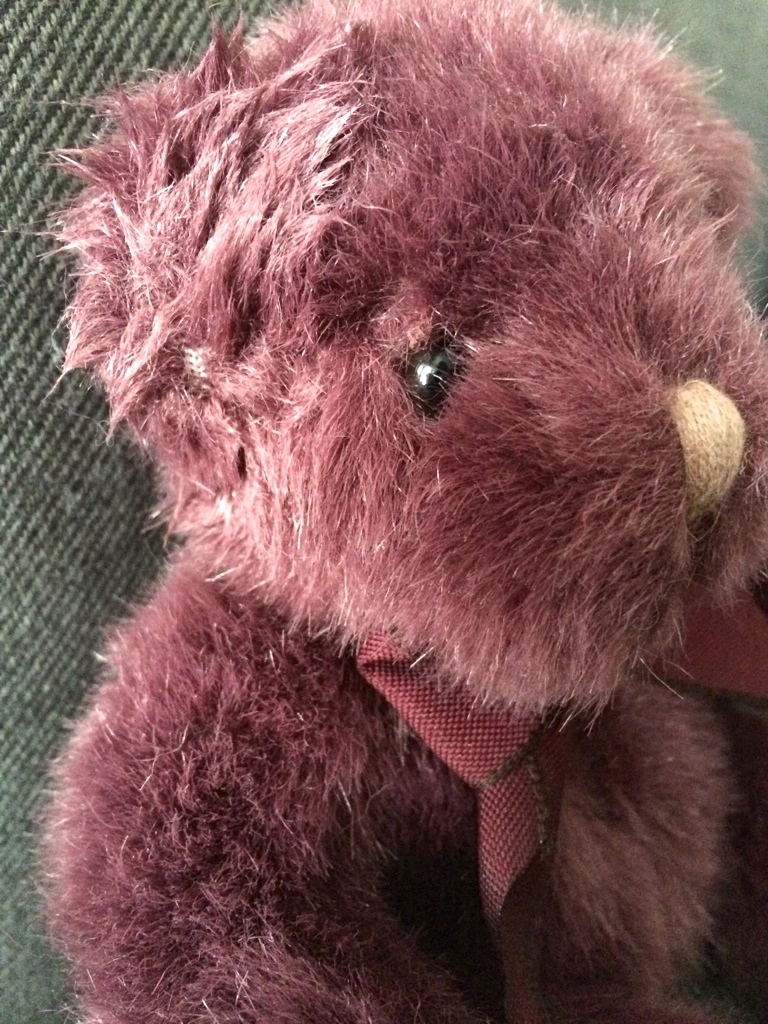
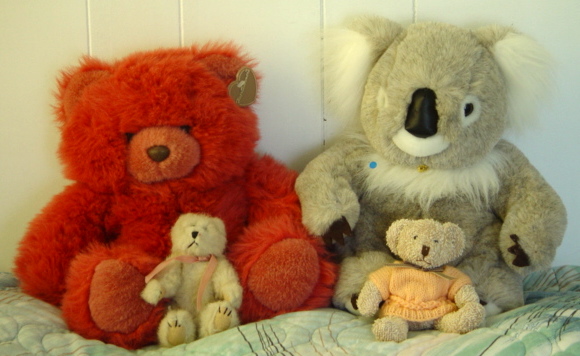
This isn’t Blueberry. It’s Purple Martyn the Purple Peril. Never mind. He looks sad. Perhaps he’s feeling blue.
Blueberry and the Night Bumps
Blueberry is a nocturnal teddy bear. At night he stands by the side of my bed and protects me all night long. Before I get into bed, I take Blueberry from the dresser and place him beside my bed. Only when he is there, on guard, do I get into bed tuck myself in.
“Goodnight, Blueberry,” I say to him, but he never replies. He has a job to do. As I drop off to sleep, he comes alive. Some nights I pretend to fall asleep. When I start to fake snore, Blueberry begins to walk around the bedroom.
He walks to the door and makes sure it is properly shut. Then he looks under the chairs and behind the dresser. Next, he opens the closet door, looks in, and checks that no Night-Bumps are hiding in there waiting to go BUMP in the night.
I am afraid of those Night-Bumps. One night, when Blueberry wasn’t there, a Night-Bump came and sat on my head and went bump-bump-bump all night long. I couldn’t get any sleep. Next morning, my head ached and I didn’t want to eat my breakfast. Nasty Night-Bumps.
The last thing Blueberry does is to check beneath the bed. Sometimes he crawls right underneath it. One night, I woke up to hear an awful noise, squeaking and screaming and a gnashing of teeth. Then silence fell.
Blueberry emerged from beneath the bed holding something that once had wriggled but that would never wriggle again. He walked to the waste-paper basket in the corner, took out and old sheet of paper, wrapped his little bundle in it, dropped it into the basket, then came over to see me.
“That’s the last Night-Bump,” he said. “It struggled wildly, but I got it before it could go bump. You can go back to sleep now. No Night-Bump will go bump in here again. They are all too afraid of me to come back. And don’t worry: if there’s anything else comes in, I’ll get it.”
“Oh Blueberry,” I said, and reached out to hug him.
“Can’t do it,” he sat down and showed me the soles of his feet, one by one. LOVE YOU: these words decorate Blueberry’s two back paws, with one word sewn into each. Usually, I can only read the message by day, when Blueberry sits down and rests.
LOVE YOU stood out as he sat down and raised his legs to show me his message. Then he got back up.
“No hugs. I’m on duty. No nightmares. No worries. Sweet Dreams. And back to sleep you go now.”
And I did.
Next morning, I picked Blueberry up, gave him a big hug, and set him down on the dresser, feet up. LOVE YOU, his feet said.
“Love you too, Blueberry,” I said. And then I added: “Everybody needs a Blueberry.”
Rosie, Teddy (BR, LR) Basil, and Orange (FR, LR). They are on holiday in Ste. Luce-sur-mer. Blueberry gets car sick and refused to travel.
Teddy and the Angels
Warm in Bed. Cozy. I roll over and the flashlight clipped to my Teddy Bear’s ear drives its hard, metal lump into my face. “Are you awake?” Teddy’s soft voice lilts across the pillow. “I am now.” “Look!” Teddy points with his little leather paw. “The moon: it’s climbing the fir tree.” Sure enough, a thin fingernail of gold is perched on a branch. It hides its face among the fir’s darkness and vanishes for a moment. “The maple tree has a garland of tiny Christmas lights,” says Teddy, pointing again. “Those aren’t Christmas lights, they’re stars.” “Spoilsport. Look, that one’s moving. I think it’s an angel.” “What time is it, Teddy?” “I don’t know.” “Here, lend me your flashlight.” I pull him towards me, switch on the torch, and focus its light on my wristwatch. “4:55 AM. That’s the early morning flight from Toronto. It’s a plane.” “I’d much rather it was an angel.” “Me too.” “Can we pretend it’s an angel?” “Of course we can. But it’s gone now.” “Perhaps angels don’t live long when they come to earth.” “I think they live for ever. Especially if we believe in them.” “Do you believe in angels?” “I was taught to believe in my guardian angel.” “What’s a guardian angel?” “He’s the one who looks after you when you sleep at night.” “But you don’t need a guardian angel. You’ve got me.” “But you’re a teddy bear, not a guardian bear.” “That’s true, but you’ve got Blueberry. He’s your guardian bear. Look at him standing there, on guard, all night long to protect you from the Night-Bumps.” “Ah yes, good old Blueberry. I’ve got a busy day today. I need some more sleep.” “Okay. Blue berry and I will watch over you. I’ll watch over you. I’ll let you know if any more angels climb the tree.” “That would be nice. Now I’m going back to sleep.” “Good night. Or should that be ‘good morning’.” Some days, when I wake up, I think I have dreamed all of this. Other days, I believe in talking teddy bears and angels. Today, I’m not so sure.
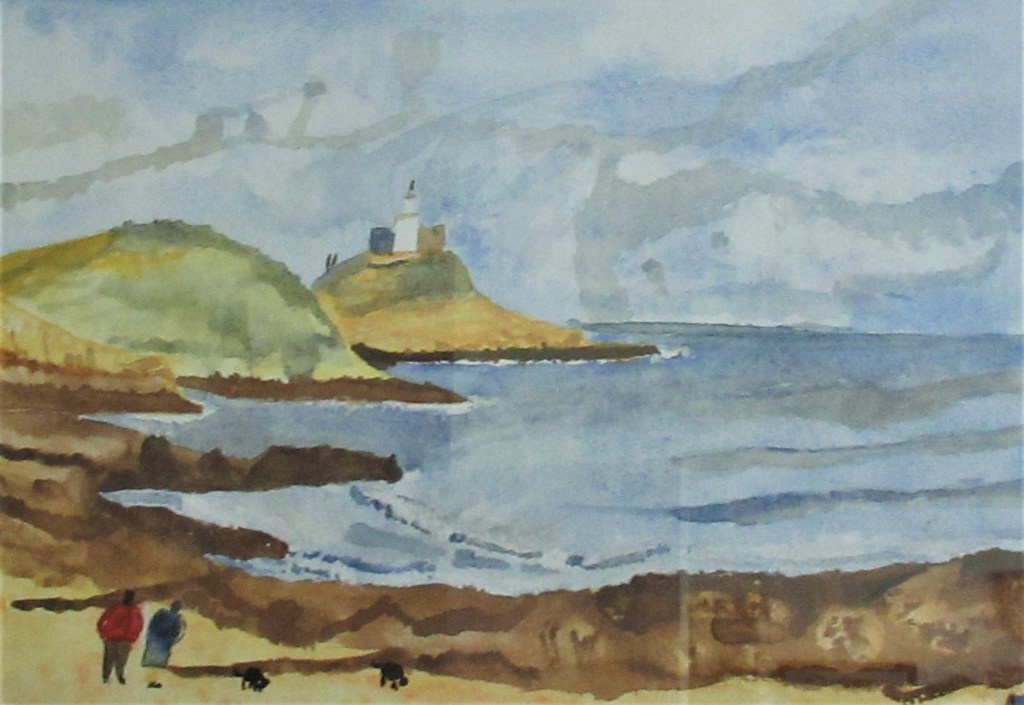
My Uncle Frank’s first water color: the Mumbles Lighthouse from Limeslade
… but it’s watch out for the dog, for the dog gets everywhere because he’s on holiday too and everybody’s on holiday in this little sea side town and the cousins have come down from London with their cockney accents, born within the sound of Bow Bells, though they’re half Welsh by blood, though you wouldn’t believe it with those incredible accents which nobody can understand … and they’ve never seen the sea, though their mother was born here, beside my mother, beside this self-same sea which has never left and which still flows in and out, even now, and it still flows through my bones and “Look at all the water!” my youngest cousin cries and then he really cries because London, the capital of England, is concrete and tarmac and all petrol smell and smog and fumes and busses and he’s never ever seen the sea, the sea’s open spaces, the wide open arms of the bay held out to embrace you with Swansea Docks on the left, a working area of ships and shipyards where my grandfather labours and takes me on workdays, even in summer, and shows me the ships and his friends and everyone is happy and laughing because it’s summer and it’s hot and there’s lots of employment and the banana boats are lining up in the bay, at low tide, waiting for high tide, when they can enter harbour and be unloaded and this happens all year round, but it’s really in summer, when the sun is as yellow as the bananas, that the banana boats become significant and we show them to my cousin who has never seen the sea nor the banana boats, though he knows what a banana is and where to buy them and what they cost, but he never knew they came in on these boats, these great white summer boats, from Africa and the Caribbean, with their funnels all yellow and their bright stripe of blue, Elder and Fyffe, and the boats all lined up in the bay and look: to the right there’s the Mumbles and the Mumbles has a pier and a playground and you can go out and walk on the pier and at the end there’s the life boat and the life boat has a slipway for the life-boat to run down into the sea to rescue people who are shipwrecked, but only in winter because in summer the sea is calm and shiny and it runs in and out twice a day, like an obedient dog, and why is the beach wet? Because the sea weed … and the pier is a world full of wonders, with its peep shows and its games and the old men fishing off the end, chatting and gossiping, and not ever worrying about whether or not they catch the fish which many of them throw back anyway, so they can catch them again tomorrow …
Summer in Wales is always as I remember it: glorious days of sun and sand and blue skies and warm winds … and especially the sun on the beaches with the water sparkling and little boys and little girls playing cricket on the dry wrinkled sand packed hard when the tide goes out and leaves the land stranded … and uncles and aunties bowl under arm, not over arm, so the little ones could manage to score lots and lots of runs … and I remember us, standing breathless between the wickets, or at the wicket, if there was only one set of stumps, or a picnic basket stood on its side, or three pieces of driftwood, with sea-weed for bails, and what are bails, you ask?
Well, bails are the sea-weed that is draped over the driftwood that stands as stumps. And we guard our stumps with the cricket bat that somebody has brought and we bowl with wet tennis balls, because nobody will risk a red, leather ball on the sands, with the wet tide standing there, waiting for the ball to be hit at it, or into it, and it’s cold, but not that cold, and when uncle hits the ball, right out so sea, someone has to run after it, then dive, and then swim after it, and if it’s real runs you want, then uncle runs two or three quite quickly; then the aunties tell him to stop running so fast or he’ll have a heart … so he slows down and trots four or five; then he walks six and seven; and when you throw the ball back, he’s walking eight or nine; and then the dog intercepts the ball, catches it in his teeth, and starts running around with it in his mouth and everyone is trying to catch the dog except my uncle who is now limping very, very slowly between the wickets, but he’s already up to eleven or twelve; and then the little ones start crying because “It’s not fair!” Loud sniff! Then uncle stops in the middle of the wicket and sits there, waiting for somebody to run him out; except everyone is tired, except the dog, who is tireless and completely energized, and now the centre of attention; and nobody is going to catch him; and finally uncle walks to the wicket and he lifts the piece of seaweed with his bat and everybody appeals, then he’s finally “OUT!” because officially he’s hit his own wicket and that’s illegal and now the game can go on once more, with everyone happy and God’s in his heaven and all’s right with the world …
And the dog has dropped the ball right at the edge of the waves and is barking furiously at the incoming waves as time and tide march up the beach and sweep us and our memories all away.
After I delivered the lecture at London University, as it was back then, I caught the tube and descended at Paddington station. While waiting for the train back to Cardiff, I sat in the station bar and ordered a pint of beer and a Cornish pasty. An older man wearing a sweater and jeans asked if he could join me. I didn’t say ‘yes’ but he sat down anyway and straight away began to talk. I paid no attention to him until he rolled up his sleeve and showed me the collection of scars that ran crisscross, hard and welted, over his left wrist. “Failed attempts,” he said. “But I’ll get it right next time. “I wouldn’t want you to make the same mistakes I did. If you want to kill yourself, you must do it this way,” he reached across the table and picked up the knife I had used to cut my pasty. He pulled out a dirty hanky and wiped the knife in it. Then he laid the blade not cross-wise but parallel to the artery in his wrist. “And you must dig deep, first time, and at a slight angle.” “I’ve got to go,” I told him as a tinny voice came over the Tannoy. “That’s my train.” I stood up, leaving the remains of my pint and my pasty on the table. I got to the door of the station bar and looked back. Then I watched as my table companion finished my pasty and reached across the table to claim the remains of my beer. “Quite the lecture,” I thought. “Good job I didn’t spit in the glass.” Then I realized that both my day’s lectures had been effective, in one way or another.
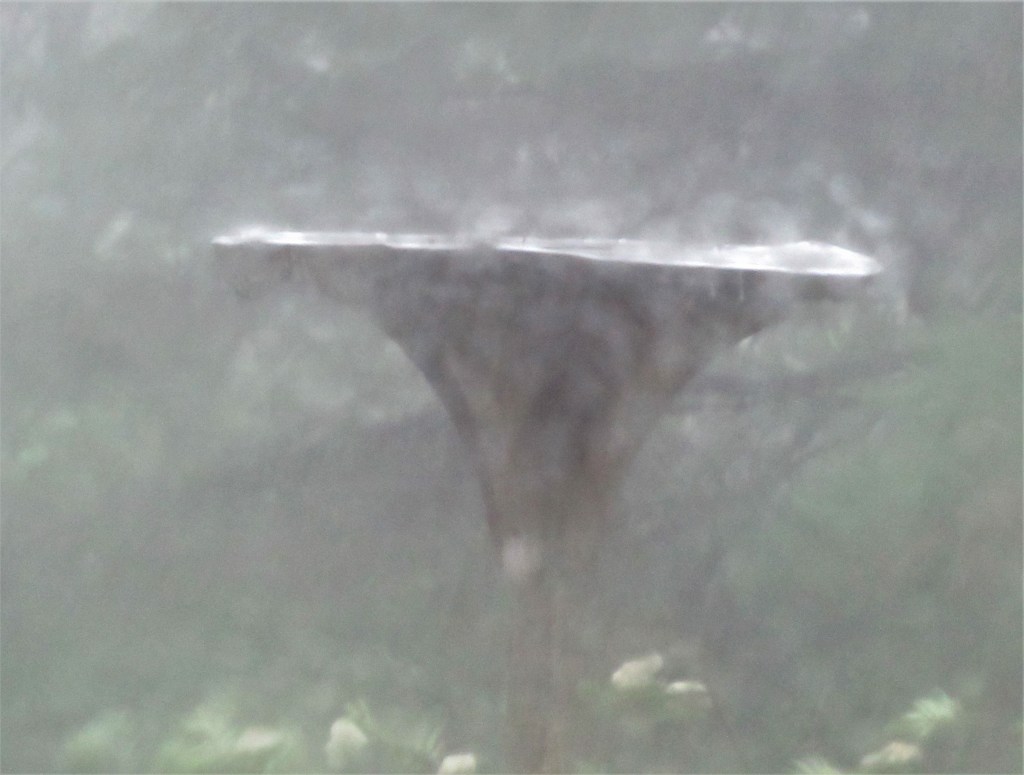
We got an incredible one inch of rain in ten minutes last Friday evening. I got some wonderful photos and no, that is not my hand shaking.
In fact the weather in June has been most strange. The end of May saw four consecutive days at 32 C / 90 F. This was followed by four consecutive nights of frost. And then this devastating rainstorm on Friday evening.
Bird Feeder in Winter
Los Días de Noé / the days of Noah, as they say in Spanish. But our one inch of rain fell in just ten minutes and the wind was horrendous. Similar storms are called chubascos and I’ve also heard tromba.
Whatever: it was cold, dark, windy, and wet and 13,000 homes went without power.
Black clouds build over the Bristol Channel, threatening to cross the Severn from Ilfracombe to Brandy Cove and climb inland to rattle our windows and bounce rain off our corrugated roof. We run out to the lane, looking for the dog, calling his name. Hoping to get him in before he gets soaked. The rubbish dump outside the gate sits on a concrete stand and dominates the lane. Tall and stinky, the red-brick structure rustles with scavenging, skirmishing rats. Pinned to the dump, a hand-written notice: “Please do not light this dump.” We smile as we read it. Our neighbours will put a match to this dump, one dry night, on the way back from the pub. Kim, Nana’s Wire-haired Fox Terrier, spends his days at the dump in an effort to achieve his life’s desire: the elimination of every worrying, scurrying rat that ever inhabited the planet. When he tires of killing rats, he will bring their bodies home to the bungalow. Sometimes he lays them in rows outside the backdoor: rats, mice, field mice, voles. Sometimes he brings them inside and places them on the concrete base beneath the old cast-iron stove. Every day Kim sacrifices to my grandmother, his Gower Goddess, and lays the victims out on her altar. The rain is close. We run back down the lane to avoid the storm that is now upon us. Violent and short-lived, like so many summer storms in Wales, raindrops will thump against windows and roof. Lightning will flash, thunder roll its celestial drums, and the wind will whip its lash round the chimney. We sit at the table and sip hot cocoa. No sign of the dog. Later, when the storm has passed, we wander up to the lane, avoiding the deeper runnels of muddy water, and stepping from high point to stony high point. We scurry hurriedly past the dump and listen to the rats. They will survive for another night. Nobody will be able to light the dump after rain like that. Back in the field, we fill up the water can, take a handle each, and carry the precious liquid back to Gran. We walk to the back door. Our neighbor is standing there, crying. “I didn’t see him,” she stammers. “He ran out from the dump as I drove round the corner,” she points to Kim, laid out on the back step, his broken body wet and bloody, the last rat he would ever catch still clasped tightly in his jaws.