Sign Language

Sign Language

A skater leaving marks on fresh ice
or a stone cast into a pond,
with multiple meanings, multiple ripples
moving slowly outwards,
to end up where?

Who knows? Not me.
I only know that the thrown stone,
like the spoken word,
can never be recalled.

Each word a stone,
and each stone leaving its mark
on many people of many cultures
and multiple languages,
though English is the language
in which I now write.

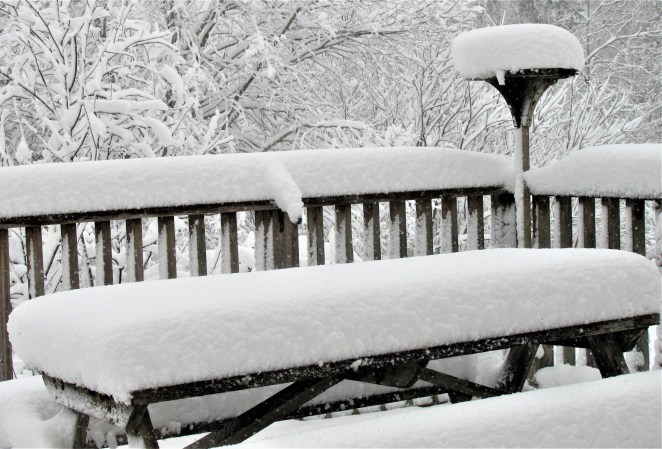
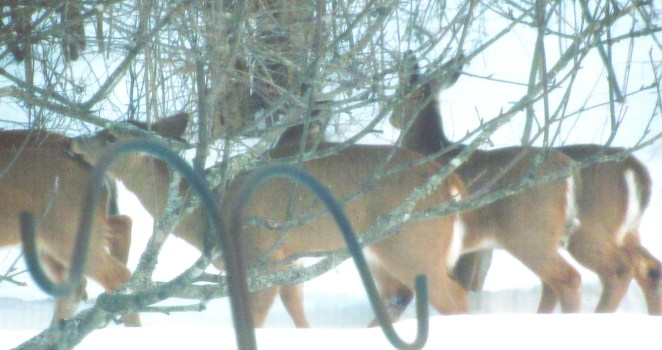
Frost and snow here this morning.
Not much, just a dusting.
I look out of the window
at the crows’ claw prints
on my yard’s white surface.

My eyes draw silence
out of the white space
with its runic language
written by the crows.

The meaning of meaning –
tell me, if you can,
what do they say?
What do they mean?
What do they want from me?

Commentary:

Intertextuality – this poem came directly from this morning’s commentary, with some minor alterations. The commentary itself, emerged from Carved in Stone, 35. Three separate steps in the great chain of intertextuality, where text speaks to text and the crows cock their heads, turn them to one side, listen, and write their answers in the snow.

Sometimes words just flow. Sometimes, I force them to flow. However, I have learned over the years that the secret is to relax and to allow the words to come to you of their own free will. Sometimes they whisper, occasionally they shout. But if you are willing to listen, you will hear them everywhere. And they have so much to say, if you will only learn to listen carefully and try to understand their language.

Carved in Stone 32

Carved in Stone
32

I dream of winter snow
snaking its whispering way
down the highway.

Waves draw lacy curtains
across the beach.

Sandpipers wade, pecking,
probing at tide’s foaming edge,
strange writings their footprints,
punctuation,
the holes they leave
drilled in the sand.

Evening now, and a low light
casts its magic on the forest,
gilding the trees.
Dry leaves rustle.

A shadow flickers
at the edge of my eye,
my childhood –
a sea bird soaring.

Commentary:

So inadequate, the word world I create. Sound – winter snow snaking its whispering way down the highway / dry eaves rustling. Absence of sound – waves draw lacy curtains across the beach / sandpipers, with their shrill voices and constant whistling’ / the gentle hiss and buddle where the sandpipers sew their holes.

What about the other senses? I miss the sense of smell, the odors borne on the wind, the different aromas that arises from dry and wet sand, the pong that wet sea weed exudes, the perfumes of sea side grass and wild flowers … And what about touch – the sandpaper scraper of dry sand between the toes, the feel of those lacy curtains as, jeans rolled up, you paddle along the shoreline, the feel of the wind on your face when sea birds soar … and who can ever forget the salt taste of the sea upon their lips?

The Catch 22 of all writers – how much can we include? How much can we suggest? How much must we let slip by? Culture – how can we describe the sea to someone who has never seen the sea? I can ask the questions – but I must leave you to work out the answers for yourself. So inadequate, the word world I create.

A Touch of Frost

A Touch of Frost

Cooler nights have brought
a touch of frost to higher ground.

At night, temperatures fall.
By day, they build.

I watch as Autumn, finger on lips,
tiptoes through the garden.

With a wave of its wand,
winter threatens.

A gust of wind swirls the leaves,
sends snow flaking round the tree.

My love has a gentle touch of frost,
a blanched fringe at her curl tips.

When I look in the mirror,
I see the full effects, snow drifts
gathered on my own head.

I look at my beloved.
Her hair –
a crab apple tree
in full spring bloom.

Commentary:

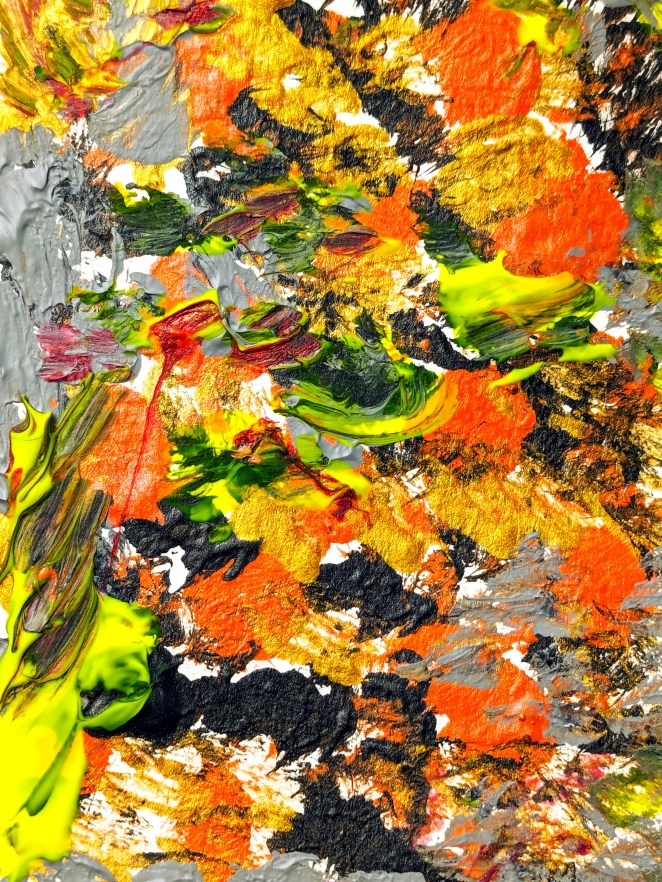
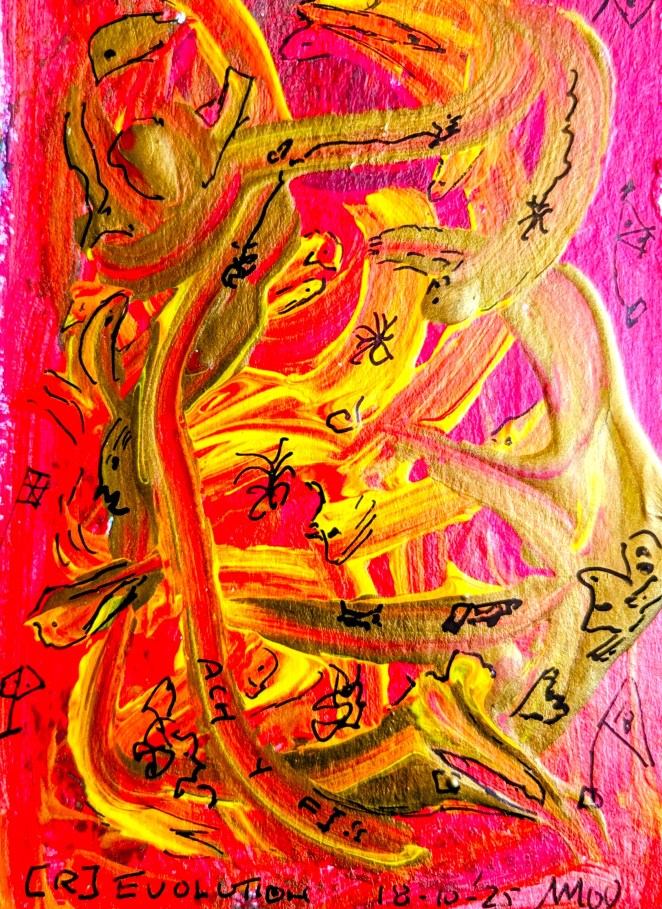
Moo to the rescue with a little touch of frost and snow in his painting. So many images here. So many pictures floating through my mind. Still Autumn, and we had some snow. Not much, but enough to remind us that winter lies just around the corner. Enough for today. More tomorrow. And snowflakes and blessings to all.

Carved in Stone 18

18

Day-dreams, cloud castles,
châteaux en Espagne.

I climb the castle tower
in Segovia, and watch
Golden Eagles flying
in the air below me.

I walk the walls in Avila,
feel the stonework, warm in the sun,
and sense the passing of time
as it slowly gathers,
like clouds in the air
when they foretell a storm.

I trace masonic signatures
on the cathedral’s central façade,
and marvel at the master carvers,
who shaped the statues.


They also created angels
and the praying pay-masters
condemned to kneel there,
seeking forgiveness for their sins,
as flickering candles mark time.

Commentary:

Avila: 3.8 kilometres of walls. 9 entrances. Inside the walls, the old city. I lived for three summers in El Rincon, a Hostal in the city centre just outside the Mercado Chico. I still dream of walking those city streets, visiting the bars each with its different customs and tapas. And I remember the tapas, each bar specializing in something different. The Rincon, a marisqueria, and I learned so much abut sea-food, its transportation, the ways of preparing and cooking it.

And while in Segovia, you look down at the Golden Eagles, in Avila, an eternity of storks looks down at you. I remember my friend, standing at the door of the Hostal and calling the storks, as they returned from a day in the fields, by the names of the churches in whose towers they built their nests.

I never thought those days would end, but end they did. As all things do. Now I must take a delight in the memories as they walk before me and call me by my name.

On Writing Poetry

On Writing Poetry

I sit here writing poetry
and, head in hands, I cry
at all the things I’ve left unsaid,
and then I wonder why
I wasted so much time on things
that perished before my eye.

Outside the night is dark and cold
and shadows flit and filter by.
I know that I am growing old,
that soon my story will be told,
and when it ends, I’ll die.

I know that death is not the end,
yet I do not want to die.
I want to paint the autumn trees,
the clouds that float on high,
with evening lights that stain the sky.

But rhyming is not all I do.
I often write in prose, with words
that wound, and sow dark seeds,
that root and flourish, grow like weeds,
and nourish other people’s needs.

Alas, I know not what I do,
nor yet what I have done,
nor when, nor where, the seeds
were sown, nor if they aided anyone
to turn away from the dark inside
and walk in the light of the sun.

Commentary:

A Golden Oldie that turned up on my Facebook page. So I copied it and pasted it here. What fun. I’ll probably revise it and sharpen it up a little bit. All best wishes to all my readers.

And remember, Remembrance Day is for Remembering. Both my grandfathers served in WWI and were decorated. Never forget those who sacrificed themselves to give us life and freedoms we enjoy.

Growing Old Together

Growing Old Together

You and I are growing old together.
We have been together for 59 years
and married for 54 of those.

We watch each other slowly breaking down,
the memories going,
the body parts not functioning
the way they used to.

In some ways,
it is incredibly beautiful.
In other ways,
it is so tragic, this slow waltz
around life’s dance-floor
towards who knows what
that last dance will bring?

It gets harder and harder
to find the right things to say,
sometimes to find anything to say.

There are days
when we just sit in silence,
filling in time,
doing a crossword or a sudoku,
or just gazing into space,
trying to avoid
the mindlessness
of endless adverts
on the television.

Commentary:

Not much to say, really. The poem and the photo speak for themselves, as good art always should. Sometimes the artist plans everything, and out it pops, all ready-made. On other occasions, a small miracle takes place and words and images tumble out, fluff their feathers, settle down and wow! – it’s a work of art. As long as one other person, other than me, thinks so, then I will be happy. “If I can reach out and touch just one person.”

I often wonder how many people are touched by traditional art nowadays. There is so much shock and awe out there, that the humble homely corner with its two doves or the image of an elderly couple dancing slowly around their kitchen, hanging onto each other – for what? And both of them waiting – for what, exactly? I expect it varies with each couple. But what I pity most are the lone doves, abandoned, autonomous, living on their own-some with nobody to talk to and only the TV to listen to. How many of them are out there, I wonder? When I walk around town, I see the street people, the homeless, the really lonely ones, just sitting, or slowly pushing a grocery cart with all their belongings tied up in plastic bags. Heads down, they plod on, never stopping, never looking.

“A sad life this, if full of care, we have no time to stop and stare.” W. H. Davies.

Carved in Stone 13

13

What is life?
Is it just an illusion,
as Calderón tells us,
and nothing but a dream?

And what is time?
Does it bend, as Dalí shows us
when his surreal clock breaks into pieces,
time and numbers flying off
as it explodes over a waterfall?

Another clock folds –
a pancake draped
over the bough of a tree.
 
Time – a water clock,
a marked candle,
a grandfather clock,
with Roman numerals,
and time marching,
round and round,
erasing the past,
establishing a future
that will itself
soon be erased.

And what am I
but a moment on time’s clock,
a drop in the clepsydra,
a striation on a flickering candle,
a piece of roughly polished sea-glass
perched on a lonely beach?

Commentary:

Well, Moo has done me proud this time. Two early paintings, both depicting aspects of time, as conceived by Moo. In the first, time is seen as a tick-tock time bomb, or rather a set of tick-tock time-bombs. In the second, in imitation of Salvador Dali (Moo always set his sights high!), a clock going over a water fall and the hours flying off the clock face as time bends. So, tell me if you can, what is time?

Perhaps more important, what is life? Is it a dream, an illusion? And if it is a dream, what happens when we wake up? I know what happens when I wake up – I get up and go pee. Is that to be my final reality? By extension, is life our only reality? Or is our life a series of lives, as some religions would persuade us? And if a cat has nine lives, how many lives do we have? Can they be numbered? Or, like innumerable onions, do we peel away layer after layer? And if so, what is in the centre of the onion when we finally get down that far?

And why do some people write center while others write centre? Is life an illusion, a play? If so does it take place in a theatre or a theater? Or is really a sort of metatheatre or metatheater, life in rings, like the onion, lay after lay, layer after layer? Oh dear, this is all much too complicated. I’ll ask Moo to paint me a painting of life and we’ll see what he comes up with. He’s a bit lazy at the moment and his paint brush has the bends and refuses to cooperate. It’s probably made of cat bristles, and is untrainable and almost impossible to train, let alone to herd. Never mind. We’ll abandon all this for now and give the cat the task of training Moo to paint another painting.

Carved in Stone 12

12

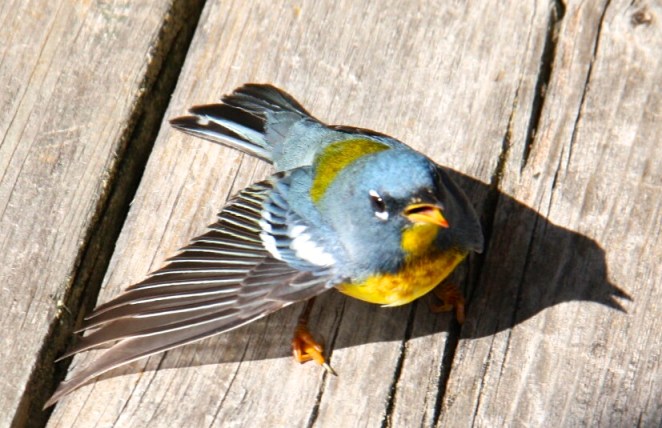
A Ruffed Grouse sought refuge
among the berries
of the Mountain Ash.

I shot him,
not with a gun,
but with a camera.

Intertextuality –
a friend borrowed the photo,
turned it into elegant brush strokes,
and now the painting
hangs on my wall,
opposite the tree
where once he sat.


A still-life
face to face with its reality
as early morning dew
forms on spider webs,
hammock-strung
between grass-blades,
bending in the wind.

And what if the spell breaks
and I can no longer see the fine seeds
of the dandelion clock kissed away
by the lisping lips of time?

What is life?
Is it just an illusion?

Commentary:

I shot him, not with a gun, but with a camera. Interesting. I have never seen the need to take the life of living creatures, except in cases of absolute necessity. And no, I have never killed, let alone for fun or sport. Shooting with a camera, that’s my ideal, and when a friend and fellow KIRA artist likes the photo and offers to paint it … well, that leads us into the nature of intertextuality, where reality becomes photo, becomes painting, becomes a text, and you, dear reader, are contemplating all those moments that join us.

The fine seeds of the dandelion clock kissed away by the lisping lips of time. This image comes from my walks in the Welsh countryside around Brandy Cove, Gower, with my paternal grandmother. “What time is it Nana?” I can still see her, bending down, plucking a dandelion, and holding it out for me to blow the seeds away – one puff, one o’clock, two puffs, two o’clock. I recall the seeds, drifting away on the summer breeze. “The Good Lord loved those dandelions,” she once told me. “That’s why He planted them everywhere.”

What will happen when the wells run dry and water runs out and there are no more dandelion seeds? How long will it be before I can no longer see them? Vis brevis, ars longa. The answer to my questions – I care, but I really don’t know.

Last Dance

Last Dance

Ten years ago,
in the Hospice for patients,
the shy lady in the corner,
body withered by cancer,
stood up to dance.

She bowed to the band
then floated into movement,
dancing alone.

She clung to the empty air
as she once clung to her lover.

Nymphs and shepherds
played sweet music at midnight
in this room turned sacred grove,
where naiads and dryads
emerged from the shadows.

Her dance-steps
were a draught of joyous water
from the fount of eternal youth
and lasting love.

Commentary:

Moo offered me one of his paintings for this poem. He calls it Keep on the green side. Every Wednesday, in the hospice, a local band came in to play. Some patients danced, others sat and watched, some stood on the sidelines and listened to the music.

I had the fortune to be present at the singular performance recounted above. I never found out that lady’s name and I never saw her again afterwards. She remains a mystery, like the naiads and the dryads, and the hamadryads, who inhabited those mythological woods where so many of us dream our dreams of one last chance and one last dance.

Carved in Stone 6 & 7

6

At Westbury White Horse,
I wandered among unkempt mounds,
forgotten graveyards,
ancient barrows, their secrets
buried deep underground.

I walked to the horse’s eye,
stood there, then sat on the hill’s edge
to watch the sun drown
in a river of blood that turned
the White Horse red.

Shadows encroached.
A creeping chill came over me.
I started to shiver, not with cold,
but with the icy fear that someone,
something, evil and powerful,
long dead, but risen again, lurked,
hidden in the ground mists,
that rose as I fled,
not daring to look back.

7

But that fear,
deep-seated as it was,
could not match the terror I felt
as the sun set
over Badbury Rings.

An ancient horror
reigned over that place.

Mist warriors, visible
only from the waist up,
their weapons drawn,
charged towards me.

I felt chill fingers
clutching my heart, gripping it,
and tightening their hold.
I fled from them in the half-light.

Ancient powers linger long
in spite of charms, spells,
and exorcisms.

No wonder so many ancient tribes
shattered the legs of their dead
so they could not rise up
and walk again.

Commentary:

According to Wikipedia, the Westbury White Horse or Bratton White Horse is a hill figure on the escarpment of Salisbury Plain, approximately 1.5 mi (2.4 km) east of Westbury in Wiltshire, England. Standing at the northern edge of Bratton Downs, on a steeply sloping hillside below an Iron Age hill fort, it is the oldest of eight white horses in Wiltshire. The white horse has long been revered in European mythology. In Celtic traditions, it was associated with the Otherworld, acting as a guide between the realms of the living and the dead. In many myths, the white horse represented purity, power, and the ability to traverse spiritual boundaries.

I love visiting these sites. However, they need bright sunshine and warm weather. When the light starts to fail and the day grows cold, strange feelings emanate from the ruins. Many people have commented on this phenomenon and there are reports of sightings, such as the one that I associate with my visit to Badbury Rings. I went there late one afternoon, and as the evening drew in and the air grew colder, I and my companions felt a sudden (and totally inexplicable) fear. One look, and we ran as fast as we could back to the car park, got into the car, and sped away. None of us have ever forgotten that strange experience.