The light fails fast, I hold up shorn stumps of flowers for the night wind to heal.
The pale magnolia bleeds into summer: white petals melting on the lawn like snow.
Sparrow sings an afterlife built of spring branches.
4
Pressed between the pages of my dream: a lingering scent – the death of last year’s delphiniums – the tall tree toppled in the yard – a crab apple flower-
a shard of grass as brittle as a bitter tongue at winter’s beginning.
Comment:
“La poesía se explica sola, si no, no se explica.” Pedro Salinas. Poetry explains itself. If it doesn’t, it can’t be explained.
This quote suggests that the poem is a self-contained entity that must be accepted and understood on its own terms. This is particularly true when metaphor rules and feelings and meaning are contained within the poem’s enunciation. In addition, the musicality of words can never be ignored. The rhythm they bear within them speaks for itself.
Show don’t tell – easy advice, but what exactly does it mean? So many people say so many different things. A cliché is always the simplest form of criticism.
“I don’t understand your poem,” Moo tells me. “Neither do I,” I reply, “and I wrote it.”
“I don’t understand your painting,” I tell Moo. “Neither do I,” Moo replies. “And I painted it.”
Words of wisdom.
Breathe deep. Look and listen. Don’t think. Feel.
Hear the smell of color. Touch the emanating light. Taste the dry leaves crackling.
See the words shaping, carving themselves deep into your dream.
Jazz piano: beneath the black and white hammers of ivory keys, old wounds crack open.
A flight of feathered notes: this dead heart sacrificed on the lawn.
I wash fresh stains from my fingers with the garden hose.
2
The evening stretches out a shadow hand.
I feel my heart squeezed like an orange by long, dark fingers.
Somewhere, the whitethroat trills its guillotine of vertical notes.
I flap my hands in the air.
They float there, white butterflies, amputated in sunlight’s net.
Comment:
So, rogermoorepoet.com returns to poetry. Happy days are here again! And Moo is happy too. I need hardly tell you he has been so upset since I started using AI to generate my images for me. Oh dear. He has been very Moo-dy (sic) recently. “But you don’t have a drawing of a clematis,” I told him. “Neither do you,” he replied. “That’s a holly hock.” “At least it’s the right color.” “How about if I find you a purple painting?” He smiled a shy, half smile. “Sure,” I said. “I don’t want to lose the human touch completely.” “I should hope not.”
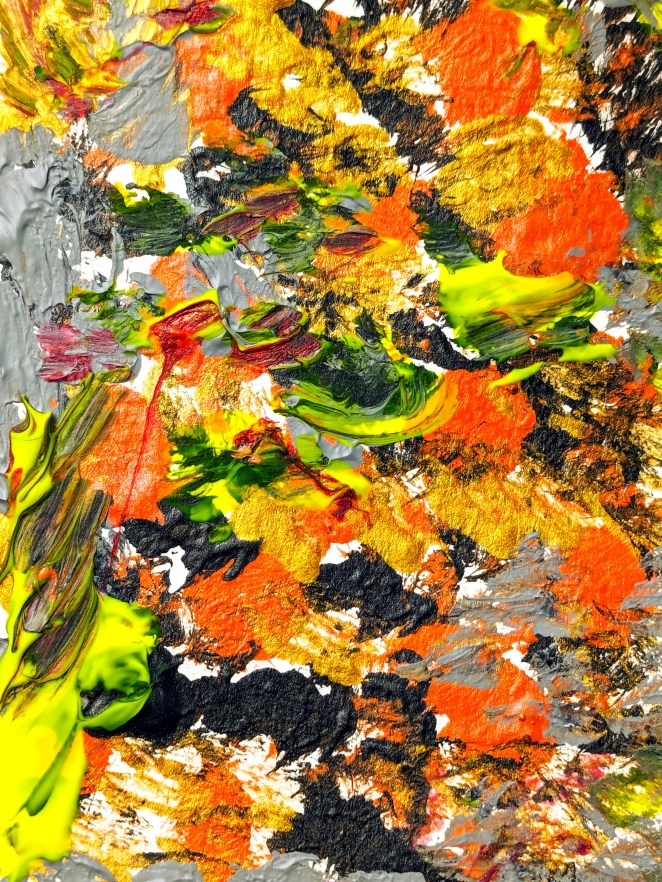
So he present ed me with this painting. “It’s called u-r-my-sunshine,” his smile lit up the room and we were both happy. Joy to the world – it’s +5C here today and the sun is shining. In my heart. And in Moo’s eyes. We are all glad that joy has not forsaken us!
A hooded figure stands with a taped mouth in this powerful depiction of silenced expression.
Image generated by AI
Ryan and Don Roger
6
Censorship
Censorship plays an important part in many societies and can take multiple forms. The Spanish Inquisition, for example, along with book burning, played a powerful role in the printing industry. Every book had to be examined and approved by a member of the Inquisition. Political correctness is itself a form of censorship. It encourages people to think about what they say and how they are saying it. Many sorts of political correctness arise from the feminist movement that began to question the male domination of the English language. Actors and actresses became actors. In cricket, wicket-keepers, bowlers, and fielders passed the linguistic test, but batsmen and batswomen became batters. I sincerely hope that glove men, for wicket-keepers, do not turn into glove persons.
Nowadays, some people feel that the correction of language has gone too far and this has resulted in the anti-woke movement, as it is called. This rejects both the correction, and the hyper-correction, of what some people call imbalances in language, culture, and society. I will self-censor myself, rather than being censored by another person or persons, and refrain from what I personally feel about these ideas. Here, I merely point out that they exist.
Lazarillo de Tormes, for example, was heavily censored by the Spanish Inquisition. All anti-clerical references in the original edition, and there were many of them, were removed. The resultant volume, heavily redacted and much smaller, became known as Lazarillo Castigado / Lazarillo chastised.
To the best of my knowledge, the only piece removed from Don Quixote was the episode in which he made a rosary from the tail of his shirt, by tying ten small knots in it, and one large one. Since the shirt tail was used for many purposes, including wiping oneself, the censor thought this idea was indecent. Cervantes replaced the shirt tail with ten acorns and a chestnut in later editions.
He also managed to escape censure by placing all his questionable statements in the mouth of a mad man. Whenever an anti-clerical comment was made, readers (and listeners, for in those days, not everybody could read), chuckled at the enormity of the statement and rejoiced in the fact that only a madman could say such things.
Together with censorship comes correction. Thus Sancho, who is illiterate and can neither read nor write, is also unable to spell. In this fashion, he offers a series of incorrect pronunciations and phonetic equivalents that Don Quixote joyfully and carefully corrects. We see this in other characters too. In DQI, VII or 7, the devil named by the housekeeper, becomes ‘the sage Muñaton’ in the mouth of the niece. Don Quixote changes this to ‘Freston’. The housekeeper continues with ‘Freston’ or ‘Friton’ and adds “I know only that his name ended in ton.”
In our modern society, I see an enormous change taking place. Where I was educated by reading books, many books in my case, today’s younger generation teach themselves via AI and Chat. They watch videos. Watch TV. Text on cell phones. They listen to multiple podcasts. All this is audio-visual, little of it is written down. As a result, essays I received from my students were filled with phonetic spellings of words that they had heard, but not seen in written form. In addition, schools are no longer teaching cursive. My grand-daughter can print. She can neither read nor write joined letters. However, she can text faster with her two thumbs than I can with my index finger! The new generations have entered an electronic world that is totally alien to me.
Quis custodiet ipsos custodies? Who shall guard the guards? Who shall police the police? Who shall program the programmers? And with what shall they program them? A long time ago, the BBC in England banned Sesame Street because it was too simplistic. Today, Sesame Street equivalents rule. So, let us extend our questions – “Who shall censor the censors?”
Sometimes, it takes a madman to do it, in our case, a madman called Don Quixote! He, in his madness, encourages us, nay (or as Rocinante might say ‘neigh!’), he forces us to re-examine our links to language, to reality, to illusion. Reading his text, we learn to ask questions of the world around us. How many of our realities are illusions? How many of our illusions are corruptions of reality? How many times has Don Quixote been banned by figures in authority because of its attacks on authority?
Quis custodiet ipsos custodies? Who shall guard the guards? Who shall program the programmers? “Who shall censor the censors?” And who will protect us if we speak truth to authority, and authority doesn’t like the truths we offer? The author of Lazarillo remains anonymous. Cervantes distanced his words from himself and put them in the mouth of a madman. Other people have taken evasive action in other ways.
The alternative – stay silent and bleat with the sheep – “Four legs good! Two legs bad!” And when the Mastiffs with their spiked collars come for us, we can always, like the sheep, change our chant. “Four legs bad! Two legs good!” After all, all sheep are equal, even when some sheep are more equal than others, and all of us can imagine we are animals on George Orwell’s Animal Farm – and then we can say what we want and nobody will listen, nobody will pay attention, and nobody will understand. And remember, somebody, somewhere will want Animal Farm banned. And 1984.
A beautifully detailed scroll depicting windmills at sunset rests on a classic wooden desk alongside traditional writing tools.
Image generated by AI.
Ryan and Don Roger
4
Stage to Page
So many questions – so much to say. Let us begin by stating that Cervantes is one of the most original novelists the world has known. Then we can continue by stating that, in spite of that, like Jean-Baptiste Poquelin, aka Molière, he is not above borrowing his material from other writers. When Molière was asked where he found sources for his plays, he replied “Je les prends où je les trouve.” Cervantes might well have said the same thing.
The source of the first sortie of Don Quixote is a short play, an entremés, called El Entremés de los Romances. These short, entertaining pieces were often installed between acts of a longer pay to keep the audience amused during the breaks. In this particular one, an old man thinks he is a knight and travels forth quoting the old border ballads and ballads of chivalry as if they were historical truth. Mind you, some of them were, or pretty close to it, especially those that carried news of the reconquest, but not all of them were true by a long way. The old man goes too far with his chivalry, gets a beating, and comes back home, draped over his horse which is led by a neighbor. Sound familiar?
In classical rhetoric, imitation – imitatio in Latin – was the highest compliment one could pay to another author as it meant he was worth imitating. Today, imitation is considered more a scourge to be avoided, although if you follow the crime and spy shows on TV you will know that the same, or very similar, incidents recur again and again, played out in different stories by different actors.
So, Cervantes starts out by imitating an older stage play and turning it from a play into a short story. This is creativity, beyond imitation, in itself. In this theory, the first story is in fact a short story, meant originally to stand on its own. This is not my theory, incidentally, I have borrowed it from my own teacher, Geoffrey L. Stagg, the man who introduced me to the scientific study of the Quixote. Stagg took as his evidence the first edition of the book in which he discovered an anomaly. The last sentence of Chapter Five ends in a comma (in the original, and certainly not in my translation by J. M. Cohen. I first read this book in 1965 – 61 years later, it is held together by glue and Scotch tape, a bit like Don Quixote’s helmet and armour!). To continue, the first word of Chapter Six begins with a lower-case letter, as if that word were joined to the last in the previous chapter. The heading of Chapter Six also runs smoothly into that first word as if they were joined. This suggested that in fact the two chapters had been united in a single story and had later been separated as the idea of turning the story into a novel dawned on the author.
But who is the author of Don Quixote? Miguel de Cervantes, obviously. But who is the narrator of the story? In the first sentence, this first person narrator states ‘a village in la Mancha that I do not wish to name – de cuyo nombre no quiero acordarme in the original Spanish. AI helps us out here. I quote – “Miguel de Cervantes was likely imprisoned in Argamasilla de Alba (specifically in the Cueva de Medrano) around the turn of the 17th century due to disputes arising from his work as a tax collector, or potentially a local dispute with a nobleman. This confinement, stemming from financial irregularities or local drama, is traditionally believed to be where he began writing Don Quixote.”
No wonder Cervantes, the initial narrator, does not wish to name that particular town. A little later, in an effort to embrace the readers and draw them into the text, the narrator uses the first-person plural- our text, followed by we make take it … we do not depart.
We will return to the narrative structure of the novel on many occasions. For the moment, we will leave the matter there. In narrative structure, the real Cervantes is the author. Cervantes, named or unnamed, is the narrator and becomes a part of the narration. I should add that the 1605 version of Don Quixote contains many short stories, that have nothing, or very little to do, with Don Quixote himself. We will return to these intercalated novels, as they are called, when we meet them later in the text.
The numbering of the chapters in Don Quixote is also interesting. While Part I and Part II often retain the Latin numbering, the chapters themselves can be found both with Latin Numbers and standard numbers.
Latin numbers are based on six letters I, V, X, L, C, D and M. Each has its own value. I = 1, V = 5, X = 10, l = 50, C = 100, D = 500, M = 1000. Most have us have seen Roman numerals on clocks and we are familiar with the numbers from 1-12. I, II, III, IV (4, that is to say one before five), V, VI (6, that is to say one after five), VII, VIII, IX (9, that is to say one before ten), X, XI (11, that is to say one after ten), XII.
This paradigm governs Latin numbers. XV = 15, XX = 20, XXX = 30, XL (ten before fifty) = 40, L = 50, LX (ten after fifty) = 60, LXX = 70, LXXX = 80, XC (ten before one hundred) = 90, C = 100, CX = 110. The date of my writing this MMXXVI (2026). You will have noticed similar numerical configurations on books and old movies.
The ancient Celtic numbering system was based on the digits of hands and feet. Counting sheep, for example, or goats, shepherds and goatherds would count up to twenty on their toes and fingers. Then they would carve a notch in a piece of wood. To keep score was to score the notch.
Something similar happens in Basque jai alai, the happy game. The scorers score in groups of IIII which they then made into 5 with a line through the numbers IIII. Four groups of 5 made 20 and the 21st notch won the game. That scoring method may have changed, but it is certainly how I learned to score the game in the Basque country (Spain) back in the 1950’s. Curiously, modern French shows the vestigial remains of this – quatre-vingts. Welsh shows a somewhat similar diversity because the Welsh word for twenty is ugain – although it’s technically not the only one, with the alternative dau ddeg (literally two tens) becoming more and more common. A case of plus ça change, plus c’est la même chose.
And we must never forget the old sterling system of the United Kingdom of Great Britain and Northern Island. £. S. D. aka pounds shillings and pence. 4 farthings = one penny, 12 pennies = one shilling, 20 shillings = one pound.
Our good friends on AI came to our aid with this one. I quote – The pre-decimal British currency system, known as £sd (librae, solidi, denarii), consisted of 12 pence in a shilling and 20 shillings in a pound (£), totaling 240 pence per pound. Used until Decimal Day on February 15, 1971, this system featured various denominations, including farthings, sixpences, florins, half-crowns, and crowns. What about a guinea you ask? Well. That was £1 and 1 shilling. Hence the auctioneer’s delight.
“What am I bid”? > “£20.” > “Guineas!”
Our trusted friends on AI sum it up this way – “A guinea was a British gold coin minted between 1663 and 1814, officially valued at 21 shillings (£1.05 in decimal currency) from 1717 onwards. It was the first machine-struck gold coin in Britain, typically worth slightly more than one pound. While no longer in circulation, it is still used in horse racing and some luxury auctions to represent £1.05.”
Luxury auctions – I love that phrase. And here we must leave our luxurious description of, and adventures into, numbers in Don Quixote! Just look where the journey has led us. And remember, in the same way that Cervantes inserted short stories, both spoken and read, that digressed from the main narrative, we can also insert such mental rants and ramblings into our own narrative. And we shall continue to do.
Here’s one, for example. How do you count goats in Wales? Click on these links for two examples. Counting the Goats traditional and Counting the Goats modern. Of course, wrth gwrs, the simplest method of all is to count their legs and divide by four! Try doing that with Latin numerals!
Don Quixote was first published in Spain in 1605. In 1609, Thomas Shelton translated it into English. By 1611 / 1612 the adjective quixotic, was already in use within English society. An AI search tells us that “In the 17th century, the term quixotic was used to describe a person who does not distinguish between reality and imagination. The etymology of the word began after the publication of Don Quixote in 1605.”
But what does quixotic mean exactly? Another AI search reveals that “Quixotism (adj. quixotic) is impracticality in pursuit of ideals, especially those ideals manifested by rash, lofty and romantic ideas or extravagantly chivalrous action. It also serves to describe an idealism without regard to practicality.”
Why is this important? Quite simply because in English we say Don Quixote / Quick-sot, not Don Key-hoe-tay a bastardized version of the Spanish. Please note that the adjective, in English, is quixotic not “key-hoe-tay-ic” which is too chaotic to be practical. Note too that the French translators offer us Don Quichotte, while the Italians suggest Don Chisciotte. Both these languages conserve the original pronunciation – a voiceless postalveolar fricative /ʃ/, which is the same sound as the English “sh” in “ship”. This is clear evidence that the X of the original had a different pronunciation in the seventeenth century than it does today.
My wonderful friends on AI confirm this as follows, and I quote:
In 17th-century Spain, the letter ‘X’ primarily represented a voiceless postalveolar fricative /ʃ/, which is the same sound as the English “sh” in “ship”. During this period, which coincided with the Spanish Golden Age and the “readjustment of the sibilants,” this sound underwent a transformation, shifting from the “sh” sound to the modern velar fricative /x/ (similar to the German ch in loch or the modern Spanish ‘j’).
Here are the key details about the pronunciation of ‘X’ during that era:
Initial “Sh” Sound: Early in the 17th century (and before), words that are now spelled with ‘j’ or ‘g’ were spelled with ‘x’ and pronounced as “sh.” For example, Don Quixote was pronounced “Don Keesh-o-teh”.
The Sibilant Shift: During the 16th and 17th centuries, the sound /ʃ/ (written as ‘x’) and the voiced /ʒ/ (written as ‘j’) merged into a single voiceless sound /ʃ/. Later in the 17th century, this sound moved backward in the mouth, evolving into the modern velar /x/ (the modern ‘jota’).
And this is just the beginning and what’s in a name? For example, what is the real name of Sancho Panza? Is it Sancho Panza or Sancho Zancas [DQI,9]? How about his wife? Is it Juana Gutierrez or Mary Gutierrez [DQI, 7]? In the same chapter she is called Teresa Panza, the name that stays with her throughout the novel.
And what about Don Quixote himself? Is his real surname Quixada, Quesada, Quexana [DQI,1] or Alonso Quijano el Bueno [DQII,74]? Don Quixada de la Mancha aka Don Quesada de la Mancha aka Don Quexana de la Mancha – and we won’t mention the alternate names he takes – the Knight of the Sad Countenance or the Knight of the Lions!
Fascinating, eh? So, after all that, tell me – what’s in a name?
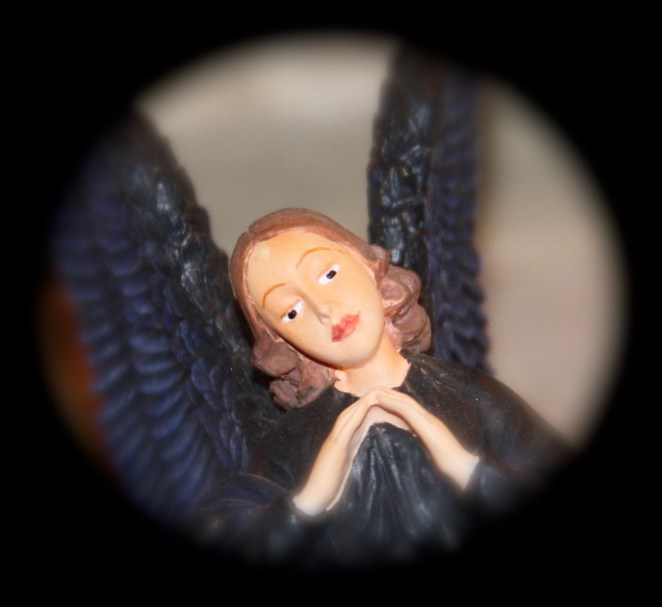
You cannot hide when the black angel comes and knocks on your door.
“Wait a minute,” you say, “While I change my clothes and comb my hair.”
But he is there before you, in the clothes closet, pulling your arm. You move to the bathroom to brush your teeth.
Now,” says the angel.
Your eyes mist over. You know you are there, but you can no longer see your reflection in the mirror.
Comment:
The last poem in the series and Rage, Rageagainst the dying of the light is over and done. Many of you will recognize the title from Dylan Thomas’s poem Do not go gentle into that dark night. I guess the theme itself has become part of the Welsh culture. And now we have exported it to New Brunswick, Canada, and perhaps beyond.
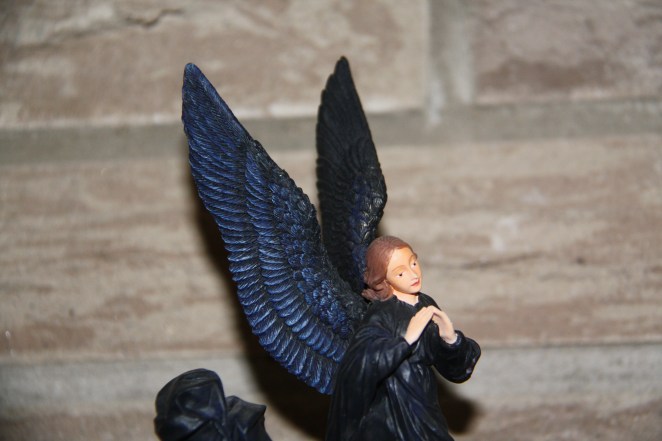
I bought The Black Angel, pictured above, in Avila, Spain. It is a plaster cast of one of the Angels in Roger Van der Leyden’s paintings, if I remember correctly. Here is the angel’s face in close up.
She or he brings a promise of rest and peace, a freedom from earthbound woes and sorrows. She stands on the shelf above the fireplace insert in our sitting room and brings blessings to the house. I look at her every time I light the fire. And she smiles down and blesses me. I think of her as a lady, but her peace and beauty outweigh any formal signs of sex.
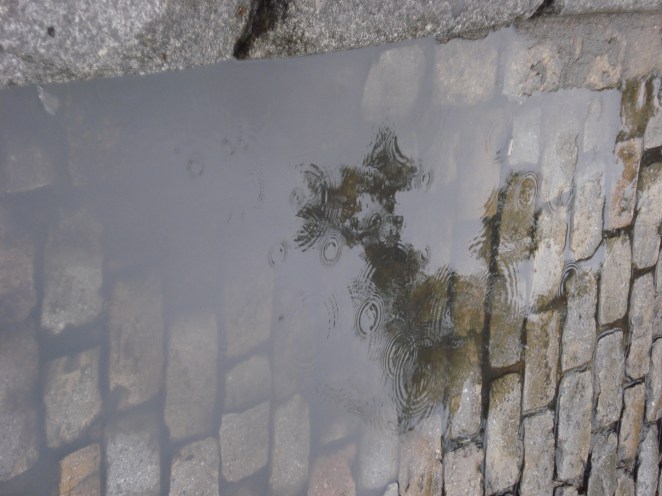
As for that reflection in the mirror, well, I don’t have one of me. But her is a photo to reflect upon:
Raining in Avila and puddles in the street. Now you see me, now you don’t. But I am there, holding the camera, and looking down at the water where —- rain has stopped play. The bails have been removed. Old Father Time has gone back to the Pavilion at Lord’s, and the cricket game is over for the day.
Terminal and terminus, they both mean nec plus ultra: the Pillars of Hercules, the end of the known world, and my own world’s end.
I throw my hands skywards in desperation: “Is anybody up there?” There’s no reply, and I see no ladder for angels to descend or ascend.
Only the crows, those black-winged monarchs destined to wear the survivor’s crown, cry out their anguish as they wait for the day when they’ll pick clean my unburied bones and rule this sickening world, an earthly paradise no more.
Comment:
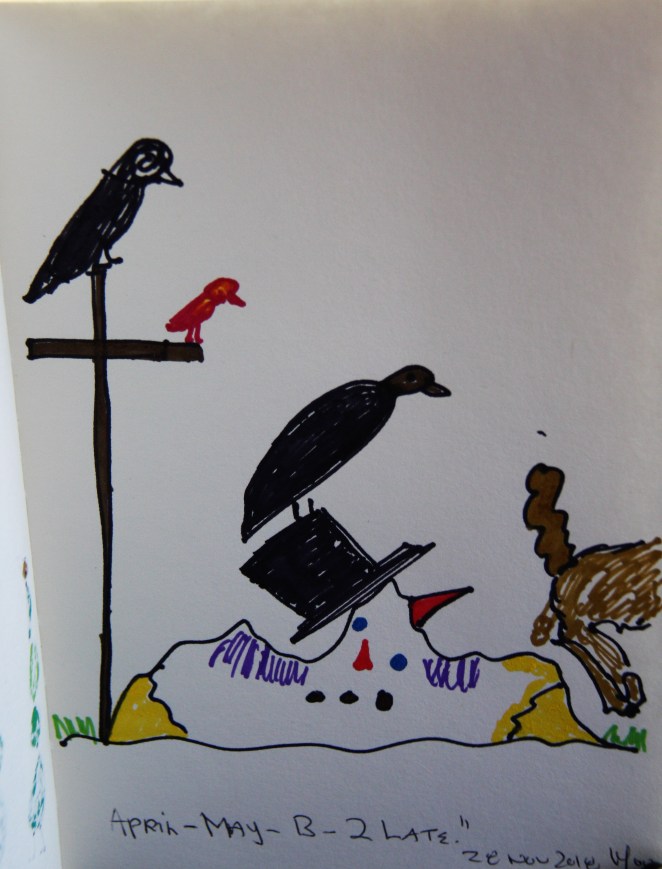
When I said “I am looking for a picture of a crow,” Moo went wild. “Me,” he said. “I’ve got one.” And indeed he had. Here it is – two crows perched like vultures over the body of a fast melting snowman. Our current world in miniature – and don’t forget the yellow snow and the doggy doing a dump. “Moo,” I said, “That’s not nice.” “True to nature, though,” he replied. “You want reality – you got it.”
Reality – what a strange word. Who knows nowadays what is real? The barber’s basin in Don Quixote – is it a barber’s basin or is it Mambrino’s Helmet? Good question. Relativism – it depends on your point of view. U a barber’s basin – turn it upside down Ω and it’s a helmet. So how do we deal with an object that has two functions and can be seen both as one thing and then another?
Good question. Cervantes solves the problem in his own unique fashion – U – bacía / basin and Ω – yelmo / helmet. Put them together and you get the neologism [newly invented word] baciyelmo – a basin that serves as a helmet and a helmet that serves as a basin. Wonderful – if it weren’t for the snout, I’d swear that was the origin of the pig-faced bassinet.
Some days, I try to understand all this – but I throw my hands skywards in desperation: “Is anybody up there?” Another good question. I often ask myself that question but I despair of an answer.
My friend Francisco de Quevedo voiced the same question in a dream that came to me last night.
¡Ah de la vida! ¿Nadie me responde?
Life ahoy! Will nobody reply? Is anybody up there? Will someone reply?
Blas de Otero once made a similar utterance –
“I raise my hands in supplication – you cut them off at the wrist.”
Tell me, if you know, – what is this life if, full of care, we have no time to stand and stare. And look at those crows, standing there, staring, waiting … waiting for their turn to come. Patient, eternally patient. Just standing around. Waiting.
I carry memories and scars like a snail wears its shell and I leave behind me a slither of silver words.
I’m a broken gramophone, needle stuck in a groove repeating the same verses again and again. This repetition drives me insane.
My thoughts just drift. My body is a ship in the doldrums, no wind to fill its sails.
I pick up my paint brush and paint myself – lonely and blue as idle as a long-lost lamb, alone with nothing to do.
Comment:
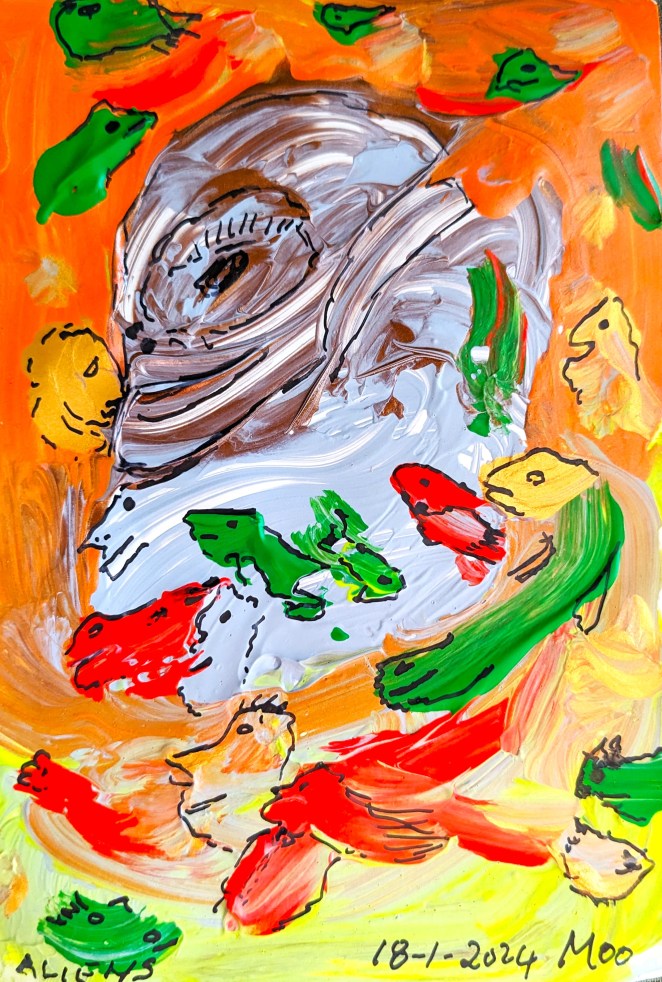
The alienation of an alien nation – and I wonder if they really are here, those aliens. So many strange happenings in my life. The silver slither of words drags me through so many lost moments in time. Fray Luis de León, I spoke to him last night, asked me the question – “Es más que un breve punto / este bajo y torpe suelo comparado / con aquel gran transunto / do vive mejorado / todo lo que es, lo que será, lo que ha pasado?”
It’s a lovely verse in Spanish, but not so easy to translate into English. Let’s try – first, word for word – “Is it more than a small dot this low and stupid soil compared with that great sky world where now lives improved all that is, all that will be, and all that has happened?”
A comment on the translation – first, the length of the sentence and the way in which it is complicated by inversions and ideas expressed in words which have little direct translation. Then there is the expression – 1. a small dot – un breve punto – a short moment in time. 2. low and stupid soil – este bajo y torpe suelo – clumsy earth below. That clarifies, a little the meaning. 3. that great sky world – aquel gran transunto – that great sky above. 4. where – do [short for donde – to keep the syllable count] – where – 5. lives improved – vive mejorado – lives a better life.
Here goes: “Is this clumsy earth below more than a short moment in time compared with that great sky above where now lives a better life all that is, all that will be, and all that has happened?” Not great, but we can live with it.
As Miguel de Cervantes said “To read in translation is to look at the reverse side of a tapestry.” So, to imagine the real side of the tapestry we need to count our syllables – they don’t match. We need to measure the length of our lines. They don’t match. We need to sharpen our metaphors and images – they don’t really match. And, last but not least, we have to imagine the Platonic, Terra-Centric universe in which the sun moves around the earth and the earth is the centre of all life.
I should add the cultural association of words. In every language, each word has an “associative field of cultural meanings”. Those “associative fields” differ from language to language. So, even getting the verbal meaning correct means that you do not necessarily get the cultural associations right. In fact, it’s almost impossible to do so. It’s a fascinating world and one which I have explored in various academic articles.
I would like to take cultural meanings a step further. In Don Quixote, II, 11 – I quote from J. M. Cohen’s Penguin translation of 1950 (rpt 1961) – Don Quixote says to Sancho ” … if I remember rightly, you said that she [Dulcinea] had eyes like pearls, and eyes like pearls suit a sea-bream better than a lady” (p. 533). I will leave aside, for now, Sancho’s comic mixing of the Petrarchan metaphors and concentrate on the single word sea-bream. To compare someone’s eyes to those of a sea-bream is comical in English. However, the word has several associative fields in Spanish which are worthy of deeper study. Secondary meanings of a sea-bream – besugo – include 1. a mild insult, as in no seas besugo / don’t be a fool / an idiot / stupid. 2. Diálogo de besugos – two people talking and neither one listening to the other. 3. Ojos de besugo – a blank or dazed expression. Quite simply, the translation besugo > sea-bream functions at the literal level, but by no means at the cultural level of the associative fields.
Alas, some days I’m a broken gramophone, needle stuck in a groove, repeating the same things again and again. Maybe one day I will get them right. And maybe I won’t. Better minds than mine have struggled with translating Spanish (poetry) into English (poetry), and most have failed. Many, dismally. We won’t mention names. Sometimes the best translations are not translations at all, but poems that recreate the original in the target language. I am quite happy with my translation of the meaning of Fray Luis de León’s poem – but how sad would be any attempt to transfer the verse form from Spanish to English? Five lines of seven and eleven syllables each – wow! Go for it. But remember – fools rush in where angels fear to tread.
Never mind. Maybe tonight I’ll have another little chat with Fray Luis de León and Miguel de Cervantes, Quevedo too, if I am lucky. Maybe their English will be good enough to give me a few hints. I’ll let you know later if any one of them does come to visit.
I fall into the easy sleep of age, pencil in hand, notebook on knee.
Shadows grow longer as my life grows shorter, day by day.
Now it is so easy to stumble and fall, each slip a steep slope down which I slide.
So difficult now to regain my feet.
I must crawl to where I can haul myself first to my knees and then stubbornly upward until I can stand.
47
Now-a-nights I fall easily into dreams that all too often turn into nightmares that rise up from my past to trouble my sleep.
I struggle and scream and pinch myself awake, only to find my cheeks wet with tears and my mind all shook up by the return of childhood fears.
Freud and Jung pull the strings of those mental puppets that dance in my head. Some nights I am afraid of falling asleep, for fear that I may never get up from my bed.
Comments:
Coming to the end of Rage, Rage. When it is finished, that will also be the end of the trilogy – Clepsydra [Chronotopos I], Carved in Stone [Chronotopos II], and Rage, Rage [Chronotopos III]. I have written a fourth volume in the sequence – No Dominion [Chronotopos IV], but this is very personal and I will probably only share it with family members and the closest of friends. However, do not despair – I have an alternate fourth volume, but that is still being written. It us under wraps, and may well replace No Dominion. We shall see.
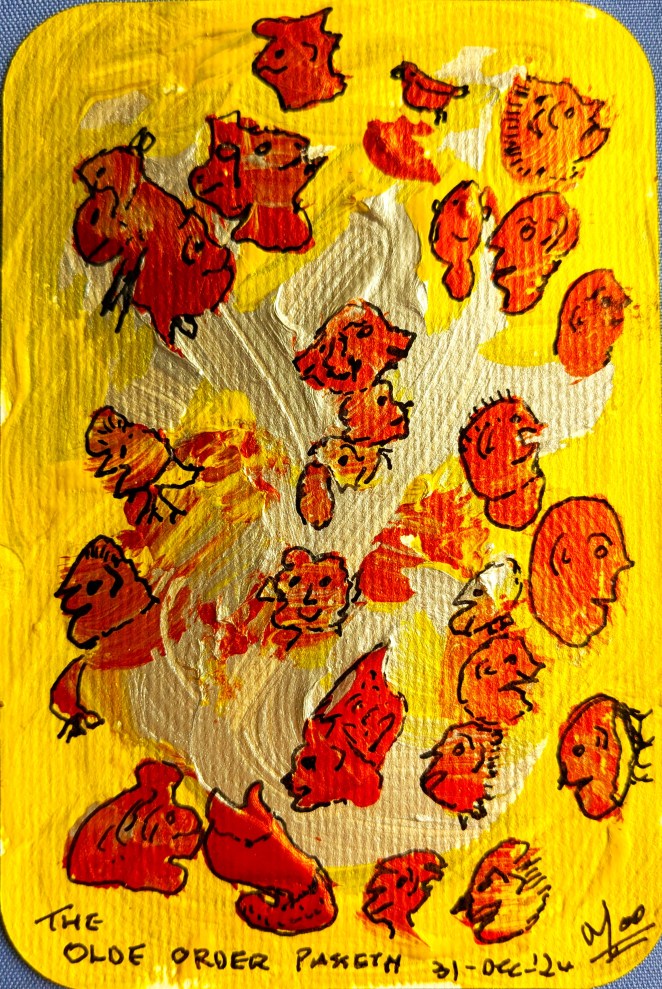
As for Freud and Jung, they certainly do pull the strings of those mental puppets that dance in my head. Moo says that there should be no strings attached. He has therefore drawn all those strange puppet like figures, a but like an Aunt Sally, really, but has left out the strings and the man / men / woman / women / people pulling them. An Aunt Sally or a lovely bunch of coconuts? Time well tell, if you ask it nicely.
Maybe one of my teddies will tell. They all romp around the room with me at night and I am sure they suspect much of what goes on in my dreams. Here they are – a selection of friendly teddy bears. Be very careful, though, they can be very grumpy, especially if you wake them up suddenly. They don’t like things that go BUMP in the night.






 rogermoorepoet