March 1 is St. David’s Day: Dewi Sant, patron saint of Wales. While we are here, immersed in cold and snow, in Wales, spring is arriving, the daffodils are out, trees are budding. This poem is a reminder that winter will end and sunshine and spring will return. So for St. David’s Day, I wish you joy and hope.
Earth to Earthlings
“Get out and about,” she told me. Take off your socks and shoes. Walk barefoot on the earth and grass: twin pleasures, you can choose.”
I took two canes, one in each hand, and left the house to walk the land.
In the garden I took off my shoes to walk barefoot on the lawn; when grass sprang up between my toes I was instantly reborn.
I stood in the shade of the crab apple tree and let leaf and flower spill over me.
Sunlight took away my frown and freckled a smile on my face. I was blessed again with hope and light; earth and grass filled me with grace
When white blossoms filtered down they gifted me a flowery crown.
I stooped to reach my shoes and carried them home in my hand, maintaining as long as I could my contact with this magic land.
Duermeivela: that time when the waker dreams he is waking, yet is still asleep. His mind wanders through a labyrinth of old memories, streets and squares, myths and legends. It is a mythical time of great creativity. To wake up from it is to be filled with hiraeth: a longing for all that is lost and can never be recaptured.
Daydreams
The alarm clock shuffles its pack of sleeping hours: a clicking of claws, needles knitting outwards towards dawn’s guillotine.
A knife edge this keening wind sharpening my bones tingling fingers and toes.
Ageing eyes refurbished in the morning’s sky fire. Ravishing rainbows dazzling the eyelash of day.
Old myths grow legs. They wander away to gather in quiet corners, where the wind weaves dry leaves into endless figures of eight.
An old man now, I dream of white rabbits, running down tunnels, escaping the hunter’s hands.
When my dreams break up, they back into a cul-de-sac: a wilderness of harsh black scars.
Scalpels, my finger nails, carving red slashes on white-washed walls, trenchant shadows, twisted dancers, old warrior kings bent into pipe wire shapes.
He knows the frogs are in there. He doesn’t need to hear them sing. But he loves to make them croak.
Croaking Angels
Their tunes are one note symphonies, croaks of joy that move their fellow frogs to ecstasy, exhorting them to share the splendors of ditch life, in a springtime bonding that will loft them skywards.
There’s an ancient magic in this calling: water and laughter, sunlight, warmth, and all those joyous things that fill the newborn spring.
Moonlight swings its cheerful love lamp. New leaves and buds are also known to sing.
Comment: This always makes me think of the croaking chorus from Aristophanes. I do hope all those wonderful ancient plays, songs, myths, and legends are not forgotten in our croaking frog chorus of modern jingoistic advertisements and propaganda. Ah well, what’s a source for the proper goose is probably a source for the proper gander. Who knows nowadays? What we do know is that spring is just around the corner. Warmth and the absence of snow will help change our lives. And yes, that croaking chorus will be back.
from an original painting by Rogier van der Weyden (1399/1400-1464)
Black Angel
You cannot hide when the black angel comes and knocks on your door.
“Wait a minute,” you say, “While I change my clothes and comb my hair.”
But she is there before you, in the clothes closet, pulling your arm. You move to the bathroom to brush your teeth.
“Now,” says the angel. Your eyes mist over.
You know you are there, but you can no longer see your reflection in the mirror.
Comment:
I first saw the Black Angel in Aldebarán’s cultural store in Ávila (2006). She sat there, in the shop window, along with several other angels, and I worshiped her from the distance of the street. Her image was taken from an original painting from Rogier van der Weyden (1399/1400-1464). This was turned into a 3-D image and then converted into the statue I saw in the shop window.
I brought the statue back to Island View, placed it on the shelf above the fireplace, where it still rests, and wrote several poems on the theme of Angels. I gathered them together in a chapbook entitled All About Angels that I self-published in Fredericton in 2009. The chapbook was dedicated to Clare’s great-aunt, D. E. Witcombe who departed this world on October 15, 2008.
All About Angels was also based on a book of a similar title, Sobre los Ángeles, written by Rafael Albertí, one of the major poets of Spain’s Generation of 1927. I avoided the ambiguity of the Spanish title — Sobre (in Spanish) can mean Above or Beyond as well as About — by limiting my own title to All About Angels.
For Carl Jung, angels are the messengers sent to inform people of the state of their world. For me, they are also the wild creatures that inhabit the world around me and often take the form of chickadees, crows, mourning doves, woodpeckers, deer, foxes, chipmunks, the occasional bear, and other spiritual creatures. They can be best seen in those moments of solitude when we are most open to the natural world around us. Then, and sometimes only then, we can hear the urgent messages they bring.
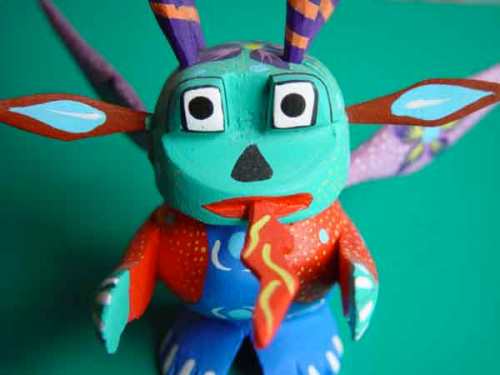
This is one of the first alebrijes I bought in the zocalo (main square) in Oaxaca. He has lost his ears and probably his tongue. They started falling out so we wrapped them up carefully and now we can’t find them. He’s still a happy chappy, hough, and has been in this house for a quarter of a century. Happy Birthday Alebrije!
Alebrijes step out from dried wood and stand in the shower of paint that falls from the brush’s tip. Yellow flash of lightning, pointillistic rain, garish colors that mirror those of the códices. The carvings take the form of fantasy figures, anthropomorphic animals, and mythological creatures. Sometimes one individual selects the wood, carves it, then covers it in paint. Occasionally an entire family takes part in the work of making the alebrije. One person collects the wood and prepares it for carving. Another carves and sands it. A third works on the undercoat, and a fourth applies the final patterns of paint. The great debate: does the form in the wood reveal itself to the carver or do the carvers impose their own visions on the wood? In the case of the team, do the family members debate and come to a joint conclusion? These thoughts, exchanged with wood-carvers in Oaxaca, have led to a series of interesting conversations. What exactly is creativity? Where does it come from? Do we, as artists, impose it upon our creations? Or do we merely observe and watch as new ideas float to the surface of our minds? How does the creative mind really function? And, by extension, how much of the sub-conscious creative sequence can be placed into words?
Alebrijes
Are they half-grasped dreams that wake, wide eyed, to a new day’s sun?
Or are they alive and thriving when they fall from the tree?
Does the carver fish their color and shape from his own interior sea, or does he watch and wait for the spirit to emerge from its wooden cocoon to be reborn in a fiery block of color?
Daybreak: in a secluded corner of my waking mind, my neighbor’s dog greets the dawn with sparks of bright colors born from his bark.
My waking dream: dark angels with butterfly bodies, their inverted wings spread over my head to keep me warm. In the town square, the local artist plucks dreams from my head and paints them on carved wood.
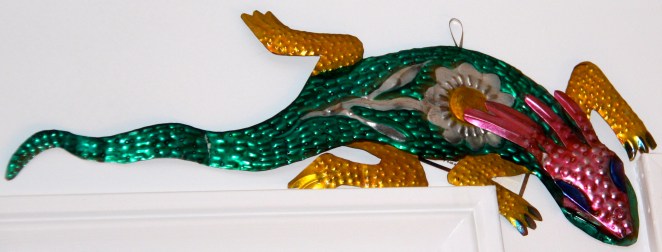
Our house iguana: he is not an alebrije, but is made out of painted metal foil, carved first, and then decorated. He’s the one who guards the front door and falls upon unwanted intruders when they least expect it. Never stay home alone without one, or two, or more. But watch out if you have too many and they get hungry.
Where e’er she treads, the glossy flowers shall rise and light, like the light of flowers, will pierce any gloom and brighten the room.
Silence
When I wait for words to come and they refuse, I know that silence is golden and spreads its early morning sunlight across the breakfast table where yellow butter melts on hot toast.
Light from the rose window in Chartres once spread its spectrum over my hands and I bathed in its speckled glow.
My fingers stretched out before me and I was speechless, for in such glory, mortal things like words cease to flow.
So much can never be said even if it is sensed: fresh coffee, poutine à pain, bread baking, flowers bursting into bloom, the sense of immanent beauty that fills me each time my beloved enters the room.
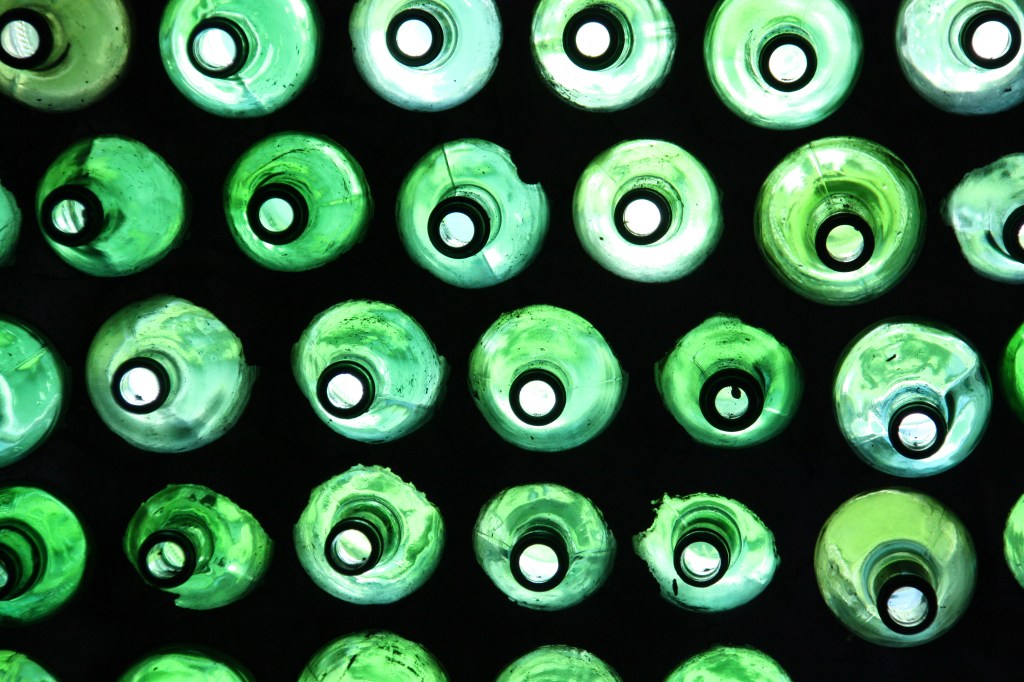
Light through glass, darkly: bottles set in one of the bottle house walls in PEI. The gardens are wonderful and well-worth a visit.
Bottle House, PEI The day begins with flowers: at the entrance, beneath the windows, flowers everywhere, a delicacy of scent. Beyond these flowers, even more flowers, then playthings in the garden: a child’s paradise, these sculptured faces, this glass among the trees, sun and shade, the fountain’s water, this dream of an old man, kept alive now by his children, a dream of health and sanity and peace out by the bay, where the mud red waters roll and the tide’s hand grasps at the land and pulls it down with watery fingers. Everywhere: faces and elements of faces: a nose, eyes, a mouth, open in surprise. Carved wooden faces, glass faces, pottery faces, flesh and blood faces, grandma’s face, grandpa’s face, then the grandchildren. Tourists travelling, old islanders returning to see family and friends, young islanders returning to visit the almost forgotten farms which their families worked a generation or three ago, before their exodus from the land. “This was grampy’s house!” they say or “that was my grandmother’s farm!” as if a life could be reborn in that pointed finger, those casual words. How many memories are snapped in each picture? How many lives are caught in this snapping of the fingers as the past is instantly summoned and perfection is bottled for a second or two in the magic of this house, this garden where the builder’s spirit roams. Sit still awhile. Be silent: you may hear him breathe, glimpse him, for a second, staking out the flowers, extracting a weed, checking the set of the concrete foundations, polishing a bottle, resting on a wooden seat, avoiding the slow snail on the path bejewelled by rain-drops from the trees or spray from the fountain. For where there are flowers, there must be water and rain and peace and happiness and all good things, glimpsed darkly through smoked glass yet grasped so smoothly in the sun’s bright light. This is the house of bottles, the glass house, where rough winds are shunned and the bottles are set in concrete. It is a museum of light and dark, the creation of sun and shadow as sunshine fails and the lighthouse’s flashlight beam reverberates from glass to stone and back again. Shapes, shadows, memories curved and carved in glass, set in glass, this shimmering beacon this glass house, this light house built as a heaven-haven for harboured ships and the soul’s refreshment, here, in these gardens, among these bottles, and at the chapel door, an angel-in-waiting.
Angel or fairy? It doesn’t matter. She was a gift one morning, when we visited. In this photo you can see how the bottles are set in the wall.
I looked for a picture of music, but could find nothing. No Carlos, no flute, no nothing. So, I invite you to use your imagination: just pretend these are the notes of an Andean flute, floating in the early morning air. Now close your eyes and listen carefully. Can you hear the music?
The Red Room
Carlos makes music on his flute. He lives in the Green Room, with its door just opposite mine
He creates the highest note of all and it floats before me in the air, a trapeze artist caught in a sunbeam and suspended between the hands that fling and those that catch.
His musical rhythms are different. I try to follow his fingering.
In the space between notes, tropical birds flash jungle colors as they flit between flowers.
With a whirring of wings, all music stops, save for the robin’s trill refreshing the early summer with his eternal song.
Comment:
I finally found a photo of Carlos. Here he is, in Kingsbrae Gardens, playing Beethoven’s Ode to Joy on ‘half-filled’ water bottles tuned to play a perfect scale. Like an Andean bird, the man could pluck notes from the air and fill the world with music.
Early morning light in the Red Room at KIRA. Such a splendid invitation for the enlightened mind to write poetryabout the splendors of light.
Light
This fragile light filtering through the early-morning mind filled as it still is with night’s dark shadowy dreams their dance demonic or perchance angelic as light rises and falls in time to the chest’s frail tidal change the ins and outs of life-giving breath
Bright motes these birds at my morning window feathered friends who visit daily known by their song their plumage their ups and downs
they dazzle and sparkle cracking the day open with their joyous songs