Dawn from the window of The Red Room, KIRA, June 2017.
Daybreak
… early morning sunshine creepy-crawly spider leg rays climbing over window and wall my bed-nest alive to light not night’s star twinkle but the sun’s egg breaking its golden yolk gilding sheet and pillow billowing day dreams through my still sleepy head …
… the word feast festering gathering its inner glimpses interior life of wind and wave the elements laid out before me my banquet of festivities white the table cloth golden the woodwork’s glow mind and matter polished and the sun show shimmering its morning glory …
Comment: It seems like only yesterday, though three and a half years have slipped swiftly by. Each summer I am envious of those chosen to represent their artistic disciplines at KIRA. The joys of waking in the Red Room and of writing at the desk there will stay with me for ever. It was pleasure and a privilege. And still I live in hopes to see sunrise from the Red Room once more. This poem incidentally is from my poetry collection entitled One Small Corner. It was written at KIRA (Kingsbrae Gardens) in the month of June, 2017. One Small Corner is available on KDP and Amazon. Here is a link to the KIRA Video.
Photo by my good friend, Geoff Slater. Books by yours truly, who stayed on the bus and believed.
To be a writer ….
He who would true valor see, let him come hither. One here will constant be, come bad or fair weather. No line length can him fright, he’ll with a paragraph fight, and he will have a right, to be a writer.
Those who beset him round with dismal stories, do but themselves confound: his strength the more is. There’s no discouragement will make him once relent his first avowed intent, to be a writer.
Rejections nor bad critics can daunt his spirit. He knows he at the end will a book inherit. So critics fly away, he’ll fear not what they say, he’ll labor night and day to be a writer.
Comment: John Bunyan tempted me and I fell into temptation. In fact, as my good friend Oscar Wilde once said: “I can resist anything except temptation.” So, ladies and gentlemen, change the he to a she or the pronoun of your choice, turn the writer to a sculptor, stoneist, poet, playwright, painter, novelist, dramatist, comedian, song-writer, singer. Breathe deep. Believe in your own artistic talent and remember: “Genius is 99% perspiration and 1% inspiration.” Remember this too: “You’ll never get to Vancouver by bus, if you get off the bus at Montreal or Toronto.”
Different bird, same question: why? This one is from one of the beaches on the road to North Cape, PEI. Why, indeed?
Why?
In the mud nest jammed tight against the garage roof, tiny yellow beaks flap ceaselessly open.
The parents sit on a vantage point of electric cable, mouths moving in silent encouragement.
A sudden rush, a clamour of wing and claw, a small body thudding down a ladder of air to crash beak first on the concrete. “Why?”
“Wye is a river. It flows through Ross-on-Wye and marks the boundary between England and Wales.”
And the swallows perch on the rafters watching their fledgling as it struggles on the floor: the weakening wings, the last slow kicks of the twitching legs. “Why?”
“Y is a crooked letter invented by the Green Man of Wye.”
Comment: This is the original poem, written back in the eighties, wow, that’s forty years ago. I included it in my first poetry chapbook, Idlewood (published, 1991). It was a slim volume, dark green color, typed and photocopied, very humble, but MINE! A couple of years ago I wrote a prose poem, sort of flash fiction, in one of my Welsh sequences and included the story as part of the text. It came to me as a memory yesterday morning, and I posted it on Facebook. Here now is the story. Hopefully, you have just read the poem: I hope you liked it but, as I know all too well, de gustibus non est disputandum. I would like to know if you prefer the poetry to the prose. Please let me know, pretty please?
Why?
“Where are you going?” I ask. “To see a man about a dog,” my father replies. “Why?” I ask. “Hair of the dog,” his voice ghosts through the rapidly closing crack as the front door shuts behind him. “Why?” I cry out. I recall the mud nest jammed tight against our garage roof. Tiny yellow beaks flap ceaselessly open. Parent birds sit on a vantage point of electric cable, their beaks moving in silent encouragement. A sudden rush, a clamour of wing and claw, a small body thudding down a ladder of air to crash beak first on the concrete. “Why?” I ask. The age-old answer comes back to me. “Wye is a river. It flows through Ross-on-Wye and marks the boundary between England and Wales.” The swallows perch on the rafters watching their fledgling as it struggles on the floor, the weakening wing flaps, the last slow kicks of the twitching legs. “Y is a crooked letter invented by the Green Man of Wye,” my grandfather says. “Why?” I repeat. “I want to know why.” Silence hangs a question mark over the unsatisfied spaces of my questioning mind.
I always hated Queen Pawn openings 1. P-Q-4 – P-Q4. 2. P-QB4… the poisoned pawn.
Queen’s Gambit the poisoned pawn
Openings are so important. They should be magnets drawing you in, but sometimes they’re whirl-pools dragging you down.
You try to hold your breath, but you must breathe and let go, you must go with the flow and sink to whatever awaits you in the deep.
Down there, it’s a different world. Light breaks its alternate shadow, and you are the light in the darkness, down there, where no sun shines.
You are the glow-worm, glowing where no stars glow. You are the line, the sinker, the hook, the bait, the temptation that encourages your opponents to sacrifice their own peace, to join you, to swim, or to drown.
Comment: To take or not to take, that is the question. It’s a long time since I read Hamlet or played competitive chess. I have forgotten many of the ins and the outs, the traps and the snares, the devils that hide in the details of ‘yes’ or ‘no’. Sometimes we must just take a chance and play by the seat of our pants. Sometimes we must try to recall all the nuances and shades of meaning. And we all know how one step leads to another and how a misstep leads to one disaster after another. Not to win or lose, but to play up, play up, and play the game. Says who? I don’t find those words in my favorite chess book: Chess for Money and Chess for Blood. The poisoned pawn, indeed: and a throw of the dice never eliminates chance / un coup de dès n’abolira jamais le hasard. Go on, take the pawn, throw the dice, I dare you.
Couldn’t find a picture of a cross-bill, so I found some genuine humming birds instead. Listen carefully: you can hear them hum.
Crosswords
I wander a vacant, black and white wonderland of empty, accusing, crossword puzzle squares. Most mornings, I sit at the kitchen table, head in hands, puzzled by the news and the crossword puzzle’s clues.
Outside my window, crossbills squat on the feeder, squabbling, heads turned sideways, blinking,
and winking sly eyes. A yellow-bellied sapsucker hops over syrup-sticky squares. His hand-carved chess board
glistens as feasting flies swarm beneath the sun.
My own thoughts are rooted in a stark, new reality. They walk wordless through threatening spaces where unmasked people wander grey, concrete streets or walk in shops, in the opposite direction to arrows, painted on the floor to guide them.
Cross-words, cross-purposes: why do some people obey the current laws while others ignore them and risk their health as well as the health of others by doing what they damn well please, in spite of the scientists who beg them to do otherwise? Like the puzzle’s clues: I just don’t know.
Comment: Well, last year was a year like no other that I can remember. It is so easy to dismiss it as an aberration, but we shouldn’t do that. Hopefully next year will be better. But it might get worse. Let’s look on the bright side and hum along with the song the humming birds are humming: “Yesterday is history, today is still a mystery, but what a day it’s going to be tomorrow.” I still can’t workout how or why some shoppers just head up the shopping aisles, walking or pushing their carts in the wrong direction. Nor how they can stand for five minutes at a time choosing a breakfast cereal, one hand on the handle of their angled carts, another poking at the cereal boxes, and the aisle totally blocked. I also love the people who still handle every apple in the box before choosing just one of them. For apple you may substitute grapes, pears, avocadoes, tomatoes. Oh the joys of ageing in an age of skepticism and pandemic. Mind you: if life is, as Albert Camus always insisted, absurd, or if it is, as Calderon told us, nothing but a dream, I guess none of it matters anyway. Il faut imaginer Sisyphe heureux / we must believe that Sisyphus is happy!
A wonderfully quiet and peaceful Christmas in Canada. Oh the sea, oh the sea, thank God it still flows between my family and me.
Boxing Day By the time I get up, the gloves are really off and the sparring has begun in earnest. I hear voices, walk downstairs to the kitchen, and a hush falls on the room. Knife-edge glances slice their menacing ways through the thick fog of war. Time for boxing: on my left, in the blue corner, my mother, smoking what is probably her second packet of the day. A thin haze of grey smoke escapes from her bruised lips and a cloud of exhaled fumes crowns her head with a murky halo. On my right, in the red corner, my father. White-faced, hungover yet again, truly into the spirits of Christmas. He breathes heavily, like a Boxer Dog in the mid-summer dog-days, snoring and snorting at a bitch in heat. In the middle, my grandfather, the referee. He is keeping the combatants apart, creating a tiny breathing space so the true Spirit of Christmas can disentangle itself from those false Christmas Spirits and bring peace to earth again for at least sixty seconds between each round. I look around the heaving, seething, threshing silence of a room where conversation has suddenly ceased. The fire is burning merrily. Beside it, tongs, poker, and small shovel stand to attention. On the hearthstone, the little red brush, with its long handle lies in ambush. This is what my father uses to beat me when he can’t be bothered to take off his leather belt. Scorch marks from the hot coal fire sear the handle and back of the little red brush. I threw it on the fire one day, hoping to see the end of it. Of course, it was rescued from the flames, resurrected, and I got beaten for that act of rebellion too. “It’s all your fault!” My father breaks the silence, pointing at me. His red-rimmed eyes blazing with a sudden and renewed anger. He starts to rise, but my grandfather steps between us. “Go and see your granny,” grandpa tells me. “She’s in the kitchen. Go now!” He points to the kitchen door. I run a gauntlet of staring eyes and go to my gran. As I shut the door behind me, voices rise higher in the room I have just left. Boxing Day, indeed. The gloves are off. The battle has begun again. My grandfather has evacuated me from no-boy’s-land and, for a moment, I am no longer trapped in the mud-filled, cratered, shell-holes between the trenches, the uncut barbed-wire barriers, the poached-egg eyes peering through periscopes and spying on me from the parental and priestly parapets. Here in the kitchen, for a while, I walk on the wooden duck-boards that keep my feet dry and clear of mud and water.
Comment: This is, of course, the true origin of the term Boxing Day. A genuine Boxing Day has nothing to do with the myth that it was the day on which the servants, who worked Christmas Day on the Lord’s estate, received their Christmas Boxes. Peace on earth and mercy mild has got nothing to do with alcohol-fueled quarrels, raging hangovers, and little children who should be seen and not heard. Sometimes, when all the elders are down at the pub on the corner, the night may, for a little while, actually be silent. But the noise when the drunks roll raucously home is most unholy. Then little children should be wise like the wise men, run quickly into bed, and lie there, neither seen nor heard.
As I walked home, it started to snow. Not the pure white fluffy snow of a pretty Merry Christmas card, but the dodgy, slippery mixture of rain, snow, and ice pellets that turned the steep streets of Swansea into ice slides and traps for the elderly. I turned up the collar of my coat, bowed my head, and stuffed my hands into my pockets. Two houses before my own, I stopped in front of our neighbor’s house. The window shone, a beacon in the gathering dark. I drew closer, pressed my nose against that window and looked in. A Christmas tree, decorated with lights, candles, more decorations, a fire burning on the hearth, two cats curled up warm before the fire, presents beneath the tree, stockings hanging from the mantelpiece. For a moment, my heart unfroze and I felt the spirit of Christmas. Then I thought of my own house. Cold and drafty. No lights, no decorations. No fire. The snowball snuggled back into my chest and refused to melt. When I got home, our house stood chill and empty. My parents were out at work and the fire had died. Nothing was ready for Christmas. I sat at the kitchen table, took out my sketch book and began to draw, then color. When my mother came home, I showed her my picture. “Very nice,” she said without looking up. “But mum, you haven’t really seen it.” She stared at the picture again. This time, she saw the Christmas tree and the lights, the cats before the fire, the candles burning on the mantelpiece, the decorations and the presents wrapped and waiting beneath the tree. But she never noticed the little boy standing outside the house in the falling sleet, cold and shivering, peering in through the window.
Comment: Everyone remembers Dylan Thomas’s story A Child’s Christmas in Wales, but not all Welsh Christmases are like that. This is the story of a forgotten child’s Christmas in Wales. It is a story about a latch-key kid, left alone at Christmas to fend for himself. I enclose the drawing he did and I dedicate the story to anyone who is alone this Covid-19 Christmas. Christmas spent on your own is not much fun. Looking through another’s window, from the cold street outside, is not much fun either. So, at this time of year, let us remember those who are lost and lonely, those who need a kindly smile and a helping hand, those who do not have the comfort of family and friends, a warm wood fire, or a cat or a dog to snuggle up to them, to lick them, and to wish them ‘all the best’ in the languages that all animals speak on Christmas Eve, and sometimes into Christmas Day. Phone a friend, nod to a neighbor, and may your Christmas season be filled with joy.
Married 54 years ago today. What a way to celebrate with 3 poems to Clare on QBF. My thanks to Brian Henry and Quick Brown Fox.
Yours
Yours are the hands that raise me up, that rescue me from dark depression, that haul me from life’s whirlpool, that clench around the jaws that bite, that save me from the claws that snatch.
Yours are the hands that move the pieces on the chess board of my days and nights, that break my breakfast eggs and bread, that bake my birthday cake and count the candles that you place and light.
You are the icing on that cake, and yours is the beauty that strips the scales from my eyes, then blinds me with light.
Comment: what excellent timing: thank you for publishing three of my poems to Clare and on our 54th wedding anniversary too (24 December 2020). An incredible gift and Clare and I both thank you for it, Brian. How to make a memorable day even more memorable. Tonight, when we open the champagne, we will have a glass for you on the table. Much as we would appreciate your presence, the two week quarantine on entering New Brunswick places a blanket over so many invitations and celebrations. That’s why every little helps, and this is so much more than a ‘little’, it is a lot, a very thoughtful lot. So, for Brian, his family, and all my family and friends: tonight we will be alone in our home. But we will raise a glass to absent friends, and we will be together in our hearts. “To absent friends”!!! Here’s the link to Brian’s page.
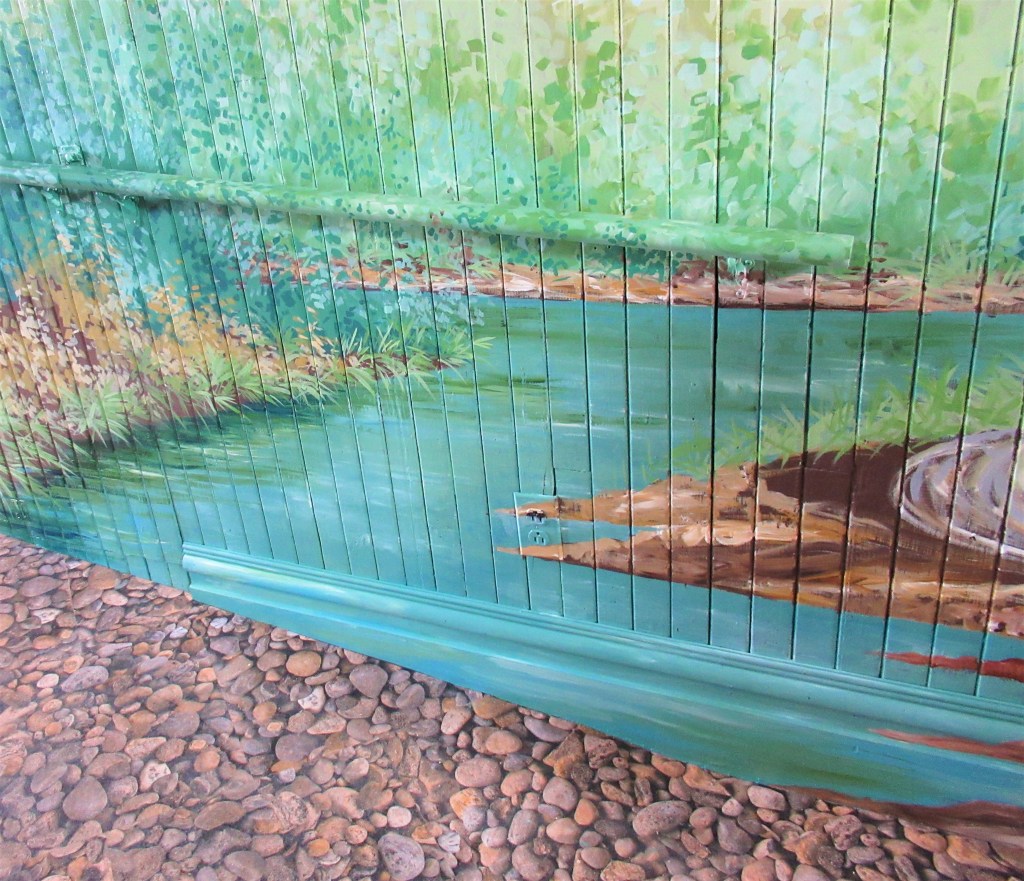
Geoff Slater’s mural at McAdam Railway Station. ‘You cannot step in the same river twice.’ Heraclitus.
Heraclitus
Nothing will ever be as it was before.
Time, like water, like these people marching, constantly flows, trickling through my fingers, uncatchable, unstoppable, sand filtering through the hour glass’ waist.
Water flows, currents shift, rocks wear down, banks slide and fall.
“You cannot walk in the same river twice nor ever attend the same demonstration.”
Nor can you recapture that first, fine, careless rapture, the touch of that first drop of river water.
Kneeling by the river bank, like St. Kevin and his Blackbird, I cannot recall the river’s name.
Comment: I love the reality of the river, its impressionist style of flowing water, impossible without the enormous presence of Claude Monet and his portraits of the Seine. However, what makes the mural, for me, is the brutal reality that breaks into the painting’s unreality. The boards covering the interior wall, the hand rail blended into the painting, the skirting board, the electric socket. I also like the intertextuality: art speaking to poetry, poetry replying to art, the links to Heraclitus, poetry speaking to poetry, the anonymity of the river, and the further poetic links to Robert Browning and Seamus Heaney. I often wonder if readers and viewers pick these things up. Or do they just speed-read, link to their own experiences, and move on with no further thought? You tell me. But what I will tell you is that artists reaches out to art, poets extend their hands to poetry, and our world is an inter-connected maze of thoughts and ideas, linking and unlinking, occurring and re-occurring, lapping like an incoming tide at the fingers and toes we immerse in those amniotic waters, often so long-forgotten, in which our creativity is berthed and from which it is born.