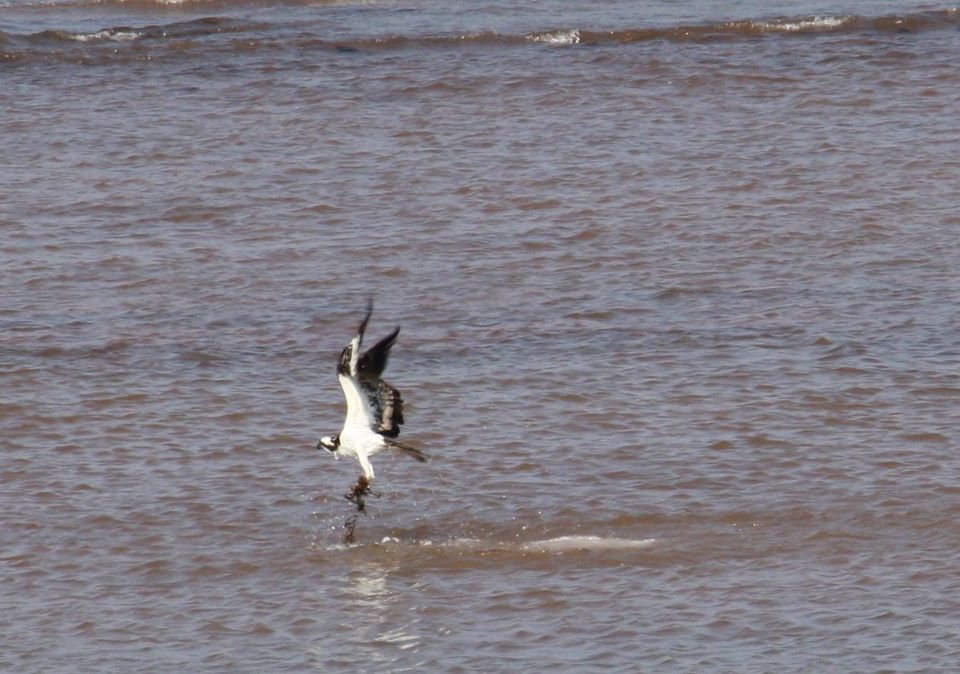
An osprey on the wind wings thrusting for maximum lift then flattened for feather-tip control
Wheeling up and away the soft-wing sway of him ascending his celestial staircase in a rush of blue air
Light his flight sky steps danced to wind music played over beach below and rock and rolling waves
Watch him wave good-bye with a waggle of his wings and a well-judged flick of his paint brush tail brown white and black lines neat strokes across a cerulean sky
There is so much happening. It’s hard to keep track of it all. Reading and annotating the material I am working on for my online writing seminar. Painting: a delightful relief and relaxation. Who cares if I can’t paint? I can make meaning out of shape and color, like my friend Matisse. Writing: the poetry is back and I will start revising those short stories again soon. I may also go back to my first novel. I have abandoned it for too long.
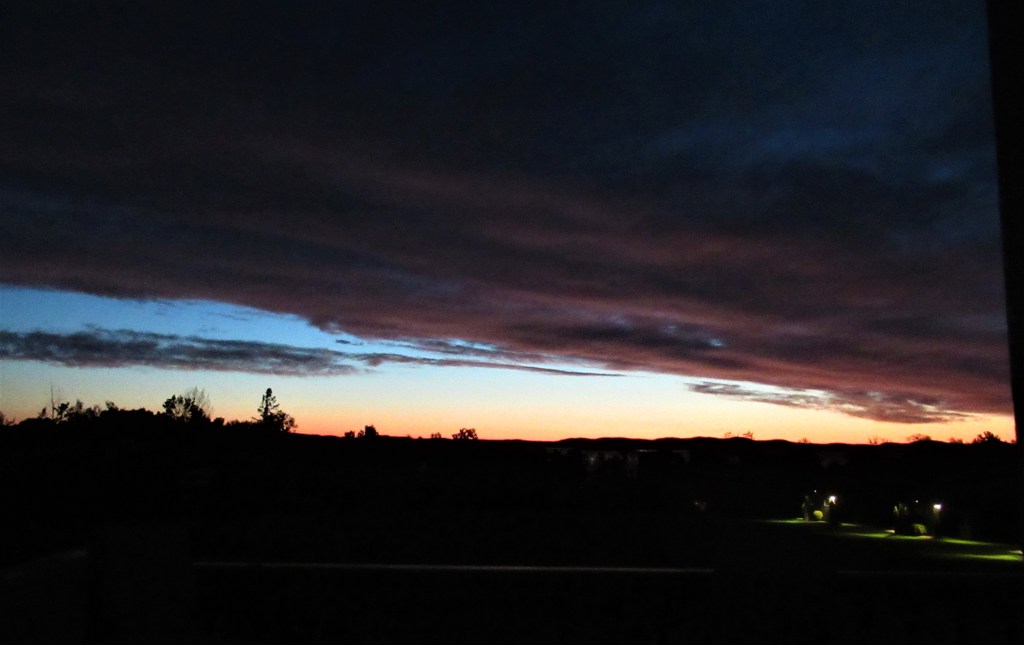
Meanwhile, each dawn is a busy dizzy time. This morning I decided to lie in bed until 24 birds had flown past my new bedroom window, one for each new pane of glass. It took about fifteen minutes. I watched the mist rise and then the sun start to break through and when the sun came, so did the birds. Dizzy Dawn is now hanging on the wall, along with another set of paintings I have finished recently.
Life is good. I hope it stays that way for as long as possible.
Rant, I say, rant and rage away, rage, rage against the death of friendship and loathing built on false love. This is a blood sport where even the spectators are spattered with the refined frenzy of friends turned into fiends and foes, and this is a protest, a rant against love that doesn’t last, that doesn’t stand the test of time, against families that break up, against a society that breaks them up, driving wedges and knives between people once bound by the puppet strings of love, against relationships that can no longer continue, against the rattling of dead white bones in empty cupboards where skeletons dance their way into legal daylight and the spectators call for more: more blood, more money, more blood money, and the engagement diamond is a blood diamond now, a tarnished garnet, and where is the Little Old Lady of Threadneedle Street, that spire inspired needle that will stitch their world back together, and stitch you back together when you’ve been shocked out of your own ruby-sweet rose-tinted world and torn into little bits in their oh-so-bitter one, the biters bitten and those bitten biting back in return, a new world this world of snapping turtles, turtles standing on the back of turtles, and turtle after turtle all the way down until this carnival world puts down its dead clown mask and turns turtle in its turn.
Comment:
National Reconciliation Day today, the first in Canada. Now that is a valid reason to rant. Let us hope for reconciliation, for a healing and a mending. I love Canada. I love all Canadians. I came here by choice, stayed here by choice, and I am very grateful to have been accepted by the Canadian communities in which I have lived. I hope I have graced Canada, with my presence, as Canada has aided me and helped me along in all my endeavors, academic, sporting, teaching, creating, and editing. As Norman Levine once wrote: Canada Made Me. In my case, it is true. On this first National Reconciliation Day, my thoughts and thanks go out to my brothers and sisters, all of us Canadians.
I don’t know what happened this morning: I put the same post up as yesterday. Different photo, same post. I really don’t know what to think about what I was thinking. Old age? Confusion? A troubled mind? All of the above!!! Never mind: here we go again, and maybe my next rant will be about getting out of touch and loss of memory! You never know what’s coming next, and that’s the beauty of Messiaen.
A statue of St. Francis stands in the corner of the roof garden. He holds out his hands for Plaster of Paris birds to settle upon them.
St. Francis wears a brown, sack-cloth cassock bound at the waist by a knotted, white cord. Living birds would come to him, if he called, but he is silent. He knows the birds by their names, not the Latin or Spanish names, nor their names in Mixtec or Nahuatl. He knows their true names, their own ineffable names that grace each of them and brightens their songs of colored glory.
Brother Sun, by day, and Sister Moon, by night, bless him with their soft-feathered gifts of light. Alas, he is bound to this earth by Brother Donkey, the flesh and blood body he once wore and now wears in effigy. Of the earth, earthy, his thoughts are bent on beating this sackcloth body down and raising his mind in birdsong that will reach up, higher and higher until it achieves his Kingdom Come.
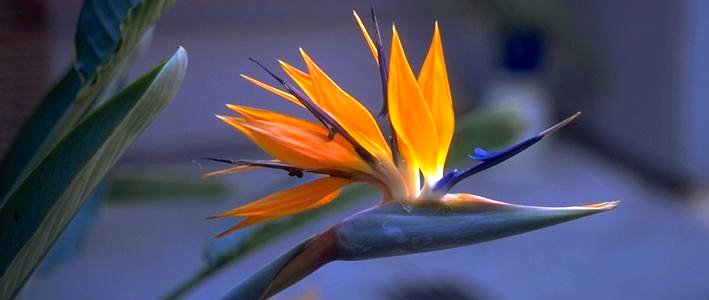
In front of him, the Bird of Paradise offers him that which he most desires, a return to earth in avian form, winged like a miniature angel armed with a golden harp and an aura of song.
Meditations on Messiaen Quartet for the End of Time
4
Transitions
Modes of limited transitions, moods of time tapped in time to time’s rhythmic piano.
Scales fall from the listener’s eyes. A transitory awakening, this glimpse of the composer’s vision, each note a new version extracted from abstracts perceived in color, each note a hue, and chords a rainbow spectrum of light glimpsed darkly through a raindrop’s lens.
Birdsong and sunshine. Notes perched on the matinal branch, each in tune with the other, at times discordant, yet the morning chorus diluting the day with the liquidity of light and sound.
Jackson Pollock it ain’t. But just look at those fledgling storks launching themselves into the air. And yes, those are their nests!
Spotify Scroll down to appropriate episode.
Bird’s Nest Jackson PollockNo5 (1948)
This bird’s nest starts with a startling tweet that wins a trilled, thrilled response. A flutter of heart-string wings, creator, viewer, join
with the creation. Thin threads of life mix and match their tangled weave, existential tapestry, fathered in a feathered nest.
World without end, this labyrinth without an entry point, without a beginning, with a spaghetti-thread middle that meets
not in a breath-catch of the mind, but in a brush-flick of coloured rain, a cycle recycled of circled paint, circular
in its circumnavigation, its square eight by four-foot globe of a new world whirled in stringy whorls, reinvented beauty
drawn haphazardly from the bicycle tour de force of this artist’s inner mind.
Comment: This is a tongue-twister of a poem, much as Jackson Pollock’s painting is a twisted vision twisting the viewer’s eye. And, no, it is not easy to read. Nor is the painting easy to view. Click here for a link > Jackson Pollock < to the painting. Click here for a link to Alejandro Botelho’s reading of < My Grandfather >. Note that Alejandro’s reading of My Grandfather begins at 17.58. And note too that the other poets are also well worth listening to. Once again, thank you for this, Alejandro: your work is very much appreciated.
Timothy heard his older brothers moving from room to room, searching for him. He knew they would find him but for now he had found refuge beneath his grandfather’s double bed. It was dark under there in that sepulchral space. He had placed his grandfather’s enormous Royal Doulton chamber pot between himself and the door so that the dog would not pick up his scent, run to his hiding place, and lay the Judas lick upon his cheek.
His grandfather had forgotten to empty the chamber pot. Dark urine splashed on Timothy’s hands and sleeves as he squeezed behind the giant china pot that overwhelmed his nose fills with his grandfather’s nocturnal vapors.
The voices got louder as his brothers climbed the stairs and approached the bedrooms on the upper floor.
“Where is he now, drat him?”
“Don’t worry, we’ll find him.”
“And then he’ll be for it.”
“I’ll beat him with the little red brush they use for cleaning the fireplace.”
“That will teach him.”
Timothy was familiar with those threats, especially the little red brush.
He remembered the fox the hounds killed at his feet, one sunny morning a year before. He cycled down the lane outside his family’s summer cottage. The fox limped along the side of the lane, saw the boy on his bike, but too tired to run from him, continued limping in the roadway. Timothy got off his bike, leaned it against the rough stone country wall, and watched the fox. Its tail, speckled with mud, dragged behind its low-slung body, sweeping the ground. Timothy observed the twigs and thorns protruding from its black-tipped orange redness.
Timothy walked towards the fox. It tried to move away from the boy but collapsed and lay at the edge of the lane, flanks heaving, tongue lolling out through the white strings of thick foam that choked the muzzle and streaked saliva on the forequarters.
The hounds came from nowhere, an incoming, barking tide that rounded the corner and rushed towards Timothy who froze with a fright that pressed him against the wall. Sun-warmed stone jutted sharp edges into his back. As he stood there, unable to move, a rough hand came over the wall and grabbed him by the shoulder. He felt himself hauled upwards. The flint points dug into his back and he yelped as the firm hand drew him over the top of the wall to safety.
“Get out of there, you stupid boy, or the hounds will have you.”
Timothy hid his face in the farmer’s rough homespun shirt. He shuddered as the dogs bayed and growled and scrapped and scratched. Then the fox, it must have been the fox, let out a high-pitched yap and whine and the pack gargled itself into a drooling, slobbering sort of silence. The farmer pushed Timothy’s face away from his shoulder and forced his head towards the spot where the hounds, on the other side of the protective barrier, rubbed their ears into the dead fox’s torn and bloodied body.
“That’s what they’d have done to you, my boy. Never come between a pack and its kill.”
Timothy watched a member of the hunt staff pull a knife from his jacket. The foxhunters broke into cheers and howls of pleasure when the man severed the fox’s brush and held it on high. The farmer thrust Timothy towards the Master of Hounds.
“Here, blood him, Master, he was in at the kill.”
The Master of Hounds opened his mouth to flash a smile filled with pointed, foxhound teeth. He stooped, dipped his fingers in the still warm fox blood, and streaked a smear across the boy’s face.
“There,” he said,” you’re blooded now. One of us, eh what?”
The mingled scents of fox and hound and blood and death and urine and feces made a heady mixture and Timothy started to hyperventilate. His breath came hard in his throat and, as he struggled to breathe, tears rolled down his cheeks.
Timothy feels safe in his secret hiding place beneath his grandfather’s bed. He can hear his brothers’ taunts and calls as they search for him, but they haven’t found him yet. Sticks and stones may break my bones, he whispers, but names will never hurt me. But names do hurt. Tiny Tim they call him and ask him where he hides his crutch. I don’t limp, Timothy once replied. When he said that, one of his brothers, Big Billy, kicked Timothy as hard as he could with the toe of his boot, just above the ankle. Timothy screamed with pain. You’ll limp now, said Big Billy, and his other brothers found the joke so funny that they all called kicked Tiny Tim at every opportunity. Limp, Timmy, limp, they chanted as they chased him round, limpTiny Tim, Tiny Timmy.
“He’s not up here,” one of his brothers called out.
“Must be out in the garden, the coward, we’ll have to hunt out there for him,” another replied.
“Can’t run, can’t hide,” said Big Billy. “Get the dog, we’ll track him down.”
The voices finally faded. Protected by the barrier of his grandfather’s cold but intimate body waste, Timothy curled up like a fox in his den and fell asleep. He dreamed of the proud brush of a tail flying in the wind, of a warm stone wall, drenched in sunlight, and of a farmer’s strong, all-protecting arm.
Comment: I have written several versions of this story, some longer, some much shorter, some in the first person singular, some in the second person. In all of them, the word-play on the little red brush (fox and fireplace) is paramount. This particular version occurs in my short story collection, Nobody’s Child available on line. Sometimes a story will not leave me alone. It wanders around, takes slightly different twists and turns, and new images and scenes emerge, as they do in this particular piece. Alas, I didn’t have a photo of a fox, so I used a photo of three plump pigeons hiding, you might even say ‘cowering away’, from a hungry hawk circling overhead while they hid in a crack in a wall in Avila, Spain. It always surprises me to know how many people (and animals) flee from what Robbie Burns called “man’s inhumanity to man”.
Just one leaf dropping from the tree and the fall a call of nature and no freak chance of fate. What throw of the dice eliminates Lady Luck? None at all, or so the poet says, lying there, indisposed, his ribs cracked hard against the wooden boards of the porch and his right foot caught in such a way that the hip slips slightly from its socket and try as he may he cannot stand but lies there in the chill evening wind, a lone leaf, getting on in age, plucked from his tree and cast to the ground.
Comment: And don’t forget the family of crows, sitting in the tree, giving me the eye. watching every movement. I half expected them to flap down on to the balcony, and take a closer look, but when I started to move, it was game over, Rover, and they all cawed and flew away.
She is an oyster, silent at low tide, yet with a host of pearls waiting inside her, ready to be released. When set, she will release those pearls herself, stringing them together, like Chantal’s beads, into a skein of meaningful, enigmatic moments.
Enigmatic, yes, but, like Elgar’s Enigma Variations, a Russian Doll puzzle of secrets and intrigue. Comic book artist, she evolved to graphic designer, then multi-tasked first to Kinetics, and then to a painter who reaches out in empathy to the world around her.
For her, all art is linked and communications are key, on many levels. Visualization. Achievable goals. A step-by-step process with each step foreseen, planned beforehand, and each step always taken with an open mind that accepts the true response, leaving falsehoods behind.
Kinetics, yes, but she is above all a loner. Kayaking. Hiking. Weight-lifting. Yoga. Meditation. Mindfulness. Caring. Sharing. She sends me her web page and I am blown away by her empathy with birds and the natural world, that world her oyster and her, an oyster in that world.
Comment: This particular bird visited our Mountain Ash in the garden at Island View. Kaitlin saw my photo and asked if she could paint it. I sent it to her, and this is the result. Wild life to Still Life to art and never Nature Morte! Together, Kaitlin and I have preserved forever the surprise visit of this beautiful bird.
Spotify Don’t forget to scroll down to appropriate audio episode.
Full Moon Over KIRA
Who shall dredge this midnight moon from the shoals of Passamaquoddy Bay? Gaunt the moon-rakers’ faces, harsh their hands hauling on nets, heaving her up, rippled and dimpled, blunt her bite as she emerges from submersion, raked from water in the traditional ritual.
Upside down, these reflected clouds, as bright as full-moon fishing boats distorted from below as the night wind blows clean dry bones across a mirrored sky where shadow fish fly wet with moonshine.
Oh pity her, you people, as she’s dragged from her element and exposed to air and oxygen that will slowly kill her, make her fade, frail and fragile, not meant for this world of rock and stone, flower and field, but destined to walk in heavenly meadows or to rest in the shallows where she rocks to sleep in the sea’s endless cradle.
Click on the link below to peruse my books for sale.