Great Blue Heron

Great Blue Heron

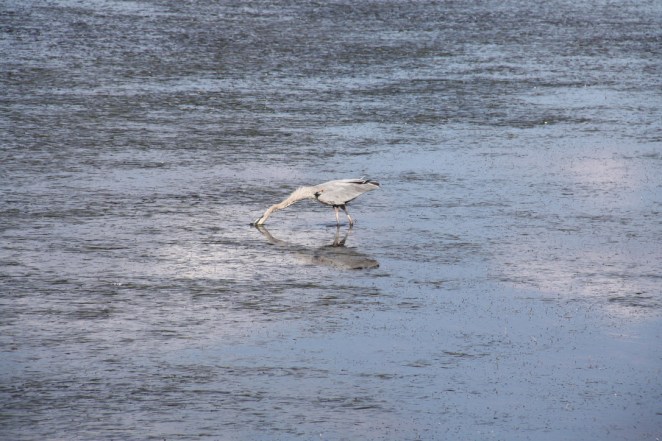
The blood light draining from the sky
midges of color
skimming the beaver pond
colors skipping across the lake
the water alive with color

the low moon skinny dipping
across the surface each ripple
a leaf of stained glass
torn from a cathedral window

twin sticks angled
stark in the water
poised on thin stilts
waiting

this angel now
stripped of all garments
save a blue-grey gown
feathered around her

Commentary:

I love the great blue herons (GBH). They appear from nowhere, perch for a while, then vanish. So many on PEI. One evening I counted 60 or 70 in the bay. Such stealth. Such patience. Such beauty. Then a quick strike and GBH – grievous bodily harm to some small fish or frog invading their fishing space.

They build colonies in the trees by the waterside yet each creates its own free space when they fish in the waters. Flying, such power, such grace. Sharp beak our front, legs out behind, and the power surge of their wings thrusting them onwards.

Such a pleasure to stand still, to watch them and to thrill to the sudden spearing lurch of the attack. The house we borrowed in PEI had a little stream at the back. A GBH fished there. Quietly. Unseen. Scarcely moving the waters. A loner, just like me and mine. An only. As we are. Stately in his loneliness. As my beloved is in hers As I am in mine. A shadow on the waters. A shadow, while the sun still shines.

Empty Nest

Empty Nest

X marks the spot
where the energy ran out,
the moment when the tide turned
and water ebbed, and refused to flow.

A place… a time…the sudden scent
not of presence, but of absence.
The absence of movement,
noise, of that other body
that once walked the rooms,
opening and shutting doors,
windows, like a robin’s whistle,
a thrush’s trilled song…
gone now, gone, all gone.

We drift through silent sadness,
avoid each other’s eyes,
sit with our heads in our hands
or knit our fingers together
in desperate gestures
that express our emptiness,
the emptiness of an empty nest…

Commentary:

The poem speaks for itself, as a good poem ought to. Even bad poems speak for themselves sometimes. Amazing how empty the house seems when we sit in separate rooms, work at different computers, read in silence, or do the crossword or sudoku, miles away in time and space. And those little feet have gone now – not that they were that little this past visit. But holidays end, child and grandchild depart, the house returns to its former silence, and we are left to contemplate the emptiness of an empty nest.

Raven

Raven

When Raven flies through his trap door in the sky, a light bulb clicks off in my head and I fall into darkness. Is there some safety net before oblivion? Raven’s claws scar crow’s feet on a fingernail moon. His bleak black beak widens the hole in my head and the Easter egg of my skull shows thin blue cracks. Outside my window, the river moves backwards and forwards with the tide. Raven shrugs at cancerous creatures, promising nothing. He soars into clear skies in search of his private exit and extinguishes sun, moon, and stars, plunging our world into blackness. The light on the point picks out a heron, mobbed by a clacking ring of gulls. The sea mist wraps the real world tight in its cloak. Now sea and lighthouse, heron and gulls, are distant things of memory. Raven, shoulders hunched, stands like a stone, an anthracite block hacked out from the coal seam in my mind, hand carved from feathers and my forefathers’ blood.

Commentary:

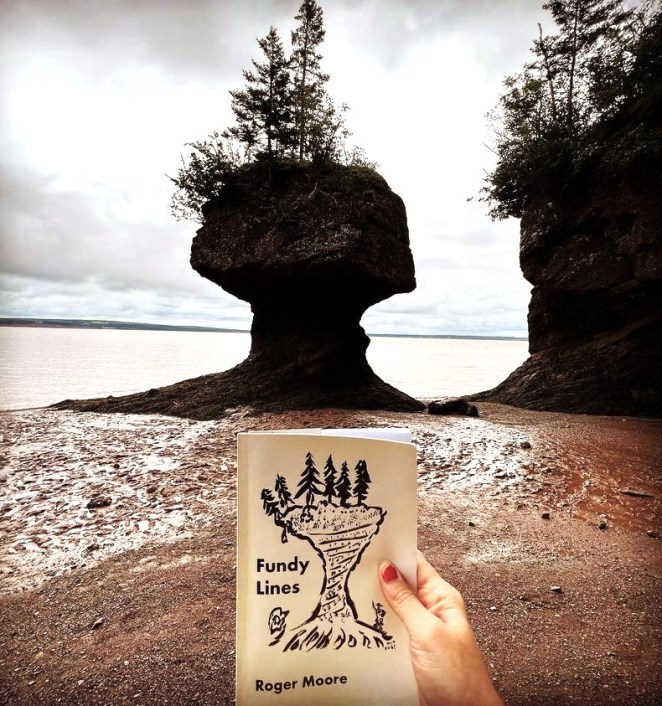
I had forgotten all about this poem in prose. It comes from Fundy Lines, if I remember correctly. Photo credit (below) to one of my former students, an excellent poet herself, who took the trouble to locate the correct rock and then take a photo of book and rock together.


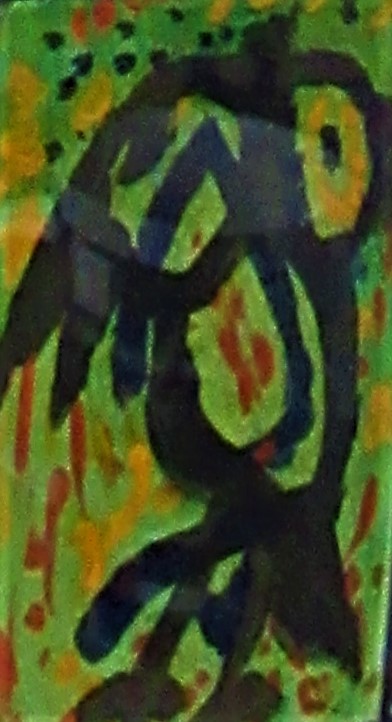
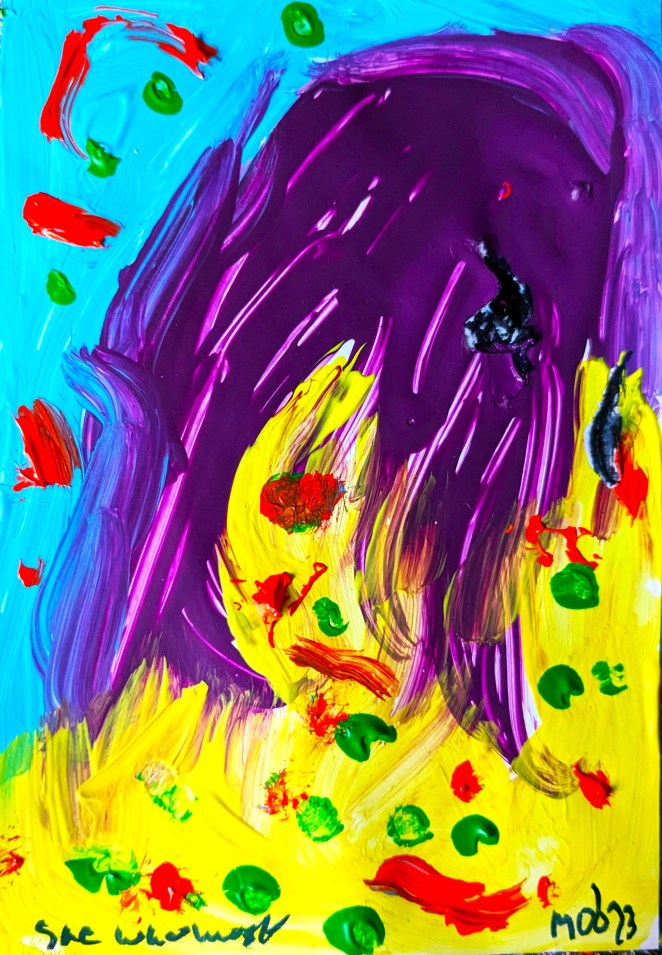
Moo thought his painting of a dark shape that looks a little bit like a bird of ill-omen would be just what this prose poem needed. Maybe he’s right. I trust him with his choice of paintings. Well, most of the time anyway. He can be a bit ‘off’ from time to time, but mostly we form a good team, especially where Surrealism is concerned.

I guess Raven formed part of my Surreal sequences. I really do enjoy Surrealism. The mixing of metaphors, for example, the unexpected meeting of a sewing machine with a carving knife and an umbrella on an operating table. And look what Raven’s up to. He discovers a trap door in the sky. Well, that would be very useful, if we had wings and could fly. Then he turns off the light bulb in my head. I didn’t even know I had one in there. I guess Raven, like coyote and zopilote is a bit of a Trickster. Next he changes into a woodpecker and widens the hole in my skull. Poor old me – avian trepanning – no wonder I have problems! My head becomes an Easter Egg and has cracks in it giving birth to what? Some mad ideas, I guess, pecking their way out into the wonderful world in which Moo and I live in perfect harmony with my beloved and our cat. And look at all those Welsh mining memories – lignite, house coal, steam coal, anthracite, jet – and remember, when the coal comes from the Rhondda down the Merthyr – Taff Vale line, I’ll be there.

It will be a long way from Canada to Taff’s Well. Maybe Raven will be kind and fly me there, through his Island View trap door that has direct access to the trap door just above Castell Coch, the Fairy Castle of my childhood. That would be faster, and easier, than my old two-wheeler Raleigh bicycle with it’s Sturmey-Archer three gear click on the handlebars. I bet Raven can fly faster than I can pedal. And if I could have pedaled as fast as Raven flies, downhill and uphill, I would have been King of the Mountains and an all time winner of the Tour de France. Now that would have been surrealistically surreal, seeing me as a cereal winner, with my snap, crackle, and pop! Not that my dad would have been happy. He never was happy with anything I did!

My favorite cat

My favorite cat

Pebbles have caught in my throat.
The word-river once flowing smooth
now backs up to spill leaf-freckled foam
over the tiniest barriers of branch and weed.

When I speak, some gypsy I find
has stolen my tongue, and my voice
is that of a changeling whisked away
from the cradle whilst her guardians slept.

Now leaves outside my window grow
rusty with autumn rain. A sharp-shinned hawk
no bigger than the blue jay he stalks
drives like a whirlwind at our feeder.

In dawn’s early light, a Great Barred owl
flaps enormous wings and drops like a stone
on my favorite cat, lifting her up and away.

Commentary:

Not a true story – sorry, my friends. However, I did see a Great Barred Owl swoop down on my neighbor’s cat. A canny old cat that one. He rolled over on his back, hissing and spitting, and showing all his unsheathed claws. Then he let out a most unnerving high-pitched whining sound and the owl backed off. Nature red in tooth and claw and our own backyard a battle ground where wild creatures roam and prey on each other.

Luckily, as a poet, I need neither seek nor deliver the truth, in any sense of the word. What I search for is emotional impact – words that ring true, even if they are not. Moments that reach out and grab us when and where we least expect it. As someone once said – never let the truth get in the way of a good story. Same with jokes.

And speaking of jokes, cross-cultural jokes are some of the most difficult things for a language learner to grasp. Humor exists in many forms. Silent comedy, like slapstick, does not need an interpreter. However, jokes based on cultural understanding are remarkably difficult to follow, unless one is totally immersed in the culture. As for linguistic jokes, even the sharpest individual can be defeated by word play and double meanings. I remember word plays from my beginner’s language classes that still leave me cold. Sorry, I just don’t find them funny even when explained. Clever, maybe, but funny? No way. Molière for example – Trissotin / trois fois fous. Really? ne dis pas que c’est amaranthe, dis plutôt que c’est de ma rente. Or, from the Spanish of Fuenteovejuna, Lope de Vega – Ciudad Real es del Rey. I hope you are splitting your sides over that one – I have never been able to laugh at it and still can’t understand what’s funny about it. C’est la vie, I guess.

Inquisitor

Inquisitor
Sun and Moon

He told me to read,
and plucked my left eye from its orbit.
He slashed the glowing globe of the other.
Knowledge leaked out, loose threads dangled.
He told me to speak and I squeezed dry dust
to spout a diet of Catechism and Confession.

He emptied my mind of poetry and history.
He destroyed the myths of my people.
He filled me with fantasies from a far-off land.
I live in a desert where people die of thirst,
yet he talked to me of a man who walked on water.

On all sides, as stubborn as stucco,
the prison walls listened and learned.
I counted the years with feeble scratches:
one, five, two, three.

For an hour each day the sun shone on my face,
for an hour at night the moon kept me company.
Broken worlds lay shattered inside me.
Dust gathered in my people’s ancient dictionary.

My heart was like a spring sowing
withering in my chest
It longed for the witch doctor’s magic,
for the healing slash of wind and rain.

The Inquisitor told me to write down our history:
I wrote … how his church … had come … to save us.

Commentary:

No wonder the little girl in Moo’s painting looks so sad. She must have read this poem and understood how the exercise of power and authority, be it religious or secular, can effect those upon whom it is exercised. Times change, but so many things remain the same. The pendulum swings, and it moves from chaos to order and back again. The meaning of meaning – how we define chaos and how we define order define who we are.

Birds of a feather flock together. Manners maketh the man. Wonderful sayings. But fine words do not necessarily make for fine men or women at that. Serpents and senators, both can speak with forked tongues. It is up to us to apply discourse analysis and distinguish between what they say and what they actually mean. As my friend Jean-Paul Sartre once said – “L’homme n’est rien d’autre que ce qu’il fait.” A man is nothing more than what he does. His deeds reveal his true inner self – and remember – the plumage doesn’t necessarily make the bird.

Clepsydra 23 & 24

23

… gulls on the wharf-side roof
     fishing boats
          returning to port
               white wakes trailing,
                    pointing to where they’ve been

where have I been
     all my life         

where is the wake
     that tracked me to and from
          so many unimportant places

so often have I waited
     for that moment of reunion
          port station airport

birds leaving nest
     only to return
          then leave again
               are not more faithful

sweet brevity of life
     a stone memorial
          on the harbour wall
               raised to all
                    who went to sea
                         and never returned
                              dying in the waves’ embrace …

24

… a watery grave
     no church no candles
          just cold waters sliding shut
               as down to the depths they go
                    

sinking from level to level
     never to rise again
          not till seas run dry
               burnt up by the sun’s candle

even then they’ll walk no more
          with their beloveds
               hand in hand
                    on diminishing land
                         or sea-licked sand …

Commentary:

“Birds leaving nest, only to return, then leave again, are not more faithful.” A lovely photo, from Avila, of storks, bouncing on their nests, waiting for the wind to lift them up aloft. I thought of using sea side photo from PEI, but this image caught my eye, and my words. A verbal – visual link. Not easy to spot, but there, in the sky above them, a parent waits. As soon as one chick takes flight, the watching parent will drop, fly under the fledgling’s wings, and tutor the young bird in the art of soaring and flying. I have spent many a happy hour, just sitting there, watching them.

And here’s the photo from PEI. An osprey, returning to the nest, after a fishing expedition. One hopes for such moments. Then, suddenly, one day, the magic happens, and verbal and visual joining hands in a single moment of magic. And listen to that baby bird, beak open, shrieking, waiting for the parent to arrive. I can still hear the screeching, although we are in the age of silent, but colorful, pictures.

In the picture below, the Grande Réunion – you can see the White Geese gathered at Bic. They return every year, so beautiful. The first time I saw them, I thought they were a drift of late snow. Then they rose from the field, and flew up, into the air. I have often seen snow falling but that was the first time I saw snow actually rising, after it had settled. A memorable moment.

Moments of magic, as I said, and each of them linked – verbal to visual. Silent dialogs with my time and my place, now shared with whoever has ears to hear and eyes to see and an imagination to reconstruct the alternate realities.

Clepsydra 22

22

… winds kiss words from lips
      sand creaks
           squeaks underfoot
                    creeps between dry toes

the sand cleanses
     purges
          brings closure
               each magnificent moment
                    lighting a candle

is this beach an altar
     under the rocks’
         shadow church
              it doesn’t matter

mindfulness
     holding each memory
          each piece of colored glass

wave after wave
     climbing ashore
          washing footprints
               memories away
                    closing
                         door after door …

Commentary:

“Wave after wave climbing ashore, washing footprints, memories away, closing door after door.” Everything turns out in black-and-white – here a crow, there a seagull. What does each say to each, when they meet upon the beach? Silence and stillness. No sound of wind or wave, no sign of the tide rising or falling, and what do the birds say to each other, when they meet like this? Two solitudes, mine and thine, and somehow the silence must be broken, or in our separate solitudes we will remain. What if I open my solitude and show it to you? Will you then open yours and spread it willingly before me? Or will you turn away, crow spurning seagull and there’s no going back.

And did my feet, in ancient time, walk upon the beach in Santander? Did they wander over the cliffs at Cabo Mayor? What did I say to the sands in Swansea Bay when, sitting on the steps by the railway station, I dusted the sand from between my toes, placed socks upon my feet, and did up my sandals? Private places, private memories, private conversations live on in the privacy of my head.

A dozen heads, all crowded onto the computer screen, zoomed in so they can be together for an hour or two, repeating their memories to each other – how much did they really share? How much can we know, your life of mine, my life of yours? At what point do those twin railway lines meet at the edge of time? Or are they doomed to a parallel universe where mind and mind, rail and rail, neither meet nor understand? Tell me, if you can, what the crow thought of the gull when they met, that morning on the sand.

Clepsydra 18-20

18

… as free as the birds
     a sky full at North Cape
          where shores retreat
               year after year
 
the big red mud diminishes
     under advancing waters
          sea-threatened cliffs
               undermined roads
                    houses
                         the lighthouse

gulls follow the fishing boats
     herring gulls
          blotting out
               sun and sky
                    above the reef

with its seals
     basking in sunshine
          knowing themselves
               being themselves
                    thinking themselves safe

kings and queens
     of their sealdom
          never questioning …

19

… an osprey
     sudden the swoop
          turned into a stoop

water shattered
     total immersion
          then emerging
               with lusty thrusts of wings

claws clasping
     imprisoned prey
          prised from the sea
               raised to the skies
                    up and away
                         murderer and victim

oblivious below
     the black horse
          with cart and farmer
               gathering seaweed

all of them
     having no doubts
          safe in the security
               of their roles …

20

… while lost in the labyrinth
      I searched for a thread
               on life’s loom

a thread woven
     by an unknown
          unseen hand
               a hand and thread
                    I could never control

yet one day
     that thread
          will lead me out
               from the dark

then shall I see
     the sun’s great candle
          beneath which red rocks
               wave and water battered
                    crumble

here at North Cape
     in a way that nobody
          can understand …

Commentary:

The osprey “emerging with lusty thrusts of wings, claws clasping, imprisoned prey prised from the sea, raised to the skies, up and away, murderer and victim.” The words are based on the photograph. A quiet day, somebody shouted, and pointed, and clickety-click, I was lucky enough to capture the whole thing on my digital camera. This one shot summarizes it all.

The stanzas (16 & 17) that precede this moment are available here. Clepsydra, the book, is one single poem, one single sentence, that rambles on and on. Each stanza stands alone, each poem (numbered) stands alone, and the whole book stands alone as a single sentence summarizing what I have seen and where I have been. Bakhtinian Chronotopos – my dialog with my time and my place. In this case, my many dialogs with my multiple times and multitudinous places.

Albert Camus lent me the phrase ‘murderer and victim’. ‘Nous sommes, ou meurtrier ou victime‘. Quoted from memory. I hope I am not too far wrong. My memory fades as I age. Louis Aragon suggested I borrow his line “rois tombés de leurs chariots” – that I found in his collection Il ne m’est Paris sans Elsa. Here, I have applied it to the seals at North Cape, PEI – “seals – basking in sunshine – kings and queens of their sealdom.” Intertextuality – texts talking to texts and recalling segments of texts within other texts.” Wonderful. Alas, I fear the coming days when the memory may no longer be so clear. ‘What will be, will be’ said the Osprey as he pulled the flounder from the sea and carried him too his nest in a nearby tree.

Sweet Dreams

Sweet Dreams

Amnesia survives in these amniotic waters,
moving in time to the water pump’s heart beat.
I close my eyes and dream. Nothing is the same.

Do I drift dreamily or dreamily drift?
The bath-tub’s rose-petals bring memories –
primroses, bluebells, cowslips, daffodils dancing

beneath the trees in Blackweir Gardens,
or beside Roath Lake, where I biked
on gravel paths so many years ago.

Photos float before me, pictures of moments
I alone recall. Spring in Paris, the trees
breaking into bud along the Champs-Élysées.

Santander in summer, walking the Piquío
as it slumbers beneath the jacarandas.
One winter in Wales, up in Snowdonia,

I ran down a valley between high hills,
on a freezing night, with only the stars
to keep me company, so cold, I nearly froze.

Autumn at the Peace Park in Mactaquac,
with leaves reflected in the head pond.
Or the Beaver Pond with its fall orgy

of gaudily painted trees, leaves drifting down
on this first chill wind, to settle like tiny,
colorful birds in my beloved’s hair.

I remember the look in her eyes when
I caught a falling leaf and put it in
her pocket, telling her to save it,
like a falling star, for a rainy day.

Bird

Bird

The bird came to me
   on the wings of Hurricane Lee.

Carried along by stronger wings
   he perched in my tree.

A new species, he was unknown to me.
   Our own power lost, the usual ways
               of searching were denied me.

He moved from the tree
   to the window feeder and gazed at me,
               eye to eye, as the hurricane’s eye
                           passed overhead.

Free. To come and go at his will,
   but there is little free will
               when the hurricane blows.

A sudden, strong gust
   whisked him away.

Unknown, and a stranger still,
   he soon was lost to me.

Comment:

All my good will and new resolutions went down the proverbial plughole when Hurricane Lee swept in, washed away one of the roads near to me, and left us without power for 52 hours. We lit candles, as much for warmth as for light, and, when dark descended outside, gathered in their flickering glow. The time has come, the Walrus said, to indulge in simpler things. Water saved in the bath upstairs and in an assortment of pots, pans, and buckets, served for the washing of hands, the flushing of toilets, washing the dishes. Food was served cold – but we indulged ourselves with perishables that needed to be finished quickly. The morning face wash and shave, in cold water, no shower, was a throwback to old times. The experience brought us closer together. Neighbors with generators dropped round with hot food and drinks, and all went well. After two days of picnics, we got a bit bored. I managed to write lots of poems though. The creativity of that experience will live on in words.