On Loneliness

Loneliness

58 What relationships have a positive impact on you?

I think one of my poems answers this question best. I write “one of my poems” but it is really my ‘free’ translation of one of Francisco de Quevedo’s sonnets – Retirado en la paz de estos desiertos. I have changed the poem slightly, but I am sure Don Francisco (1580-1645) will excuse Don Roger’s impoverished effort (2023).

On Loneliness
29 December 2023

Resting in the peace of these small rooms,
with few, but welcome books together,
I live in conversation with my friends,
and listen with my eyes to loving words.

Not always understood, but always there,
they influence and question my affairs,
and with contrasting points of view,
they wake me up, and make me more aware.

The wisdom of these absent friends,
some distant from me just because they’re dead,
lives on and on, thanks to the printed word.

Life flits away, the past can’t be retained.
each hour, once past, is lost and gone,
but with such friends, I’m never left alone.

And there are so many of those literary friends. I still read Rudyard Kipling and I have just finished Kim, Captains Courageous, Stalky and Co., Puck of Pook’s Hill, and Rewards and Fairies. I read these first when I was nine or ten years old, and I return to them regularly. Other friends include Garcilaso de la Vega, Fray Luis de León, St. John of the Cross, Quevedo, Góngora, Calderón, Miguel de Unamuno, Antonio Machado, various members of the Generation of 1898, the majority of the poets from the Generation of 1927… and these are just my Spanish literary friends. I have French friends, English friends, Anglo-Welsh friends, Canadian friends, Mexican friends, and, in translation, many, many more. My relationship with each of these friends has had an impact upon me.

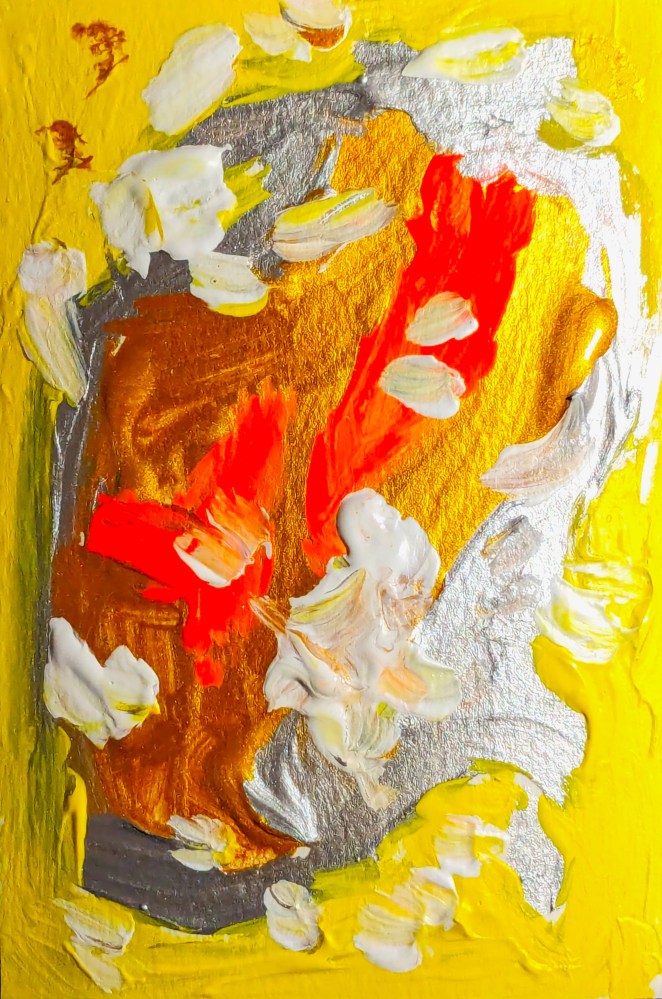
A recent painting, by my friend Moo, is called Fiat Lux – Let There Be Light. It is reminiscent of Dylan Thomas’s poem, Light breaks where no light shines. Intertextuality – Quevedo drew inspiration from the Stoics. I drew inspiration from Quevedo. Moo drew inspiration from Dylan Thomas. The nature of creativity, and its continuing links throughout the ages, shines clearly through these wonderful associations. Long may they continue, and may others enjoy them and be influenced by them as much as I have.

Comment:
The funny thing is that I do not remember writing this blog prompt, nor do I remember having translated Quevedo’s poem into English. I wonder how many other forget-me-nots there are out there. Or, to be more precise, in my books and in my notes. A treasure trove – that’s my guess. Borges wrote of Quevedo that he was more a library than an author, and I am beginning to think that way about my self. A strange world, this, one in which the creator abandons, and then forgets, his creations. Perhaps we should change the image – not so much a library as an orphanage, and so many lost and abandoned orphans wandering around The Little World of Don Rogelio.

Time Flies

Time Flies

… bends like a boomerang,
flies too rapidly away,
limps back to the hand.

Endless this shuffle of unmarked
days dropping off the calendar.

Hands stop on the clock.
The pendulum swings:
time and tide stand still,
do not move.

‘As idle as a painted ship
upon a painted ocean.’

The painting in my grandma’s room:
seemingly moving seas,
sails swelling out,
but the ship doesn’t move,
it stays firm in its frame.

Our garden fills with birds
and squirrels, light and dark.
Morning ablutions: each day
a twin of the day before.

The TV screen churns ceaselessly,
tired, shadow faces boring us
with shallow wit
and worn-out wisdom.

Time:
an albatross around the neck,
an emu, an ostrich, a dodo,
an overweight bumble bee,
too clumsy, too heavy to fly.

Clepsydra 6 & 7

Clepsydra 6 & 7

6

… I say I walked alone
     along a long lonely road

nobody could cross that threshold
     nor enter that inner sanctum
          where hungry metal monsters
               lay in silent ambush waiting

nobody could share that sacrificial altar
     the single bed with its iron frame
          on which I lay on my own waiting

uniformed attendants
     locked themselves
          behind their concrete defences
               away from the radiation
                    so dangerous

while I waited
     for those circling stars
          that would burn
               and scar me
                    to descend …

7

… and single beds
     were only meant for one
         
just me
     strapped in
          tied so tight
               lying motionless
                    as I waited for
                         the bed to rise …

upwards
     into that dark night of the soul
          and I the sole sufferer
               under a claustrophobic sky

behold my body
     a mass of red and green striations
          burned by pin-pricks of light
               walking across my body
                    follow the red map
                          painted on my body

burns and blisters
     body and mind scarred
          scared by knowing
               all this suffering
                    might be in vain

others walked this road before me
     some never returned
          empty places at breakfast
               hushed whispers
                    faces turned away

when the tide turns
     it brings with it
          the joy of life
               a spark of hope
                    life’s waters
                         resuming their flow …

Comment:
All that happened to me ten years ago – but the memories are still fresh in my mind. At night, I often watch those planets circling, closing in, those star ships, guns blazing, burning my skin. So many of us have walked that lonely path, lain on that bed, faced those demons. Holst’s Planets – it amazes me that the music still plays in my mind, the celestial dance still goes on in the ballroom of my head, and the memories refuse to fade, though the burns on the skin have vanished and are long gone.

Rock

Rock

You are the rock
on which I build
my life.

You are the fairy castle
planned in paradise
where the sun always shines
and stress is distant.

How often have I mapped
your inner islands,
traveled your well-known ways,
always discovering
new sacred spots
where I can immerse myself
in your inner serenity?

You are the fortress
within whose walls
I can forget my past
and create my future.

Candle Light

Candle Light

Candle light
softens your features
brings out the bone shape
makes me forget
the minor flaws
of ageing.

Bone shape,
rock shape,
land scape,
your face contours
traced by the flame,
counting the years,
like tree rings.

Beneath the surface
you are as you always were
and always will be.

When I look into your eyes,
I see your soul
dancing in the candle’s flame.

Carved In Stone

Carved in Stone

Brief Introduction

“Poetry explains itself. If it doesn’t, it’s inexplicable.” Pedro Salinas.

I entered this collection of poems for the Alfred G. Bailey Awad (poetry manuscript), WFNB, 2025. Alas, it did not win an award, but the judge, Kathy Mac, made some excellent suggestions as to how I might improve the manuscript. I have followed her advice to the best of my ability.

Carved in Stone is the second dialog (Chronotopos II) in my Bakhtinian Dialogs with my time and my place. Clepsydra, Chronotopos I, won third place in the Bailey Award (2025) and has already been published. I have one, possibly two, more Dialogs planned.

Reception Theory – I write, you read. Any meaning that you extract from my poetry will depend on your own culture and background. Tolle, Lege – Take and read. Read slowly, and with care.

I am a poet, a dreamer, if you will. These are my dreams. When you enter my world, you mingle your dreams with mine. The result, I hope, will be an interesting intellectual blend of new creativity. Pax amorque.

1

Behold me here,
filled with a sort of shallow,
hollowed-out wisdom
accumulated over decades
while listening with my eyes
to the words and thoughts
of writers, long-dead.

Imprisoned in book pages,
do they bang their heads
against walls that bind,
or hammer with their fists
at the barred lines
of their printed cages?

These spirits long to break free,
but they choke on library dust
and pollen from verbal flowers
that bloom unseen.

Those old ones avoided
the traps of temporal power,
or, once trapped,
gnawed off a precious limb
to limp into freedom.

Comment:
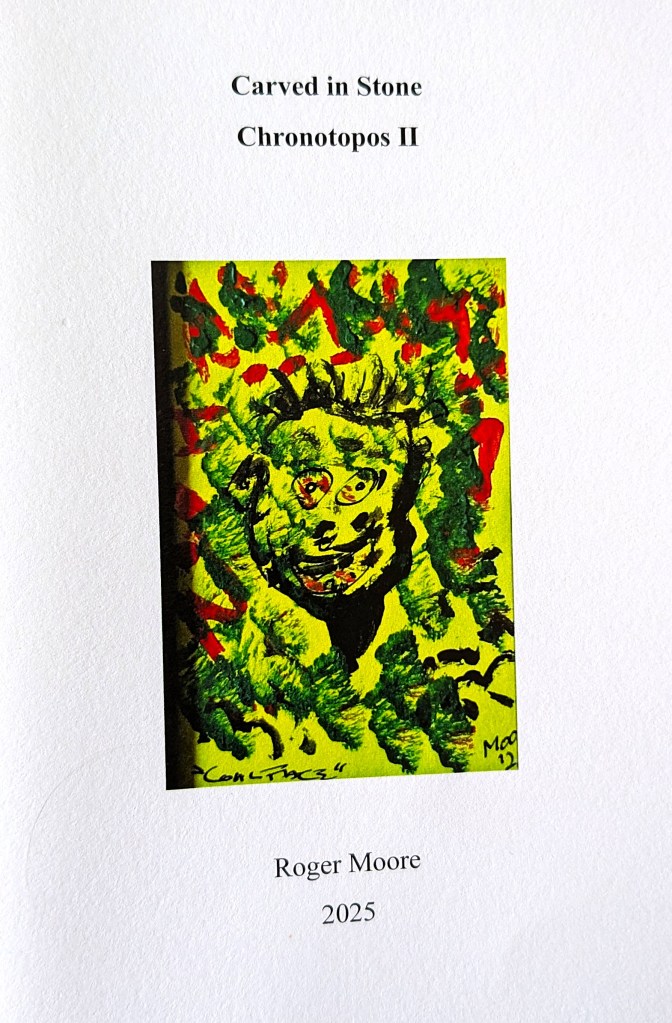
The cover painting, painted for me by my friend Moo when he read the manuscript of this book, is called Coal Face. It refers to the young Welsh boys in the Rhondda coal fields, aged 8-12 years old, who went down the mines to work at the coal face. This happened when the coal seams grew thin and only small children had the ability to work at the coal face and carve and mine the coal. Here are the relevant verses (44 – 45).

44

The old man, withered,
last house on the left,
leaning on his garden wall,
coughing, spitting up
coal dust and blood.

He’s not old, when you get close,
just grown old, underground,
where emphysema
and pneumoconiosis
devour men and boys.

He spits on the side walk.
Mining souvenirs,
Max Boyce calls them,
and they appear
every time the young man,
turned suddenly old,
starts to cough.

He can’t walk far,
wearing carpet slippers,
soft and furry,
just leans on the wall.

He fell, or was pushed,
into the trap at an early age,
when the coal seams
had grown so thin,
that only a small boy
could kneel at the coal face
before the black altar
of the underground god.

There, with a pick and shovel
he learned to carve and shape
those seams.

45

No candles burned at that altar.
A single match, let alone
a candle flame,
would spell the end,
if gas leaked from the seam.

Only the canaries,
confined in their cages,
sang songs.

Doomed,
like the blind pit ponies,
never to see the light of day,
they lived out their lives
down there.

So many died underground,
unable to get out,
buried alive,
before they were even dead.

Fall Foliage

Fall Folly Age

Fall Folly Age aka Fall Foliage is a play on words.
Thank you, Moo, my painter friend, for putting this title
on your painting and allowing me to use it for one of my book covers.

After intense heat
the garden is dusty dry.
The hollyhocks,
stressed out,
bow their heads
and tumble down.

Before the heat,
heavy rain drenched
the flowerbeds.
The yucca subsided
beneath waves of water.

One hollyhock,
regally proud,
stored so much liquid
in its flowery crown
that it bent and broke.

The mountain ash
bears a host of berries.
Bright orange,
they are already turning
to their winter shades.

I see so much stress
in the little world
I inhabit.
I no longer listen
to the news
or watch TV.

So much is beyond
my control.
Yet I can control
the radio and the TV
by turning them off.

The friends I meet
now have white hair.
Like me and my flowers,
they are dried up
and bent, held up
by sticks and canes.

My beloved and I
are growing old together.
We watch each other
with great care
wondering who
will be the first
to topple and fall.

Comment:

It has been a long, long time since I last wrote on my blog. Many things have distracted me, including editing books for friends, working on my own books, journaling, painting, and surfing the web in search of something positive to read. As for my own books, I published four this summer. Clepsydra Chronotopos I, Carved in StoneChronotopos II, Rage RageChronotopos III, and No Dominion Chronotopos IV. Maybe I will try to post on a regular basis and copy some of those poems here, in my blog.

The End of Time

The End of Time

A thin violin crying
its cat-gut heart out
in tears of sound, falling,
rhythmic raindrops,
down a grey-streaked face
tight with stress and taut with pain.

Such concentration,
such soulfulness packed
into each mindful note.

An audience of one,
I sit, head bowed, meditating
on the meaning of meaning
and the nothingness
of a being condemned
to oblivion, yet oblivious
of the how and when.

Each note a hammer-blow,
then, the piano pounding nail
after nail into this living coffin,
this body I drag through the motions
of extracting meaning
from this meaningless life.

Comment:

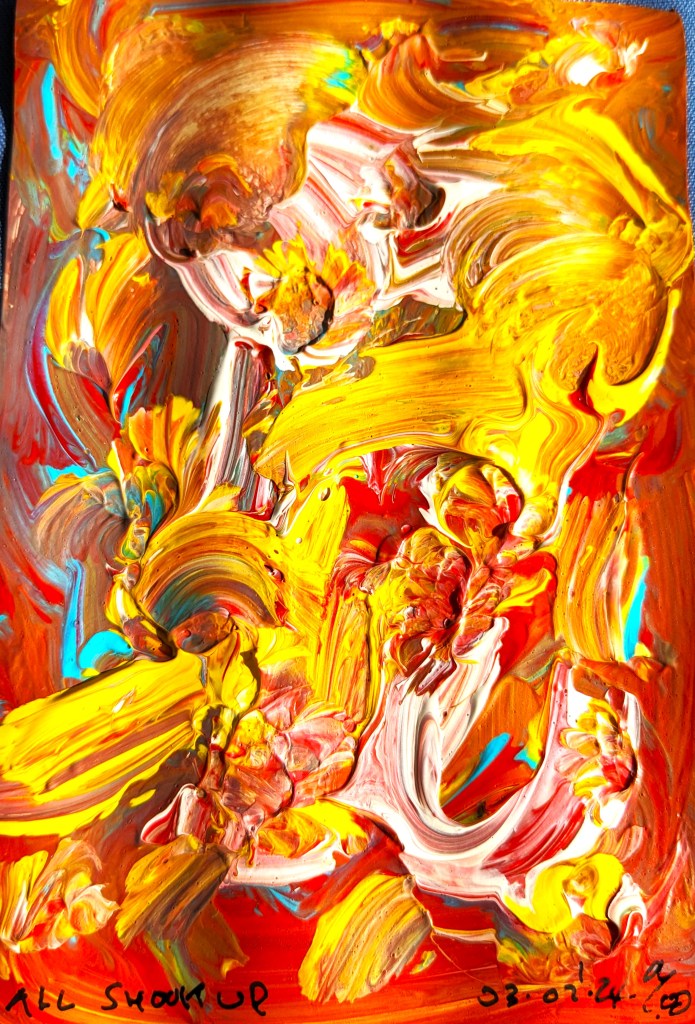
The End of Time is the second poem in the first sequence (Crystal Liturgy) of Septets for the End of Time. The painting, by my friend Moo, expresses his impressions of the nature of the end – but he doesn’t tell me the end of what. Certainly not of our friendship, I hope.

I am always worried by those last two lines: extracting meaning from this meaningless life as I don’t think that life is meaningless. However, there are times when it certainly feels that way. Those are the times when we need our beliefs in truth and the purity of art to survive. But how do you define them, you ask me. In all honesty, I don’t. I can’t. Art changes. What we consider to be true changes. Relativism? Yes, to a certain extent. I know what I believe. I don’t know what you believe. But I would never try to inflict or enforce my beliefs on to you. That is not how I work.

As for Moo, I don’t know how his mind works. I think he just sees things in color and shape and in the creation of movement within the stillness of a two dimensional illusion. I also think he thinks like a child. Maybe, like me, he has entered his second childhood, though I don’t really remember ever having had a first one. Oh dear – the meaning of meaning – one of the great enigmas of this wonderful world in which we live.

Where did my mojo go-go?

Where did my mojo go-go?

Wow! My first post since January 8, 2025. What on earth has happened to me? Good question – I just don’t know.

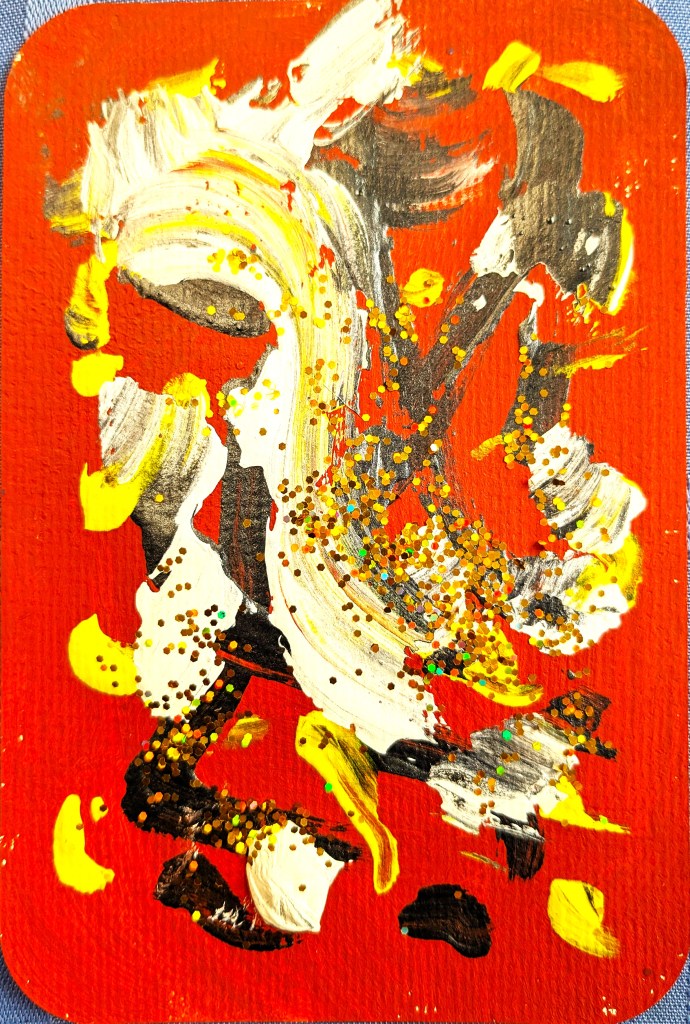
Today’s painting, from the last day of 2024, is taken from The Idylls of the King, Tennyson. “The olde order changeth lest one good custom should corrupt the world.”

This quote is used in my Old Boys magazine at the end of each school year when the students leave the college and go out into the real world. This happened to me in 1962 – 63 years ago. Certainly I changed, and for the better, without the college. Whether the college changed or not, in my absence, I really don’t know. I suppose it did. It became co-educational, quite the thing for a boys’ boarding school. It expanded into larger grounds. It tore down at least two of the old houses, including the one in which I boarded for four years. I read about these things, but I have only been back on one or two occasions, so I don’t really know. And living in Canada, I rarely see any old boys from the school. They don’t cross the pond to visit me.

I receive the old school magazine regularly, by e-mail. However, I no longer recognize faces or places, unless the places are totally unchanged since I was there. And not many of them are. The most important page for me has become the obituaries, and I study with care those who have passed on before me and those who remain. I grieve when I see the names of old friends. But I grieve even more when I see the names of people so much younger than me falling by the wayside.

As for that mojo of mine, well, I guess that writing on a regular basis has become more and more difficult. “Don’t sit with your head in your hands thinking of time past,” says the Spanish poet. Yet time past seems preferable, in many ways, to time future. I am beginning to feel a bit like a pin-cushion, on account of all the needles now being stuck into me. Perhaps that’s where all my mojo went? Still, for anyone interested, I am still here. Still happy. I am working on my latest novel and I have two books of poetry waiting to be published. So maybe my mojo hasn’t done a bunk, just my blog mojo! I shall have to kick start it. Or maybe I’ll get that little yellow duck who wears blue gumboots to stand on a brick and give me a hearty booted boost. Yup! That should do the trick.

And so, in the words of Dylan Thomas, “I’ll take a bow, and say ‘good-bye’ but just for now.

What is your mission?

Daily writing prompt
What is your mission?

What is your mission?

Let us begin, as usual, by asking, what do we mean by ‘mission’? Here are some examples of the meaning of mission. (a) an important assignment carried out for political, religious, or commercial purposes, typically involving travel. (b) the vocation or calling of a religious organization, especially a Christian one, to go out into the world and spread its faith. (c) any important task or duty that is assigned, allotted, or self-imposed. (d) an important goal or purpose that is accompanied by strong conviction; a calling or vocation.

I can happily dismiss (a) and (b) from the start. I do not consider an assignment to be a mission, not in my case anyway. I am not one to wander the world, good book in hand, heart on sleeve, convincing people to believe what I believe. That said, I can work with (c) and (d) because, as a life-long teacher, who was offered, at various time, an array of other jobs, I am happy to say that I was a teacher by vocation, by calling. Teaching was my mission. My mission was accomplished.

I taught, in Canada, from 1966 to 2009. Then I reached retirement age. On June 30, 2009, I was a teacher. On July 1, 2009, I was nothing. The shock was enormous. It took me a long time to recover and discover that no, my life was not over, and yes, I had many other things to do. Thankfully they all involved teaching, in one way or another. I used my teaching / research experience to sit on the editorial boards of various learned journals. I even edited a couple of them. I also translated, usually from Spanish to English, and worked with the translations of other people. I also wrote articles on teaching and on creativity.

Creativity gradually took me over. I offered workshops on prose and poetry, wrote and edited books, penned introductions for other writers, and even published some books by other people, usually my family or close friends.

There was never much money in teaching or in creative writing. I always did it for love – love of the subject, love of learning, love of the students, love of watching them grow and develop. When I work one-on-one with another writer, or with a small group of writers, that love is still there. Alas, as I grow older (much older!), I feel the ability to motivate slipping away. The will, the vocation if you like, is still there, but body and mind are growing weak, and that, my friends, is the saddest thing of all.

Dark Angel

He will come to me, the dark angel,
and will meet me face to face.

He will take all that I own,
for my wealth is only temporary:
health, wealth, possessions are all on loan.

My house, my wife, my car,
my daughter, my grand-child,
 my garden, my trees, my flowers,
my poetry, my works of art.
I use the possessive adjective
knowing full well that these things
are only on loan. I will never be able
to preserve and possess them.

I even rent this aching heart,
these ageing, migrant bones,
this death that has walked beside me,
step by step, every day
since the day that I was born.

My death alone is mine.
It belongs to nobody else.
It will be my sole possession.
It will soon be the only thing
I have ever really owned.

Comment:

Dark Angel is from my poetry book – Septets for the End of Time / Poems for the end of Time. The lead painting in today’s blog is by my friend, Moo, and he calls it Storm-Me.