Drink up thy Tizer!

Drink up thy Tizer!

I wonder how many people actually remember Tizer, the Appetizer. It used to be sold in grocery stores and corner shops. Don’t forget the Tizer, shrieked the adverts. I hated the stuff – but others loved it. Sweet, sticky, a little bit like dynamic Lucozade – and who remembers that, I ask. The same people as had cod liver oil poured down their throats when they were little children in the United Kingdom. An old and almost forgotten generation with its own traditions. But this post is not about Tizer, it’s about cider. Good old Somerset / Zummer Zett scrumpy.

I met Scrumpy when I went to Bristol University. It was an alternate drink to beer, and many pubs sold cider, in one form or another. A pint of cider – sufficient unto the evening was a pint thereof. After a couple of months, one could manage two pints of Scrumpy. Our drinking competitions including drinking a Yard of Ale. Someone always brought one when we went on a coach trip and we always ended up in a bar, in the middle of nowhere, trying to drain our yards of ale. I remember one lad bravely trying to quaff a yard of cider – scrumpy at that. Honk city – and it had nothing to do with the geese. But it was spectacular.

My own adventures with scrumpy really started in my second year at Bristol. The boarding house I lived in stood close to the Coronation Tap, one of the best cider house in England, if not in Bristol. First night I went in there and asked for a pint of scrumpy the barman suggested I have just a half. In my best Somerset accent, I said no, I’d appreciate a full pint. The barman duly placed it before me. As he did so, the man standing next to me at the bar suddenly woke up from his meditations, poked me in the ribs with a boney finger, and announced “Ah, lad. That’ll put lead in thy pencil.” I looked over at his pint of scrumpy and saw a slice of lemon floating in it. “What’s that lemon doing there,” I asked. “I’m waiting for the cider to eat it,” the man replied. “Better for the scrumpy to eat the lemon than to eat my insides.” Another night, at the Cori Tap, I met an old gaffer who wouldn’t touch scrumpy. I asked him why not and he replied that one night he’d managed to down seventeen pints of scrumpy. “That’s a lot,” I said. “What happened?” “Oi spend three weeks in ‘orspital, in bed, doan I?” He muttered.

In my third year, Hamburg University Athletics Cub arrived by coach to participate in an athletics competition with Bristol. The Cross-Country Club became the Athletics Club, in the summer, and we specialized in distances from 400 > 800 > 1500 > 3000 > 5000 > 10,000 metres. Thirsty work on a hot summer’s day. We took the Hamburg athletes back to our apartment building and spent the Saturday night slurping scrumpy down the Tap. They slept on the floor at our place, and next morning, a Sunday, they went shopping early. When they came back to their coach, they all grinned happily at us, and waved their bottles of Tizer in farewell. I looked around and saw that they had twenty cases of those bottles stored in the bus. “Ve vill have gut trip to Hamburg, no?” I started to laugh and they all joined in, waving their bottles at me. I didn’t have the heart to tell them that Scrumpy came in barrels, not bottles, and that they had not purchased cider at the local stores. Alas, they had bought 20 cases of Tizer the Appetizer. Somehow, in translation, cider had become Tizer – oh the glories of discourse analysis and the meaning of meaning.

Gone out

Gone out

“She has lived.
Now she has gone out.”

And all too soon
I too will go out
and people
will be able to say
he has gone out.

Or not.
Maybe there’ll just be
a silence.
Few people know me.
Even fewer care about me,
know who I really am
what I’ve actually done.

What have I done?
Nothing, really.
Nothing at all.

But I have struck a match or two,
lit some candles,
and allowed them to shine
in the darkness …

and soon, I too,
like those candles,
will go out.

Commentary:
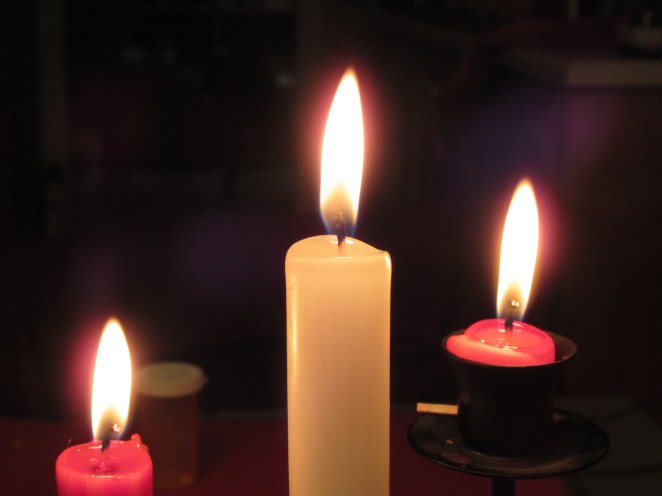
The opening quote, changed and adapted, is from Rudyard Kipling’s novel Kim. I was reading it a few days ago, by candlelight, as we had a brief, and totally unexpected power outage because some idiot ran into a power pole on the highway below us and cut off our power.

Reading by candlelight is so inspirational. It brings back memories of my childhood in Wales, summer evenings in the bungalow, no power, no running water, reading by lamplight or candle light. The candle’s scent, the flicker of shadowy thoughts across the page, each word held for a moment or two in a magic, shimmering glow. I recall also the candles on the high altar, lit for midnight mass, and the church all a-sparkle with shimmering light, incense, and flowers.

Power outage – I often think they should be called power out[r]ages. Then I think of the war zones, rife with suffering, where power outages are only one of the many outrages from which people are suffering. “Man’s inhumanity to man.” Robbie Burns, I believe. I regret calling that driver who took out the power pole an idiot. Shame on me. I found out later that he was a human being, suffering, just like me, from the attributes of ageing. A heart attack took him and his leaden foot, dead on the accelerator, sped him into the power pole.

DOA – dead on arrival at the power pole, and at the hospital. “He has lived. Now he has gone out,” snuffed out like the candles I blew out when the power was finally restored. It’s so easy to relight a candle, so hard to relight the beauty of a lost human life.


Absence

Absence …

… makes the heart grow
callouses scabs you can
pick at with your finger
nails bleeding fresh blood

they remind you that you have
a heart feelings something
buried so deep you need
a pick and a shovel to dig
a shaft with wooden slats
placed carefully at the sides
so your mine won’t collapse

you dig deeper and deeper
until in the gloom you see
the feathered fluttering —

a broken-winged canary
sacrificed in its cage
so part of you can escape
flee the mine
and come out alive

Commentary:

A golden oldie. Moo thought Poppy Day (11/11/2024) would be a suitable painting. Those who survive rarely forget those they were forced to leave behind. Kindred spirits, they travel though life together, the live one carrying the other on his shoulders as he would have done earlier, had he been able to.

Moo still has a teddy bear. He tells me he has always slept with one. His first teddy was an Australian Koala, a real stuffed koala given him by his Australian family, back when he was born. Moo was reading a book on the Battle of Britain (15 September 1940). It had a picture of the gunner from a Bolton Paul Defiant, sitting in the gun turret. Behind him, he had his little teddy bear. Moo couldn’t stop crying. He thinks he might have been an air gunner in another life, and when he saw that teddy, it brought back so many memories – flak, night fighters, search lights, tracer bullets, pain, flames, and then the unending darkness. So many did not come back, especially the tail-gunners. Their absence is still a presence to someone in their families. And so it should be.

Monkey Meets An Anarchist Ant

Monkey Meets An Anarchist Ant
(Memories of El Camino de Santiago)

The anarchist ant is dressed in black.
He has a little red base-ball cap
worn backwards on his head.
His eyes are fiery coals.

“Phooey!” He says.
“It’s folly to go with the flow.”
So he turns his back
on his companions
and marches in the other direction.

Some ants call him a fool.
The Ant Police try to turn him.
The Thought Police try
to make him change his mind.

Others, in blind obedience
to a thwarted, intolerant authority,
first bully him, then beat him,
then bite him till he’s dead.

Commentary:

I wrote this last century, no – last millennium – in the 1990’s, after walking the Camino de Santiago in Northern Spain. I travelled alone, on my own. An incredible journey. One of the sayings along the road is that if you do not make the pilgrimage to Santiago while you are alive, you will have to walk it in ant form, when you are dead. I often saw ants on the lonely, dusty roads, especially off the beaten track, and they were all headed for Santiago, except for one or two, who headed in the wrong direction, and were cut off by their companions. From these humble roots was this poem born.

Looking back nearly thirty years, I am surprised – and rather shocked – by the ‘little red base-ball cap worn backwards on his head’. I aways associated red hats with cardinals and bona fide llamas from Tibet (Kim – Rudyard Kipling). It obviously has a totally different meaning today, but I was definitely not aware of that thirty years ago when I first wrote this poem.

I was aware, however, of that in human nature, that made some people rebel and some conform. The conformists were rarely able to tolerate the rebels. This was particularly true in the Monkey Temple where the animals are bound by rules to which they must conform – or else. Thus, our poor anarchist ant broke away from the norm, refused to go with the flow, and suffered an awful fate as a result. Moo and I have always loved the rhythm and alliteration of that final brutal line ‘first bully him, then beat him, then bite him till he’s dead.’ But Moo definitely didn’t want to paint that picture. He encouraged me to use the photo of the ants in the honey pot instead. And guess what – there were fifteen ants floundering in that pot of honey. The luckiest ones were the anarchist ants who adjusted their baseball caps and fled!

How many anarchist ants, I wonder, baseball caps of any color askew on their heads, have suffered a similar fate? Some things, my friends, we’ll never know. And sometimes, my friends, I think we are better off not knowing.

Monkey’s Clockwork Universe

Monkey’s Clockwork Universe


Some days, monkey winds himself up
like a clockwork mouse.
Other days he rolls over and over
with a key in his back like a clockwork cat.

Monkey is growing old and forgetful.
He forgets where he has hidden the key,
pats his pockets, and slows right down
before he eventually finds it
and winds himself up again.

One day, monkey leaves the key
between his shoulder blades
in the middle of his back.

All day long,
the temple monkeys play with the key,
turning it round and round,
and winding monkey’s clockwork,
tighter and tighter,
until suddenly the mainspring breaks
and monkey slumps at the table –
no energy, no strength,
no stars, no planets, no moon at night,
the sun broken fatally down,
the clockwork of his universe
sapped, and snapped.

Commentary:

I guess we normal human beings, not the monkeys who live in the Monkey Temple, think of this as a sort of mental and physical burn out. It can happen to anyone really. You don’t have to be a monkey. But if you live in a clockwork universe where you clock in at nine and clock out at five, and regulate everything – your eating, your breathing, your visits to the loo – by the tick of the tick-tock work clock, then I guess this can happen to you.

Escarmentar en cabeza ajena – a lovely Spanish proverb that means ‘to learn from the blows delivered to another’s head’. Much better to let this poor monkey teach you that yes, you have to take breaks or, like monkey, you will break down. You must learn to pace yourself, not to be put upon by others, and to look after yourself. Because, if you don’t, others will take advantage of you and push you to, and beyond, your limits. Don’t learn that lesson the hard way, by ending up broken, run down, and in hospital. Learn from monkey’s experience. Keep the key hidden. Don’t let other people see it, or steal it, or wind you up with it.

Life is hard enough anyway. Look after yourself first. And then you will be much better able to look after other people – especially your family and friends – when they need your help. A difficult lesson to learn, especially in this world of multi-tasking where too many people hold too many low-paying jobs and work long, long hours, day after day, just to make ends meet.

There is no escape from the clockwork labyrinth, you think. Alas, that too is true, all too often. But escape you must. Somewhere, Ariadne’s thread will lead you out. You must seek it, even in the darkness and the gloom. Once found, it will lead you out from the darkness and back into the light. And that is what we must all hope for and work for. Pax amorque – and blessings.

Fear

Fear

Now is the time of fear:
ice on the morning step,
a child’s slide on the sidewalk,
a parking space too narrow
for me to get out of the car.

Sometimes the shopping cart
lurches beneath my weight
and I clutch at thin air:
each fall a precipice.

An emptiness in the gut,
a tightening of the elastic band
clamped around chest and heart,
a chill through the bowels
in the washroom’s dark:

 a long night that threatens.

Commentary:

Things happen, from time to time, and seem inevitable. With the coming of fall and the threat of frost comes the fear of ice. All year round, the fear of wet and slippery floors walks beside me. I am very careful about how and where I place my canes.

Shopping brings the fear that someone will park so close to me that I cannot get back into the car. Shopping carts can be treacherous. In one shop, their light-weight carts always seem ready to tip up or lurch over. The tell-tale leap in my chest reminds me that yes, this can and does happen. I am ultra careful in that particular shop.

Oh yes, and don’t forget the diuretics that upset the tummy and leave one struggling for time, and space, and the right place. Such things arrive so suddenly. They make the night seem dark and long.

Funny how the same thoughts change shape when published in prose, rather than poetry. The narrative is the same, but the emotional impact can be so different. Góngora wrote about such moments, a long time ago, in the early seventeenth century. “Cada pie mal puesto es una caída, cada caída es un precipicio. / Each false step means a fall, every fall is down a precipice.” The fear of falling is inherent to those of us who age. It is interesting that precipicio (Spanish) ends in -ice, precip-ice (English). How many readers note such seemingly minor coincidences?

Accident or deliberate? Who knows when the shopping cart or the cane slips out beneath us and we stumble as the ground comes suddenly rushing up, with us on the way down.

Water

Water

Here, in Island View, my lawn’s parched grass
longs for water, long-promised but never drawing near.
Do my flowers remember when the earth slept without form
and darkness lay upon the face of the deep?

The waters under heaven gathered into one place.
When they separated, the firmament appeared.
Light sprang apart from darkness
and with the beginning of light came the word,
more words, and then the world …

… my own world of water in which my mother
carried me until her waters broke
and the life sustaining substance drained away
throwing me from dark to light.

In Oaxaca, water was born free, yet everywhere
lies imprisoned in bottles, in jars, in frozen cubes,
its captive essence staring out with grief-filled eyes.

A young boy on a tricycle pedals the streets
with a dozen prison cells, each with forty captives:
forty fresh clean litres of drinkable water. He holds
out his hand for money and invites the villagers
to pay a ransom, to set these prisoners free.

Real water yearns to be released, to be spontaneous,
to trickle out of the corner of your mouth,
to drip from your chin, and fall to the ground.

It is a mirage of palm trees upon burning sand.
It is the hot sun dragging its blood red tongue across the sky
and panting for water like a great big thirsty dog.

Commentary:

This year, spring came with lots of rain. At one stage it looked like the waterlogged plants in our flower beds would all drown. Then, just before summer came, the rain went away and we suffered day after day of unbearable heat followed by nights during which the temperatures scarcely dropped.

As a result, the woods dried up and dry lightning strikes started fires. At one stage close to forty wild fires burned, many out of control. Entry to the woods was forbidden by law. Gradually, the fire-fighters fought back, extinguished the fires, one by one, and reclaimed control. I hope everyone realizes the enormous debt we owe to those brave men and women who risk their lives to save not only our lives, but our houses and our properties.

The fires have gone now. We had a day’s rain, 11 mms fell, but it’s not enough. We need more, a great deal more. We need to soak the trees, the grass, and to feed the streams and rivers. We also need to refill the aquifers on which life on earth, as we know it, depends. We need deep ends in our pools, not the shallow ends of depends, when it depends on whether or not the skies open and the heavenly waters fall.

CBC radio last night – farmers say they have lost their winter hay. How will the animals survive our winters with the hay fields burned and dry? One farmer said that, having no hay himself, it would cost him a minimum of $55,000 to bring in hay – if he could find anyone to sell it to him. Unfortunately, the same is true across the Maritimes – drought, forest fires, and a lack of winter hay. Spare a thought (and a prayer or two) for all those poor creatures, born to die, who will suffer this winter on account of this summer’s heat.

Clepsydra 14-15 – Clowns clowning around

Clepsydra 14-15
Clowns clowning around

14

… walking life’s walk
     grey jays in the ash tree
          fresh snow on the ground

at night
     deer track out of the woods
          moon’s dead skull
               chalking its slow path
                    westwards

snow falls
     white upon white
          whirling our world
               back to its cratered life

nothing needed
     other than moonlight on snow
          to ignite us

a white wall of water cascades
     earthwards from the moon
          waters of renewal
               waters of life
                    waters that restore us
and save us
     from the moonbeam’s slicing knife
          that amputates all life …


15

… it is scary tonight
     inside the topsy-turvy
          big-top of my circus world

carnival time
     clowns clowning around
          turning my life
               upside down

is my mind
     a spider-web
          spun by worry and doubt

I remember how
     they pushed me around
          kicked me out
               always the anonymous they

they abandoned me
     told me I was unwanted
          surplus to purpose
               forced me to exit

they told me to forget
     those amniotic waters
          that water world of comfort
               that illusion of reality
                     they had created
                          then threw me onto the street

    I left behind
          their stultified personalities
               with all their stupid rules
                    and blinkered minds
                         that stopped them
                              from seeing straight …

Carved In Stone

Carved in Stone

Brief Introduction

“Poetry explains itself. If it doesn’t, it’s inexplicable.” Pedro Salinas.

I entered this collection of poems for the Alfred G. Bailey Awad (poetry manuscript), WFNB, 2025. Alas, it did not win an award, but the judge, Kathy Mac, made some excellent suggestions as to how I might improve the manuscript. I have followed her advice to the best of my ability.

Carved in Stone is the second dialog (Chronotopos II) in my Bakhtinian Dialogs with my time and my place. Clepsydra, Chronotopos I, won third place in the Bailey Award (2025) and has already been published. I have one, possibly two, more Dialogs planned.

Reception Theory – I write, you read. Any meaning that you extract from my poetry will depend on your own culture and background. Tolle, Lege – Take and read. Read slowly, and with care.

I am a poet, a dreamer, if you will. These are my dreams. When you enter my world, you mingle your dreams with mine. The result, I hope, will be an interesting intellectual blend of new creativity. Pax amorque.

1

Behold me here,
filled with a sort of shallow,
hollowed-out wisdom
accumulated over decades
while listening with my eyes
to the words and thoughts
of writers, long-dead.

Imprisoned in book pages,
do they bang their heads
against walls that bind,
or hammer with their fists
at the barred lines
of their printed cages?

These spirits long to break free,
but they choke on library dust
and pollen from verbal flowers
that bloom unseen.

Those old ones avoided
the traps of temporal power,
or, once trapped,
gnawed off a precious limb
to limp into freedom.

Comment:
The cover painting, painted for me by my friend Moo when he read the manuscript of this book, is called Coal Face. It refers to the young Welsh boys in the Rhondda coal fields, aged 8-12 years old, who went down the mines to work at the coal face. This happened when the coal seams grew thin and only small children had the ability to work at the coal face and carve and mine the coal. Here are the relevant verses (44 – 45).

44

The old man, withered,
last house on the left,
leaning on his garden wall,
coughing, spitting up
coal dust and blood.

He’s not old, when you get close,
just grown old, underground,
where emphysema
and pneumoconiosis
devour men and boys.

He spits on the side walk.
Mining souvenirs,
Max Boyce calls them,
and they appear
every time the young man,
turned suddenly old,
starts to cough.

He can’t walk far,
wearing carpet slippers,
soft and furry,
just leans on the wall.

He fell, or was pushed,
into the trap at an early age,
when the coal seams
had grown so thin,
that only a small boy
could kneel at the coal face
before the black altar
of the underground god.

There, with a pick and shovel
he learned to carve and shape
those seams.

45

No candles burned at that altar.
A single match, let alone
a candle flame,
would spell the end,
if gas leaked from the seam.

Only the canaries,
confined in their cages,
sang songs.

Doomed,
like the blind pit ponies,
never to see the light of day,
they lived out their lives
down there.

So many died underground,
unable to get out,
buried alive,
before they were even dead.

Dark Angel

Dark Angel

He will come to me, the dark angel,
and will meet me face to face.

He will take all that I own,
for my wealth is only temporary:
health, wealth, possessions are all on loan.

My house, my wife, my car,
my daughter, my grand-child,
 my garden, my trees, my flowers,
my poetry, my works of art.
I use the possessive adjective
knowing full well that these things
are only on loan. I will never be able
to preserve and possess them.

I even rent this aching heart,
these ageing, migrant bones,
this death that has walked beside me,
step by step, every day
since the day that I was born.

My death alone is mine.
It belongs to nobody else.
It will be my sole possession.
It will soon be the only thing
I have ever really owned.

Comment:

Dark Angel is the third poem in the first sequence (Crystal Liturgy) of my poetry book Septets for the End of Time. The painting, by my friend Moo, expresses his impressions of how he reacts, in paint, to my poem, in words.

“Well,” I said to Moo, “you’ve gone and done it this time. Do you think that painting really represents my poem? I see no darkness in it and certainly no angel.”

Moo gave me a long, strange look. I felt like I was looking in the mirror and seeing parts of my own soul fragmenting and falling away, like scales from my eyes.

“It’s not what the poem says,” he replied. “It’s what I think you feel as you’re writing that poem. I see the tension, the cry from the heart, the struggle to accept, and the realization that, in the end, everything is inevitable and must turn out as it will. That said, more than anything, it is the cry, de profundis, from the depth of your self that I feel. My painting depicts that cry and your suffering.”

“What if it’s not my suffering? What if it’s the suffering of Messiaen and his musicians as they play the soul music that keeps them alive?”

“But surely,” Moo replied, “that’s the whole point. Orde Amoris, according to the recent Pope who has just passed away, is love felt for the person suffering, no matter who he or she is. Pope Francis spoke in praise of the parable of the Good Samaritan. When you see someone suffering at the wayside, you stop and help that person. You don’t just walk on by. Your suffering is my suffering. When I paint your suffering I also paint my own suffering and when you grieve, then I grieve with you.”

“And when that happens, when we all grieve together, we do not grieve alone and in vain.”

“Exactly.”