Clepsydra 39 & 40

39

… all too soon I too shall move on
     leaving behind me
          fading memories and cloud shadows


yet I recall
     standing beneath the cathedral’s
          great rose window
               on a sunny day
                    my body dressed
                         in a harlequin suit
                              of glistening lights 

in such splendour
     mortal things like words
          cease to flow

I held my breath
     shocked by an enormous presence
          that filled me then
               as it does now
                    with the knowledge
                         that nothing happens in vain …

40


… illumination
     I must find it for myself
  were another to tell me
      where it dwells
            its light would be untrue

only I can strike the match
     ignite the flame
          and trap its warmth
              in my body’s bone cage

when it flowers within me
     I’ll need no candle
          not even in the darkest mine

in Alma, I have seen
     the tide lower
          Fundy fishing boats
               down into the mud

like those boats
     I lack the power
          to resist both time and tide …

Commentary:

I asked Moo for a painting of boats from Fundy, preferably from Alma, lying on their sides at low tide. “Let me see what I am meant to be illustrating,” he said. He read the above excerpt from Clepsydra and told me “You’re navel gazing again. I thought I told you not to do that. Now, have I got a painting for you.” I didn’t dare refuse to post it – he’s had a bad couple of days and it has sharpened his sense of humor – so it’s here it is. Moo calls is – now don’t laugh – Naval Gazing.

“Nothing happens in vain.” So maybe I was predestined to ask Moo for a painting he didn’t have and to end up with one that tickled his fancy. Now that set off a light bulb in my skull. Mr. Dimwitty came to his sense – I have been navel gazing. Naughty, naughty. How many of you remember Mr. Dimwitty, the not too bright schoolmaster on BBC radio? Hold up your hands, and I’ll count them.

Meanwhile, things happen to Moo and me, and like the boats on the Fundy, we lack the power to resist both time and tide. And that’s why we help each other, carry each other along. “We few, we few, we band of brothers.” That was Shakespeare. Nowadays we have to say “we band of siblings.” It pays to be inclusive. Speaking of bands, I saw a man walking down Main Street yesterday, blowing a rubber trumpet. I asked him what he was doing and he told me that he was looking for a rubber band. Joy to the world and help spread the joy. If you don’t like joy, spread Marmite. And if you don’t like Marmite I am sure you’ll love Vegemite. Ma might, but Pa won’t. That’s why it’s not called Pa-mite.

Writing in the Red Zone

Writing in the Red Zone

The Red Zone:
it’s a familiar concept.
Monday Night football
talks about it all the time.

“Success percentage
in the Red Zone,
offense and defense.”

It’s not just football.
Other sports, soccer, rugby,
have their red zones.
So does life, my life,
for better or for worse,
and now I know I’m in
the Red Zone.

I can see the goal line.
I can feel the tension rising.
I know the clock’s ticking down.
I can sense it, but can’t see it.
I no longer know the score,
and I don’t know whether
I’m playing offense or defense.

They tell me it’s a level playing field,
but every day they change the rules,
and today I wonder what the heck’s
the name of the game I’m playing.

Clepsydra 37 & 38

37


… now I am absent from myself
     but can an absence
          be a presence

 I guess it can
     like when I lose a tooth
          I lament the loss of its presence
               and run my tongue
                    around the tender gum

a space where my tooth once stood
     where the candle flame
          once flickered and flared
               before it disappeared …

38

… I grieve for my mother
     standing in the garden
          her magnolia bleeding
               ivory petals
                    as soft as spring snow

some settled on her head
     crowning her
          with youthful beauty
               as she walked towards me
                    eyes shining arms held out

yet when I try
     to recapture that scene
          I only see a winter garden
               with withered blossoms
                    on a leafless tree …

Commentary:

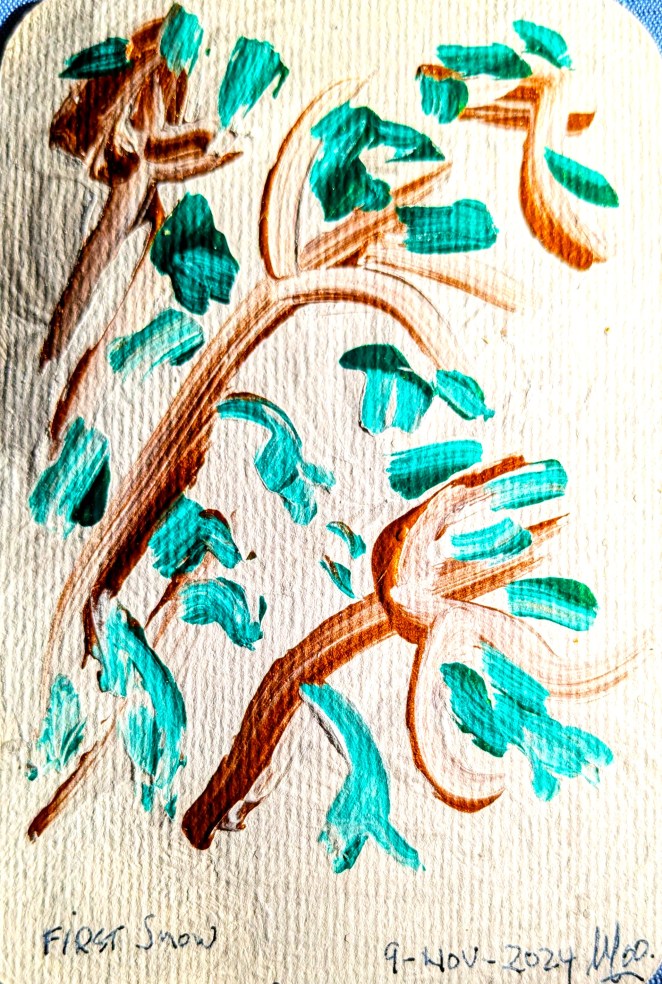
“Can an absence be a presence?” Good question I asked Moo that and he showed me several paintings of trees in winter and vacant faces that he had knowingly filled with sorrow. But I preferred the image of “I only see a winter garden with withered blossoms on a leafless tree.” So I chose my own photo. Moo was very upset and asked me to put in one of his winter paintings anyway, so here it is.

Now Moo is very happy, and he needs to be, because he has had a bad day. I am so glad I am not Moo when he has a bad day. His cardiologist wanted Moo to wear a Holter. Moo didn’t want to wear one. But he listened to his specialist, and obeyed. He was very stressed when he went into the hospital. The acquisition of the Halter was meant to take 15 minutes, maximum. Moo sent 75 minutes sitting in a cold room with no shirt on, terminals attached, and no Holter available. “Can an absence be a presence?” Indeed it can. And Moo is still very upset and very stressed. Nobody’s fault. Things happen. “The candle flame once flickered and flared before it disappeared.” Now you see it, now you don’t. And Moo laments the absence of what should have been a presence and then became a delayed presence. Oh fickle life and times!

I still grieve for my mother, standing in the garden, her magnolia bleeding ivory petals as soft as spring snow. I remember that some settled on her head crowning her with youthful beauty as she walked towards me, eyes shining arms held out. Yet when I try to recapture that scene I only see a winter garden with withered blossoms on a leafless tree. Maybe Moo, with all his stressed out Moo-ds saw that scene more clearly than I did. So, Moo boosts me, and I boost Moo, and that’s what best friends always do. So you go out and boost your best friend too. Blessings and blossoms. And may you all help each other to fare well.

Clepsydra 35 & 36

35
… to save myself
     I must grasp it firmly
          as I would a nettle
               not with my hands
                    but with my teeth

but my hands are tied
     behind my back
a cloth is bound
     over my eyes         
          and I cannot see … 

36

… I struggle and squirm
     until released
          I float ashore
               and stand on the sea wall
                    calling out to the moon
                         begging her not to hide
                              her scarred face


I entreat the ebbing tide
     to carry me with it out to sea
          past the island
               beyond the lighthouse
                    into deep water

waves stronger than any

     thing I have known
          thrust rough fingers
               under my arms
                    lift me up
                         then drag me down

to the depths
     where I can finally rest
          in peace …

Commentary:

Mors omnia solvit – death solves everything. But does it? What about the crossword, the jigsaw puzzle, the unsolved ? What about the problem of life itself? What is it? How does it function? And what is that poor bird doing lying on its PEI beach half-covered in sand? What problems did he have solved?

” my hands are tied behind my back, a cloth is bound over my eyes and I cannot see” …  so how can I tell where I am going and why I am going there? Simple questions – yet there are no answers, none that are given to me anyway. And who am I to reason why? Is my detiny, as always, to just do and die?

I do not know. The bird on the beach does not know. The ebbing tide doesn’t know, or care what it carries out with it. And what are we anyway? Why do we search for meaning in the meaningless? For answers in the absurd? And why does Sisyphus roll his rock up the hill, release it, then walk back down, pick it up and carry it up again? And why must we imagine that Sisyphus is happy? Our daily work – ce boureau sans merci – why should we be thankful for it?  Because there is nothing else? Because otherwise we would be abandoned? Or just because?

Oh, ho-ho-ho-ho, tell me if you know, who the… where the … why …. the what for … where did that one go? Even poor old Alf and dear old ‘Erbet, somewhere on the Somme, didn’t know the answer to that one. And they had their little dugout made a mess of by a bomb. Well, at least they found another hole, but when that other shell went over, it left them still wondering! And don’t we all?

Clepsydra 34

34

… my heart so broken
     I can’t count the pieces
          nor solve the puzzle

scars are trenches
     deep defensive lines
          gouged into my face 

every night
     the black dog returns
          and I wake up from a dream
               to find myself pincered

attracted by the light
     squeezed tight
          between cave walls

my top half struggles to be free
     my bottom half
          hips down is held
               in a ferocious grip

I scream the way
     a stuck pig screams
          when the knife flashes
               and the hot blood spurts

all at sea
     I move up and down
          on dark restless waves

I reach for a life raft
     but find only an apple
          bobbing as it floats …

Commentary:

Moo thought I needed cheering up, so he did this painting for me. U R My Sunshine, he said to me, then gave me the painting for today’s post. I think he was rather taken with the phrase ‘attracted by the light’ … hence the nice, bright, sunny painting. Whenever I feel down, Moo reminds me that every cloud has a silver lining. Today’s clouds over Island View certainly do. They have actually brought rain and we need that rain so badly. We are in the middle of a drought, in places it is a severe drought. Wells are drying up, the river and the aquifers are low, we need rain – and now we have some. Too late for the apple orchards and the farmers who do not have enough winter feed for their cattle. Too late for the local deer who do not have their usual post-summer glossy looks. And too late for the trees that look drab, having lost their usual fall glow to appear very pale and peaky. Let us hope that a little more rain, on a regular basis, will change all that, and give us the sort of silver lining that, next year, will produce golden apples and brightly colored fall leaves

Great Blue Heron

Great Blue Heron

The blood light draining from the sky
midges of color
skimming the beaver pond
colors skipping across the lake
the water alive with color

the low moon skinny dipping
across the surface each ripple
a leaf of stained glass
torn from a cathedral window

twin sticks angled
stark in the water
poised on thin stilts
waiting

this angel now
stripped of all garments
save a blue-grey gown
feathered around her

Commentary:

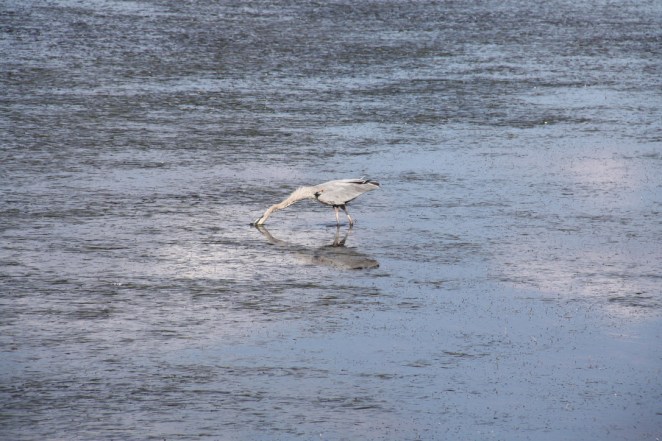
I love the great blue herons (GBH). They appear from nowhere, perch for a while, then vanish. So many on PEI. One evening I counted 60 or 70 in the bay. Such stealth. Such patience. Such beauty. Then a quick strike and GBH – grievous bodily harm to some small fish or frog invading their fishing space.

They build colonies in the trees by the waterside yet each creates its own free space when they fish in the waters. Flying, such power, such grace. Sharp beak our front, legs out behind, and the power surge of their wings thrusting them onwards.

Such a pleasure to stand still, to watch them and to thrill to the sudden spearing lurch of the attack. The house we borrowed in PEI had a little stream at the back. A GBH fished there. Quietly. Unseen. Scarcely moving the waters. A loner, just like me and mine. An only. As we are. Stately in his loneliness. As my beloved is in hers As I am in mine. A shadow on the waters. A shadow, while the sun still shines.

Book of Life

Book of Life

When I lost my place, I tied my hanky in a knot,
to help me remember the number of my page.
Last night I looked in pockets and sleeve, but
I couldn’t remember where I put my hanky.

At midnight the stars dropped liquid fires and they
pooled like letters on the fresh snow of my dreams.

One night I caught some falling stars and I joined them
together, one by one, till they stretched their daisy chain
across the garden. Words grow like flowers in the Spring.

Once I could accelerate the universe. But now I slow
down when I spell my name. There is a circlet of gold
on the sky’s bright brow. What gave these stars the right
to write my future in expanding letters? A satellite moves
in a straight line, north to south and starlight crumbles
in the wake of artificial knowledge spanning the eye ball
of the planet.  Who will repair these broken tunes? Who
will glue these scattered notes back into the piano’s frame?

My tongue stumbles against my teeth and trips on my lip.
A leaf of fire scorches the deep bell sound of my throat.

Commentary:

I looked over my shoulder, backward into time and space, and discovered this poem, penned more than a quarter of a century ago and abandoned in an old folder. Moo tells me he hasn’t painted for some time – I wondered if he was on a rotating striking, like our posties (Canadian for mail men and women), but he assured me that he had been sleeping, not sleep-walking in circles. Anyway, he felt inspired, put paintbrush to postcard and gave new life to my Book of Life. Thank you, Moo.

Do you remember when we used to tie knots in our hankies to remember what we had to do? Paper tissues put an end to that. No point in tying a knot in a soggy tissue, even if you could. And as Francisco de Quevedo told us – no point in looking in your hanky after you’ve used it. No point in searching for diamonds and emeralds, let alone pearls of wisdom, they just won’t be there. Good one, Franky. Of course, he was writing in Spanish, not English and my translation can’t do him justice.

It used to be fun watching the night sky out here in Island View. So clear – the satellites passed overhead and followed different paths from the stars. No Platonic dancing to ethereal music for them. Tone deaf, the lot of them, cutting their own little paths across the night sky. We used to get Northern Lights too, Aurora Borealis. They were always spectacular. Great crackling curtains of light hanging down from the heavens almost to the rooftops. Moo wishes he could paint everything h sees. I wish I could write down in verse every thought I think. If each of us had our wishes fulfilled, we’d have two books of life – one in color and one in black and white!

Clepsydra 33

33

… but the light cannot last forever
     so where do I go
          when the door in my head
               slams shut
         
then I know
     I have lost the key
          to my mind’s labyrinth
               I struggle
                    but I realize
                         there’s no escape

Ariadne’s thread
     the one that should lead me
          out of the labyrinth
               turns into a woven web
                     trapping me
                         leading nowhere

the minotaur
     half-bull – half-man
          bellows
               stifles all thoughts

my heart turns to stone
     indigestible
          in the throat’s gorge
               or the stomach’s pit
                    and my mouth’s
                         too dry to spit

in this starless night
     when fear descends with the dark
          a guillotine slices its way
               through muscle and bone
                    to sever all hope

no glow worm
     can worm its way
          into my mind
               to enlighten the path …

Commentary:

“… the minotaur, half-bull, half-man, bellows and stifles all thoughts …” I asked Moo for a painting of a Minotaur, but he didn’t have one. So I pottered about and found this photo of Los Toros de Guisando, a pre-Roman set of sculptures, in the Province of Avila, carved by the Celts. Not exactly a Minotaur, but certainly a set of taurine images that baffle with their size, silence, and presence. Indeed, they conjure up the images of the poem’s next verse ” … stone, indigestible in the throat’s gorge or the stomach’s pit …”

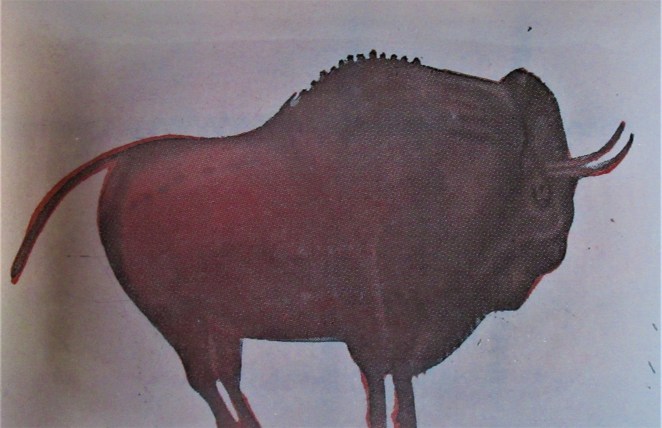
This is the cave painting, circa 5,000 BC of a bull, as found on the wall of the Caves of Altamira. Alas, he cannot bellow. Or should I say, Thank heavens, he can neither bellow nor pursue us. He stands silent on his cave wall. This photo comes from a glass ash tray my father purchased as a souvenir when we visited those caves (circa 1963-65, before they were closed to the public). Intertextuality – this bull as text and the long history of his multiple appearances. Metaphor and magic, mysterious and marvelous.

The idea that “religion is a glow-worm that glows in the darkness” is a metaphorical observation on the nature of faith. Its most famous expression comes from the German philosopher Arthur Schopenhauer. The statement suggests that religion appears most valuable and needed when people are in a state of ignorance, uncertainty, or despair.” Wikipedia – AI Generated. Our poet, that’s me, in case there are any doubts, refers back to this idea when he writes “no glow worm can worm its way into my mind to enlighten the path”. This too links back to the poetry of St. John of the Cross and his references to the dark night of the soul when hope seems lost and we despair of everything. Then we link to Goya’s etching – The Sleep of Reason – “when reason sleeps, monsters are born.”

However dark the night, someone has walked this way before us. We can follow in their footsteps and hope for the dawn. When it arrives, we can rejoice. But never forget the law of circularity, what goes round, comes round. Night will come back, the way will again be dark, but the light will always return once more. Images and symbols, metaphors and mystery, even the unspeakable can be spoken in the ways in which the ancient artists, sculptors, painters, saints, and philosophers have shown us.

Memories

Memories

All that remains of you: memories
and these swift-flowing rivers of blood
embodied within my flesh and skin.

A lifeless kite, each word I write,
too heavy to rise. Each sentence,
a wasted movement of lips and tongue.

And you, a black and white snap-shot,
of blooded washing hanging on the barbed
wire fence we grew each day between us.

Today, sunlight streams through stained
glass windows of the house you no longer
inhabit. Dust rises from artificial flowers.

Your poinsettia’s dry silk leaves, now mine,
brush a taut, barren kiss against my face.
I dream of the drowned lying cold on a beach.

Fresh memories pound through my head.
Waves on a rocky shoreline. Each word
a grating grind of shingle and sharp stones.

Commentary:

Moo calls it going Bodmin but the idea comes from Doc Martin and Porthwen. People lose their minds, their directions, and end up ‘going Bodmin’. This means they wander about, lost, on the Bodwin Moor and can’t find their way home. As we age, it happens to many of us. Not only do we go Bodmin, but our memories betray us. Sometimes we remember what we did as children, but forget what we did a few moments ago.

WWI – my grandfather told me all about it. “We’ll hang out our washing on the Siegfried Line, have you any dirty washing mother dear?” Or worse, “If you want to find the Sargent, I know where he is, he’s hanging on the old barbed wire.” Unbroken wire, covered by enemy machine guns, we who die like cattle – such bitter memories. And the French, walking to the front, baaing like lambs being led to the slaughter, decimated, one in ten (10%) being shot for cowardice or insubordination. “If you want the whole battalion, I know where they are, they’re hanging on the old barbed wire.”

And now you must think of the barriers, the fences, that we grow between us, day after day, as we grow old, and older. Artificial flowers, houses we no longer inhabit, dust motes floating in the air through rooms well-remembered, but no longer open to us. “Each word, each memory, a grating grind of shingle and sharp stones.”

Look at them, those lost people, those forgotten faces. You may even recognize one or two of them. Listen – well-remembered voices, bugles calling from sad shires, and every night, a drawing down of blinds.

Clepsydra 31 & 32

31

… I become more aware
     of the world
          outside my mother’s womb

I listen to the house’s heartbeat
     the occasional creak
          intruding rarely
               the house inhaling
                    exhaling

 I pay attention
     to my own bodily sounds
          my heart rate slowing
               increasing

now I can hear
     the faint tick-tock
          of a distant clock

a sunray illuminates
     a dust mote
          that dances before my eyes

light without sound
     silent butterfly wings
          seeking celestial light …

32

… did I write
          these words for me
               or did I write them
                    for someone else

does it matter
     when the only thing that counts
          is the beauty released,
               when the butterfly breaks free
                    and takes flight …

Commentary:

“The only thing that counts is the beauty released when the butterfly takes flight.” Sounds beautiful, doesn’t it? Just like the old poetic adage “beauty is truth and truth beauty.” But is it true? There are some very ugly truths and it is very hard to beautify them, even though we do our best to do so. I have always hated simplicities like “lipstick on a pig” or “silk purse out of sow’s ear”. And then there’s ‘a rose by any other name would smell as sweet.’ Probably true. Yet an ugly truth is still an ugly truth however much the spin doctors try to spin it.

And for whom does a poet (he in this case, the poet being me) write his poetry? Did I write those words for me, or for someone else? Good question. I certainly wrote them in the hopes that someone, somewhere, perhaps you, whoever you are, might read them. But I don’t know you, can’t know you, how could I know you? But if I don’t know you, how could I write for you? Did Cervantes write the Quixote for himself, or for his readers? And who were his readers, did he know them? He certainly didn’t know me, because he passed away on April 23, 1616, same date as William Shakespeare and the Inca Garcilasso de la Vega. The same date, you notice, but not the same day! Puzzle that one out, if you will. Meanwhile, he died 328 years, give or take a month or two, before I was born, so I don’t think he had me in mind as he penned his words, much as I didn’t have you (specifically) in mind, as I penned mine.

Carpe diem – seize the day. Don’t wase it on such idle philosophical speculations. Speculation / peculation – go buy yourself a lottery ticket – you may even win the jackpot. Of course, if you wish, you can be like me. I never buy lottery tickets and that would put money in my pocket every week (think of it as winnings!) except I never take it out. And remember – “Keep your water weak and your cider strong, keep your hands in your pockets and you won’t go wrong.”