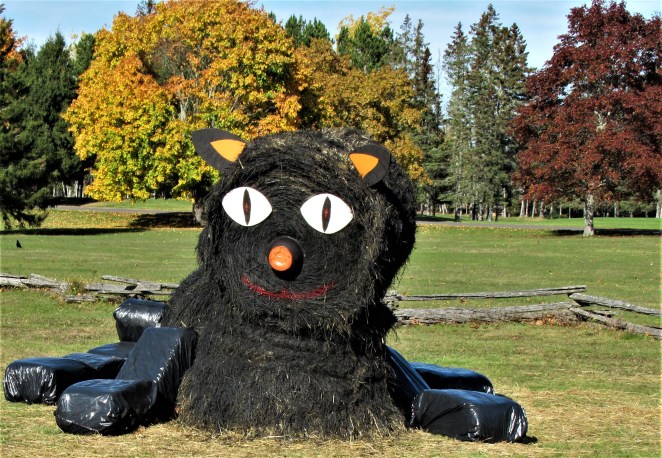
My favorite cat

My favorite cat

Pebbles have caught in my throat.
The word-river once flowing smooth
now backs up to spill leaf-freckled foam
over the tiniest barriers of branch and weed.

When I speak, some gypsy I find
has stolen my tongue, and my voice
is that of a changeling whisked away
from the cradle whilst her guardians slept.

Now leaves outside my window grow
rusty with autumn rain. A sharp-shinned hawk
no bigger than the blue jay he stalks
drives like a whirlwind at our feeder.

In dawn’s early light, a Great Barred owl
flaps enormous wings and drops like a stone
on my favorite cat, lifting her up and away.

Commentary:

Not a true story – sorry, my friends. However, I did see a Great Barred Owl swoop down on my neighbor’s cat. A canny old cat that one. He rolled over on his back, hissing and spitting, and showing all his unsheathed claws. Then he let out a most unnerving high-pitched whining sound and the owl backed off. Nature red in tooth and claw and our own backyard a battle ground where wild creatures roam and prey on each other.

Luckily, as a poet, I need neither seek nor deliver the truth, in any sense of the word. What I search for is emotional impact – words that ring true, even if they are not. Moments that reach out and grab us when and where we least expect it. As someone once said – never let the truth get in the way of a good story. Same with jokes.

And speaking of jokes, cross-cultural jokes are some of the most difficult things for a language learner to grasp. Humor exists in many forms. Silent comedy, like slapstick, does not need an interpreter. However, jokes based on cultural understanding are remarkably difficult to follow, unless one is totally immersed in the culture. As for linguistic jokes, even the sharpest individual can be defeated by word play and double meanings. I remember word plays from my beginner’s language classes that still leave me cold. Sorry, I just don’t find them funny even when explained. Clever, maybe, but funny? No way. Molière for example – Trissotin / trois fois fous. Really? ne dis pas que c’est amaranthe, dis plutôt que c’est de ma rente. Or, from the Spanish of Fuenteovejuna, Lope de Vega – Ciudad Real es del Rey. I hope you are splitting your sides over that one – I have never been able to laugh at it and still can’t understand what’s funny about it. C’est la vie, I guess.
Alone

Alone

the longing
to belong
appears from
nowhere

I want
to lose myself
in something bigger
than myself

religion
can bite like that
church and altar
feast days
incense and candles
confession
repentance
forgiveness
then sin again

I am not religious
not in that sense

nor am I militant
right arm raised
goose-stepping
in a parade
each step in time
with every one else

if that’s the meaning
of belonging
I guess I’ll continue
to dream alone

Commentary:

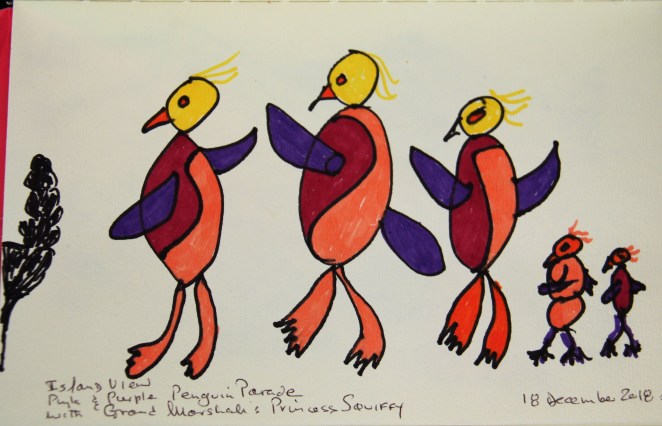
Moo thinks that Princess Squiffy, out at the front of the parade, a solitary cat, all alone and on her own, would be perfect for this poem. I am not so sure. Everybody is so happy, so engaged, except for Princess Squiffy aka Vomit, who is vanishing into the woodwork – about to plan and execute her next act of sabotage, I guess. Yes, Vomit! She’s the one who throws up in my chair.

The meaning of meaning – such a simple phrase, such a complicated philosophical history. How does one ‘belong’? In what ways can one ‘belong’? Does one yearn to belong or long to belong? And what does it mean – to belong? Does my cat belong to me? Does my dog belong to me? Cat and dog are long dead now – so how can they belong to me? And when I am gone, all my belongings will belong to someone else. A strange world, eh? And yet I long to belong in it for as long as possible.

The two most dangerous words in the world – thine and mine. Cervantes wrote that somewhere. For thine and mine are possessives. They teach us to possess things, to claim them as ours. My house, my garden, my trees, my flowers, my lawn. With the drought that has occurred this summer and into the fall, I can no longer say my lawn, my flowers, my garden, for they have all dried up and marched along, privatim et seriatim, – a touch of Kipling there, Storky and Co. if I remember correctly, and I don’t, because I just checked and it’s Stalky not Storky! – into whatever happy gardens dead flowers and gardens inhabit in their after life.

I think one of the most dangerous games ever invented is Monopoly. Make no mistake, I love my Monopoly set – especially the top hat and the flat iron – but what do we learn from Monopoly and from all similar types of game playing and role modelling? Why, to gather everything into our hands hands and possess everything on the Monopoly Board. At least when we play chess, we defeat an opponent by check-mating his / her king. We don’t have to accrue all 31 pieces on our side of the board leaving the poor king alone on the other. Even Fox and Hounds – and that’s an impossible game to win when you’re the fox- doesn’t humiliate anyone in quite that fashion. Ah well, the meaning of the meaning of Monopoly – Happy Canadian Thanksgiving – we can all have a good rant about that one.

Monologue

Monologue

“They broke our walls,” Mono whispered, “stone by stone.
A new church they built on the land they stole from us.
Red was its roof from a thunderstorm of blood.
The white bones of their lightning scattered us like hail.

They ripped out our tongues and commanded us to sing.
Carved mouths were ours, stuffed with grass.
Stone music forced its way through our broken teeth.

Few live who can read the melodies of our silence.
We wait for some wise man to measure our dance steps.

Pisando huevos: we walk on tiptoe across
these stepping stones of time.

Commentary:

Mono means monkey (in Spanish). Hence, monologue means monkey speaking to himself. Cute, eh? Monkey is one of the day signs in the Mixtec Codices. Lots of double meanings and rabbit holes down which the ardent reader can descend. Dig deep, my friend. Pisando huevos – literal meaning – ‘walking on eggs’ – meaning walking very carefully, on tip-toe, step by step.

Who said poetry was simple? You want it simple, there are so many simplifying factors out there. I want you to think. To think for yourself. To understand complicated language with multiple meanings. You want simplicity? Go watch a TV ad – Tide’s in, Dirt’s out. Omo adds bright, bright, brightness. The Esso sign means happy motoring. Don’ forget the Fruit Gums, mum – (said as the little boy throws a brick out of the window and it hits his mother on the head).

I’d say “wake up and smell the coffee.” But if wake means woke, I’m not the sort of bloke that accepts the meaning of wake or woke! Hereward the Wake. Robin Hood the Bloke in the Hood who Awoke- and I don’t mean the flower / flower, nor the Lincoln Green of the Lincoln Continental.

So what do I mean? I don’t know. Coded words are meaningless unless you have the meaning to the code. What code? The miscued code. And the meaningless lack of meaning in meaningless. Just like my friend who’s just been screwed, blued, and tattooed – and totally rude. Or was it scrod?

My First Thanksgiving

My First Thanksgiving

For the first twenty-two years of my life,
Thanksgiving had no meaning, no substance,
no shape, nor form, nothing to hold me.

When I emigrated to Canada,
my Canadian cousins changed all that.
when they invited me to come to
Kincardine for Thanksgiving.

They served a traditional Thanksgiving Dinner
with vegetables in colored jellies
and all sorts of things I had never seen.

We were all surprised
at how alike we looked.
Like Cousin George in Vancouver,
or Cousin Elsie in Revelstoke.

They told me how WWII
had brought the family back together
on these special holidays –
Christmas in Wales for the Canadian troops
or Thanksgiving in Winnipeg
for the Welsh boys learning to fly.

That thanksgiving, the old family names
turned into photographs before me.
Snaps of my mother’s wedding,
my grandmother holding me on her knee.

And finally, as a special Thanksgiving gift
a long-distance phone call to Britain
and Clare on the phone saying
yes she would come to Canada
and yes she would marry me.

And I remember crying
all the way back from Kincardine
to Toronto and that was my first
Thanksgiving in Canada.

Inquisitor

Inquisitor
Sun and Moon

He told me to read,
and plucked my left eye from its orbit.
He slashed the glowing globe of the other.
Knowledge leaked out, loose threads dangled.
He told me to speak and I squeezed dry dust
to spout a diet of Catechism and Confession.

He emptied my mind of poetry and history.
He destroyed the myths of my people.
He filled me with fantasies from a far-off land.
I live in a desert where people die of thirst,
yet he talked to me of a man who walked on water.

On all sides, as stubborn as stucco,
the prison walls listened and learned.
I counted the years with feeble scratches:
one, five, two, three.

For an hour each day the sun shone on my face,
for an hour at night the moon kept me company.
Broken worlds lay shattered inside me.
Dust gathered in my people’s ancient dictionary.

My heart was like a spring sowing
withering in my chest
It longed for the witch doctor’s magic,
for the healing slash of wind and rain.

The Inquisitor told me to write down our history:
I wrote … how his church … had come … to save us.

Commentary:

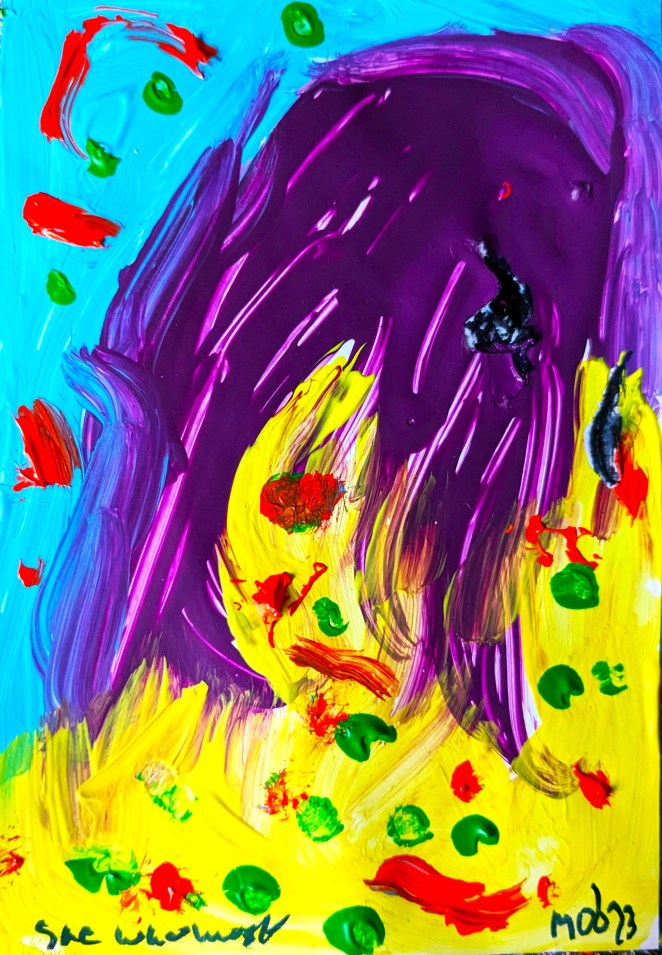
No wonder the little girl in Moo’s painting looks so sad. She must have read this poem and understood how the exercise of power and authority, be it religious or secular, can effect those upon whom it is exercised. Times change, but so many things remain the same. The pendulum swings, and it moves from chaos to order and back again. The meaning of meaning – how we define chaos and how we define order define who we are.

Birds of a feather flock together. Manners maketh the man. Wonderful sayings. But fine words do not necessarily make for fine men or women at that. Serpents and senators, both can speak with forked tongues. It is up to us to apply discourse analysis and distinguish between what they say and what they actually mean. As my friend Jean-Paul Sartre once said – “L’homme n’est rien d’autre que ce qu’il fait.” A man is nothing more than what he does. His deeds reveal his true inner self – and remember – the plumage doesn’t necessarily make the bird.

Gaia

Santo Domingo
Worshipping Gaia before the great altar
in Santo Domingo

If the goddess is not carried in your heart
like a warm loaf in a paper bag beneath your shirt
you will never discover her hiding place

she does not sip ambrosia from these golden flowers
nor does she climb this vine to her heavenly throne
nor does she sit on this ceiling frowning down

in spite of the sunshine trapped in all this gold
the church is cold and overwhelming
tourists come with cameras not the people with their prayers

my only warmth and comfort
not in this god who bids the lily gilded
but in that quieter voice that speaks within me

and brings me light amidst all this darkness
and brings me poverty amidst all this wealth

Commentary:

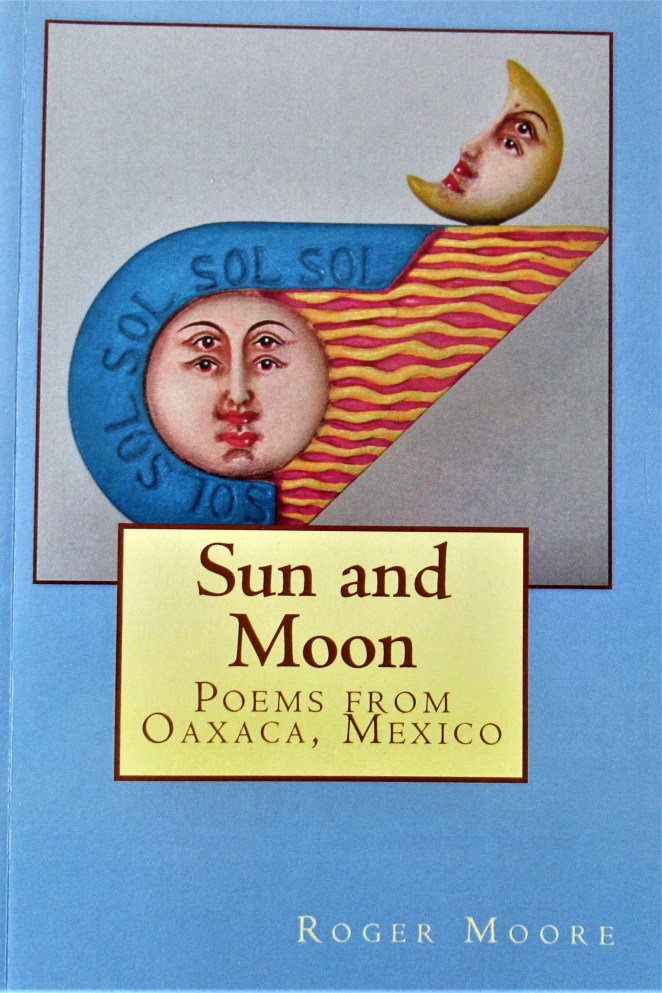
A Golden Oldie from Sun and Moon – Poems from Oaxaca. The Church of Santo Domingo in Oaxaca, Mexico, contains approximately six tons of gold and gold leaf. Incredible. I visited it regularly, but rarely saw anyone else in there. The local people seemed to avoid it and tourists with cameras were the main visitors. I refuse to take pictures inside churches, for several reasons.

It has always amazed me that the Spaniards built their churches on the sites of previous places of religious worship. This is partly because the indigenous appreciated the sacredness of certain sites, and partly because it was to these sites that the indigenous had traveled prior to the arrival of the Spaniards. Interesting, too, that the Spaniards call their arrival the Discovery while the indigenous call it the Conquest. History – a coin with two different sides – and it is sometimes difficult to look at both sides at once. Malinche – heroine or traitress? Cortes – hero or murderer? And, as they used to say in Northern Ireland, during the troubles, one man’s freedom fighter is another man’s terrorist.

Spin the coin of history, by all means. But beware of seeing only ‘heads’ and forgetting that there are ‘tails’. And never reduce those ‘tails’ to mere ‘tales’. Neither the written tradition nor the oral tradition is infallible. Many people, quiet and secretive as they may be, have long memories. And remember too that all that glitters is not necessarily gold.

The Screws

The Screws

There is no science to sciatica,
just a series of sensations
most of them involving pain.

I don’t know how or when it comes,
but one day, it knocks on your door
and makes you clutch back and buttock.

It’s like a hawk at the bird feeder,
flown in from nowhere to shriek
and shred, unawares, one small bird.

Was it the flannel I dropped yesterday
when showering?  I stooped to pick it up,
lunged forward and, was that it?

The pain came later. It kept me awake
all night, my worst nightmare.
No comfort anywhere. An endless

wriggling and every movement a knife
blade stabbing at my buttock and groping
its slow, painful way down my leg.

The screws, my grandfather called it,
a metal screw screwed into his leg,
leaving him limp and limping.

I googled it today, sciatica, and they
suggested an ice pad for twenty minutes,
repeated twenty minutes later.

“Yes,” I muttered, “yes” and found
in the fridge the ice pack we used
to use in our Coleman’s cooler.

My beloved helped me undo my pants.
“This,” she said, “will be icing on the cake.”
“No,” I said, “it will be icing on the ache.”

Tomorrow, I will call the pyro-quack-tor.
She will bend me to her will, straighten
my back, cure the pain, set me right again,
provided she doesn’t read this post
and will permit me to enter her domain.

Commentary:

Moo doesn’t paint pain, even though it occasionally emerges in his paintings. This painting of his is called Grey Day and I guess a Grey Day is rather like a Blue, Blue Day, something to be avoided, because you feel like running away. And that’s the problem with “The Screws” – it’s hard to face the pain when it’s behind you, unless you are a contortionist and can twist and twirl and see yourself in the mirror. I suppose another solution is to have eyes in the back of your head, but not everyone is that gifted.

As for the pyro-quack-tor, my apologies, Chiropractor, mine is excellent. I limp into her office, crawl onto the medical bed, and then, thirty minutes later, I hop off it like a man reborn, and skip down the corridor, waving my sticks and grinning as if I were a Gorilla in heat. Oh dear, not the sort of condition in which one should drive the zoo bus!

As for my joke – “This,” she said, “will be icing on the cake.” “No,” I said, “it will be icing on the ache!” This takes me back to my old school days – Aix-les-Bains / Aches and Pains. I remember one of my school friends going to Baden-Baden for his summer holiday. A double-barreled name, wow, very foreign. He asked me where I had been and I replied “Cardiff-Cardiff – this is Cardiff.” They used the English version back in those days, not the Welsh one – “Caer Dydd – Caer Dydd.” Doesn’t sound quite the same in Welsh. And how about Cas Newydd – Cas Newydd [Newport] or Pen y Bont – Pen y Bont [Bridgend]. And let’s not get into Llanfair.p.g – Lanfair.p.g – [Llanfairpwllgwyngyllgogerychwyrndrobwllllantysiliogogogoch – Llanfairpwllgwyngyllgogerychwyrndrobwllllantysiliogogogoch].

Try saying that one twice in quick succession. You’ll be sitting in the railway station a long time, just waiting to find out where you are. That, of course, is if trains still run to Llanfair p. g. “Gentlemen will please refrain from …. ” and if you can finish that little ditty off, in public, you have more courage than I do! Besides which, my voice broke long ago, and I haven’t mended it yet!

Clepsydra 23 & 24

23

… gulls on the wharf-side roof
     fishing boats
          returning to port
               white wakes trailing,
                    pointing to where they’ve been

where have I been
     all my life         

where is the wake
     that tracked me to and from
          so many unimportant places

so often have I waited
     for that moment of reunion
          port station airport

birds leaving nest
     only to return
          then leave again
               are not more faithful

sweet brevity of life
     a stone memorial
          on the harbour wall
               raised to all
                    who went to sea
                         and never returned
                              dying in the waves’ embrace …

24

… a watery grave
     no church no candles
          just cold waters sliding shut
               as down to the depths they go
                    

sinking from level to level
     never to rise again
          not till seas run dry
               burnt up by the sun’s candle

even then they’ll walk no more
          with their beloveds
               hand in hand
                    on diminishing land
                         or sea-licked sand …

Commentary:

“Birds leaving nest, only to return, then leave again, are not more faithful.” A lovely photo, from Avila, of storks, bouncing on their nests, waiting for the wind to lift them up aloft. I thought of using sea side photo from PEI, but this image caught my eye, and my words. A verbal – visual link. Not easy to spot, but there, in the sky above them, a parent waits. As soon as one chick takes flight, the watching parent will drop, fly under the fledgling’s wings, and tutor the young bird in the art of soaring and flying. I have spent many a happy hour, just sitting there, watching them.

And here’s the photo from PEI. An osprey, returning to the nest, after a fishing expedition. One hopes for such moments. Then, suddenly, one day, the magic happens, and verbal and visual joining hands in a single moment of magic. And listen to that baby bird, beak open, shrieking, waiting for the parent to arrive. I can still hear the screeching, although we are in the age of silent, but colorful, pictures.

In the picture below, the Grande Réunion – you can see the White Geese gathered at Bic. They return every year, so beautiful. The first time I saw them, I thought they were a drift of late snow. Then they rose from the field, and flew up, into the air. I have often seen snow falling but that was the first time I saw snow actually rising, after it had settled. A memorable moment.

Moments of magic, as I said, and each of them linked – verbal to visual. Silent dialogs with my time and my place, now shared with whoever has ears to hear and eyes to see and an imagination to reconstruct the alternate realities.

Books

Books
… they fornicate at night
double in size and numbers
fall off the shelves
copulate in piles on the floor

… origami
I guess it’s what books do
when they wrap themselves
in their own pages
and enfold their stories
mingling their tales

… synaesthesia
the critics call it
that mixing of senses
taste with touch
and the lingering
smell of fresh print
tingling in the nostrils

… intertextuality
books talking to books
they start off with one word
and cling to each other …

… and you know
what happens next …

Commentary:

No comment!

St. Mary Redcliffe

St. Mary Redcliffe

Time and Temple Meads
have begrimed your wand-thin spire,
the tallest in England.

You waved goodbye
to the Cabot boys,
Nova Scotia bound,
as they set sail.

Starling lime your belfry,
gift and inspiration
of Merchant Adventurers,
that gentlemen’s company.

Worms wriggle and gnaw
at your ship’s figure-head,
harbored now, bare-breasted,
sturdy in your oak-beam nave.

Rust rustles and creaks
at the Edney Gates,
wrought to last centuries
by Bristol ironmasters,
themselves apprenticed
to learn time’s laws.

Commentary:

Yesterday, via Zoom, I met with the Canadian Alumni of Bristol University. Sarah Price (Bristol Alumni Association) and Heather Proctor (Alumna) set the meeting up for us. Golden Oldies, all of us, we sat there and reminisced about our days, so long ago for most of us, at Bristol. I graduated in 1966, the same year I came to Canada. Most of the other alumni graduated long before I did. My last visit was in 1986 when I met with the Spanish Department, much changed, and talked abut my most recent research. One alumnus had visited just last year and talked of his returning to his old hall, his old room, his olde department, and all the changes that he had seen.

Most of those gathered had been in halls of one sort or another. Their experiences and friendships seemed very different to mine. Digs out in Knowle, Bristol, my first year. Then rooms in a rooming house, up by the Clifton Suspension Bridge, with other members of the Cross-Country team, for my next two years. Summers in Spain and France distanced me enormously from both England and the university. I remember coming back from Spain one summer and standing at the bus stop in Clifton, waiting for a bus to take me to Temple Meads Railway Station, a Number 18, if I remember correctly. Well, the bus arrived and drove towards me at enormous speed. It didn’t look as if the driver had any attention of stopping. So, I ran out into the road, waving my arms. He braked, gave me a very strange look, and asked me what I wanted. I said I wanted to go to Temple Meads. He said well get on the ****ing bus then. I looked at a great expanse of green metal, with windows, but no door, and asked him “Where’s the door?” Of course, after three months in Spain, like an idiot, I was standing on the wrong side of the road, and the wrong side of the bus. Such bitter-sweet memories.

I suppose I wasn’t a very good student. My only talent was speaking Spanish fluently. I worked hard at that, completely immersed in Santander, playing soccer on the sand, wandering through bars at night, learning to drink from a porrón and a bota without disgracing myself, and fishing on the weekends for panchos and julias in the Bay of Santander. I also learned how to row an old battered row boat, un bote. And it was all marvelous fun.

I also wrote a great deal of poetry and even managed to publish regularly in the Nonesuch Magazine. St. Mary Redcliffe, the poem above, dates from those days. I loved that church and visited it regularly. I wonder how many other Bristol students went in there and walked around inside. I also wonder how many stood with Jorge Luis Borges by the polished, black slate of the city hall, with its coal mine on the green, and gazed at their reflections in those shiny azabache mirrors. As I wrote yesterday on my blog – “How much can we know, your life of mine, my life of yours? At what point do those twin railway lines meet at the edge of time? Or are they doomed to a parallel universe where mind and mind, rail and rail, neither meet nor understand?” Sometimes, we can take a great joy in working out the answers to such questions.