Carved in Stone 43

Carved in Stone
43

Back home, in that little cul-de-sac,
the husbands are away,
working their night shifts,
while the wives are at home,
entertaining the truckers,
those long-distance drivers,
who park in that street and lodge there,
overnight, in the houses.

The children, boys and girls,
go out into the street,
climb into the trucks,
duck under the tarpaulins,
and, with all of us sworn to silence,
practice what their elders
are doing back home.

Commentary:
Monkey see, monkey do. And who knows what Monkey sees or does when the lights are turned out, darkness descends, and the honor of the blood cult takes control. Ask the animals, they will teach you. That was the motto of Bristol Zoo, where the Monkey Temple ruled, and Alfred the Gorilla and Rosie, the Elephant, were King and Queen of the beasts.

Knowledge – where does it come from? How do we attaint it? Is there a difference between knowledge, what is known, felt, and worked out for yourself, and education, when you obey orders and do what you are told to do (and how to do it). “We don’t need no education, we don’t need no thought control.” I have always loved Pink Floyd and The Wall. So many walls, so many barriers, so many things to break down in order to build them up again. Songs – Frank Sinatra – “I did it my way!” And who teaches what and to whom, underneath the tarpaulin when the lights are out? “Hey, teacher, leave those kids alone.”

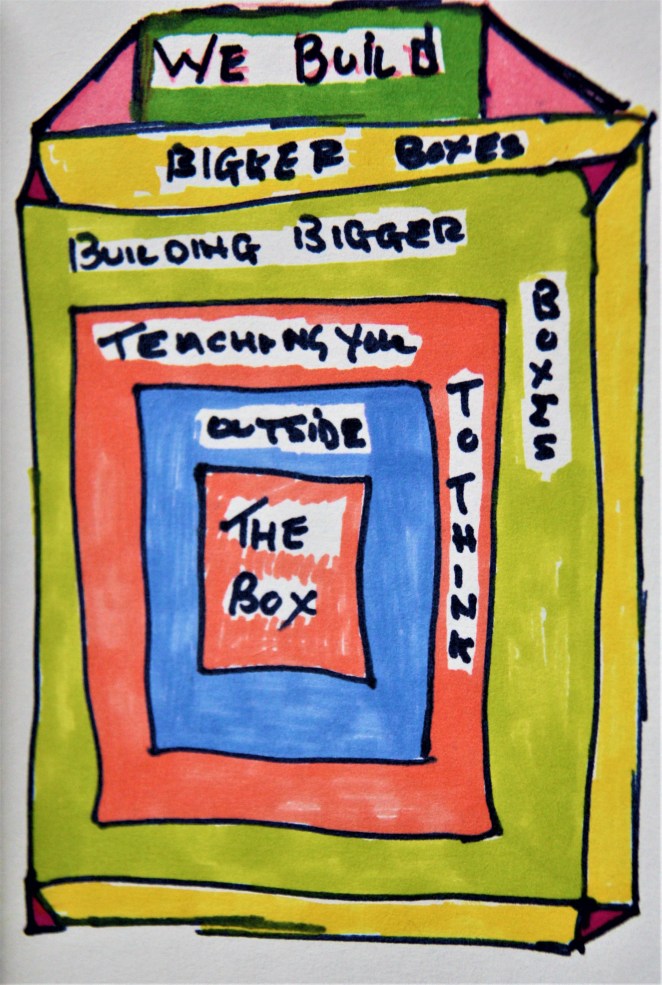
And beware of anyone who tells you that “we teach you to think outside the box.” That person will only give you a slightly bigger box, of his or her own making, inside of which you will be forced to think.

Of course, there are other ways in which we can think about education. How about this one? Filling empty heads with knowledge. How many ways are there to do this? And what is the exact content of the jug from which the knowledge will flow? And how many sows’ ears does it take to make a silk purse? “Hey, teacher, leave those kids alone.” Giddy up, Neddy I’m on my hobby horse now.

Carved in Stone 42

Carved in Stone
42

After school, in a cul-de-sac
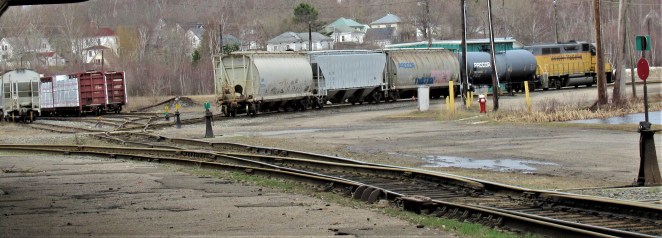
that backs on to the railway yards,
the street boys show me
how to hold a knife,
how to approach a man,
how to ask for a light,
for a forbidden cigarette,
while other boys,
knives in hand, lie in wait
to ambush the victim.

How old am I?
Five or six.

I would go to Woolworth’s
with my friends and distract
the shop girl while the others
stole whatever they could.

Then we would go
to the public washroom,
boys and girls together,
and share the spoils.

Something for everyone,
and everyone sworn to secrecy,
a blood cult, knives
or razor blades inserted,
and wrist pressed to wrist.

Commentary:

Free will or determinism? How does one escape from the back-street poverty of a run-down neighborhood and emerge from the shadows to bask in the light of the sun? Or is it all a dream, a made-up picture of a childhood that never was in a neighborhood that never existed? Vanishing point – the railway tracks fading away into the distance. Point of vanishing – to lose oneself in the mysteries of a past that never was in order to establish a future that never will be. Dream, dream, dream – all I have to do is dream!

And then there are the nightmares, when the dreams are true and the memories are so exact that you can see the blood on the razor blade and feel the almost silent slash of this particular slice of life. Secrecy – and who can tell whether I am telling the truth, or not, here in a foreign land, not the land of my fathers – and I only had one father, that I am aware of, and one mother too – where nobody knows me and the children from that imagined back street would never think of visiting.

For Jorge Luis Borges, whom I met twice, once in Bristol and once in Toronto, – Canada was a land so distant and so cold that it lacked reality. And thus I can dream my dreams, rewrite my past, reimagine myself, in whatever way I want to and I can vanish at any vanishing point I choose and emerge wherever I want to, and do it over and over and again, and who knows the truth? Over the points, over the points, and Liza none the wiser, whoever Liza happens to be!!!

Sign Language

Sign Language

A skater leaving marks on fresh ice
or a stone cast into a pond,
with multiple meanings, multiple ripples
moving slowly outwards,
to end up where?

Who knows? Not me.
I only know that the thrown stone,
like the spoken word,
can never be recalled.

Each word a stone,
and each stone leaving its mark
on many people of many cultures
and multiple languages,
though English is the language
in which I now write.

Frost and snow here this morning.
Not much, just a dusting.
I look out of the window
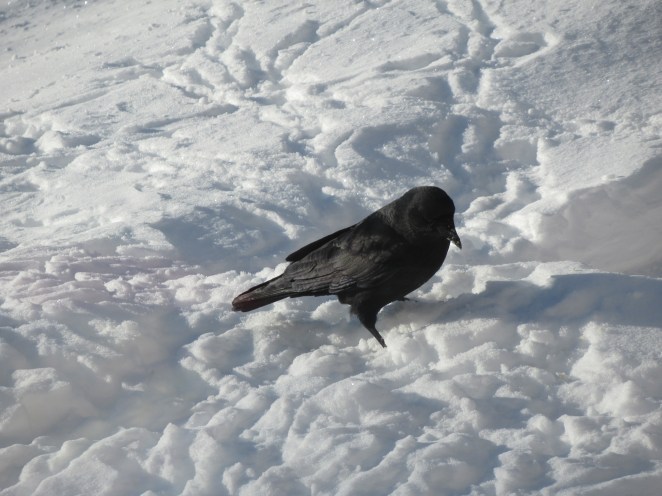
at the crows’ claw prints
on my yard’s white surface.

My eyes draw silence
out of the white space
with its runic language
written by the crows.

The meaning of meaning –
tell me, if you can,
what do they say?
What do they mean?
What do they want from me?

Commentary:

Intertextuality – this poem came directly from this morning’s commentary, with some minor alterations. The commentary itself, emerged from Carved in Stone, 35. Three separate steps in the great chain of intertextuality, where text speaks to text and the crows cock their heads, turn them to one side, listen, and write their answers in the snow.

Sometimes words just flow. Sometimes, I force them to flow. However, I have learned over the years that the secret is to relax and to allow the words to come to you of their own free will. Sometimes they whisper, occasionally they shout. But if you are willing to listen, you will hear them everywhere. And they have so much to say, if you will only learn to listen carefully and try to understand their language.

Carved in Stone 35

Carved in Stone

35

My eyes draw sound
out of the white space
of silence.

Silent the pen,
gliding smooth,
over unlined paper,
a skater leaving marks
on fresh ice.

Each mark is a signifier,
or a series of signifiers
constituting a signified,
a message engraved
in the reader’s mind.

Commentary:

Each mark is a signifier, part of a series of signifiers constituting a signified, a message written on paper, then engraved in the reader’s mind. But, of course, the message has to be read, and the reader has to be diligent enough to burrow into the meaning of the message. And what is the meaning of meaning? Ah, we have been down that rabbit hole before and Alice has been through the looking glass, and we have seen ourselves in our daily mirrors, slowly fading as the years go by.

A skater leaving marks on fresh ice or a stone cast into a pond, with multiple meanings, multiple ripples moving slowly outwards, to end up where? Who knows? Not me. I only know that the thrown stone, like the spoken word, can never be recalled. And there’s a 2,000 year history behind those words. Each word a stone, and each stone leaving its mark on many people of many cultures and multiple languages, though English is the language in which I now write.

Frost and snow here this morning. Not much, just a dusting. I looked out of the window at the crows’ prints on the white surface of the garden. My eyes drew silence out of the white space with its runic language written by the crows.

The meaning of meaning – tell me, if you can, what did they say? What did they want from me? What did they mean?

Carved in Stone 23 & 24

Carved in Stone

23

It isn’t true that art
lives longer than life,
for all too often art and artist
are destroyed together.

Words, all words,
and words emerge
from the silence of blood,
bone, and stone, breaking
that silence the day they are born,
and the word once spoken
cannot be recalled.

24

Here, among the ruins of my life,
I have learned how to be alone,
how to sink into silence,
how to smother at birth
that world of words,
and that world, still-born,
becomes a lost world
whirled on the silent wind that fans
the unborn fires within.

I sit here
brushed by a tadpole’s solitude
as it swims through the sultry silence
of blood, bone, and stone,
into its own metamorphosis.

The wind that blows unspoken words
tugs at the spider web of my mind
twisting and untwisting
its frayed, fragmented ends.

Commentary:

The fragility of life. The single puff that turns the dandelion into a dandelion clock. The multiple puffs that dowse the candles on the birthday cake. And then, one day, there are no more candles, no more cakes, just the heart ache of multiple absences, family and friends all gone and each of us alone with our individual loneliness.

That’s when we finally turn in and seek the inner roads that lead us to ourselves. The selves that were, the selves that are, the selves that always will be. Crack the walnut – inside is the map of a brain – your brain? If it is you will have found yourself in this labyrinth. But if it is the brain of another, you must not give up, you must seek yourself, walnut after walnut.

And when you go to the library, you must check book after book, because one day, if you are lucky, you will find the book of your life and it will tell you who you were, what you are, and what you will always be.

Carved in Stone 16 & 17

16

The Bulls of Guisando,
pre-historic, unweighable,
the bearers of Roman graffiti,
itself two thousand years old.

Were they carved as boundary markers,
or designed to designate pastures,
for horses, pigs, sheep, and bulls,
all grazing in their stone dreams?

Celtic, pre-Roman,
they speak to my Welsh blood,
and to the Irish soul
that will always be a part of me.

I place my hand
on the dimpled granite hide
and feel time coursing
beneath the stone skin.

Granite ships,
islands in a sea of time,
I sense a heart beating,
something surviving
within the stone.

17

We are powerful people,
we creative artists,
we carvers of stone,
we dreamers,
whether we dream
by day or by night.

Those of us
who dream by day,
often see our day-dreams
come true.

Commentary:

“Those of us who dream by day, often see our day-dreams come true.” Lawrence of Arabia – The Seven Pillars of Wisdom. You recognized the quote of course, wrth gwrs. Intertextuality, the weaving of words through text after text in different combinations according to our time and space. Some of us think we are original, but there are only so many plots to a play, 24 or so, if I remember my Aristotle correctly, and I have changed the number, just to test you. Oh ye of too much faith!

We think we are original, but, as Picasso said, the painters of the cave paintings, all those many years ago, created everything we artists could ever dream of. We all borrow in one way or another and originality is merely a disguised form of borrowing. The faces change, the actors change, the medium changes, the times change, but otherwise, everything else is the same. Sad, really, that we should claim originality (and fresh water) for all that water that has passed under so many bridges.

Welsh blood and Irish soul – not even original, but shared by so many in my family. Add an English education, studies and residence in Spain, France, Mexico, Canada, and the USA, and what do you have? An intellectual mongrel, that does not know its own mother, like so many other mongrels, and that shakes its coat only to shed so many multi-cultural and multi-lingual fleas.

And remember – “Great fleas have lesser fleas upon their backs to bit them, and lesser fleas have smaller fleas, and so ad infinitum.” Intertextuality – they were only playing leap-frog and one jumped over and another jumped over someone else’s back.

Carved in Stone 13

13

What is life?
Is it just an illusion,
as Calderón tells us,
and nothing but a dream?

And what is time?
Does it bend, as Dalí shows us
when his surreal clock breaks into pieces,
time and numbers flying off
as it explodes over a waterfall?

Another clock folds –
a pancake draped
over the bough of a tree.
 
Time – a water clock,
a marked candle,
a grandfather clock,
with Roman numerals,
and time marching,
round and round,
erasing the past,
establishing a future
that will itself
soon be erased.

And what am I
but a moment on time’s clock,
a drop in the clepsydra,
a striation on a flickering candle,
a piece of roughly polished sea-glass
perched on a lonely beach?

Commentary:

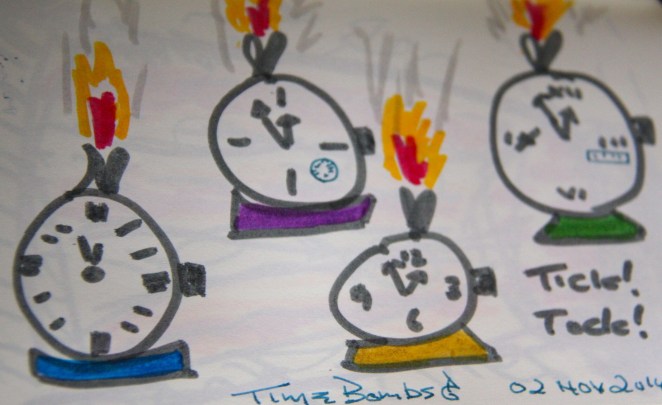
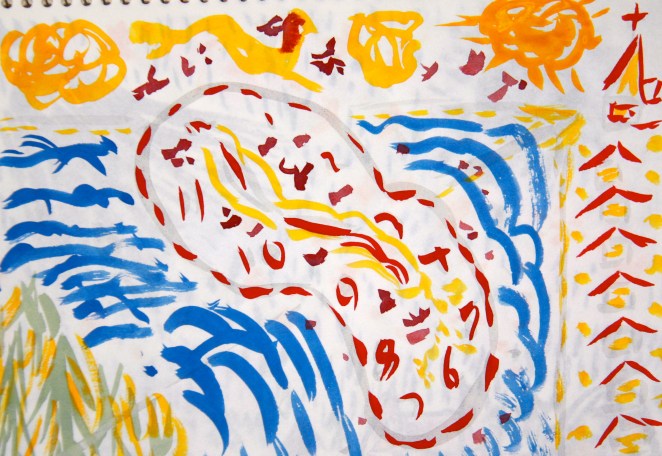
Well, Moo has done me proud this time. Two early paintings, both depicting aspects of time, as conceived by Moo. In the first, time is seen as a tick-tock time bomb, or rather a set of tick-tock time-bombs. In the second, in imitation of Salvador Dali (Moo always set his sights high!), a clock going over a water fall and the hours flying off the clock face as time bends. So, tell me if you can, what is time?

Perhaps more important, what is life? Is it a dream, an illusion? And if it is a dream, what happens when we wake up? I know what happens when I wake up – I get up and go pee. Is that to be my final reality? By extension, is life our only reality? Or is our life a series of lives, as some religions would persuade us? And if a cat has nine lives, how many lives do we have? Can they be numbered? Or, like innumerable onions, do we peel away layer after layer? And if so, what is in the centre of the onion when we finally get down that far?

And why do some people write center while others write centre? Is life an illusion, a play? If so does it take place in a theatre or a theater? Or is really a sort of metatheatre or metatheater, life in rings, like the onion, lay after lay, layer after layer? Oh dear, this is all much too complicated. I’ll ask Moo to paint me a painting of life and we’ll see what he comes up with. He’s a bit lazy at the moment and his paint brush has the bends and refuses to cooperate. It’s probably made of cat bristles, and is untrainable and almost impossible to train, let alone to herd. Never mind. We’ll abandon all this for now and give the cat the task of training Moo to paint another painting.

Carved in Stone 12

12

A Ruffed Grouse sought refuge
among the berries
of the Mountain Ash.

I shot him,
not with a gun,
but with a camera.

Intertextuality –
a friend borrowed the photo,
turned it into elegant brush strokes,
and now the painting
hangs on my wall,
opposite the tree
where once he sat.


A still-life
face to face with its reality
as early morning dew
forms on spider webs,
hammock-strung
between grass-blades,
bending in the wind.

And what if the spell breaks
and I can no longer see the fine seeds
of the dandelion clock kissed away
by the lisping lips of time?

What is life?
Is it just an illusion?

Commentary:

I shot him, not with a gun, but with a camera. Interesting. I have never seen the need to take the life of living creatures, except in cases of absolute necessity. And no, I have never killed, let alone for fun or sport. Shooting with a camera, that’s my ideal, and when a friend and fellow KIRA artist likes the photo and offers to paint it … well, that leads us into the nature of intertextuality, where reality becomes photo, becomes painting, becomes a text, and you, dear reader, are contemplating all those moments that join us.

The fine seeds of the dandelion clock kissed away by the lisping lips of time. This image comes from my walks in the Welsh countryside around Brandy Cove, Gower, with my paternal grandmother. “What time is it Nana?” I can still see her, bending down, plucking a dandelion, and holding it out for me to blow the seeds away – one puff, one o’clock, two puffs, two o’clock. I recall the seeds, drifting away on the summer breeze. “The Good Lord loved those dandelions,” she once told me. “That’s why He planted them everywhere.”

What will happen when the wells run dry and water runs out and there are no more dandelion seeds? How long will it be before I can no longer see them? Vis brevis, ars longa. The answer to my questions – I care, but I really don’t know.

Carved in Stone 3

3

Death is everywhere.
It rides a pale horse
in the lands
where Odin reigned.

Sleipnir, his eight-legged steed,
carried him round the world.

It also carried the god
to the underworld,
and brought him back,
one of the few to enjoy
a return ticket.

Purity, innocence, power,
the White Horse rules
these Wiltshire hills,
a symbol of hope and renewal.

Above the horses,
hill forts in high places,
lie hidden.

Wave after wave
of earth-wall and ditch
blend into the landscape
making the forts
invisible from below.

Commentary:

Odin > Wodin > Wednesday, in English, not Mercredi (French) or Miercoles (Spanish). English, via Anglo-Saxon, often goes back to the Nordic gods of the invaders. Not so in Welsh for Wednesday in Welsh is Dydd Mercher, the word breaking down into “Dydd” (day) and “Mercher” (which is named after the Roman god Mercury). Alas, it is all too easy to reduce language to its most basic level. But dig below the surface and the wonders of language, history and culture, adoption and rejection, complication and simplification, are all there to be seen.

Our language links us, binds us, holds us across our culture and history. And remember ‘to lose our language is to lose ourselves.’ While to learn another language is to grow another heart and soul.


Clepsydra 45 & 46

45

… I enter ancient rooms
     on the walls
          pale ghosts walk
               flickering shadows

why am I tongue-tied
     why do I struggle
          a fly in a spiderweb
               to make myself heard

I long for
     the freedom of flight
          for culture restored
                    for a return
                         to my own lost world

I grasp at shadows
     reaching out
          for the ones I know
                         are no longer there …

46

… how deeply time’s wounds

     have cut and carved
          through my flesh and bone

               into the embers
                    of that slow-burn fire
                         they call the heart

some days those wounds
     neither ache nor itch
          but in moments of madness
               a knife-edged finger nail
                    careless in the dark
                         opens them up

they throb again
     and begin to bleed afresh …

Commentary:

” … on the walls, pale ghosts walk flickering shadows – I grasp at shadows, reaching out for the ones I know are no longer there …” Vanity of vanities, all is vanity. For in much wisdom is much grief, and he who increases knowledge increases sorrow.

” … the embers of that slow-burn fire they call the heart … ” Pulvus eres et pulvus eris. Just another shadow on life’s wall.