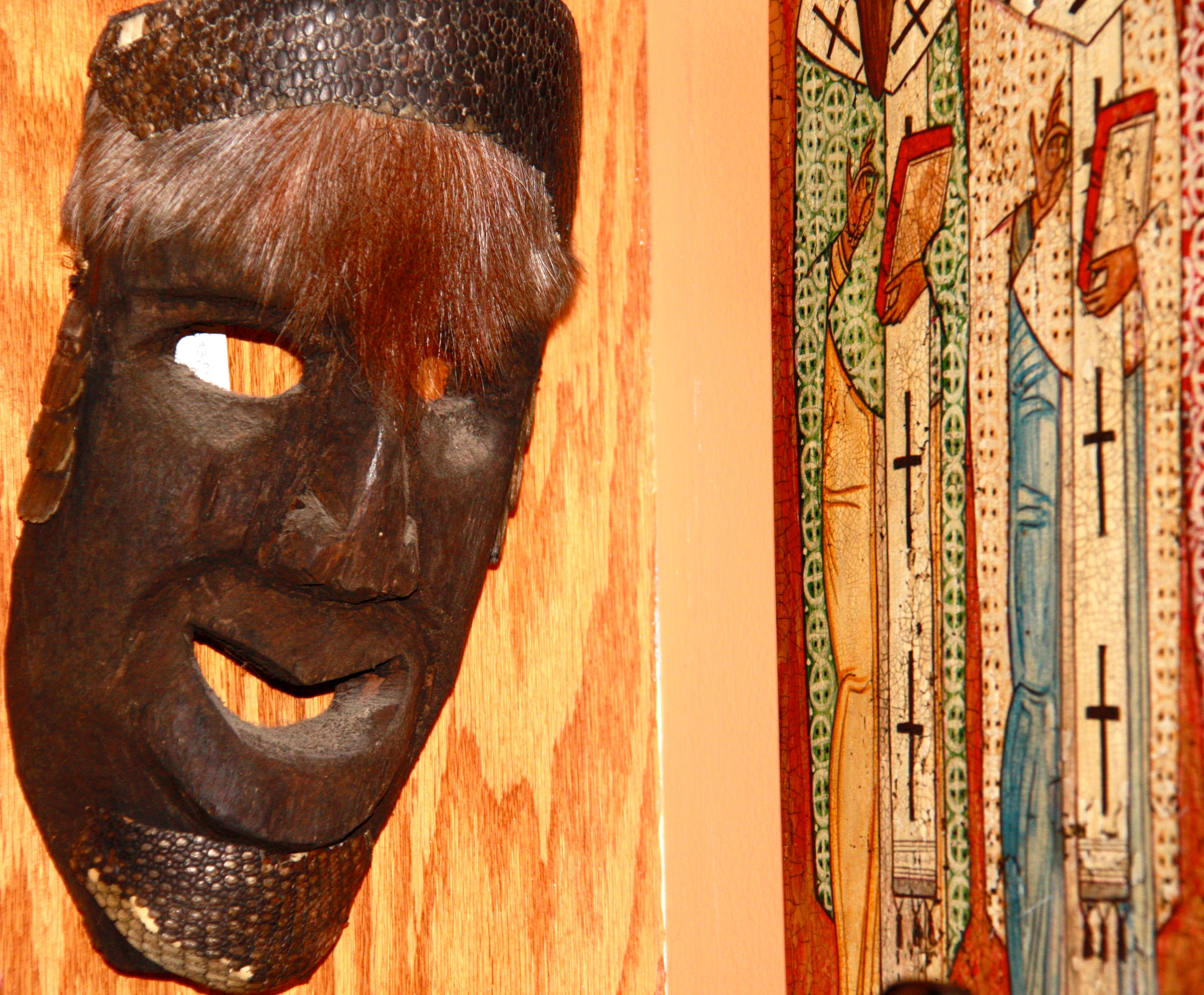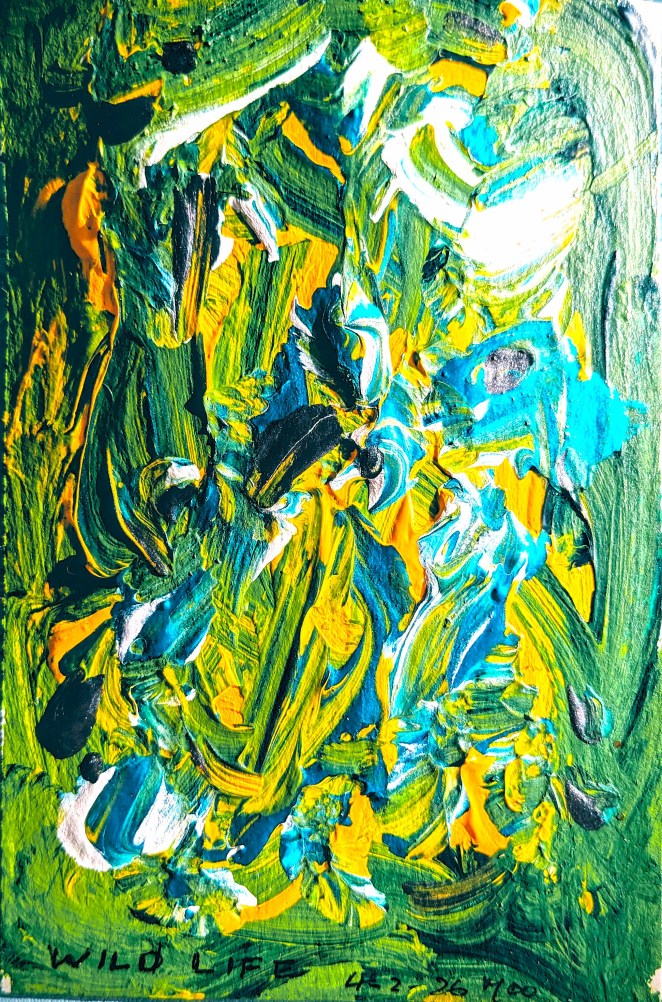
Carved in Stone 67 & 68

Carved in Stone
67

At night, on the cool
sea-shore of my dreams,
the calls of shore-birds
at Ste. Luce-sur-Mer
are borne on the wind.

High-pitched, they are,
like the voices of children,
or of men and women,
in distress.

I walk on the sand
at low tide and a lone gull
flies past my head,
battering itself
against the wind’s cage
with outraged, sturdy wings.

68

Sunset.
Sea mists descend.
The church on the headland
steps in and out of darkness.

Shadows gather, persistent.
Gulls surround a lone heron.
It clacks its beak in anger
forcing the gulls to scatter.

These words are not my words.

They came to me in the speech
of birds hidden in the foliage,
or carried on a feathered plume
sprung from the osprey’s wing.

Some came from the click
of the crab’s claw as he dug
deeper into the sand
a refuge where he thought
he could live safely.

Commentary:

Sunset. Sea mists descend. The church on the headland steps in and out of darkness. And so do I. I seek clarity, but there is no clarity when the sea mist descends, just the blurred image and the clouded thought. The cloud of unknowing, one philosopher called it, many years ago, and it is still with us. Especially when the sunlight fades and we are left wandering in the mists of unknowing.

“Is it here, you ask, or over here?” Well, if you do not know, I cannot tell you. But I will ask you this, and think very carefully before you answer – does the answer come from outside of you, given by another, or does it come from the deep, sacred intimacy of your own soul? The answer to that question will tell you all you need to know, one way, or the other.

These words are not my words. They came to me in the speech of birds hidden in the foliage, or carried on a feathered plume sprung from the osprey’s wing. Some came from the click of the crab’s claw as he dug deeper into the sand a refuge where he thought he could live safely. Sunset. Sea mists descend. The church on the headland steps in and out of darkness.

Carved in Stone 30 & 31

Carved in Stone

30

A well of beauty dwells within me,
not skin deep, but buried, arcane.

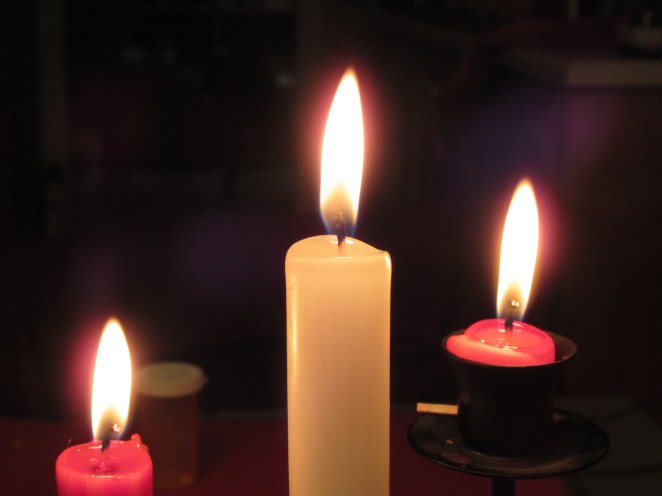
A flickering candle
tethered to an altar,
shimmers at midnight,
when the Latin mass is said,
bringing me light.

In the dark, canonical hours,
shadows move beside me
as I walk long corridors
from dormitory to a chapel
filled with heady incense.

31

I kneel, dumb-founded,
as candle flames wax and wane,
their brightness enhanced
by the midnight magic
that turns doubters into believers.

Spell and symbol, each candle a star,
shining, twinkling, in a galaxy of light,
and everywhere, the incense,
overloading my brain, releasing me
to revelations way beyond
muttered responses, mumbled words.

A world of inner darkness,
yet heart and soul soar together
up to the altar’s immortal light.

My shadow flickering
on the corridor walls,
as candle in hand, half-asleep,
I return to my cold bed
where the long, chill snake
of the bamboo cane
reminds me of tomorrow’s
flagellation.

Commentary:

Shadows on the wall or candles – with which should we start? Verbal and visual – how do they blend and knit together? Does my visual take away from your visual, or does it enhance it? To what extant does my verbal and the commentary on my verbal change the nature of your original thoughts when you re-create, within your own mind, my images, both verbal and visual?

Verbal and visual – now add the sense of smell. “The incense, overloading my brain, releasing me to revelations way beyond muttered responses, mumbled words.” And now remember that I was only six or seven years old when I experienced these things. Add the Latin mass, only half understood, the cold, damp feel of walls and wood beneath the hands. A world of inner darkness, yet heart and soul soaring together up towards the altar’s immortal light.”

My words are black print on white paper. My memories flare – an aurora borealis of senses sent crackling down the spine, in and out of the mind, tumbling the brain into a world … what sort of world? An unimaginable world. One never forgotten. One never re-recreated. One that never existed. One that never could exist. One for which the young child, six or seven years old, yearns for the rest of his life. His unsatisfied life. His unsatisfying life. His meaningless life. His absurd life.

Oh pity the poor puppy, not knowing what he has done wrong, not knowing how to put things right, always inadequate, whining and cringing at his master’s feet. And always, “that cold bed where the long, chill snake of the bamboo cane reminds me of the next day’s flagellation.”

Inquisitor

Inquisitor
Sun and Moon

He told me to read,
and plucked my left eye from its orbit.
He slashed the glowing globe of the other.
Knowledge leaked out, loose threads dangled.
He told me to speak and I squeezed dry dust
to spout a diet of Catechism and Confession.

He emptied my mind of poetry and history.
He destroyed the myths of my people.
He filled me with fantasies from a far-off land.
I live in a desert where people die of thirst,
yet he talked to me of a man who walked on water.

On all sides, as stubborn as stucco,
the prison walls listened and learned.
I counted the years with feeble scratches:
one, five, two, three.

For an hour each day the sun shone on my face,
for an hour at night the moon kept me company.
Broken worlds lay shattered inside me.
Dust gathered in my people’s ancient dictionary.

My heart was like a spring sowing
withering in my chest
It longed for the witch doctor’s magic,
for the healing slash of wind and rain.

The Inquisitor told me to write down our history:
I wrote … how his church … had come … to save us.

Commentary:

No wonder the little girl in Moo’s painting looks so sad. She must have read this poem and understood how the exercise of power and authority, be it religious or secular, can effect those upon whom it is exercised. Times change, but so many things remain the same. The pendulum swings, and it moves from chaos to order and back again. The meaning of meaning – how we define chaos and how we define order define who we are.

Birds of a feather flock together. Manners maketh the man. Wonderful sayings. But fine words do not necessarily make for fine men or women at that. Serpents and senators, both can speak with forked tongues. It is up to us to apply discourse analysis and distinguish between what they say and what they actually mean. As my friend Jean-Paul Sartre once said – “L’homme n’est rien d’autre que ce qu’il fait.” A man is nothing more than what he does. His deeds reveal his true inner self – and remember – the plumage doesn’t necessarily make the bird.

What aspects of your cultural heritage are you most proud of or interested in?

What aspects of your cultural heritage are you most proud of or interested in?

Right now, I am quite interested in (re-) learning the Welsh Language. Although I was born in Wales, I was never allowed to speak Welsh at home and my parents sent me to schools in which Welsh was never seen nor heard, let alone taught. That didn’t stop me from hearing out on the streets, reading it on the street signs, or visiting places whose names were only available in Welsh, or an Anglicized form of Welsh.

I am no longer an assiduous student of languages, but I get a Welsh Word a day by e-mail, and each word comes with an explanation of meaning and extended meanings. I also receive the words’ pronunciation and its phonetic changes (something peculiar to Welsh – they come in written form and can be quite complicated). Useful sentences are added – not long, but 3-4 seconds, repeatable ad infinitum, by reliable Welsh speakers, who often offer the variant pronunciations not only of North and South Wales but of other regions as well.

A great deal of linguistic and cultural history is wrapped up in language and the origins of the word are analyzed – sometimes going back to Indo-European, proto-Welsh, Medieval forms, and modern changes to the language. Emphasis is also placed on the survival of Welsh and its preservation, in written form, in Y Beibl Cymraeg, The Bible in Welsh. This fixed the language and helped enormously in its preservation.

I am also interested in Welsh Songs and Hymns. I already know most of the tunes having sung them in English during my childhood. Now I am learning them in Welsh and am currently working on the words to Calon Lan, one of my favorite hymn tunes. So, there you are. A new start at a very advanced age. A return to the past and an investment in the unknown future!

New Year’s Day

Self-portrait with mask

New Year’s Day
What’s in a name?

Only the winners write the history of their conquests, only the winners. Am I a winner, then? Of course I am. I’m writing this aren’t I? Therefore, ipso facto, I am a winner. This means that although they trashed and thrashed me, they never broke me nor was I a loser. I survived. And in that world in which I lived, surviving without surrendering was a victory in itself. But this is no tale of a hero, of bloody deeds, of a great victory. It is a survivor’s tale. So, if I won, then they lost, and who knows now how the losers felt, history’s non-winners, their slates wiped clean now, their names anonymous, erased from my story, not carved in stone nor impressed into steel.
            What’s in a name? The Red Wings, the Black Hawks, the Braves, the Algonquins? Whose heart lies broken and buried at Wounded Knee? Why does the Wolastoq rise in the Notre Dame mountains and flow down through unceded land to the City of Fredericton that noble daughter of the woods, and on to the city of Saint John on Fundy Bay? Why Wolastoq, Notre Dame, Fredericton, Saint John?
            “Sticks and stones will break my bones, yet names will never hurt me.” But what if I am called Nemo and have no other name? No-name man, no-name woman, no-name child, no language to call my own, no culture, no history, except the one that others wrote and forced me to believe or the innocent who causes me to rebel

            “Grandpa,” she says, climbing on my knee. “Tell me a story. Please.”
            “Once upon a time,” I begin. “There was this little girl …” She wriggles and giggles.
            “What was her name?”
            “I don’t know.”
            “Yes, you do.”
            “Don’t.”
            “Do.”  
            “Was it me? Am I that little girl?”
            “You can be if you want.”
            “I want. How does my story end?”
            “I don’t know. You’ve only just started it.”

So, write your poems, write your stories, write your childhood, write your memories, write what you know, invent what you don’t know. You can’t remember your name? Give yourself a new one. You have forgotten your myths? Create new ones. You have forgotten your language? Seek and you will find, and when you have found, learn your language again, a word at a time, phrase by phrase, word-picture by word-picture, until you have renewed your world and your place in it. Let your ancestors stride through your veins again and again to stand in the spotlight that you shine upon them.
            Restriction, extinction, suppression of the weakest and poorest, survival of the fittest … You, you who are reading this, you who have survived, you can count yourself among the strongest and the bravest. Now name yourself for who and what you are.
            Pick up your pen and write. Lazarus I name you: step out from your living tomb, step out from your kennel-cave. Pick up your bed and walk and talk, and write your own story. And remember the words of Oscar Wilde, “Tell your own tale, and be yourself, my friend, because everyone else is taken.”

Click here for Roger’s reading.
New Year’s Day
What’s in a name?

Comment: This is the penultimate chapter from On Being Welsh. I will put the last chapter up tomorrow.

Shower (A Selfie)

IMG_1256 (2).JPG

Shower
(A Selfie)

I smell. I whiff. I gloriously stink.
My arms, my feet, my crotch, reek with beauty.
This is me. I am still alive. I’m rank.
The time has come, the Walrus said, to take
a shower. I strip. I weigh. I obey.

Hot water streams. Bathroom steams up. I draw
faces on grey glass, smiling, glum. Soft soap
works its miracle turning Japanese
nylon into a rough body cloth that
rubs and cajoles all putrid dirt away.

Butterfly from its chrysalis, I step
from the shower, sniff with caution, and stench
no more. I am clean. I no longer pong.
My body has been taken over by
perfumes no longer mine. Who am I now?

I am no more myself. I am no more
my own gorgeous underarm muscular
ripeness. I have left my odor circling
in the soap suds and drifting down the drain.
What a pain. It will take me a week or
more to start smelling like myself again.

Comment: The cartoon is today’s effort. I looked out of the window and saw all the garden plants with ‘no particular place to go’ and that’s how it is sometimes, especially at this time of year, the summer behind, us fall present , and the winter ahead. We are left with the tiding up, the readying for next year, a sense of sorrow, and a feeling of hope that yes, the garden will return and yes, we will be here to witness it.

So, what are the figures in my cartoon saying to each other? Well, they have been reading the wise words of my olde friend, Oscar Wilde. “Be yourself,” he told them, ” everybody else is taken.” What are they you ask? They are themselves, as I am myself, and you are yourself, and yes, I am very happy to be who I am. And of course, everybody else is taken, so who and what is there left for us to be?

Coat of Arms

coatofarms.png


I’ve never yearned for a coat of arms. All those advertisements for this and that, DNA tests to prove your ancestry, where your family name comes from, how many famous people were in your past, how many convicts … and the convicts were often poorer family members, wallowing in poverty and forced into theft, money, a loaf of bread,  a chicken, a lamb, some eggs, something to feed the children, to pay the bills … the possibility of blue bloods and royalty outweighed by the probability of some dark skeletons swinging on gallows somewhere in the distant past.

Yet when I got my online advent calendar this year, there was the coat of arms game … make your own coat of arms. So I did. The choices were very limited, not too original, and came with a ‘clan history’ that has absolutely nothing to do with me. A bear and a dog … I can live with those, especially as the bear is apparently my Canadian spirit animal. A Welsh dragon draped round the top of the frame … wrong color and definitely not Y Ddraig Coch, the blood Red Dragon of Wales, but still a symbol I can happily live with. Down below, we have Sun and Moon, the symbol of Oaxaca and title of the first book in the Oaxacan Trilogy (first published in 2000). Unfortunately, I have reversed the symbols to give us Moon and Sun. Oh dear. Such things happen.

Then we have a snowman and a beer tankard. Sounds good to me. I have now lived in Canada for more than fifty years in Canada and I know all about snowmen, and the taste of beer, sometimes mulled, to take away the cold. I am not so sure about ‘my clan’ as I don’t really think that I have one. I feel it is a very foreign term  like Hi there, gang. I can take Robin Hood and his Merry Men, but Roger and his Merry Gang, no thank you, that’s not for me. Sorry. As for ‘throughout the land’, I wonder which land they are referring to: Wales, England, France, Spain, Mexico, Canada … I don’t really feel that any of these stand up as my ‘land’ … except possibly for Canada, and as for Canada, well, this land is enormous. I have certainly visited some of it, but by no means all, and there is so much more to see and hear.

‘In Battle’, well, I have never been in a battle. I dislike violence and fighting, and I cannot imagine how a phrase like that got in there. ‘Fierceness’ same thing, I am as mild as milk and very easy-going. ‘Loyalty’, yes: that’s what the bear and the dog are famed for. ‘Us bears never forget’, or words like it, from the Chronicles of Narnia. Oh dear, there I go … I can hear mother bear now … ‘Stop sucking your paw’.

Seize the day is goodCarpe Diem … but never in battle … in poetry, maybe, or else in gathering old age where every moment of every day seems more and more precious. I wold have preferred Horas non numero nisi serenas, but they didn’t have that one, even though, nowadays particularly, it is the happy hours that I count, and not all of them spent in a local bar, or home alone, with my own beer mug.


Catch Up

IMG_0112

Catch up

The mask I wear has strings
attached. Two I have tied,
two more hang down like
pigtails, swaying as I walk.

My tongue pulses round
my mouth in search of
that tooth I cracked, yet
afraid of its sharp-edged scar.

It feels as if I have lost
a part of my life and I am
running in circles looking for it.
I guess I’ll catch up with it
someday, and when I do,
I hope it will know me
and tell me who and what I am.

Meanwhile, the mask clings
heavy to my features
and prompts me in the new
role I must play. My friends
walk past me now
and do not stop to talk.

When I look in the mirror,
I no longer recognize myself.
All my ID is fake. The success
of my disguise fills my empty head
with a sudden sense of shame
and I know the sound of sorrow.

Torticollis

Avila 2007a 039

Torticollis

A sudden crick of the neck and I am back in the chalet at Perines with Trini.

“Torticollis,” she says, raising a hand to her neck, except she says it in Spanish, ‘tortículis’.

She offers me tea, very English, from the Wedgewood tea pot I brought her, all those years ago. Beside her, the Pirate with the Parrot on his Shoulder, my Toby Jug, still stands on guard, and protects my memories.

Orphaned, I was, from England, abandoned on that Spanish shore, and left there all summer to learn the language. Trini taught me how to eat, speak, choose my books and my friends … she had lost a son, same age as me, just after the Civil War, and treated me like her son, returned, like the Prodigal Son I was to all who had sent me away from home to improve my lifestyle and my manners.

Wanted? Unwanted by my family? I wouldn’t know the difference.

In that far-of land, in time and space,  I only knew the loneliness of being lost, marooned in a foreign land, feeling my way, day by day, among foreigners, still foreign, although they took me into their homes and hearts and loved me as I had never been loved before.

Back home, drowsing  at the kitchen table, I doze into my dreams, only to be woken by that beloved voice.

Wistful, I turn my head and glance backwards into that past of sunshine and beaches, where the sun sparkled on hill, sand, and sea and the table cloth was spread on the family table, pure and white, with a dozen of us sitting, talking, smiling, drinking wine, that bottled sunshine that still adorns my dining room table.

“Trini? Is that you?”

Her name slips from my lips as I snap my head towards her voice. As I turn, I twist my neck and raising my hand to the sudden pain, I hear again that word: “¡Tortículis!”

Night Thoughts

15-may-2002-pre-rimouski-224

Night Thoughts
(for Tanya Cliff)

The weight of the weather
with its dark clouds pushing
down on my shoulders
bends me to its omnipotent will.

I know my back doesn’t have
the power to lift up my heart
and soar above such heavy clouds.

I need a chariot of fire …
yet the clouds are so strong,
and the light is so weak
it won’t break through,
except in sudden flashes.

I hear the creak of sodden wheels.
Clouds blinker the lightning
as thunder crashes through my brain.

I listen to the pouring down of rain
and pull the bed sheets over my head.