Carved in Stone 44

Carved in Stone
44

The old man, withered,
last house on the left,
leaning on his garden wall,
coughing, spitting up
coal dust and blood.

He’s not old, when you get close,
just grown old, underground,
where emphysema
and pneumoconiosis
devour men and boys.

He spits on the side walk.
Mining souvenirs,
Max Boyce calls them,
and they appear
every time the young man,
turned suddenly old,
starts to cough.

He can’t walk far,
wearing carpet slippers,
soft and furry,
just leans on the wall.

He fell, or was pushed,
into the trap at an early age,
when the coal seams
had grown so thin,
that only a small boy
could kneel before
the coal black altar
of the underground god
and, with a pick and shovel,
he learned to carve and shape
the long, slow death
contained in those seams.

Commentary

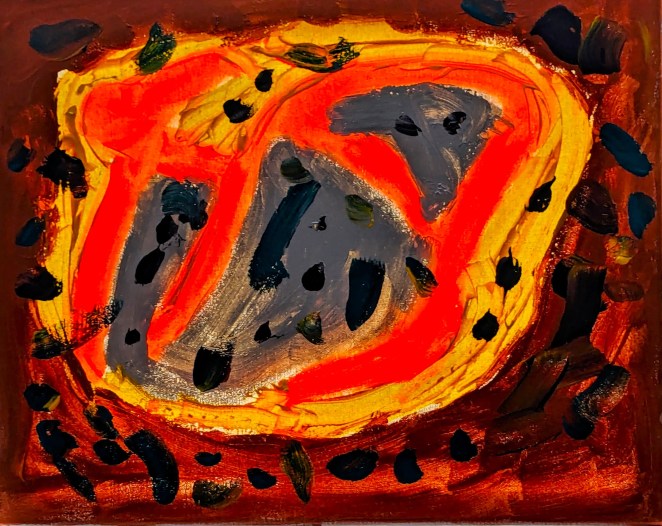
Moo’s painting, Coal Face, adorns the front cover of Carved in Stone, Chronotopos II. Coal Face is not the denigration of Black Face, white men pretending to be black by dyeing their faces, although they have some similarities. In Welsh Mining, the coal face is where the men used to dig when, with their shovel and their pick and their little lamp and wick, they knelt to dig out the coal. Knelt, because there was no standing room, deep down underground. Then, when the seams grew thinner, and the men could no longer reach them, the young boys were sent underground.

A day underground left men and boys with coal dust seamed into their bodies, especially their hands and their faces. Hence the triple meaning of black face – where the coal is dug, what men and boys looked like after a day’s work, and the blackening of their faces by white men, for the fun of it.

Faces are one thing, coal dust in the lungs is another. The result – emphysema and pneumoconiosis devour men and boys. Black lung, some call it. “And every time he coughs, he gets a mining souvenir” – a black spot coughed up on the sidewalk – Max Boyce.

Child labor, minimum wage, living wage, work that kills, slowly and silently, – what can I say? Forgive me, for I can say no more.

Carved in Stone 43

Carved in Stone
43

Back home, in that little cul-de-sac,
the husbands are away,
working their night shifts,
while the wives are at home,
entertaining the truckers,
those long-distance drivers,
who park in that street and lodge there,
overnight, in the houses.

The children, boys and girls,
go out into the street,
climb into the trucks,
duck under the tarpaulins,
and, with all of us sworn to silence,
practice what their elders
are doing back home.

Commentary:
Monkey see, monkey do. And who knows what Monkey sees or does when the lights are turned out, darkness descends, and the honor of the blood cult takes control. Ask the animals, they will teach you. That was the motto of Bristol Zoo, where the Monkey Temple ruled, and Alfred the Gorilla and Rosie, the Elephant, were King and Queen of the beasts.

Knowledge – where does it come from? How do we attaint it? Is there a difference between knowledge, what is known, felt, and worked out for yourself, and education, when you obey orders and do what you are told to do (and how to do it). “We don’t need no education, we don’t need no thought control.” I have always loved Pink Floyd and The Wall. So many walls, so many barriers, so many things to break down in order to build them up again. Songs – Frank Sinatra – “I did it my way!” And who teaches what and to whom, underneath the tarpaulin when the lights are out? “Hey, teacher, leave those kids alone.”

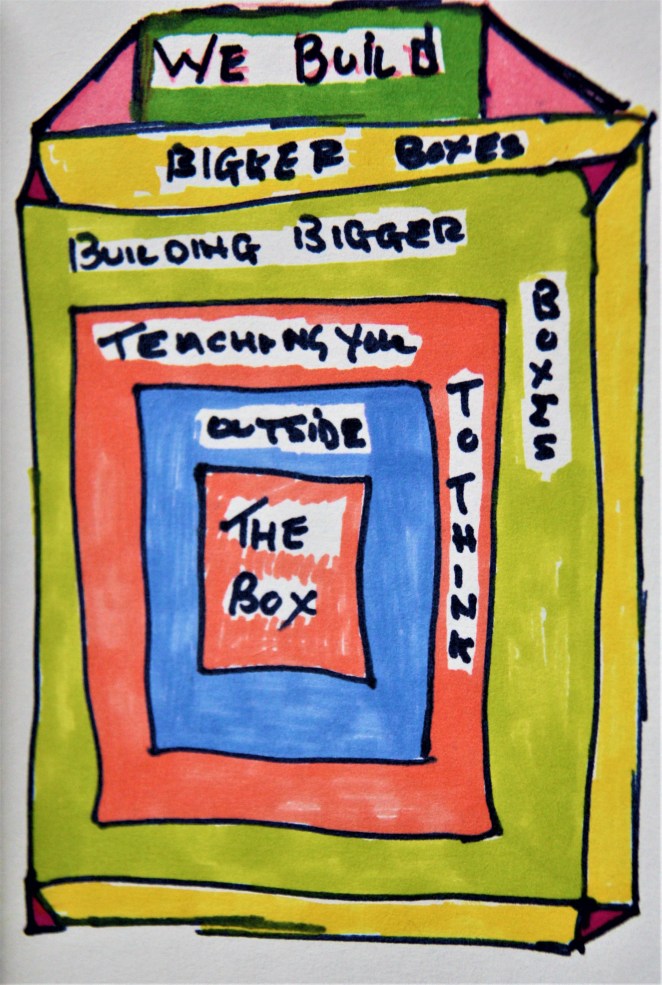
And beware of anyone who tells you that “we teach you to think outside the box.” That person will only give you a slightly bigger box, of his or her own making, inside of which you will be forced to think.

Of course, there are other ways in which we can think about education. How about this one? Filling empty heads with knowledge. How many ways are there to do this? And what is the exact content of the jug from which the knowledge will flow? And how many sows’ ears does it take to make a silk purse? “Hey, teacher, leave those kids alone.” Giddy up, Neddy I’m on my hobby horse now.

Carved in Stone 37

Carved in Stone
37

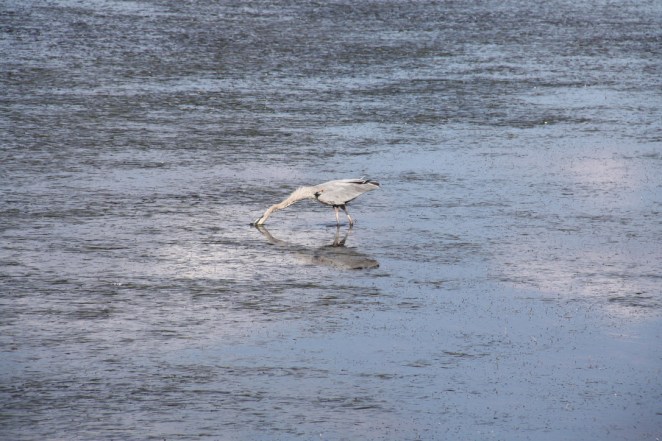
A great blue heron,
half-buried in the sand,
lies, covered in flies.

What words could I carve
in sand beside his grave?

What words would I carve
on mine?
What could anyone say?

I guess I could say
that I was happy,
in spite of the pain,
but would I do it
all again?

Commentary:

I guess I could say that I was happy, in spite of the pain, but would I do it all again? – Good question, and I have no answer to that question. Is life circular? Do we pass on from existence to existence, learning as we go? Some religions think so. Do the participants and believers have a choice? That I do not know.

Would we, like the English cricket team currently in Australia, make the same mistakes again and again, never learning from each dismissal, never learning from the blows given to another’s body or head? All good questions. Or would we learn from each life, each circumstance, slowly ascending a sort of Platonic Ladder until we climbed to the highest level of perfection? Who knows? I most certainly don’t. Nor do I know where the light and the flame go when I blow out the candle.

So many mysteries, as the fate of my little bird was a mystery, as the fate of the fish in the first photo was also a mystery. Albert Camus – meurtriers ou victimes? Are these the only choices that we have, to be the predator or the prey? I most certainly hope not. Libre albedrío – free will in the Calderonian world of the seventeenth century in Spain. But how free are we? What cultural and developmental chains bind us, pull us down, and are we surrounded by our childhood and our culture, and our education, in such a way that we have little or no choice in how we think and what we do?

Answers by air mail, please, and tied to the back of a great blue heron, preferably the one in the upper photo, not in the lower one!

Carved in Stone 30 & 31

Carved in Stone

30

A well of beauty dwells within me,
not skin deep, but buried, arcane.

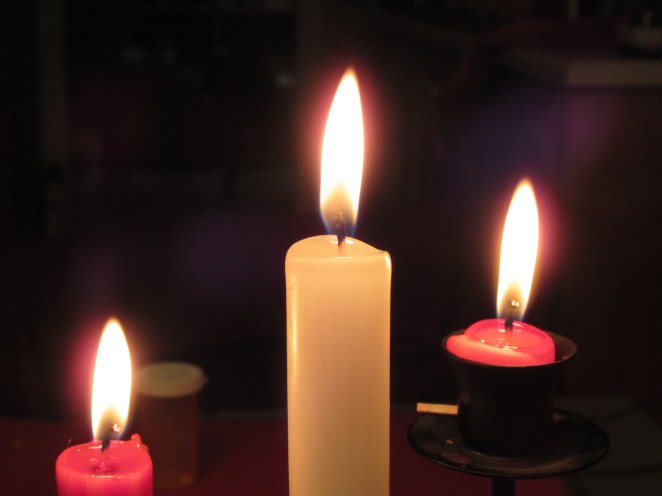
A flickering candle
tethered to an altar,
shimmers at midnight,
when the Latin mass is said,
bringing me light.

In the dark, canonical hours,
shadows move beside me
as I walk long corridors
from dormitory to a chapel
filled with heady incense.

31

I kneel, dumb-founded,
as candle flames wax and wane,
their brightness enhanced
by the midnight magic
that turns doubters into believers.

Spell and symbol, each candle a star,
shining, twinkling, in a galaxy of light,
and everywhere, the incense,
overloading my brain, releasing me
to revelations way beyond
muttered responses, mumbled words.

A world of inner darkness,
yet heart and soul soar together
up to the altar’s immortal light.

My shadow flickering
on the corridor walls,
as candle in hand, half-asleep,
I return to my cold bed
where the long, chill snake
of the bamboo cane
reminds me of tomorrow’s
flagellation.

Commentary:

Shadows on the wall or candles – with which should we start? Verbal and visual – how do they blend and knit together? Does my visual take away from your visual, or does it enhance it? To what extant does my verbal and the commentary on my verbal change the nature of your original thoughts when you re-create, within your own mind, my images, both verbal and visual?

Verbal and visual – now add the sense of smell. “The incense, overloading my brain, releasing me to revelations way beyond muttered responses, mumbled words.” And now remember that I was only six or seven years old when I experienced these things. Add the Latin mass, only half understood, the cold, damp feel of walls and wood beneath the hands. A world of inner darkness, yet heart and soul soaring together up towards the altar’s immortal light.”

My words are black print on white paper. My memories flare – an aurora borealis of senses sent crackling down the spine, in and out of the mind, tumbling the brain into a world … what sort of world? An unimaginable world. One never forgotten. One never re-recreated. One that never existed. One that never could exist. One for which the young child, six or seven years old, yearns for the rest of his life. His unsatisfied life. His unsatisfying life. His meaningless life. His absurd life.

Oh pity the poor puppy, not knowing what he has done wrong, not knowing how to put things right, always inadequate, whining and cringing at his master’s feet. And always, “that cold bed where the long, chill snake of the bamboo cane reminds me of the next day’s flagellation.”

Carved in Stone 19 & 20

19

The Spanish Civil War –
one brother pro-Franco, and the other,
imprisoned for a quarter of a century.

They locked him, with two dozen men,
in a deep cell below the convent
of San Marcos de León.

All save him were executed.
He spent our time together
telling me how guilty he felt
because he survived.

20

So many died standing blind-folded
with their backs to unforgiving stone walls,
because they refused to believe
what the enemy told them to believe.

Nobody spoke for them.
Who can speak for those who carry
the candle or board the tumbril,
or see the hooded executioner draw near?

The axe approaches. The gallows draw closer.
The guillotine falls. The single eye of each rifle
stares at the victim’s chest.

Commentary:

I find it hard, very hard, to talk about these two stanzas (19 & 20). I remember two of Goya’s paintings, The Second of May and the Third of May. The Third of May says everything that I cannot say. So, I will just leave you with two paintings to google and one photo of an unforgiving stone wall, with the gateway filled in. Pax amorque – we all need peace and love – I can say that, for we all need it.

Writing in the Red Zone

Writing in the Red Zone

The Red Zone:
it’s a familiar concept.
Monday Night football
talks about it all the time.

“Success percentage
in the Red Zone,
offense and defense.”

It’s not just football.
Other sports, soccer, rugby,
have their red zones.
So does life, my life,
for better or for worse,
and now I know I’m in
the Red Zone.

I can see the goal line.
I can feel the tension rising.
I know the clock’s ticking down.
I can sense it, but can’t see it.
I no longer know the score,
and I don’t know whether
I’m playing offense or defense.

They tell me it’s a level playing field,
but every day they change the rules,
and today I wonder what the heck’s
the name of the game I’m playing.

Empty Nest

Empty Nest

X marks the spot
where the energy ran out,
the moment when the tide turned
and water ebbed, and refused to flow.

A place… a time…the sudden scent
not of presence, but of absence.
The absence of movement,
noise, of that other body
that once walked the rooms,
opening and shutting doors,
windows, like a robin’s whistle,
a thrush’s trilled song…
gone now, gone, all gone.

We drift through silent sadness,
avoid each other’s eyes,
sit with our heads in our hands
or knit our fingers together
in desperate gestures
that express our emptiness,
the emptiness of an empty nest…

Commentary:

The poem speaks for itself, as a good poem ought to. Even bad poems speak for themselves sometimes. Amazing how empty the house seems when we sit in separate rooms, work at different computers, read in silence, or do the crossword or sudoku, miles away in time and space. And those little feet have gone now – not that they were that little this past visit. But holidays end, child and grandchild depart, the house returns to its former silence, and we are left to contemplate the emptiness of an empty nest.

Apocalypse When?

Apocalypse When?

A strange, milk-cloud sky, skimpy, with the sun
a pale, dimly-glowing disc, and my pen scarce
casting a shadow as the nib limps over the page.

Out on the west coast, fires still range free and this
is the result, these high, thin clouds casting a spider
web cloak over the sun face and darkening the day.

The west coast: five or six hours by plane and three
whole days to get there by train, even longer by bus,
all chops and changes with multiple stops.

The wind blew and the clouds came widdershins,
backwards across the continent. Today they reached
across the ocean to claw the sun from European skies.

It is indeed a small world after all. Isostasy:
you push the balloon in here, and it bulges out
over there, in the place you least expected

Now we are all interconnected in an intricate network
of a thousand ways and means. What does it all mean?
Ripples ruffle the beaver pond’s dark mirror.

The forest mutters wind-words, devious and cruel,
that I sense, but cannot understand. High in the sky
clouds turn into horsemen on plunging steeds.

Fear, fire, flood, foe, poverty, pandemic, crops destroyed,
unemployment, and, waiting in the wings, the threat of civil unrest,
leading to the apocalypse, and another war to end all wars.

Commentary:

Plus ça change, plus c’est la même chose. I wrote that particular poem several years ago. Poets, some people say, are sensitive to time and its changes. Certainly, this poem is full of premonitions that still ring true today. We have seen the sky cloudy from the various forest fires that have colored and covered the skies here in NB. We have smelled the burning and seen the sun blotted out, not entirely, but just enough for a slight, subtle chill to settle in. Shivers can come from the weather, but they can also arise from premonitions and fear of the future and what it might hold.

High in the sky, clouds turn into horsemen on plunging steeds. This particular line comes from Ponferrada – Pons Ferrata in Latin. Sitting in the park one day, I saw the clouds lining up, climbing higher and higher, then pouring down from the hills like a cavalry charge. It reminded me of the legends of St. James, the Moor-slayer / Santiago Matamoros, who appeared in the sky at various battles and helped the Spanish defeat the Moors, during the Reconquista, and reclaim the land of Spain. So may poetic moments were born from those days. We would do well to remember them.

Another war to end all wars – oh dear, oh dear, how many of those have there been throughout history? Countless, no doubt, and yet there’s always another one, waiting in ambush, just around the corner. Well, the next war to end all wars may just do that, especially if the unthinkable happens and it goes thermo-nuclear. Mad, the world is going mad and it’s very sad because madness – MAD > Mutually Assured Destruction – will destroy us and our planet. And then we will all be homeless, in the worst sense of the word, for as many demonstrators have said, waving their placards from side to side, ‘There is no Planet B.”

Gone out

Gone out

“She has lived.
Now she has gone out.”

And all too soon
I too will go out
and people
will be able to say
he has gone out.

Or not.
Maybe there’ll just be
a silence.
Few people know me.
Even fewer care about me,
know who I really am
what I’ve actually done.

What have I done?
Nothing, really.
Nothing at all.

But I have struck a match or two,
lit some candles,
and allowed them to shine
in the darkness …

and soon, I too,
like those candles,
will go out.

Commentary:
The opening quote, changed and adapted, is from Rudyard Kipling’s novel Kim. I was reading it a few days ago, by candlelight, as we had a brief, and totally unexpected power outage because some idiot ran into a power pole on the highway below us and cut off our power.

Reading by candlelight is so inspirational. It brings back memories of my childhood in Wales, summer evenings in the bungalow, no power, no running water, reading by lamplight or candle light. The candle’s scent, the flicker of shadowy thoughts across the page, each word held for a moment or two in a magic, shimmering glow. I recall also the candles on the high altar, lit for midnight mass, and the church all a-sparkle with shimmering light, incense, and flowers.

Power outage – I often think they should be called power out[r]ages. Then I think of the war zones, rife with suffering, where power outages are only one of the many outrages from which people are suffering. “Man’s inhumanity to man.” Robbie Burns, I believe. I regret calling that driver who took out the power pole an idiot. Shame on me. I found out later that he was a human being, suffering, just like me, from the attributes of ageing. A heart attack took him and his leaden foot, dead on the accelerator, sped him into the power pole.

DOA – dead on arrival at the power pole, and at the hospital. “He has lived. Now he has gone out,” snuffed out like the candles I blew out when the power was finally restored. It’s so easy to relight a candle, so hard to relight the beauty of a lost human life.


Apocalypse when?

Apocalypse When?

A strange, milk-cloud sky, skimpy, with the sun
a pale, dimly-glowing disc and my pen scarce
casting a shadow as the nib limps over the page.

Out on the west coast, fires still range free and this
is the result, these high, thin clouds casting a spider
web cloak over the sun face and darkening the day.

The west coast: five or six hours by plane and three
whole days to get there by train, even longer by bus,
all chop and change with multiple stops.

The wind blew and the clouds came widdershins,
backwards across the continent. Today they reached
across the ocean to claw the sun from European skies.

It is indeed a small world after all. Isostasy:
you push the balloon in here, and it bulges out
over there in the place you least expected.

Now we are all interconnected in an intricate network
of a thousand ways and means. What does it all mean?
Ripples ruffle the beaver pond’s dark mirror.

The forest mutters wind-words, devious and cruel,
that I sense, but cannot understand. High in the sky
clouds turn into horsemen on plunging steeds.

Fear, fire, flood, foe, poverty, pandemic, crops destroyed,
unemployment, and, waiting in the wings, the threat of civil
unrest, leading to the apocalypse and the war to end all wars.