Carved in Stone 58

Carved in Stone
58

Modern shamans
roam the pyramid’s flat top,
looking for its energy point,
not knowing that, seated,
peacefully in silence,
that power will seek them out.

The more they seek,
the less they find,
yet that power seeks me out,
because I no longer seek it.
Is that the secret of creativity?

Commentary:

A long time ago my judo instructor taught me the following –

“The more you strive,
you cannot grasp it,
the hand cannot hold it,
nor the mind exceed it.
When you no longer seek it,
it is with you.”

It was the same with the St. John Ambulance course that I took. The instructor told us that we might not remember now exactly what we were doing, but if the occasion arose, everything we were practicing now would appear before us and we would just do it, knowing exactly what to do. A rugby coach, I saw and met and solves several such injuries on the field of play. Something took me over and I did what I had to do.

I still don’t know how or why. But it is the same with creativity. “When you no longer seek it, it is with you.”

Just breathe deep and believe.


Latch-Key Kid

Latch-Key Kid

In one room in my head, I stand on a stool beside my father’s mother helping her to mix the cake she will later bake in the wood-fired oven of her black, cast-iron stove. Every time she mixes a cake, she places a small piece in a dish and bakes it just for me. As a child, I spent hours in that kitchen, watching her cook. When she boiled vegetables, she never threw out the vegetable water, but used it for boiling other vegetables or for making rich, thick, delicious gravy.

Later, with both my parents working, I became a latch-key kid. I spent all day in an otherwise empty house and cooked my own breakfast and lunch. I also prepared supper for my parents so that it would be waiting when they came home. I grew up loving to cook.

When I went abroad to spend my summers in Spain or in France, I spent as much time as possible in the kitchens, watching, listening, learning. The women always had time for a small child. Then men seldom did. Children should be seen and not heard. They just got in the way. That was the male attitude. I learned so much in those kitchens.

Later, in Santander, my landlady would place one egg, one onion, and one potato beside the stove. It didn’t matter what time I came back from a night out with the boys, my supper was there, a Spanish omelet, una tortilla Española, waiting for me to cook it. Sometimes she left me a piece of chorizo, but I preferred the omelets. I did enjoy making shapes and designs out of the chorizo – that was always fun.

Not many people knew about my cooking skills. One of my aunties always cooked for me. She told me that her husband didn’t even know how to boil an egg. The men in my family seldom cooked, except for my maternal grandfather, who learned how to fend for himself in the trenches and dug-outs during WWI. He taught me how to make stews and soups, rich and nourishing, and always better on the third day. He also told me what he put in them – and you wouldn’t want to know about what he hunted and scavenged to stay alive in those cold, dark days. Nowadays, so many of us just don’t know how lucky we are. I do know how happy and lucky I am, not to be homeless, not to be living out on the streets, dependent on soup kitchens, charity, and fighting the elements just to stay alive.

Banks of the Seine

Banks of the Seine

Gnawing at the carcass of an old song,
my mind, a mindless dog, chasing its tail,
turning in circles, snapping at the fragment
of its own flesh, flag flourished before it,
tournons, tournons, tournons toujours,
as Apollinaire phrased it, on a day
when I went dogless, walking on a mind-leash
before the Parisian bouquinistes who sold,
along the banks of the Seine, such tempting
merchandise, and me, hands in pockets,
penniless, tempted beyond measure,
by words, set out on pages, wondrous,
pages that, hands free, I turned, and turned,
plucking words, here and there, like a sparrow,
or a pigeon, picks at the crumbs thrown away
by pitying tramps, kings, fallen from chariots,
as Éluard wrote, and me, a pauper among riches,
an Oliver Twist, rising from my trance, hands out,
pleading, “Please, sir, can I have some more?”

Commentary:

Intertextuality – how many different texts can you recognize in this one piece of verse? I can count six reminiscences of other poets, ones that have influenced me to a lesser or greater extent. A couple of novelists lurk in the shadows as well. Fascinating, eh? Do these voices echo in any other ears than mine? Good question – and does it matter if they do or they don’t? The main thing is that they harmonize, the old world with the new, the centuries that went before with the one that is with us now. Quevedo – “Vivo en conversación con los difuntos y escucho con mis ojos con los muertos.” I live in conversation with the defunct and I listen with my eyes to the dead.

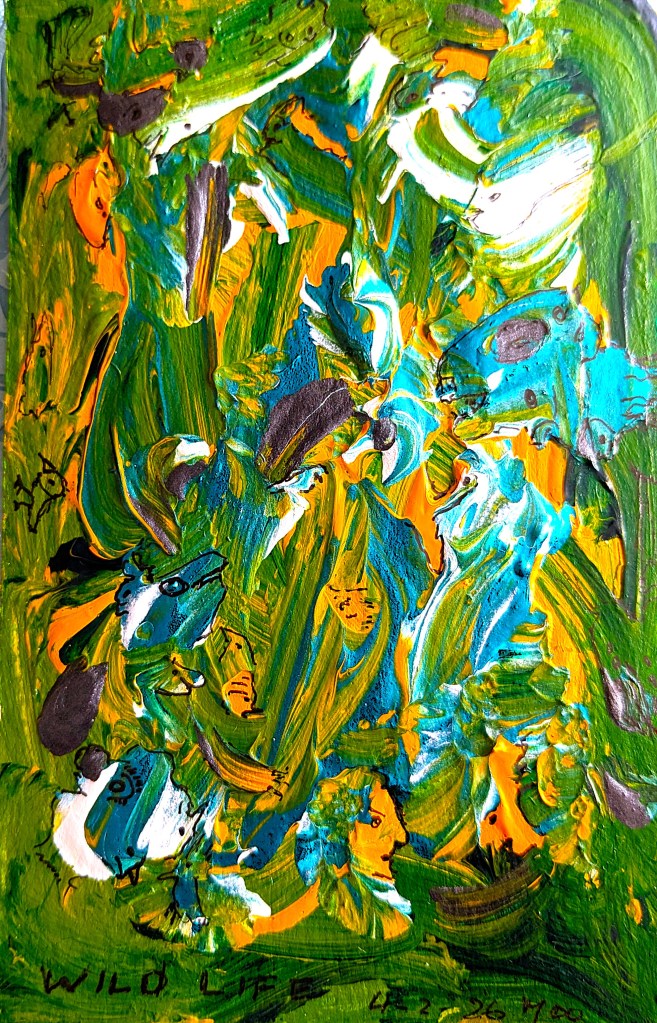
And look at that painting. No, not the Banks of the Seine, but the banks of the Fundy, near St. Andrews. And it’s Moo, at his best, doing a cross between a cartoonist, a genuine artist, a surrealist, and an amateur artist who lends his paintings to friends when they want a picture of water, or a river bank, or something or someone else that will add to the intertextuality of his works. Yea, Moo. Go Team Moo, go. Long may you survive and work together.

Sign Language

Sign Language

A skater leaving marks on fresh ice
or a stone cast into a pond,
with multiple meanings, multiple ripples
moving slowly outwards,
to end up where?

Who knows? Not me.
I only know that the thrown stone,
like the spoken word,
can never be recalled.

Each word a stone,
and each stone leaving its mark
on many people of many cultures
and multiple languages,
though English is the language
in which I now write.

Frost and snow here this morning.
Not much, just a dusting.
I look out of the window
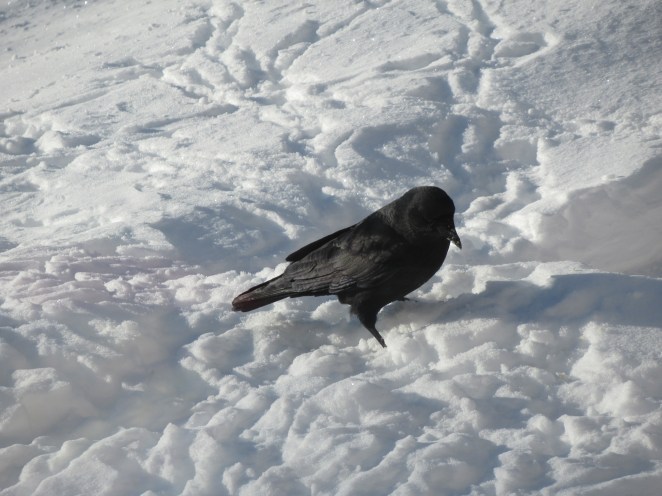
at the crows’ claw prints
on my yard’s white surface.

My eyes draw silence
out of the white space
with its runic language
written by the crows.

The meaning of meaning –
tell me, if you can,
what do they say?
What do they mean?
What do they want from me?

Commentary:

Intertextuality – this poem came directly from this morning’s commentary, with some minor alterations. The commentary itself, emerged from Carved in Stone, 35. Three separate steps in the great chain of intertextuality, where text speaks to text and the crows cock their heads, turn them to one side, listen, and write their answers in the snow.

Sometimes words just flow. Sometimes, I force them to flow. However, I have learned over the years that the secret is to relax and to allow the words to come to you of their own free will. Sometimes they whisper, occasionally they shout. But if you are willing to listen, you will hear them everywhere. And they have so much to say, if you will only learn to listen carefully and try to understand their language.

Book of Life

Book of Life

When I lost my place, I tied my hanky in a knot,
to help me remember the number of my page.
Last night I looked in pockets and sleeve, but
I couldn’t remember where I put my hanky.

At midnight the stars dropped liquid fires and they
pooled like letters on the fresh snow of my dreams.

One night I caught some falling stars and I joined them
together, one by one, till they stretched their daisy chain
across the garden. Words grow like flowers in the Spring.

Once I could accelerate the universe. But now I slow
down when I spell my name. There is a circlet of gold
on the sky’s bright brow. What gave these stars the right
to write my future in expanding letters? A satellite moves
in a straight line, north to south and starlight crumbles
in the wake of artificial knowledge spanning the eye ball
of the planet.  Who will repair these broken tunes? Who
will glue these scattered notes back into the piano’s frame?

My tongue stumbles against my teeth and trips on my lip.
A leaf of fire scorches the deep bell sound of my throat.

Commentary:

I looked over my shoulder, backward into time and space, and discovered this poem, penned more than a quarter of a century ago and abandoned in an old folder. Moo tells me he hasn’t painted for some time – I wondered if he was on a rotating striking, like our posties (Canadian for mail men and women), but he assured me that he had been sleeping, not sleep-walking in circles. Anyway, he felt inspired, put paintbrush to postcard and gave new life to my Book of Life. Thank you, Moo.

Do you remember when we used to tie knots in our hankies to remember what we had to do? Paper tissues put an end to that. No point in tying a knot in a soggy tissue, even if you could. And as Francisco de Quevedo told us – no point in looking in your hanky after you’ve used it. No point in searching for diamonds and emeralds, let alone pearls of wisdom, they just won’t be there. Good one, Franky. Of course, he was writing in Spanish, not English and my translation can’t do him justice.

It used to be fun watching the night sky out here in Island View. So clear – the satellites passed overhead and followed different paths from the stars. No Platonic dancing to ethereal music for them. Tone deaf, the lot of them, cutting their own little paths across the night sky. We used to get Northern Lights too, Aurora Borealis. They were always spectacular. Great crackling curtains of light hanging down from the heavens almost to the rooftops. Moo wishes he could paint everything h sees. I wish I could write down in verse every thought I think. If each of us had our wishes fulfilled, we’d have two books of life – one in color and one in black and white!

My First Thanksgiving

My First Thanksgiving

For the first twenty-two years of my life,
Thanksgiving had no meaning, no substance,
no shape, nor form, nothing to hold me.

When I emigrated to Canada,
my Canadian cousins changed all that.
when they invited me to come to
Kincardine for Thanksgiving.

They served a traditional Thanksgiving Dinner
with vegetables in colored jellies
and all sorts of things I had never seen.

We were all surprised
at how alike we looked.
Like Cousin George in Vancouver,
or Cousin Elsie in Revelstoke.

They told me how WWII
had brought the family back together
on these special holidays –
Christmas in Wales for the Canadian troops
or Thanksgiving in Winnipeg
for the Welsh boys learning to fly.

That thanksgiving, the old family names
turned into photographs before me.
Snaps of my mother’s wedding,
my grandmother holding me on her knee.

And finally, as a special Thanksgiving gift
a long-distance phone call to Britain
and Clare on the phone saying
yes she would come to Canada
and yes she would marry me.

And I remember crying
all the way back from Kincardine
to Toronto and that was my first
Thanksgiving in Canada.

Poppy Day

Poppy Day

Remembrance Day
11 November 202
4

I wasn’t there
I never saw the gas clouds
            rolling over our positions
            never felt the barbed wire’s bite
            nor the bayonet’s jab

I never hung out my washing
            on the Siegfreid Line
            (“Have you any dirty washing, mother dear?”)
            never broke out of barracks
            never did spud bashing
            nor feasted on bread and water
            nor heard the rifle’s rapid rattle

I wasn’t there
            to see them carried away in carts
            coughing spluttering vomiting
            or bandages over their eyes
            walking slowly to triage a hand on
            the shoulder of the man ahead
            the sighted leading the blind

I wasn’t there
            but both my grandfathers were
            both decorated
            one mentioned in dispatches
            signed by Winston Churchill
            that one uninjured
            the other one gassed
            coughing up his lungs
            bit by bit for forty years

I am here now
    to remember
    and to honor them
           though so much
    has been lost

Comment:
My friend, the painter known as Moo, painted this poppy today. My generation, unless they served voluntarily, as many have done, was never conscripted. As a result, the horrors and tragedies of combat were never known to us, except as seen through they eyes of other people. I think of Wilfred Owen and his magnificent, heart-rending poems from WWI.
Today, I pay tribute to those members of my family who served in the armed forces by land, sea, and air. I also pay tribute to the veterans who survived, and to those who gave their lives in the defense of our country.

Who do you spend the most time with?

Daily writing prompt
Who do you spend the most time with?

Who do you spend the most time with?

My Teddies. I know, I know. Most of you will say “A Teddy Bear is not a real person. You can say what, but you can’t say who.” And most of you would be wrong. Teddy Bears are trained confessors – they listen to everything you tell them – in silence – and they never condemn you. They are a great comfort too, and are just as good and effective as a comfort dog. Also, they are very, very obedient. Tell your Teddy Bear to sit and wait, and s/he does, very patiently.

I sleep in the same room as my teddies. And since I am in that room for 8-10 hours almost every night, that doesn’t leave much time for spending with other people. Besides which, while Rose and Teddy, the big ones, Mother and Father Bear, so to speak, usually stay in the bedroom, while Basil Bear, the small pocket bear with the pink ribbon, often travels with me, in my pocket, and usually sits on the table with me at meal times and when I read and write.

And remember – Teddy Bears don’t eat your porridge, so you never have to look at your Teddy Bear and say “Who’s been eating My porridge?” I hate porridge, by the way, “Porridge, porridge, thin and brown, waiting for breakfast when I come down. They clean the table of every dish, eggs and bacon, cheese and fish. But however early, however late, porridge is always sure to wait.” Sometimes I wish my Teddy would devour my porridge, especially when it’s burnt. I wounder if I could train him?

Here’s Basil Bear, on the table with me, helping me to choose my wine. He reads the label, very carefully, and then tells me which one it is. Now that’s what a Care Bear does – cares for and looks after his human. And look at that Black Cat – I do think he’s envious of Basil, four green eyes filled with the light of jealousy. I hope he doesn’t scram my Basil – a gath wedi scrapo Basil fach.

I also talk to that friend , who always walks with me. As Antonio Machado says – “El que habla solo, espera hablar con Dios un dia.” “He who talks to himself hopes to talk to God one day.” Let’s hope that particular chat is delayed a little bit longer. I enjoy writing these prompts. So, happy thoughts, and may you all share a Teddy or two who really care.

Illumination

Two Poems to help you find your way in the dark!

1

Suit of Lights

I am a man of straw
          shivered by raw winds,
frosted by the cold
          enveloping this enigmatic body
with its rattle of drying bones.

I walk with two canes,
          not just a sick man,
but a stick man.

My broken body
          hangs on the coat hanger
of my battered bones,
          its worn-out sack
knitted from skin,
          bonded with blood.

The magic hour descends.

Earth glows
          with a different light,
my world is transformed,
          translucent, bright.

A touch of the almighty,
          this beauty surrounding me,
blessing me.

I wear a sudden clarity
          with this suit of lights.

2

Illumination

You must find it for yourself.
         Were I to tell you what it is
and where it dwells,
          the light it brings you
would be warped,
          untrue.

Only
          you can find
that light.

Only you
          can strike the match,
ignite that blaze,
          trap its warmth
in your own bone cage.

Enlightened,
          you must dig and dig,
deeper and deeper,
          until you lose yourself
in a bottomless pit.

When you are lost,
          look up.

In the dark above,
            you will find
a tiny pinhole of light,
          a star to guide,
a glow-worm
          to light your way
in the darkest night.

Silence

Silence

silence
          between words
tranquil movements
          the world
stands still
          suspended
in space

silent space
          between the stars

Aurora Borealis
          soundless night
drenched
          in silent light

listen –
          can you hear
your heart beat

can you hear
          the silence
of your house

time
          sifting silent
through an hour glass
         filled with light
drifting into
          night