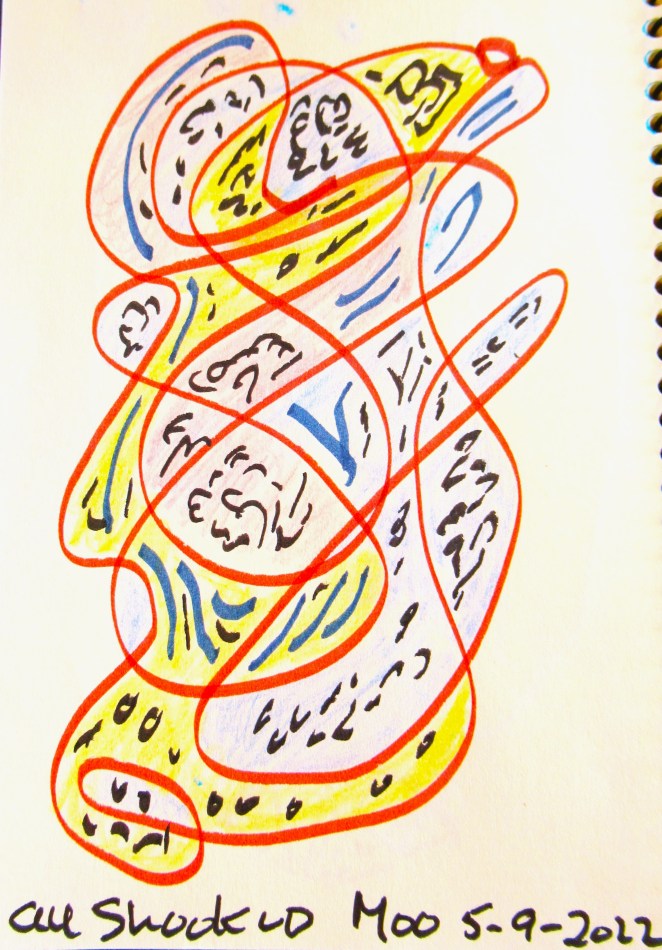
My favorite cat

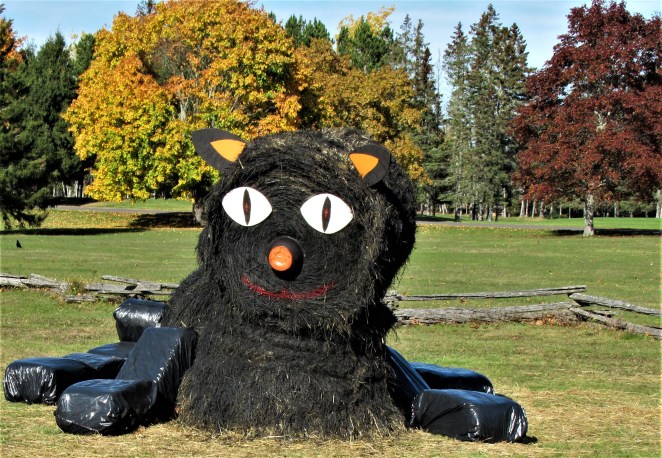
My favorite cat

Pebbles have caught in my throat.
The word-river once flowing smooth
now backs up to spill leaf-freckled foam
over the tiniest barriers of branch and weed.

When I speak, some gypsy I find
has stolen my tongue, and my voice
is that of a changeling whisked away
from the cradle whilst her guardians slept.

Now leaves outside my window grow
rusty with autumn rain. A sharp-shinned hawk
no bigger than the blue jay he stalks
drives like a whirlwind at our feeder.

In dawn’s early light, a Great Barred owl
flaps enormous wings and drops like a stone
on my favorite cat, lifting her up and away.

Commentary:

Not a true story – sorry, my friends. However, I did see a Great Barred Owl swoop down on my neighbor’s cat. A canny old cat that one. He rolled over on his back, hissing and spitting, and showing all his unsheathed claws. Then he let out a most unnerving high-pitched whining sound and the owl backed off. Nature red in tooth and claw and our own backyard a battle ground where wild creatures roam and prey on each other.

Luckily, as a poet, I need neither seek nor deliver the truth, in any sense of the word. What I search for is emotional impact – words that ring true, even if they are not. Moments that reach out and grab us when and where we least expect it. As someone once said – never let the truth get in the way of a good story. Same with jokes.

And speaking of jokes, cross-cultural jokes are some of the most difficult things for a language learner to grasp. Humor exists in many forms. Silent comedy, like slapstick, does not need an interpreter. However, jokes based on cultural understanding are remarkably difficult to follow, unless one is totally immersed in the culture. As for linguistic jokes, even the sharpest individual can be defeated by word play and double meanings. I remember word plays from my beginner’s language classes that still leave me cold. Sorry, I just don’t find them funny even when explained. Clever, maybe, but funny? No way. Molière for example – Trissotin / trois fois fous. Really? ne dis pas que c’est amaranthe, dis plutôt que c’est de ma rente. Or, from the Spanish of Fuenteovejuna, Lope de Vega – Ciudad Real es del Rey. I hope you are splitting your sides over that one – I have never been able to laugh at it and still can’t understand what’s funny about it. C’est la vie, I guess.

Alone

Alone

the longing
to belong
appears from
nowhere

I want
to lose myself
in something bigger
than myself

religion
can bite like that
church and altar
feast days
incense and candles
confession
repentance
forgiveness
then sin again

I am not religious
not in that sense

nor am I militant
right arm raised
goose-stepping
in a parade
each step in time
with every one else

if that’s the meaning
of belonging
I guess I’ll continue
to dream alone

Commentary:

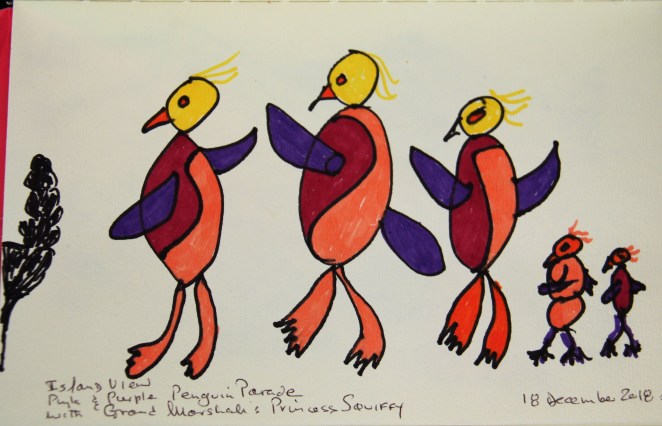
Moo thinks that Princess Squiffy, out at the front of the parade, a solitary cat, all alone and on her own, would be perfect for this poem. I am not so sure. Everybody is so happy, so engaged, except for Princess Squiffy aka Vomit, who is vanishing into the woodwork – about to plan and execute her next act of sabotage, I guess. Yes, Vomit! She’s the one who throws up in my chair.

The meaning of meaning – such a simple phrase, such a complicated philosophical history. How does one ‘belong’? In what ways can one ‘belong’? Does one yearn to belong or long to belong? And what does it mean – to belong? Does my cat belong to me? Does my dog belong to me? Cat and dog are long dead now – so how can they belong to me? And when I am gone, all my belongings will belong to someone else. A strange world, eh? And yet I long to belong in it for as long as possible.

The two most dangerous words in the world – thine and mine. Cervantes wrote that somewhere. For thine and mine are possessives. They teach us to possess things, to claim them as ours. My house, my garden, my trees, my flowers, my lawn. With the drought that has occurred this summer and into the fall, I can no longer say my lawn, my flowers, my garden, for they have all dried up and marched along, privatim et seriatim, – a touch of Kipling there, Storky and Co. if I remember correctly, and I don’t, because I just checked and it’s Stalky not Storky! – into whatever happy gardens dead flowers and gardens inhabit in their after life.

I think one of the most dangerous games ever invented is Monopoly. Make no mistake, I love my Monopoly set – especially the top hat and the flat iron – but what do we learn from Monopoly and from all similar types of game playing and role modelling? Why, to gather everything into our hands hands and possess everything on the Monopoly Board. At least when we play chess, we defeat an opponent by check-mating his / her king. We don’t have to accrue all 31 pieces on our side of the board leaving the poor king alone on the other. Even Fox and Hounds – and that’s an impossible game to win when you’re the fox- doesn’t humiliate anyone in quite that fashion. Ah well, the meaning of the meaning of Monopoly – Happy Canadian Thanksgiving – we can all have a good rant about that one.

Monologue

Monologue

“They broke our walls,” Mono whispered, “stone by stone.
A new church they built on the land they stole from us.
Red was its roof from a thunderstorm of blood.
The white bones of their lightning scattered us like hail.

They ripped out our tongues and commanded us to sing.
Carved mouths were ours, stuffed with grass.
Stone music forced its way through our broken teeth.

Few live who can read the melodies of our silence.
We wait for some wise man to measure our dance steps.

Pisando huevos: we walk on tiptoe across
these stepping stones of time.

Commentary:

Mono means monkey (in Spanish). Hence, monologue means monkey speaking to himself. Cute, eh? Monkey is one of the day signs in the Mixtec Codices. Lots of double meanings and rabbit holes down which the ardent reader can descend. Dig deep, my friend. Pisando huevos – literal meaning – ‘walking on eggs’ – meaning walking very carefully, on tip-toe, step by step.

Who said poetry was simple? You want it simple, there are so many simplifying factors out there. I want you to think. To think for yourself. To understand complicated language with multiple meanings. You want simplicity? Go watch a TV ad – Tide’s in, Dirt’s out. Omo adds bright, bright, brightness. The Esso sign means happy motoring. Don’ forget the Fruit Gums, mum – (said as the little boy throws a brick out of the window and it hits his mother on the head).

I’d say “wake up and smell the coffee.” But if wake means woke, I’m not the sort of bloke that accepts the meaning of wake or woke! Hereward the Wake. Robin Hood the Bloke in the Hood who Awoke- and I don’t mean the flower / flower, nor the Lincoln Green of the Lincoln Continental.

So what do I mean? I don’t know. Coded words are meaningless unless you have the meaning to the code. What code? The miscued code. And the meaningless lack of meaning in meaningless. Just like my friend who’s just been screwed, blued, and tattooed – and totally rude. Or was it scrod?

Inquisitor

Inquisitor
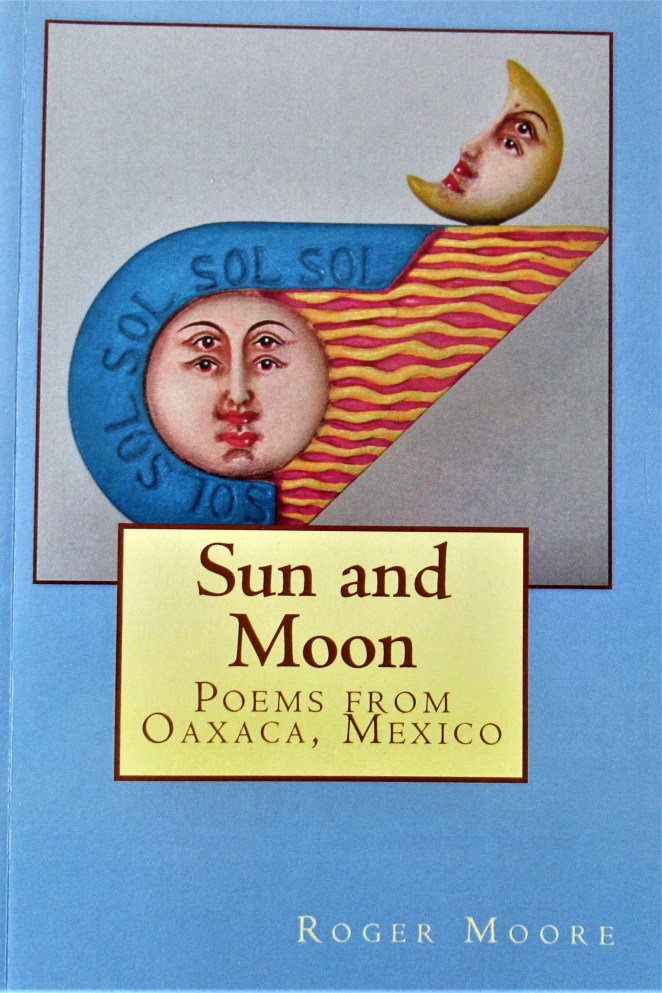
Sun and Moon

He told me to read,
and plucked my left eye from its orbit.
He slashed the glowing globe of the other.
Knowledge leaked out, loose threads dangled.
He told me to speak and I squeezed dry dust
to spout a diet of Catechism and Confession.

He emptied my mind of poetry and history.
He destroyed the myths of my people.
He filled me with fantasies from a far-off land.
I live in a desert where people die of thirst,
yet he talked to me of a man who walked on water.

On all sides, as stubborn as stucco,
the prison walls listened and learned.
I counted the years with feeble scratches:
one, five, two, three.

For an hour each day the sun shone on my face,
for an hour at night the moon kept me company.
Broken worlds lay shattered inside me.
Dust gathered in my people’s ancient dictionary.

My heart was like a spring sowing
withering in my chest
It longed for the witch doctor’s magic,
for the healing slash of wind and rain.

The Inquisitor told me to write down our history:
I wrote … how his church … had come … to save us.

Commentary:

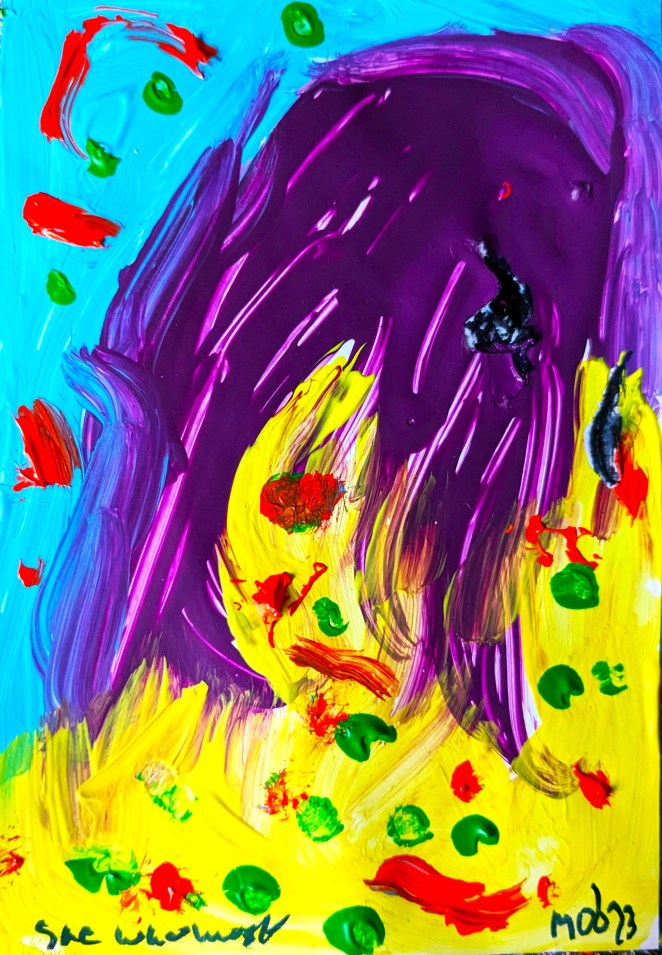
No wonder the little girl in Moo’s painting looks so sad. She must have read this poem and understood how the exercise of power and authority, be it religious or secular, can effect those upon whom it is exercised. Times change, but so many things remain the same. The pendulum swings, and it moves from chaos to order and back again. The meaning of meaning – how we define chaos and how we define order define who we are.

Birds of a feather flock together. Manners maketh the man. Wonderful sayings. But fine words do not necessarily make for fine men or women at that. Serpents and senators, both can speak with forked tongues. It is up to us to apply discourse analysis and distinguish between what they say and what they actually mean. As my friend Jean-Paul Sartre once said – “L’homme n’est rien d’autre que ce qu’il fait.” A man is nothing more than what he does. His deeds reveal his true inner self – and remember – the plumage doesn’t necessarily make the bird.

The Screws

The Screws

There is no science to sciatica,
just a series of sensations
most of them involving pain.

I don’t know how or when it comes,
but one day, it knocks on your door
and makes you clutch back and buttock.

It’s like a hawk at the bird feeder,
flown in from nowhere to shriek
and shred, unawares, one small bird.

Was it the flannel I dropped yesterday
when showering?  I stooped to pick it up,
lunged forward and, was that it?

The pain came later. It kept me awake
all night, my worst nightmare.
No comfort anywhere. An endless

wriggling and every movement a knife
blade stabbing at my buttock and groping
its slow, painful way down my leg.

The screws, my grandfather called it,
a metal screw screwed into his leg,
leaving him limp and limping.

I googled it today, sciatica, and they
suggested an ice pad for twenty minutes,
repeated twenty minutes later.

“Yes,” I muttered, “yes” and found
in the fridge the ice pack we used
to use in our Coleman’s cooler.

My beloved helped me undo my pants.
“This,” she said, “will be icing on the cake.”
“No,” I said, “it will be icing on the ache.”

Tomorrow, I will call the pyro-quack-tor.
She will bend me to her will, straighten
my back, cure the pain, set me right again,
provided she doesn’t read this post
and will permit me to enter her domain.

Commentary:

Moo doesn’t paint pain, even though it occasionally emerges in his paintings. This painting of his is called Grey Day and I guess a Grey Day is rather like a Blue, Blue Day, something to be avoided, because you feel like running away. And that’s the problem with “The Screws” – it’s hard to face the pain when it’s behind you, unless you are a contortionist and can twist and twirl and see yourself in the mirror. I suppose another solution is to have eyes in the back of your head, but not everyone is that gifted.

As for the pyro-quack-tor, my apologies, Chiropractor, mine is excellent. I limp into her office, crawl onto the medical bed, and then, thirty minutes later, I hop off it like a man reborn, and skip down the corridor, waving my sticks and grinning as if I were a Gorilla in heat. Oh dear, not the sort of condition in which one should drive the zoo bus!

As for my joke – “This,” she said, “will be icing on the cake.” “No,” I said, “it will be icing on the ache!” This takes me back to my old school days – Aix-les-Bains / Aches and Pains. I remember one of my school friends going to Baden-Baden for his summer holiday. A double-barreled name, wow, very foreign. He asked me where I had been and I replied “Cardiff-Cardiff – this is Cardiff.” They used the English version back in those days, not the Welsh one – “Caer Dydd – Caer Dydd.” Doesn’t sound quite the same in Welsh. And how about Cas Newydd – Cas Newydd [Newport] or Pen y Bont – Pen y Bont [Bridgend]. And let’s not get into Llanfair.p.g – Lanfair.p.g – [Llanfairpwllgwyngyllgogerychwyrndrobwllllantysiliogogogoch – Llanfairpwllgwyngyllgogerychwyrndrobwllllantysiliogogogoch].

Try saying that one twice in quick succession. You’ll be sitting in the railway station a long time, just waiting to find out where you are. That, of course, is if trains still run to Llanfair p. g. “Gentlemen will please refrain from …. ” and if you can finish that little ditty off, in public, you have more courage than I do! Besides which, my voice broke long ago, and I haven’t mended it yet!

Drink up thy Tizer!

Drink up thy Tizer!

I wonder how many people actually remember Tizer, the Appetizer. It used to be sold in grocery stores and corner shops. Don’t forget the Tizer, shrieked the adverts. I hated the stuff – but others loved it. Sweet, sticky, a little bit like dynamic Lucozade – and who remembers that, I ask. The same people as had cod liver oil poured down their throats when they were little children in the United Kingdom. An old and almost forgotten generation with its own traditions. But this post is not about Tizer, it’s about cider. Good old Somerset / Zummer Zett scrumpy.

I met Scrumpy when I went to Bristol University. It was an alternate drink to beer, and many pubs sold cider, in one form or another. A pint of cider – sufficient unto the evening was a pint thereof. After a couple of months, one could manage two pints of Scrumpy. Our drinking competitions including drinking a Yard of Ale. Someone always brought one when we went on a coach trip and we always ended up in a bar, in the middle of nowhere, trying to drain our yards of ale. I remember one lad bravely trying to quaff a yard of cider – scrumpy at that. Honk city – and it had nothing to do with the geese. But it was spectacular.

My own adventures with scrumpy really started in my second year at Bristol. The boarding house I lived in stood close to the Coronation Tap, one of the best cider house in England, if not in Bristol. First night I went in there and asked for a pint of scrumpy the barman suggested I have just a half. In my best Somerset accent, I said no, I’d appreciate a full pint. The barman duly placed it before me. As he did so, the man standing next to me at the bar suddenly woke up from his meditations, poked me in the ribs with a boney finger, and announced “Ah, lad. That’ll put lead in thy pencil.” I looked over at his pint of scrumpy and saw a slice of lemon floating in it. “What’s that lemon doing there,” I asked. “I’m waiting for the cider to eat it,” the man replied. “Better for the scrumpy to eat the lemon than to eat my insides.” Another night, at the Cori Tap, I met an old gaffer who wouldn’t touch scrumpy. I asked him why not and he replied that one night he’d managed to down seventeen pints of scrumpy. “That’s a lot,” I said. “What happened?” “Oi spend three weeks in ‘orspital, in bed, doan I?” He muttered.

In my third year, Hamburg University Athletics Cub arrived by coach to participate in an athletics competition with Bristol. The Cross-Country Club became the Athletics Club, in the summer, and we specialized in distances from 400 > 800 > 1500 > 3000 > 5000 > 10,000 metres. Thirsty work on a hot summer’s day. We took the Hamburg athletes back to our apartment building and spent the Saturday night slurping scrumpy down the Tap. They slept on the floor at our place, and next morning, a Sunday, they went shopping early. When they came back to their coach, they all grinned happily at us, and waved their bottles of Tizer in farewell. I looked around and saw that they had twenty cases of those bottles stored in the bus. “Ve vill have gut trip to Hamburg, no?” I started to laugh and they all joined in, waving their bottles at me. I didn’t have the heart to tell them that Scrumpy came in barrels, not bottles, and that they had not purchased cider at the local stores. Alas, they had bought 20 cases of Tizer the Appetizer. Somehow, in translation, cider had become Tizer – oh the glories of discourse analysis and the meaning of meaning.

Tell us about a time when you felt out of place!

Tell us about a time when you felt out of place!

I think it would be much easier to tell you about a time when I felt as if I was in my proper place. There were so few of them. As for the original question – Tell us about a time when you felt out of place – I think that a time should be replaced by the many times. Learning languages has always been more of a pain than a pleasure, for me, anyway. In the Basque Country, Northern Spain, at first with my parents, and then on my own. Sitting at the table or standing in the kitchen, listening to people chattering away in Spanish some days, in Basque, on other occasions. I was reduced to interpreting looks, smiles, scowls, meaningless sounds … how could I have felt that I was in my proper place? Etiquette – I knew nothing about their etiquette. Culture – I knew nothing about their culture and they knew even less about mine. I lived in a world where waves of sound battered at my body and I stood there, a rock on a seemingly deserted linguistic beach, being gradually worn down by the endless waves and the eroding tides. How could I have felt anything but ‘out of place’?

The same thing happened when I became immersed in French culture. I spent some time in the South of France, in an area where Provencal was still spoken. Between the two languages and the differing accents, I was lost, lost, lost.

Something similar happened when I came to Canada. Here, it wasn’t the language that baffled me, but the culture. I remember trying to learn to skate. My cousin played Junior “B” hockey and volunteered to teach me. Well, I learned very slowly (a) to keep my balance and (b) to move forwards very slowly. However, I couldn’t skate back wards and I couldn’t stop. In spite of that, I decided to try and play hockey. The park close to where I lived in Toronto had a frozen area where the little kids played shinny. I asked if I could join in. After three falls and a total inability to stick handle in any known fashion, they stuck me in goal. I used the goalie’s stick to try and stand up. After the third or fourth goal, one five or six year old whisked up to me, stopped in a sideways shower of ice, and said “Sir, please sir, you’re allowed to use the stick to stop the puck, you know.” I retired from ice hockey soon after that, and from skating. I did learn to cross-country ski, though. I also earned the name Wapiti (white-tailed deer) long before I saw one or knew what it meant.

And that is all just scratching the surface. I could say more, so much more. But I’ll control myself.

Clepsydra 21

Clepsydra 21

… she left me
          at the lighthouse
               rising tide
                    beach diminishing

and grew smaller
     as she walked away

I search the sand for sea-gems
     sand-dollars
          cerulean sea-glass
               rarest of all the reds

ground down
     polished
          sanded to perfection

so many worlds
     in a grain of sand
          their words going unspoken
               carried away by the sea-wind

the wind that haunts
     caves and cliffs
          hooting like a ghost train
               in a forlorn
                    tunnel of love

love lost
     love found
          an old love
               rediscovered
                    only to be lost anew

what is this thing
     called love …

Commentary:

Listen! “Can you hear the music?” “No, but I hear singing even though there’s no one there.” I know, I know, we have had this conversation before. Moo didn’t have a painting along the lines of ‘what is this thing called love’, so he dug out this one – Walking on Air – the painting, not Moo. But then, Moo’s a silly old romantic and verses and songs settle in his mind. All too often, when he walks he finds he’s ‘walking on air’! The two of us, Moo and me, have always loved that song. Great to work it into a commentary on a poem (again).

Love – what is this thing called love? And how many types of love are there? We use the word so frequently, or infrequently, if we are Mr. Grinch. But what does it mean? Love of self, love of other? And how many others can we love – I know that Minnie had a heart as big as a whale, but how many loves can fit into it? Love of father, mother, daughters , sons, brothers, sisters, cousins – how far do we go? Winning sports teams – everybody loves everyone on the team when they win they cup. That love is so much harder if they lose it – especially if there is a goat on the team, and I don’t mean greatest of all time! I mean sacrificial.

I love you with all my heart! Does that include the pacemaker and the stent? What does atrial fibrillation mean in that situation? Good questions. Neither me nor Moo have the answers. Write your answers on a postcard and send it to – where? With Canada Post on strike, you will need a team of real snails. Hitch your postcards to them. Threaten them with the salt shaker. And off they go. Snail mail is back. Or you could place them on a dog sled, hitch up the huskies and Mush, Moo, mush! Away they all go hauling the mail. Why does it always be the mail? Why can’t it be the Femail? Mail – Femail. Oh, but I love that. There, you see. We’ve just added another meaning to love. Let’s hope none of the huskies lies down to rest. That’s called a Canadian flat tire. Oh, I love that one too.

I am running out of time, space, and ideas. And that’s only one word from the poem that we’ve looked at. Oh, shame and scandal in the letter-box.

Time Flies

Time Flies

… bends like a boomerang,
flies too rapidly away,
limps back to the hand.

Endless this shuffle of unmarked
days dropping off the calendar.

Hands stop on the clock.
The pendulum swings:
time and tide stand still,
do not move.

The print in my grandma’s house:
seemingly moving seas,
sails swelled out,
the ship stays firm in its frame.

‘As idle as a painted ship
upon a painted ocean.’

Our garden fills
with brightly colored birds
and red and grey squirrels.

Light and dark
switch back and forth
each day
a twin of the day before.

The TV screen hangs out
the daily washing.
Tired, worn out shadow,
their faces boring us
with shallow wit
and hand-me-down wisdom.

Time:
an albatross around the neck,
an emu, an ostrich, a dodo,
an overweight bumble bee,
too clumsy, too heavy to fly.

“Time flies?”
“You can’t.
They fly too fast.”

Commentary:

My friend Moo told me he was ‘all shook up’ when I read him this poem. I don’t think Moo’s too smart. He thought All Shook Up was written by the Rolling Stones when they went out moss gathering during the Fredericton Harvest Festival, but I said no, it was definitely written by Buddy Holly on an off-day when he was playing cricket. It wasn’t okay in those days to play croquet.

The last three lines come from an examination question in the General Paper, “S” Level, as it used to be. “Punctuate this sentence – time flies you can’t they fly too fast” – of course, they should have said, “in exactly the same way we want you to. Corrections and alternative versions will not be accepted.” What did they think I was? A mind-reader? I wasn’t. I was a teenager having a field day in the national examinations. I would love to have been a fly on the wall when they marked my paper.

In the biology exam, they gave each one of us a Brussel Sprout and asked us to draw it and tell us as much as we could about it. Of course, I ate mine, and I said it tasted a little bit dry and needed some salt. Then I drew a mess of potage, all yellow and green with chewed up squiggles, and added “That’s what the sprout probably looks like right now.” I failed that exam too. Didn’t even get a part mark for ingenuity, though the science teacher said I could have a glow of satisfaction. Very useful after lights out in a boarding school, I can tell you.

I can’t remember if Moo went to that school with me or not. I don’t think he did. I think he drifted into my life a little bit later. He wasn’t a painter at that stage, just a half-starved philosopher doomed to live in a garret. Of course, once he started painting houses, he made money. It’s amazing how many people will pay you for painting their houses. Of course, that was before they invented plastic siding.

About now you realize that I live in a strange world all of my own and a lot of people live in it with me. You, too, if you enjoyed reading this. Long may the ‘strange world of me, you, and Moo’ continue. I’d send you a penny for your thoughts, but they have gone out of circulation. I can’t even sing you a song of sixpence these days either. Silver sixpences have walked the dodo path too.

Fear

Fear

Now is the time of fear:
ice on the morning step,
a child’s slide on the sidewalk,
a parking space too narrow
for me to get out of the car.

Sometimes the shopping cart
lurches beneath my weight
and I clutch at thin air:
each fall a precipice.

An emptiness in the gut,
a tightening of the elastic band
clamped around chest and heart,
a chill through the bowels
in the washroom’s dark:

 a long night that threatens.

Commentary:

Things happen, from time to time, and seem inevitable. With the coming of fall and the threat of frost comes the fear of ice. All year round, the fear of wet and slippery floors walks beside me. I am very careful about how and where I place my canes.

Shopping brings the fear that someone will park so close to me that I cannot get back into the car. Shopping carts can be treacherous. In one shop, their light-weight carts always seem ready to tip up or lurch over. The tell-tale leap in my chest reminds me that yes, this can and does happen. I am ultra careful in that particular shop.

Oh yes, and don’t forget the diuretics that upset the tummy and leave one struggling for time, and space, and the right place. Such things arrive so suddenly. They make the night seem dark and long.

Funny how the same thoughts change shape when published in prose, rather than poetry. The narrative is the same, but the emotional impact can be so different. Góngora wrote about such moments, a long time ago, in the early seventeenth century. “Cada pie mal puesto es una caída, cada caída es un precipicio. / Each false step means a fall, every fall is down a precipice.” The fear of falling is inherent to those of us who age. It is interesting that precipicio (Spanish) ends in -ice, precip-ice (English). How many readers note such seemingly minor coincidences?

Accident or deliberate? Who knows when the shopping cart or the cane slips out beneath us and we stumble as the ground comes suddenly rushing up, with us on the way down.