Rage, Rage 7

Rage, Rage
7

Blood of my blood,
my daughter’s daughter,
time is not on our side.
 
I sometimes wonder
if I’ll survive,
if you and I
will ever meet again.

When we talk online
I see you trying
to understand, to hold
my image in your mind,
to figure out this shadow
that moves and talks
on the computer screen.

Words, born from old Welsh
melodies, bring poetry
to my heart, place music
on my lips.

But they fall short,
and fail to satisfy
my need to reach out
and hold you.

In spite of that I still survive
and live in hopes to see you
in our realities of flesh and blood.

Commentary:

When I first came to Canada, such a long time ago, I communicated with home by means of air mail letters written on special air mail paper that came in very thin, foldable envelopes. Very rarely I communicated by means of very expensive telephone calls of a limited three minute duration. How times have changed. Now via Skype (as was), Team (as is), Messenger, FaceTime, and other means, we can have unlimited face to face conversations, free of charge, with people on the other side of the world. And yet, face to face and screen to screen, there is still something missing. The cat senses it. She stares at the screen and sniffs – then she bristles and hisses. She fails to understand a known voice that has sound and movement but no smell.

And yet, what we now have is so much better than what we had before. Communication is so much easier. We have generated a generation that works in the audio-visual world, not in my preferred world of written verbalization. How we have changed. I can do so many things, in my head, that the younger generation cannot do, even with pen or pencil and paper. However, when my computer fails me, or my cell phone acts up, it is to that younger generation I go, because they dominate this new world in which we live.

I gave one of my academic articles to a friend the other week. “I can’t read this,” he said. “Tell me, what’s it all about?” I started to explain. “Hold on,” he said. He asked his AI program to read my article and generate, in words a 14 year old could understand, the main contents of my not-so-easy-to-read academic writing and thinking. About thirty seconds later, the analyzed contents appeared on the screen before him. I threw my mind back to when Coles Notes were forbidden. “Anybody caught using Coles Notes will be given an automatic F.” Then I looked at my own article, analyzed perfectly, and set out in the very way I had planned it, albeit with a simplified vocabulary – and the longer words explained in a sort of appendix. Quite simply, I was blown away.

Then my mind went back to my childhood in Wales. No running water, no electricity, no indoor toilets, no telephones, no television, a radio with limited stations and programming … imagine what we have come from – imagine where we are going. My only questions – will we control it or will it control us? And you know what it is. The clarion call goes out across the centuries. – Quis custodiet ipsos custodies? Who shall guard the guards? Who shall police the police? Who shall program the programmers? Each generation must find its own answers to those questions. And the sooner you do it, the better because it’s not going to be my problem for much longer!

Carved in Stone 72 & 73

Carved in Stone
72

Is this world I create real?
Of course it isn’t.

It exists only in my head,
and on the page,
but perhaps, one day,
you too will see
the things I have seen.

Yet the world I describe
is as unreal as the words
from which it is woven.

73

Heraclitus once wrote
we can never bathe
in the same river twice
.

This is the Catch 22
faced by all poets,
to remember,
and to try to recreate.

Shadow hands on cave walls,
colored pictographs on gesso,
hieroglyphics on papyrus,
ink on paper, raw words,
and in the end,
everything reduced
to these three little letters
carved in stone –

RIP

Commentary:

If you have read this far, we have walked a long journey together – 73 verses that comment on life and the meaning of life. Hard reading in places, easy in others. I trust you have enjoyed the journey and found some stops and resting points along the way in which to contemplate the ways in which the threads of your own life intermingle with mine.

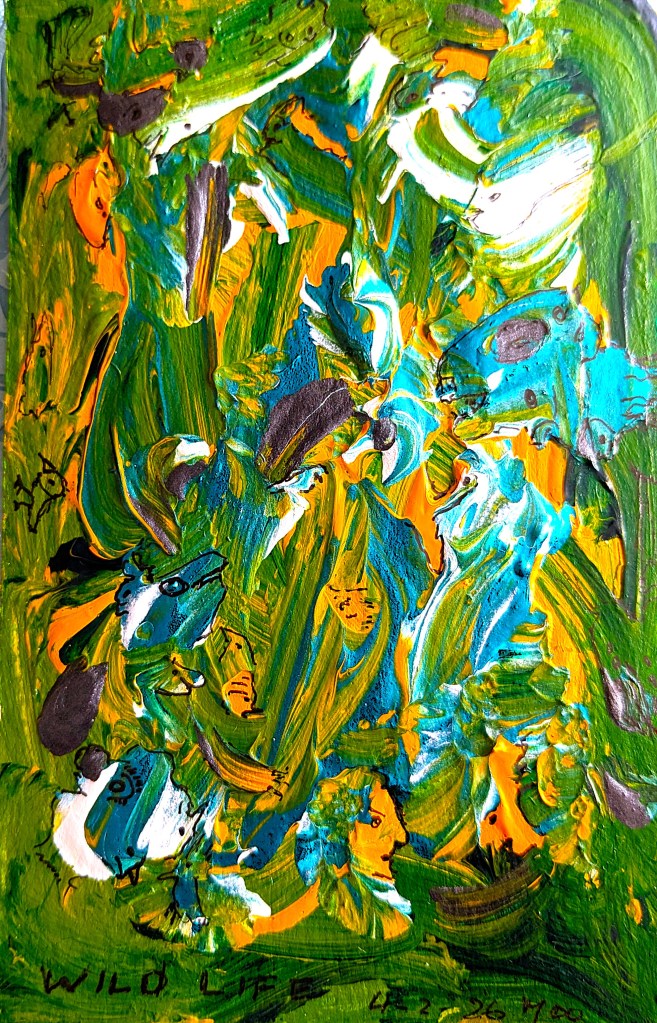
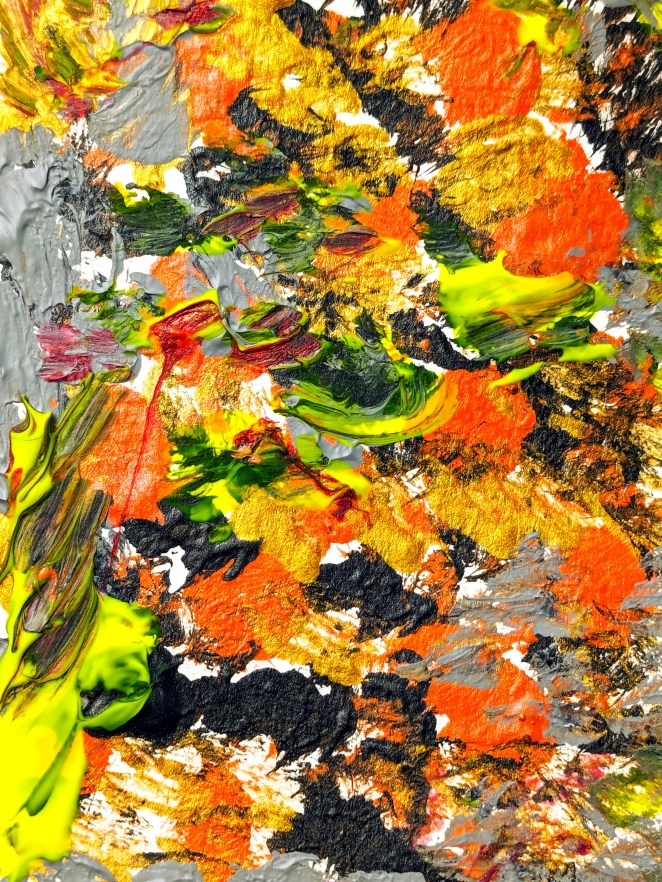
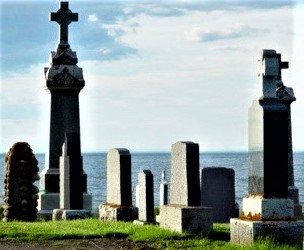
Throughout this journey, I have tried to use a four step process. (1) Verbal – the poems themselves. (2) Visual – photos that intertwine with the verbal. (3) A Commentary – that goes beyond the verbal and visual and opens up the ideas a little more. (4) A Dialog between myself – the poet – and Moo – the visual artist who has so frequently loaned me his paintings when he thinks they illustrate my words.

It’s been a topsy-turvy journey through what Bakhtin calls a world of carnival, where little is at it seems, and the world is turned upside down. That said, we have a clear choice – to slide down the downside of this life, or to scale the upside, to contemplate, with joy and happiness, the world from those heady heights.

Blessings. Pax amorque.
And thank you for travelling with me.

Carved in Stone 61 & 62

Carved in Stone
61

Water through the water clock,
water off a duck’s back,
the waters of life,
continually flowing,
trapped in our children
and their children,
and the love we create
never lost, just circling,
like the hands of the clock,
like the planets and stars.

But who will wind up
the clockwork universe,
and tend the mechanism
that balances planets and stars?

What will happen
when the clockwork
finally runs down,
the last candle is snuffed,
and the water clock dries up?

62

Whoever, whatever remains
will be left to contemplate
Ozymandias with his two vast
and trunkless legs of stone,
standing in the desert.

“Look on my works,
ye mighty, and despair.”

Commentary:

“Look on my works, ye mighty, and despair.” Well, Moo does have a sense of humor after all. I thought he did. From Ozymandias to the meaning of “works” to the destiny of the work we did. What a journey. It goes from the joy of the children who build a snowman to the warm spring wind that melts him to the crows and the dog who do what crows and doggies do. Intertextuality – the links between verbal and visual and think about it – such strange things happens in Moo’s creative mind.

But what do we leave behind? Think about it. Only the wake of the ship in which we sail. The wake – that white trail we leave behind us, on the surface of the sea, slowly vanishing as we also vanish, pulling away into the unknown that always lies ahead. Moo is right – so many things disappear out of the frame of the painting. “There are no pockets in shrouds” said the preacher in the hospital where I took my father, so long ago for treatment.

And even if there were, how would you fit a snowman, several crows, a cardinal, and the rear end of a dog into the pocket? “Contemplate Ozymandias with his two vast and trunkless legs of stone, standing in the desert. Now contemplate the fate of the snowman. Now look on my works, ye mighty, and despair.”


Carved in Stone 43

Carved in Stone
43

Back home, in that little cul-de-sac,
the husbands are away,
working their night shifts,
while the wives are at home,
entertaining the truckers,
those long-distance drivers,
who park in that street and lodge there,
overnight, in the houses.

The children, boys and girls,
go out into the street,
climb into the trucks,
duck under the tarpaulins,
and, with all of us sworn to silence,
practice what their elders
are doing back home.

Commentary:
Monkey see, monkey do. And who knows what Monkey sees or does when the lights are turned out, darkness descends, and the honor of the blood cult takes control. Ask the animals, they will teach you. That was the motto of Bristol Zoo, where the Monkey Temple ruled, and Alfred the Gorilla and Rosie, the Elephant, were King and Queen of the beasts.

Knowledge – where does it come from? How do we attaint it? Is there a difference between knowledge, what is known, felt, and worked out for yourself, and education, when you obey orders and do what you are told to do (and how to do it). “We don’t need no education, we don’t need no thought control.” I have always loved Pink Floyd and The Wall. So many walls, so many barriers, so many things to break down in order to build them up again. Songs – Frank Sinatra – “I did it my way!” And who teaches what and to whom, underneath the tarpaulin when the lights are out? “Hey, teacher, leave those kids alone.”

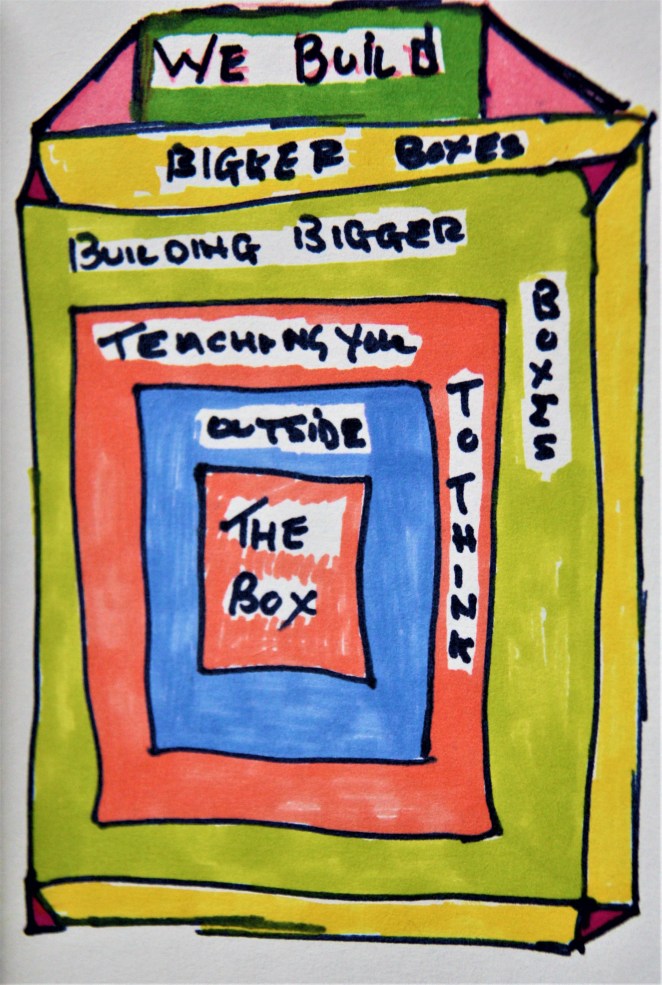
And beware of anyone who tells you that “we teach you to think outside the box.” That person will only give you a slightly bigger box, of his or her own making, inside of which you will be forced to think.

Of course, there are other ways in which we can think about education. How about this one? Filling empty heads with knowledge. How many ways are there to do this? And what is the exact content of the jug from which the knowledge will flow? And how many sows’ ears does it take to make a silk purse? “Hey, teacher, leave those kids alone.” Giddy up, Neddy I’m on my hobby horse now.

Carved in Stone 42

Carved in Stone
42

After school, in a cul-de-sac
that backs on to the railway yards,
the street boys show me
how to hold a knife,
how to approach a man,
how to ask for a light,
for a forbidden cigarette,
while other boys,
knives in hand, lie in wait
to ambush the victim.

How old am I?
Five or six.

I would go to Woolworth’s
with my friends and distract
the shop girl while the others
stole whatever they could.

Then we would go
to the public washroom,
boys and girls together,
and share the spoils.

Something for everyone,
and everyone sworn to secrecy,
a blood cult, knives
or razor blades inserted,
and wrist pressed to wrist.

Commentary:

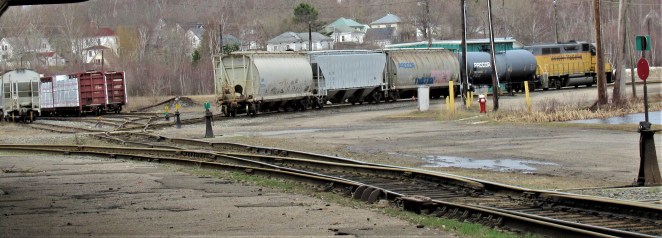
Free will or determinism? How does one escape from the back-street poverty of a run-down neighborhood and emerge from the shadows to bask in the light of the sun? Or is it all a dream, a made-up picture of a childhood that never was in a neighborhood that never existed? Vanishing point – the railway tracks fading away into the distance. Point of vanishing – to lose oneself in the mysteries of a past that never was in order to establish a future that never will be. Dream, dream, dream – all I have to do is dream!

And then there are the nightmares, when the dreams are true and the memories are so exact that you can see the blood on the razor blade and feel the almost silent slash of this particular slice of life. Secrecy – and who can tell whether I am telling the truth, or not, here in a foreign land, not the land of my fathers – and I only had one father, that I am aware of, and one mother too – where nobody knows me and the children from that imagined back street would never think of visiting.

For Jorge Luis Borges, whom I met twice, once in Bristol and once in Toronto, – Canada was a land so distant and so cold that it lacked reality. And thus I can dream my dreams, rewrite my past, reimagine myself, in whatever way I want to and I can vanish at any vanishing point I choose and emerge wherever I want to, and do it over and over and again, and who knows the truth? Over the points, over the points, and Liza none the wiser, whoever Liza happens to be!!!

Carved in Stone 27

The philosopher in search of his stone.

Carved in Stone

27

Miguel de Cervantes –
I read and re-read his words,
envious of his ability to reach out
with language that thrills me still.

I see him as a total entity,
while I see myself in pieces,
broken, unable to express
the simplest thoughts.

As I age, I sense the water
slipping from the water-clock,
the candles burning lower.

I still cannot make the mark
I want to make, for they are beyond me,
those marvelous word-worlds.

My words are mortal, his are immortal.
Mine just ink stains on a humble page,
his cast in print, but crafted to last forever.

As I bear witness to those powers,
so much greater than mine,
my eyes fill with tears.

Commentary:

They are beyond me, those marvelous word-worlds. Indeed they are. But I do not seek to create ‘a marvelous word-world’. I am happy with ‘ink stains on a humble page’. I seek to reach out and find those one or two people who accept me for what I am and find their own selves in a small corner of the tiny gardens I discover or create. Not a world, then, but a tiny corner of my own world, described, and offered to those who have eyes to see and ears to hear and hearts and minds to feel and understand.

And what is this infatuation with the poem itself? I no longer write individual poems, I write sequences of linked poems, a set of poetic narratives, if you need to find a label for what I am trying to do. Cervantes once wrote “La épica también puede escribirse en prosa.” / Epic poetry can also be written in prose. What happens if we reverse that statement and say – “A narrative sequence can also be written in poetry.” Interesting, eh?

And what is this desire to leave something, some trace of us, behind? I cannot answer that question. The answer will vary for each one of us, and for each fall wall flower perishing against the garden wall. I look at the homeless, pushing their grocery carts, head down. Their existence is as important as mine. Their desire to survive, for another day, another week, another season – and winter is coming one – is more powerful than any poet’s desire to leave a work – a magnum opus – to celebrate their lives.

And yes, my words are mortal, as I am mortal, as Miguel de Cervantes and all the great writers were mortal. Patrick Lane once told me that if poets leave one poem behind them that is remembered, they have done well. Even the greatest poets, and you can check this in the anthologies over the ages, rarely leave more than ten or a dozen memorable poems. As for me, I am happy to say that I have never had a poem included in an anthology. Not to my knowledge anyway.

And what does Magnum Opus actually mean? I leave you with the quote from Wikipedia set out above. Click on it, and find yet another way to distract, deflect, and change the direction of our lives! Given that road, who would ever want to walk it to its end?

Growing Old Together

Growing Old Together

You and I are growing old together.
We have been together for 59 years
and married for 54 of those.

We watch each other slowly breaking down,
the memories going,
the body parts not functioning
the way they used to.

In some ways,
it is incredibly beautiful.
In other ways,
it is so tragic, this slow waltz
around life’s dance-floor
towards who knows what
that last dance will bring?

It gets harder and harder
to find the right things to say,
sometimes to find anything to say.

There are days
when we just sit in silence,
filling in time,
doing a crossword or a sudoku,
or just gazing into space,
trying to avoid
the mindlessness
of endless adverts
on the television.

Commentary:

Not much to say, really. The poem and the photo speak for themselves, as good art always should. Sometimes the artist plans everything, and out it pops, all ready-made. On other occasions, a small miracle takes place and words and images tumble out, fluff their feathers, settle down and wow! – it’s a work of art. As long as one other person, other than me, thinks so, then I will be happy. “If I can reach out and touch just one person.”

I often wonder how many people are touched by traditional art nowadays. There is so much shock and awe out there, that the humble homely corner with its two doves or the image of an elderly couple dancing slowly around their kitchen, hanging onto each other – for what? And both of them waiting – for what, exactly? I expect it varies with each couple. But what I pity most are the lone doves, abandoned, autonomous, living on their own-some with nobody to talk to and only the TV to listen to. How many of them are out there, I wonder? When I walk around town, I see the street people, the homeless, the really lonely ones, just sitting, or slowly pushing a grocery cart with all their belongings tied up in plastic bags. Heads down, they plod on, never stopping, never looking.

“A sad life this, if full of care, we have no time to stop and stare.” W. H. Davies.

Carved in Stone 14 & 15

14


The sun throws shadows
across the cathedral’s face.

Crosses, arrows, stars,
masonic symbols
hammer-and-chiseled
into the granite sea-cliff
of the entrance way,
reveal the signatures
of the master masons
who laboured here.

And not just here,
for they traveled everywhere,
adding their stone signatures
to those of the other workmen
who left a piece of themselves,
carved in stone.

15

In the cathedral
of Santiago de Compostela,
Maese Pedro sculpted
a statue of himself,
a figurine, small,
low down, facing the main altar.

Students rub noses with him
before their exams,
when they look for luck
having forsaken their studies.

Illiterate people
consult these carvings
in the same way the educated
seek knowledge in their books.

16

The Bulls of Guisando,
pre-historic, unweighable,
the bearers of Roman graffiti,
itself two thousand years old.

Commentary:

workmen who left a piece of themselves, carved in stone … I couldn’t find my masonic markings from the cathedral in Avila, so I added the words carved into one of the Bulls of Guisando instead. Amazing how people want to make a little bit of themselves eternal – in the sense that we extend our names, our graffiti, our messages beyond our lifetime and, stones thrown into a pond, who knows how long the ripples from those tiny word-waves will endure?

So, what’s it all about, Alfie? And which Alfie are we referring to, the one who burnt the cakes or the (in)-famous gorilla in Bristol Zoo, who went missing? And how many Alfies are there out there? And why buy an Alfie-Romeo when you can buy a neat tombstone for a much smaller sum of money and have it remind people of you long after you have gone?

Silly questions, really, but this is what poetry is for, to open up the curious mind and to dig warrens for bunny rabbits so that the hunters of curiosities can dig their ways down and find whatever they shall find. But do we ever find what we are looking for when we first start out? Good question. Carve your answers into a piece of rock and leave it by the roadside to see what happens to it. Or else, you can write a message, stick it in a bottle, and send it out to sea to float on the waves. Put my name on it, along with yours, and maybe, one day, it will arrive at my doorstep in Island View and, if I am still here, I will reply to you by the same method.

Carved in Stone 13

13

What is life?
Is it just an illusion,
as Calderón tells us,
and nothing but a dream?

And what is time?
Does it bend, as Dalí shows us
when his surreal clock breaks into pieces,
time and numbers flying off
as it explodes over a waterfall?

Another clock folds –
a pancake draped
over the bough of a tree.
 
Time – a water clock,
a marked candle,
a grandfather clock,
with Roman numerals,
and time marching,
round and round,
erasing the past,
establishing a future
that will itself
soon be erased.

And what am I
but a moment on time’s clock,
a drop in the clepsydra,
a striation on a flickering candle,
a piece of roughly polished sea-glass
perched on a lonely beach?

Commentary:

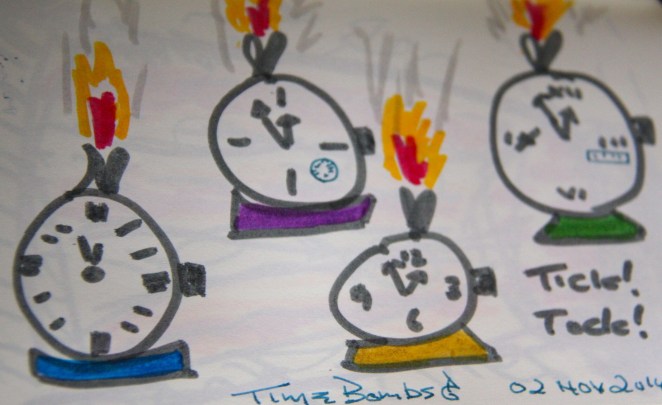
Well, Moo has done me proud this time. Two early paintings, both depicting aspects of time, as conceived by Moo. In the first, time is seen as a tick-tock time bomb, or rather a set of tick-tock time-bombs. In the second, in imitation of Salvador Dali (Moo always set his sights high!), a clock going over a water fall and the hours flying off the clock face as time bends. So, tell me if you can, what is time?

Perhaps more important, what is life? Is it a dream, an illusion? And if it is a dream, what happens when we wake up? I know what happens when I wake up – I get up and go pee. Is that to be my final reality? By extension, is life our only reality? Or is our life a series of lives, as some religions would persuade us? And if a cat has nine lives, how many lives do we have? Can they be numbered? Or, like innumerable onions, do we peel away layer after layer? And if so, what is in the centre of the onion when we finally get down that far?

And why do some people write center while others write centre? Is life an illusion, a play? If so does it take place in a theatre or a theater? Or is really a sort of metatheatre or metatheater, life in rings, like the onion, lay after lay, layer after layer? Oh dear, this is all much too complicated. I’ll ask Moo to paint me a painting of life and we’ll see what he comes up with. He’s a bit lazy at the moment and his paint brush has the bends and refuses to cooperate. It’s probably made of cat bristles, and is untrainable and almost impossible to train, let alone to herd. Never mind. We’ll abandon all this for now and give the cat the task of training Moo to paint another painting.

Carved in Stone 10 & 11

10

Firelight dances,
bringing things back to life.

Each morning,
I take time to empty my mind
of those restless cats
I herd at night as they shimmy
through my troubled dreams.

By day, each cat
throws a different shadow
that parades before me
in the sweetness of soft sunlight
where a honeyed sweetness reigns
and no bitterness dwells.

My own cat haunts me,
purring for butter,

sitting there, staring,
eyes wide open, hypnotic.

What, I wonder,
does she really want
as she turns her back,
walks away,
and stalks a different prey
among my books?

11

Does she hear the clock’s dry tick
and sense the Roman numerals
marching round, left – right – left,
always in step
with the pendulum’s sway.

Does she recall migrating birds
or those gaudy summer butterflies,
fanning their wings
as they perch on Cone Heads,
Bees’ Balm, Black-eyed Susans,
generic butterflies,
specific flowers,
planted by my own hands?

I often ask myself –
“What does she know
that I don’t know?”

Commentary:

A strange thing knowledge. I have learned the hard way that “the more I know, the more I know I don’t know.” Just look at today’s second stanza. I would love to know more about, and understand better, migrating birds, summer butterflies, especially the lovely Monarchs that fly at Mexico and back, the flowers themselves, the way language substitutes the generic (butterflies, flowers) for the specific (Red Admirals, buttercups), and as for that cat, I really would like to know what she knows that I don’t know. I have never been able to train her, but she has certainly managed to train me!

And I would love to understand humor and laughter. Slapstick aside, humor is one of the cultural secrets that travels least in translation. Jokes in French or Spanish just do not translate well into English. It takes a deep cultural and linguistic knowledge to grasp foreign humor at first glance.

Take today, for instance. I drove the car to the garage to change the tires from summer to winter. I asked the garage guy, my friend, if he would drive me home, and he said he would. He got i the passenger side and I drove home. Then he drove the car back to the garage. He opened the garage doors, drove the car in, turned the engine off, hoisted the car up, and changed the tires. When he’d finished, he tried to start the engine. No luck. He called me – “Where’s the key?” “In my pocket!” I replied. We were having such fun chatting we never thought to offer or request the car key when we exchanged drivers. Well, we are all still laughing about it.

When I got into the house, even the cat was laughing, and as for that cat, I really would like to know what she knows that I don’t know. Maybe, it’s just that we humans, especially as we age, aren’t as clever as we sometimes think we are. Some things, I guess, I’ll never know.