A wonderfully quiet and peaceful Christmas in Canada. Oh the sea, oh the sea, thank God it still flows between my family and me.
Boxing Day By the time I get up, the gloves are really off and the sparring has begun in earnest. I hear voices, walk downstairs to the kitchen, and a hush falls on the room. Knife-edge glances slice their menacing ways through the thick fog of war. Time for boxing: on my left, in the blue corner, my mother, smoking what is probably her second packet of the day. A thin haze of grey smoke escapes from her bruised lips and a cloud of exhaled fumes crowns her head with a murky halo. On my right, in the red corner, my father. White-faced, hungover yet again, truly into the spirits of Christmas. He breathes heavily, like a Boxer Dog in the mid-summer dog-days, snoring and snorting at a bitch in heat. In the middle, my grandfather, the referee. He is keeping the combatants apart, creating a tiny breathing space so the true Spirit of Christmas can disentangle itself from those false Christmas Spirits and bring peace to earth again for at least sixty seconds between each round. I look around the heaving, seething, threshing silence of a room where conversation has suddenly ceased. The fire is burning merrily. Beside it, tongs, poker, and small shovel stand to attention. On the hearthstone, the little red brush, with its long handle lies in ambush. This is what my father uses to beat me when he can’t be bothered to take off his leather belt. Scorch marks from the hot coal fire sear the handle and back of the little red brush. I threw it on the fire one day, hoping to see the end of it. Of course, it was rescued from the flames, resurrected, and I got beaten for that act of rebellion too. “It’s all your fault!” My father breaks the silence, pointing at me. His red-rimmed eyes blazing with a sudden and renewed anger. He starts to rise, but my grandfather steps between us. “Go and see your granny,” grandpa tells me. “She’s in the kitchen. Go now!” He points to the kitchen door. I run a gauntlet of staring eyes and go to my gran. As I shut the door behind me, voices rise higher in the room I have just left. Boxing Day, indeed. The gloves are off. The battle has begun again. My grandfather has evacuated me from no-boy’s-land and, for a moment, I am no longer trapped in the mud-filled, cratered, shell-holes between the trenches, the uncut barbed-wire barriers, the poached-egg eyes peering through periscopes and spying on me from the parental and priestly parapets. Here in the kitchen, for a while, I walk on the wooden duck-boards that keep my feet dry and clear of mud and water.
Comment: This is, of course, the true origin of the term Boxing Day. A genuine Boxing Day has nothing to do with the myth that it was the day on which the servants, who worked Christmas Day on the Lord’s estate, received their Christmas Boxes. Peace on earth and mercy mild has got nothing to do with alcohol-fueled quarrels, raging hangovers, and little children who should be seen and not heard. Sometimes, when all the elders are down at the pub on the corner, the night may, for a little while, actually be silent. But the noise when the drunks roll raucously home is most unholy. Then little children should be wise like the wise men, run quickly into bed, and lie there, neither seen nor heard.
Silence in the garden. A hawk perched nearby. There are so many ways to die.
Death by Devilry
Silence in the garden. A hawk perched nearby. There are so many ways to die.
A cerebral bleed, minor, but enough to send him to hospital and keep him there.
Cured, ready for release, he would need extra care and added attention.
The devil lived in the small print. Too much attention needed now: his care home wouldn’t care for him.
Back to the old folks ward he went. There he lay, waiting for a vacancy in a home that would really care.
One day, Covid came a-visiting, stalked the ward that night, choosing its victims: you, you, and her, and him.
What killed him? A cerebral bleed, a minor stroke? Or a major stroke from the devil’s pen?
Bold words, bare words, a barren ward, another vacant place around a Christmas table.
Comment: Sitting at the breakfast table, with an empty space before me, I penned these words. So tragic, so avoidable. Yet how many families have gone through something similar in the past twelve months? How many empty spaces are there, vacancies that will never again be filled? I look at today’s figures from the USA: 18,466,231 infected and 326,232 already perished, an increase of 227,998 and 3,338 since yesterday. I am reminded of the words of Pink Floyd: “Is there anybody out there?” Blas de Otero also echoes through my mind: “levanto las manos: tu me las cercenas” / I hold up my hands: you cut them off. And yet it is Christmas Eve and there is still the Christmas promise of joy, and hope, and a new year entering. Let us raise our hands in prayer: and let us pray they are not hacked off.
He was a good man, and a better friend. He came over to mow the lawn and stayed for a beer. “This is gonna sizzle!”
Some called him uneducated, no BA, no MA, no LLB, but he had a golden heart and a PhD in the school of life and hard knocks.
I met men like him in Wales, coal miners in bars, steel workers on rugby teams, sheep farmers from the hills in the big city for the game.
Humble, they were, honest, hard men, hard working, intolerant of pretension and fools. When I went to university, nineteen and full of ideals, they pulled me on one side.
“You’re one of us,” they said. “However high you rise, don’t lose the common touch.”
I met men like him in Spain, foot-soldiers from the Civil War, riflemen, dynamite throwers with their skills learned at coal face and quarry.
Machado wrote poems about them: “Donde hay vino, beben vino; donde no hay vino, beben agua de las fuentes.” Where there is wine, they drink wine. Where there is no wine, they drink water from the fountains.
A good man, an honest man, an uneducated man, some say, who taught me more about life and how to live it than any university professor.
Comment: I read the obituary of one of my best friends in the newspaper today. He moved away from the neighborhood and we lost touch. But I never forgot him. As I have never forgotten those who shaped me in Wales and Spain. I have forgotten many of their names. But I have never forgotten their faces, nor their words of wisdom.At first, his passing brought a shadow to my life. Then I realized that no, he would not have wanted that. I think now of the good times, the laughter, the joy and, instead of mourning for him, I rejoice in all the goodness he gave me. Rest in peace, my friend. I will forget-you-not.
Los toros de Guisando, pre-Christian Celtic stone bulls, Avila, Spain.
Invisible Scars
Our minds absorb words as blotting-paper soaks up ink. Phrases carve beehives deep in our inner circuits. No te preocupes / don’t worry. Yet tone and carry are different in each language and the comfort-blanket serenity of note preocupes does not translate easily from Spanish to English. The verbal vibes are just not the same. Nor do the catcalls from the soccer, aimed equally at opponent and referee, and tumbling raucous from the stands where people sit. Shrill whistles sound in the bull ring: a matador who seems afraid to approach this particular bull for reasons only known to him, yet his shakiness visible to all who watch and understand what they are seeing. The Cordobés answers the telephone he places on the bull’s nose, yet fails to approach between the horns and his sword rebounds off bull bone: pincha hueso. Each one wounds, the last one kills. El Viti, stately, graceful, an elderly churchman proud of his vocation and always willing to perform to perfection the weekly ceremony of the sacrifice. The boos when the bull enters the ring, stumbles, and comes up lame and limping. The cheers that accompany the arrival of the seventh bull. The refusal to eat meat that has been slaughtered in the bullring, even though it is advertised outside the butcher’s: tenemos solomillo de toro de lidia / we have tenderloin steaks from fighting bulls. Bulls who have led the best of lives, fed on the tenderest pastures, watered by flowing streams. Bulls grown for slaughter and public sacrifice.
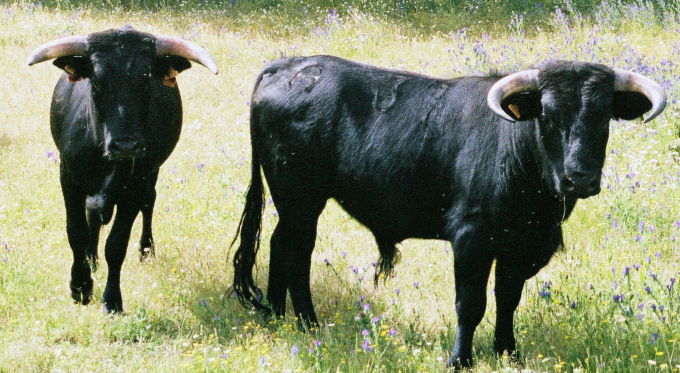
The real thing: young fighting bulls (novillos) on a bull farm in Salamanca, Spain.
Guernica. The bull fight in the sand-filled square. Except it wasn’t a fight, it was more a circus. The slippery pig. The hens and chickens. The rabbits and hares. All the animals running scared. The animals released, one by one, and the spectators jumping into the ring, really a sand-filled square, one by one, and chasing down the animals, taking them home for dinner, if they could catch them. Then the bigger beasts. The mule, ferocious, jumping into the air, kicking four tormentors, one with each leg, and biting a fifth with his teeth. No fearful, clucking chicken this, nor the cow who came after with her padded horns. Participants moved more carefully now. She watched them from her querencia, the where she chose to fight, not die. She knelt, scraped off the rubber balls that covered her horns. Re-armed, she charged and the crowd scattered, all but one young kid, caught, falling to the ground, the cow standing over him, ready to gore again. Sixteen years old, an outsider, I jumped with others over the barrier, twisted this away and that, thumped the cow’s side, smelled her fury, her fear, the whole soured being that emanated from her. Together, we hustled her, bustled her, dragged her kicking, butting, from the ring, backwards, pulled by the tail. Visible scars of damaged animals. Scars of the participants. That young man who broke his leg. That old man, inebriated, stuffed with food and drink, who loosened his belt to move more freely. We watched as his pants slipped from his waist to fall around his knees and trap him, just as the cow charged. He survived but will bear the scars forever, some visible, many not. Long summer days, on the Sardinero, the Segunda Playa, playing soccer. Different rules, different skills, different swear words: I carry a dictionary tucked into my bathing trunks and refuse to play while I look up the words spat at me by my opponent. Good heavens, I think, is that anatomically possible? The ball bounces away on the hard, sand ridges. I chase it and steadily dehydrate under the hot sun. A sea-salt wind desiccates my body. My mouth fills with salt water when I swim out to retrieve the ball from the sparkling sea. My tongue sticks to the inside of my mouth. When I spit, I spit dry and everyone laughs. Now I am totally dry, shiver, and no longer sweat. On the way home, we get off the trolleybus early, at Jesús del Monasterio and enter the long string of bars that lead past Numancia towards Perines. Red wine in glasses, in porrones, with tapas and raciones to soak up the alcohol, morcilla, mariscos, callos, patatas bravas, wine consumed until our blotting-paper bodies are ready once more to sweat. Bread soaks up the wine that relieves the oil that now filters through our skins and who needs suntan lotion when the oil is inside us and bodies are oiled, well-oiled, from the inside out? These excursions are all male, just like the soccer teams. I have four friends and I know them by their nicknames and the way they play soccer. I also know them from the way they try to trick me and laugh at my mistakes, or the way they treat me as a human being and help me to understand this new world into which, sink or swim, I have been thrust. Total immersion in another culture does not come with a set of instructions and the rules of soccer change from grass field to beach sand. Pedro plays centre-half, loves heading the ball, even when it’s laden with sand. I watch him playing field hockey one day, out at La Albericia, and when a low shot heads for the corner of the goal, he dives and heads it away. They carry him off on a stretcher, blood everywhere, and you wonder if his scars will ever heal. Tennis on the clay courts, also at La Albericia. I play so slow but they play so fast. I learn top spin, side spin, back spin, cutting the racket beneath the ball and learning to bend it sideways off the clay that is not clay really, but a fine-packed Italian sand on which I can slide and glide, and commit to a shot running one way then turn and commit to another in the opposite direction. I try it on a hard court, after the immersion period ends, when I get home, and my foot sticks on the tarmac (or whatever that hard, non-slip surface is) and over I go, skinning my knees, creating more scars.
Comment: Another Golden Oldie reclaimed from the reject file. I remember the scenes so well, even though I have moved deliberately in the piece from Elanchove and Guernica (Basque Country) to Santander (now Cantabria). I got lucky and was able to attend a series of workshops on memoirs run by Brian Henry of Quick Brown Fox. Taking his workshops, I realized that most of what I write is more akin to Creative Non-Fiction (CNF), rather then memoir, though much of what I write is rooted in memory. What thrills me in this style of writing is the rhythm that emerges, the word patterns I knit with my pen and a skein of ink, the remembered brightness of the Spanish sun, the sparkle of the waves, the warmth of a people, still grieving after their losses in a bitter civil war, their willingness to accept me, a foreigner, and take me to their hearts. The Other: we talk so much about The Other. But when we ourselves have been That Other, have been dependent on Other Others for food, drink, warmth, care, and love it is so much easier to understand what The Other is lacking and what we can give. Warmth, not scars; a hug, not a punch; open arms, not a fist… so easy to say. I have been there. I know. But can we, deep in our hearts, find it in ourselves to make the sacrifices for The Other that other others have made for us? Only time will tell.
Memories deceive me with their remembered shows, shapes shifting with a click of the magician’s fingers. What magic lantern now slips its subtle slides
across night’s screen? Desperate I lap at salt-licks of false hope that increase my thirst and drive me deeper into thick, black, tumultuous clouds.
A pandemic storm lays waste to the days that dog my mind. Carnivorous canicular, hydropic, it drinks me dry, desiccates my dreams, gnaws me into nothingness.
At night a black dog hounds me, sends my head spinning, makes me chase my own tail, round and round. It snaps at dreams, shadows, memories that ghost through my mind.
Tarot Cards and Tea Leaves are lost in a Mad Hatter’s illusion of a dormouse in a teapot in an unkempt tale. Hunter home from the hill, I return to find my house empty, my body devastated, my future a foretold mess.
Comment: Tough days around us and even tougher ahead. Covid-19 in the schools and people I know, young and old, frightened and in quarantine as a result. People I know and members of my far-flung (thank you, Jennifer, for that long-lost word) family. Funerals to the right of me, funerals to the left of me, of friends I know, acquaintances I hardly know, and many more whom I’ll never know now. “Into the jaws of Covid-19 rode the gallant six hundred, all masked, many falling, fewer of them every minute of every day.” Gallows humor keeps me alive. Last night my favorite teddy bear went AWOL. I got up at 3:00 am and sent out a search party. Sharp eyes spotted the copper band I lost last week. It had been hiding under the pillow. Then, joy of joys, they spotted Teddy’s black velvet band, the one that ties up the hair that falls over his shoulder and gets up my nose and makes me sneeze. They hauled him out from under the bed. I picked up the phone and cancelled the 911 call before the masked men in their jackboots and their PPE could break down the door and strip search the house for a missing bear. Alas, dear Mabel: I would if I could but I am not able.” How those words resound in my ears. Left ear, right ear, and, like Davy Crockett, a wild front ear. I will not give in to morbidity. ‘He who fights and runs away lives to fight another day.” I will survive for another day. Meanwhile, I’ll call for General Worthington, the fellow who can always make the enemy run. “Will you have a VC?” I said “Not me: I’d rather have a bottle of Worthington.” Alas, they don’t make it anymore. And Watney’s Daft Red Barrel has bitten the dust and gone the way of the dodo. And all my friends are in the doldrums, watching, as Admiral Brown abandons ship, mans the boats, and hauls away into fairer weather and cleaner waters. You say you do not understand? ‘Blessed are the poor in intellect, for they shall know peace in these troubled times.’
Some people leave indelible impressions memorable moments impressed on memory’s eye or clasped closely to the butterfly heart caged in its chest wings wildly beating as it strives for flight
some people cast shadows on snow leave footprints light as flakes as they walk across our waking dreams or call on us in those midnight hours when their image sears the drowsing mind
Some people set a fire in our hearts allow us to see things out of sight to write what we never thought to write to reach out to the unreachable to teach what we thought was unteachable
Stars in night’s silence they point the way lead us on paths we never thought to tread present us with a thread to lead us through life’s labyrinths and out from the darkness into bright light
Sometimes they cross the rainbow bridge before we do and when they go we know deep down in our hearts that they are there just out of sight waiting for us ready to welcome us when it’s our time to go
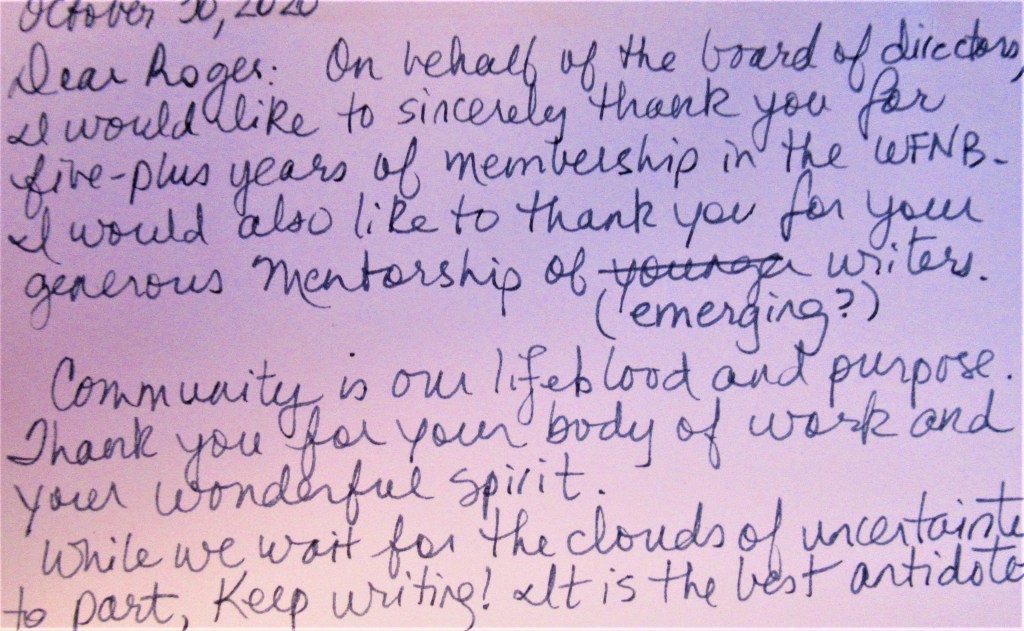
I have been a member of the Writers’ Foundation of New Brunswick for a long, long time. I am not a ‘founding member’, but I think I have been a member since around 1985, and I am sure I was a member in 1986, when Goose Lane Editions, Fredericton, published my second poetry collection, Broken Ghosts. I was most certainly a member in 1989 when my still-unpublished poetry manuscript Still Lives placed first in the Alfred G. Bailey poetry competition.
In the years between 1985-1986-1989 and 2020, I have never received a hand-written communication from any member of the WFNB Board, other than an official communication of one kind or another. Imagine, then, my surprise, when the above postcard, inserted in a hand-addressed envelope, arrived in my mail box yesterday. I was truly amazed and very grateful to the president who wrote these kind words to me. Amidst the panic and the pandemic, it is so nice to be remembered and in such a thoughtful way. Madam President: thank you so much for reaching out to me with this verbal gesture. And yes, you can count on my support for yourself and our Writers’ Federation, I hope for a long, long time to come.
I was in two minds whether to post this or not. However, I wish to emphasize several things: the importance of reaching out, the importance of continuing to believe in ourselves and our creative talents during these difficult times, the necessity of creating alternate communities and of supporting each other as much as possible, the need to avoid total isolation and to maintain human contact in different ways when the physical things — meeting, touching, holding, direct dialog — and the normal activities and relationships of healthy human beings are denied to us, and last, but by no means least, the need to encourage each other and to offer comfort and recognition whenever and wherever possible.
November on the Berryfield: duck weather, we call it, with the rain pouring down and the watchers standing on WWI duckboards, chilled their fingers, eyes blinking against the wind.
West Country clay turns rugby boots into leaden counterweights. Hands stuck in pockets, the railway carriage where we changed is a distant memory. The only reality, this wet clay holding us back.
Mouldy and muddy, our rugby jerseys are all the same and it’s hard to distinguish friend from foe.
Trench warfare, we think, as the two packs strain, a Roman tortoise, sixteen bodies, thirty-two legs, crabbing from side to side as they seek a perfection that will never be found on a day like today.
Rain shrouds the goalposts and the scrum half’s kick is a yard too far from clumsy, chilled fingers as they scrabble in vain at this soap-bubble nightmare we call a rugby ball. Worn-out legs churn through mud that clutches like an octopus at feet and ankles.
Running rhythms are lost. Wet clay fingers hold us back. Grey ghosts of ancient alumni raise up our hearts, help us to haul our opponents’ tired bodies down.
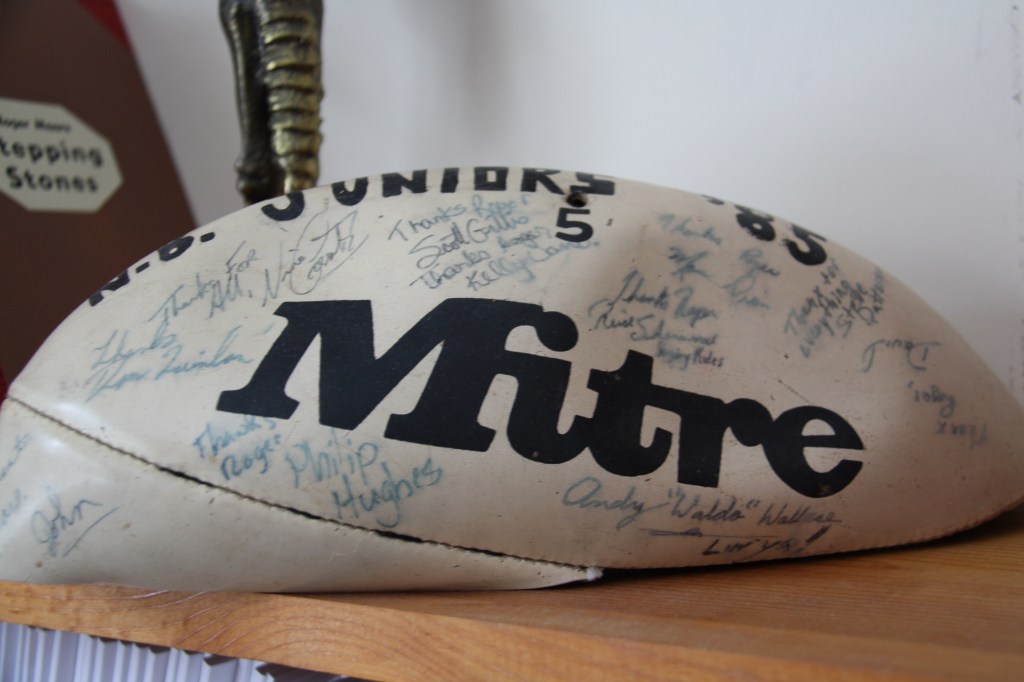
Comment: Just rediscovered this, revised it, and now I am posting it again. The Berryfield is where I played my school rugby. If anyone remembers the Berryfield, or actually played there, by all means drop me a line. That West Country clay mud was the devil. Heavy and clinging, it grew on your boots until they became as heavy as diver’s boots and gradually weighed you down. It was worse for the opposition than for us. We, at least, were accustomed to it. It was even worse for the cross-country runners and I have never forgotten those ploughed clay fields.
Some days, monkey winds himself up like a clockwork mouse. Other days he rolls over and over with a key in his back like a clockwork cat.
Monkey is growing old and forgetful. He forgets where he has hidden the key, pats his pockets, and slows right down before he eventually finds it and winds himself up again.
One day, monkey leaves the key between his shoulder blades in the middle of his back. All day long, the temple monkeys play with the key, turning it round and round, and winding monkey’s clockwork, tighter and tighter, until suddenly, one day, the mainspring breaks and monkey slumps at the table:
no energy, no strength, no stars, no planets, no moon at night, the sun broken fatally down, the clockwork of his universe sapped, and snapped.
… and the wind a presence, sudden, rustling dusty reeds and leaves, the pond no longer a mirror, its troubled surface twinkling, sparking fall sunshine, fragmenting it into shiny patches.
It’s warm in the car, windows raised and the fall heat trapped in glass. Outside, walkers walk hooded now, gloved, heads battened down beneath woollen thatches.
A wet dog emerges from the pond, shakes its rainbow spray soon to be a tinkle of trembling sparks when the mercury sinks and cold weather closes the pond to all but skaters. Then fall frost will turn noses blue and winter will start to bite.