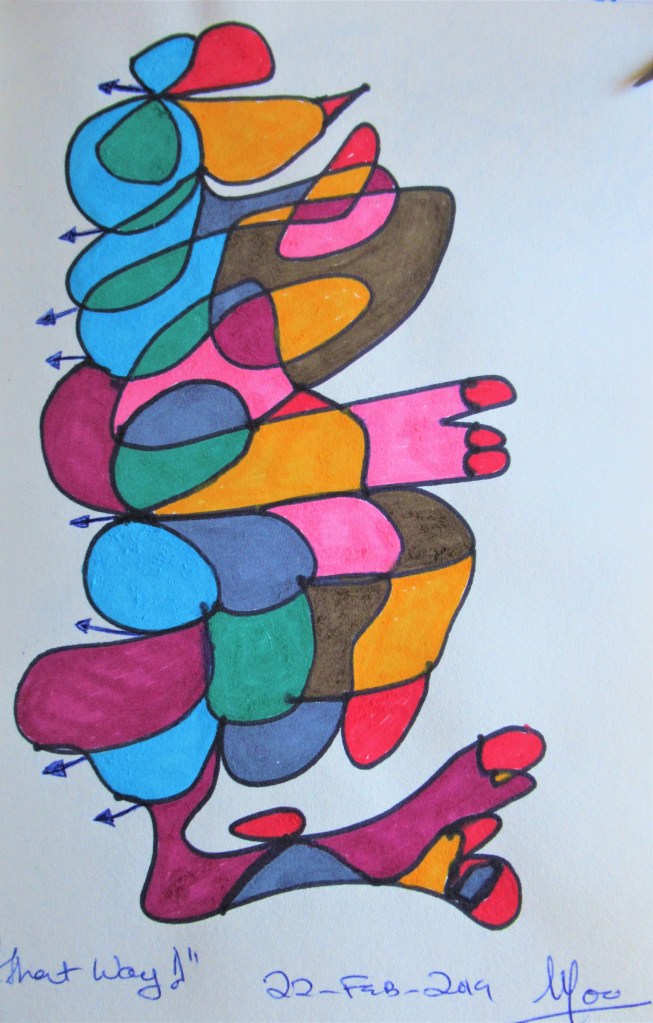
A once-upon-a-time god struts past the table where I drowse. Once I stole his nose, breaking it from a sacred statue. Now I watch it cross the square: a proud beak nailed to a face.
Casting shadows on the cobbles, zopilote flies over the square. I caught him once, dozing on a local bus filled with love-birds: he begged me to fold his wings and let him sleep forever.
The balloon lady sits in the square selling tins of liquid soap. Released from school, the children charm my days blowing colored bubbles that seek freedom in the skies.
Eight Deer, eight years old, sets out on his conquests. Nine Wind gives birth to his people, releasing them from their underworld prison by carving a door in a tree .
Faces crowd the trees above me, as long-dead friends come back to life, chattering like sparrows in the branches. Roosting time and their voices slip slowly into silence.
Sometimes, at midnight, they scratch at the window in my head and tumble through my half-awake mind. They need me, these dreams, for I bring them to life. Without me, the dreamer, they would surely fade and die.
Trapped in this fragile vessel with the pandemic a passenger waiting to board, I drift from port to port, looking for a haven, safe, to have and to hold me.
No harbour will let me dock. “No room at this inn,” they say. “No haven here.” They wave me away.
Now I have no destination. Aimless, I float and every where I go the message is: “No vacancy: no room at all.”
Unwanted, abandoned, I wander with wind and waves, my only friends seals, porpoises, and whales. I walk the whale road, leaving a frail, white wake behind.
This vessel has become a gulag now, a prison camp where I exist just to survive. Each hour of each day endless, boundless, like this shadowy, haunted sea.
Today there is no motion, no goal. What is there to achieve but survival? Each day’s journey is sufficient unto itself.
A strange, milk-cloud sky, skimpy, with the sun a pale, dimly-glowing disc and my pen scarce casting a shadow as the nib limps over the page.
Out on the west coast, fires still range free and this is the result, these high, thin clouds casting a spider web cloak over the sun face and darkening the day.
The west coast: five or six hours by plane and three whole days to get there by train, even longer by bus, all chop and change with multiple stops.
The wind blew and the clouds came widdershins, backwards across the continent. Today they reached across the ocean to claw the sun from European skies.
It is indeed a small world after all. Isostasy: you push the earth balloon in here, and it bulges out over there in the place you least expected.
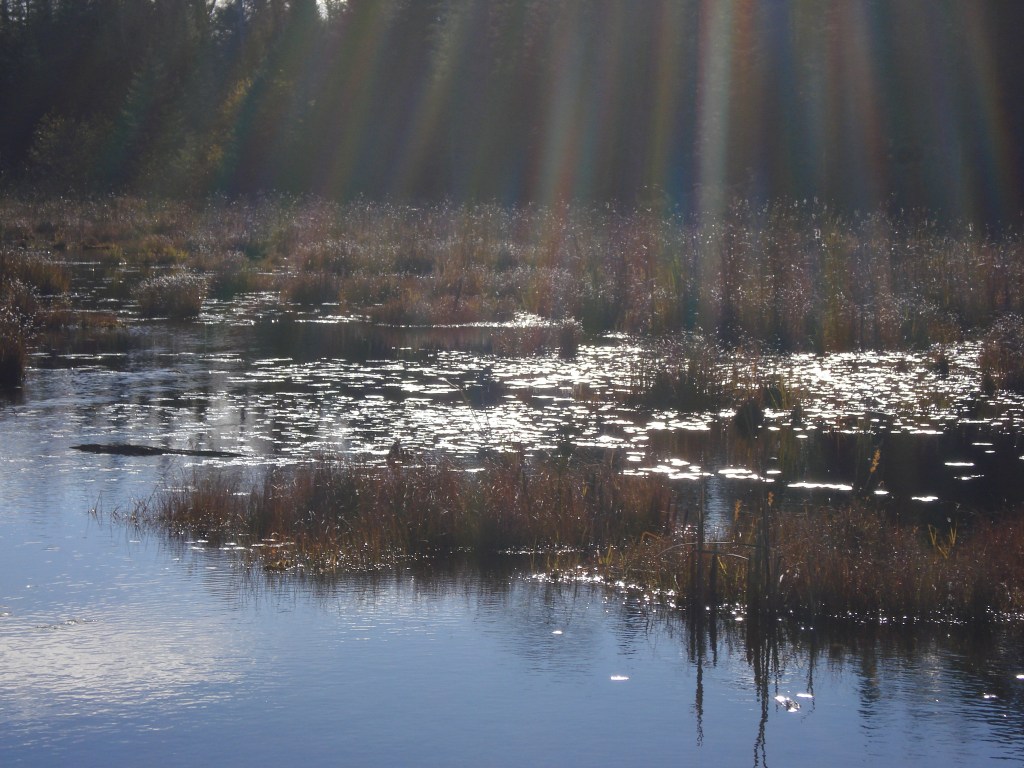
Now we are all interconnected in an intricate network of a thousand ways and means. What does it all mean? Ripples ruffle the beaver pond’s dark mirror.
The forest mutters wind-words, devious and cruel, that I sense, but cannot understand. High in the sky clouds turn into horsemen on plunging steeds.
Fear, fire, flood, foe, poverty, unemployment, pandemic, crops destroyed and, waiting in the wings, threats of civil unrest, the apocalypse, and a war to end all wars.
Comment: A week in bed, unable to sit, to write, to use the computer, except standing on one leg and typing with one finger. Unable to concentrate, to create, and now, after four visits to my medical team, acupuncture, manipulation, massage, finally that pinched nerve has stopped pinching and I can get back to writing. However, my thoughts are as grey as these clouds that dim the skies. I no longer know who or what or where I am. The world around me has turned sinister and I suffer.
The result: black thoughts, black poetry, red, flaming skies, and the knowledge that all is not well, neither with me, nor with our sick little planet. There is no Planet B and this one, like me, is suffering.
Premonitions and dark thoughts. I lie awake in bed each night, sleepless, hugging my Teddy Bear and my hot water bottle, aching, suffering, waiting for the dawn.
Between Two Places Dianne Fitzpatrick Where’s Home?
Where’s Home (3) Part III of an open letter to Jan Hull
The Little Things
In 1898, Spain fought and lost a war with America over possession of Cuba. Cuba was the last of Spain’s overseas Empire and when it went, the all conquering fatherland, upon whose empire the sun never set, was reduced to its original territory in the Spanish Peninsula. That same year, the literary Generation of 1898 started a new movement, one that made Spain itself central to its imagery and thought. Theirs was not the Spain of Imperial History, with its wars and treaties, battles and conquests. Theirs was the eternal countryside of Spain, the Spain of Old Castille that was rooted to the soil, and that had remained virtually unchanged in the small towns, fishing ports, and villages, for hundreds of years. This was the Spain of Miguel de Unamuno’s Intra-historia: the history of small things.
St. David, Dewi Sant, the patron saint of Wales, a historical figure flourishing circa 600 CE, is famous within Wales for his many sayings. But for me, one stands out. “Byddwch lawen a chadwch eich ffyd a’ch credd, a gwnewch y petheu bychainmewn bwywd” / Be joyful and keep your faith and creed and do the little things in life. In these times of stress and strain, faced by enormous changes brought about by the pandemic, to these prophetic words I turn.
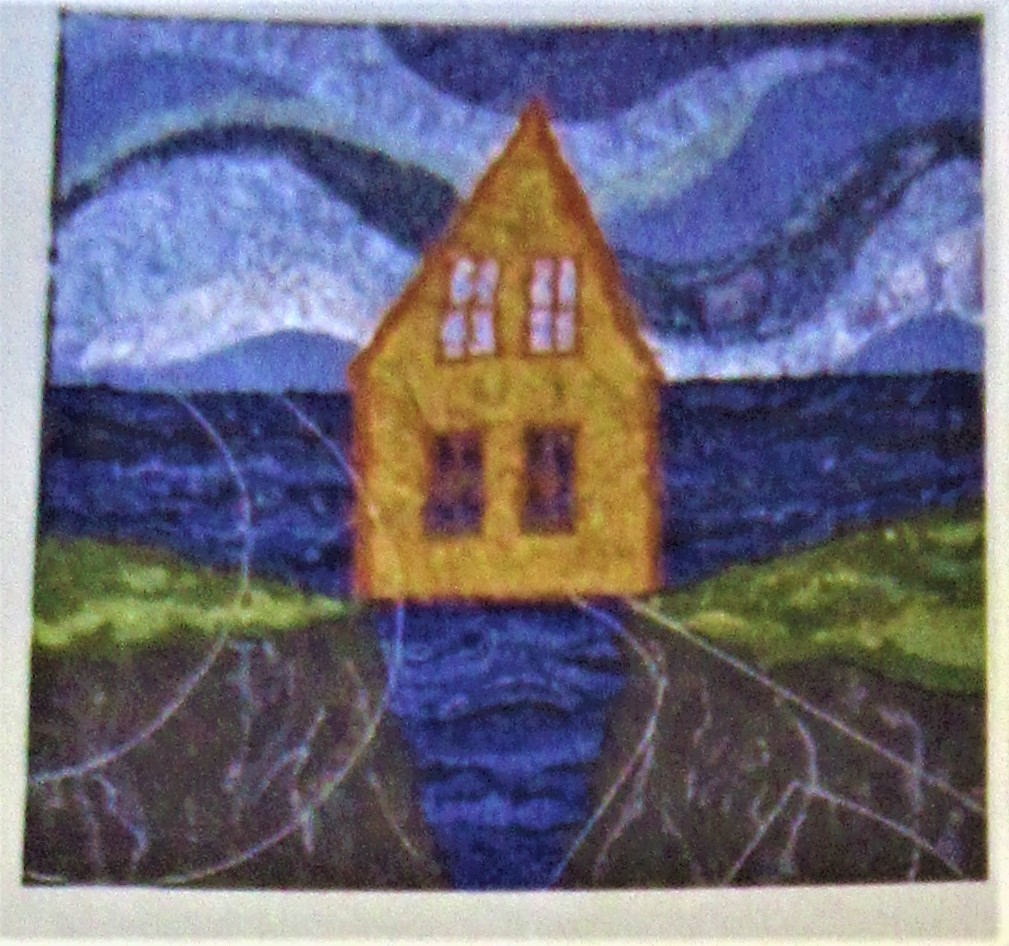
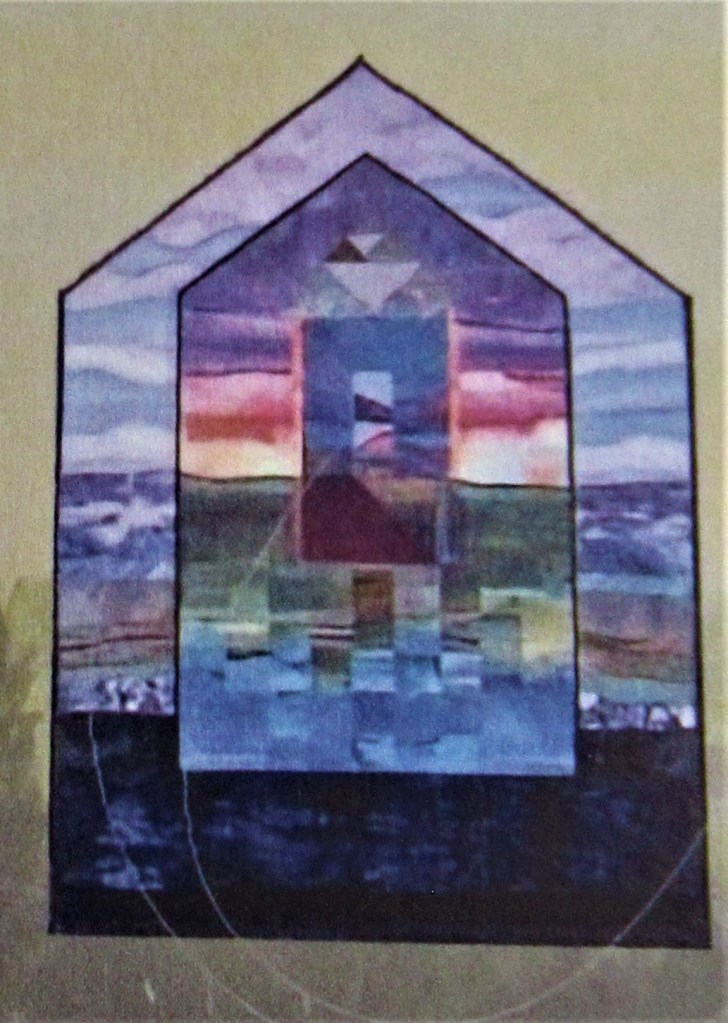
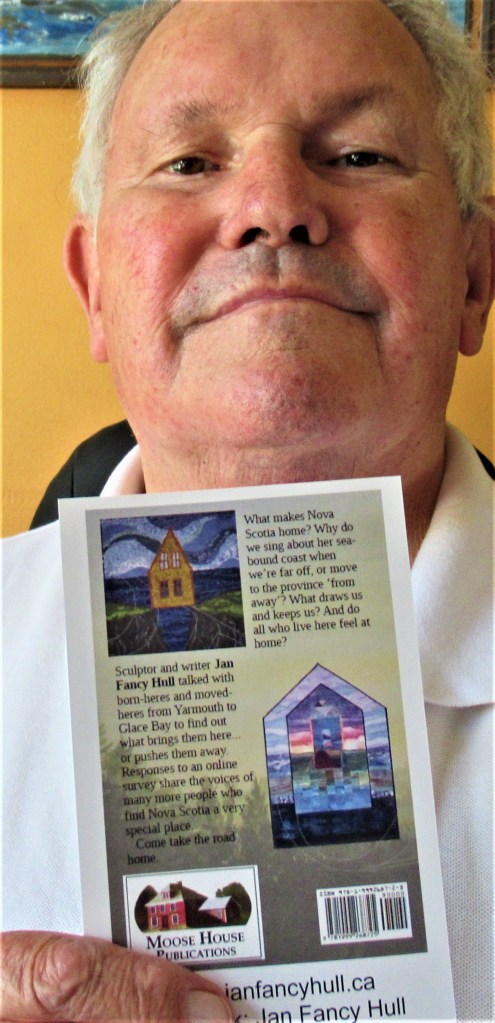
Poets, creators, artists, stoneists, craft-workers of all kinds … we are the antennae of the people. We sense the directions in which life flows and will flow and we are ahead of our times, not behind them. We are the ones who ‘do the little things’, often abandoning larger, more financially rewarding projects in favor of smaller ones that spiritually enrich both us and the people around us. And that is what I am now reading in Jan Hull’s Where’s Home? People, real, live, flesh-and-blood people, many of them artists at heart, abandoning the big city’s rush and rock and roll to enjoy the quietude of small communities which they help to build with their own hands.
Troglodytes, cavemen, people living in the past, I have heard ‘so-called saner citizens’ mutter about some of our contemporary artists. They live off hand-outs and charity and welfare, and they live in the past. Grey-suited, working in concrete boxes, these well-heeled critics are all made out of ticky-tacky, as the old song says, and they work in little boxes, and they come out all the same. Fine fr some, but you certainly cannot say that of the characters who inhabit the small towns, villages, and ports, as Where’s Home? demonstrates so clearly, with quote after quote from contented people, all resident in Nova Scotia, some CFA (Come From Away), others CBC (Come By Choice), and yet others native to the province.
Living in the past … when Hurricane Arthur struck, we went without power for twelve days. No water, no warm food, no cooking, no refrigeration, no flush toilets, no showers, no air conditioning, no television, no Wifi, no internet … In 1928, my grandfather and my father built a summer home, a bungalow, in Gower. I remember, even in the late fifties, living there during the summer with my grandparents: wood stove, rain water barrels, no running water, outhouse, no electricity, no refrigeration, oil lamps … Hurricane Arthur … and Clare and I went back to bungalow living. Several of our neighbors did not know how to cope with the ‘problems’. A couple moved into hotels or stayed with family elsewhere until the crisis was over. As for us, this was the life I was used to as a child. We went into bungalow mode and had more fun than anyone could imagine… living in the past? … or preparing for the future? … Think about it, and don’t jump too quickly to the wrong conclusion.
Above all, Jan Hull’s book, Where’s Home?, has made me think. It has made me think deeply about my own life, my own memories, my own restless, rootless existence, my own attempts to settle and resettle. More, in light of the pandemic with so many working from home, so much home schooling, and so much online back and forth, maybe we, the artists, the returnees, the WAH (Work At Homers), maybe we are not stranded, forgotten, on the back-burners of modern life. Maybe, just maybe, we are the fore-tellers, the front-runners, the pioneers of how a better, more meaningful existence may be created and kept. Thank you, Jan, and please thank all your contributors on my behalf.
Right from the address on the envelope where you gifted me a knighthood, calling me Sir Roger, I was captivated by this package.
I opened it at the Beaver Pond in Mactaquac and started to read as Clare did her daily walk, widdershins round the pond. Alas, I missed the great blue heron flying. Ditto, the osprey and the kingfisher. I heard all about them later.
Only you, Jan, only you. You are truly unique. Your words jump off the page, lean across the table to me, and offer me bread and wine. I do hope that this book is the first of many. Your words brought tears to my eyes and hope to my heart.
So many themes that touched me deeply. The loss of language and culture: in this case, French and Gaelic, in my own case Welsh, a forbidden language when I was growing up. It is only now, at an advanced age, that I have started to learn it. What memories it brings back.
The sending of indigenous children to residential schools: in my own case, starting at age six, I was sent away to a series of boarding schools and never escaped until I was 18 years old. Good-bye family and culture: hello loneliness and solitude.
The enforcement of religion, top down, with the vicious punishments that accompanied doubt, unbelief, or non-acceptance. The brutal separation from family, with the whole experience of reintegration into a now-become-foreign world, relocation, loss of roots and culture, the difficulties of not belonging to the new communities.
There is a brighter side too, and I will get to that another day. Meanwhile, congratulations on this book, Jan. May it be the first of many and a delight and revelation to all.
There I was, in dreamland, half-asleep, leaning on my cart, when this phantom drifted towards me. “Help me,” it said. “I’m hungry.”
I woke up from my dream, looked at the ghost, tall, skeletal, thin, cavernous eyes, cheekbones protruding, gaps in the teeth, grey face drawn.
“Sorry!” My reply was automatic. I looked at him again. “I only carry plastic.” The excuse limped heavily across the air between us.
I saw something in his eyes, I knew not what. As I walked away, I added one hundred pound of muscle to his frame. He had played hard.
I remembered him holding up the Maritime Cup. But I couldn’t remember his name. I pushed my cart all over the store searching for him.
At the ATM I withdrew cash I could give him. I would tell him he had dropped it. I could invite him to the snack bar, buy him a meal and more.
I could tell him to buy what he needed and meet me at the check out. I could add his purchases to my bill. I looked everywhere. Nor sight, nor sign.
One opportunity. That’s all we get. Miss it, blow the match. Grasp it, hold it tight, we’re champions.
Comment: “Am I my brother’s keeper?” “Or my sister’s?” Here and now we are living with realities that we have rarely faced before. Not everyone has kept their jobs. Some are indeed living out on the streets, helpless, homeless, panhandling, hoping. Right now they are lucky. Sunny, warm, hot … though sometimes too hot. At least it isn’t 40 below and freezing their butts off. So what do we do? Turn a blind eye? Say we are sorry? Suddenly recognize an old friend, turn quickly away before he recognizes us, and burn ever afterwards with shame?
I cannot answer for you. I can only answer for myself. I am ashamed of my slick answers, my throwaway negatives, my disguised barbs. “Go get a job.” There are no jobs, or very few anyway, Covid-19 has seen to that. “Do something useful, can’t you?” There’s very little they can do, and seemingly there’s very little can be done for them. “Go home!” They have no homes to go to.
So what are the alternatives? Love? Charity? Comprehension? Embracing their situation? Understanding? How can we understand, you and I, who sit before the computer screen, the cell phone, or the I Pad, scanning this in comfort? Think about it: there, out into the street, but for some good luck, and the grace of God, go you and I. Think about it. Now do you understand?
My body’s house has many rooms and you, my love, are present in them all. I glimpse your shadow in the mirror and your breath brushes my cheek
when I open the door. Where have you gone? I walk from room to room, but when I seek, I no longer find and nothing opens when I knock.
Afraid, sometimes, to enter a room, I am sure you are in there. I hear your footsteps on the stair. Sometimes your voice breaks the silence
when you whisper my name in the same old way. How can it be true, my love, that you have gone, that you have left me here alone? I count the hours,
the days, embracing dust motes to find no solace in salacious sunbeams and my occasional dreams.
Comment: Another golden oldie, polished, rewritten, and revised. Today is Clare’s birthday and fifty-five years ago today we got engaged, on her birthday, in Santander, Spain. I wrote this poem a couple of years ago when she was visiting our daughter and grand-daughter in Ottawa and I was left alone to look after the house. I will be including this poem in my new collection, All About Ageing … in an age of pandemic, on which I am currently working.
My vision of absence and of the bereaved wandering, lost, the house the couple once shared, is sharpened in this age of pandemic in which we live. My heart goes out to all those who have suffered short term or long term effects from the pandemic. My premonitions and visions, my memories and dreams, reach out especially to those who have lost loved ones and who live in the daily reality of that loss.
Once a month, they stick a needle in my arm and check my PSA, cholesterol, and testosterone: blood pressure rising, cholesterol high, body clock ticking down.
The doctor keeps telling me it’s a level playing field but every week he changes the rules and twice a year he moves the goal-posts.
A man in a black-and-white zebra shirt holds a whistle to his lips while another throws a flag. It comes out of the tv and falls flapping at my feet.
Yes, I’m living in the Red Zone and the clock’s ticking down.