Clematis

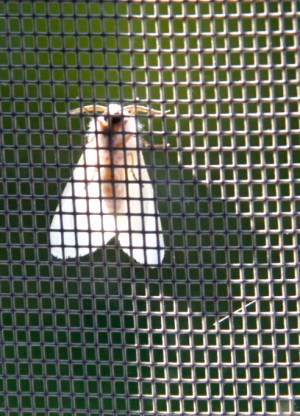
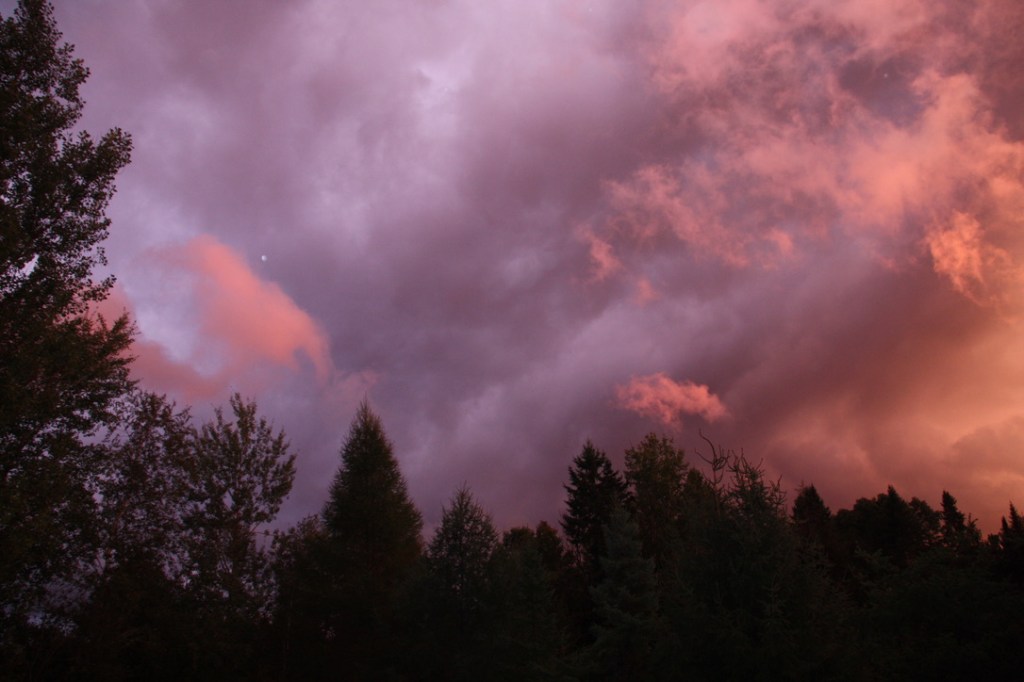
Not clematis, but bruised clematis clouds.
I’ll keep looking.
Maybe I’ll find the real things.

The clematis unfolds bruised purple on the porch. Beneath the black and white hammers of ivory keys, old wounds crack open. A flight of feathered notes: this dead heart sacrificed on the lawn. I wash fresh stains from my fingers with the garden hose while the evening stretches out a shadow hand to squeeze my heart like an orange in its skin. Somewhere, the white throat sparrow trills its guillotine of vertical notes. I flap my hands in the air and they float like butterflies, amputated in sunlight’s net. The light fails fast. I hold up shorn stumps of flowers for the night wind to heal and a chickadee chants an afterlife built of spring branches.
Pressed between the pages of my dream: a lingering scent; the death of last year’s delphiniums; the tall tree toppled in the yard; a crab apple flower; a shard of grass as brittle as a bitter tongue at winter’s end. I know for sure that a dog fox hunts for my heart. Vicious as a vixen, the fox digs deep at midnight, unearthing the dried peas I shifted from bowl to bowl to measure time as I lay in bed. I sense a whimper at the window, the scratch of a paw. I watch a dead leaf settle down in a broken corner and it fills me with sudden silence.
Midnight stretches out a long, thin hand and clasps dream-treasures in its tight-clenched fist. The lone dove of my heart flaps in its trap of barren bone and my world is as small as a pea in a shrunken pod. Or is it a dried and blackened walnut in its wrinkled shell of overheating air? Sunset, last night, was a star-shell failing to fire. Swallows flew their evensong higher and higher, striving for that one last breath lapped from the dying lisp of day. Its last blush rode red on the clouds for no more than a second’s lustrous afterglow.
I lower the delphiniums, body after body, into their shallow graves. Night’s shadows weave illusions from earth’s old bones and rock becomes putty, malleable in the moonlight. Midnight readjusts her nocturnal robes and pulls bright stars from a top hat of darkness. Winged insects with human faces appear with the planets and clutter the owl’s path. Night swallows the swallows and creates more stars. The thin moon hones its cutting edge into an ice-cold blade.

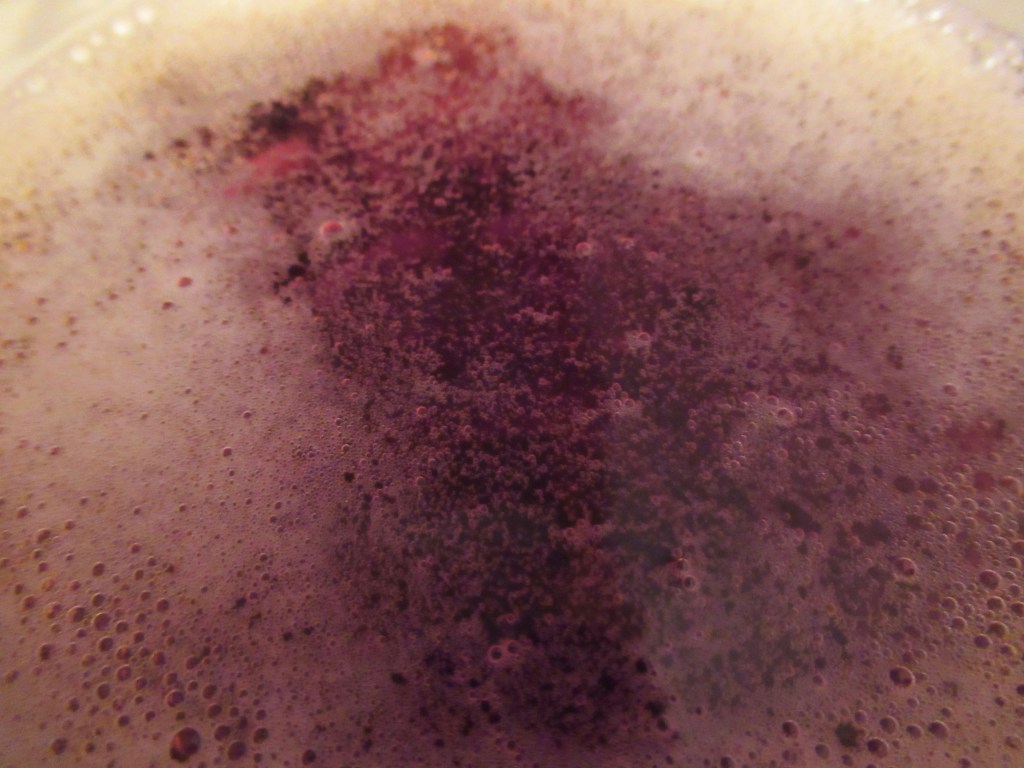
Now that’s a clematis bruise!

Crazy Glue

The autumn leaves: what does it take with it when it goes? And what does it leave behind?

Crazy Glue

Late last night, a fallen star grazed by the lamp-post. A bouquet of golden sparks flew from an iron tree and sanctified the gutter. The gas lamps sputtered patiently in uniform rows. A scarecrow stuttered into the limelight and shook my hand. She was wearing my grandmother’s Easter bonnet, with all the flowers renewed, but she couldn’t keep my heart from last winter’s left over crumbs. Suddenly a tulip thrust through the concrete. It became as red as a robin and flew into the lounge bar of a public house. The bronze leaf necklace circling my throat filled with a flow of springtime song. My heart stood upright, a warped piano in my breast, and my skeleton tarried at the corner to play knuckle-bones with the wind. Torn butterflies of news fluttered round and round and kissed my eyelids when they closed. Yesterday’s horoscope winked its subversive eye and called to the hermit in his lonely cell: “Look out for the stranger with the tin can alley smile. Tie your heart to the tail of the first stray dog that comes whistling down the street and follow it home to the empty house that breathes in and out, moving thin membranes of memory.”
            That’s where I now live. Upstairs, downstairs, a lonely route I tread while the wind at the window scratches tiny notes. Something breaks loose in the confines of my mind and walks beside me. My twin brother stalks through this silvery sliver of splintered glass, this simian mirror wrinkling our troubled suits of skin. I glimpse the old moon’s monkey face through a broken window. Jagged and thin, it wanders like an itinerant snail, cobbled with clumsy clouds. Once, I descended the playground slide in a shower of sparks. A vagabond in a paving stone sky, I rumbled across metal cracks, a knapsack of nightmares humped on my old man’s back. Tell me: when the snail moves house, who stores the furniture he leaves behind? The hermit crab lurks naked on the beach, seeking new lodgings. Who killed the candle and left us in darkness?
            Two eyes in limbo watch me roll this snowman’s belly of flab across an unknown, clouded room where yesterday I got lost in the mirror. I know how to swim, but I would have drowned, except the light was too shallow and my feet touched bottom when I let the wheels down. I swam on and in looking for a deserted island on which to build my idle sand castle dreams. Two people said they saw my reflection swimming like a goldfish in the silver of that secret space. They said I stared back out at them with circles of longing ringing my eyes; but I laughed when they said they had seen me, for when I looked in the mirror this morning to shave, I just wasn’t there. My razor dragged itself over an empty space and its sharpened blade scraped white music from the margin of a cd rom that spun on edge like dust rings round a vanished planet. Now there is a black hole where my passport photo used to thrive. Someone plucked me from the circle and cut me out in the dance last night. Today I’m looking for a scrapbook in which to stick myself with crazy glue that never, never, ever comes undone.

Chance Encounter

IMG_0138.JPG
“You only find what you leave behind.”

Chance Encounter
(Overheard at the bar)

“Meeting her, unexpected,
with another man,
and me, with another woman,
all four of us looking
bemused by what the other
had chosen in each
other’s absence
— suspense and silence —
then the halted, faltering
politeness of a nod,
a handshake, ships
passing in the night,
signals no longer recognized.”

Diagnosis

Diagnosis

Diagnosed with a terminal illness
that I also call life I know
this sickness will surely
terminate in my death.

Death:
it has walked beside me
for more than seventy years.
It has gazed back from my mirror,
as I shave my face, and part my hair.
It has lain its head on the pillow
beside me as I lie in bed.

We have shared so many things:
the soul’s dark night,
the winding ways of life’s
once infinite, now soon-to-be-ended maze.

Now, arm in arm, life, death, and me,
an intimate ménage à trois,
we are running a three-legged race
while carrying an egg in a spoon
and playing life’s ultimate game of chicken.

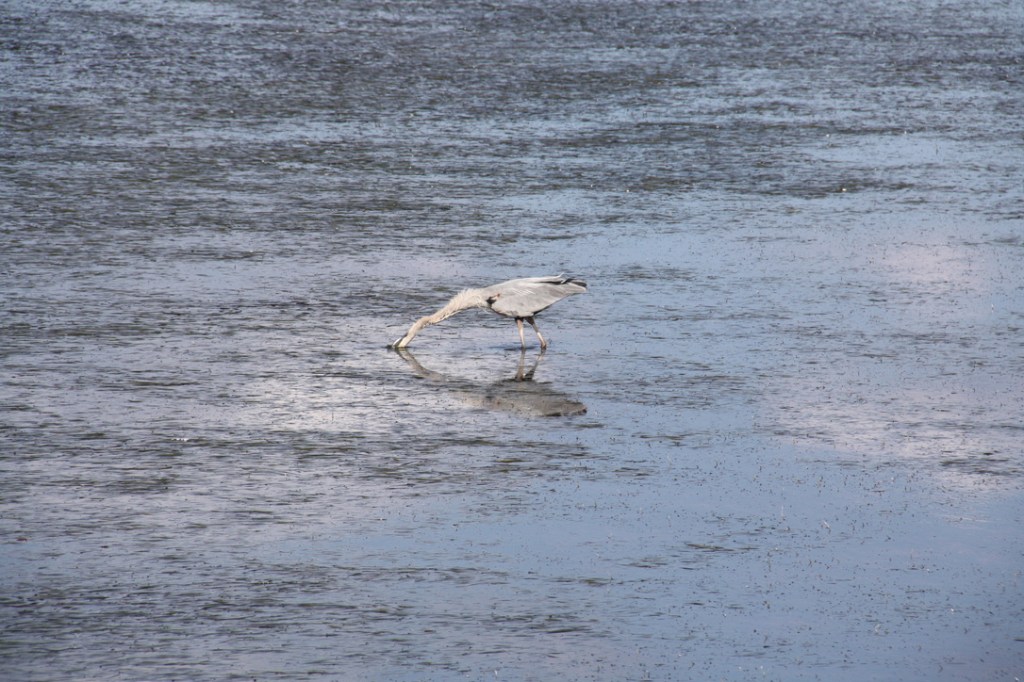
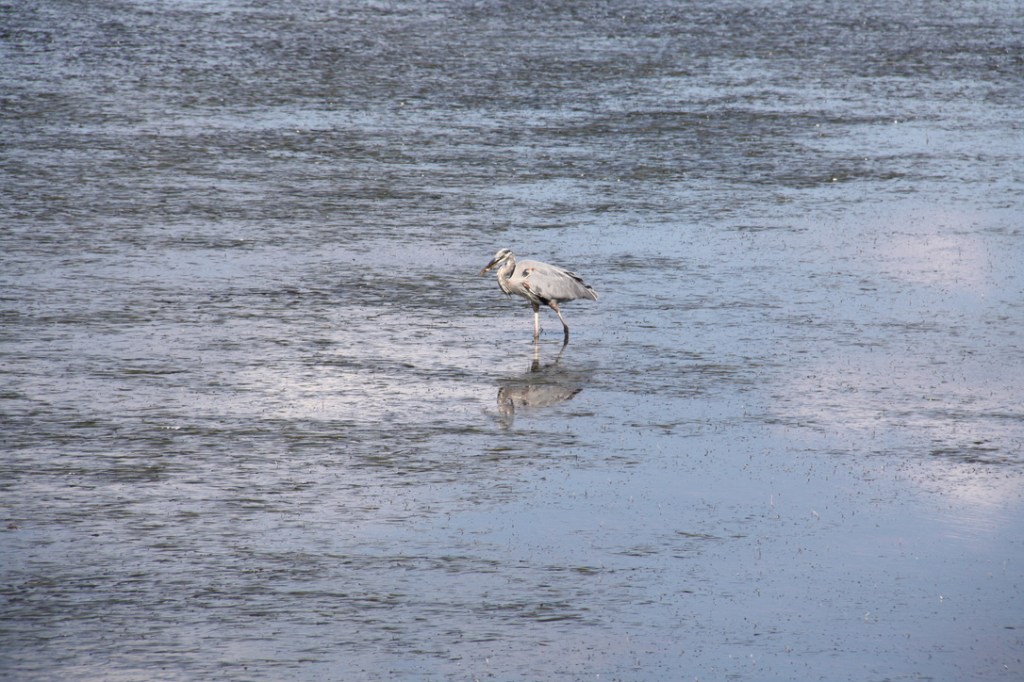
Comment: Look carefully at the second picture: you will see the fish he has just caught, sideways in his beak. These photos are from the bay at Alberton in PEI, taken about two seconds apart!

R.I.P.

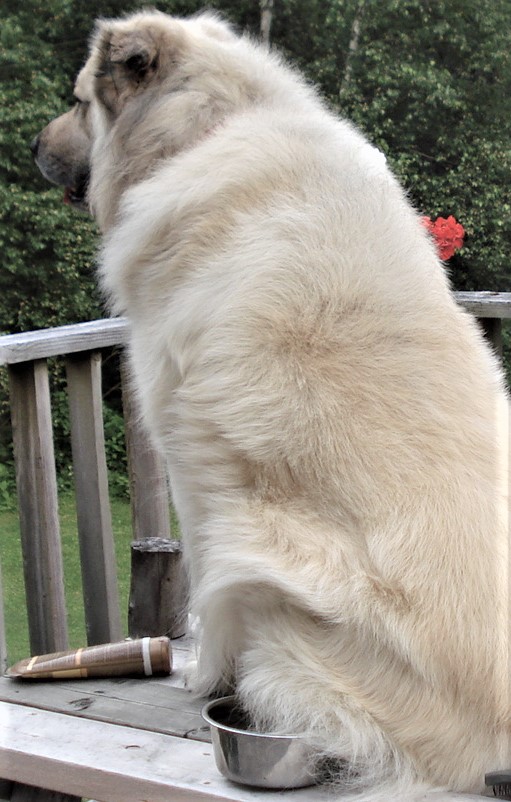
Tigger blowing his coat in Spring and waiting on the picnic table for his daily grooming. Some days I am convinced he is still out there, waiting for me.

What’s in a name?
            At the Farmer’s Market there are fourteen puppies in a cardboard box. One of the puppies, still blind, clambers whimpering over the side of the box and totters toward me. An elderly lady picks him up, thrusts him towards me and says:
            “Here: he’s your dog. He wants to be with you!”
            “No way, Lady!” I say and turn away.
            When I exit the market, I walk past the dog box. There are five dogs left but the one that wandered in my direction has gone. The salesman calls out to me: “Hey you!” He walks towards me. “That woman said you’d be back for your dog. Here: take him!” He unzips his coat, and there’s the dog, snuggled against his chest.
            “When was he born?” I ask.
            “January 16!” comes the reply.
            January 16 is my birthday. Today is March 8, the anniversary of my mother’s death. The dog is 53 days old, much too young to leave his mother.
            When I get home, my wife tells me to take the dog straight back to the market.
            “I can’t do that!” I say. “The man will be gone by now.”
            “But we don’t know anything about the dog!”
            “I’ll clean up after it.” I say. “I’ll feed it and train it.”
            “You’ll have to put it in a cage.” She tells me. “I’m not having it peeing and pooping all over the floor. You know why they’re called poopies.”
            Later that evening, I force the little puppy into the old dog’s crate, and I retire to bed. No sooner have I gone upstairs than there’s an unholy noise from the kitchen.
            “Help me!” I say to my wife.
            She laughs. “Not a chance! You know the rules!”
            Down in the kitchen the puppy is in distress. I take him out of his cage and he waddles and wags and promptly pees. I clean up after him and wonder what to do. The cage isn’t a solution. There’s no box in which to put him and any form of captivity, like a board across the door or a baby’s gate, sets him howling again. I gather my sleeping bag and a couple of cushions and I lie down on the kitchen floor. He immediately snuggles up to me, finds my finger, and sucks on it.
            I get up off the floor, make my way to the fridge, open the door, and pour a glass of milk; for the rest of the night, every time the dog gets restless, I stick my finger into the milk and the dog sucks my finger. I spend the next week doing this.
            While I’m lying on the floor, I study the dog.
            “What is your name?” I ask him constantly.
            Then, one night, as I watch him bounce across the room towards my milky finger, I know what to call him.
            “Tigger!”
            If I had waited another week, I might have called him Pooh!
            Tigger never leaves me. He is like an orphaned duck who follows the first human being who feeds it. Tigger follows me around the house with his nose behind my knee and if I stop suddenly, he bumps into me. My wife has started to call me Dada Duck. I now call her Mother Duck and our daughter has been renamed Baby Duck. Tigger has a second name: Dada Duck Dog.
            We have a little corner piece on our lot where the roads join and all the dogs stop, including mine. I went out there one day and put up a large sign with “Pooh Corner!” written on it. Beside it I placed an arrow which points “To the house!”
            All the children on the block love Tigger. When he came home, he weighed 6 pound and covered six tiles. Full grown, he weighs 110 pound and covers 108 tiles! He is gentle and well-behaved and everyone adores him. Some of the children want to buy a little saddle and ride on him, he is certainly big enough, but I won’t let them do that. The children on the block now call me Christopher Robin. At Christmas, they bring me pots of honey.
            As eleven years went by, Tigger grew old and slow. He developed cancer and had arthritis. On fine days he was fine, but on damp days he could hardly place one foot in front of the other. He had difficulty climbing the stairs and would sleep for hours rising only for his morning and evening walks and his food.
            Yesterday, el cinco de mayo, at 12 noon, Tigger passed away.
            Today, there is a little white cross at the corner of our lot. The children have laid a circle of flowers around the cross. On it somebody has painted: R.I.P. Tigger.

Collateral Damage

And that’s not all they checked: a regular Spanish Inquisition. Post Covid-19 it has all fallen silent. Those doctors don’t call anymore.

Collateral Damage

Once a month, they used to stick
a needle in my arm and check my PSA,
cholesterol, and testosterone:
blood pressure rising, cholesterol high.

The doctors kept telling me
it was a level playing field
but every week they changed the rules
and twice a year they moved the goal-posts.

Monday Night Football:
a man in a black-and-white zebra shirt
held a whistle to his lips while another
threw a penalty flag. It came out of the tv
and fell flapping at my feet.
Someone on the field called a time out.

I haven’t seen my doctor for three years.
My urologist has been silent
for more than eighteen months.
It’s been two years since I last spoke
with my oncologist.

I have become collateral damage.
My body clock is ticking down.
I know I’m running out of time.

Comment: I know I am not the only one to have fallen between the cracks in the medical service. Nor will I be the last. I don’t want to cry ‘wolf!’ and yet I feel as though I have been completely rejected. A year after I recovered from my cancer, I received a survey asking me to assess my post-cancer treatment and services. I read it and cried. I did not even know that the services I was being asked to assess were even being offered. I had certainly received none of the follow-up services. “A law for the rich and a law for the poor” indeed. And so many cracks between so many floorboards with so many people falling through. This is not a rant: it is a warning that all of us must look out for ourselves. I can assure you that if you don’t care for yourself, nobody, but nobody, except for your nearest and dearest, will give a damn for you either.

Crosswords

Couldn’t find a picture of a cross-bill, so I found some genuine humming birds instead. Listen carefully: you can hear them hum.

Crosswords

I wander a vacant, black and white wonderland
of empty, accusing, crossword puzzle squares.
Most mornings, I sit at the kitchen table, head in hands,
puzzled by the news and the crossword puzzle’s clues.

Outside my window, crossbills squat on the feeder,
squabbling, heads turned sideways, blinking,

and winking sly eyes. A yellow-bellied sapsucker hops
over syrup-sticky squares. His hand-carved chess board

glistens as feasting flies swarm beneath the sun.

My own thoughts are rooted in a stark, new reality.
They walk wordless through threatening spaces where
unmasked people wander grey, concrete streets or walk
in shops, in the opposite direction to arrows,
painted on the floor to guide them.

Cross-words, cross-purposes:
why do some people obey the current laws
while others ignore them and risk their health
as well as the health of others by doing what
they damn well please, in spite of the scientists
who beg them to do otherwise?
Like the puzzle’s clues: I just don’t know.

Comment: Well, last year was a year like no other that I can remember. It is so easy to dismiss it as an aberration, but we shouldn’t do that. Hopefully next year will be better. But it might get worse. Let’s look on the bright side and hum along with the song the humming birds are humming: “Yesterday is history, today is still a mystery, but what a day it’s going to be tomorrow.” I still can’t workout how or why some shoppers just head up the shopping aisles, walking or pushing their carts in the wrong direction. Nor how they can stand for five minutes at a time choosing a breakfast cereal, one hand on the handle of their angled carts, another poking at the cereal boxes, and the aisle totally blocked. I also love the people who still handle every apple in the box before choosing just one of them. For apple you may substitute grapes, pears, avocadoes, tomatoes. Oh the joys of ageing in an age of skepticism and pandemic. Mind you: if life is, as Albert Camus always insisted, absurd, or if it is, as Calderon told us, nothing but a dream, I guess none of it matters anyway. Il faut imaginer Sisyphe heureux / we must believe that Sisyphus is happy!

Boxing Day

A wonderfully quiet and peaceful Christmas in Canada. Oh the sea, oh the sea, thank God it still flows between my family and me.

Boxing Day
            By the time I get up, the gloves are really off and the sparring has begun in earnest. I hear voices, walk downstairs to the kitchen, and a hush falls on the room. Knife-edge glances slice their menacing ways through the thick fog of war.
            Time for boxing: on my left, in the blue corner, my mother, smoking what is probably her second packet of the day. A thin haze of grey smoke escapes from her bruised lips and a cloud of exhaled fumes crowns her head with a murky halo. On my right, in the red corner, my father. White-faced, hungover yet again, truly into the spirits of Christmas. He breathes heavily, like a Boxer Dog in the mid-summer dog-days, snoring and snorting at a bitch in heat. In the middle, my grandfather, the referee. He is keeping the combatants apart, creating a tiny breathing space so the true Spirit of Christmas can disentangle itself from those false Christmas Spirits and bring peace to earth again for at least sixty seconds between each round.
            I look around the heaving, seething, threshing silence of a room where conversation has suddenly ceased. The fire is burning merrily. Beside it, tongs, poker, and small shovel stand to attention. On the hearthstone, the little red brush, with its long handle lies in ambush. This is what my father uses to beat me when he can’t be bothered to take off his leather belt. Scorch marks from the hot coal fire sear the handle and back of the little red brush. I threw it on the fire one day, hoping to see the end of it. Of course, it was rescued from the flames, resurrected, and I got beaten for that act of rebellion too.
            “It’s all your fault!” My father breaks the silence, pointing at me. His red-rimmed eyes blazing with a sudden and renewed anger. He starts to rise, but my grandfather steps between us.
            “Go and see your granny,” grandpa tells me. “She’s in the kitchen. Go now!” He points to the kitchen door.
            I run a gauntlet of staring eyes and go to my gran. As I shut the door behind me, voices rise higher in the room I have just left. Boxing Day, indeed. The gloves are off. The battle has begun again. My grandfather has evacuated me from no-boy’s-land and, for a moment, I am no longer trapped in the mud-filled, cratered, shell-holes between the trenches, the uncut barbed-wire barriers, the poached-egg eyes peering through periscopes and spying on me from the parental and priestly parapets. Here in the kitchen, for a while, I walk on the wooden duck-boards that keep my feet dry and clear of mud and water.

Comment: This is, of course, the true origin of the term Boxing Day. A genuine Boxing Day has nothing to do with the myth that it was the day on which the servants, who worked Christmas Day on the Lord’s estate, received their Christmas Boxes. Peace on earth and mercy mild has got nothing to do with alcohol-fueled quarrels, raging hangovers, and little children who should be seen and not heard. Sometimes, when all the elders are down at the pub on the corner, the night may, for a little while, actually be silent. But the noise when the drunks roll raucously home is most unholy. Then little children should be wise like the wise men, run quickly into bed, and lie there, neither seen nor heard.

Death by Devilry

Silence in the garden. A hawk perched nearby. There are so many ways to die.

Death by Devilry

Silence in the garden.
A hawk perched nearby.
There are so many ways to die.

A cerebral bleed, minor,
but enough to send him to hospital
and keep him there.

Cured, ready for release,
he would need extra care
and added attention.

The devil lived in the small print.
Too much attention needed now:
his care home wouldn’t care for him.

Back to the old folks ward he went.
There he lay, waiting for a vacancy
in a home that would really care.

One day, Covid came a-visiting,
stalked the ward that night, choosing
its victims: you, you, and her, and him.

What killed him?
A cerebral bleed, a minor stroke?
Or a major stroke from the devil’s pen?

Bold words, bare words,
a barren ward, another vacant place
around a Christmas table.

Comment: Sitting at the breakfast table, with an empty space before me, I penned these words. So tragic, so avoidable. Yet how many families have gone through something similar in the past twelve months? How many empty spaces are there, vacancies that will never again be filled? I look at today’s figures from the USA: 18,466,231 infected and 326,232 already perished, an increase of 227,998 and 3,338 since yesterday. I am reminded of the words of Pink Floyd: “Is there anybody out there?” Blas de Otero also echoes through my mind: “levanto las manos: tu me las cercenas” / I hold up my hands: you cut them off. And yet it is Christmas Eve and there is still the Christmas promise of joy, and hope, and a new year entering. Let us raise our hands in prayer: and let us pray they are not hacked off.

R.I.P.

Forget-me-not!

R.I.P.

He was a good man,
and a better friend.
He came over to mow the lawn
and stayed for a beer.
“This is gonna sizzle!”

Some called him uneducated,
no BA, no MA, no LLB,
but he had a golden heart
and a PhD in the school
of life and hard knocks.

I met men like him in Wales,
coal miners in bars,
steel workers on rugby teams,
sheep farmers from the hills
in the big city for the game.

Humble, they were, honest,
hard men, hard working,
intolerant of pretension and fools.
When I went to university,
nineteen and full of ideals,
they pulled me on one side.

“You’re one of us,” they said.
“However high you rise,
don’t lose the common touch.”

I met men like him in Spain,
foot-soldiers from the Civil War,
riflemen, dynamite throwers
with their skills learned
at coal face and quarry.

Machado wrote poems about them:
“Donde hay vino, beben vino;
donde no hay vino,
beben agua de las fuentes.”

Where there is wine,
they drink wine.
Where there is no wine,
they drink water from the fountains.

A good man, an honest man,
an uneducated man, some say,
who taught me more about life
and how to live it
than any university professor.

Comment: I read the obituary of one of my best friends in the newspaper today. He moved away from the neighborhood and we lost touch. But I never forgot him. As I have never forgotten those who shaped me in Wales and Spain. I have forgotten many of their names. But I have never forgotten their faces, nor their words of wisdom. At first, his passing brought a shadow to my life. Then I realized that no, he would not have wanted that. I think now of the good times, the laughter, the joy and, instead of mourning for him, I rejoice in all the goodness he gave me. Rest in peace, my friend. I will forget-you-not.