Some days, monkey winds himself up like a clockwork mouse. Other days he rolls over and over with a key in his back like a clockwork cat.
Monkey is growing old and forgetful. He forgets where he has hidden the key, pats his pockets, and slows right down before he eventually finds it and winds himself up again.
One day, monkey leaves the key between his shoulder blades in the middle of his back.
All day long, the temple monkeys play with the key, turning it round and round, and winding monkey’s clockwork, tighter and tighter, until suddenly the mainspring breaks
and monkey slumps at the table no energy, no strength, no stars, no planets, no moon at night, the sun broken fatally down, the clockwork of his universe sapped, and snapped.
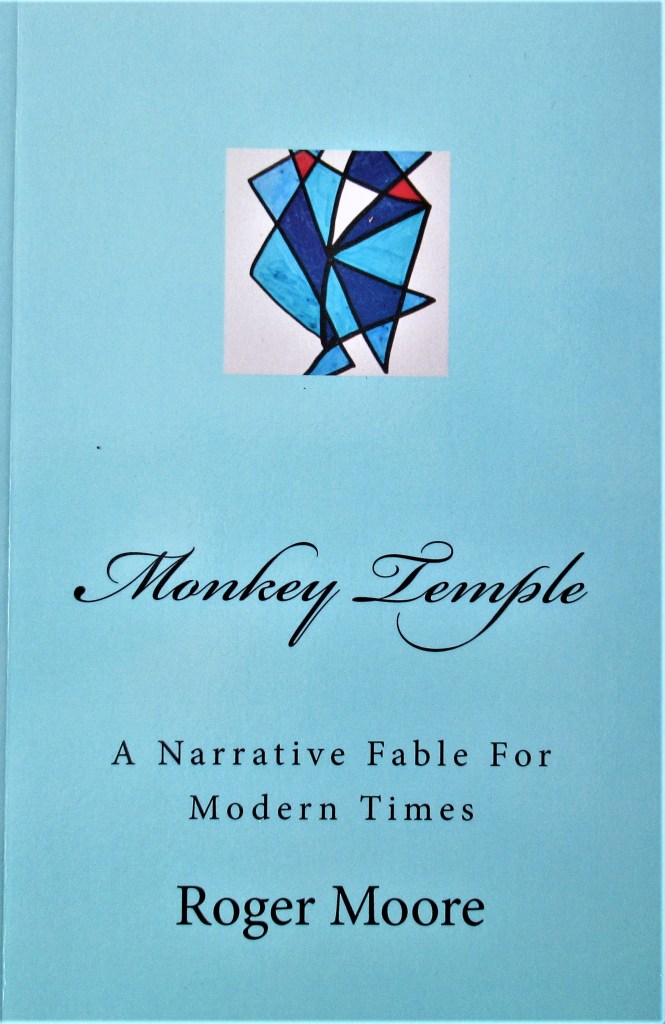
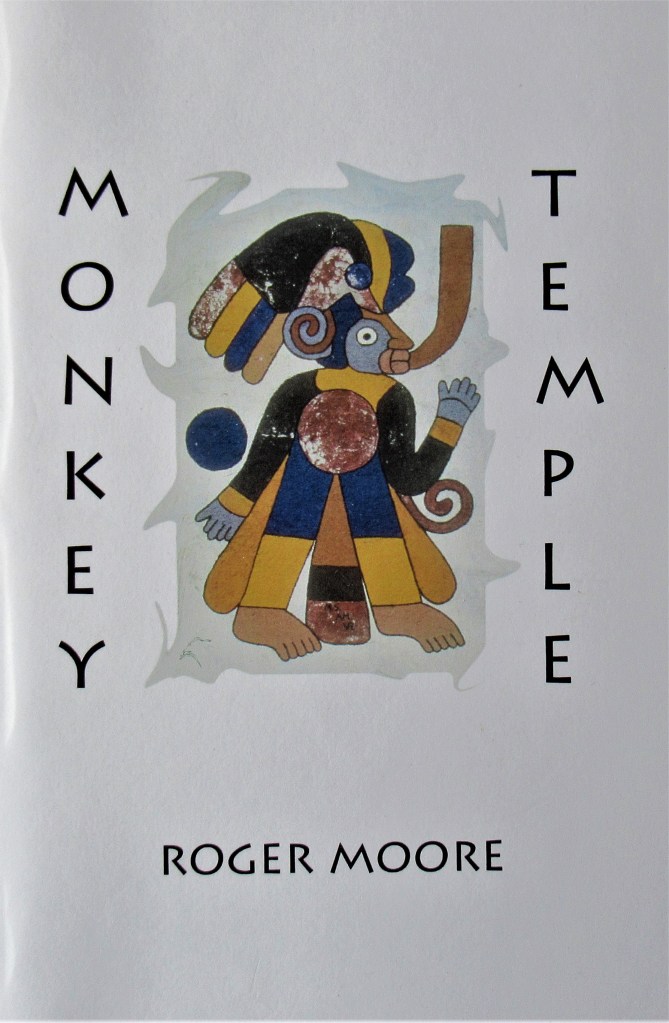
Comment: Monkey Temple is A Narrative Fable for Modern Times written in verse. The poems show strong links to Surrealism and Existential Philosophy. They portray the upside-down world of Carnival and out line Monkey’s Theory of the Absurd in a dystopian world that mirrors that of George Orwell’s Animal Farm, LaFontaine’s Fables, the esperpento of Valle-Inclan, and the witty conceptismo of Francisco de Quevedo. This is a walk through the jungle of the Jungian innermost mind. But watch out for those monkeys: they bite.
Timothy heard his older brothers moving from room to room, searching for him. He knew they would find him but for now he had found refuge beneath his grandfather’s double bed. It was dark under there in that sepulchral space. He had placed his grandfather’s enormous Royal Doulton chamber pot between himself and the door so that the dog would not pick up his scent, run to his hiding place, and lay the Judas lick upon his cheek.
His grandfather had forgotten to empty the chamber pot. Dark urine splashed on Timothy’s hands and sleeves as he squeezed behind the giant china pot that overwhelmed his nose fills with his grandfather’s nocturnal vapors.
The voices got louder as his brothers climbed the stairs and approached the bedrooms on the upper floor.
“Where is he now, drat him?”
“Don’t worry, we’ll find him.”
“And then he’ll be for it.”
“I’ll beat him with the little red brush they use for cleaning the fireplace.”
“That will teach him.”
Timothy was familiar with those threats, especially the little red brush.
He remembered the fox the hounds killed at his feet, one sunny morning a year before. He cycled down the lane outside his family’s summer cottage. The fox limped along the side of the lane, saw the boy on his bike, but too tired to run from him, continued limping in the roadway. Timothy got off his bike, leaned it against the rough stone country wall, and watched the fox. Its tail, speckled with mud, dragged behind its low-slung body, sweeping the ground. Timothy observed the twigs and thorns protruding from its black-tipped orange redness.
Timothy walked towards the fox. It tried to move away from the boy but collapsed and lay at the edge of the lane, flanks heaving, tongue lolling out through the white strings of thick foam that choked the muzzle and streaked saliva on the forequarters.
The hounds came from nowhere, an incoming, barking tide that rounded the corner and rushed towards Timothy who froze with a fright that pressed him against the wall. Sun-warmed stone jutted sharp edges into his back. As he stood there, unable to move, a rough hand came over the wall and grabbed him by the shoulder. He felt himself hauled upwards. The flint points dug into his back and he yelped as the firm hand drew him over the top of the wall to safety.
“Get out of there, you stupid boy, or the hounds will have you.”
Timothy hid his face in the farmer’s rough homespun shirt. He shuddered as the dogs bayed and growled and scrapped and scratched. Then the fox, it must have been the fox, let out a high-pitched yap and whine and the pack gargled itself into a drooling, slobbering sort of silence. The farmer pushed Timothy’s face away from his shoulder and forced his head towards the spot where the hounds, on the other side of the protective barrier, rubbed their ears into the dead fox’s torn and bloodied body.
“That’s what they’d have done to you, my boy. Never come between a pack and its kill.”
Timothy watched a member of the hunt staff pull a knife from his jacket. The foxhunters broke into cheers and howls of pleasure when the man severed the fox’s brush and held it on high. The farmer thrust Timothy towards the Master of Hounds.
“Here, blood him, Master, he was in at the kill.”
The Master of Hounds opened his mouth to flash a smile filled with pointed, foxhound teeth. He stooped, dipped his fingers in the still warm fox blood, and streaked a smear across the boy’s face.
“There,” he said,” you’re blooded now. One of us, eh what?”
The mingled scents of fox and hound and blood and death and urine and feces made a heady mixture and Timothy started to hyperventilate. His breath came hard in his throat and, as he struggled to breathe, tears rolled down his cheeks.
Timothy feels safe in his secret hiding place beneath his grandfather’s bed. He can hear his brothers’ taunts and calls as they search for him, but they haven’t found him yet. Sticks and stones may break my bones, he whispers, but names will never hurt me. But names do hurt. Tiny Tim they call him and ask him where he hides his crutch. I don’t limp, Timothy once replied. When he said that, one of his brothers, Big Billy, kicked Timothy as hard as he could with the toe of his boot, just above the ankle. Timothy screamed with pain. You’ll limp now, said Big Billy, and his other brothers found the joke so funny that they all called kicked Tiny Tim at every opportunity. Limp, Timmy, limp, they chanted as they chased him round, limpTiny Tim, Tiny Timmy.
“He’s not up here,” one of his brothers called out.
“Must be out in the garden, the coward, we’ll have to hunt out there for him,” another replied.
“Can’t run, can’t hide,” said Big Billy. “Get the dog, we’ll track him down.”
The voices finally faded. Protected by the barrier of his grandfather’s cold but intimate body waste, Timothy curled up like a fox in his den and fell asleep. He dreamed of the proud brush of a tail flying in the wind, of a warm stone wall, drenched in sunlight, and of a farmer’s strong, all-protecting arm.
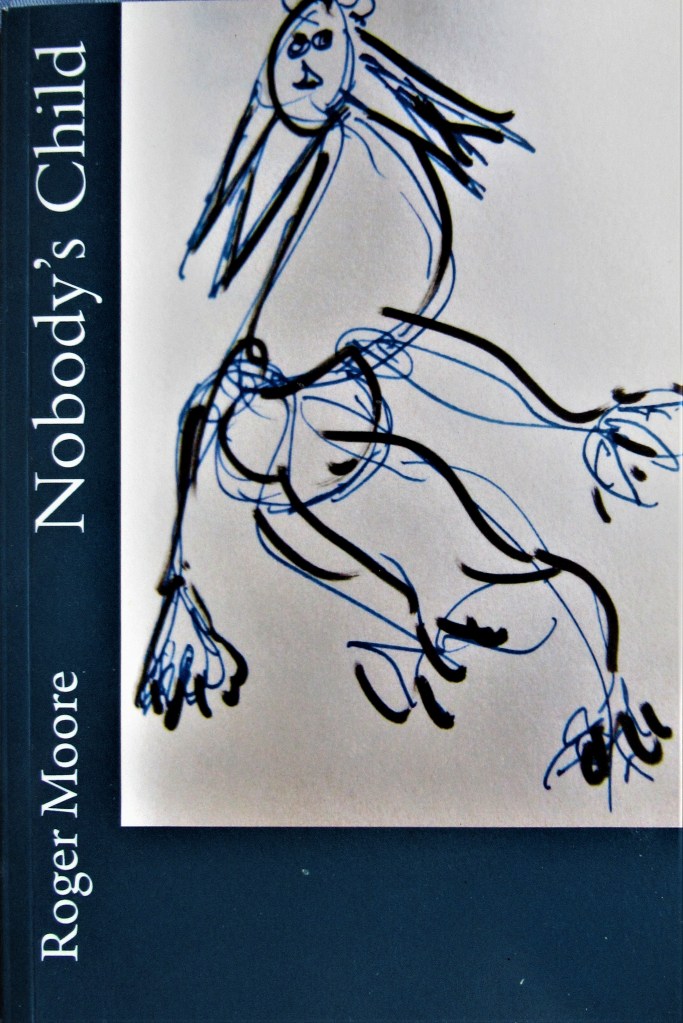
Comment: I have written several versions of this story, some longer, some much shorter, some in the first person singular, some in the second person. In all of them, the word-play on the little red brush (fox and fireplace) is paramount. This particular version occurs in my short story collection, Nobody’s Child available on line. Sometimes a story will not leave me alone. It wanders around, takes slightly different twists and turns, and new images and scenes emerge, as they do in this particular piece. Alas, I didn’t have a photo of a fox, so I used a photo of three plump pigeons hiding, you might even say ‘cowering away’, from a hungry hawk circling overhead while they hid in a crack in a wall in Avila, Spain. It always surprises me to know how many people (and animals) flee from what Robbie Burns called “man’s inhumanity to man”.
“I left her by the gate to the Beaver Pond at 2:38. It takes her twenty minutes to walk around the circuit. I always check my watch. Then I know when I can expect her back. In exactly eight minutes, she comes out of the woods and I can see her at the end of the boardwalk. I park the car in a spot from which I can watch her and wave to her. Today, I didn’t see her come out of the woods. It’s the radiation for prostate cancer … it’s left my bowels weak. I had to go to the bathroom … so I turned the car engine on … it was 2:44 … about two minutes before she was due to appear on the boardwalk … yesterday, a Great Blue Heron stood fishing in the pond … he flew when he saw her … a great crack of the wings … but today, the heron wasn’t there … just ducks … they flapped their wings, stood on the water, you know, the way they do, and scattered from the spot where she should have appeared … she walks very quietly, tip-toe, you know … she likes watching the heron and the ducks … she doesn’t like to frighten them … I don’t know what to think … I had to go … it was urgent … so I turned the car around and drove to the nearest bathroom … about one hundred yards away … I was in there … I don’t know … about five minutes … I didn’t check my watch … it’s dark in there … no electricity …besides, between hobbling on my sticks, praying to God to help me to hold on, opening and closing the door, struggling to get my pants down without soiling them …and then I drove back to the picnic tables … and waited … and waited …and she never appeared. I haven’t seen her since … she’s gone missing … I fear the worst … “
On the other end of the phone, a long silence, some heavy breathing, then:
“We’ll file a missing person’s report.”
“You will find her, won’t you? I love her, you know. I must find her. I want to know what’s happened … ” the old man wiped the corner of his right eye with the knuckle of the index finger of his left hand. He coughed and cleared his throat.
“Twenty years younger than you, you said?”
“Yes,” the old man nodded.
“Well, sir: we’ve already started our investigation. We’ll do our best to find her. We’ll contact you as soon as anything turns up.”
The police officer put down the phone and the circuit clicked out.
“What the hell you gonna do?”
“Not me … us.”
“Okay … us then … well … what the hell we gonna do?”
“You tell me. We got her on video. She walked out the other exit, by the park HQ, straight into the arms of the Deputy Police Commissioner. She’s twenty years younger than her husband and her husband’s got the sort of cancer that’s killed his sex life. Cancer? And the Deputy Commissioner’s the one who’s waiting for her? What the hell do you think we’re gonna do?”
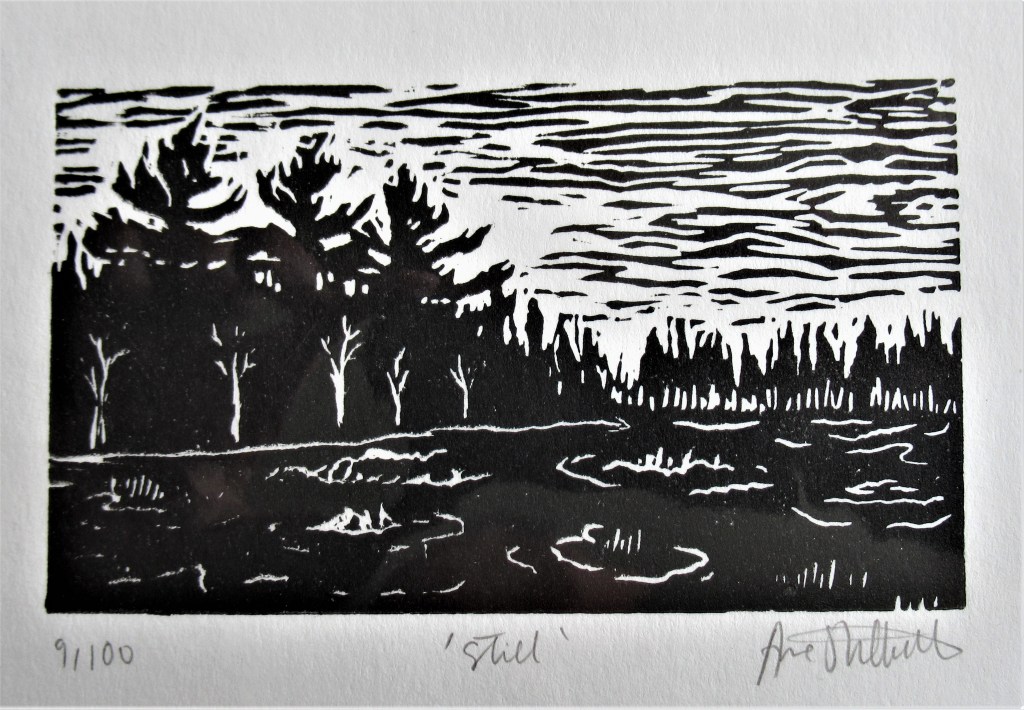
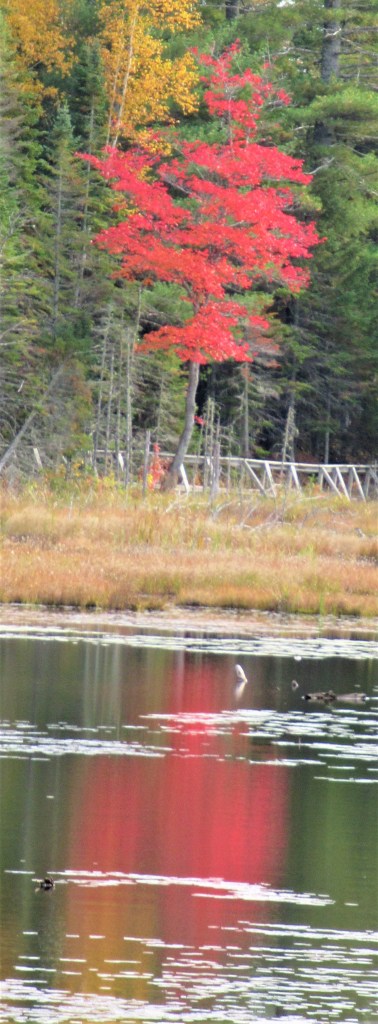
Fall: Beaver Pond
Comment The Beaver Pond at Mactaquac is a beautiful place to be, all year round. We love it in summer and fall and Anne Stillwell-Leblanc (< click on link for website) has captured the stillness and silence of the place in the above engraving. As I have become less mobile, so I have sent Clare cantering around the pond to enjoy the beauty we used to enjoy together. Meanwhile, I sit in the car and watch for Clare’s regular appearances through the trees and on the footbridge. As I sit, I write. Sometimes it is journal style, sometimes poetry, and occasionally a short story, like this one.
I have published three books this year and I am working on a fourth and a fifth. Somehow, the blog, like these hollyhocks, seems ephemeral. It will not out last me, though its seedlings, children and grandchildren, may creep into my printed books and remain a lot longer. These, incidentally, are the children and grandchildren of the first hollyhock grown in the garden. I think a little bird must have dropped it about five years ago. Now it has seeded and reseeded itself. Reseed, yes — recede, we hope not. They are so tall we can sit in the kitchen and they are at eye level with us.
And don’t forget the yucca. He was $120 in the local garden store. Reduced to half price ($60). Then to $50. “We are in the wrong zone for yuccas,” I told the salesman. “Yours for $20, then. He probably won’t last.” That was 32 years ago. And baby, just look at that yucca now.
He hides behind the hollyhocks, but he doesn’t live in their shade. Not by any means. There are so many things to see and do. The blog seems to have drifted by a little bit. I know it’s lonely, but I haven’t forgotten it, as the hollyhocks haven’t forgotten the yucca and vice versa. It’s just that it’s summertime and things are busy and well, I guess I’ll try to do a little bit better. I promise!
I cover my face with a white mask of soap and carve intricate patterns with the razor.
… painted masks … death masks … the masks the priests wear in the pre-Columbian Oaxacan codices … the prisoner struggling … not yet fully understanding his fate … around him … animal masks … priest masks … the jaguar cult of the regiments … they strip him down … paint his body … arm him with flowers … place him on a pedestal … from there he will dance his last dance … fight his last fight .. his destiny … like the bull in the bull ring … to die bravely showing no fear … he strikes first with the flower … his opponents strike back … one by one … with their obsidian knives … each wound a flesh wound on legs and thighs … the heart pounds … the blood flows .. faster and faster … more flowers … more knives … more blood … until almost bloodless the prisoner weakens and stumbles … rough arms seize him by the arms and legs … they carry him to the sacrificial stone … bend him over it … chest exposed … and tear the living beating heart from the cavity the carve in his chest … the severed arms and legs bounce down the temple steps to the waiting crowds … tomorrow his spirit will return as a hummingbird … and dance around the sun … for now his torn heart sizzles in the sacrificial fire … a horse’s head … teeth bared … grins from the temple walls …
My razor, held like a flower, slips and I gash my lip. The slow blood seeps through the soap streaking my mask with faint shades of pink. I shiver and stare at my reflection in the mirror. It’s a very plain face with a nose slightly larger and more hooked than it ought to be. I think of it as the prow of a ship or a bird’s beak: an eagle perhaps. My nose is very much like the nose of the man who died in the flower dance. In spite of the warmth in the room, I shiver again.
Spotify Remember to scroll down to appropriate audio episode.
Vets A Thursday Thought
Mary Jones
I met her unexpectedly in a restaurant in St. George. I was masked, but she knew me right away. She hadn’t changed. How could she have? She is as she is. Straight forward, upright, honest, true to her words and her values. Ex-military. A United Nations Peace-Keeper. A Blue Beret. World traveller to some of the roughest, toughest, ugliest, craziest spots. Everywhere she went, she helped keep the peace.
She came back home to find out what she already knew: that rural New Brunswick was as wild as anywhere she had been. She was anonymous, here, was just another number in a book, a casualty in a nameless war of attrition after which the winners rewrite the history of events, twisting them this way, that way to suit themselves and their own instincts and interests.
“Best of the best,” I wrote in the book I gave her. Fortuitous, it was, finding her again, finding that copy close to hand, reserved for her alone. That book and this poem are my tribute to her for her courage, her fortitude, and her strength of will. They are also a tribute to her role in making the world a safer place in which others, less fortunate, can create, without fear, their lives.
Comment: There is very little more to be said. Each former soldier is an individual with a history and personality of their own. This is my tribute to a very good friend who served her country and the United Nations Peace Keeping Forces with pride and distinction. Mary Jones, I, an academic, a writer, and a non-combatant, salute you for all the positive values which you have brought into this sometimes troubled world of ours. You and your well-being are in my Thursday Thoughts.
Spotify Don’t forget to scroll down to appropriate audio episode.
Cave Paintings Cantabria
Who painted these pictures on the walls of night’s cave? This grayish hand, fingers flexed, outlined in black soot, that deer dancing, those bears, horses, bison, running?
Did they come from nowhere, plucked from nothing but the artist’s memories of what he saw as the ice age faded and heat and warmth returned to warm his world? Drawn from life, without doubt. Unless these Neanderthals were truly creating art from a literal vacuum with nothing new invented since according to Picasso. And he should know.
Imagine them as sounds, as letters from distant relatives, as colored vowels scored on the blocks of a child’s first alphabet set. Sit and stare. Watch flames flitter over sharp shapes. See life enter the drawings as flimsy light flickers over the cave walls’ dips and bumps.
Once seen, never forgotten. Not just the paintings, but also the clammy cave damp, the red hanky draped over a pocket torch to imitate firelight, the drip of water, slow growth of limestone deposits growing into stalagmite and stalactite. Such things flit in and out of my mind like owls or bats, drop in on my sleep wake me with predatory beaks and claws, calling for my skull’s shut doors to open wide, to let them in, and to bring them back to life.
Comment: The picture comes from an ash-tray my parents bought at the Cuevas de Altamira, in Santillana del Mar (Cantabria, Santander as it was known then) in 1963. We visited many cave sites in Cantabria including Puente Viesgo, where we saw the sooty hands. Back then, the caves had only just been opened. At Altamira, a young lady came to greet us. We asked her if we might view the caves and she whistled loudly. Her husband came down from the fields where he was working. He took a large iron key from his pocket, opened a huge door set in the rock, and in we went. One light bulb illumined the inner chamber. Only a small segment had been dug out. We reclined on a rocky bank. He doused the electric light, took a torch from his pocket, and covered it with a red pocket handkerchief. He moved this back and forth to imitate firelight and immediately the whole wall came to life and the animals moved in the flickering light. Pure magic. Unforgettable. We were the only people there. Four of us. A few years later, you had to book an appointment and a place. Within six years, the caves were closed as the heat of human bodies raised the cave temperatures and caused the paintings to deteriorate. I was so fortunate, so privileged, to see those paintings in what was almost their pristine state. In 1991, I visited the facsimile of the caves built in Madrid. I paid my money, went in, sat down, and came out crying for all those things we had lost, for all that beauty that had been denied.
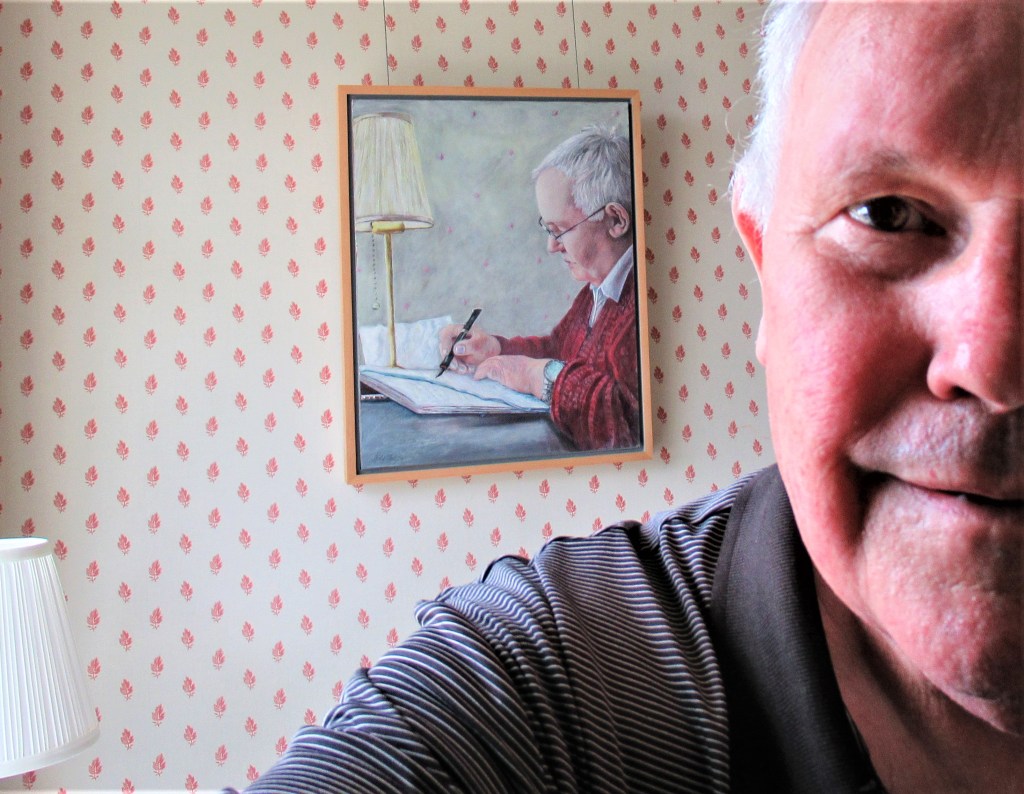
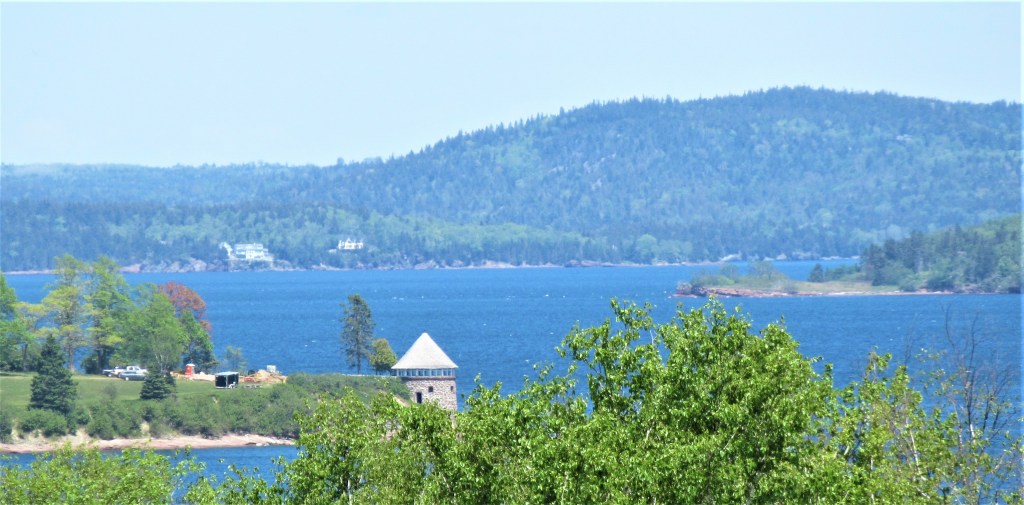
I never dreamed I would one day share the Red Room at KIRA with a portrait on the wall of Roger Writing in the Red Room at KIRA. It is a great honor to be here again and to be the first alumnus (June, 2017) invited back for a second stay (May-June, 2021). I will do my best to ensure that this stay is a successful one. I am honored to be the first returnee. I most certainly have no wish to be the last.
My desk is in its usual place by the window. To the right, on the wall above me, hangs my portrait. This is new, especially for me. The view from my working window has changed. The auditorium was just being constructed when I was here first (June, 2017). My companions from that first cohort of resident artists are here with me, in spirit. Ann, Carlos, Elise, and Ruby, the one who painted my likeness. My hope is that they too may sometime return.
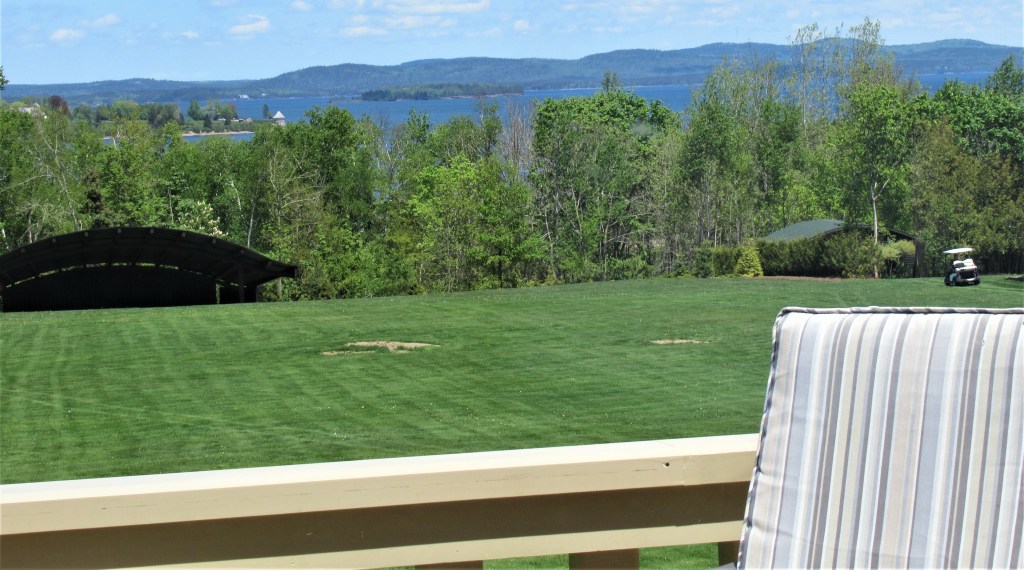
The Tower on Minister’s Island is still visible above the trees. It has long kept me company and long may it continue to do so. Across the bay, behind the red tree on the left, Magic Rock and Holt’s Point can almost be seen. What beauty. What joy. Sitting here, at my desk, I review twelve days absent without leave, AWOL from Social Media and the Blog. Those Tiz-Woz days are hopefully over now. The bone scan was negative and showed no metastases. So that is a huge relief, though there may yet be some complications. There will be further testing, ad possibly some more medication. That lies in the future. This is the present. The sun is shining. I am here among friends. All’s right with the world.
Spotify Remember to scroll down to the correct audio episode.
Monet at Giverny
Day’s executioner stripes evening across the sacrificed horizon. In blood he was born, in earth will he rest his flesh, turning it into bread. Purple this imperial wine streaming with day’s death, ruffling these troubled waters.
Green footprints, the lily pads. A halo, this drowned man’s beard, liquescent. Like the gods, he dreamed he walked dry on water. Stepping stones, these goldfish flowering beneath this thin line of cloud.
Maples flash ruby thoughts that ripple outwards, waves cast upon a liquid sky towards what farther shores?
Wisteria blesses him with its curly blue locks. Narcissus, he clads himself in an abyss of lilies, imperial, his reflection, and imperiled. Slowly he slides to sleep, merging into his dream: a vaulted cathedral, his earthbound ribs, the blood space immaculate.
His lily pond turns into a fallen mirror, shattering as it ripples in the breeze. Shards of clouds flare like flames. Fractured fish, red and gold, shelter beneath white lilies.
Night and day, sun and moon, leapfrog over tranquil water. Something always survives: sepia tints, old photos, dreaming on and on.
Click on the link below to peruse my books for sale.
Spotify Remember to scroll down to the correct audio episode.
Chaos Theory
Chaos theory: it states that we don’t know what we’re doing and it wouldn’t really matter anyway, even if we did, because life lacks meaning, chance rules, and Lady Luck with her lusty locks attached to her forehead and she, all bald and hairless from behind, must be caught as she arrives, because later is much too late, and when past, she’s gone for good and our good luck’s gone with her, and we’re left for ever, sitting there, head in hands, bemoaning all that milk spilled before we ever had a chance to actually taste it.
Click on the link below to peruse my books for sale.