Memory loss punched holes in your head and let in the dark, instead of the light. Constellations faded from your sight, erased by the arch-angel’s coal-dust wing.
“I’m shrinking,” you said, the last time I saw you, you, who had been taller, were now smaller than me.
Tonight, when the harvest moon shines bright and drowns the stars in its sea of light, I will sit by my window and watch for your soul as it rides its coal-fired rocket to eternity.
My eyes will be dry. I do not want pink runnels running down this coal-miner’s unwashed face. I’ll sing you a Welsh lullaby, to help you sleep.
“When the coal comes from the Rhondda down the Merthyr-Taff Vale line, when the coal comes from the Rhondda I’ll be there.”
With you, my friend, shoulder to shoulder. “With my golden pick and shovel, I’ll be there.” Farewell, my friend, safe journey, sleep deep, as deep as a Rhondda coal mine may you sleep.
Patients must be patient. The waiting-room is where the doctor makes them wait.
My father waited, patiently, to see the specialist. At the stroke of noon, nurse told the waiting patients not to wait patiently and to all go home.
“Come back next week,” nurse said. “What’s up?” I asked. “The doctor,” she said, “has a very important meeting.”
I hurried for a taxi. My father on his Zimmer followed slowly behind. On the hospital steps I met the doctor.
“Damnation!” he said, into his cell phone. “I’m going to be late for that appointment. I’ve left my golf clubs behind.”
Thursday Thoughts: I remember that day well. My father was due to visit the hospital for his appointment with the stroke specialist. I wanted to drive him there, but he insisted on waiting for the old folks’ ambulance. It was due at 9:00 am and his appointment was for 10:30 am. We waited patiently, watching the hands on the clock moving slowly round. 9:00 > 9:15 > 9:30 > 9:45. “I can drive you,” I said. My father shook his head: “If I don’t take the ambulance, they won’t come to pick me up again. They’ll say I have other means of transport.”
The ambulance / ambwlans (in Welsh) arrived just before 10:00 and dad was sure they’d make his appointment time. Except there were still empty seats and that meant more passengers to pick up. Used to the system, my father waited patiently while I got more and more frustrated. Finally, the ambulance was full and we made our way to the hospital, getting there about 10:45. “Run,” my father said, thrusting his appointment papers at me, “tell the nurse I’m on my way.” Run I did. When I got to the waiting room, I found it full of people with never a chair for my father to sit on. When he arrived, a younger patient offered him his seat and he flopped down into it.
Names rang out. Patients disappeared. Some returned to the waiting room, then walked out. Some didn’t return. At 11:15 my father demanded tea. I got him a cup. At 11:30, a man stood up and started to preach to his captive audience. “Does that every week,” dad muttered in my ear. “He’s mad.” “You can’t take it with you,” the preacher thundered. “There aren’t any pockets in shrouds.” People fiddled and looked uncomfortable. Most had teacups perched precariously on saucers, and some rattled them, whether in applause or anguish, I still don’t know.
Then at noon the nurse appeared and announced what you have read above. “Dr. XXX’s patients: you can all go now. Dr. XXX has an important appointment. Come back next week.” My dad pushed me. “Run,” he said. “Get a taxi. They’ll all be wanting one and by the time I get there there’ll be none left.” That was the only visit I made with my father to that particular hospital. I had so many questions to ask that specialist, but, alas, I never met him.
What I did learn was that patients must learn patience. Hospitals, like airlines, run to their own schedules. A sign should be placed above every hospital door. “Abandon hope, all ye who enter here.” Just a thought, nothing more. The delays in all our medical systems, caused by the Covid-19 pandemic, have been disastrous for many people, especially the old. Missed appointments. Delayed and cancelled treatment. Long waits and delays. The medical staff have been placed in such stressful conditions. Many are finding it difficult to cope with their inability to fulfill their desires to help their patients. Many are so stressed out. Two of my own doctors have cried when talking to me. I think of it as Covid Collateral Damage, CCD, just like the Colony Collapse Disorder that wiped out our bee population a few years back. Now we are the bees and hospitals and nursing homes are the hives.
Looking back, that morning spent waiting with my father, was a lesson in what old age has in store for us Golden Oldies as we age. Patience: as patients, we must learn patience. And remember, as Bette Davis once said “Old age is not for cissies.” And those are my thoughts for today!
Pictures and models. 1 Prostate: normal size and shape. 2 Prostate enlarged. 3 Prostate enormously enlarged. 4 Prostate lumpy, malformed, cancerous, and me prostrate.
Lumpy and treacherous: a gross shape growing its grossness within me. Gross, but mine and a vital part of my living body.
A mad world this, twisted time and fairground mirrors distorting everything, and me grossed out by the mechanical clockwork, tick-tock, snip-snap, removing samples for some lab to examine and test.
“Give them back!” I want to scream. I guess I’ll get them back on Judgement Day, when the body resurrects and I am whole again, warts, cancer, and all.
Meanwhile, the biopsy’s done. I get up from the bed and the nurse hands me a towel so I won’t drown my sorrows in my body blood, a crimson tide, ample, thick, flowing red.
Comment: After a couple of phone calls, some e-mails, and some messages on Facebook, I realize that some of my friends are actually following this blog and reading it. Thank you for the care and attention you have shown me by writing or calling to inquire about my health. All is well. I visited my urologist yesterday for a regular check-up and sat there a little longer than usual, waiting. Never one to waste time, I studied the things in the office and discovered a model prostate over which I could run my fingers (I didn’t!). It showed the four stages of prostate enlargement and cancer development as outlined above. I had no paper with me, so I jotted down four poems on the back of the paper bag in which I carried the injection I would later receive. This poem was one of them. The reference to Judgement Day and the recovery of body parts comes from one of Quevedo’s Suen~os, El suen~o del infierno, I believe. Anyway, my apologies, if I have worried you. I am fine, thank you. However, as Quevedo also wrote, “The day I was born I took my first step on the road to death”. Alas, I too am one of Dylan Thomas’s ‘poor creatures, born to die,’ as are we all. If not now, when? Not too soon, I hope. Blessings and thanks to all who read this. Take care and stay healthy.
Clarity is essential now: the cycle of seasons, the will and willingness to change. Nothing can alter this flow: rain and river, pond and sea, the moon pull of the tide. Each half-truth glimpsed through the helmet’s slotted visor as we charge in the lists, knee against knee, spear against spear, knight against knight. On the shore at the earth’s edge, a new planet mapped in miniature: each grain of sand, a speck of dust, light upon the palm, yet the whole beach, in unison, weighing us up, weighting us down. This world, immanent, renascent, growing more solid through its thinning veil of mist. Freckled the water, as the wild man sculls towards us, over the waves, over the sand, a fisher of what kind of men? Was he without guilt, he who cast that first stone? The pond’s water-mask, reconfigures in ever-widening circles traveling who knows where to lap at an unseen shore. Light bends like a reed; liquid are the letters dancing, distorted, on speckled waters and the white sand undulating under the rising waves.
Comment: So this is the messenger, and what now is the message? And who or what do we believe? And why should we believe it? Better by far, say some, to bury our heads in the sand and to pretend to be unaware, uncaring about all that is going on around us. Why worry about what we cannot change? Just let it be. But not all people think that way. And, unfortunately, not all people think. I do. But I am beginning to think that I am one of the few who does think. And not only that, I think I am getting out of step with the world around me. Yes, I know the Spanish saying: “in the Kingdom of the Blind, the one-eyed man is king”. I am neither blind, nor one-eyed, nor am I a king, nor a king-maker. More than anything, I think I am an anarchist ant!
Monkey Meets an Anarchist Ant Memories of El Camino de Santiago
The anarchist ant is dressed in black. He has a little red base-ball cap worn backwards on his head.
His eyes are fiery coals. “Phooey!” He says. “It’s folly to go with the flow.” so he turns his back on his companions and marches in the other direction.
Some ants call him a fool. The Ant Police try to turn him.
The Ant Police try to turn him. The Thought Police try to make him change his mind.
Others, in blind obedience to a thwarted, intolerant authority, first bully him, then beat him, then bite him till he’s dead.
Monkey loves walking behind the gorillas. The gorillas break and enter: and when they do, monkey simply points and gorillas do their thing: it’s that simple …
Monkey has a code word that he took from his computer course. “Delete!” he says with delight and the gorillas delete whatever he points to.
Monkey loves burning other people’s books. He also loves deleting parents especially in front of their children, and deleting children in front of their parents can be just as exciting.
The delete button excites monkey: maneuvering the mouse tightens his scrotum and he feels a kick like a baby’s at the bottom of his belly as he carefully selects his victim and “Delete!”
The gorillas go into action: ten, twenty, thirty, fifty, seventy years of existence deleted with a gesture and the click of an index finger pointed like a gun.
Some days, monkey winds himself up like a clockwork mouse. Other days he rolls over and over with a key in his back like a clockwork cat.
Monkey is growing old and forgetful. He forgets where he has hidden the key, pats his pockets, and slows right down before he eventually finds it and winds himself up again.
One day, monkey leaves the key between his shoulder blades in the middle of his back.
All day long, the temple monkeys play with the key, turning it round and round, and winding monkey’s clockwork, tighter and tighter, until suddenly the mainspring breaks
and monkey slumps at the table no energy, no strength, no stars, no planets, no moon at night, the sun broken fatally down, the clockwork of his universe sapped, and snapped.
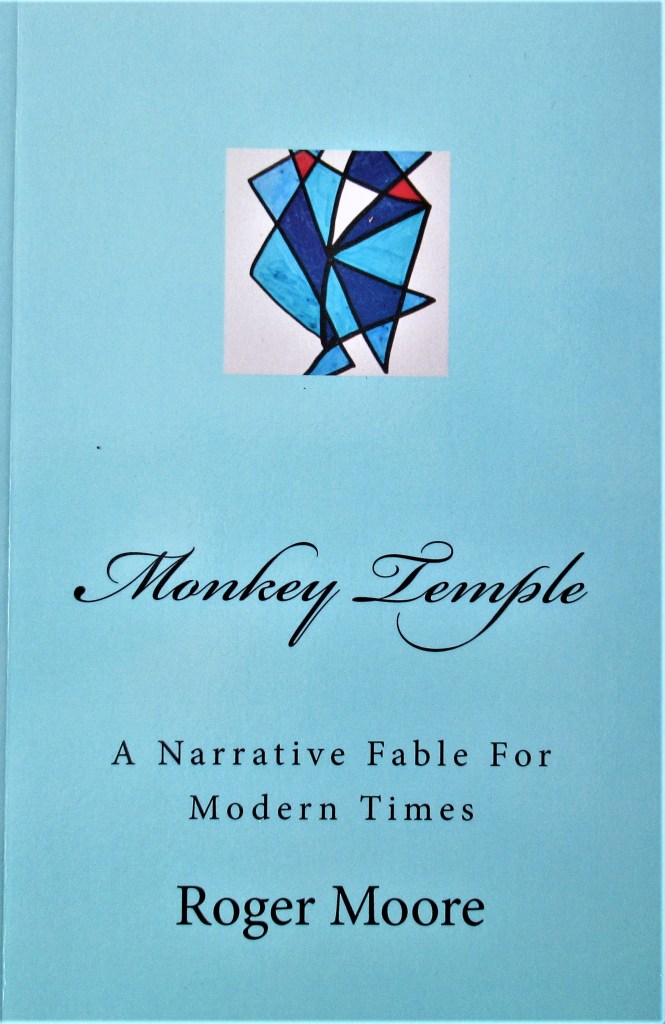
Comment: Monkey Temple is A Narrative Fable for Modern Times written in verse. The poems show strong links to Surrealism and Existential Philosophy. They portray the upside-down world of Carnival and out line Monkey’s Theory of the Absurd in a dystopian world that mirrors that of George Orwell’s Animal Farm, LaFontaine’s Fables, the esperpento of Valle-Inclan, and the witty conceptismo of Francisco de Quevedo. This is a walk through the jungle of the Jungian innermost mind. But watch out for those monkeys: they bite.
Timothy heard his older brothers moving from room to room, searching for him. He knew they would find him but for now he had found refuge beneath his grandfather’s double bed. It was dark under there in that sepulchral space. He had placed his grandfather’s enormous Royal Doulton chamber pot between himself and the door so that the dog would not pick up his scent, run to his hiding place, and lay the Judas lick upon his cheek.
His grandfather had forgotten to empty the chamber pot. Dark urine splashed on Timothy’s hands and sleeves as he squeezed behind the giant china pot that overwhelmed his nose fills with his grandfather’s nocturnal vapors.
The voices got louder as his brothers climbed the stairs and approached the bedrooms on the upper floor.
“Where is he now, drat him?”
“Don’t worry, we’ll find him.”
“And then he’ll be for it.”
“I’ll beat him with the little red brush they use for cleaning the fireplace.”
“That will teach him.”
Timothy was familiar with those threats, especially the little red brush.
He remembered the fox the hounds killed at his feet, one sunny morning a year before. He cycled down the lane outside his family’s summer cottage. The fox limped along the side of the lane, saw the boy on his bike, but too tired to run from him, continued limping in the roadway. Timothy got off his bike, leaned it against the rough stone country wall, and watched the fox. Its tail, speckled with mud, dragged behind its low-slung body, sweeping the ground. Timothy observed the twigs and thorns protruding from its black-tipped orange redness.
Timothy walked towards the fox. It tried to move away from the boy but collapsed and lay at the edge of the lane, flanks heaving, tongue lolling out through the white strings of thick foam that choked the muzzle and streaked saliva on the forequarters.
The hounds came from nowhere, an incoming, barking tide that rounded the corner and rushed towards Timothy who froze with a fright that pressed him against the wall. Sun-warmed stone jutted sharp edges into his back. As he stood there, unable to move, a rough hand came over the wall and grabbed him by the shoulder. He felt himself hauled upwards. The flint points dug into his back and he yelped as the firm hand drew him over the top of the wall to safety.
“Get out of there, you stupid boy, or the hounds will have you.”
Timothy hid his face in the farmer’s rough homespun shirt. He shuddered as the dogs bayed and growled and scrapped and scratched. Then the fox, it must have been the fox, let out a high-pitched yap and whine and the pack gargled itself into a drooling, slobbering sort of silence. The farmer pushed Timothy’s face away from his shoulder and forced his head towards the spot where the hounds, on the other side of the protective barrier, rubbed their ears into the dead fox’s torn and bloodied body.
“That’s what they’d have done to you, my boy. Never come between a pack and its kill.”
Timothy watched a member of the hunt staff pull a knife from his jacket. The foxhunters broke into cheers and howls of pleasure when the man severed the fox’s brush and held it on high. The farmer thrust Timothy towards the Master of Hounds.
“Here, blood him, Master, he was in at the kill.”
The Master of Hounds opened his mouth to flash a smile filled with pointed, foxhound teeth. He stooped, dipped his fingers in the still warm fox blood, and streaked a smear across the boy’s face.
“There,” he said,” you’re blooded now. One of us, eh what?”
The mingled scents of fox and hound and blood and death and urine and feces made a heady mixture and Timothy started to hyperventilate. His breath came hard in his throat and, as he struggled to breathe, tears rolled down his cheeks.
Timothy feels safe in his secret hiding place beneath his grandfather’s bed. He can hear his brothers’ taunts and calls as they search for him, but they haven’t found him yet. Sticks and stones may break my bones, he whispers, but names will never hurt me. But names do hurt. Tiny Tim they call him and ask him where he hides his crutch. I don’t limp, Timothy once replied. When he said that, one of his brothers, Big Billy, kicked Timothy as hard as he could with the toe of his boot, just above the ankle. Timothy screamed with pain. You’ll limp now, said Big Billy, and his other brothers found the joke so funny that they all called kicked Tiny Tim at every opportunity. Limp, Timmy, limp, they chanted as they chased him round, limpTiny Tim, Tiny Timmy.
“He’s not up here,” one of his brothers called out.
“Must be out in the garden, the coward, we’ll have to hunt out there for him,” another replied.
“Can’t run, can’t hide,” said Big Billy. “Get the dog, we’ll track him down.”
The voices finally faded. Protected by the barrier of his grandfather’s cold but intimate body waste, Timothy curled up like a fox in his den and fell asleep. He dreamed of the proud brush of a tail flying in the wind, of a warm stone wall, drenched in sunlight, and of a farmer’s strong, all-protecting arm.
Comment: I have written several versions of this story, some longer, some much shorter, some in the first person singular, some in the second person. In all of them, the word-play on the little red brush (fox and fireplace) is paramount. This particular version occurs in my short story collection, Nobody’s Child available on line. Sometimes a story will not leave me alone. It wanders around, takes slightly different twists and turns, and new images and scenes emerge, as they do in this particular piece. Alas, I didn’t have a photo of a fox, so I used a photo of three plump pigeons hiding, you might even say ‘cowering away’, from a hungry hawk circling overhead while they hid in a crack in a wall in Avila, Spain. It always surprises me to know how many people (and animals) flee from what Robbie Burns called “man’s inhumanity to man”.
“I left her by the gate to the Beaver Pond at 2:38. It takes her twenty minutes to walk around the circuit. I always check my watch. Then I know when I can expect her back. In exactly eight minutes, she comes out of the woods and I can see her at the end of the boardwalk. I park the car in a spot from which I can watch her and wave to her. Today, I didn’t see her come out of the woods. It’s the radiation for prostate cancer … it’s left my bowels weak. I had to go to the bathroom … so I turned the car engine on … it was 2:44 … about two minutes before she was due to appear on the boardwalk … yesterday, a Great Blue Heron stood fishing in the pond … he flew when he saw her … a great crack of the wings … but today, the heron wasn’t there … just ducks … they flapped their wings, stood on the water, you know, the way they do, and scattered from the spot where she should have appeared … she walks very quietly, tip-toe, you know … she likes watching the heron and the ducks … she doesn’t like to frighten them … I don’t know what to think … I had to go … it was urgent … so I turned the car around and drove to the nearest bathroom … about one hundred yards away … I was in there … I don’t know … about five minutes … I didn’t check my watch … it’s dark in there … no electricity …besides, between hobbling on my sticks, praying to God to help me to hold on, opening and closing the door, struggling to get my pants down without soiling them …and then I drove back to the picnic tables … and waited … and waited …and she never appeared. I haven’t seen her since … she’s gone missing … I fear the worst … “
On the other end of the phone, a long silence, some heavy breathing, then:
“We’ll file a missing person’s report.”
“You will find her, won’t you? I love her, you know. I must find her. I want to know what’s happened … ” the old man wiped the corner of his right eye with the knuckle of the index finger of his left hand. He coughed and cleared his throat.
“Twenty years younger than you, you said?”
“Yes,” the old man nodded.
“Well, sir: we’ve already started our investigation. We’ll do our best to find her. We’ll contact you as soon as anything turns up.”
The police officer put down the phone and the circuit clicked out.
“What the hell you gonna do?”
“Not me … us.”
“Okay … us then … well … what the hell we gonna do?”
“You tell me. We got her on video. She walked out the other exit, by the park HQ, straight into the arms of the Deputy Police Commissioner. She’s twenty years younger than her husband and her husband’s got the sort of cancer that’s killed his sex life. Cancer? And the Deputy Commissioner’s the one who’s waiting for her? What the hell do you think we’re gonna do?”
Fall: Beaver Pond
Comment The Beaver Pond at Mactaquac is a beautiful place to be, all year round. We love it in summer and fall and Anne Stillwell-Leblanc (< click on link for website) has captured the stillness and silence of the place in the above engraving. As I have become less mobile, so I have sent Clare cantering around the pond to enjoy the beauty we used to enjoy together. Meanwhile, I sit in the car and watch for Clare’s regular appearances through the trees and on the footbridge. As I sit, I write. Sometimes it is journal style, sometimes poetry, and occasionally a short story, like this one.