Finisterre

fundy 05 mist+wolfepipers 081

Finisterre

Nothing left now but this pain in my heart.
It makes me think about ageing, growing old,
that unstoppable process of the body’s slow,
inevitable breaking down from all to nothing.

I should probably go to the doctor, but what
can she, will she do? She can’t stop the hands
on my body clock and lop ten or twenty years
from my life. Nor can her pills, lotions, potions

gift me with the long-sought magic of the Fountain
of Youth. The truth, unwelcome as it is, is that
the day I was born I took my first steps on the path
to death, my own death, an inescapable law

that tells me that body and spirit will be forced
apart, that the flesh will wither and perish,
and that the person the world and I know as
me will no longer be able to hold together.

Comment: Finisterre, the Pillars of Hercules, the Nec Plus Ultra beyond which there is nothing, Terra Incognita … that spot in Newfoundland where my friend, Dr. Leo Ferrari, who founded the Flat Earth Society, stood at the edge of the world and looked at the horrible void below him which ended in nothingness.

Nihilism is the point of view that suspends belief in any or all general aspects of human life, which are culturally accepted. Most commonly, nihilism is presented in the form of existential nihilism, which argues that life is without objective meaning, purpose, or intrinsic value. Moral nihilists assert that morality does not exist at all. Nihilism may also take epistemological, ontological, or metaphysical forms, meaning respectively that, in some aspect, knowledge is not possible, or reality does not actually exist.

The term is sometimes used in association with anomie  to explain the general mood of  despair at a perceived pointlessness of existence that one may develop upon realizing there are no necessary norms, rules, or laws.

Nihilism has also been described as conspicuous in or constitutive of certain historical periods. Many have called post-modernity  a nihilistic epoch and some religious theologians and figures of religious authority have asserted that post-modernity and many aspects of modernity, represent a rejection of theism, and that such rejection of theistic doctrine entails nihilism. All the above is borrowed shamelessly from this Wikipedia article on nihilism.

What this leads to is the danger of losing our faith in these troubled times. G. K. Chesterton wrote, a long time ago, in the century before last, that people who lost their faith were inclined to believe anything. Please, do not believe everything and anything you hear. For example, no, Leo, my friend, the world is not flat. And no, my beloved readers, drinking Chlorox or Drano will do you much more harm than good. In fact it may well turn you into the nihil [Latin for nothing] from which nihil-ism is formed.

More important: believe in life, in positivity, in the light that will shine through this darkness. Believe, as Our Lord Don Quixote [thank you, don Miguel de Unamuno, for that wonderful book, and thank you also for gifting us with your philosophy in The Tragic Sense of Life] believed that yes, we can see all of this through and that yes, we are the children of our deeds, and that yes, as my friend Pedro Calderón de la Barca told me a long time ago, obrar bien, to do only good, be the best that we can be, that’s what really matters in this vale of tears and shadows, this tv reality show that we call life.

Don’t tell me

IMG_0624 (3)

Don’t tell me your troubles …

… words wrapping themselves around your neck, the tune a loose scarf, brilliant in the sunshine, and so warm, flapping as you walk the street … people see frayed ends … wave back at you … the sun picking out gold spots in your hair … all’s well with the world … a marching song … the world walks over the hills … and far away … you march to work or play … every day is a new day … blood stirring with this call to arms … to alarms … everything up for grabs … tunes in your head … words wrapped around you  … warming you …
… a sad song … rain drops falling … mist or mizzle … you walk through damp, low clouds … you are sad … but comforted … wrapped warm in a verbal comforter … the sun breaks through … throws its arms around you … hugs you …. until raindrops radiate … gathering on eye-lash … at leaf’s end … twinkling an abundance of radiant flowers …         … a Nor’easter … snow in the air … on the trees … on the ground … a steady accumulation … you know how it is, East Coast Canada … down by the Fundy …  a fire in the fireplace … warm heart … warm hearth … no travel today … books and computer beckon … a time to read … to write … to remember the old ways … the old days … those memories … a warm scarf wrapped around the neck … and the comforter … so comforting … so much to wrap around you … so much to wrap your head around …

Garbage Day

image1 (17) - Copy.jpeg

Garbage Day
(1789 AD)

all the dustbins
dancing down the street
trying no doubt to achieve
a spring time copulation
so they can give birth
to even more dustbins

you can’t have a revolution
without dustbins
dusty … dusty … filthy
dusty dustbins
a sadistic way to look at
dustbins full of sawdust
heading off down the street
between potholes
and blowing bins
a right Danse Macabre
conducted by
St. Vitus

me sitting there knitting
Montreal Canadians
this Red Cap
I keep flying high

even though I stand
upon Gibraltar’s Rock so fair
not to mention Paris
the Place de la Bastille
with tumbrils rattling

Old Moll in a Moll’s Cap
toothless fairy
at a Goblin Party
watch out
for toad s’tools
[sick this poem
this joke

and all that’s in it]

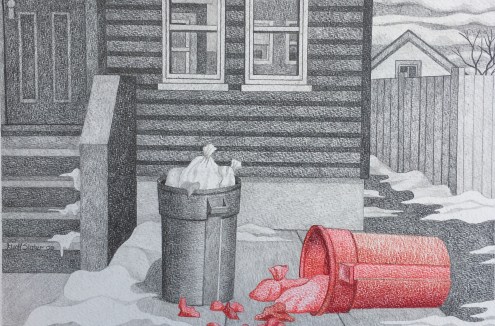
Comment: A wonderful drawing by my friend, line painter Geoff Slater. The poem, of course, represents the garbage in (and out of) the garbage can. 1789 is the date of the French Revolution. I found this poem in my discard file, so it was one of those that didn’t make it anywhere. Maybe it shouldn’t have made it here either. But it takes all sorts to make a world and Geoff’s red dustbin reminds me of the red caps knitted by the old women beneath the scaffold and the guillotine. Funny things, guillotines: invent them and they drop on you when you fall out of favor. There are so many allusions in this poem that I am ashamed to say I remember them all, and not all of them are pleasant. Mind you, few things are pleasant nowadays and remember: it is better to leave your dustbins out to roam the streets and be plundered by the crows and swept away by the high winds than to leave them festering and smelling bad and all cooped up in the locked down garage.

Southern Platform

Southern platform2.png

Comment: The wind that whistles through Island View today carries snowflakes and ice pellets that pitter-patter across the window. The wind brought in clouds, grey wisps of drapery that curtained the sky. When the wind falls silent, the trees continue to wave and thereby fan the air into action and the wind starts up again. Yellow sunshine, warmth, the sun in Mexico, in Oaxaca, in Monte Alban where the danzantes dance in stone and my friends and I wander at will among sunshine and shadow. On grey days like these when I crave the sun, I conjure images of Oaxaca, its warmth and its mysteries of mescal, that early-morning spinner of inner myths, word music, and magic metaphors.

Why?

IMG_0446

Why?

“Where are you going?” I ask again. “To see a man about a dog,” my father replies.  “Why?” I ask. “Hair of the dog,” his voice ghosts through the rapidly closing crack as the front door shuts behind him. “Why?” I cry out.

I recall the mud nest jammed tight against our garage roof. Tiny yellow beaks flap ceaselessly open. Parent birds sit on a vantage point of electric cable, their beaks moving in silent encouragement. A sudden rush, a clamour of wing and claw, a small body thudding down a ladder of air to crash beak first on the concrete.

“Why?” I ask.

The age-old answer comes back to me. “Wye is a river. It flows through Ross-on-Wye and marks the boundary between England and Wales.” The swallows perch on the rafters watching their fledgling as it struggles on the floor, the weakening wing flaps, the last slow kicks of the twitching legs.

“Why?” I ask.”

Y is a crooked letter invented by the Green Man of Wye,” my grandfather says.

“Why?” I repeat. “I want to know why.” Silence hangs a question mark over the unsatisfied spaces of my questing mind.

Comment: A golden oldie. We would all like to know why. But there are no answers. Just riddles cast, like two trunk-less legs of stone, on the sands of time. Nothing beside remains. Yet still we ask the age old question? Why? And still we get the age old answer from the ageing masters who rule our childhood lives and teach us everything they know: “Because.”

Keeping Score


IMG_1337 (2)

Keeping Score

(‘… we blossom and flourish
like leaves on a tree
and wither and perish …’)

In the beginning was the number,
and that number was one:
number one.

Place it on the chessboard,
square A1,
bottom left corner,
black.

Next door,
on square B1,
white,
place number 2.
Next door,
C1,
place number 4.

The D1 square
claims number 8.
The players are abandoned
to their fate.
16 perch
on square E1.

32
land next door,
what fun,
and crowd into
square F1.

Square G1
sees 64
and H1
numbers
128,
each number a person,
forsaken of late,
and left to perish
in a perilous state.

Black on the left,
white on the right,
the numbers will soon rise
out of sight.

That’s just the start,
the first rank done.
Now we can really
have some fun.
A bean counter’s work
is never done.

H2 = 2-5-6.
Now we’re really
in a fix.

G2 = 5-1-2.
Whatever are we
going to do.

F2 = 1-0-2-4.
Now we’re rattling
up the score.

E2 = 2-0-4-8:
why did we procrastinate,
enjoying ourselves,
rich, young and wealthy,
thinking everyone
hale and healthy,
encouraging them
to drink and party.

D2 = 4-0-9-6.
‘What’s this?’
They cried.
‘It’s just the dead ones,’
we replied.
“Surely there can’t be
many more?”
We said we really
couldn’t be too sure,
though we all wished
it was somewhat fewer.

Body bags are not too pleasant,
laid out in rows,
or curved in a crescent.

“C2?”
We were asked
by a man in a surgical mask.
“8-1-9-2,”
came the reply,
“and there’s lots more
yet to die.”

“B2?”
“I’ll have to tell you later,
when I’ve checked
my calculator.”

We punch the numbers,
one by one.
Keeping score is so much fun.
“8192
multiplied by 2
gives us
1-6-3-8-4.”
“My God,” he said.
“How many more?”

A2
multiplies by two
the numbers laid out
on B2.
“We’re sorry,” we said,
“the news ain’t great:
now we’ve climbed to
32 thousand,
seven hundred
and sixty-eight.”

Don’t bother to give us any thanks.
We’ve got to calculate six more ranks.

Maybe when we get to square H8,
the dying will decelerate.
Then maybe we can celebrate.

Until then we’ll just keep score
and hope there aren’t too many more.

Outrageous Fortune

IMG_1186 (2)

Outrageous Fortune

When the Black Dog descends it is difficult to see beyond the latest slings and arrows. Everything hurts and everybody hurts you. “Sticks and stones may break my bones, but words will never hurt me.” But they do. They gouge into the brain, splinter the mind, and leave us gasping for air, mouths open like landed, stranded fish.
How do we stop the hurt? We hurt ourselves more, much more, and then what they do to us can never ever be as bad as what we have done to ourselves. That cut-throat razor, that pop-gun with the cut cord, that carving knife, that finger stuffed into the electric socket … why, they ask, why did you do it? Head down, in silence, I know the answer, but I will not tell them.
They send me to doctors with fancy names who ask strange questions that I fudge or will not answer. They take my family’s money and then write reports and say that ‘his behavior is quite normal for a child of his age’.
Have they checked the scars on my mind, the black holes in my heart? Does the local priest who tells my parents that all is well also tell them about what happens in and out of church, in and out of school? I think of the city watch walking on the castle walls: “Nine o’clock and all’s well!”
Hurt yourself, I say. Hurt yourself so badly that nobody else will ever again be able to hurt you.

Deer Dance

IMG_1572.JPG

Deer Dance

They came with the snow, of course. Last year there were seven, this year six of them sniffed their cautious way, step by step, into the yard. I looked out of the bedroom at 3:00 am, and there they were, standing beneath the mountain ash and reaching up to the lower branches to snaffle the berries. They also dug into the snow and ate the fruit that had fallen beneath the tree. The night was cold and dark. I didn’t want to risk the camera and have the flash or the laser beam frighten them so I just stood and watched.

Next morning, I wondered if it had all been a dream. Then I saw the dance-steps in the snow. They have been back a couple of times now and this morning Clare spotted seven, in the early morning light, ghosting their almost perfect camouflage through the trees. So now we have a couple of questions: are there two groups this year, one of six and one of seven? Or had the seventh deer from last year rejoined the group?

We think the group of six has larger deer while the group of seven has two seemingly smaller ones. But this may be a trick of moon light and shifting moon shadows. Climate change: the local deer at sixes and sevens. What would Ocho Venado, the Oaxacan / Mixtec King known as Eight Deer, think of it? Ah, a conundrum indeed. And when and if I work out any answers, I will let you know.

Aliens

IMG_1584 (2).JPG

Aliens

They came in from nowhere. Appeared on the coaster. Smallish, slightly flaky, dried on the outside, they craved liquid. Climbed into the coffee. I fished them out on a spoon. They floated down my throat.

Now they are within me. They have taken possession of my system. Now nothing is the same and I see things in a different way. That plate on the table, diminished and slightly blurred.

IMG_1585.JPG

Those flowers, edible now. Those geese in the garden, my brothers and sisters.

IMG_1380 (2).JPG

That cat, my friend.

IMG_1374 (2).JPG

The Medallion

img_0265.jpg

The Medallion (Solace 7, 8, & 9)

7

St. James, Santiago, the patron saint of Spain and of the Conquistadores. Pale, egg shell blue walls, darkness ruling inside the church. It will do so until the sun peeps in the stained- glass windows and awakens all the sleeping colours. I bow my head, then my knee, and kneel at the back. Ahead of me, I recognize some of my neighbours who concentrate on the gestures of the priest as he mumbles to himself before the altar.

The early morning shadows creep across the walls until a single beam of sunshine descends and shatters the altar into a thousand tiny chips of fragmented light. My hands are pallid butterflies fluttering in the sun’s rays and a rainbow halo adorns my head. I shift away from the sunbeam and move to the side-chapel dedicated to the statue of St. James.

… St. James the Moor-Slayer … Santiago Matamoros … he stands on the severed heads of the Moors he has killed … behind him hands tied behind their backs dusky skinned warriors march away into slavery … my eyes are level with those severed heads and I stare eyeball to eyeball at a decapitated Moor … beside the statue stands a photo of the Gate of Glory, la Puerta de la Gloria, in the Cathedral of Santiago de Compostela in Spain … … generations of pilgrims have laid hands upon the Tree of Jesse, imprinting their fingers into the stone … human hands clasping rough granite in a search for comfort and warmth …

8

When I leave St. James, I find the witchdoctor squatting, in a trance. His fire burns low and a strong scent of copal rises from the coals, hangs heavy on the air, then slowly dissipates. I stop for a second to study El Brujo and the witch doctor speaks without opening his eyes.

“I spoke to your mother yesterday.”

“That’s nonsense,” I replied. “My mother’s dead.”

“What ails you, my son?”

“I’m not your son.”

“It’s a wise man knows his own father,” El Brujo opens his eyes. “One night, many years ago, Jaguar crept between your ribs and took your heart into his mouth. When he closed his jaws, your heart was as heavy as stone and Jaguar broke his tooth upon it. He cursed you and your heart remained a rock within your chest. At night, when you sleep, you dream of dust and ashes.”

“You speak in riddles,” I try to remain calm yet the words fan a sorrow within me that I thought had died a long time ago.

“Perhaps, but my words speak true.”

            … curses, stone, dust, ashes, broken heart, rock, heart in mouth … a marigold path, zopilote, high in the morning air, fire-red his wing-tips, and then an old stone bridge, a river below it with the snow floating down to be carried away by the current, three crones dancing on the steps of an orphanage, three beautiful ladies dancing on the temple steps, an old man, dead, then alive and walking in his burial clothes … hummingbirds dancing round the sun … red slashes of blood … tulips against a white-washed wall … an old man vanishing into a tomb … death’s face simmering in the moon’s dwindling pool …

“You must make a sacrifice, my friend.”

“I don’t do sacrifice, not like that boy this morning.”

“No, not like that,” El Brujo shakes his head. “You must sacrifice your beliefs and allow me to bless you.”

“I have no beliefs.”

“Even that is a belief.”

“Then I am sacrificing nothing.”

“If that is what you believe, it is so. Here: take this. It’s yours by right,” El Brujo offers me a medallion on a braided leather thong. “This is your mother’s gift to you.”

“You’re crazy. I told you: my mother’s dead. She didn’t leave me this.”

“I tell you that she did.”

“Did you know her?”

“I did.”

“I don’t believe you.”

“You may believe what you want. But tell me, does the medallion call you?”

“I like it, yes. I can’t say it calls. How much?” I put my hand in my pocket.

9

“You do not have enough money to buy it, and if you did, you wouldn’t be the man I think you are. And in that case, I wouldn’t sell it to you,” his eyes took on a faraway look. “However, it comes from your mother and I promised your mother I’d give you this.”

            El Brujo’s eyes hold a power that disconcerts me. I lower my head to his fire and the copal makes my eyes water. I cough and my vision blurs. My lungs fill with perfume and El Brujo pushes me closer to the incense. I inhale deeply and break out in a sweat.

“You must wear this always. It will protect you,” El Brujo places the medallion round my neck. I place my hand upon it, feel its rough edges, and see through my tears that it is incomplete, for it has been broken in half. What remains shows half a cross with some broken roses where the crucified Christ would normally appear.

“But it’s broken.”

“Not broken, but divided. You must find the missing half.”

“Did my mother tell you that?”

“Your mother is dead.”

El Brujo lapses into silence and stares me down. Then he breaks into a weird, wailing chant, using a language that I do not know. As he sings, he leans forward and brushes my eyes with an eagle feather that he draws from his pocket.

“Now, you will be able to see.”

… an old woman dressed in black, pushes at a young man … colored threads hang out from her basket … they flap like flags in the single ray of sunshine that breaks into a million tiny sparks of fire … hummingbirds, tiny warriors, wing their dance around a sun that bears a man’s  face … a pair of scissors snips at the string that ties a child’s balloon to the earth and it floats away up into the air high above the cathedral tower … fire catches its wings and it flares like zopilote, the trickster, in the dawn’s early light … the cathedral spire is a notched measuring stick conducting the clouds as they dance and weave their patterns … within the prison of the sky … trenchant shadows, twisted dancers, old warrior kings bend themselves in and out of shape as they struggle to escape … an old man  wrings his hands, then vanishes …  a soap bubble floats away on the wind … a young girl stands on a bridge in winter … snow swirls and  draws a curtain around her body as she falls into the waters below … an old crone wrapped in rags carries a bundle of clothes to a set of steps and leaves it there …

            “The medallion vibrates, it’s heavy and warm.”

“It knows you.”

“What do you mean, ‘it knows me’?”

“Did you feel nothing? Did you see nothing?”

“I saw nothing,” I cough and clear my throat. “I saw nothing at all.”

El Brujo looks at me long and hard. He opens his mouth to speak, then shrugs his shoulders.

“Come, you have accepted the medallion your mother left you. Now accept my blessing.”

“Why?”

“Because I ask you to. Are you such a coward that you cannot accept a blessing from an old man? Here, kneel beside me,” El Brujo taps the ground at his side and, wondering what on earth I think I am doing, I kneel beside him.