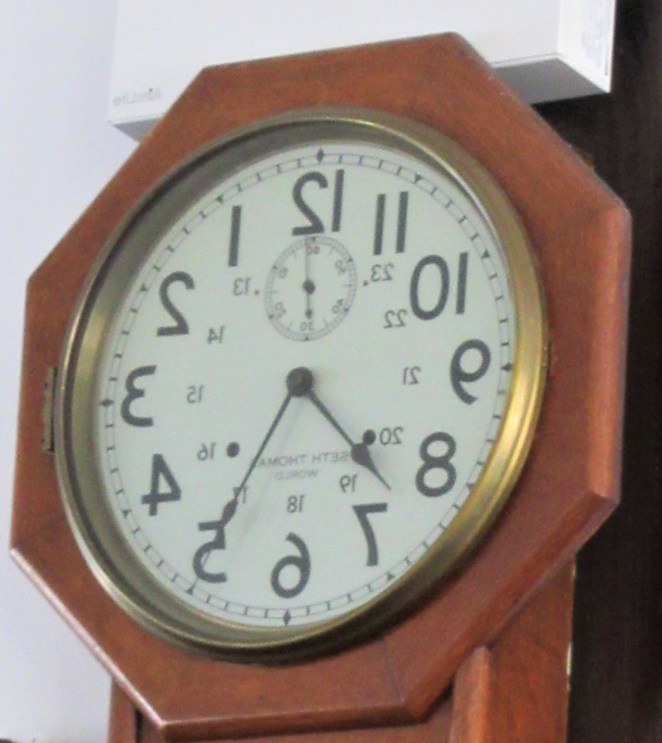
Clepsydra 28 & 29

28

… diagnosed
     with a terminal illness
          called life
               I know it will end
                    in death

I have seen many
     pass that way
          two-legged humans
               four-legged friends
                    and none have come back

I recall
     holding the dog’s shaved paw
          while the vet slipped
               that last redeeming needle
                    into the exposed vein

the dog’s eyes
     pleaded for release
          her tongue licked my hand
               oh so trusting
                    even at that
                         for me
                              so bitter end

and did the poor dog know
     what was coming
          did she live her life
               as I have led mine
                    waiting for that last word
                         to be spoken
                              the last order given …

29

… two of us
     me and my death
          walking side by side
               everywhere
                    sharing the same bed
                         sleeping between
                              the same sheets

I wonder if
     we dream
          the same dreams

my death
     how would I greet him
          when he came
               as executioner
                    not friend

I re-create him as a man
     or as a dark angel
          with all-comforting wings

is he open-eyed,
          while I am blindfolded
               not knowing the way
                    afraid of falling

this death
     is it cruelty
          or merely love               

the path is ahead is new
     and totally unknown …

Commentary:

Many of the images in these two pieces are exercises in intertextual examples, Stanza 29 in particular, drawn from the Neo-Stoicism of Francisco de Quevedo (1580-1645). His advice, set out in poem after poem, is to embrace death before it comes. Prepare for it, mentally, and be aware that it is the natural end of life. As Dylan Thomas also writes, “Every morning when I wake, oh Lord this little prayer I make, that thou wilt keep thy watchful eye on all poor creatures born to die.” The Dunvant Male Voice Choir gives us this version of it. Remember to turn your sound on! I like this version, not just for the music, but also for the views over one of my favorite childhood beaches, Rhossili and the Worm’s Head, not far from my home in Gower.

As I grow older and creakier, as my ailments accumulate, one by one, so I realize that indeed I have been “diagnosed with a terminal illness called life.” It’s funny to think of life as a terminal ailment. “Take two Tylenol and when you wake up tomorrow morning you’ll be feeling much better.” And yes, like every sane person “I know it [this terminal ailment] will end in death.” So, don’t be sad. Carpe Diem – seize each day and enjoy every one of them to the best of your ability. Remember the inscription on the Roman Sundial – horas non numero nisi serenas – I count only the happy hours. Whatever you do, have no regrets. If you do have some, make your peace with them now – or as soon as you possibly can. And, when the call comes, go willingly. Step with pride and joy onto that new and unknown path that will lead you to an eternity of joy, acceptance, and love.
                   

Things


Things

I fumble in my mind for things
long lost in an upper attic.
I can no longer read the words
I wrote. What does this mean?

At night I dream of things
beyond my reach. My fingers
clutch but cannot clasp
those clouds that clutter.

Who, oh who, the owl cries,
can free the mice that nibble
through my mind and set me
gnawing at my own soul?

Once upon a time, a long
time ago, I thought I saw light
at the end of the tunnel.
I travelled on a ghost train.

The light I saw was a gaslight
ghosting my mind with fictional
fantasies of an illusive kingdom
that would never be mine.

Elusive, these memories of things
that never were, but might have been.
Will o’ the wisps dancing shadows
on the salt-marsh of my unknown life.

Commentary:
Memory loss. I guess it happens to all of us at one time or another. One of my long-lost friends visited yesterday and between us we could hardly put two consecutive memories together. Every other sentence was punctuated with a pause – ‘Now, when did that happen?’ ‘What was his name? I can’t remember now.’ ‘Me neither.’

I am not particularly worried by such happenings. I am a poet and a story-teller. Sometimes, I forget the truth – so what? – I just go ahead and reinvent it, tickling it here, sticking a spot of paint there, adding a word or two, or a magic moment. I often remind myself of Oscar Wilde when he created a magic moment of verbal ingenuity – “I wish I had said that, Oscar.” “You will, Roger, you will.”

Best of all, even in those moments when personal memories fail me, literary magic returns. I think of Dylan Thomas and his words spring to my mind – ‘time has ticked a heaven round the stars’. Wonderful. Or Francisco de Quevedo ‘soy un fué, y un será, y un es cansado.’ / ‘Tired I was, tired I am, tired I always will be.’ My own translation from the summer of 1963 when José Manuel Blecua introduced me to the poem, or rather Blecua introduced the poem to me, in that summer’s courses of the UIMP.

So, according to this theory, even when you feel lost, you are never really lost, because there are an enormous number of people living inside your head, who who will step out from the shadows, when needed, and give your memory a little boost. But don’t get too carried away. Think too of José María Valverde and his poetic premonition: ‘Pobres poetas de hoy, destinados a ser polvo seco de tesis doctoral.’ / ‘Poor poets of today, destined to be the dry dust of doctoral theses.’ (My translation).

Dust to dust and ashes to ashes – ‘Serán ceniza, pero tendrá sentido. Polvo serán, pero polvo enamorado.’ Quevedo, of course. But you didn’t need me to tell you that. You might need me to help you with the translation, though – ‘Ashes they’ll be, but ashes with feeling. They will be dust, but dust that burns with love.’ (My translation, with a little bit of exaggeration [sorry, don Francisco!] just at the end.)

Butterflies

Butterflies
Miguel de Unamuno

… butterflies … temporal forms … fluttering …
existing for one sweet day … they perch … spread
their wings … fan us with their beauty … flourish …
catch our attention … then caught by a gust
tear their wings on a thorn … and perish … blink
your eye and they are gone … yet reborn … they
cluster and gather in dusty ditches …
congregate on bees’ balm … smother Black-Eyed
Susan and Cape Daisy … shimmer in shade …
butterflies by day … fireflies by night …
terrestrial stars floating in their forest
firmament … dark tamarack … black oak … bird’s
eye maple … silver birch … impermanence
surrounds us … dances beneath stars … sings with
robins … echoes the owl’s haunting cry …
eternity held briefly in our hands …
then escaping like water or sand … black
words on white paper capturing nothing …
… my dialog … my time … my place … butterflies …

Note: “La poesía da permanencia a las formas temporales del ser / Poetry gives permanence to the temporal forms of the self.” Miguel de Unamuno (1864-1936)

The temporal forms of the self – and so much today is unsettled, changing, insubstantial. I have often wondered how one makes time stop. Is it even possible to do so? Time and tide wait for no man. And why should they? Fray Luis de León – “Con paso silencioso, el cielo vueltas dando, las horas del vivir le va hurtando.” / With silent step, the ever-turning sky, steals away life’s hours. Or Fancisco de Quevedo – “Que sin saber ni cómo, ni adónde, la edad y la salud se hayan huído. Falta la vida, asiste lo vivido, y no hay calamidad que no me ronde.” Without me knowing how or where, age and health have fled. Life is lacking, past life flew by, and there isn’t a calamity that doesn’t hound me.

Ars longa, vis brevis – art endures, life flies by. My translations are freer than usual today, but I too feel like being creative in my own language. So, if we can’t slow time down, what can we do? We can create – poems, paintings, photos. We can read – and translate from one language to another. We can, like butterflies, perch on flowers and enjoy our brief days in the sun. Mindfulness – we can make the most of each moment by living it thoroughly and well. Carpe diem – we can seize each moment of every day and live it to its full measure. And, above all, we can write and read poetry – because, as Unamuno says – Poetry gives permanence to the temporal forms of the self.

On Loneliness

Loneliness

58 What relationships have a positive impact on you?

I think one of my poems answers this question best. I write “one of my poems” but it is really my ‘free’ translation of one of Francisco de Quevedo’s sonnets – Retirado en la paz de estos desiertos. I have changed the poem slightly, but I am sure Don Francisco (1580-1645) will excuse Don Roger’s impoverished effort (2023).

On Loneliness
29 December 2023

Resting in the peace of these small rooms,
with few, but welcome books together,
I live in conversation with my friends,
and listen with my eyes to loving words.

Not always understood, but always there,
they influence and question my affairs,
and with contrasting points of view,
they wake me up, and make me more aware.

The wisdom of these absent friends,
some distant from me just because they’re dead,
lives on and on, thanks to the printed word.

Life flits away, the past can’t be retained.
each hour, once past, is lost and gone,
but with such friends, I’m never left alone.

And there are so many of those literary friends. I still read Rudyard Kipling and I have just finished Kim, Captains Courageous, Stalky and Co., Puck of Pook’s Hill, and Rewards and Fairies. I read these first when I was nine or ten years old, and I return to them regularly. Other friends include Garcilaso de la Vega, Fray Luis de León, St. John of the Cross, Quevedo, Góngora, Calderón, Miguel de Unamuno, Antonio Machado, various members of the Generation of 1898, the majority of the poets from the Generation of 1927… and these are just my Spanish literary friends. I have French friends, English friends, Anglo-Welsh friends, Canadian friends, Mexican friends, and, in translation, many, many more. My relationship with each of these friends has had an impact upon me.

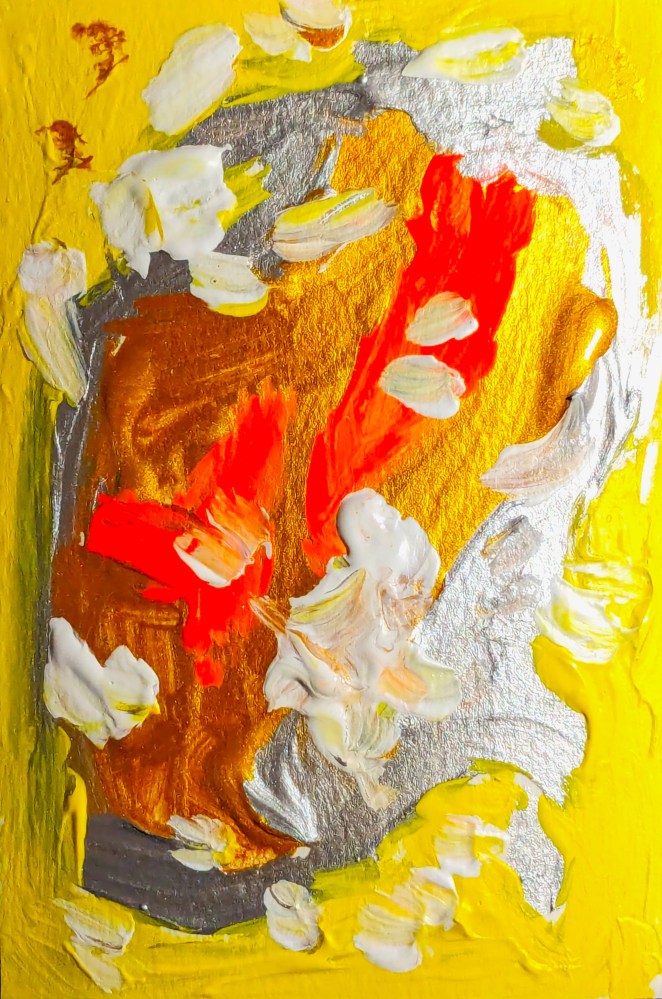
A recent painting, by my friend Moo, is called Fiat Lux – Let There Be Light. It is reminiscent of Dylan Thomas’s poem, Light breaks where no light shines. Intertextuality – Quevedo drew inspiration from the Stoics. I drew inspiration from Quevedo. Moo drew inspiration from Dylan Thomas. The nature of creativity, and its continuing links throughout the ages, shines clearly through these wonderful associations. Long may they continue, and may others enjoy them and be influenced by them as much as I have.

Comment:
The funny thing is that I do not remember writing this blog prompt, nor do I remember having translated Quevedo’s poem into English. I wonder how many other forget-me-nots there are out there. Or, to be more precise, in my books and in my notes. A treasure trove – that’s my guess. Borges wrote of Quevedo that he was more a library than an author, and I am beginning to think that way about my self. A strange world, this, one in which the creator abandons, and then forgets, his creations. Perhaps we should change the image – not so much a library as an orphanage, and so many lost and abandoned orphans wandering around The Little World of Don Rogelio.

The Book of Everything

Discourse Analysis
and
The Meaning of Meaning

Words have dictionary definitions that allow us to agree on what they mean. In this fashion, when I say ‘my grandmother’, you automatically know that I am referring either to the mother of my mother (maternal grandmother) or the mother of my father (paternal grandmother). This is the dictionary meaning of the word ‘grandmother’.

But words have lives of their own, and their meaning changes when used by individuals. You, the reader, never knew my grandmothers. You never will. They both passed away a long time ago. I loved them both, but for very different reasons, and to me they were as different as different can be.

This means that when you, the reader of these words, reach the word ‘grandmother’, the faces you see, the emotions you feel, the memories conjured up by that word are totally different from mine. Same word, same dictionary definition, different personal memories, experiences, relationships. In addition, the role that our grandmother(s) played in our lives will be very different too. That role may vary from culture to culture, from language to language, and from the social structure of the changing society in which we live.

For example, when I first went to Santander, Spain, I visited a family who lived in a large, detached house that contained three generations of the family – grandmother and siblings, father and mother, grandchildren, and an assortment of aunts and uncles. No need for babysitters in that household. Everybody had a vested interest in the development of the young ones and the older ones received tender, loving care, twenty-four hours a day, every day of the week.

I lived from time to time in the same town as my own grandparents. I saw them regularly, but rarely on a daily basis. When my parents sent me to my first boarding school, age six (if I remember correctly), I lost contact with my family. My paternal grandfather died when I was away at school. My maternal grandmother died while I was away at school. My paternal grandmother died when I was living in Spain. My maternal grandfather died when I was living in Canada. Alas, after those early years, I scarcely knew them. My experience, then, was so different from that of other people.

When I moved to Canada, the Atlantic Ocean separated me from my parents. My daughter, born in Canada, grew up with no close knowledge of her grandparents. The word ‘grandmother’ did not mean the same to her as it did to the grandchildren in Santander, or to me. How could it? All those miles between the families, and visits limited to a couple of weeks every other year at best. Although the dictionary meaning is always the same, what a difference in the emotional meanings for each person using that word.

Discourse Analysis, the way I use it, builds not on the dictionary meanings of words, but on their emotional and personal resonance. I take the standard, dictionary meaning of words, twist it, look for meanings at different levels, and then build an alternative narrative on that changed meaning. I have great fun doing so.

Part of that verbal fun comes from my childhood. I listened to Radio Shows like The Goon Show and Beyond Our Ken. Giles’ Cartoons gave my names like Chalky White, the skeletal school teacher, or Mr. Dimwitty, a rather dense teacher in another school. These shows also twisted the meaning of words and drew their humor from such multiple meanings. The Goon Show – “Min, did you put the cat out?” “No, Henry, was it on fire?” Or on an escaped convict – “He fell into a wheelbarrow of cement and showed every sign of becoming a hardened criminal.” Or from Beyond Our Ken – “My ear was ringing. I picked it up and answered it. ‘Ken here, who am I speaking to?’ ‘Larry Choo.’ ‘Ah, Choo.’ ‘Bless you, Ken.’ Verbal scenes like these – it’s hard to get visual pictures from listening to the radio – remain engraved in my memory banks. More than engrained, they become part of the verbal system from within which I write.

This system includes Direct Discourse, Indirect Discourse, and the Twisted Discourse of an Inventive Mind that still wishes to create. It also comes from Francico de Quevedo’s Conceptismo, from Ramón del Valle-Inclán’s esperpento, and from certain aspects of Albert Camus’s Theory of the Absurd, all blended with the poetry of Jacques Prévert and the songs of Georges Brassens. This from the latter – “Tout le monde viendra me voir pendu, sauf les aveugles, bien entendu.” Everyone will come to see me hanged, except the blind of course.

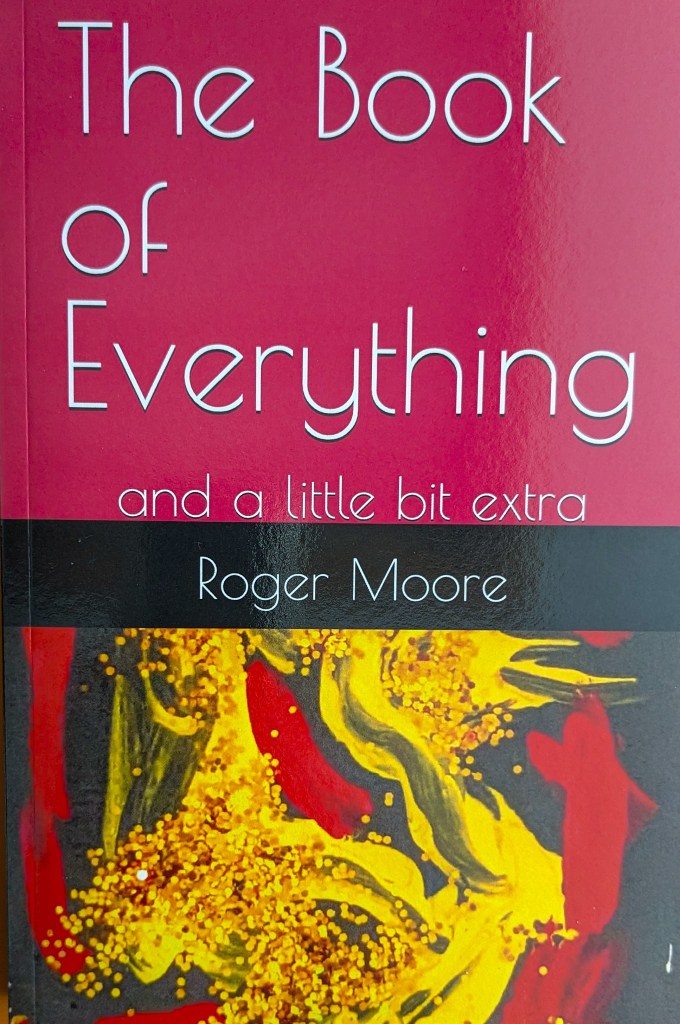
This is not always easy humor, nor is it a comfortable way to see the world. But it is a traditional one with a long literary history. The title of my book goes back to Francisco de Quevedo, of course, who, in 1631, in Madrid, published El libro de todas las cosas y otras muchas más / The book of everything and a lot more things as well. Don Roger turns to his good friend Don Francisco whenever he needs a helping hand.

The pieces themselves were first published on my blog rogermoorepoet.com. They have been revised, and I have added some more pieces in a similar vein. Tolle, lege – Take and read.  Above all, enjoy this world of mine, with its subtle and not so subtle humor, its sly digs at many of our follies, and its many forms of creativity.

The Book of Everything
and
a little bit extra

Click on the title to purchase this book.

What things give you energy?

Daily writing prompt
What things give you energy?

What things give you energy?

What on earth do you mean by energy? And why should energy be associated with things? For example, today’s painting (above) is by my friend Moo. He calls it Joy to the World. It is indeed a joyous painting, full of light and creative energy. The photo does not do justice to the painting, which sparkles and reaches out to draw the viewer in. We must never underestimate the energy that comes from the creativity and art that creative people put into their art works. It is like bread cast upon the waters – it will return tenfold. The world would be a sad place if we lost our powers of creativity and invention. May we always keep them close by us, and turn to them when the skies are grey – for with our ingenuity and skills we can always turn those grey skies blue again. It just takes time, trust, belief, creativity, and a little bit of energy.

Or is the prompt referring to the energy that comes from food? Vonnegut refers to such energy as comes from the breakfast of champions. Was that really Scott’s Porridge Oats? Certainly used to be – and all those caterwauling bagpipes puffing out their oaten tunes. More foods, please. Cornish Hens and Kedgeree, unzipped bananas, eggs – preferably fresh and free range – boiled, poached, scrambled, fried, or served in various types of omelets … energy from food – oh, I could go on and on and on … caws wedi pobi, cennin a tatwystortilla espanola, paella de mariscos, calamares en su tintachapulines from Oaxaca … food as a source of energy … wow! And who said the foods had to be written in English?

Mind you, an alternate source of energy is the current news cycle. When not a storm in a tea-cup, sugared or un-sugared, it is ferocious and opinionated enough to set people banging their heads against the walls so the pain will come from an alternate source. And noise demands energy – energy in (and also garbage) and energy out (mainly garbage), and all that rage, fury, wind, despair, blather, generated by written, printed, spoken, televised, radio borne waves of noise. We could start a wind farm if we trapped the blatherings of congress, the senate, the houses of parliament.

Meanwhile, we live in a large house, almost a barn really. Some of our friends call it our hacienda. They are the ones who speak no Spanish and can’t pronounce Quevedo correctly, even though I’ve known them for a quarter of a century. Actually, strictly speaking, most of them are ex-friends now. Many went AWOL when I retired and the rest disappeared, fates unknown, during Covid.

That house has an electric furnace that warms us in winter and circulates cool air, in summer, from the basement (cool) to the upstairs bedrooms (warm). We also have a fireplace insert that burns wood. But we only use that in emergencies (power loss during cold weather or storms) or for decoration (the yule log) at Christmas and over the New Year.

A large house means large heating bills. About ten years ago, we installed a wonderful heat pump that serves the whole house. It heats in winter and cools in summer. It also halves (or more) our electricity bills. Most of the house functions on electricity, hydro-electricity from the dam at Mactaquac, just up the road. No coal-fired furnaces for our electric supply. We do, however, have the ability to connect to a petrol-driven generator. But we rarely, if ever use it and that, too, is for emergency use only.

Otherwise, many of the things we use on a daily basis – computers, cell phones – can be battery driven (when the power fails) and those batteries can be charged in the car (during emergencies) or from reserved chargers hidden away. The car itself is a normal gas engine – nothing special – as is the snow blower. We do not use solar power – nor wind power – but we do have candle power and our fireplace insert can be used for heating food and boiling water.

So there, as a challenge to your lack of clarity, you have a clear account of my many sources of different types of energy. Oh, and don’t forget, I am energized by earing your prompts apart and chomping them into tiny pieces.

Comment – revised, Sunday, 22 September 2024.

How has technology changed your job?

Daily writing prompt
How has technology changed your job?

How has technology changed your job?

I suppose I must begin by saying that, having retired fifteen years ago, I no longer have a job. So, Technology has not changed my job at all. However, when I was actually working full time, technology made an enormous impact on my work.

Keeping up with the Jones’s! I travelled to Oaxaca, Mexico, on a faculty exchange program in 1995 and was astonished to find that the Escuela de Idiomas of UABJO, had better computer and technology features than I did in my home university. I was way behind the Oaxacans in what I taught and how to deliver it. How to catch up, that was the question!

In 1996, I started a Multi-Media Certificate at the University of New Brunswick, completing it in 1999. As a result of this certificate, my beloved and I built our first web pages and produced our first Quevedo Online Bibliography. This also enabled me to start teaching a course entitled Mexico Online. This course took place in the university’s computer laboratory and, instead of requiring written papers, it asked the students to create their own web pages and to do their own online research.

This was the first step into the brave new world of WebCT, Blackboard, and the many other web platforms that rapidly became available, often at great cost to the student. Student costs – well, they skyrocketed. So, I did my best to cut them down. Texts, especially literary texts, in online format, for free. A formal course outline, online, discussed with the students each term, and changed in accordance with each class’s particular needs. This guaranteed that teaching and learning were both flexible, and did not become bogged down by the trap of the one course, set “in electronic stone” for all eternity. This is a trap into which far too many teachers fall. The everlasting course, as it was in the beginning, is now, and ever shall be, taught without further changes and with no end, amen. No thought, no development, and knowledge a static state.

But technology also changed the teaching environment. We began with the static classroom with rows and rows of desks looking down on the stage where the professors, at the podium, performed their annual circus acts of passing knowledge from their notes to the students’ notes, without it passing through anybody’s head, as my first prof in my first university once told the class.

Then we moved to the chairs and tables classroom, where the professors could, if they chose, wander among the students, get to know them by their names, and create a dynamic small group teaching environment in which each individual received increased professorial attention if and when needed.

Enter Technology. The Computer screen replaced the black, green, white board (I have scrawled with chalk and marker pens on all of them). Classrooms became fixed spaces again. And the computer program doubled with, or replaced, the formal lecture. Static knowledge delivered to stationary students sitting and passively watching.

They were called smart classrooms. My favorite moment of the day? When I stood up and asked the class if this was indeed a smart classroom. Yes sir, they always replied. I would tap on the wall and ask the wall – “What’s two plus two?” The class would wait and wait. No answer. I would ask again. No answer. “Not such a smart classroom, then,” I would tell them.

Technology is great, as a tool for genuine teaching and learning. But it brings problems with it, as we are beginning to find out. Brainwashing, false information, erroneous material that misleads, quite often deliberately … Quis custodiet ipsos custodies? Who shall police the police? Who shall program the programmers? Perhaps the Romans, all that time ago, had it right. Caveat emptor – buyer beware.

What relationships have a positive impact on you?

Daily writing prompt
What relationships have a positive impact on you?

What relationships have a positive impact on you?
I think one of my poems answers this question best. I write “one of my poems” but it is really my ‘free’ translation of one of Francisco de Quevedo’s sonnets – Retirado en la paz de estos desiertos. I have changed the poem slightly, but I am sure Don Francisco (1580-1645) will excuse Don Roger’s impoverished effort (2023).

On Loneliness
29 December 2023

Resting in the peace of these small rooms,
with few, but welcome books together,
I live in conversation with my friends,
and listen with my eyes to loving words.

Not always understood, but always there,
they influence and question my affairs,
and with contrasting points of view,
they wake me up, and make me more aware.

The wisdom of these absent friends,
some distant from me just because they’re dead,
lives on and on, thanks to the printed word.

Life flits away, the past can’t be retained.
each hour, once past, is lost and gone,
but with such friends, I’m never left alone.

The painting, by my friend Moo, is called Fiat Lux – Let There Be Light. It is reminiscent of Dylan Thomas’s poem, Light breaks where no light shines. Intertextuality – Quevedo drew inspiration from the Stoics. I drew inspiration from Quevedo. Moo drew inspiration from Dylan Thomas. The nature of creativity and its continuing links throughout the ages shines clearly through these wonderful associations.

On Death and Dying

On Death and Dying

I once asked my grandfather, a decorated soldier from WWI, if he was worried about dying. “No,” he replied. “Why not?” “Well, Roger, we’re all going to die. We just don’t know when. So, if I worry, I will die. If I don’t worry, I will die. So, why worry about it?” I was about five years old at the time and we were standing outside the Swansea Hospital, as was, by the seat where the old men used to sit and gossip. I didn’t realize it at the time, but that was my first lesson in Stoicism.

“The day I was born, I took my first step on the path to death.” Francisco de Quevedo (1580-1645), Spanish Neo-Stoic, among so many other things. Thinking like that tends to put things into perspective, for death walks with us every day. Death is our twin sibling, brother or sister. We face his shadow every time we look in the mirror and that shadow follows us around all day. “Death is a law, not a punishment, so why worry about it?” Also Quevedo. Dying is a different matter and yes, there are so many ways to go, some of them, especially nowadays, with the advent of life-preserving medicines, slow and unpleasant. Yet, mors omnia solvit – death solves everything. And it brings a release from all pain and suffering.

The lead photo shows a plaque in Avila (Spain). La Calle de la Cruz (1660) -The Street of the Cross. It is also known locally as La Calle de la Vida y de la Muerte – The Street of Life and Death. Why? It is rumored that here, turning left outside the main cathedral, duels were fought. Two men entered, but only one emerged alive. It is interesting to meditate on the close proximity of life and death, always there, side by side.

So, for the fun of it, let’s change the question: what is life? “What is life? A frenzy. What is life? An illusion, a shadow, a fiction. And the greatest good is small, for the whole of life is a dream, and dreams are nothing but dreams, after all.” Life is a Dream, Calderon (1600-1681). Looked at from this point of view, what is death? Is it the shutting down and the turning off of the cerebral computer or is it the great awakening from the sleep of life? You can think of it either way but, either way, it’s pointless worrying about it. As my grandfather also told me: “If there’s nothing afterwards, I’ll just fall asleep and that will be the end of it. But if death is the great awakening, then I will be very happy to wake up in a new reality.”

Robert Bly, in The Sibling Society, writes of the lateral movement that now embraces society with its grip of instant pleasure, instant gratification, instant happiness. As a result, we have strayed far from the vertical knowledge that sustained us for centuries. We have abandoned the wise words of our ancestors. Now the old are no longer the keepers of wisdom and the guardians of culture, the institutional memories of the race, if you like. Now they are foolish, clumsy, out of date with the world’s most rapid advances. Only the young, and their siblings, can keep up with the ever changing instants of life as presented to us.

But all is not lost. “What a peaceful life, that of the wise man who withdraws from this noisy world and follows the hidden path along which the world’s wisest people have always walked.” Fray Luis de Leon (1527-1591). We can move far from the madding crowd. We can construct our own realities. We can base them on the words of wisdom handed down to us over the generations. Switch off the TV. Watch the sun as it moves across the cathedral face (Monet) or the walls of your house (Moo). Live each moment of each day. Do not fall into despair. Above, don’t worry – it does no good at all.

Intertextuality

Intertextuality

Wednesday Workshop
25 August 2021

            This is another academic word that has a simple meaning. In essence, it means texts talking to texts. Quevedo (1580-1645) writes escucho con mis ojos a los muertos’ / ‘I listen with my eyes to dead men.’ He is suggesting that, each time we read a text written by another person we enter into a dialog with that text and that author. His metaphoric conversations with the writings of the long-dead Seneca become intertextual the moment he put pen to paper and wrote about them.

This intertextuality is a key component of my writing.  You may not recognize all the phrases that I have used previously by other writers. I do. Some other readers will. Just take, as an example, the titles of some of my earlier books. The title of Broken Ghosts (Goose Lane, 1986) comes from these lines penned by the Swansea poet, Dylan Thomas (1914-1953). ‘Light breaks where no sun shines; / where no sea runs, the waters of the heart / push in their tides; and, broken ghosts with glow-worms in their heads, the things of light / file through the flesh where no flesh decks the bones.” Stars at Elbow and Foot, the title of my Selected Poems (Cyberwit.net, 2021) was also inspired by one of Dylan Thomas’s poems. “And death shall have no dominion. Dead men naked they shall be one with the man in the wind and the west moon; when their bones are picked clean and the clean bones gone, they shall have stars at elbow and foot.” The title of Though Lovers Be Lost (Kindle, 2016) also comes from this same poem, one of my favorites, obviously.

Sometimes readers are aware of these intertextual clues that I sow throughout my poems. Sometimes not. It doesn’t matter. There is a resonance in such chosen words and that resonance is there, irrespective of whether you are aware of the word-source or not. That said, the recognition and acknowledgement of intertextual relationships expands the poetic meanings of the creative world even further. It also establishes verbal links between author and author, epoch and epoch, genre and genre, thus establishing a wider intertextual network and a stronger chain of linked literary thoughts and meanings. In our creative journeys, we rarely walk alone, whether we are aware of it, or not.

The art of writing poetry about paintings is known as ekphrasis – which basically just means a verbal description of a visual work of art, whether it’s real or imaginary. The conversion of the visible (painting) to the printed page (verbal) is another link in the great chain of intertextuality, for paintings, too, are narratives with a different form of text. Other component parts are audible to verbal (alliteration, onomatopoeia), touch and feel (tactile) to verbal (as in synesthesia or the mixing of the senses) and the transfer of taste to verbal forms. Many of these transitions and transformations are present, not only in my own poetry, but in surrealism (verbal and visual) as well.