Alone

Alone

the longing
to belong
appears from
nowhere

I want
to lose myself
in something bigger
than myself

religion
can bite like that
church and altar
feast days
incense and candles
confession
repentance
forgiveness
then sin again

I am not religious
not in that sense

nor am I militant
right arm raised
goose-stepping
in a parade
each step in time
with every one else

if that’s the meaning
of belonging
I guess I’ll continue
to dream alone

Commentary:

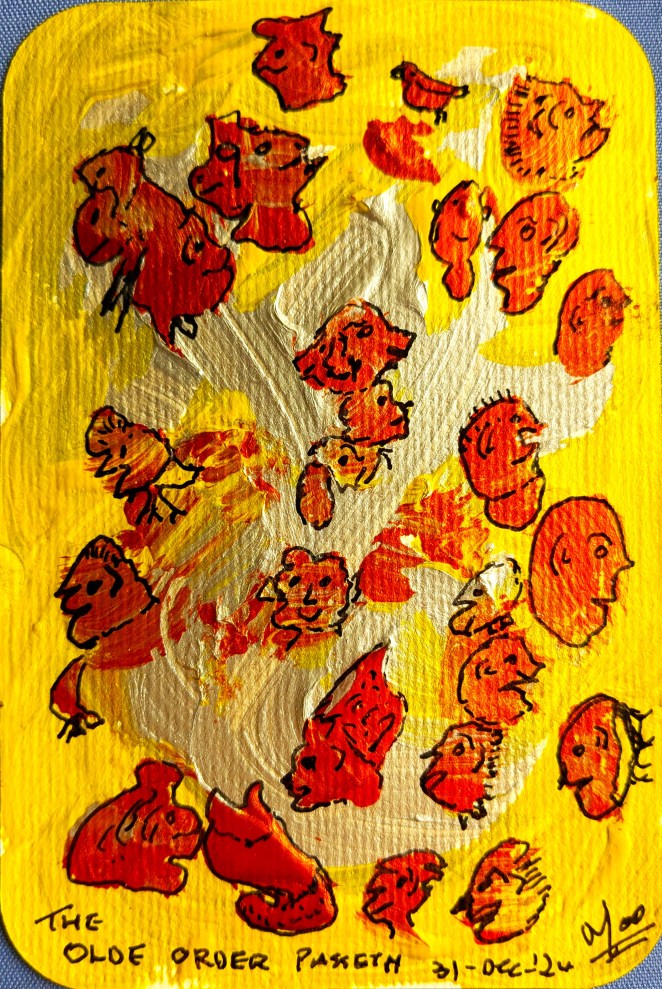
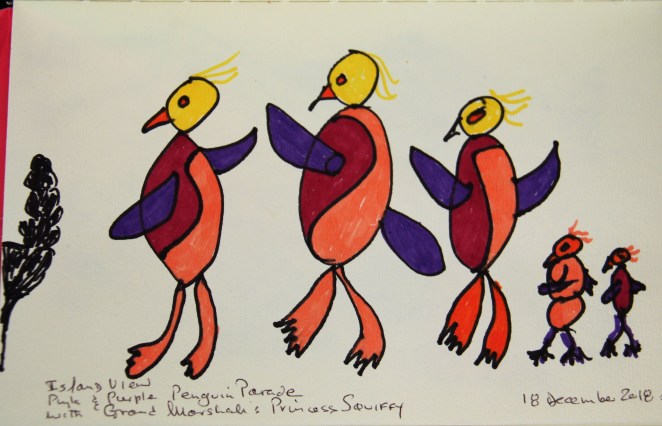
Moo thinks that Princess Squiffy, out at the front of the parade, a solitary cat, all alone and on her own, would be perfect for this poem. I am not so sure. Everybody is so happy, so engaged, except for Princess Squiffy aka Vomit, who is vanishing into the woodwork – about to plan and execute her next act of sabotage, I guess. Yes, Vomit! She’s the one who throws up in my chair.

The meaning of meaning – such a simple phrase, such a complicated philosophical history. How does one ‘belong’? In what ways can one ‘belong’? Does one yearn to belong or long to belong? And what does it mean – to belong? Does my cat belong to me? Does my dog belong to me? Cat and dog are long dead now – so how can they belong to me? And when I am gone, all my belongings will belong to someone else. A strange world, eh? And yet I long to belong in it for as long as possible.

The two most dangerous words in the world – thine and mine. Cervantes wrote that somewhere. For thine and mine are possessives. They teach us to possess things, to claim them as ours. My house, my garden, my trees, my flowers, my lawn. With the drought that has occurred this summer and into the fall, I can no longer say my lawn, my flowers, my garden, for they have all dried up and marched along, privatim et seriatim, – a touch of Kipling there, Storky and Co. if I remember correctly, and I don’t, because I just checked and it’s Stalky not Storky! – into whatever happy gardens dead flowers and gardens inhabit in their after life.

I think one of the most dangerous games ever invented is Monopoly. Make no mistake, I love my Monopoly set – especially the top hat and the flat iron – but what do we learn from Monopoly and from all similar types of game playing and role modelling? Why, to gather everything into our hands hands and possess everything on the Monopoly Board. At least when we play chess, we defeat an opponent by check-mating his / her king. We don’t have to accrue all 31 pieces on our side of the board leaving the poor king alone on the other. Even Fox and Hounds – and that’s an impossible game to win when you’re the fox- doesn’t humiliate anyone in quite that fashion. Ah well, the meaning of the meaning of Monopoly – Happy Canadian Thanksgiving – we can all have a good rant about that one.

Inquisitor

Inquisitor
Sun and Moon

He told me to read,
and plucked my left eye from its orbit.
He slashed the glowing globe of the other.
Knowledge leaked out, loose threads dangled.
He told me to speak and I squeezed dry dust
to spout a diet of Catechism and Confession.

He emptied my mind of poetry and history.
He destroyed the myths of my people.
He filled me with fantasies from a far-off land.
I live in a desert where people die of thirst,
yet he talked to me of a man who walked on water.

On all sides, as stubborn as stucco,
the prison walls listened and learned.
I counted the years with feeble scratches:
one, five, two, three.

For an hour each day the sun shone on my face,
for an hour at night the moon kept me company.
Broken worlds lay shattered inside me.
Dust gathered in my people’s ancient dictionary.

My heart was like a spring sowing
withering in my chest
It longed for the witch doctor’s magic,
for the healing slash of wind and rain.

The Inquisitor told me to write down our history:
I wrote … how his church … had come … to save us.

Commentary:

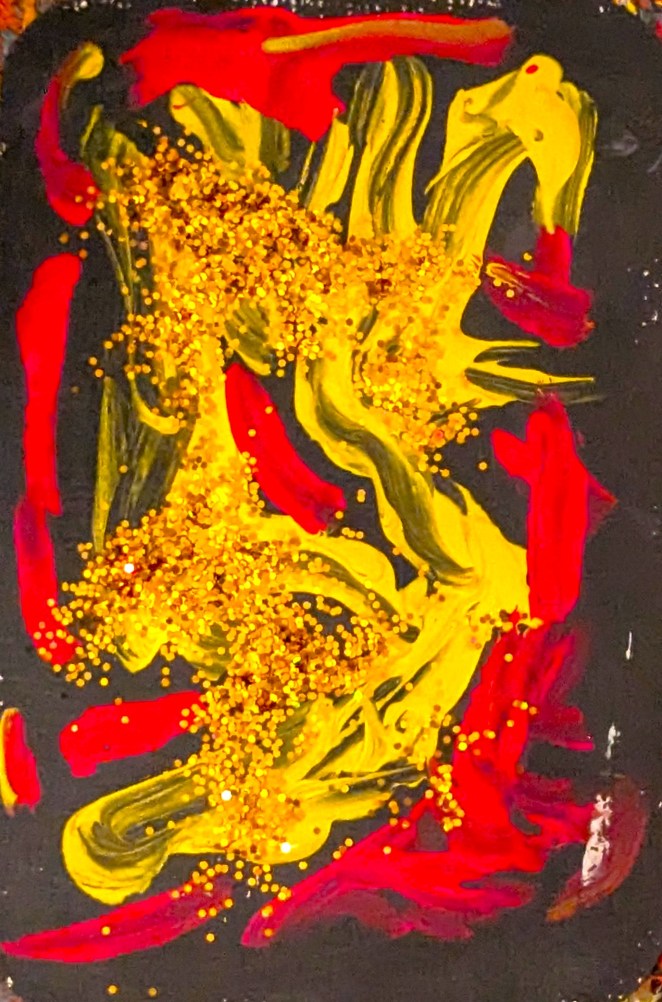
No wonder the little girl in Moo’s painting looks so sad. She must have read this poem and understood how the exercise of power and authority, be it religious or secular, can effect those upon whom it is exercised. Times change, but so many things remain the same. The pendulum swings, and it moves from chaos to order and back again. The meaning of meaning – how we define chaos and how we define order define who we are.

Birds of a feather flock together. Manners maketh the man. Wonderful sayings. But fine words do not necessarily make for fine men or women at that. Serpents and senators, both can speak with forked tongues. It is up to us to apply discourse analysis and distinguish between what they say and what they actually mean. As my friend Jean-Paul Sartre once said – “L’homme n’est rien d’autre que ce qu’il fait.” A man is nothing more than what he does. His deeds reveal his true inner self – and remember – the plumage doesn’t necessarily make the bird.

Gaia

Santo Domingo
Worshipping Gaia before the great altar
in Santo Domingo

If the goddess is not carried in your heart
like a warm loaf in a paper bag beneath your shirt
you will never discover her hiding place

she does not sip ambrosia from these golden flowers
nor does she climb this vine to her heavenly throne
nor does she sit on this ceiling frowning down

in spite of the sunshine trapped in all this gold
the church is cold and overwhelming
tourists come with cameras not the people with their prayers

my only warmth and comfort
not in this god who bids the lily gilded
but in that quieter voice that speaks within me

and brings me light amidst all this darkness
and brings me poverty amidst all this wealth

Commentary:

A Golden Oldie from Sun and Moon – Poems from Oaxaca. The Church of Santo Domingo in Oaxaca, Mexico, contains approximately six tons of gold and gold leaf. Incredible. I visited it regularly, but rarely saw anyone else in there. The local people seemed to avoid it and tourists with cameras were the main visitors. I refuse to take pictures inside churches, for several reasons.

It has always amazed me that the Spaniards built their churches on the sites of previous places of religious worship. This is partly because the indigenous appreciated the sacredness of certain sites, and partly because it was to these sites that the indigenous had traveled prior to the arrival of the Spaniards. Interesting, too, that the Spaniards call their arrival the Discovery while the indigenous call it the Conquest. History – a coin with two different sides – and it is sometimes difficult to look at both sides at once. Malinche – heroine or traitress? Cortes – hero or murderer? And, as they used to say in Northern Ireland, during the troubles, one man’s freedom fighter is another man’s terrorist.

Spin the coin of history, by all means. But beware of seeing only ‘heads’ and forgetting that there are ‘tails’. And never reduce those ‘tails’ to mere ‘tales’. Neither the written tradition nor the oral tradition is infallible. Many people, quiet and secretive as they may be, have long memories. And remember too that all that glitters is not necessarily gold.

Apocalypse When?

Apocalypse When?

A strange, milk-cloud sky, skimpy, with the sun
a pale, dimly-glowing disc, and my pen scarce
casting a shadow as the nib limps over the page.

Out on the west coast, fires still range free and this
is the result, these high, thin clouds casting a spider
web cloak over the sun face and darkening the day.

The west coast: five or six hours by plane and three
whole days to get there by train, even longer by bus,
all chops and changes with multiple stops.

The wind blew and the clouds came widdershins,
backwards across the continent. Today they reached
across the ocean to claw the sun from European skies.

It is indeed a small world after all. Isostasy:
you push the balloon in here, and it bulges out
over there, in the place you least expected

Now we are all interconnected in an intricate network
of a thousand ways and means. What does it all mean?
Ripples ruffle the beaver pond’s dark mirror.

The forest mutters wind-words, devious and cruel,
that I sense, but cannot understand. High in the sky
clouds turn into horsemen on plunging steeds.

Fear, fire, flood, foe, poverty, pandemic, crops destroyed,
unemployment, and, waiting in the wings, the threat of civil unrest,
leading to the apocalypse, and another war to end all wars.

Commentary:

Plus ça change, plus c’est la même chose. I wrote that particular poem several years ago. Poets, some people say, are sensitive to time and its changes. Certainly, this poem is full of premonitions that still ring true today. We have seen the sky cloudy from the various forest fires that have colored and covered the skies here in NB. We have smelled the burning and seen the sun blotted out, not entirely, but just enough for a slight, subtle chill to settle in. Shivers can come from the weather, but they can also arise from premonitions and fear of the future and what it might hold.

High in the sky, clouds turn into horsemen on plunging steeds. This particular line comes from Ponferrada – Pons Ferrata in Latin. Sitting in the park one day, I saw the clouds lining up, climbing higher and higher, then pouring down from the hills like a cavalry charge. It reminded me of the legends of St. James, the Moor-slayer / Santiago Matamoros, who appeared in the sky at various battles and helped the Spanish defeat the Moors, during the Reconquista, and reclaim the land of Spain. So may poetic moments were born from those days. We would do well to remember them.

Another war to end all wars – oh dear, oh dear, how many of those have there been throughout history? Countless, no doubt, and yet there’s always another one, waiting in ambush, just around the corner. Well, the next war to end all wars may just do that, especially if the unthinkable happens and it goes thermo-nuclear. Mad, the world is going mad and it’s very sad because madness – MAD > Mutually Assured Destruction – will destroy us and our planet. And then we will all be homeless, in the worst sense of the word, for as many demonstrators have said, waving their placards from side to side, ‘There is no Planet B.”

Drink up thy Tizer!

Drink up thy Tizer!

I wonder how many people actually remember Tizer, the Appetizer. It used to be sold in grocery stores and corner shops. Don’t forget the Tizer, shrieked the adverts. I hated the stuff – but others loved it. Sweet, sticky, a little bit like dynamic Lucozade – and who remembers that, I ask. The same people as had cod liver oil poured down their throats when they were little children in the United Kingdom. An old and almost forgotten generation with its own traditions. But this post is not about Tizer, it’s about cider. Good old Somerset / Zummer Zett scrumpy.

I met Scrumpy when I went to Bristol University. It was an alternate drink to beer, and many pubs sold cider, in one form or another. A pint of cider – sufficient unto the evening was a pint thereof. After a couple of months, one could manage two pints of Scrumpy. Our drinking competitions including drinking a Yard of Ale. Someone always brought one when we went on a coach trip and we always ended up in a bar, in the middle of nowhere, trying to drain our yards of ale. I remember one lad bravely trying to quaff a yard of cider – scrumpy at that. Honk city – and it had nothing to do with the geese. But it was spectacular.

My own adventures with scrumpy really started in my second year at Bristol. The boarding house I lived in stood close to the Coronation Tap, one of the best cider house in England, if not in Bristol. First night I went in there and asked for a pint of scrumpy the barman suggested I have just a half. In my best Somerset accent, I said no, I’d appreciate a full pint. The barman duly placed it before me. As he did so, the man standing next to me at the bar suddenly woke up from his meditations, poked me in the ribs with a boney finger, and announced “Ah, lad. That’ll put lead in thy pencil.” I looked over at his pint of scrumpy and saw a slice of lemon floating in it. “What’s that lemon doing there,” I asked. “I’m waiting for the cider to eat it,” the man replied. “Better for the scrumpy to eat the lemon than to eat my insides.” Another night, at the Cori Tap, I met an old gaffer who wouldn’t touch scrumpy. I asked him why not and he replied that one night he’d managed to down seventeen pints of scrumpy. “That’s a lot,” I said. “What happened?” “Oi spend three weeks in ‘orspital, in bed, doan I?” He muttered.

In my third year, Hamburg University Athletics Cub arrived by coach to participate in an athletics competition with Bristol. The Cross-Country Club became the Athletics Club, in the summer, and we specialized in distances from 400 > 800 > 1500 > 3000 > 5000 > 10,000 metres. Thirsty work on a hot summer’s day. We took the Hamburg athletes back to our apartment building and spent the Saturday night slurping scrumpy down the Tap. They slept on the floor at our place, and next morning, a Sunday, they went shopping early. When they came back to their coach, they all grinned happily at us, and waved their bottles of Tizer in farewell. I looked around and saw that they had twenty cases of those bottles stored in the bus. “Ve vill have gut trip to Hamburg, no?” I started to laugh and they all joined in, waving their bottles at me. I didn’t have the heart to tell them that Scrumpy came in barrels, not bottles, and that they had not purchased cider at the local stores. Alas, they had bought 20 cases of Tizer the Appetizer. Somehow, in translation, cider had become Tizer – oh the glories of discourse analysis and the meaning of meaning.

OAS

OAS

I take up my pen to scribble
my name and a riddle in the sands,
neither seen nor understood
by folk in far off lands.

Yet here I stand on foreign strand
my body twice marooned
by friends and fate and oft of late
my achievements all lampooned.

I bid you spare a thought for me
and also for my fate:
I came, I saw, I got a job,
but retirement ain’t great.

A pittance for a pension,
a life on OAS,
a walking stick and SOS,
that’s all that’s left, I guess.

Commentary:

A Golden Oldie from way back (2013 or so). Things get worse, in many ways, but yma o hyd – we’re still here. And that’s the main thing. We need rain, more rain, and yet more rain. Yet the damp really gets to those of us who suffer from osteo-arthritis. Maybe we should put a tariff on it (250%) and then it would be priced out of existence. Then it can rain as much as it wants and the aches and pains will stay in Aix-les-Bains and not come running after me.

I asked Moo for a painting of rain drops falling on my head, but he didn’t have one. So I found a photograph of a real rain storm falling on the back porch, a year or so ago. We need one of those right now. Moo is nodding his head as I type. Oh dear, he just snored. He must have fallen asleep. He does much more noddy now than he used to. And so do I. Maybe I’ll do a photo of a big yawn next. Or he can paint one.

Monkey Meets An Anarchist Ant

Monkey Meets An Anarchist Ant
(Memories of El Camino de Santiago)

The anarchist ant is dressed in black.
He has a little red base-ball cap
worn backwards on his head.
His eyes are fiery coals.

“Phooey!” He says.
“It’s folly to go with the flow.”
So he turns his back
on his companions
and marches in the other direction.

Some ants call him a fool.
The Ant Police try to turn him.
The Thought Police try
to make him change his mind.

Others, in blind obedience
to a thwarted, intolerant authority,
first bully him, then beat him,
then bite him till he’s dead.

Commentary:

I wrote this last century, no – last millennium – in the 1990’s, after walking the Camino de Santiago in Northern Spain. I travelled alone, on my own. An incredible journey. One of the sayings along the road is that if you do not make the pilgrimage to Santiago while you are alive, you will have to walk it in ant form, when you are dead. I often saw ants on the lonely, dusty roads, especially off the beaten track, and they were all headed for Santiago, except for one or two, who headed in the wrong direction, and were cut off by their companions. From these humble roots was this poem born.

Looking back nearly thirty years, I am surprised – and rather shocked – by the ‘little red base-ball cap worn backwards on his head’. I aways associated red hats with cardinals and bona fide llamas from Tibet (Kim – Rudyard Kipling). It obviously has a totally different meaning today, but I was definitely not aware of that thirty years ago when I first wrote this poem.

I was aware, however, of that in human nature, that made some people rebel and some conform. The conformists were rarely able to tolerate the rebels. This was particularly true in the Monkey Temple where the animals are bound by rules to which they must conform – or else. Thus, our poor anarchist ant broke away from the norm, refused to go with the flow, and suffered an awful fate as a result. Moo and I have always loved the rhythm and alliteration of that final brutal line ‘first bully him, then beat him, then bite him till he’s dead.’ But Moo definitely didn’t want to paint that picture. He encouraged me to use the photo of the ants in the honey pot instead. And guess what – there were fifteen ants floundering in that pot of honey. The luckiest ones were the anarchist ants who adjusted their baseball caps and fled!

How many anarchist ants, I wonder, baseball caps of any color askew on their heads, have suffered a similar fate? Some things, my friends, we’ll never know. And sometimes, my friends, I think we are better off not knowing.

Gorilla Drives the Zoo Bus

Gorilla Drives the Zoo Bus

Gorilla drives the same zoo bus
all day, every day;
same starting time, same finishing time,
same route, same stops,
different passengers,
but every passenger the same:
faceless.
Gorilla doesn’t want to know their names.

“Please tender the exact fare!”
Not a penny less, not a penny more,
and he polices every penny.
Bus conductor and master
of every passenger’s destiny,
he opens and shuts the door,
letting passengers on and off the bus,
but only at official stops.

Every passenger has a ticket,
and he punches every ticket
with a neat, round hole.

He never makes mistakes.
He grinds, like God’s own mills,
exceedingly small.

He has spent all his life in uniform.
He has a belt and braces to hold his trousers up.
He’s always prepared for the worst.  

Ten, fifteen, twenty years:
an anonymous wife;
anonymous little babies;
at shift’s end, a pension,
and another bus.

St. Peter’s at the wheel.
He doesn’t want to know
where gorilla wants to go:
he wants to know where he’s been.

Commentary:

Moo didn’t have a painting of a gorilla driving a bus, so he offered me a painting of the passengers instead. Look carefully – you might even find a portrait of me or you in there. Who knows where Moo goes and who he sees? I certainly don’t. Remember Picasso – he used to run downstairs, out into the street, see a face he liked, and run back upstairs and paint it from memory. I wonder if Moo does the same thing. I’d ask him, but if he doesn’t want to answer the question, he just grunts. And I can imagine him grunting at that one.

Anyway, we all know and recognize the gorillas when we meet them. They are totally unimportant, have a miniscule job to do, but do it with absolute authority and the utmost perfection. Like Gorilla – “Not a penny less, not a penny more, and he polices every penny.” – “he opens and shuts the door, letting passengers on and off the bus, but only at official stops.” – “he punches every ticket with a neat, round hole.” – and probably in the exact same spot of every ticket! – “He never makes mistakes.” – and if he does, it’s the passenger who suffers, because ‘Get on, get off, who ever you may be, I am the lord of the bus,’ says he.

What will happen to us at the end of our shift? I really don’t know. And I don’t think anyone else does, either. Will St. Peter be there to greet us? (I don’t know.) Has the Zoo bus replaced the ferry over the River Styx? (I don’t know.) What will we be asked when we get there? (I don’t know.) How will we answer? (I don’t know.) Is there a little book in which all our deeds, good and bad, are written down? (I don’t know.) Are we to be divided into sheep and goats? (I don’t know.) What will poor monkey do when he is turned into a sheep or a goat? (I don’t know.)

So many questions, deep questions, packed into one small poem. Most of those questions unanswerable. But that’s one of the joys of poetry – to open a poem is to open a tin of calamares – there’s always another something or other left in the corner. Look, over there, bottom left, right at the bottom of the can, I spy with my little eye another question. ‘What is that question?’ you ask. Sorry, mate, I’m afraid I don’t know.

Monkey’s Clockwork Universe

Monkey’s Clockwork Universe


Some days, monkey winds himself up
like a clockwork mouse.
Other days he rolls over and over
with a key in his back like a clockwork cat.

Monkey is growing old and forgetful.
He forgets where he has hidden the key,
pats his pockets, and slows right down
before he eventually finds it
and winds himself up again.

One day, monkey leaves the key
between his shoulder blades
in the middle of his back.

All day long,
the temple monkeys play with the key,
turning it round and round,
and winding monkey’s clockwork,
tighter and tighter,
until suddenly the mainspring breaks
and monkey slumps at the table –
no energy, no strength,
no stars, no planets, no moon at night,
the sun broken fatally down,
the clockwork of his universe
sapped, and snapped.

Commentary:

I guess we normal human beings, not the monkeys who live in the Monkey Temple, think of this as a sort of mental and physical burn out. It can happen to anyone really. You don’t have to be a monkey. But if you live in a clockwork universe where you clock in at nine and clock out at five, and regulate everything – your eating, your breathing, your visits to the loo – by the tick of the tick-tock work clock, then I guess this can happen to you.

Escarmentar en cabeza ajena – a lovely Spanish proverb that means ‘to learn from the blows delivered to another’s head’. Much better to let this poor monkey teach you that yes, you have to take breaks or, like monkey, you will break down. You must learn to pace yourself, not to be put upon by others, and to look after yourself. Because, if you don’t, others will take advantage of you and push you to, and beyond, your limits. Don’t learn that lesson the hard way, by ending up broken, run down, and in hospital. Learn from monkey’s experience. Keep the key hidden. Don’t let other people see it, or steal it, or wind you up with it.

Life is hard enough anyway. Look after yourself first. And then you will be much better able to look after other people – especially your family and friends – when they need your help. A difficult lesson to learn, especially in this world of multi-tasking where too many people hold too many low-paying jobs and work long, long hours, day after day, just to make ends meet.

There is no escape from the clockwork labyrinth, you think. Alas, that too is true, all too often. But escape you must. Somewhere, Ariadne’s thread will lead you out. You must seek it, even in the darkness and the gloom. Once found, it will lead you out from the darkness and back into the light. And that is what we must all hope for and work for. Pax amorque – and blessings.

Fear

Fear

Now is the time of fear:
ice on the morning step,
a child’s slide on the sidewalk,
a parking space too narrow
for me to get out of the car.

Sometimes the shopping cart
lurches beneath my weight
and I clutch at thin air:
each fall a precipice.

An emptiness in the gut,
a tightening of the elastic band
clamped around chest and heart,
a chill through the bowels
in the washroom’s dark:

 a long night that threatens.

Commentary:

Things happen, from time to time, and seem inevitable. With the coming of fall and the threat of frost comes the fear of ice. All year round, the fear of wet and slippery floors walks beside me. I am very careful about how and where I place my canes.

Shopping brings the fear that someone will park so close to me that I cannot get back into the car. Shopping carts can be treacherous. In one shop, their light-weight carts always seem ready to tip up or lurch over. The tell-tale leap in my chest reminds me that yes, this can and does happen. I am ultra careful in that particular shop.

Oh yes, and don’t forget the diuretics that upset the tummy and leave one struggling for time, and space, and the right place. Such things arrive so suddenly. They make the night seem dark and long.

Funny how the same thoughts change shape when published in prose, rather than poetry. The narrative is the same, but the emotional impact can be so different. Góngora wrote about such moments, a long time ago, in the early seventeenth century. “Cada pie mal puesto es una caída, cada caída es un precipicio. / Each false step means a fall, every fall is down a precipice.” The fear of falling is inherent to those of us who age. It is interesting that precipicio (Spanish) ends in -ice, precip-ice (English). How many readers note such seemingly minor coincidences?

Accident or deliberate? Who knows when the shopping cart or the cane slips out beneath us and we stumble as the ground comes suddenly rushing up, with us on the way down.