Gorilla Drives the Zoo Bus

Gorilla Drives the Zoo Bus

Gorilla drives the same zoo bus
all day, every day;
same starting time, same finishing time,
same route, same stops,
different passengers,
but every passenger the same:
faceless.
Gorilla doesn’t want to know their names.

“Please tender the exact fare!”
Not a penny less, not a penny more,
and he polices every penny.
Bus conductor and master
of every passenger’s destiny,
he opens and shuts the door,
letting passengers on and off the bus,
but only at official stops.

Every passenger has a ticket,
and he punches every ticket
with a neat, round hole.

He never makes mistakes.
He grinds, like God’s own mills,
exceedingly small.

He has spent all his life in uniform.
He has a belt and braces to hold his trousers up.
He’s always prepared for the worst.  

Ten, fifteen, twenty years:
an anonymous wife;
anonymous little babies;
at shift’s end, a pension,
and another bus.

St. Peter’s at the wheel.
He doesn’t want to know
where gorilla wants to go:
he wants to know where he’s been.

Commentary:

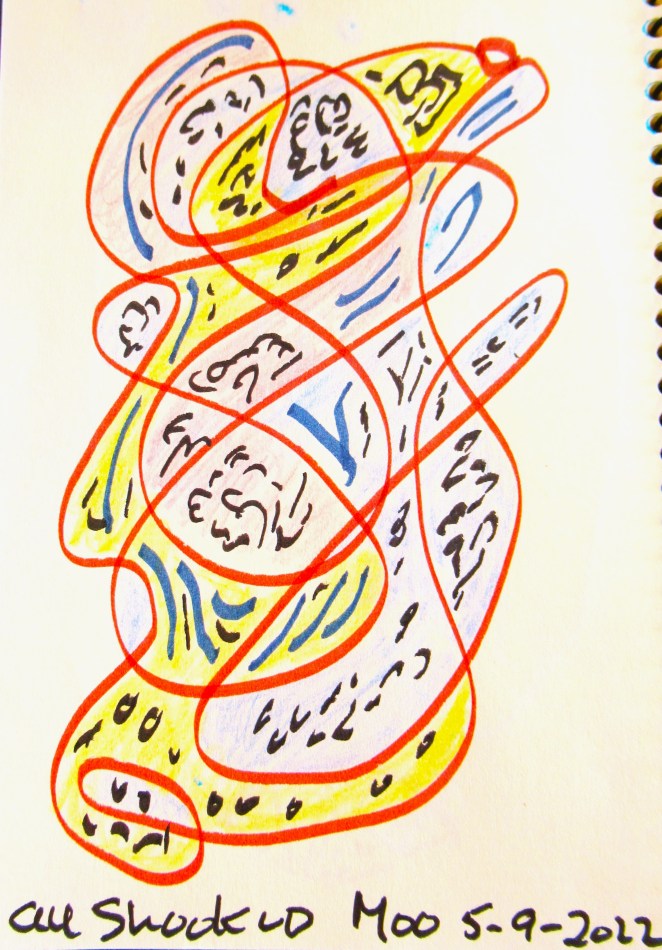
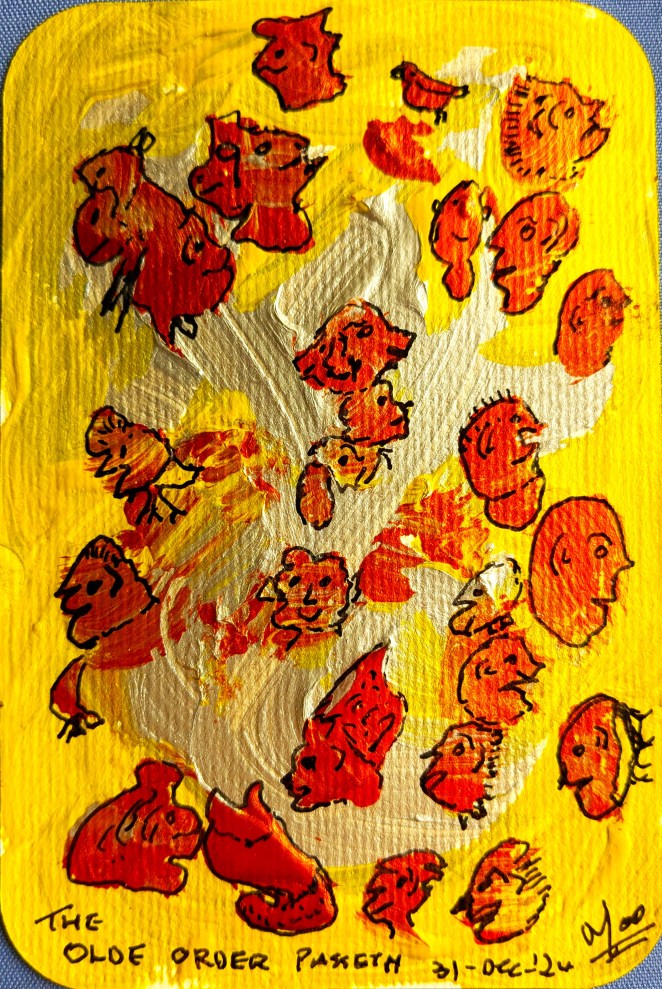
Moo didn’t have a painting of a gorilla driving a bus, so he offered me a painting of the passengers instead. Look carefully – you might even find a portrait of me or you in there. Who knows where Moo goes and who he sees? I certainly don’t. Remember Picasso – he used to run downstairs, out into the street, see a face he liked, and run back upstairs and paint it from memory. I wonder if Moo does the same thing. I’d ask him, but if he doesn’t want to answer the question, he just grunts. And I can imagine him grunting at that one.

Anyway, we all know and recognize the gorillas when we meet them. They are totally unimportant, have a miniscule job to do, but do it with absolute authority and the utmost perfection. Like Gorilla – “Not a penny less, not a penny more, and he polices every penny.” – “he opens and shuts the door, letting passengers on and off the bus, but only at official stops.” – “he punches every ticket with a neat, round hole.” – and probably in the exact same spot of every ticket! – “He never makes mistakes.” – and if he does, it’s the passenger who suffers, because ‘Get on, get off, who ever you may be, I am the lord of the bus,’ says he.

What will happen to us at the end of our shift? I really don’t know. And I don’t think anyone else does, either. Will St. Peter be there to greet us? (I don’t know.) Has the Zoo bus replaced the ferry over the River Styx? (I don’t know.) What will we be asked when we get there? (I don’t know.) How will we answer? (I don’t know.) Is there a little book in which all our deeds, good and bad, are written down? (I don’t know.) Are we to be divided into sheep and goats? (I don’t know.) What will poor monkey do when he is turned into a sheep or a goat? (I don’t know.)

So many questions, deep questions, packed into one small poem. Most of those questions unanswerable. But that’s one of the joys of poetry – to open a poem is to open a tin of calamares – there’s always another something or other left in the corner. Look, over there, bottom left, right at the bottom of the can, I spy with my little eye another question. ‘What is that question?’ you ask. Sorry, mate, I’m afraid I don’t know.

Monkey Turns Down Promotion

Monkey Turns Down Promotion

“I hereby appoint you head of the asylum.”

The young office monkey with the plastic stethoscope
was dressed neatly in a white sheet.

“Dr. Freud, I presume?”
Monkey held out his hand
but his witticism was lost in a flood of water
flowing from the flush and over the floor.

Monkey stood there, paddling in piddle.
Inmates with crowded heads and vacant faces,
fools grinning at a universe of folly,
paddled beside him. He wiped
a sick one’s drool from his sleeve.

The office boy spat on his hands,
slicked down his hair, and placed
his stethoscope on monkey’s heaving chest.

“You have no pulse.”
“How do you know I have no pulse?
Surely, you cannot hear my heart
for you have a banana stuck in your ear.”

“Speak up!” said the doctor,
“I cannot hear you:
I have a banana stuck in my ear.”

Then monkey felt fear.

Daylight diminished
and waters closed over his head.
He spurned the proffered paw,
the life belt thrown
by the offer of a new position.

Exit monkey left,
pursued by a chorus:
“Run, monkey, run!”

Commentary:

A Golden Oldie from Monkey Temple (2010). I came across it by accident as I thumbed through some older books – wow, fifteen years ago that came out. A Golden Oldie indeed. I had forgotten all about Monkey Temple. However, the last couple of days I have watched New Zealand vs Canada and England vs France (Women’s Rugby World Cup). Both semi-finals took place at Ashton gate, Bristol. That’s when I started thinking about Bristol and Bristol Zoo.

We had family in Bristol (Westbury-on-Trym) and from an early age we visited Bristol Zoo. One of my favorite places was the old ruined Monkey Temple, full of monkeys that impressed me with their antics. A small, walled zoo, it was full of innovations and I remember well Alfred the Gorilla and Rosie the Elephant. I loved the rides on Rosie’s back. The camels too offered lifts to young children and the elephants took apples from my hand with their long trunks. I also remember the bear pit, and loved watching the brown bear climb to the top of his pole and catch food thrown to him by the visitors.

I think everybody’s greatest thrill came with feeding time for the seals. What a racket when the attendant appeared with his / her pail of fish and he/she threw them to the waiting seals. Almost as thrilling was the penguin house with its aquarium and glass windows. Animals that seemed so clumsy, waddling on land, turn into sea-angels when they dived and we could meet them, face to face, so to speak, almost in their own environment.

My love of zoos reached out and I recall the zoo in Madrid, established when Columbus returned from his voyages with species of animals hitherto unknown. And who could forget Copo de Nieve, the albino gorilla in Barcelona zoo.

Alas, my zoo day’s are over. But the world is wonderful. Today, two deer entered our front yard, lunched on the fallen crab apples, and went to sleep underneath the trees outside our window. Joy to the world and the world brings me joy -sunrise and sunset, colored clouds, the deer in my yard, a fox passing through. However, I must admit I am not impressed by the little red squirrel that nests under the hood of my car and gnaws my cables. Nor by the porcupine who loves the salt in my garage doors and nibbles at the door frame every chance it gets. The love of nature – red in tooth and claw – I guess we have to enjoy the good and put up with the bad. Life’s like that. “Ask the animals, they will teach you.” Bristol Zoo motto.

Dog Days

Dog Daze

1

A dry storm lays waste the days that dog my mind.
Carnivorous canicular, hydropic, it drinks me dry,
desiccates my dreams, gnaws me into nothingness.

At night a black dog hounds me, sends my head spinning,
makes me chase my own tail, round and round. It snaps at
dreams, shadows, memories that ghost through my mind.

Tarot Cards and Tea Leaves are lost in a Mad Hatter’s
dream of a dormouse in a teapot on an unkempt table.
Hunter home from the hill, I awake to find my house
empty, my body devastated, my future a foretold mess.

Desperate I lap at salt-licks of false hope but
they only increase my thirst and drive me deeper
into thick, black, tumultuous clouds. Dry lightning.
The drought continues and no raindrops fall.

Dog Daze
2

The drought continues and no raindrops fall.
Desperate I lap at salt-licks of false hope but
they only increase my thirst and drive me deeper
into thick, black, tumultuous clouds. Dry lightning.

Tarot Cards and Tea Leaves are lost in a Mad Hatter’s
dream of a dormouse in a teapot on an unkempt table.
Hunter home from the hill, I awake to find my house
empty, my body devastated, my future a foretold mess.

At night a black dog hounds me, sends my head spinning,
makes me chase my own tail, round and round. It snaps at
dreams, shadows, memories that ghost through my mind.

A heat wave lays waste the hopes that dog my days.
Carnivorous canicular, hydropic, it drinks me dry,
desiccates my dreams, gnaws me into nothingness.

Dog Daze
3

The drought continues. No raindrops fall.
No fresh water. None at all.

Dark clouds gather in the sky.
No rain falls. The ground is dry.

Grass all burned. No more hay.
How much livestock will they slay?

No rain comes, but a flash of light
sets the woods and fields alight.

Home from the fields, some farmers confess
their future is an unpredictable mess.

Desperate farmers are losing hope.
Out in the barns, they keep some rope.

The roof beams are sturdy and built high.
One little jump and problems good-bye.

Commentary:

Dog Daze 1 is a reverse sonnet. Instead of being structured 4-4-3-3 it moves in reverse 3-3-4-4. What fun to pretend to be Milton Acorn, and to turn my sonnet upside down. It should rhyme, but I abandoned rhyme in favor of metaphor a long time ago. Was I right to do so? What, if anything, catches you unawares in Dog Daze 1? Does it work for you? What would happen if we turned it upside down? You be the judge.

Dog Daze 2 is more or less the same sonnet returned to its normal stanzaic shape 4-4-3-3. In what ways has the poem now changed? Clearly there is a structural difference. Obviously some of the lines and images have changed. Is the poem stronger? Weaker? Does each one affect you in a different fashion? Do you prefer one version to the other?

Mission Impossible – How many more adaptations can we make to this poem and how would each one affect the poem and the reader’s reception of it? For example – Dog Daze 3 sees our sonnet turned into a poem composed of seven rhyming couplets. Couplets are easy to rhyme. But do they simplify the thoughts too much? Is the poem now too dark? Can you lighten the mood? How? Your mission, should you decide to accept it, is to rewrite the poem in seven non-rhyming couplets. That will make a change from the Daily Sudoku and the Cross-word puzzle. If you do take up the challenge, let me see what you do! And remember, you can make it personal to you, your life, and your garden.

Poisoned Pawn

Poisoned Paw

Openings are so important.
They should be magnets
drawing the opposition in,
but sometimes they’re whirl-pools
dragging you down.

You try to hold your breath,
but you must breathe deep, let go,
go with the flow and prepare for
whatever awaits you in the deep.
Down there, it’s a different world.

Light breaks its black and white bishops,
and the knights walk a forked path
when not pinned down. When you lose
do you mourn for the simplicity of draughts,
or Fox and Hounds or do you strive
to establish, once more, your light in the dark,
down there, where no sun shines.

You are the glow-worm,
glowing where no light glows.
You are the line, the sinker, the hook,
the bait, the temptation that encourages
your opponents to sacrifice their own peace,
 to join you, and together, to swim, or drown.

Commentary:

My family didn’t play much chess. I bought my first chess set when I was ten years old, at Boot’s the Chemist, down by the market, in Swansea. I also bought Harry Golembek’s book The Game of Chess. I still have both the set and the book, seventy years later. Descriptive notation. Absolutely bewildering. I stared at the chart that gave the code names of every square and remained totally confused. I had to look up each square, from its notation, locate it on the chart, then move the piece on my board into the appropriate position. And remember, each side had exactly the same format – QR1, QKt1, QB1, Q1, K1, KB1, KKt1, KR1. Not quite a mirror image as the squares reversed themselves on the other side of the board.

I remember clearly the day that ‘Light broke where no light shone.’ I looked at the maze of numbers, and suddenly the pattern clicked into shape in my mind and I understood the whole idea of descriptive notation. Boundary Knowledge – you cross a boundary after days of bewilderment, and enter a new phase of enlightenment ‘light breaks where no light shines’. When I watched the film, The Poisoned Pawn, I remembered my own learning days in chess. Great fun, that particular opening. Do we take the poisoned pawn, or do we leave it? I will leave you to decide. But remember, it’s not called the poisoned pawn for nothing, damned if you do and damned if you don’t!

I used descriptive notation throughout my school days. I had one particular friend in boarding school who also played chess. We slept in the same dormitory, two beds apart. After lights out, no talking, no reading. Prefects prowled at night to enforce the rules. After lights out, one of us would call out ‘P-K4’ and thus the game started. We weren’t exactly talking, so it wasn’t easy to catch us. Every night, we played the game in our heads. A great memory trainer. Occasionally we managed to finish a game – not often – we were both too wary of Fool’s Mate and the simple early traps! Each day, during one of the school breaks, we would restart the game of the night before, from memory, and then play it to its end. We very rarely forgot the moves we had made and we virtually never disagreed on the board position.

This was totally unlike chess with my family. The grown-ups would all gather round the board. Their object was to distract me, to move pieces when I wasn’t looking, to remove (MY) pieces and leave me in a desperate situation. “‘Knock, knock!’ ‘Who’s that at the door? Go and look.” And off I would go to return to a battlefield that had totally changed its shape and mood. I would carefully reconstruct it, piece by piece, square by square. But I have never forgotten the black looks, the accusations of cheating, the fury of the old ones being beaten by the younger generation. In the end, nobody within the family would play me, unless I gave them a handicap by removing a rook or one of the bishops.

I didn’t discover algebraic notation until I lived first in France, and then in Spain. Algebraic notation. Each of the 64 squares had its own letter and number and, as a result, there was no way to confuse the position of the pieces. Staunton chess sets in England became a variety of different piece shapes on the continent and I often lost games when I forgot that the pawn had one circle, the bishop two, and the queen three, but they all looked like. Many a time I gave up a bishop thinking it was a pawn – oh that poisoned pawn again.

Now, in my dotage, I play chess against the computer. I haven’t played a live opponent for years. But I do have a chess book collection and I have played Fisher’s best games, and Fisher vs Spassky, and I have studied the Russians and how they play and think – very differently from me. And so, in my old age, I sit at the chessboard of my life, and I move the pieces here and there, and remember old friends, and how we shifted across the shifting boards of our days. So many pieces have dropped from life’s chessboard, but a few of us are left, and we move more slowly, but we wander on and on.

PS Moo, sometimes slow in understanding, offered me several paintings that suggested the aftermath of the Poisoned Prawn. When I explained the basics of chess to him, he said he didn’t have a chess painting he could recommend, so he suggested this painting – the correct way to teach. ‘You can’t teach chess,’ I said, ‘it is so instinctive.’ I took one look at the right way to teach and loved it. Here we go The Right Way to Teach! X – WRONG!

Hair Cut

Hair Cut 

Curly locks, wisps of grey and silver,
curve around my ears, cuddle my collar.
I stand in the bathroom, look at my scissors,
glance in the mirror, and start to hack.

I turn my head swiftly from side to side,
watching white hair falling, like snow.

“All done!” I look at myself in the mirror:
hair shorter, still sticking out in clumps,
but some curls still tickle and cling.

Not bad for front and sides. I still
can’t see the back, but if feels fine.
“Right” I say. “I’m ready for the show.”

What show? The one where I sit before
the computer screen and admire myself
before I click in the code, type the password,
and join the virtual meeting that today,
in the pandemic, passes for face to face.

Commentary:

Face to Face – Moo helped me with this one by allowing me to have one of his ‘face to face’ paintings. Thank you, Moo. Sorry I said you weren’t too bright yesterday. And we both got the singer of All Shook Up wrong – it was Tommy Steele of course. Also, as you explained to me, you may not be great at adding two and two and making four, and you may be unenlightened with words, but wow, when you add a colour or two to the palette you are enlightened and enlightening and dazzle people with the lightness of your enlightenment. There – hope we can be friends again now. I would miss your paintings if you withdrew your services.

And this is a Golden Oldie. In 2020, when Covid walked with us, I started cutting my own hair – hacking might be a better word – and I have continued to do so ever since. In fact, I have only been to the barber’s three times since 2020. Each time, the hair lay so thickly upon the floor behind the barber’s chair that we walked knee deep in the white stuff. Great fun. How the young lady made fun of me. Right down the middle of the back of my head she found a large mullet that I couldn’t reach with either hand. She found that so funny. Asked me if I wanted to keep it. Of course, I said no!

I remember those face to face on the computer days. At least we couldn’t catch Covid from an image talking back to us on a screen. I always find those online meetings so difficult and awkward. I love the awkwardness of that word – awkward. The facilitator always began with – ‘Now, let’s all introduce ourselves.’ What on earth do you say on such occasions. ‘Easy,’ Moo told me. ‘I always say “Hi. I’m Moo. I’m a painter.” Nobody bothers me after that. Once somebody asked me what I painted and when I replied ‘houses’, everyone lost interest and the facilitator moved on.’

I always get tongue-tied and can never manage to be coherent. In fact, I am neither coherent nor cohesive and I often fall apart. “Hi! I’m Roger. I’m a writer.” This always opens the doors and the windows to all sorts of questions. ‘What do you write?’ ‘Have you published anything?’ ‘What’s your latest work?’ Of course, if I had any sense – and often I have less sense than Moo – when someone asks me ‘What do you write?’ I should reply. ‘English.’ Or ‘Italics.’ Or ‘Greeting cards.’ That last would be as much of a show stopper as Moo’s response – ‘houses’! Of course, I could get really inventive and say ‘Bilingual jokes for Christmas Crackers.’ Another pet peeve – have you noticed how the French and the English don’t match up? I could have a great old rant about that one. But don’t let’s talk about Fortune Cookies!

And suddenly, we have strayed a log way from the act of getting our hair cut during Covid. But, like many diversions, the journey is often more important than the destination, especially if we are amusing ourselves! And I hope you had some fun and took some joy from my words.

Time Flies

Time Flies

… bends like a boomerang,
flies too rapidly away,
limps back to the hand.

Endless this shuffle of unmarked
days dropping off the calendar.

Hands stop on the clock.
The pendulum swings:
time and tide stand still,
do not move.

The print in my grandma’s house:
seemingly moving seas,
sails swelled out,
the ship stays firm in its frame.

‘As idle as a painted ship
upon a painted ocean.’

Our garden fills
with brightly colored birds
and red and grey squirrels.

Light and dark
switch back and forth
each day
a twin of the day before.

The TV screen hangs out
the daily washing.
Tired, worn out shadow,
their faces boring us
with shallow wit
and hand-me-down wisdom.

Time:
an albatross around the neck,
an emu, an ostrich, a dodo,
an overweight bumble bee,
too clumsy, too heavy to fly.

“Time flies?”
“You can’t.
They fly too fast.”

Commentary:

My friend Moo told me he was ‘all shook up’ when I read him this poem. I don’t think Moo’s too smart. He thought All Shook Up was written by the Rolling Stones when they went out moss gathering during the Fredericton Harvest Festival, but I said no, it was definitely written by Buddy Holly on an off-day when he was playing cricket. It wasn’t okay in those days to play croquet.

The last three lines come from an examination question in the General Paper, “S” Level, as it used to be. “Punctuate this sentence – time flies you can’t they fly too fast” – of course, they should have said, “in exactly the same way we want you to. Corrections and alternative versions will not be accepted.” What did they think I was? A mind-reader? I wasn’t. I was a teenager having a field day in the national examinations. I would love to have been a fly on the wall when they marked my paper.

In the biology exam, they gave each one of us a Brussel Sprout and asked us to draw it and tell us as much as we could about it. Of course, I ate mine, and I said it tasted a little bit dry and needed some salt. Then I drew a mess of potage, all yellow and green with chewed up squiggles, and added “That’s what the sprout probably looks like right now.” I failed that exam too. Didn’t even get a part mark for ingenuity, though the science teacher said I could have a glow of satisfaction. Very useful after lights out in a boarding school, I can tell you.

I can’t remember if Moo went to that school with me or not. I don’t think he did. I think he drifted into my life a little bit later. He wasn’t a painter at that stage, just a half-starved philosopher doomed to live in a garret. Of course, once he started painting houses, he made money. It’s amazing how many people will pay you for painting their houses. Of course, that was before they invented plastic siding.

About now you realize that I live in a strange world all of my own and a lot of people live in it with me. You, too, if you enjoyed reading this. Long may the ‘strange world of me, you, and Moo’ continue. I’d send you a penny for your thoughts, but they have gone out of circulation. I can’t even sing you a song of sixpence these days either. Silver sixpences have walked the dodo path too.

On reste ici

On reste ici

The double meaning
troubles my brain,
tugs heart strings,
sings a violin strain
or strums a throbbing
double-bass tightly
enclosed in my chest.

Rest, reste: here
we will remain and rest.
I like the sound of it.

Outside my window,
the mountain ash weeps
red autumn tears.
Robins flock, grow tipsy
feasting on its berries.
Ici on reste.

You and I, now,
and here we will remain
until, at last, in peace,
we will rest.

Commentary:

I live in a functionally bilingual province in a legally bilingual country. Yet I am consistently told that poems should contain only one language and should not wander between two (or more) of them.

This always reminds of the old joke – “I know what CBC Radio means, but what do the initials EC mean in ici [EC] Radio Canada?” This draws attention to one of my pet hates – the translators who translate for our politicians as they transfer their thoughts from one language to another. Suddenly, without warning, the husky-voiced male prime minister starts speaking French and his deep voice immediately changes into the high-pitched feminine interpreter’s alto. Most disconcerting. I flick back and forth between channels to catch those politicians in both languages. Alas, they rarely deliver the same message in both languages as the nuances and emotions change. Listen carefully and you’ll see (or hear) what I mean.

And so it is with poetry. I love the play on English – rest (to rest or to stay) and French rester (to stay or remain). Why shouldn’t I use that type of play in my poetry? It lends infinite shades of meaning and emotion to the verse. Ah well, the jury’s out. But don’t put foreign words (NB in Canada, French is NOT a foreign language) in your poems. You won’t get published and you won’t win any competitions, even if you do explain what the words mean. And remember, T. S. Eliot didn’t translate the foreign words he used in his Four Quartets. And he wasn’t a bad poet!

Things


Things

I fumble in my mind for things
long lost in an upper attic.
I can no longer read the words
I wrote. What does this mean?

At night I dream of things
beyond my reach. My fingers
clutch but cannot clasp
those clouds that clutter.

Who, oh who, the owl cries,
can free the mice that nibble
through my mind and set me
gnawing at my own soul?

Once upon a time, a long
time ago, I thought I saw light
at the end of the tunnel.
I travelled on a ghost train.

The light I saw was a gaslight
ghosting my mind with fictional
fantasies of an illusive kingdom
that would never be mine.

Elusive, these memories of things
that never were, but might have been.
Will o’ the wisps dancing shadows
on the salt-marsh of my unknown life.

Commentary:
Memory loss. I guess it happens to all of us at one time or another. One of my long-lost friends visited yesterday and between us we could hardly put two consecutive memories together. Every other sentence was punctuated with a pause – ‘Now, when did that happen?’ ‘What was his name? I can’t remember now.’ ‘Me neither.’

I am not particularly worried by such happenings. I am a poet and a story-teller. Sometimes, I forget the truth – so what? – I just go ahead and reinvent it, tickling it here, sticking a spot of paint there, adding a word or two, or a magic moment. I often remind myself of Oscar Wilde when he created a magic moment of verbal ingenuity – “I wish I had said that, Oscar.” “You will, Roger, you will.”

Best of all, even in those moments when personal memories fail me, literary magic returns. I think of Dylan Thomas and his words spring to my mind – ‘time has ticked a heaven round the stars’. Wonderful. Or Francisco de Quevedo ‘soy un fué, y un será, y un es cansado.’ / ‘Tired I was, tired I am, tired I always will be.’ My own translation from the summer of 1963 when José Manuel Blecua introduced me to the poem, or rather Blecua introduced the poem to me, in that summer’s courses of the UIMP.

So, according to this theory, even when you feel lost, you are never really lost, because there are an enormous number of people living inside your head, who who will step out from the shadows, when needed, and give your memory a little boost. But don’t get too carried away. Think too of José María Valverde and his poetic premonition: ‘Pobres poetas de hoy, destinados a ser polvo seco de tesis doctoral.’ / ‘Poor poets of today, destined to be the dry dust of doctoral theses.’ (My translation).

Dust to dust and ashes to ashes – ‘Serán ceniza, pero tendrá sentido. Polvo serán, pero polvo enamorado.’ Quevedo, of course. But you didn’t need me to tell you that. You might need me to help you with the translation, though – ‘Ashes they’ll be, but ashes with feeling. They will be dust, but dust that burns with love.’ (My translation, with a little bit of exaggeration [sorry, don Francisco!] just at the end.)

This Vessel in which I Sail

This Vessel in which I Sail

Trapped in this fragile vessel, with the pandemic
a passenger waiting to board, I drift from port to port,
looking for a haven, safe, to have and to hold me.

No harbour will let me dock. “No room at this inn,”
they say. “No haven here.” They wave me away.

Now I have no destination. Aimless, I float and every
where I go the message is: “No vacancy: no room at all.”

Unwanted, abandoned, I wander with wind and waves,
my only friends seals, porpoises, and whales.
I walk the whale road, leaving a frail, white wake behind.

This vessel has become a gulag now, a prison
camp where I exist just to survive. Each hour of each day
endless, boundless, like this shadowy, haunted sea.

Today there is no motion, no goal. What is there to achieve
but survival? Each day’s journey is sufficient unto itself.

Commentary:

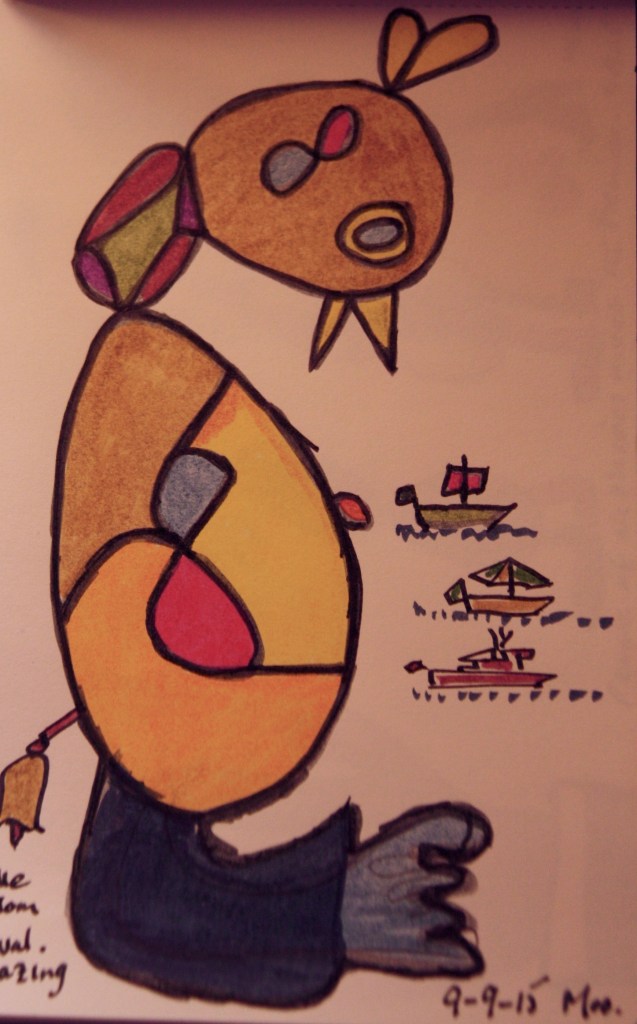
Moo’s cartoon, Naval Gazing, dates from 2015. That year I spent eight weeks in Moncton at the Georges Dumont, gazing at my navel while waiting for my anti-cancer radiation treatment. Naval gazing / navel gazing, indeed. Good one, guys. You make a great pairing.

The poem dates from 2020 when Covid stalked the streets and we wore masks when we were not confined to our houses. I thought of the tour ships, wandering the seas, with the disease on board, and no port wanting them. It was a strange time.

Golden Oldies, then, both poem and painting. There are signs, small at present, but still visible, that such days are on their way back. We must each ask the question – What is there to achieve but survival? Hopefully we will come up with a similar answer – Each day’s journey is sufficient unto itself. Journey well and journey safely, my friends.

Hello again – our old friend is back!

Hello again – our old friend is back!

Co-[vidi]-s
17 March 2020

I saw time change with the clocks
and my body clock
is no longer in sync
with the tick-tock chime
that denounces each hour.

Hours that used to wound
now threaten to kill.
They used to limp along,
but now they just rush by
and I, who used to run
from point to point,
now shuffle a step at a time.

Around us, the Covidis
thrives and flowers.
Wallflowers, violets,
we shrink into our homes,
board up the windows,
refuse to open doors.
We communicate by phone,
e-mail, messenger, Skype.

Give us enough rope
and we’ll survive a little while,
fearful, full of anguish,
yet also filled with hope.

Comment:

A Golden Oldie, written on 17 March 2020, St. Patrick’s Day.

Only yesterday, I read that Covid is back once more, in a new and mutated shape. Masking is once again demanded in the local Horizon hospitals especially in areas where patients and the public gather. I lost a couple of good friends to Covid last time round. I hope I don’t lose any in this new session. Guess I’ll be continuing to get my vaccinations and keep them up to date.

Whoever is reading this, I wish you all the best. May you stay Covid and illness free. May you also enjoy a long and happy life with sunshine days – and enough rain to keep the forests cool, the trees happy, the flowers flourish, and the wildfires at bay.