What things give you energy?

Daily writing prompt
What things give you energy?

What things give you energy?

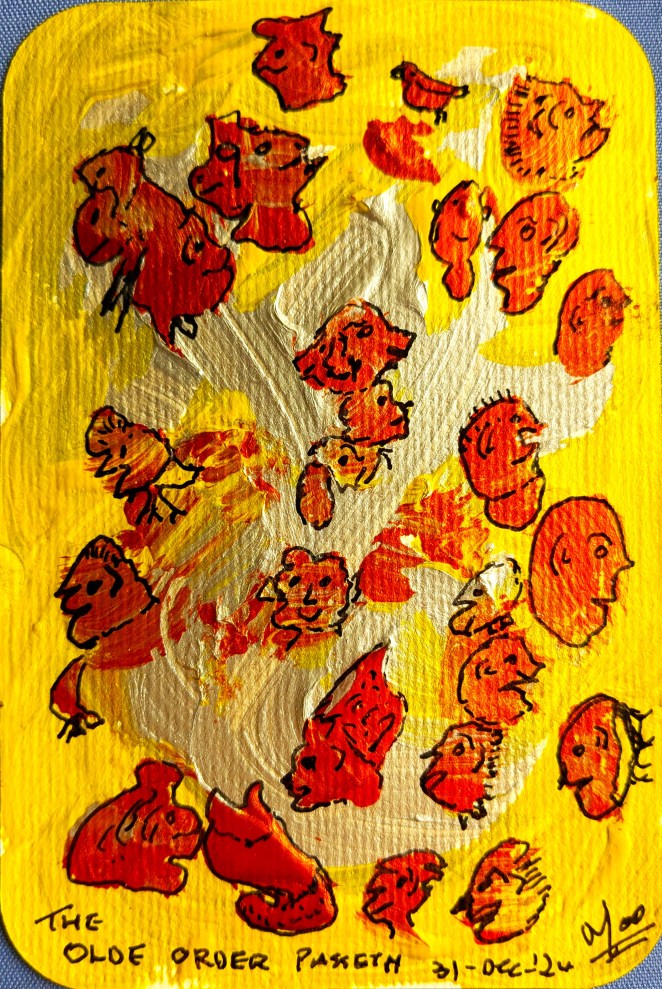
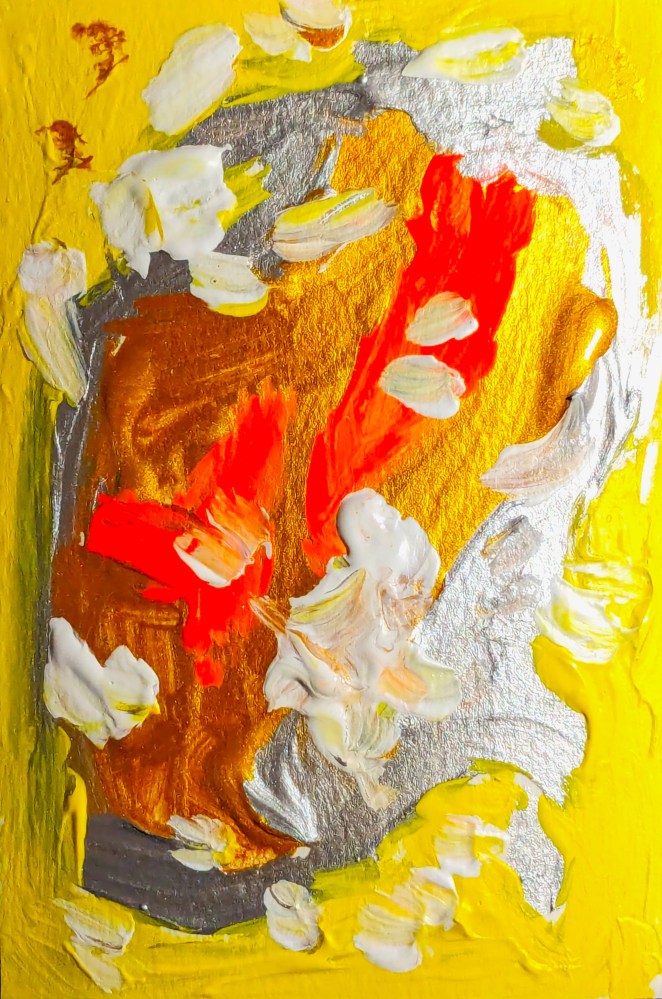
What on earth do you mean by energy? And why should energy be associated with things? For example, today’s painting (above) is by my friend Moo. He calls it Joy to the World. It is indeed a joyous painting, full of light and creative energy. The photo does not do justice to the painting, which sparkles and reaches out to draw the viewer in. We must never underestimate the energy that comes from the creativity and art that creative people put into their art works. It is like bread cast upon the waters – it will return tenfold. The world would be a sad place if we lost our powers of creativity and invention. May we always keep them close by us, and turn to them when the skies are grey – for with our ingenuity and skills we can always turn those grey skies blue again. It just takes time, trust, belief, creativity, and a little bit of energy.

Or is the prompt referring to the energy that comes from food? Vonnegut refers to such energy as comes from the breakfast of champions. Was that really Scott’s Porridge Oats? Certainly used to be – and all those caterwauling bagpipes puffing out their oaten tunes. More foods, please. Cornish Hens and Kedgeree, unzipped bananas, eggs – preferably fresh and free range – boiled, poached, scrambled, fried, or served in various types of omelets … energy from food – oh, I could go on and on and on … caws wedi pobi, cennin a tatwystortilla espanola, paella de mariscos, calamares en su tintachapulines from Oaxaca … food as a source of energy … wow! And who said the foods had to be written in English?

Mind you, an alternate source of energy is the current news cycle. When not a storm in a tea-cup, sugared or un-sugared, it is ferocious and opinionated enough to set people banging their heads against the walls so the pain will come from an alternate source. And noise demands energy – energy in (and also garbage) and energy out (mainly garbage), and all that rage, fury, wind, despair, blather, generated by written, printed, spoken, televised, radio borne waves of noise. We could start a wind farm if we trapped the blatherings of congress, the senate, the houses of parliament.

Meanwhile, we live in a large house, almost a barn really. Some of our friends call it our hacienda. They are the ones who speak no Spanish and can’t pronounce Quevedo correctly, even though I’ve known them for a quarter of a century. Actually, strictly speaking, most of them are ex-friends now. Many went AWOL when I retired and the rest disappeared, fates unknown, during Covid.

That house has an electric furnace that warms us in winter and circulates cool air, in summer, from the basement (cool) to the upstairs bedrooms (warm). We also have a fireplace insert that burns wood. But we only use that in emergencies (power loss during cold weather or storms) or for decoration (the yule log) at Christmas and over the New Year.

A large house means large heating bills. About ten years ago, we installed a wonderful heat pump that serves the whole house. It heats in winter and cools in summer. It also halves (or more) our electricity bills. Most of the house functions on electricity, hydro-electricity from the dam at Mactaquac, just up the road. No coal-fired furnaces for our electric supply. We do, however, have the ability to connect to a petrol-driven generator. But we rarely, if ever use it and that, too, is for emergency use only.

Otherwise, many of the things we use on a daily basis – computers, cell phones – can be battery driven (when the power fails) and those batteries can be charged in the car (during emergencies) or from reserved chargers hidden away. The car itself is a normal gas engine – nothing special – as is the snow blower. We do not use solar power – nor wind power – but we do have candle power and our fireplace insert can be used for heating food and boiling water.

So there, as a challenge to your lack of clarity, you have a clear account of my many sources of different types of energy. Oh, and don’t forget, I am energized by earing your prompts apart and chomping them into tiny pieces.

Comment – revised, Sunday, 22 September 2024.

What would your life be like without music?

Daily writing prompt
What would your life be like without music?

What would your life be like without music?

Very quiet.

I consulted Moo, my favorite artist, on this one and he said that the above answer was much too brief and slightly cynical.
“Look,” he said to me, “this is today’s painting. It’s called Walking on Air.”
“Walking on air?” I queried.
“Yup,” he replied – “I hear music, but there’s no one there.” Then he told me to listen quietly to his painting. And I did. But nothing happened.
“I can’t hear a thing,” I told him.
“How many people do you see inside the painting?” he asked.
“About four,” I replied. “A girl with long red hair, a little girl with a little curl, right in the middle of her forehead, an old man, all hunched up, running away from something, and someone on the left hand-side, at the bottom, but I’m not sure what they’re doing.”
“Idiot,” he said to me. “Open your mind, not just your eyes. Look again. Now what do you see?”
“The same people, and there may be a couple more. How many people do you see, Moo?” “None. That’s why I hear music, because there’s no one there.”
“You’re having me on, aren’t you? You’re pulling my leg? You’re taking the…”
“Easy now,” he grinned maliciously, ” you don’t want your next word to be taken and used in evidence against you, do you? Now, look out of the window. What do you see?”
“I see blossoms…”
“But the trees are bare,” he smiled. “Do you toss and turn in your bed at night?”
“I do. And I’ve gone and lost my appetite.”
“I bet those stars shining in the skies last night, will be shining in your eyes tonight.”
“My golly, Moo, I think they might be. You know, you are a genius.”
“I am indeed. But I usually travel incognito. And listen…”
“Wow. I hear someone singing softly, and the voice is coming from the painting… but…”
“I know. There’s no one there.”

How quiet would my life be without music? As quiet as it would be without art, poetry, a sense of humor, friends who laugh with me, not at me, and people like you, who read this, and don’t think that I am totally insane. Oh yes, and if there was no music in my life, there would be no Great Starts to the Day, and no Poems for the End of Time.

What’s your favorite word?

Daily writing prompt
What’s your favorite word?

What’s your favorite word?
Seems like a daft question to me. Just one word?

Llanfairpwllgwyngylldrawbwlchllantisilioggogogoch – how’s that for a single word? And what’s wrong with married ones anyway. Or should I go for something like – home, health, morning (good or bad), night, how? -as in How! And what about the vast quantity of expletives that are found in so many languages? Many of them are single words, although many others are found in fertile and creative compound structures.

Of course, wrth gwrs, we are thinking of how many single words in how many languages? Or are we? I personally think that phrases might be more important than single words. Thank you becomes gracias (in Spanish) or te / se lo agradezco (more formally). It changes to merci (in French) or merci bien, or merci beaucoup, or grand merci, or merci mille fois, or je vous remercie. Then, in Welsh it becomes diolch, though many prefer diolch yn fawr.

Mind you, when living in Mexico, especially in some of the more isolated villages where food and water are not always the cleanest, bathroom may be a key word. Quick is also an important one. Put them together and you get bathroom quick! Help is also very useful when travelling alone and lost. As is Please! Por favor, in Spanish – two words of course!

Single words, in isolation, can be very dangerous. Especially when using a second language that one doesn’t dominate. Examples of embarrassing mistakes are multiple in the language-learning text-books. Speaking of which, it is interesting how infrequently they offer phrases like “Where is the bathroom?” or “I need the toilet. Now.” Alas, they also avoid the inevitable consequences like – “Too late!” “Sorry!” “Where is the nearest dry cleaners?”

A funny thing, language. And other people’s languages are equally funny. By funny, I mean weird, strange, and unpredictable, especially without a sharp cultural knowledge to permit the speaker to actually understand what he or she wants to say and how to phrase it correctly. Simple example – embarazada, in Spanish, does not mean embarrassed, it means pregnant. You would be surprised at how many young ladies, learning Spanish in Spain, have amazed their hosts and teachers by the simple announcement, often in class, that ‘estoy embarazada’‘I am pregnant’ – and I have seen the looks of amazement adorning the sympathetic faces of the families gathered round the table or the looks on the faces of the classes being so addressed.

So, a little knowledge is a dangerous thing. I can think of very few words, single words, that I would use on their own. But I can think of many, many phrases, most short, that I would be happy to use, and many more that I would avoid at all costs. As the students in the lower grades of Spanish used to say – “Buenas Nachos” and “I only want to be able to ask for a beer.” “Can’t we watch the Smurfs?” Have you ever tried to understand humor in another language, another culture? It is one of the hardest things to master, especially when it depends on the double-meaning of words, words which, all too often, only have one meaning in the pocket dictionaries people carry around with them. Caveat emptor. Buyer beware. And tread carefully, for you may not know just whose toes you are treading on, nor why, nor how they will react – the people, not the toes. Dangerous things those pronouns.

On the other hand, we can always go religious and turn to the Bible for advice. There we find “Faith, hope, and charity, and the greatest of these is charity.” So. Problem solved. I have found my one word – Charity. That said, I do like the painting Moo offered me for this prompt. He calls it Hope. And remember, you can’t go wrong with any of those three words – Faith, Hope, and Charity. Tolle lege. Amen.

Where did your name come from?

Daily writing prompt
Where did your name come from?

Where did your name come from?
That seems to be a strange sort of question. First of all, what do you mean by ‘your name’? My surname (or family name), my Christian name, my second name, my nick-name? I have already answered that particular question – to find out, click on this link – What’s the story behind your nickname?

As for my surname, well, that came from my father, and his came from his father, and his came from his father – and so on, ad infinitum. If we go back to the original chicken and egg theory, then we find out that, according to Wikipedia, Moore (pronounced mʊər or mɔːr/ is a common English-language surname. It was the 19th most common surname in Ireland in 1901 with 15,417 members. It is the 34th most common surname in Australia, 32nd most common in England, and was the 16th most common surname in the United States in 2000. It can have several meanings and derivations, as it appeared as a surname long before written language had developed in most of the population, resulting in a variety of spellings. Variations of the name can appear as MooreMore or Moor; as well as the Scottish Gaelic originations MuirMure and Mor/Mór; the Manx Gaelic origination Moar; the Irish originations O’More and Ó Mórdha; and the later Irish variants O’Moore and de Mora. The name also arises as an anglicisation of the Welsh epithet Mawr meaning great or large.

So, where did my surname, Moore, come from? Well, you tell me. Because Wikipedia didn’t exactly give me a perfect location for its origin.

As for Roger – well, here we go again. Wikipedia says the following – Roger is a masculine given name, and a surname. The given name is derived from the Old French personal names Roger and Rogier. These names are of Germanic origin, derived from the elements hrōdχrōþi (“fame”, “renown”, “honour”) and gārgēr (“spear”, “lance”) (Hrōþigēraz). The name was introduced into England by the Normans. In Normandy, the Frankish name had been reinforced by the Old Norse cognate Hróðgeirr. The name introduced into England replaced the Old English cognate HroðgarRoger became a very common given name during the Middle Ages. A variant form of the given name Roger that is closer to the name’s origin is Rodger. So there you are. Or you could blame my father and mother, or the gentleman who dipped me in the baptismal font and baptized me with that name. Personally, I cannot remember a thing about it.

Of course – wrth gwrs – me being a creative writer with a sense of humor and a parentage that was also creative, my name might have been drawn out of a hat, or found in a Christmas Cracker, or suggested by the slip of paper inside a Fortune Cookie, or discovered in a bottle left by that ubiquitous Welsh or Irish or French or Scottish or English milkman, Moore the Milk. I only know that I am one of the few people I have ever met blessed with that name. Alas, I never met my namesake – Roger Moore aka James Bond aka .007 [respect that dot, it comes from Rudyard Kipling!] – although I have been gifted with those names and that number by several of my acquaintances.

What profession do you admire most and why?

Daily writing prompt
What profession do you admire most and why?

What profession do you admire most and why?

Why admire a profession? I used to admire the fire-fighters when I was in Spain. Then I discovered that a small group of them were setting fires deliberately so that they could get double pay and danger money extinguishing the fires they had set. I used to admire politicians. Then I discovered that they weren’t always honest, had their hands in other people’s pockets, used their positions to entrench and enrich themselves, and pulled all sorts of tricks to stay in power. I used to admire priests. Then I started reading horror stories of child abuse, abuse of power, negligence of priestly duties. And these things aren’t new. In The Book of Good Love, (Spain, 1330-1343) written by Juan Ruiz, the Archpriest of Hita details how the celibate priests were ordered in a letter from the pope of the time to give up the ladies with whom they were living (and with whom they had children) to return to a life of celibacy. All fictitious, of course, but also based on a truthful reality, as was the Seller of Papal Bulls (as described in Lazarillo de Tormes – Spain 1554, and published anonymously because of its anti-clerical content).

I hope, with that short selection of potential professional felonies, I have made my point. In brief, to admire the ideal of a profession is one thing. But to admire the unprofessional conduct of certain individuals who ruin the reputation of their own profession is something else entirely.

Therefore, I would propose that we change the title of this prompt from What profession do you admire most and why?, to What professional do you admire most, and why? Now the question can be answered with ease. I most admire those professionals whose profession is a vocation. They do their jobs out of love and not just for money. They are dedicated individuals who put their profession and the people they serve before their own home comforts, wants and desires.

Such unsung heroes abound. The baker who gets u at 4:00 am, arrives at the bakery at 5:00 am, bakes, prepares, and wraps the goods, until 8:00 am when the customers arrive and the shop opens. This is done at minimum wage, autumn, winter, spring, and in the summer when the heat warnings go out and the bakery is a living hell, what with the ovens and the heat dome outside. The teacher whose work does not end in the classroom, but starts outside, when class has ended, and the students really need the TLC that comes from a teacher who puts them before his/her office schedule of 30 minutes student time a week. The general practitioner who does not retire at age 55 to bask in the sun on a Caribbean Island, but who continues his work, until at age 80, he can tend his flock of patients no more, and who then retires with grace, heartfelt thanks, and love from a job well done.

These are my heroes. These are the professionals that I most admire. Not the profession, but the person who performs that profession with skill, hope, love, commitment, and a dedication that reaches out to embrace that specific professional world, whatever it is, and the people who share it.

Scour the news for an entirely uninteresting story. Consider how it connects to your life. Write about that.

Daily writing prompt
Scour the news for an entirely uninteresting story. Consider how it connects to your life. Write about that.

Scour the news for an entirely uninteresting story. Consider how it connects to your life. Write about that.

Scour the news – what on earth does that mean? Let’s begin with scour – If you scour something such as a place or a book, you make a thorough search of it to try to find what you are looking for. Rescue crews had scoured an area of 30 square miles. Synonyms: search, hunt, comb, ransack. Search, hunt, scour, ransack – well? Which one are you after? And how long have I got? Question: what am I looking for? Answer: an entirely uninteresting story. What a tremendous waste of my time. And, when you get to my age, time is precious.

As for the news, well, what on earth do you mean by that? I speak several languages fluently. Am I looking for an entirely uninteresting piece of news in all of them? As one of the Two Ronnies used to say “You’re having me on, aren’t you? You’re having me on.” Let’s just stick to one language – English. Then let us ponder for a moment the meaning of the news. How many newspapers do you wish me to purchase and peruse? I am not a millionaire, you know. Or do you want me to listen to the news on the radio or the television? If so, how many channels? How about sending me online? I love the thought of that. There are thousands of websites out there filled with all kinds of news, good bad, indifferent, fake, artificial? And you want me to scour them all in search of, and I quote “an entirely uninteresting story”! Pull the other one, as the old comedians used to say, ‘”it’s got bells on”.

I’ll tell you what I’ll do. I’ll scour your prompt, that’s what I’ll do. Having given it a brief analysis, I declare it entirely uninteresting. Next I’ll consider how it links to my life. Well, sorry, it doesn’t. If I were to follow it through, I’d be sitting here for hours, wearing my fingers out on the keyboard. So, what’s the link between your prompt and my life? A total waste of time, that’s what. Sorry, I have better things to do with my life. Like reading Shakespeare – “Friends, Romans, Countrymen, and prompt readers, lend me your shovels. I come to bury this prompt, not to praise it.”

Here endeth the lesson and the prompt.

If you were going to open up a shop, what would you sell?

Daily writing prompt
If you were going to open up a shop, what would you sell?

If you were going to open up a shop, what would you sell?

That is a very hard question to answer. I think of all the material things that everyone else can think of, but I do not want to sell commonplace things – antique furniture, paintings, books, stamps, groceries – I could go on and on, but I will resist the temptation to do so.

When I lived in Santander, Spain, the local wines were sometimes called ‘sol embotellado‘ / bottled sunshine. I wouldn’t want to open a wine shop, but I would love to bottle the essence of a warm sunny summer day and – why should I sell it? I wouldn’t. I would give it away, free of charge, to all the needy people, inner city boys and girls, the impoverished, those who live in the streets and sleep in doorways or under bridges at night. Oh the joy and happiness that would come when they opened their bottle of summer sunshine and felt the warm fresh air gather around them so they could breathe it in.

But why stop there? I would also give away ‘essence of butterflies’, that special feeling that comes on the colored wings of a butterfly and combines with the joy of flowers and the gift of taking flight. How special that would be. But sell it? It is much too valuable to sell. Put a dollar, Euro, yen, rupee, or sterling price upon it, and all its powers would vanish, like fairy dreams fading away.

Fairy dreams – yes, I would offer them as well to those who needed them. And not the sort that fade away, but those fairy dreams that suspend us in the wondrous beauty of their ethereal light. And I would bottle hope, and self-belief, and the power to change oneself from what one is to what one is destined to be. And I would add essence of self-knowledge and powder of Davey Lamp light that would enable the seekers to seek in the darkest corners of their souls and find that elusive inner self, and bring it out from the darkness. And I would stock fragrant filaments of firefly that would also allow my customers to enlighten that darkest of nights, the dark night of the soul. And a map of hidden foot paths that would allow the wanderer to wander and never get lost.

How about an elixir of happiness and joy? A quintessence of rainbows, perhaps? Or a magic lantern that would shine out from heart and eyes and enlighten the soul friends of those lucky souls who were able to locate and enter my shop of conditioners, vital vitamins, and soul magic for all those lost and lonely people. And there, that mirror on the wall – look in it, gaze deep into your own eyes, and maybe, just maybe, you will find my shop.

And “What will your shop be called?”, you ask. Look into your heart and you may find the answer engraved therein. It will be called The Gift Shop of Hope Restored. I look forward to welcoming you when you open the door and step in.

What’s the most money you’ve ever spent on a meal? Was it worth it?

Daily writing prompt
What’s the most money you’ve ever spent on a meal? Was it worth it?

What’s the most money you’ve ever spent on a meal? Was it worth it?

The real question is not, how much money did you spend, but was the meal worth it! Think hamburgers – they can vary in price from a couple of dollars to twenty or thirty dollars, each. Is a good hamburger at $2.00 worth more than a rotten hamburger at $20.00? Of course it is. However, if you get a rotten hamburger at $2.00, even those dollars seem to be a waste of money, in the stomach pains of post-gobbling regret.

The same question and answer can be applied to most things – a sweater, a suit of clothes, a dress, a diamond ring… What we are really talking about is value for money. One of the best meals I have ever eaten was at a small restaurant outside the railway station in Lisbon. I arrived early for the overnight train to Madrid, checked my luggage in the left-luggage office, and walked down the road to this wonderful restaurant. I had plenty of time.

When I arrived a plate of hors d’oeuvres appeared before. These were meant to be snacked on before I placed my order. I asked for the menu of the day and chose pork tenderloin cutlets, with patatas bravas (hot spicy fried potatoes). After this came a small omelet, with fines herbes, French style, and this was followed by a lettuce, tomato, onion salad, in an oil and vinegar dressing. A fresh loaf of bread accompanied the meal and red wine was served throughout. Dessert was half a melon, hollowed out, filled with ice cream and soaked in cherry brandy. Afterwards, came a cigar (I smoked occasionally in those days), and a glass of brandy, with espresso coffee. It was simply delicious. How do you valley such a meal? I asked for the bill and reached for my traveler’s cheques (these were indeed the old days, before the ubiquitous credit card). I was ready to pay what the waiter demanded.

When the bill came, I couldn’t believe my eyes – $25, $50, $75, $100? No such luck. $4.50 and $5.00 with the tip added on. I didn’t need my traveler’s cheques. I pulled my wallet out and gave the waiter the equivalent of $10. What a wonderful meal. Totally unforgettable.

I have eaten in five star restaurants, in Michelin recommended restaurants, in restaurants owned by the friends of friends, and I have been ripped off, left right, and centre / center – whichever way you want to spell it. I have often found that the simple restaurants, with home cooking, and a simple menu were better than the over-rated, highly expensive, glitzy showpieces.

In Santander, we used to regularly visit a small restaurant that specialized in fish. The owners had their own fishing boat. They would net fish at sea, but line fish on the way back to port, genuine trawling, the old-fashioned way. The fish they caught was fresh, unbruised from the nets, and, at their restaurant, always cooked simply and well. Family and friends, we all shared the bounty of the sea. And the prices were low, while the quality and love was high.

Discourse Analysis – look at the question. Think about the words and ask what they mean. Search beyond them (and the simple answer) for the true values by which you wish to live your life. Do you crave the $100 cigar, or the free one delivered to your table after a wonderful meal? The $100 sauces that cover up the taste of the rancid meat or fish, or the simplicity of family food, hand picked and as fresh as fresh can be?

Oh yes – and I remember waiting two hours for my meal at one restaurant, a tiny one in a small community in Northern Spain, that nestled by a fish-filled stream. The trout, fried with bacon, were on special. The owner’s son had been sent to the stream to catch them, but they were slow to bite that day. The wine and tapas were free until the meal arrived. And arrive it did, dripping wet and still wriggling slightly. Twelve delicious trout, four each between the three of us. Who’s for fast food? Not me. I want the simple life – shared with friends and filled with love – any day of the week, no matter the cost. But when you look well and seek wisely, it will not cost that much – and it will be unforgettable.

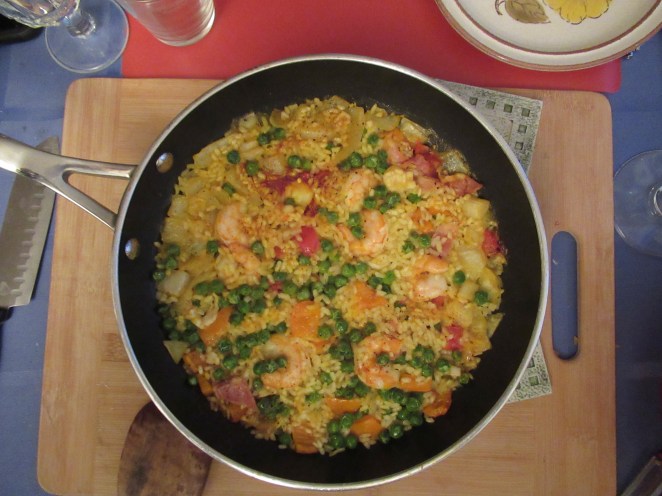
And look at the paella I made for my beloved and I – in the photo above -. Warm for supper and cold for lunch the next day. Simple, relatively quick, and four round meals (they really weren’t square) served at about $2.oo a plate. Unbeatable. Unforgettable.

What are you curious about?

Daily writing prompt
What are you curious about?

What are you curious about?

I am curious about how you generate prompts for people to write about. Do you put words in a hat and pull them out? Or do you examine a multitude of Christmas crackers to see what words of wisdom are contained within them? As for me, I am curious about Olde Curiosity Shoppes and the curious things that one finds in them.

I am also curious about aliens. There are so many of them. At night, they often invade my brain and stamp around causing enormous damage up there. I think they think the own the place, throwing parties at two in the morning and chanting things that shouldn’t be chanted. They embarrass me. Even worse they sometimes shame me. You should hear the things they say and sing. Snippets of old rugby songs and limericks that never even saw the shores of the Emerald Isle. Sometimes, next day, they are still partying, and those little snippets go earwigging their way on and on.

What’s worse, they speak several languages and I hear them chanting in Latin, French, English, Spanish, Catalan, Italian, Galician, and even in Welsh. As for the Welsh, it rolls on and on – ar hyd a nos – in fact they sing until Harry is hoarse. I looked in the mirror one morning, and I saw a whole crowd of them waving their tentacles like multiple octopi and chanting yma o hyd. And yes, indeed, they were still there. They weren’t going anywhere. They followed me around all day.

Another thing about which I am curious – how do I de-alienate the aliens who have alienated me from my old peaceful world of curiosity shops? “Ho-ho-ho-ho-ho, tell me if you know, who the, why the, where the, what the, where do aliens go?”

And if you happen to be curious about what makes me tick, well, I have a long arm and a short one, just like a grandfather clock, and a key in the middle of my back with which you can wind me up and set me off on any topic, however curious it may be. Just light the blue paper and retire.

Do you still sleep in your childhood bedroom?

Do you still sleep in your childhood bedroom?

Good question. A better one might have been – “Did you have your own bedroom as a child?” The answer is “No, I didn’t. Not that I can remember.” As a war baby, I was moved around quite a bit in my childhood. I remember sleeping in three different bedrooms in our first house. Then we moved in with my maternal grandparents, and I slept in three more bedrooms, often in the same bed with one or other of the grandparents, sometimes on a makeshift bed on the floor. Later, or it may be around the same time, those early childhood memories are so hazy, I went to live with my parental grandparents – three more bedrooms there – same conditions. The family also had a bungalow close to the beach on the Gower peninsula. It had three bedrooms and I slept in all of them, under similar conditions, and seldom alone, until my later years.

I was bundled off to boarding school while I was still a child. Two dormitories at the first boarding school. I was between six and eight years old, and the memories of that school are not sharp, though I recall with total clarity the canings and the shaming of myself and the other young children. It was a religious school. And I need say no more on that subject.

My second boarding school , a preparatory school, saw me inhabiting four dormitories that I can remember. My clearest memory of that place is running away one night, only to be brought kicking and screaming back to the place. Both my parents worked. During the holidays, I was shipped around to various members of the family – aunts, uncles, and grandparents. When I left that school, for the last time, age eleven, my grandparents drove me to my new forever home in a city far from my birthday place. There, three bedrooms witnessed my sleeping habits.

My third boarding school, the Junior School of a larger college, provided me with two dormitories, one per year while I was there. This was the time at which I started to travel with my mother during the vacations. A coach tour on the continent once saw us visiting six countries in two weeks, and that wasn’t the only coach tur I did with her. A succession of hotel bedrooms, then, and no nocturnal stability at all.

I stayed in my fourth boarding school, the Senior School of that Junior School, for five years and received a new dormitory each year. From there I went to study in Paris – more bedrooms – then down to Spain for the summer courses at the International University in Santander, but by now, age eighteen, my childhood was over.

So, a quick count shows that I slept in at least twenty-five bedrooms during my child. And that’s without counting holiday hotels, flats, apartments, and other forms of lodgings, including Youth Hostels.

So, remind me – what was the question? Ah yes, I remember now. “Do You still sleep in your childhood bedroom?” Well, my friends and readers, the answer is a very loud “NO!” Think about it – how could I have? I am not sure that I even had a childhood bedroom!