Reading the poem aloud, I changed some of the word order to the rhythm of my speaking voice. It’s reading before an audience and hearing their reaction that tells me when a poem is right or needs retouching. Alas, those live readings are gone for now. Anchor, Spotify, Facebook, Twitter, and this blog are good, but not quite the same. But, for a rhythm and voice poet, who loves live readings and welcomes a live audience, they are better than that midnight silence under dark trees.
Searching for what exactly? For the exact word, le mot juste, the word that sums it all up, catches the essence of the thing and holds it in the mind forever.
Le mot juste? Think color. Think color blind. Think blind. Think of the world we see reduced to grey scale. Think of the seven colors that stripe the rainbow sky, each with a unique name: it seems so easy, so simple.
But the world has changed. Think now of the computer, its screen more accurate than the human eye and color coordinated by a million or more tiny little pixels that multiply the seven rainbow colors by a million or two and every color numbered beyond the recognition point of the human eye: le mot juste reduced to precision of number.
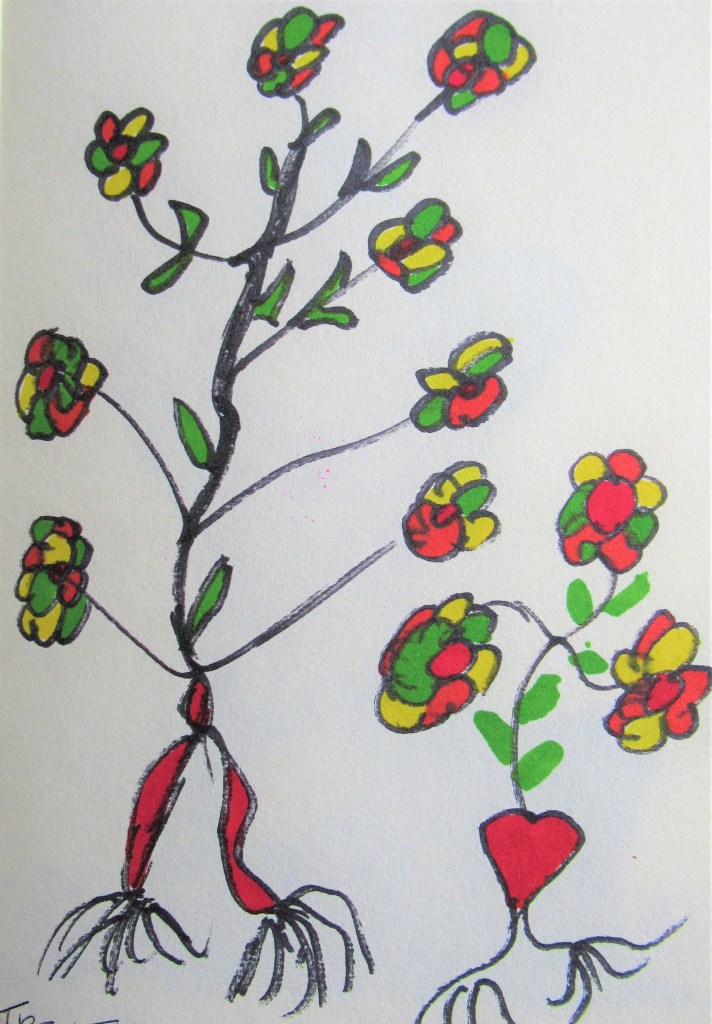
Think flowers. Think scent. Think of the limited ways we describe the smell of things.
I look across the breakfast table and see my wife of fifty years, a teenager reborn, walking into the café where we first met. I search my memory and my mind for the words to describe that beauty, that surge of excitement, but I cannot find les mots justes.
They are not as inanimate as you might suspect. This is where I found them this morning. [up] This is where they started out last night. [down] Don’t ask me, I know nothing about it.
This from the days when I was a wannabe artist who thought he could actually be an artist. But no, it was not to be and the masks fell off and dropped to the ground. There was no Covid back then, so I didn’t have to pick them up and put them back on again. And I didn’t have to stay two metres – six -feet – away from the painting. If you paint with the Devil, you need a long brush. Also known s a Devil’s Paint Brush.
To paint or not to paint, that is the question. So, I chose the path of mindfulness, la escondida senda por donde han ido los pocos sabios que en el mundo han sido / the hidden path along which have walked the few wise men who have lived in the world. And yes, art, in all its forms, is mindfulness, being in yourself, being aware of the moment, being taken up by that split second when paint hits paper, canvas, or whatever, and being absorbed totally in that.
Gardening will do that for you. Also what I call hyperspace, that wonderful world between fingertips, and screen where the great ideas flow naturally, like paint, and words come tumbling out onto the page. Today’s theme: The Great Pretender. Not all the words are wonderful, nor all the ideas great. The greatest skill is to be able to differentiate between gems and dross. This comes with patience and practice. But when the words flow, and the paint settles, there are few joys like it.
Those that have been chosen to survive have walked indoors, Now they are safe behind glass, in the warm, low sunshine that floods the rooms. We watch the sun’s fingers starting to reach into the deepest corners and know that winter is on its way.
Thanksgiving has come and gone yet we still give thanks: indoor flowers to brighten the dark days, flu shots tomorrow, blood tests on Friday. I guess it’s a case of ‘last man standing’!
Orion confirms this. He has risen in the night sky and now accompanies me on my journey through the dark hours, sword at belt, faithful dog at heel. Yes. Winter is on its way. Warmer clothing. Thicker jerseys. Non-slip shoes. Oh the joys of Canada.
Remember: there is no such thing as bad weather, only inadequate clothing. Locked out of the university, walking the picket lines at -35C, we learned the facts of outdoor winter life only too well. So, dress warmly. Keep safe. Keep your distance. Wear those masks. Did out your snow tires. Tune up the snow blower.
And may you always wake with the flowers in the house.
How could one not give thanks for the bounties of Thanksgiving? Listening to Cross Country Check Up, last night, as I have done for the last 55 years, I was amazed at how people, some of them in dire circumstances, were able to find things for which to be thankful. I haven’t made a list of the things for which I am thankful and I certainly didn’t call in to the talk show to give my opinion, but let me think…
I am thankful for the beauty of the natural world. Just look at that sunrise! Yesterday we walked in Mactaquac and admired the beauty of the changing leaves. Migrating geese put on a display, taking off from the waters of the head pond, flying, then settling down again. We: I am grateful for the presence of my beloved, still beside me after all these years. I am grateful that we are together and that we are both of us able to walk and indulge in this province’s autumnal beauties.
I am grateful for faithful friends. I will not name them all. If I did, this blog would never be finished. This morning, an e-mail from Geoff Slater, whose paintings and drawings have often appeared on the blog, spoke of the nature of ritual and how we use it. He spoke of external rituals and how, during times like these, when our normal lives are upside down, we lose the ability to follow our external rituals. This may cause dismay and a loss of stability to many. However, he also reminded me that we, as practicing artists, have established our own internal rituals. These keep us going in the difficult times, for they are always there to fall back on. Following his line of thought, I explored my own daily rituals, the ones that have kept me going throughout Covid-19. Thank you, Geoff, for those ideas and for your long-term friendship.
I am grateful for the initial offer, from the University of Toronto, to come to Canada to study all those years ago. Canada gave me a chance to challenge my established rituals and to build and shape new ones that were more suitable to my inner being, a being that I had kept well hidden from the Masters of the Universe who limited my creativity, and ruled the rituals of my Boarding schools and my undergraduate studies. Above all, I am grateful for that rich, inner world of creativity and dream and I am doubly grateful for those who have allowed me and encouraged me to express it and set it down for others to share.
So, Thanksgiving Day: a day on which to give thanks for all the blessings that are in our lives, large and small. Sure, times are tough. Sure, we could all do with more money. Sure, we could go on and on about our wants and needs. But today my want and my need is to give thanks for who, what, where, when and why I am. As my friend Norman Levine once wrote: Canada Made Me.
“The only difference between a madman and me is that I am not mad,” Salvador Dali. It is a great honor to borrow his words and to be able to make the same declaration: the only difference between a madman and me is that I am not mad.
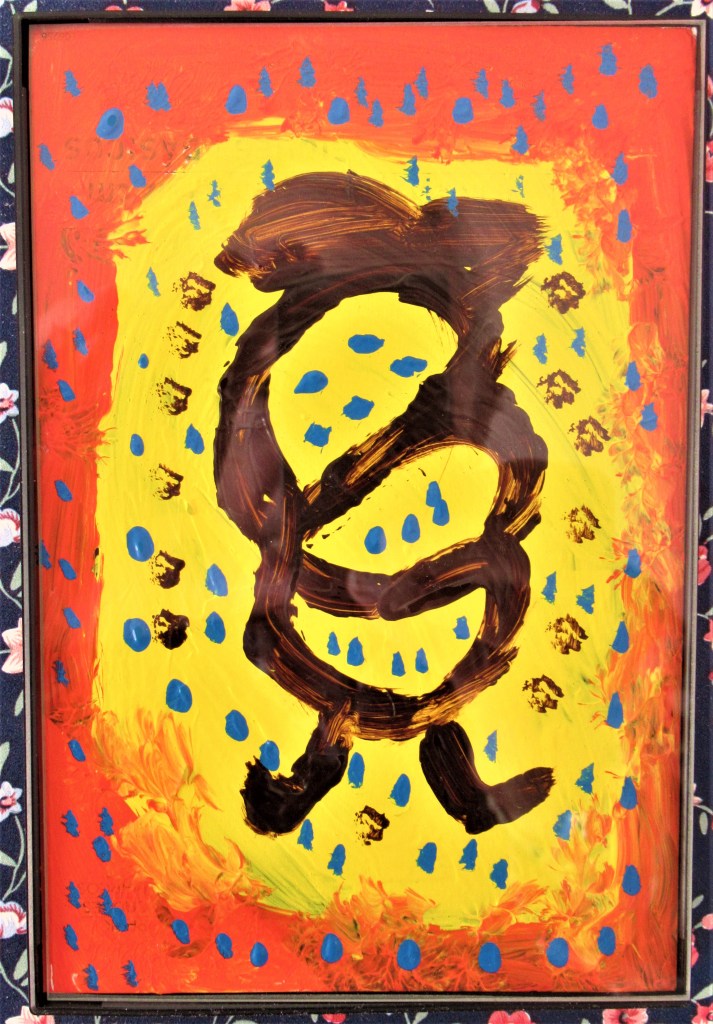
Mikhail Bakhtin: carnival, the world turned upside down, the world going bananas and those bananas dancing, as you can see in the painting above. It is a mad moment frozen in the still time of paint. And why shouldn’t bananas dance? Some one out there will remember Thunder Bay, 1981: ‘you just have to go bananas’ and the bananas duly appeared at half time instead of the oranges. Saint John, 1985: same thing.
And now the dancing bananas have emerged once more to fill your minds with pleasure and your hearts with joy. Go, bananas, go. Bananas-a-go-go. Way to go, bananas. And I tell you, given the current state of society, going bananas is the only way to go. So, in the next election, I shall form the Banana Party and we can all stand firmly, shoulder to shoulder and shout “Oh, Mighty Banana!” and “Go, Bananas!”
Ah yes, and my next painting? Maybe it will be Banana Custard or Banana Splits, not that I have ever done the splits!
So, the writing is back. I have reformatted The Nature of Art and the Art of Nature and am now checking it through one last time before I send it to the publishers. This feels good. I haven’t stopped painting though. Luckily the original, hanging on the wall, looks better than the photo. My angles are all wrong and the colours are definitely not as sharp as in the original. As I always said, when introducing Spanish Art via slides and photos: “Do not trust the imitations. Go back to the original.” Easier said than done, especially when the original may be tucked away in a foreign museum hidden in a small town. As Dylan Thomas once said of Swansea Museum: “it’s the sort of museum that ought to be in a museum.”
As for the Introduction of Art, and please note I do not write ‘the teaching of art’, here’s my article on my career as an art facilitator! ‘In the beginning was the picture and the picture was in the book.’ I guess my art career ran parallel to my career as a facilitator of Spanish literature, prose, theatre, and poetry. Some things you can present and introduce. But no, you cannot teach them, not unless you are completely without humility and understanding.
This is a painting inspired by one of Messiaen’s works: Visions from Beyond. His music inspired me to write the Meditations on Messiaen, and I have posted several of those poems on this page. For me, creativity is continuous: verbal and visual. The visual includes painting and photography, the verbal, short stories, poems, and short philosophical pieces on life and art. This is the link to the first poem from the sequence entitled Visions from Beyond. I should add that the audio reading is part of what I call creativity too: audio, visual, verbal. The complete package.
My Thursday thought: I feel that I have been blessed. To be able to see, speak, write, hear, and express some of the beauty of this world around me. I know there is ugliness out there, sickness, ill health, poverty and despair. So far, I have been spared. “Why me?” I think to myself, “Why me?” Then I cease to question and I just say “Thank you” to the Spiritus Mundi and to the Muse when she descends.
Every morning, when I wake, my mind runs through some of the hymns I used to sing as a child. “Songs of praises, I will ever give to Thee.” “Laud, bless, and praise Him all thy days, for it is seemly so to do.” “Good Shepherd may I sing Thy praise, within Thy house forever.” Meanwhile, until that time comes, I will do my best to celebrate and sing the beauties of this world in the oh-so-limited ways I know best, poetry and paint!
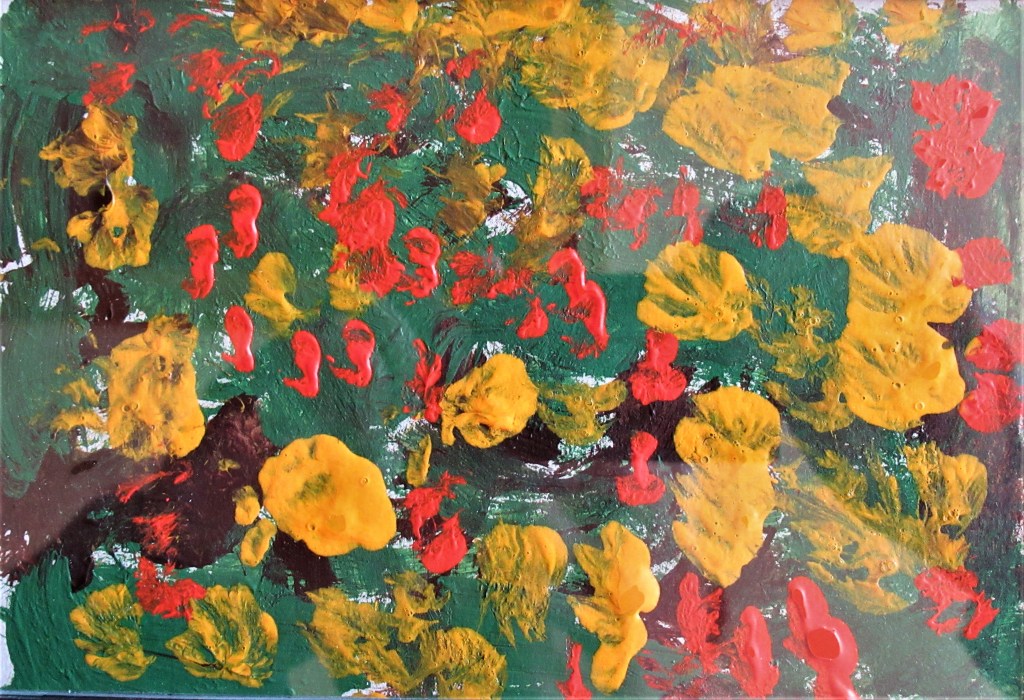
One of my good friends always greets me with the following phrase: “Still on the green side of the grass, then”. So, here’s my painting: Stay on the Green Side. Much better than the other side, from all that I am told by my more down-to-earth companions. I will not intrude upon the thoughts of some of my other friends, nor expose their beliefs. I’ll paint for them another day.
So, while you can, and while you may, Stay on the Green Side, my friends. Wake up each morning, smell the coffee, and gather ye rosebuds while ye may!