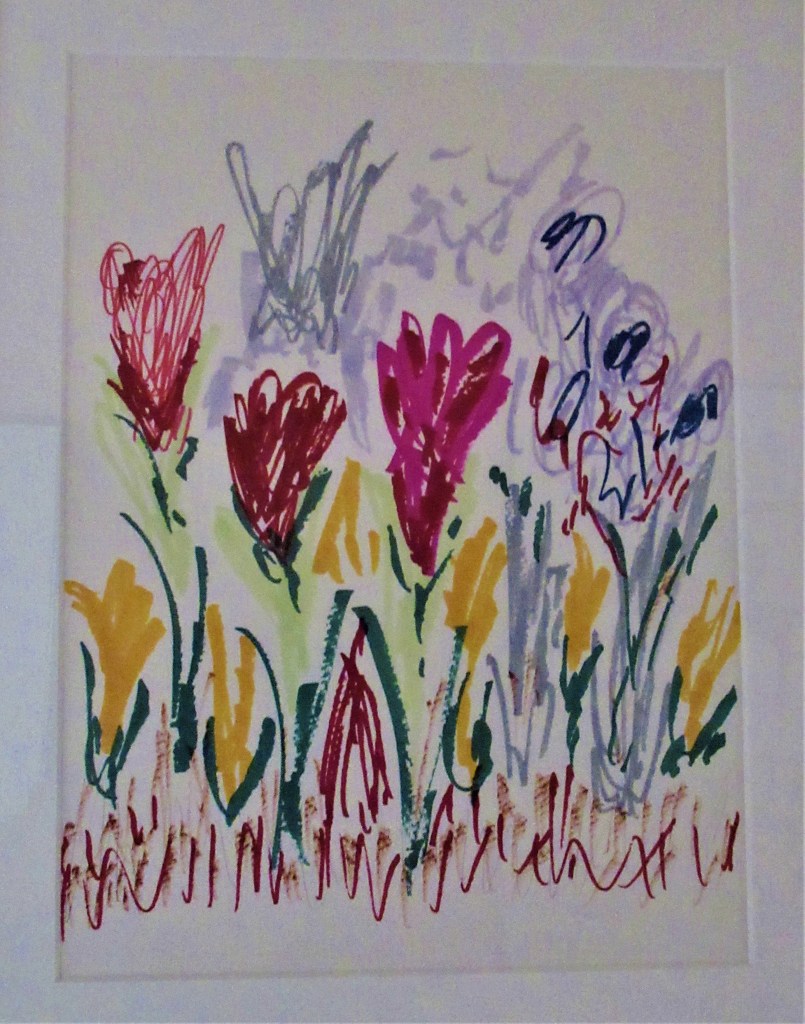
Duermeivela: that time when the waker dreams he is waking, yet is still asleep. His mind wanders through a labyrinth of old memories, streets and squares, myths and legends. It is a mythical time of great creativity. To wake up from it is to be filled with hiraeth: a longing for all that is lost and can never be recaptured.
Daydreams
The alarm clock shuffles its pack of sleeping hours: a clicking of claws, needles knitting outwards towards dawn’s guillotine.
A knife edge this keening wind sharpening my bones tingling fingers and toes.
Ageing eyes refurbished in the morning’s sky fire. Ravishing rainbows dazzling the eyelash of day.
Old myths grow legs. They wander away to gather in quiet corners, where the wind weaves dry leaves into endless figures of eight.
An old man now, I dream of white rabbits, running down tunnels, escaping the hunter’s hands.
When my dreams break up, they back into a cul-de-sac: a wilderness of harsh black scars.
Scalpels, my finger nails, carving red slashes on white-washed walls, trenchant shadows, twisted dancers, old warrior kings bent into pipe wire shapes.
Light in dark bright yellow stridence shrill golden dog’s bark to warn off death’s wolves that freeze her blood
she dreaded night’s unease the devil’s wintry anti-spring life’s darkest sparks
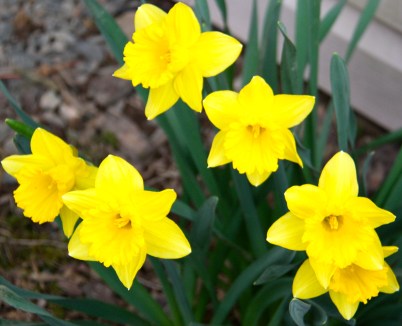
but loved the daffodils’ sunny March cadence of brief piercing dance
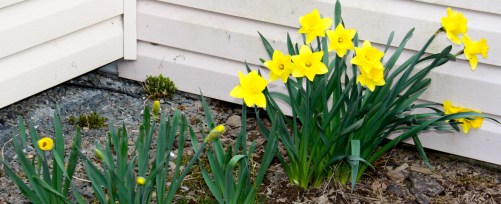
Comment: A Golden Oldie. My mother loved daffodils and planted them all over the garden in Cardiff, Wales. They are the national flower of Wales and break into blossom just in time to welcome St. David on St. David’s Day, soon to be upon us, Dydd Dewi Sant.
Daffodils A poem for the lady who brought some to us when Clare fell
Daffodils in our garden, last year in Island View. We won’t see the live ones until May, at the earliest. I dream of them at night, tossing their heads in sprightly dance’, in Roath Park and Blackweir Gardens, Cardiff. They will be out now, all ready to welcome Dydd Dewi Sant on March 1.
Daffodils
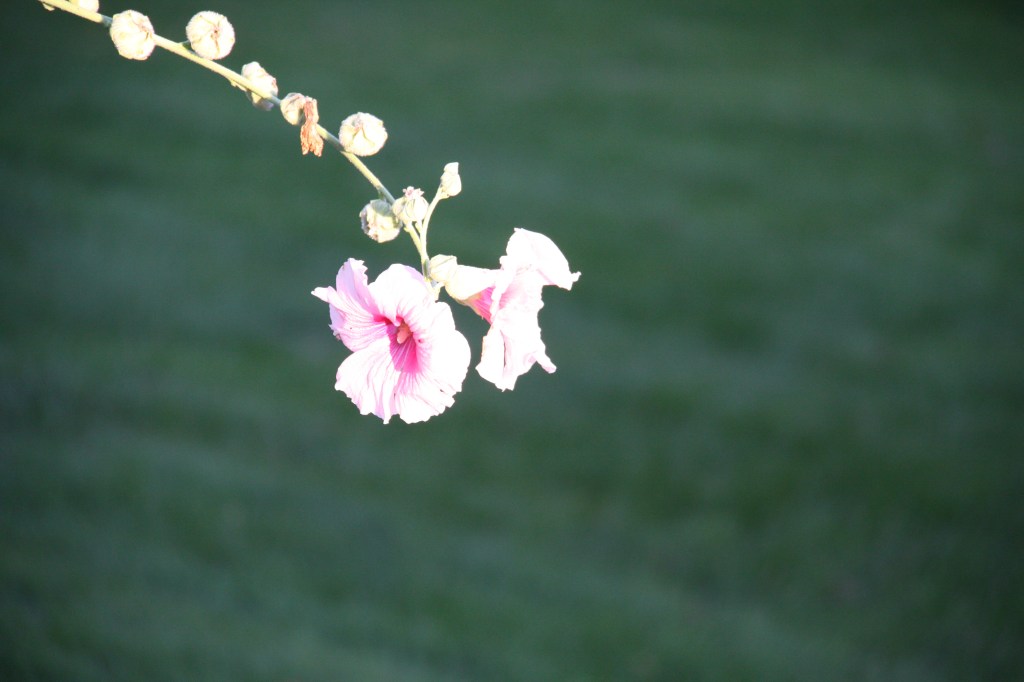
For ten long days the daffodils endured, bringing to vase and breakfast- table stored up sunshine and the silky softness of their golden gift.
Their scent grew stronger as they gathered strength from the sugar we placed in their water, but now they have withered and their day’s done.
Dry and shriveled they stand paper- thin and brown, crisp to the touch. They hang their heads: oncoming death weighs them down.
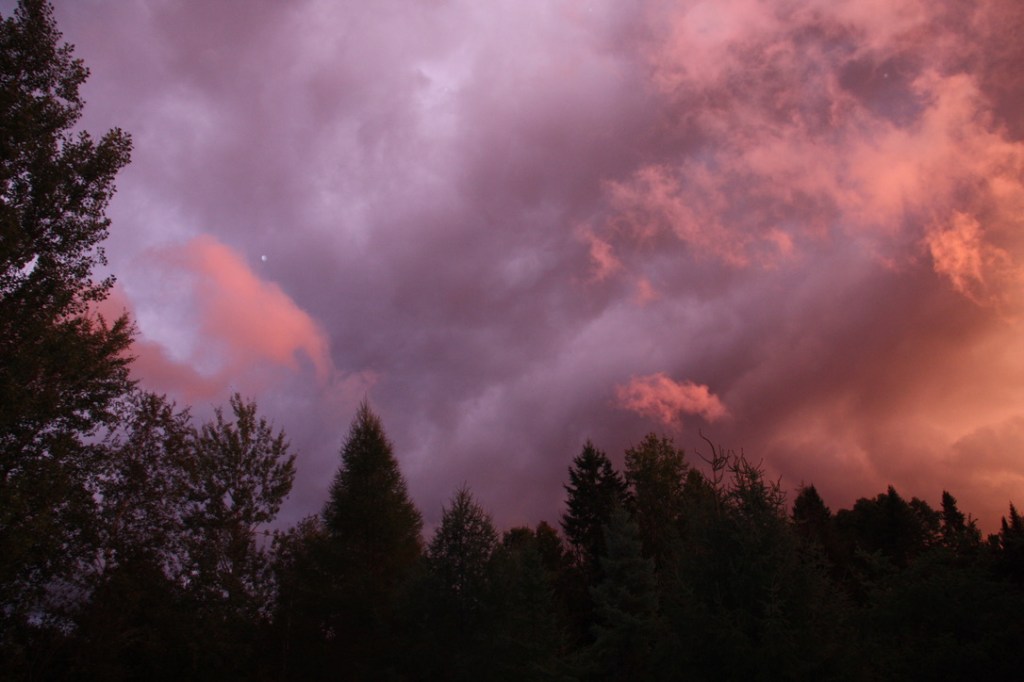
Sunset at Ste. Luce. We wait for the choir to arrive. Take a deep breath: it will soon be here.
Angel Choir (on seeing the Northern Lights at Ste. Luce-sur-mer) Sonnet
Listen to the choristers with their red and green voices. Light’s counterpoint flowering across this unexpected son et lumière, we tremble with the sky fire’s crackle and roar.
Once upon another time, twinned with our heavenly wings, we surely flew to those great heights and hovered in wonderment. Now, wingless, our earthbound feet are rooted to the concrete. If only our hearts could sprout new wings and soar upwards together.
The moon’s phosphorescent wake swims shimmering before us. The lighthouse’s finger tingles up and down our spines. Our bodies flow fire and blood till we crave light, and yet more light. We fall silent, overwhelmed by the celestial response.
When the lights go out, hearts and souls are left empty. Leaving the divine presence is a gut-wrenching misery. Abandoned, hurt and grieving, we are left in darkness.
Comment: The Spanish mystics, St. John of the Cross, and St. Teresa of Avila, wrote, in the sixteenth-century, about the ‘dark night of the soul’. That dark night also arrives when the communion with the spiritual finishes and the communicants are left alone, in their loneliness, abandoned to their earthly selves. To leave the divine presence is a heart-breaking, gut-wrenching misery. To turn from the marvels of nature can produce lesser, but still deeply moving feelings of grief and sadness. The secret is to preserve that joy and to carry it with us always, warm, in our hearts. Doing so makes the pain of separation much more bearable.
from an original painting by Rogier van der Weyden (1399/1400-1464)
Black Angel
You cannot hide when the black angel comes and knocks on your door.
“Wait a minute,” you say, “While I change my clothes and comb my hair.”
But she is there before you, in the clothes closet, pulling your arm. You move to the bathroom to brush your teeth.
“Now,” says the angel. Your eyes mist over.
You know you are there, but you can no longer see your reflection in the mirror.
Comment:
I first saw the Black Angel in Aldebarán’s cultural store in Ávila (2006). She sat there, in the shop window, along with several other angels, and I worshiped her from the distance of the street. Her image was taken from an original painting from Rogier van der Weyden (1399/1400-1464). This was turned into a 3-D image and then converted into the statue I saw in the shop window.
I brought the statue back to Island View, placed it on the shelf above the fireplace, where it still rests, and wrote several poems on the theme of Angels. I gathered them together in a chapbook entitled All About Angels that I self-published in Fredericton in 2009. The chapbook was dedicated to Clare’s great-aunt, D. E. Witcombe who departed this world on October 15, 2008.
All About Angels was also based on a book of a similar title, Sobre los Ángeles, written by Rafael Albertí, one of the major poets of Spain’s Generation of 1927. I avoided the ambiguity of the Spanish title — Sobre (in Spanish) can mean Above or Beyond as well as About — by limiting my own title to All About Angels.
For Carl Jung, angels are the messengers sent to inform people of the state of their world. For me, they are also the wild creatures that inhabit the world around me and often take the form of chickadees, crows, mourning doves, woodpeckers, deer, foxes, chipmunks, the occasional bear, and other spiritual creatures. They can be best seen in those moments of solitude when we are most open to the natural world around us. Then, and sometimes only then, we can hear the urgent messages they bring.
Where e’er she treads, the glossy flowers shall rise and light, like the light of flowers, will pierce any gloom and brighten the room.
Silence
When I wait for words to come and they refuse, I know that silence is golden and spreads its early morning sunlight across the breakfast table where yellow butter melts on hot toast.
Light from the rose window in Chartres once spread its spectrum over my hands and I bathed in its speckled glow.
My fingers stretched out before me and I was speechless, for in such glory, mortal things like words cease to flow.
So much can never be said even if it is sensed: fresh coffee, poutine à pain, bread baking, flowers bursting into bloom, the sense of immanent beauty that fills me each time my beloved enters the room.
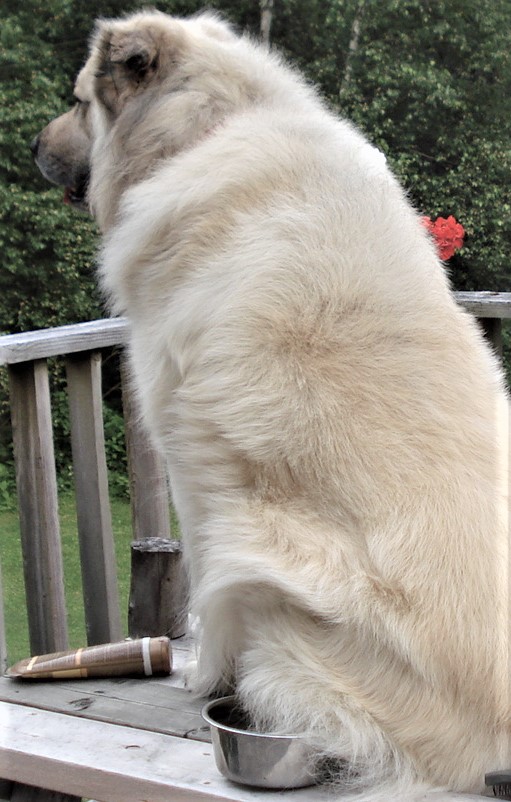
Tigger blowing his coat in Spring and waiting on the picnic table for his daily grooming. Some days I am convinced he is still out there, waiting for me.
What’s in a name? At the Farmer’s Market there are fourteen puppies in a cardboard box. One of the puppies, still blind, clambers whimpering over the side of the box and totters toward me. An elderly lady picks him up, thrusts him towards me and says: “Here: he’s your dog. He wants to be with you!” “No way, Lady!” I say and turn away. When I exit the market, I walk past the dog box. There are five dogs left but the one that wandered in my direction has gone. The salesman calls out to me: “Hey you!” He walks towards me. “That woman said you’d be back for your dog. Here: take him!” He unzips his coat, and there’s the dog, snuggled against his chest. “When was he born?” I ask. “January 16!” comes the reply. January 16 is my birthday. Today is March 8, the anniversary of my mother’s death. The dog is 53 days old, much too young to leave his mother. When I get home, my wife tells me to take the dog straight back to the market. “I can’t do that!” I say. “The man will be gone by now.” “But we don’t know anything about the dog!” “I’ll clean up after it.” I say. “I’ll feed it and train it.” “You’ll have to put it in a cage.” She tells me. “I’m not having it peeing and pooping all over the floor. You know why they’re called poopies.” Later that evening, I force the little puppy into the old dog’s crate, and I retire to bed. No sooner have I gone upstairs than there’s an unholy noise from the kitchen. “Help me!” I say to my wife. She laughs. “Not a chance! You know the rules!” Down in the kitchen the puppy is in distress. I take him out of his cage and he waddles and wags and promptly pees. I clean up after him and wonder what to do. The cage isn’t a solution. There’s no box in which to put him and any form of captivity, like a board across the door or a baby’s gate, sets him howling again. I gather my sleeping bag and a couple of cushions and I lie down on the kitchen floor. He immediately snuggles up to me, finds my finger, and sucks on it. I get up off the floor, make my way to the fridge, open the door, and pour a glass of milk; for the rest of the night, every time the dog gets restless, I stick my finger into the milk and the dog sucks my finger. I spend the next week doing this. While I’m lying on the floor, I study the dog. “What is your name?” I ask him constantly. Then, one night, as I watch him bounce across the room towards my milky finger, I know what to call him. “Tigger!” If I had waited another week, I might have called him Pooh! Tigger never leaves me. He is like an orphaned duck who follows the first human being who feeds it. Tigger follows me around the house with his nose behind my knee and if I stop suddenly, he bumps into me. My wife has started to call me Dada Duck. I now call her Mother Duck and our daughter has been renamed Baby Duck. Tigger has a second name: Dada Duck Dog. We have a little corner piece on our lot where the roads join and all the dogs stop, including mine. I went out there one day and put up a large sign with “Pooh Corner!” written on it. Beside it I placed an arrow which points “To the house!” All the children on the block love Tigger. When he came home, he weighed 6 pound and covered six tiles. Full grown, he weighs 110 pound and covers 108 tiles! He is gentle and well-behaved and everyone adores him. Some of the children want to buy a little saddle and ride on him, he is certainly big enough, but I won’t let them do that. The children on the block now call me Christopher Robin. At Christmas, they bring me pots of honey. As eleven years went by, Tigger grew old and slow. He developed cancer and had arthritis. On fine days he was fine, but on damp days he could hardly place one foot in front of the other. He had difficulty climbing the stairs and would sleep for hours rising only for his morning and evening walks and his food. Yesterday, el cinco de mayo, at 12 noon, Tigger passed away. Today, there is a little white cross at the corner of our lot. The children have laid a circle of flowers around the cross. On it somebody has painted: R.I.P. Tigger.
I looked for a picture of music, but could find nothing. No Carlos, no flute, no nothing. So, I invite you to use your imagination: just pretend these are the notes of an Andean flute, floating in the early morning air. Now close your eyes and listen carefully. Can you hear the music?
The Red Room
Carlos makes music on his flute. He lives in the Green Room, with its door just opposite mine
He creates the highest note of all and it floats before me in the air, a trapeze artist caught in a sunbeam and suspended between the hands that fling and those that catch.
His musical rhythms are different. I try to follow his fingering.
In the space between notes, tropical birds flash jungle colors as they flit between flowers.
With a whirring of wings, all music stops, save for the robin’s trill refreshing the early summer with his eternal song.
Comment:
I finally found a photo of Carlos. Here he is, in Kingsbrae Gardens, playing Beethoven’s Ode to Joy on ‘half-filled’ water bottles tuned to play a perfect scale. Like an Andean bird, the man could pluck notes from the air and fill the world with music.
Early morning light in the Red Room at KIRA. Such a splendid invitation for the enlightened mind to write poetryabout the splendors of light.
Light
This fragile light filtering through the early-morning mind filled as it still is with night’s dark shadowy dreams their dance demonic or perchance angelic as light rises and falls in time to the chest’s frail tidal change the ins and outs of life-giving breath
Bright motes these birds at my morning window feathered friends who visit daily known by their song their plumage their ups and downs
they dazzle and sparkle cracking the day open with their joyous songs