Gone out

Gone out

“She has lived.
Now she has gone out.”

And all too soon
I too will go out
and people
will be able to say
he has gone out.

Or not.
Maybe there’ll just be
a silence.
Few people know me.
Even fewer care about me,
know who I really am
what I’ve actually done.

What have I done?
Nothing, really.
Nothing at all.

But I have struck a match or two,
lit some candles,
and allowed them to shine
in the darkness …

…

and soon, I too,
like those candles,
will go out.

Commentary:
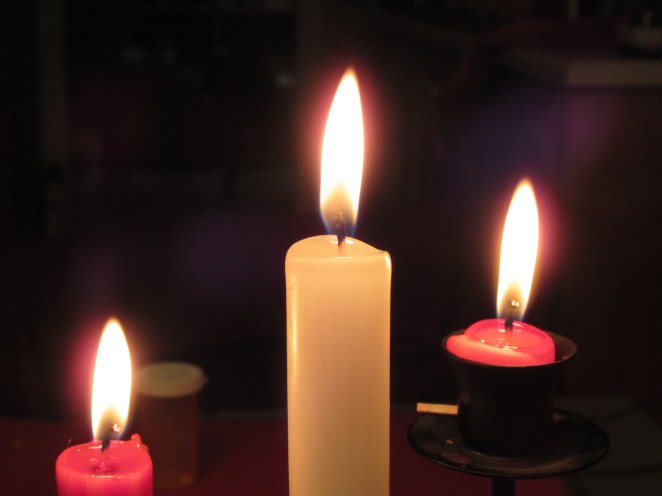
The opening quote, changed and adapted, is from Rudyard Kipling’s novel Kim. I was reading it a few days ago, by candlelight, as we had a brief, and totally unexpected power outage because some idiot ran into a power pole on the highway below us and cut off our power.

Reading by candlelight is so inspirational. It brings back memories of my childhood in Wales, summer evenings in the bungalow, no power, no running water, reading by lamplight or candle light. The candle’s scent, the flicker of shadowy thoughts across the page, each word held for a moment or two in a magic, shimmering glow. I recall also the candles on the high altar, lit for midnight mass, and the church all a-sparkle with shimmering light, incense, and flowers.

Power outage – I often think they should be called power out[r]ages. Then I think of the war zones, rife with suffering, where power outages are only one of the many outrages from which people are suffering. “Man’s inhumanity to man.” Robbie Burns, I believe. I regret calling that driver who took out the power pole an idiot. Shame on me. I found out later that he was a human being, suffering, just like me, from the attributes of ageing. A heart attack took him and his leaden foot, dead on the accelerator, sped him into the power pole.

DOA – dead on arrival at the power pole, and at the hospital. “He has lived. Now he has gone out,” snuffed out like the candles I blew out when the power was finally restored. It’s so easy to relight a candle, so hard to relight the beauty of a lost human life.


Absence

Absence …

… makes the heart grow
callouses scabs you can
pick at with your finger
nails bleeding fresh blood

they remind you that you have
a heart feelings something
buried so deep you need
a pick and a shovel to dig
a shaft with wooden slats
placed carefully at the sides
so your mine won’t collapse

you dig deeper and deeper
until in the gloom you see
the feathered fluttering —

a broken-winged canary
sacrificed in its cage
so part of you can escape
flee the mine
and come out alive

Commentary:

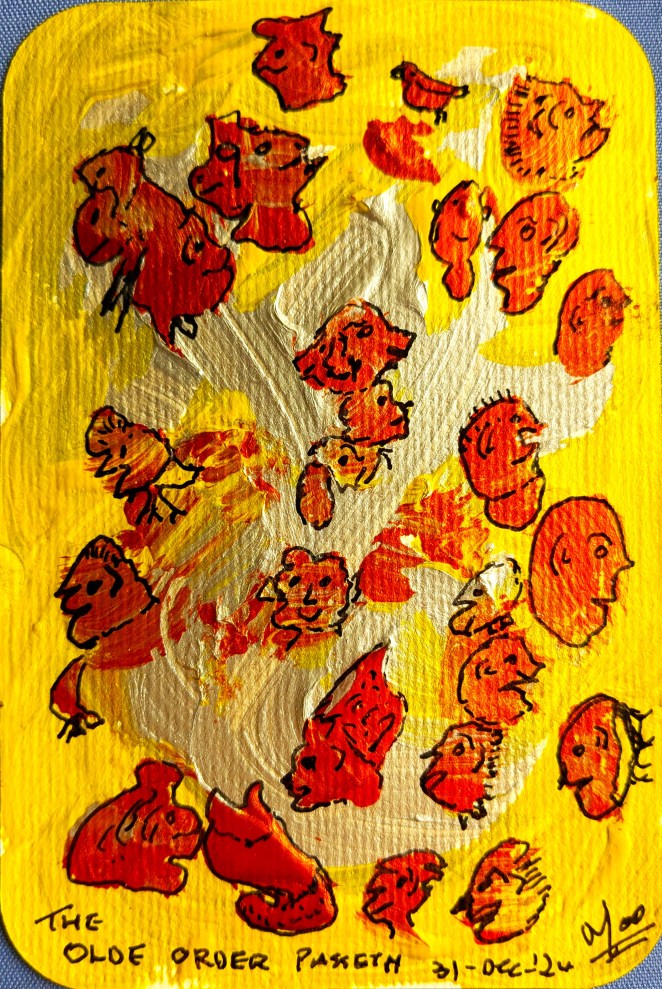
A golden oldie. Moo thought Poppy Day (11/11/2024) would be a suitable painting. Those who survive rarely forget those they were forced to leave behind. Kindred spirits, they travel though life together, the live one carrying the other on his shoulders as he would have done earlier, had he been able to.

Moo still has a teddy bear. He tells me he has always slept with one. His first teddy was an Australian Koala, a real stuffed koala given him by his Australian family, back when he was born. Moo was reading a book on the Battle of Britain (15 September 1940). It had a picture of the gunner from a Bolton Paul Defiant, sitting in the gun turret. Behind him, he had his little teddy bear. Moo couldn’t stop crying. He thinks he might have been an air gunner in another life, and when he saw that teddy, it brought back so many memories – flak, night fighters, search lights, tracer bullets, pain, flames, and then the unending darkness. So many did not come back, especially the tail-gunners. Their absence is still a presence to someone in their families. And so it should be.

Monkey Meets An Anarchist Ant

Monkey Meets An Anarchist Ant
(Memories of El Camino de Santiago)

The anarchist ant is dressed in black.
He has a little red base-ball cap
worn backwards on his head.
His eyes are fiery coals.

“Phooey!” He says.
“It’s folly to go with the flow.”
So he turns his back
on his companions
and marches in the other direction.

Some ants call him a fool.
The Ant Police try to turn him.
The Thought Police try
to make him change his mind.

Others, in blind obedience
to a thwarted, intolerant authority,
first bully him, then beat him,
then bite him till he’s dead.

Commentary:

I wrote this last century, no – last millennium – in the 1990’s, after walking the Camino de Santiago in Northern Spain. I travelled alone, on my own. An incredible journey. One of the sayings along the road is that if you do not make the pilgrimage to Santiago while you are alive, you will have to walk it in ant form, when you are dead. I often saw ants on the lonely, dusty roads, especially off the beaten track, and they were all headed for Santiago, except for one or two, who headed in the wrong direction, and were cut off by their companions. From these humble roots was this poem born.

Looking back nearly thirty years, I am surprised – and rather shocked – by the ‘little red base-ball cap worn backwards on his head’. I aways associated red hats with cardinals and bona fide llamas from Tibet (Kim – Rudyard Kipling). It obviously has a totally different meaning today, but I was definitely not aware of that thirty years ago when I first wrote this poem.

I was aware, however, of that in human nature, that made some people rebel and some conform. The conformists were rarely able to tolerate the rebels. This was particularly true in the Monkey Temple where the animals are bound by rules to which they must conform – or else. Thus, our poor anarchist ant broke away from the norm, refused to go with the flow, and suffered an awful fate as a result. Moo and I have always loved the rhythm and alliteration of that final brutal line ‘first bully him, then beat him, then bite him till he’s dead.’ But Moo definitely didn’t want to paint that picture. He encouraged me to use the photo of the ants in the honey pot instead. And guess what – there were fifteen ants floundering in that pot of honey. The luckiest ones were the anarchist ants who adjusted their baseball caps and fled!

How many anarchist ants, I wonder, baseball caps of any color askew on their heads, have suffered a similar fate? Some things, my friends, we’ll never know. And sometimes, my friends, I think we are better off not knowing.

Monkey’s Clockwork Universe

Monkey’s Clockwork Universe


Some days, monkey winds himself up
like a clockwork mouse.
Other days he rolls over and over
with a key in his back like a clockwork cat.

Monkey is growing old and forgetful.
He forgets where he has hidden the key,
pats his pockets, and slows right down
before he eventually finds it
and winds himself up again.

One day, monkey leaves the key
between his shoulder blades
in the middle of his back.

All day long,
the temple monkeys play with the key,
turning it round and round,
and winding monkey’s clockwork,
tighter and tighter,
until suddenly the mainspring breaks
and monkey slumps at the table –
no energy, no strength,
no stars, no planets, no moon at night,
the sun broken fatally down,
the clockwork of his universe
sapped, and snapped.

Commentary:

I guess we normal human beings, not the monkeys who live in the Monkey Temple, think of this as a sort of mental and physical burn out. It can happen to anyone really. You don’t have to be a monkey. But if you live in a clockwork universe where you clock in at nine and clock out at five, and regulate everything – your eating, your breathing, your visits to the loo – by the tick of the tick-tock work clock, then I guess this can happen to you.

Escarmentar en cabeza ajena – a lovely Spanish proverb that means ‘to learn from the blows delivered to another’s head’. Much better to let this poor monkey teach you that yes, you have to take breaks or, like monkey, you will break down. You must learn to pace yourself, not to be put upon by others, and to look after yourself. Because, if you don’t, others will take advantage of you and push you to, and beyond, your limits. Don’t learn that lesson the hard way, by ending up broken, run down, and in hospital. Learn from monkey’s experience. Keep the key hidden. Don’t let other people see it, or steal it, or wind you up with it.

Life is hard enough anyway. Look after yourself first. And then you will be much better able to look after other people – especially your family and friends – when they need your help. A difficult lesson to learn, especially in this world of multi-tasking where too many people hold too many low-paying jobs and work long, long hours, day after day, just to make ends meet.

There is no escape from the clockwork labyrinth, you think. Alas, that too is true, all too often. But escape you must. Somewhere, Ariadne’s thread will lead you out. You must seek it, even in the darkness and the gloom. Once found, it will lead you out from the darkness and back into the light. And that is what we must all hope for and work for. Pax amorque – and blessings.

Fear

Fear

Now is the time of fear:
ice on the morning step,
a child’s slide on the sidewalk,
a parking space too narrow
for me to get out of the car.

Sometimes the shopping cart
lurches beneath my weight
and I clutch at thin air:
each fall a precipice.

An emptiness in the gut,
a tightening of the elastic band
clamped around chest and heart,
a chill through the bowels
in the washroom’s dark:

 a long night that threatens.

Commentary:

Things happen, from time to time, and seem inevitable. With the coming of fall and the threat of frost comes the fear of ice. All year round, the fear of wet and slippery floors walks beside me. I am very careful about how and where I place my canes.

Shopping brings the fear that someone will park so close to me that I cannot get back into the car. Shopping carts can be treacherous. In one shop, their light-weight carts always seem ready to tip up or lurch over. The tell-tale leap in my chest reminds me that yes, this can and does happen. I am ultra careful in that particular shop.

Oh yes, and don’t forget the diuretics that upset the tummy and leave one struggling for time, and space, and the right place. Such things arrive so suddenly. They make the night seem dark and long.

Funny how the same thoughts change shape when published in prose, rather than poetry. The narrative is the same, but the emotional impact can be so different. Góngora wrote about such moments, a long time ago, in the early seventeenth century. “Cada pie mal puesto es una caída, cada caída es un precipicio. / Each false step means a fall, every fall is down a precipice.” The fear of falling is inherent to those of us who age. It is interesting that precipicio (Spanish) ends in -ice, precip-ice (English). How many readers note such seemingly minor coincidences?

Accident or deliberate? Who knows when the shopping cart or the cane slips out beneath us and we stumble as the ground comes suddenly rushing up, with us on the way down.

Apocalypse when?

Apocalypse When?

A strange, milk-cloud sky, skimpy, with the sun
a pale, dimly-glowing disc and my pen scarce
casting a shadow as the nib limps over the page.

Out on the west coast, fires still range free and this
is the result, these high, thin clouds casting a spider
web cloak over the sun face and darkening the day.

The west coast: five or six hours by plane and three
whole days to get there by train, even longer by bus,
all chop and change with multiple stops.

The wind blew and the clouds came widdershins,
backwards across the continent. Today they reached
across the ocean to claw the sun from European skies.

It is indeed a small world after all. Isostasy:
you push the balloon in here, and it bulges out
over there in the place you least expected.

Now we are all interconnected in an intricate network
of a thousand ways and means. What does it all mean?
Ripples ruffle the beaver pond’s dark mirror.

The forest mutters wind-words, devious and cruel,
that I sense, but cannot understand. High in the sky
clouds turn into horsemen on plunging steeds.

Fear, fire, flood, foe, poverty, pandemic, crops destroyed,
unemployment, and, waiting in the wings, the threat of civil
unrest, leading to the apocalypse and the war to end all wars.


Hello again – our old friend is back!

Hello again – our old friend is back!

Co-[vidi]-s
17 March 2020

I saw time change with the clocks
and my body clock
is no longer in sync
with the tick-tock chime
that denounces each hour.

Hours that used to wound
now threaten to kill.
They used to limp along,
but now they just rush by
and I, who used to run
from point to point,
now shuffle a step at a time.

Around us, the Covidis
thrives and flowers.
Wallflowers, violets,
we shrink into our homes,
board up the windows,
refuse to open doors.
We communicate by phone,
e-mail, messenger, Skype.

Give us enough rope
and we’ll survive a little while,
fearful, full of anguish,
yet also filled with hope.

Comment:

A Golden Oldie, written on 17 March 2020, St. Patrick’s Day.

Only yesterday, I read that Covid is back once more, in a new and mutated shape. Masking is once again demanded in the local Horizon hospitals especially in areas where patients and the public gather. I lost a couple of good friends to Covid last time round. I hope I don’t lose any in this new session. Guess I’ll be continuing to get my vaccinations and keep them up to date.

Whoever is reading this, I wish you all the best. May you stay Covid and illness free. May you also enjoy a long and happy life with sunshine days – and enough rain to keep the forests cool, the trees happy, the flowers flourish, and the wildfires at bay.

Clepsydra 12 & 13 – Pilgrim in this barren land …

Clepsydra 12 & 13 –
Pilgrim in this barren land …

12

… pilgrim in this barren land
     lost in my wanderings
          the wander-lust still tugging at me

in my back-pack
               dusty with memories
                    photos that only I have seen
                         sepia
                              spotted in places

only I know names and faces
     recall relationships
          a mystery to me, an outsider,
               such images haunt me
                    move me in ways
                         I do not understand

the irregular heart-beat
     of my life walks inside me
          down new corridors of time
               fresh music
                    strums my heart-strings

a heart
     a bridge a time too far
          lost I wander the woods
               searching for things
                    I know I must find
                         my lost self among them …


13

… but to find myself
     I must first lose myself,
          not in a barren land
               nor in the inner depths
                    of my suffering mind
                         nor the deeper depths
                              of another’s body

am I nothing more
     than an offering on the altar
          where nothing alters more
               than this interchange
                    eye to eye
                         mind to mind
                              body to body

will the I ever transform
     into the power of us
          together
               both of us

and are we much more
     than one plus one
          with three or four or more
               conjured from the word
                    that was from the beginning

or is all of this
     nothing more than
          the woven magic of pillow-talk …

Time Flies

Time Flies

… bends like a boomerang,
flies too rapidly away,
limps back to the hand.

Endless this shuffle of unmarked
days dropping off the calendar.

Hands stop on the clock.
The pendulum swings:
time and tide stand still,
do not move.

‘As idle as a painted ship
upon a painted ocean.’

The painting in my grandma’s room:
seemingly moving seas,
sails swelling out,
but the ship doesn’t move,
it stays firm in its frame.

Our garden fills with birds
and squirrels, light and dark.
Morning ablutions: each day
a twin of the day before.

The TV screen churns ceaselessly,
tired, shadow faces boring us
with shallow wit
and worn-out wisdom.

Time:
an albatross around the neck,
an emu, an ostrich, a dodo,
an overweight bumble bee,
too clumsy, too heavy to fly.

Absence in Presence

Absence in Presence

Just before her flight left,
she came up
from the basement,
her cleaning tasks
complete,
and smiled at me.

In the background, music,
a Golden Oldie,
the Rolling Stones playing
‘This could be the last time.’

Present in her eyes,
and in my heart,
the thought,
more than a thought,
the knowledge
that those words
might actually be true.