Self-portrait with flowers

Self-portrait with flowers

I walk past the Jesuit Church
where the shoe-shine boys store
polish, brushes, and chairs overnight.
I walk past the wrought-iron bench
where the gay guys sit, caressing,
asking the unsuspecting to join them.

Nobody bothers to ask me for a match,
for a drink, for charity, for a walk
down the alley to a cheap hotel.

The witch doctor is the one who throws
the hands of all the clocks into the air
at midnight, in despair.
He’s the one who leaves this place,
and returns to this place, all places being one.

The witch doctor sees little things
that other men don’t see. He reaches out
and flicks a fly away from my nose.
“It too has lost its way,” he sighs.

I think I know who I am,
but I often have doubts when I shave,
rasping the razor across my chin’s dry husks.
The witch doctor, my lookalike, my twin,
stares back at me from my bathroom mirror.

Three witches dance on the waning soap dish.
One spins the yarn, one measures the cloth,
one wields the knife, that will one day sever
the thread of I, who the same as all
poor creatures, was born only to die.

You too must one day look in that mirror,
oh hypocrite lecteur,
mon semblable, mon frère.

Type on this link for Roger’s reading.
Self-portrait with flowers

Comment: My thanks to all those who click on earlier poems and express their liking for them. I am particularly pleased when an earlier poem lacks a voice reading. Then I can revisit it, rethink it, rewrite it, record it, and speak it aloud. Here’s the link to the earlier version of the poem Charles Baudelaire. Fast away the old year passes, and we must renew ourselves, our thoughts, and our poetry for the new year soon to be upon us. To all my readers, old and new, welcome to that world.
Striations

Striations

There are striations
in my heart, so deep,
a lizard could lie there,
unseen, and wait
for tomorrow’s sun.

A knot of
sorrow in daylight’s throat;
the heart a great stone
cast in placid water,
each ripple
knitted to its mate.

Timeless,
the worm at the apple’s core
waiting for its world to end.

Seculae seculorum:
the centuries
rushing headlong.

Matins:
wide-eyed
this owl hooting
in the face of day.

Somewhere,
I remember
a table spread for two.
Breakfast.
An open door.
“Where are you going, dear?”

Something bright has fled the world.
The sun unfurls shadows.
The blood whirls stars
around the body.

“It has gone.” she said. “The magic.
I no longer tremble at your touch.”

You can drown now
in this liquid
silence.

Or you can rage against this slow snow
whitening the dark space
where yesterday
you placed your friend.

The silver birch wades
at dawn’s bright edge.

Somewhere,
sunshine will break
a delphinium
into blossom.

Tight lips.
A blaze of anger.
A challenge spat
in the wind’s face.

High-pitched
the rabbit’s grief
in its silver snare.
The midnight moon
deep in a trance.

If only I could kick away
this death’s head,
this sow’s bladder.

Full moon
drifting
high in a cloudless sky.

A Golden Oldie
Click on this link for the original post

https://rogermoorepoet.com/2016/05/

Click on this link for Roger’s reading.
Striations

Water

Water

Water: does it remember when the earth was without form
and darkness lay upon the face of the deep?

Water gathered into one place and the firmament appeared.
Then light drifted apart from darkness and with light
came The Word, more words, and then the world …

… the world of water in which I was carried until
the waters broke and my life sustaining substance
drained away ejecting me from dark to light.

Here, in Oaxaca, the valley’s parched throat
longs for water, born free, yet everywhere imprisoned.
It languishes in bottles, tins, jars, and frozen cubes,
its captive essence staring out with grief filled eyes.

A young boy on a tricycle pedals past my apartment.
He carries a dozen prison cells, each with forty captives,
forty fresh clean bottles of warm water.
“¡Peragua!” he call out to me. “¡Super Agua!”
he holds out his hand and asks me to pay
a handsome ransom to set some of these captives free.

Real water yearns to be released, to be set free from its captivity,
to trickle out of the corner of your mouth, to drip from your chin,
to slip from your hand and seek sanctuary in dust and sand.

Real water slips through your hair and leaves you squeaky clean.
It is a mirage of palm trees upon burning sand. It is the hot sun
dragging its blood red tongue across the sky and panting for water
like a great big thirsty dog.

A Golden Oldie
Click on the link below for the earlier version.
https://rogermoorepoet.com/2016/04/28/water/

Click on this link for Roger’s reading.
Water


Alebrijes

Alebrijes

 Are they half-grasped dreams
that wake, wide eyed, to a new day’s sun?

Or are they alive and thriving
when they fall from the tree?

Does the carver fish their color and shape
from his own interior sea,
or does he watch and wait for the spirit
to emerge from its wooden cocoon
to be reborn in a fiery block of color?

Daybreak:
in a secluded corner of my waking mind,
my neighbor’s dog greets the dawn with sparks
of bright colors born from his bark.

My waking dream: dark angels with butterfly bodies,
their inverted wings spread over my head to keep me warm.
In the town square, the local artist plucks dreams
from my head and paints them on carved wood.

A Golden Oldie
Click on this link for early version.
https://rogermoorepoet.com/2016/04/27/alebrijes/

Click on this link for Roger’s reading.
Alebrijes

Le Mot Juste

Danzante
dancing with joy!

Le mot juste

Searching for what exactly?
For the exact word, le mot juste,
the word that sums it all up,
catches the essence of the thing
and holds it in the mind forever.

Le mot juste? Think color.
Think color blind. Think blind.
Think of the world we see
reduced to grey scale.
Think of the seven colors
that stripe the rainbow sky,
each with a unique name:
it seems so easy, so simple.

But the world has changed.
Think now of the computer,
its screen more accurate
than the human eye and color
coordinated by a million or more
tiny little pixels that multiply
the seven rainbow colors
by a million or two and every
color numbered beyond
the recognition point
of the human eye: le mot juste
reduced to precision of number.

Think flowers. Think scent.
Think of the limited ways
we describe the smell of things.

I look across the breakfast table
and see my wife of fifty years,
a teenager reborn, walking into
the café where we first met.
I search my memory and my mind
for the words to describe that beauty,
that surge of excitement,
but I cannot find les mots justes.

Click on link for Roger’s reading
Le mot juste

My First Thanksgiving

My First Thanksgiving

For the first twenty-two years of my life
Thanksgiving held no meaning, no life,
no substance, no form, nothing familiar,
nothing special to hold my attention.

When I emigrated to Canada
my cousins changed all that
with an invitation to visit them
in Kincardine for Thanksgiving.

Turkey on the table, colored
table napkins, and a family gathered,
arms outstretched, to make me welcome.

We were all surprised at how alike we looked.
“Like Cousin George, in Vancouver,” they said.
“Like Cousin Elsie in Revelstoke.”
“Like my mother’s mother, back home
in Swansea,” I said.

They told me how the Second World War
had brought the family back together
on these special holidays:
Christmas in Wales for the Canadian boys
or Thanksgiving in Winnipeg
for the Welsh boys learning to fly.

That Thanksgiving, the old family names
turned to photographs: snaps of my mother’s wedding,
my grandmother holding me, age three, on her knee.

And finally, as a special Thanksgiving gift,
a long-distance call to Britain and Clare
on the telephone saying
“Yes,” she would come to Canada,
and “yes,” she would marry me.

And I remember crying all the way
from Kincardine to Toronto,
and that was my first Thanksgiving in Canada.

Comment: A Golden Oldie, indeed. This poem is from my collection Secret Gardens. The secret love poems I write to Clare. It was published on our Silver Wedding Anniversary, 24 December 1991. It is a pleasure to re-publish it here for Thanksgiving, 2021. Now what am I going to do for 24 December 2021?

Click on the link below for Roger’s reading.

My First Thanksgiving

Silence

A stopped clock: accurate twice a day.

Meditations on Messiaen
Quartet for the End of Time

5

Silence

Pain stops as the sounds of silence
break against the walls of the room
in which I sit.

Silence, yes, yet silence broken
by the renewed intrusion of the clock,
by the electric hum from lights
and heating, from a distant tv
suddenly breaking into my thoughts:
cheers from a tennis court,
the eternal advertisements
invading my innermost being.

What triviality now shatters
the Messiaenic mood that wrapped
me for a moment in a many colored
cloak of musical oblivion.

Now time’s teeth gnaw again
and the grandfather clock
nibbles at my soul, extracting
its essence in a surge of sound,
tick-tock, tick-tock.

Westminster Chimes now choke
life from the hour and ring
the tick-tock knell that files
my life away, second by second,
minute by minute, day by day.

Click on link below for Roger’s reading.

Silence

True Love

True Love

True love flows so much deeper
than an exchange of body fluids
or a handing over of ritual rings.

Our advancing lives are no longer
ruled by nature’s primal urges.
Our bodies have been taken over
by old age stiffness, aches, and pains.

Some nights, I wake up to find
she no longer breathes. I reach out
in panic, touch her gently, and when
she breathes again, I heave a sigh
redolent with love and relief.

Listen to podcast here.
True Love

Pianissimo

Pianissimo


            You sit at the piano, my old piano, still extant in my father’s house, yet soon to be given away, though we don’t know that yet. It’s an upright, iron-frame Bechstein, a piano that I was given when I was the same age as you are now. Handel’s Largo, the Harmonious Blacksmith, hours and hours of scales. They locked me in the front room, my mum and dad, and there I stayed for an hour, two hours, or more. I came to hate music. As soon as I could, I gave up the piano, I rejected piano practice, I turned my face away from the discipline of the lock up.
            Now, I listen to you. Your untaught fingers tickle the black keys, then the white keys, one after another. You are six years old. You’ve never had a lesson, but you have music in your blood and some residual instinct latches on to rhythm and sound. Your fingers are long and supple and your touch is light, so much lighter than mine used to be, and now, on the deep bass notes of the left hand, your stronger hand, you pound away, awakening the dark ghosts of soul music that pour through my memories awakening echoes in this piano.
            I think of you as a jazz musician. Thelonius Monk, perhaps, a tinkle here, a light touch there, now a chord or two, inexplicable, and who would want to explain. It is a joy to sit here, to see your smile of absolute absorption. Mood music you call it, and today your moods are as dark as the shadows that tug at my heart, and as light as the sunlight that floats through the windows and makes the dust motes sparkle. It also frames a halo round your head. You hum to yourself as the morning sunshine fragments into colored gems and you sculpt your rainbow of sound.
            “Stop that noise. You’re driving me mad,” your grandfather, my father, stumbles into the room. He has taken his last cigarette out of the packet and the white cylinder hangs down from his lips, like an extraneous chalk outcrop hanging from the lip of an errant teacher. He pats his pockets. “Where are my matches? Has anyone seen my matches?”
            “They’re on the table in the kitchen,” I reply. “Where you always put them.”
            “I thought I left them in here,” my father leans on his stick then turns and stumbles out of the living room and into the kitchen.
            You hop off the piano stool, take the matches from your pocket, and carefully place them on the arm of your grandfather’s favorite chair.
            “Sssssh!” you say, putting a finger on your lips. Then you skip back to the piano and start playing pianissimo on high notes that float like tiny raindrops of sound produced by miniscule angels.          
            Your grandfather returns, glances round the room, spots the match box, and pounces upon it, a caged tiger finally served his red meat.
            “That’s funny,” he mutters. “They weren’t there a moment ago.” He takes out a match, strikes it, lights up his cigarette, inhales a lungful of smoke, then exhales it in a great locomotive puff of cloud. He grimaces at you through a haze of smoke.
            “There’s nice music you’re playing.”
            Your young lungs, unaccustomed to a house of smokers, can’t cope with this thin, grey, choking cigarette waste. You stop playing, put a hand over your mouth, and start to gag.

Listen to the Podcast here:
Pianissimo

Blood and White Wash

Blood and Whitewash
A Thursday Thought

2-September-2021

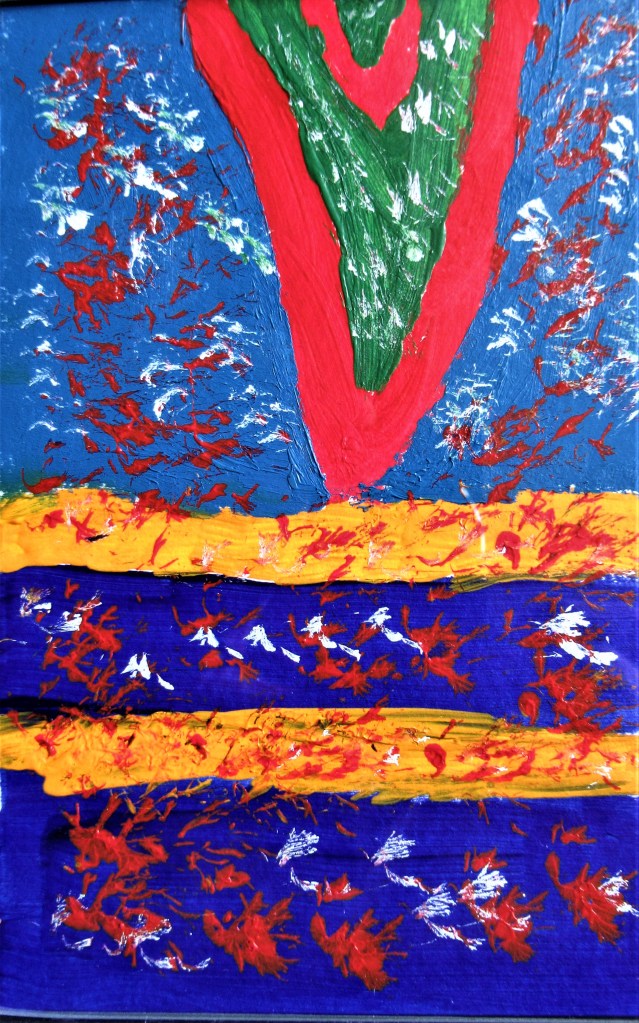
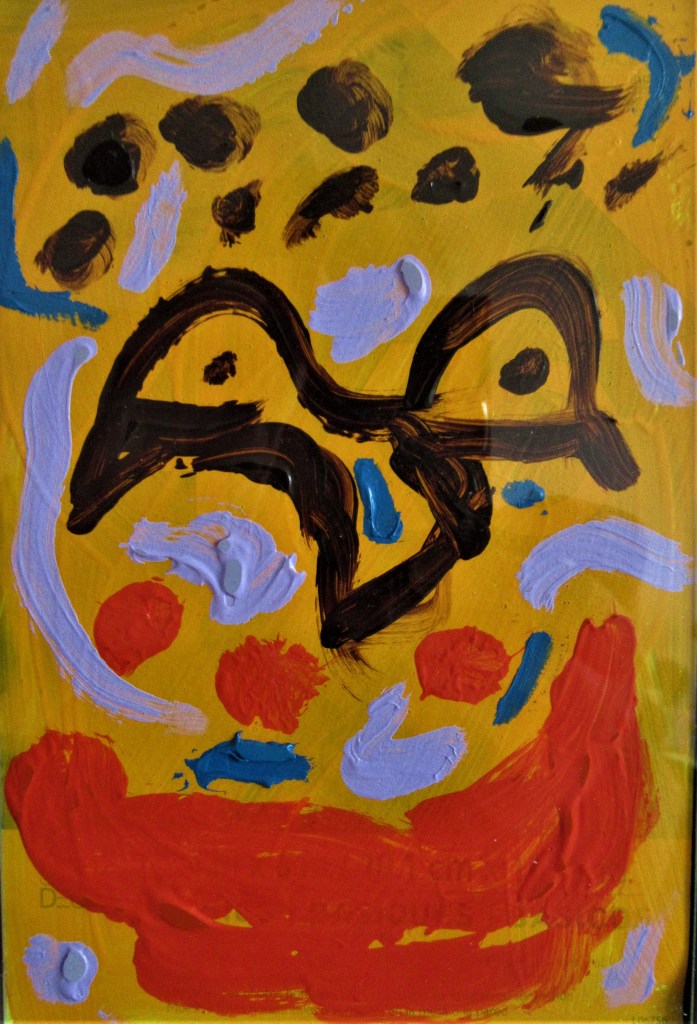
Blood and Whitewash is the title of this painting. It has a subtitle: My Plan of Attack.

The origins of the title, and hence of the painting, go back to the Goon Show, with Spike Milligan, Peter Sellers, and of course / wrth gwrs, Harry Secombe, the Swansea Comedian and Master Singer. Away in boarding school back in the late fifties, one of my greatest pleasures was listening to the Goon Show on one of the dormitory’s transistor radios. As a teenager, I found the jokes and the accents incredibly funny. Still do. That’s why I painted this painting. Alas, it is silent, and you cannot hear the accents.

The following snippet of dialog occurred on one such Goon Show, I cannot remember which.

“What are we going to do?”
“Well, this is my plan of attack.”
“That’s not a tack, it’s a nail.”
“No it’s not. It’s a tack.”

So above you have my painting of My Plan of Attack, resurrected after all those years. I throw my mind back to the First World War.

The General:
“He’s a cheerful Cove,” said Jimmy to Jack,
as he walked to Arras with his pack on his back.
But he did for them both, with his plan of attack.

And there in essence is the history of the painting. First, the plan of attack, then the failure and the blood-letting, and then the white-washing of the whole history, a white-washing that turns failure into success, defeat into victory, and loss into gain. But in WWI, it was the poor Tommies who bore the burden, and all the other front line troops who obeyed orders, went blindly over the top, and charged unbroken wire with fixed bayonets.

“If you want to find the sargent,
I know where he is, I know where he is,
If you want to find the sargent,
I know where he is.
He’s hanging on the old barbed wire.”

“If you want to find the chaplain,
I know where he is, I know where he is,
If you want to find the chaplain,
I know where he is.
He’s hanging on the old barbed wire.”

“If you want the whole battalion,
I know where they are, I know where they are,
If you want the whole battalion,
I know where they are.
They’re hanging on the old barbed wire.”

Singing as they marched to their deaths, obeying orders, like sheep, and nipped on by the eternal sheep dogs. Things were so bad at Verdun that instead of singing, the men marched, bleating, like sheep. “Sheep unto the slaughter.” There was so much ill-feeling and rebellion in the face of orders and certain slaughter, that French regiments were decimated, one man in ten shot for mutiny, as they marched bleating, instead of singing, to their deaths.

“Oh, we’ll hang out our washing on the Siegfried Line,
have you any dirty washing, Mother dear?”

“Those who do not learn from history are condemned to repeat it.” So, tell me, “where have all the young men gone, gone to graveyards everyone, when will they ever learn, when will they ever learn?”

And that, dear friends, is my thought for today: The History of My Plan of Attack. When, indeed, will we ever learn?