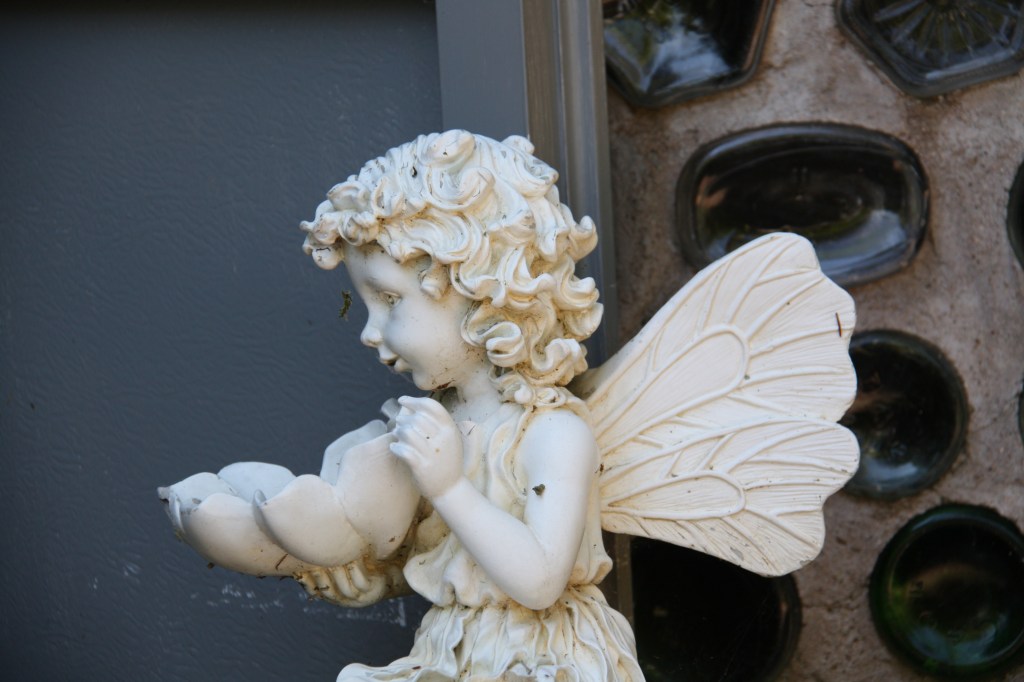
March 1 is St. David’s Day: Dewi Sant, patron saint of Wales. While we are here, immersed in cold and snow, in Wales, spring is arriving, the daffodils are out, trees are budding. This poem is a reminder that winter will end and sunshine and spring will return. So for St. David’s Day, I wish you joy and hope.
Earth to Earthlings
“Get out and about,” she told me. Take off your socks and shoes. Walk barefoot on the earth and grass: twin pleasures, you can choose.”
I took two canes, one in each hand, and left the house to walk the land.
In the garden I took off my shoes to walk barefoot on the lawn; when grass sprang up between my toes I was instantly reborn.
I stood in the shade of the crab apple tree and let leaf and flower spill over me.
Sunlight took away my frown and freckled a smile on my face. I was blessed again with hope and light; earth and grass filled me with grace
When white blossoms filtered down they gifted me a flowery crown.
I stooped to reach my shoes and carried them home in my hand, maintaining as long as I could my contact with this magic land.
The iguana that guards the front door of our house. At night he comes alive, goes round on patrol, checking and securing everything and everybody. Beware the jaws that bite, the claws that clutch!
Striations
There are striations in my heart, so deep, a lizard could lie there, unseen, and wait for tomorrow’s sun. Timeless, the worm at the apple’s core waiting for its world to end. Seculae seculorum: the centuries rushing headlong. Matins: wide-eyed this owl hooting in the face of day. Somewhere, I remember a table spread for two. Breakfast. An open door. “Where are you going, dear?” Something bright has fled the world. The sun unfurls shadows. The blood whirls stars around the body. “It has gone.” she said. “The magic. I no longer tremble at your touch.” The silver birch wades at dawn’s bright edge. Somewhere, tight lips, a blaze of anger, a challenge spat in the wind’s taut face. High-pitched the rabbit’s grief in its silver snare. The midnight moon deep in a trance. If only I could kick away this death’s head, this sow’s bladder, this full moon drifting high in a cloudless sky.
Comment: a fitting ending for the month of February: ubi sunt? Where have all those days gone: Ou sont les neiges d’antan?
Looking back at my old photos from Oaxaca I am amazed at the contrasts between sun and shade, light and dark. I will never forget that ultimate glory: a sunbeam through a stained glass window, casting fragmented light.
San Pedro Oaxaca
A single sunbeam descends. Sharp blade of a heliocentric sword, it shatters the chapel’s dark. Fragmented light stains me with glazed colors.
A pallid lily truncated in the dawn’s pearly light, Peter, the young widower, kneels in prayer.
His head wears a halo. His pilgrim palm presses into the granite forcing warming fingers into a cradle of cold stone.
His flesh clings to the statue’s marble hand. A mingled maze: marble and human veins.
Light in dark bright yellow stridence shrill golden dog’s bark to warn off death’s wolves that freeze her blood
she dreaded night’s unease the devil’s wintry anti-spring life’s darkest sparks
but loved the daffodils’ sunny March cadence of brief piercing dance
Comment: A Golden Oldie. My mother loved daffodils and planted them all over the garden in Cardiff, Wales. They are the national flower of Wales and break into blossom just in time to welcome St. David on St. David’s Day, soon to be upon us, Dydd Dewi Sant.
Daffodils A poem for the lady who brought some to us when Clare fell
Daffodils in our garden, last year in Island View. We won’t see the live ones until May, at the earliest. I dream of them at night, tossing their heads in sprightly dance’, in Roath Park and Blackweir Gardens, Cardiff. They will be out now, all ready to welcome Dydd Dewi Sant on March 1.
Daffodils
For ten long days the daffodils endured, bringing to vase and breakfast- table stored up sunshine and the silky softness of their golden gift.
Their scent grew stronger as they gathered strength from the sugar we placed in their water, but now they have withered and their day’s done.
Dry and shriveled they stand paper- thin and brown, crisp to the touch. They hang their heads: oncoming death weighs them down.
Sunset at Ste. Luce. We wait for the choir to arrive. Take a deep breath: it will soon be here.
Angel Choir (on seeing the Northern Lights at Ste. Luce-sur-mer) Sonnet
Listen to the choristers with their red and green voices. Light’s counterpoint flowering across this unexpected son et lumière, we tremble with the sky fire’s crackle and roar.
Once upon another time, twinned with our heavenly wings, we surely flew to those great heights and hovered in wonderment. Now, wingless, our earthbound feet are rooted to the concrete. If only our hearts could sprout new wings and soar upwards together.
The moon’s phosphorescent wake swims shimmering before us. The lighthouse’s finger tingles up and down our spines. Our bodies flow fire and blood till we crave light, and yet more light. We fall silent, overwhelmed by the celestial response.
When the lights go out, hearts and souls are left empty. Leaving the divine presence is a gut-wrenching misery. Abandoned, hurt and grieving, we are left in darkness.
Comment: The Spanish mystics, St. John of the Cross, and St. Teresa of Avila, wrote, in the sixteenth-century, about the ‘dark night of the soul’. That dark night also arrives when the communion with the spiritual finishes and the communicants are left alone, in their loneliness, abandoned to their earthly selves. To leave the divine presence is a heart-breaking, gut-wrenching misery. To turn from the marvels of nature can produce lesser, but still deeply moving feelings of grief and sadness. The secret is to preserve that joy and to carry it with us always, warm, in our hearts. Doing so makes the pain of separation much more bearable.
He knows the frogs are in there. He doesn’t need to hear them sing. But he loves to make them croak.
Croaking Angels
Their tunes are one note symphonies, croaks of joy that move their fellow frogs to ecstasy, exhorting them to share the splendors of ditch life, in a springtime bonding that will loft them skywards.
There’s an ancient magic in this calling: water and laughter, sunlight, warmth, and all those joyous things that fill the newborn spring.
Moonlight swings its cheerful love lamp. New leaves and buds are also known to sing.
Comment: This always makes me think of the croaking chorus from Aristophanes. I do hope all those wonderful ancient plays, songs, myths, and legends are not forgotten in our croaking frog chorus of modern jingoistic advertisements and propaganda. Ah well, what’s a source for the proper goose is probably a source for the proper gander. Who knows nowadays? What we do know is that spring is just around the corner. Warmth and the absence of snow will help change our lives. And yes, that croaking chorus will be back.
Luck, sometimes, just being in the right place at the right time. One step, two steps, and up he went and look at those footsteps. His flight, a step of faith, two steps of faith, and away he goes, fait accompli.Another golden oldie. I do love rediscovering them. The photos, too.
Flight of Fancy
Just by chance, I caught this cormorant. “Behind you, quick,” said Clare. I turned and ‘Click!’
Such a miracle: the first steps of flight taken over water. That first step heavy, the second one lighter, and the third one scarcely a paint brush pocking the waves.
The need to take flight lies deep within me. Fleeing from what? Running towards what? Who knows?
All I know is that the future lies to the right of this photo and the past lies to the left, and I don’t know the meaning of either.
But I do remember the words of Antonio Machado: ‘Caminante, no hay camino, sólo hay estela sobre la mar.’ “traveler, there is no road, just a wake across life’s sea.”
Comment: I revised this poem a few minutes ago and cut it down to its essentials. If you want to read the original and check the revisions, click on this link to the earlier poem. Any comments on the rewrite and the revision process would be welcome.
Another golden oldieand, with the snow fallen and my back aching, it does sometimes feel like it’s an uphill battle. There are always angels at the roadside, though, and some have called and offered to help. Thank you, special angels.
Sometimes the road seems uphill all the way. Lungs burn. Breath comes hot and hard and chunky in the throat. Legs hang heavy, muscles will not obey the owner’s instructions.
Consult the operating manual: “Take a break,” it says. “Rest now. Don’t push too hard.” But to rest is to give in, to come to an abrupt halt, or to drift backwards down the hill.
What stubborn streak is painted so deep in us that it shouts ‘never surrender’ when our most urgent need seems to be to throw in the towel? Is it the urge to get to the top, to see the lower lands stretched out below us? Or is it the mantra of fight the good fight?
Many things can drive us on: a need, a desire, a whim, an urge, or merely a refusal to stop fighting. Some of us will never give up. We will never lie down and curl up in a corner, a dead leaf to be blown hither and thither by the cold night wind.
Look carefully: there are no drugs, no needles, in the biker’s uniform. There is no small accessory motor hidden in the back wheel to help when times get hard.
The mouth is open, the eyes are set on the target, the legs still move, the sun still shines, and three smiling heart-shaped faces cheer the cyclist on.
Who can they be, these three angels at the road side, who can they be? Yet they are there and we are here and the bike is there and the hill is there and sometimes … yes, sometimes, the road IS uphill all the way.
But we keep the pedals turning and we don’t get off our bikes … and that’s life.
Not Oaxaca, but Avila, with una tromba, a meseta rainstorm, about to descend upon us. And when it descends, there is water, water, everywhere, as you can imagine from the clouds. In Oaxaca, water is precious. Tap water is to be avoided. Bottled water is to be preferred. We used to wash our vegetables in water that was specially chlorinated, also the pots and pans!
Water Peragua Water seeks its final solution as it slips from cupped hands. Does it remember when the earth was without form and darkness was upon the face of the deep? The waters under heaven were gathered into one place and the firmament appeared.
Light was divided from darkness and with the beginning of light came The Word, and words, and the world … … the world of water in which I was carried until the waters broke and the life sustaining substance drained away throwing me from dark to light.
The valley’s parched throat longs for water, born free, yet everywhere imprisoned: in chains, in bottles, in tins, in jars, in frozen cubes, its captive essence staring out with grief filled eyes.
A young boy on a tricycle bears a dozen prison cells, each with forty captives: forty fresh clean litres of water. “¡Agua!¡Peragua!” he calls. “¡Super Agua!”
He holds out his hand for money and invites me to pay a ransom, to set these prisoners free.
Real water yearns to be released, to be set free from its captivity, to trickle out of the corner of your mouth, to drip from your chin, to seek sanctuary in the ground.
Real water slips through your hair and leaves you squeaky clean. It is a mirage of palm trees upon burning sand.
It is the hot sun dragging its blood red tongue across the sky and panting for water like a great big thirsty dog.
Comment: More and more competitions, publishers, and magazines are asking for ‘original material, not previously published, or self-published, even on your own blog.’ So what is a poet to do? Put up fresh material, and it is illegible for entry elsewhere. Recycle and revise old material? Now that might work. Click on the link above for the original version of this post! And yes, it has been previously published on these ages!