GBH

20180904_163015-1_resized

GBH

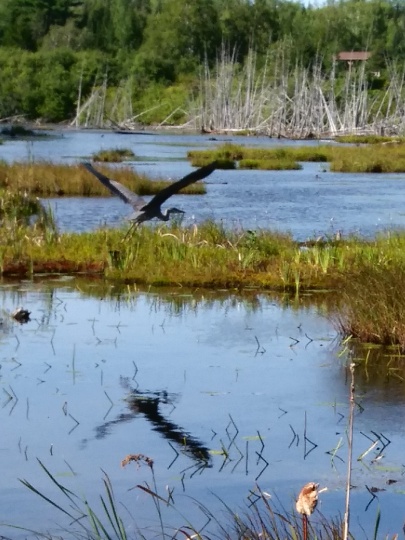
Grievous Bodily Harm to some, but to others, Great Blue Heron. I guess it’s all in the eye of the beholder. How about Grand Beautiful Harmony? Awesome is an overused word, especially when it comes out as almost an expletive: awesome. Awesome haircut. Awesome meal. Awesome tie. Awesome photo. Awesome heron. Or just plain, old awesome! With an exclamation mark of course, and the air punched up from diaphragm and out through tight lips.

That said, certain moments do fill us with awe: an awe of the wild, of nature’s bounty and beauty, awe of the elements, the stillness of the fall pond, the subdued rifle crack when the great wings first open, or the echoing slap of the beaver tail striking flat on open waters. Poetry in motion: that sudden catch of the breath as the launch into the air makes our hearts, just for a moment, first stop, then beat more quickly.

Falling into Fall

20180823_152000-1_resized

Falling into Fall

Not just Beaver at the Beaver Pond. Wonderful, this transition from end of summer to start of fall and look, there’s  a little pot of gold at rainbow’s end. By tomorrow, some tiny mouse will have gnawed the edges in search of sustenance. Meanwhile, this moment of perfection caught forever in the transient eye of the passing camera. Tread carefully when you walk these woods. Look everywhere, not just at the path ahead. But watch out for those tree roots. Their little hands will reach out and pull you down and you’ll roll in the already fallen leaves, an old man turned into a child once more. But oh, it’s so much harder to leap to your feet and run, run, run from shadows and the nightmare hands that haunt your dreams and reach out to grasp you.


Life-Long Learning

IMG_0068 (2)

Life-Long Learning
KIRA & Kingsbrae Gardens

It’s hard to believe I could be back with my friends at KIRA & Kingsbrae by the end of next month. What an honor and a pleasure to be invited to help facilitate the first KIRA Boutique Retreat on Creative Writing. Geoff, Jeremy, and me … we will make a truly creative dream team. We are working out the details as I type this.

My task will be to work with poets and short-story writers. I have just successfully completed two online courses from the School of Creative Writing at the University of Toronto, my  Canadian Alma Mater (MA, PhD). Kerry-Lee Powell offered the first course: Writing Short Fiction II, while the second course, Poetry II, found me studying with Sachiko Murakami.

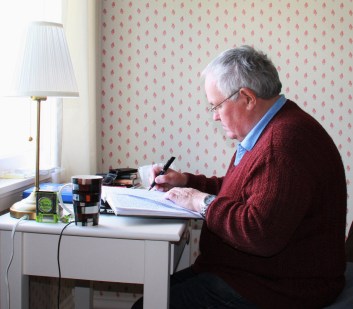
Life-long learning is so important. Over my life, I am not that old at seventy-four, I have learned that it is the ability to change, to adapt, to learn new things, that marks us out as creative people. Since my escape from imprisonment in the Ivory Tower of Academia (aka retirement), I have ventured into several new worlds, including that of online learning. My two most recent online courses from U of T now stand alongside an online course from Humber College on novel writing. Alas, this course did more to confirm that I wasn’t really a novelist at heart. As we live, we learn. I have now laid aside my three embryo novels to concentrate on my stronger areas: poetry and short stories.

Along with these online courses, I have been through the give (offering) and take (participating) of multiple creative writing workshops. So much knowledge gained. I have also enjoyed several positions as academic editor, associate editor, editorial board member, of multiple national and international publications, in English, French, and Spanish. In each of these new adventures, there was so much to learn.

Now I have the chance to return some of that acquired and accumulated knowledge to others who, like me wish to practice their life-long-learning skills. The unique KIRA combination of conversations, selected workshops, one-on-one talks, round-the-table discussions, evening talks, and readings will open many horizons to writers old and new, and not least to myself. As I live, I learn.

Round-the-table discussions: The Spanish have a wonderful term for this, de sobremesa. This refers to the discussions that take place, around the dining table, when the meal is done and everyone is comfortable in each other’s company and multiple conversations flow.

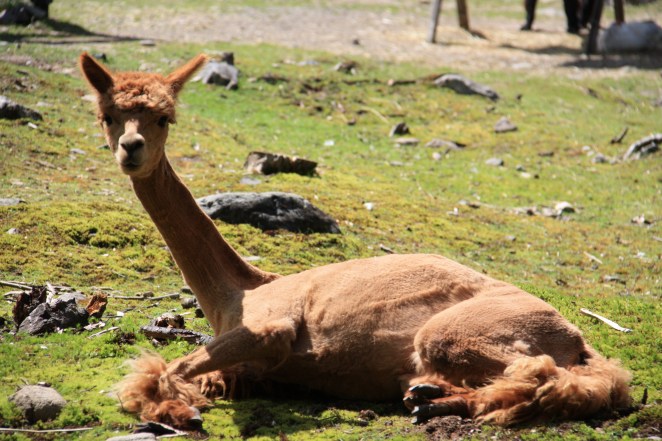
As for KIRA itself, I look forward to returning to my conversations with the land, the sea, the flowers, the birds, the statues, the alpacas … I love talking to them in Spanish … and the rowdy, old peacock who squawks his joy at evening, when the sun goes down. And don’t forget those Indian Runner Ducks: Beatrix Potter talked to them … and so did I … in fact, in Beatrix Potter’s case, one of her own Runner Ducks, possibly a distant cousin to those at Kingsbrae Gardens, became better known as Jemima Puddleduck. Who knows? Between poetry and painting, you too may find your own version of Jemima Puddleduck … Paco the Alpaca, perhaps?
IMG_0124

IMG_0084

KIRA: The three standing stones, though I think of them as talking statues. I stood in the middle between them, closed my eyes, opened my mind, and listened to the magic as the breeze blew through them and sang secret songs to the music of their stone flutes. They filled me  with the sound of their ancient voices, their poems and stories, the magical mysteries of their myths. Come and visit and I’ll show you how to stand still and listen to what the stones have to say. When you allow that poetry to flow through you, you’ll never suffer from writer’s block again!
Dandelion Flowers

IMG_0174

Dandelion Flowers

My flowers fly bright flags as if trooping their colors
for Her Majesty, the Queen of England. They drink water
dosed with chemicals to keep them healthy and alive,
refusing to fade, flourishing in their vase on the table.

They withstand both sunshine and shade, neither wilting
nor fainting under the hot summer sun. In this house
there dwells no queen, just a domestic pussy cat
called Princess Squiffy who knows she may look at a Queen.

“Your Majesty,” say Cape Daisies as the pussy cat passes.
“Ma’am,” say Peonies and Pansies, bending knees, bobbing heads.
Outside my window, the garden fills up with onlookers,
still green Tomatoes, Clematis, and a tall Hollyhock.

A multitude of weeds crowds onto the lawn. Dandelions
standing splendiferous, waiting to take plebeian selfies,
for plebs, they are, vox populi, people’s voice, people’s choice.

Some ancient god must have loved them very much,
for they are ubiquitous, and totally indestructible.
That said, you must never trust them in your flower bed.

Dawn at KIRA

IMG_0021

Dawn
at
KIRA

1

A fiery wedge, fierce beneath
black-capped clouds, alive
the firmament with light,
breaking its waves over woods,
waters, tranquil the bay, grey,
yellow-streaked, then blue,
the new day dawning,
driving night away,
false shadows fleeing.

2

To rock this new born babe,
to swaddle it in a cloak of cloud,
disguised for a moment its promise,
nature nurturing heart and mind,
filling the flesh with memory’s
instantaneous flash breaking its light
into the dark where no light shone,
fearful, the dream world,
gone now, dwindling, as day light
shafts its arrowed flight.

3

How thoughtful My Lady
who placed me here,
at this desk,
at this window,
at this moment of time.

Glorious, this day-break:
words no justice can do
to peace and light,
this early morning,
filtering sunlight
through the waking mind,
relighting the fires
within the heart,
and glory
a word’s throw away
outside this window.

Darning Socks

F1030024 2

Darning Socks
(for Angela Wink)

My grandfather taught me how to darn socks.
I sat beside him by the fire and placed
a grey, wooden mushroom inside the sock,
stretching the sock wool to expose the hole.
He chose his colors with care, bright yellows,
oranges, reds, sky blues, anything that
stood out against the sock’s dark drabness. If
the socks were thin, he split new wool, pulling
it into individual strands that
he would draw through tongue and lips, wetting them
so they would thread with ease through the needle.
Curled wool threaded, I would cross-hatch the sock’s
hole, slowly forming a life raft that I’d
fill with colored wool. All my life, I have
darned socks, sewn buttons, mended my sweaters.
I always use bright colors, to my wife’s
dismay. Then, I know who did the darning,
and when. I still have my grandad’s First World
War sewing kit, all wrapped up in his signed
canvas wrap with his needles and some wool.
It’s lovely just to touch where his hands touched.
I still see dark blood traces where he pricked
his thumb, and where he sewed up wounded friends.

Commentary:

This poem comes from a comment, made by Angela Wink, on yesterday’s post. Such exchanges are precious and help create new memories. Thank you Angela.

Braids

IMG_0080


Braids

All thumbs,
I can manage
two bunches,
one on each side.

But now,
with her mother gone,
it’s much more difficult
to part my daughter’s hair
neatly into three.

I work hard to perfect
that one thick plait
she loves down her back.

As for fish-bones
and French braiding…
she begs me to try

and I promise
that when my thumbs
turn into fingers,
I’ll give it a go.

Coffee House

Roger poster 1

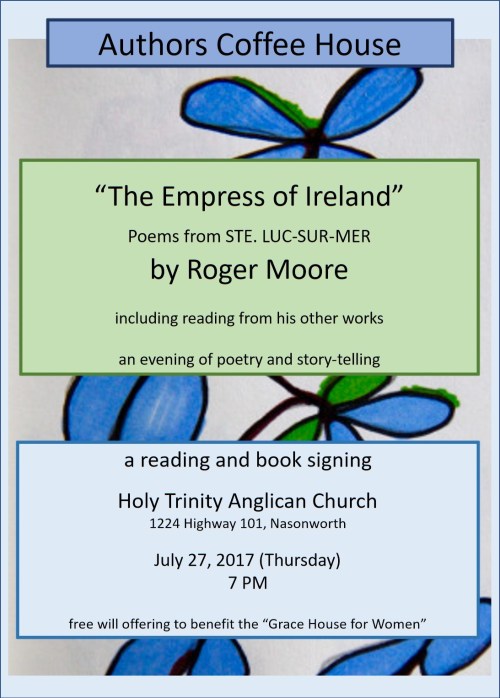
I have not been very active on the reading scene for some time now, so I welcome this chance to appear in public behind a microphone and with a book in my hand.

My thanks to Jane Tims for organizing this reading and creating the poster.

If anyone is in the area, please drop in and visit. I’ll be on my best behavior.

I promise.

Identity: Wednesday Workshop

IMG_0067


Identity
Wednesday Workshop

5 July 2017

Today’s workshop settles on the question of identity, loss of identity, and the attempt to recover any form of cultural identity that one feels one has lost. These questions are particularly important in the current age when so many differences are so easily erased. Language, culture, identity, music … they are all tied closely together.

The search for identity runs parallel to the search for the poetic voice (or the writing voice) that is so unique to each good writer. In fact, one can distinguish between good writers and lesser writers merely on the basis of voice. Lesser writers rarely establish a distinct voice while good writers usually have voices that are uniquely their own.

What to do we mean by voice? When we read Shakespeare or Miguel de Cervantes we know almost immediately whose work we are reading. The same is true of the great musicians. Bach, Mozart, Beethoven, Mahler, all have sequences and styles that are individual to them, as do Scarlatti, Brassens, The Beatles, Gordon Lightfoot, Gilles Vigneault, Edith Butler … their style, their voice is established. We listen to them and we know who they are.

Cultural identity is also very important. It is tied into language, childhood beliefs, fairy tales, myths, the basic culture that we receive as children. When we all listen to the same radio stations, or download the same ITunes, or watch the same TV programs with their infinity of ad nauseam advertisements, then we are socially engineered to be the same or, if not the same, remarkably similar within a series of very limited and extremely limiting patterns. When we establish our own identities, — and this is always difficult both for people who have had their culture taken from them and for immigrants, or the children of immigrants, who want to retain their culture at the same time as they blend in and fit in socially — then at the same time we develop our own voices.

When I hear the poetry of Lorca, of Antonio Machado, of Miguel de Unamuno, of Octavio Paz, of Dylan Thomas, of Gerard Manley Hopkins, of Wilfred Owen, I hear their very distinctive voices and recognize their individual styles and the cultural / poetic identities that they have established. The goal that we, as writers, are aiming for is to establish our own style, our own voice. To do this, we must listen to ourselves and discover how we think and how we feel. Then we must listen to others of our own generation. We must make comparisons and establish what we do differently, why we are different, what forms our differences … our own individual voice may come from speech rhythms, from language usage, from the establishment of a certain form of narrative, from the use of imagery or metaphor … there are so many different ways in which we are, each of us, different … or capable of being perceived as different.

When we write often enough and frequently enough, we at last begin to recognize those words, those phrases, those rhythms, those ideas, that are ours and nobody else’s. This is when we start to discover our own voices and our own personalities. It is a goal worth striving for … step by step … poco a poco … little by little … and a step forward everyday … until we grow into the type of writer or poet, fully established (or establishing), that we were always meant to be.

It is never easy to capture oneself and place oneself on the page in readable form. It’s a bit like trying to draw Picasso’s blue vase using only one blue pencil: not easy. It’s much easier to take a selfie with a flashy cell-phone.  Cell-phone selfies are easy, but verbal selfies are what we are seeking for. They take much longer to ‘produce’ and it is only when we finally achieve them, that we realize how difficult they are to actually achieve. But remember, read and re-read my earlier postings: don’t give up; don’t get off the bus!