Writers’ Block

IMG_0182

Writer’s Block
(For Kentucky Blue Angel)

This is a golden oldie that I am re-posting. Today, several people talked to me abut writers’ block. Here are my thoughts on the topic.

Every day, well, almost every day, I meet people who tell me that they cannot write anymore. They have abandoned their current project. They sit in their work space and stare at blank screens or empty walls. They have come face to face with the dreaded Writer’s Block.

While some consider Writer’s Block to be an actual illness, others flaunt it like a flag or a badge of honor:

“Don’t touch me — I’ve got Writer’s Block: I wouldn’t want you to catch it.”

“I’m having a bad week: I’ve got Writer’s Block.”

“Sorry, I can’t make the writer’s meeting, I’ve got Writer’s Block.”

According to Wikipedia, “Writer’s block is a condition, primarily associated with writing, in which an author loses the ability to produce new work or experiences a creative slowdown. The condition ranges in difficulty from coming up with original ideas to being unable to produce a work for years. Throughout history, writer’s block has been a documented problem.”

We have probably all experienced the sensation of being unable to write, unable to think, unable to continue. As an academic, I found that something similar happens frequently in examinations with young students whose minds suddenly go blank when faced by a white page and an awkward question. This form of Writer’s Block comes at the most unfortunate times. Students need to be switched on just when their minds switch off. And something similar happens to writers.

Examination Block can be overcome. In many cases careful preparation for an exam will reduce or eliminate examination block. These preparations may well include correct note-taking and relevant revision procedures. There should be no last minute all-night study the night before the exam and a good night’s sleep, proper food, and water are essentials. Appropriate physical exercises before the exam starts are also useful as these make the heart beat and the blood flow. All these things prepare both body and mind and free the student for that most important task: the struggle with the blank page and the awkward question.

Will a similar set of preparations work for those who suffer from Writer’s Block?

In order to answer this question, I would rather take a different approach. Instead of seeing Writer’s Block as a physical / mental presence that stops us writing, why not look at it as an absence that can be overcome? What can we call that absence? Personally, I look upon it as an absence of creativity. If the creativity isn’t there, then writing creatively won’t happen. So what do we do?

Let us define creativity. For me, creativity is the expression of the creative principle that dwells within all of us. It is there, within us. We may suppress it or we may let it be suppressed. We may ignore it or we may deny it: but it is still there. It is always there. Sometimes it is beaten out of us; or we think it is. But it is still there, beneath the surface, waiting to be called on. The Roman poets spoke of it as Deus est in nobis … the god that dwells within us.

Creativity, for me, is like a river that vanishes underground and then reappears: it will be back.

The most important thing in my opinion is what you do when you’re not writing, what you do when you’re faced with that wall of blackness, what you do when you stare at that blank screen and nothing makes your fingers dance on the key board.

Here’s what I do. I make up my mind not to force myself to be creative. Forget about writing. Do something else. Ignore all idea of Writer’s Block, or the End of the World, or the Imminent Disaster of not being able to write. It may take a mental effort, but forget about it.

Now do something else, something positive. Different people respond to different stimuli. Here’s what I do.

(1) I read books
I read other people in their creative moments. I love reading people who write in other languages that I speak and read, because my own mind tries to recreate their images, their stories. This re-creation is a form of creation in itself. New words, new ideas, new combinations, rise to the surface of the mind, like bubbles on a river.

(2) I color and draw
As any who have seen my drawings know, I cannot draw. However, I can take a line for a walk. And that’s what I do. Then I color the spaces I create. My friends thought I was wasting my time and I believed them until I read one of Matisse’s sayings: “My ambition: to liberate color, to make it serve both as form and content.” Voilà: I have my raison d’être. Nature abhors a vacuum. When you create a space, color and meaning rush in.

(3) I take photos
The capturing of a moment: a sunset, a new bird at the feeder, deer wandering through the garden, a black bear visiting, rain on a spider web, sunlight through a prism, a cat made out of cherry stones … the re-creation of the moment is the creation of the memory. More bubbles flow on the surface of the stream.

(4) I go for a walk, look at nature and the world around me, people too
It is incredibly important to do this. A visit to the local coffee shop, a walk around the super-market or corner store, a seat in the park on a sunny day … just be yourself, believe in your existence, watch things as they happen, relax, look and listen, empty yourself, let the world flow back in … look at the ducks on the lake or the goldfish in the tank … more bubbles on the water, more ideas floating down the stream …

(5) I listen to music
De gustibus non disputandum … we can’t argue about taste. Where music goes, each person must make their own choices. The music I like fills my mind, relaxes me, flows out when it ends, takes my mind for a walk and leaves … a vacuum … into which dreams and colors, words and ideas, build like clouds …

(6) I cook
Cooking has always relaxed me. Sometimes the repeating of an old recipe helps clear my mind. Sometimes I have a need to invent something new. Hands and mind occupied, the secret, sacred underground river of creativity flows on …

(7) I sew
Last summer, an unexpected event led me to join a quilting group … oh what fun … a man quilting among a dozen women … I learned so many things … so many different ways of looking at the world … so many concepts that I would never have dreamed of on my own … Sewing runs in the family: I still have my grandfather’s sewing kit … darning and sewing needles that served him for two years before the mast … that darned his socks as he survived in the trenches of the First World War … it bears his name and I use it with pride … and what memories arise in my mind as I choose the needle … his needle … the one that will lead me into the next adventure, be it quilt, button or patch …

(8) I keep a journal
… and come hell or high water, I write in it every day and have done so since 1985. That’s 31 years during which I have scarcely missed a day. The writing maybe banal, it may be nothing but a note on the weather or a comment on a sporting event … but it’s there … a vital challenge to the idea that Writer’s Block can take me over and stop me writing. This journal is 95% drivel … maybe more … but bobbing along the stream of words are ideas, verses, rhyme schemes, choruses, stories, flashes of inspiration, jokes, memories, magic moments, falling stars, … the secret is to catch these falling stars, to recognize these rough diamonds and to return to them and polish when the moment is ripe … and it will be, sooner or later … for bubbles are buoyant and will lift you to the stars.

(9) Free Writing and the Creation of Metaphors
I also use the journal for free writing and automatic writing. These techniques, drawn from the Surrealists, allow the mind to wander at random. While wandering, the mind creates an interior monologue or a stream of consciousness that in fact turns up a series of delightful metaphors that can be polished and re-used at will. When I use this style of writing, I am reminded of Dalí’s saying (again and as always, from memory): “I don’t know what it means, but I know it means something.” My own theory of metaphor is that the metaphor is defined by two (sometimes more) points and rather than settling on one or the other (as in a simile), the mind moves and flickers sub-consciously between the two extremes so that meaning is sensed, but rarely can be grasped or stated in definitive terms. Thus, the marvelous line from André Breton, quoted by Mr. Cake,  “The wolves are clothed in mirrors of snow” has, according to my theory of metaphor, four defining points, namely, wolves … clothed … mirrors … snow. All four of these defining points creates an image, a very personal image, in the reader’s mind. The mind moves quickly between each defining point and meaning is lost in the rapid shift from image to image. Quite simply, “the hand cannot grasp it, nor the mind exceed it.” This means we have to return, as readers, to the unconscious level where the metaphors were first created. Then: “when we no longer seek it, it is with us.” This same analytical exercise can be performed for each line of Breton’s poem. When we indulge in free writing, much of what we write can be abandoned. The secret is to recognize and rescue the little gems we so often find.

(10) I believe
Through all this runs a thread of belief … belief that the black cloud of despair will not win. The Writer’s Block will go. Creativity will never be not lost. It is there, beneath the surface, always ready to be contacted, waiting to rise and take you over again. And all too soon and quite unexpectedly, one form of creativity slips into another and the creative writing (it never really went away because of the journal) comes back.

Writer’s Block: it does exist. It’s how we deal with it that’s important. Creativity rules: forget Writer’s Block and let creativity and the multiple ways back to creativity grow and flow. Sooner or later the clouds will lift, the sun will return, the block will unblock and the words will flow again.

Remember the words on the Roman sundial: Horas non numero nisi serenas … I count only the happy hours. And remember: the clouds will lift, the sun will return.

Trust me.
And believe.

A Different Kind of Doorway

different kinf of doorway.png

A Different Kind of Doorway

When one door closes, another opens. And yes, they are so important, these doors, that open and close. One day everything is open to us; the next, the future seems closed. But another door opens and we walk right through.

Avila 2008 072 (2).jpg

Or maybe we don’t. So much depends. The brain drain, as they called it. The migration of students from Great (as she used to be) Britain to North America.  “Make sure,” they told us, “That you can see light at the end of the tunnel. If you can’t, don’t go.” I went to Canada for a year and stayed here for the rest of my life. I came to New Brunswick for a year and stayed here for the rest of my life.

Regrets? None. Dim o gwbl /  none at all, as we say in Welsh, the language of my maternal grandfather, from the land of my father(s), who never spoke a word of it. A language that I am just learning now with great pleasure, in the evening of my life. I am losing my French. I am losing my Spanish. I am learning Welsh.

So how do we open those doorways? Well, that depends on you, each one of you. Keep your eyes open. Study. Learn. Don’t waste your life. Recognize your talents. Don’t despair. Never give in. Nil carborundum illegitimi. No. Don’t allow yourself to be beaten down. Believe. Breathe deep and believe. And remember: there is always light at the end of the tunnel. Any tunnel. Don’t give up. Never give up. You just have to find that light. Seek: and you will find it.

Avila 2007a 105 (2).jpg

KIRA

KIRA Boutique Writing Retreat Advertisement.jpg

Commentary:

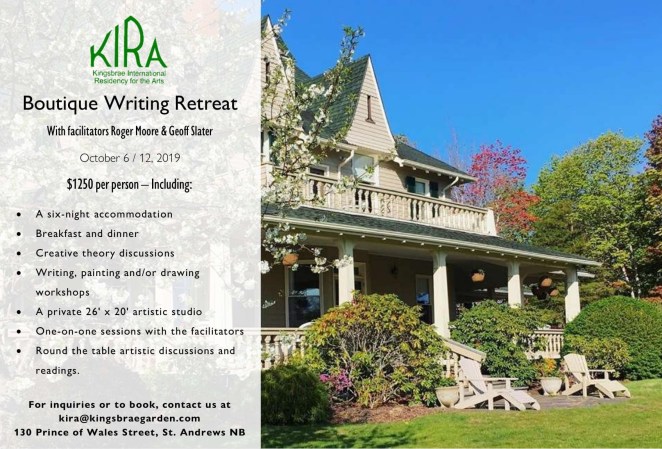
This is the new advertisement for the KIRA (Kingsbrae International Resdencies for Artists) Fall Session (October 6/12, 2019). Geoff Slater and I will be again facilitating a week of creative workshops, including drawing and painting (Geoff) and writing (Roger, both poetry and prose). These will take place in the KIRA Residence, just beside Kingsbrae Gardens. Residential enrollment is limited to five people. Just send us an e-mail if you are interested in attending this workshop. If you click on the KIRA link in the first line (above), be sure to watch the opening video. Pictures speak louder than words and the video will help you to understand what Creativity at KIRA is all about.


Growing Up

IMG_0817 (4).JPG

Growing Up
in Brynmill

They drag the kids kicking and squealing
from childhood’s universe into an older
world of smoking and drinking, forbidden
fruits stolen after Christmas dinner when
drowsy grown-ups’ eyes are turned away.

Why do bigger boys follow smaller ones,
buying their sisters’ kisses then thrusting
their fingers into little girls’ knickers, or
invading Woolworth’s and tucking stolen
goods in shirts with their buttons undone?

The games they play: offering a little girl
a cigarette  or a sweet while two boys
wait behind the garden gate with a sharp
knife to  press against the victim’s throat.

Zeitgeist

IMG_0638.JPG


Zeitgeist

Zeitgeist is a concept from 18th- to 19th-century German philosophy, translated as “spirit of the age” or “spirit of the times”. It refers to an invisible agent or force dominating the characteristics of a given epoch.
Wikipedia 

Those who cannot learn from history are doomed to repeat it.

“Plus ça change, plus c’est la même chose.”

Poems for troubled times.

My current poems are deliberately cryptic. Each one is a mind game I am playing with you. I do not underestimate you. I have placed clues throughout each poem and if you follow the clues you will arrive at many of the poem’s hidden meanings. Some poems are more difficult than others, their meaning more recondite. Others seem very straightforward, yet still contain secrets.

This style of poetry has a long history going back to Anglo-Saxon riddles and way beyond, back into the mists of time. Luis de Góngora (1561-1627) and Francisco de Quevedo (1580-1645) specialized in similar forms of recondite poetry, often based on metaphor and the juego alusivo-elusivo, the game of alluding to something while eluding the act of saying what it is. Jorge Guillén (1893-1984) and Federico García Lorca (1898-1936) also played this game, as did Octavio Paz (1914-1998) and many of the surrealist writers. In the works of all of these poets, the clues may rest in the poem or they may be found in a generic knowledge of the mythology of the poem’s exterior world.

Our world finds itself in an incredible mess right now. Somehow, we have to sort it out. We must pick our ways through the difficulties of these troubled times, as you must pick your way through the intricacies of these poems. Many of you will give up. Some of you, the chosen few, will make your way to the heart of each poem. Remember that images and metaphors tie past, present, and future together. Each word, each image offers a picture that reflects some of the shared realities with which we live.

Remember, as I said above: “those who cannot learn from history are doomed to repeat it” (George Santayana). Otherwise expressed, in the words of T. S. Eliot: “Time present and time past / are both perhaps present in time future / and time future contained in time past” (Burnt Norton). The seeming anachronisms in my recent poems suggest that perhaps all time is ever-present and always one.

Madness & Method

IMG_0622 (2).JPG

Madness & Method
(1729 & 1955-1962 AD)

his voice woke the wilderness
shook bread from heaven
he cast it on wild waters

scything and tithing
Frocester’s old barn
Gloucester a stomping ground
walking and biking
whenever he can

dry dusty parchments
old faded leaves
talking together
among the wheat sheaves
Hebrew Greek Latin
vernacular spaces
falling like rain
between words on a page

dearly beloved
moved into sundry places
a town mice stirred into open fields
harvesting blackberries and apples
gleaning like a country mouse
house tumbling wind-blown down

marooned now and listless
an old hermit crab
basking on a sun-dried beach
quilts and crisp  sheets
mermaid-hair pillowed
claws click and comb
fresh footprints laundered
warm summer sands

Orphanage

img0040_1

Orphanage
(circa 1948 AD)

black crucifix
ivory figurine
white walls
cowled heads
downcast eyes

holy water
damp fingertips
genuflection
sign of the cross
in nomine …

salt tang of tears
wax-scented floors
flip flop of leather
sandals without socks

brown robes
black skirts
hair covered
white wimples
rattling of rosaries
telling of beads

musty confessionals
shaped and shamed
by shadowy sins

time without end
dustless and clean
cleaner than consciences


Avila 2007a 039


My Favorite Pen

IMG_0395.JPG

My Favorite Pen

This is my oldest Mont Blanc fountain pen. I must have bought it in 1986 when I traveled to London to attend a Spanish Golden Age seminar at one of the university colleges. I can’t remember which, though I do remember the seminar was on someone called Francisco de Quevedo. We met like spies, my pen friend and I, on the steps of the British Museum. I had never met him before, so he carried a specific book under his arm, one of Quevedo’s I think, by which I would recognize him. We lunched together at an Italian Trattoria, whose name also escapes me, and we discussed the ways of that ancient Hispanic world and our own research upon it. I paid for our lunch from my travel funds. I had a sabbatical that year and had arranged a short tour of four or five British universities in my search for knowledge. After lunch, he took me back to his London college and I sat and absorbed wisdom from 2:00 until 5:00 pm.

After the seminar, walking back to the nearest tube station, I passed a shop that had this Mont Blanc in the window. I went in and bought it. On the spot. No second thoughts. Then I caught the tube to Paddington station. While waiting for the train back to Cardiff, I sat in the station bar and ordered a pint of beer. A well-dressed man, slightly older than me, asked if he could join me. I said yes. He sat down and began to talk. He told me how to commit suicide by slashing my wrist with a knife.  There were many incorrect ways to do it, he explained. But only one right way, if you wanted to be successful. He rolled up his sleeve and showed me his collection of scars that ran crisscross and welted over his left wrist. Failed attempts, he said. But I’ll get it right next time. I wouldn’t want you to make the same mistakes as me, if you decided to try it.

Must go, I told him. My train’s about to leave. I left the remains of my pint on the table, looked back, and watched him finishing my beer. Good job I didn’t spit in it, I thought. Then I realized that I probably had, one way or another. I boarded my train and 90 minutes later I was back in Cardiff. No more post-war, coal and steam engines, a diesel this, powerful, fast, and smelly. It reduced the former four hour journey to much, much less than two. Cafeteria style, the train carriage offered a table top for every four seats. I opened my new pen and wrote in the pocket journal I had bought for the trip.

So many memories. But I don’t remember the names of either of these two men. I do recall those scars, though, deep and ridged, crisscrossing like railway tracks. Every time we clicked over a junction or a cross track I shivered and my writing wiggled on the page.

IMG_0396

Pen Friends

IMG_0376 (2).JPG

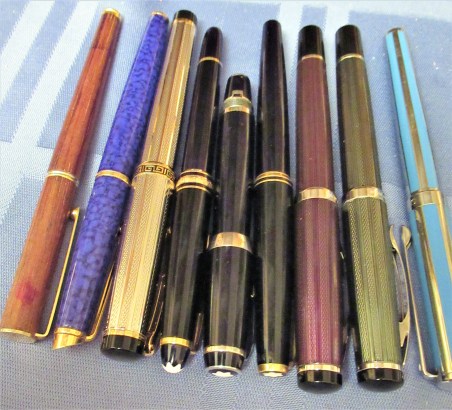
Pen Friends

A writing day, today: so, spoiled by choices, even though some of those choices have grown wings and flown away. Pen friends and mood pens: I think I’ll begin with … and they are color coordinated for ink … this one … but you’ll never know which I chose … Maybe it will be my Waterman’s: speckled blue, second left. I do love pens: so essential to write with. Cursive hand-writing too, no longer taught in schools. It has become my secret code: nobody can read it.

But do you remember when pen friends really were pen friends and you wrote long letters to people in France, or Spain, or Germany, so they could practice their English and you could practice whatever language they spoke? I can remember playing postal chess with some of my pen friends. A move per letter and each letter taking a week or more to arrive. A full game with a pawn ending could take years! Did anyone ever meet their pen friends, I wonder? I know I did. I think of the immediacy of today’s online dating sites and I sometimes sigh for the old days. Courting by fountain pen … the slow and solemn can-can of two tortoises in the Carnival of Animals by Saint-Saens.

I write every day in a hand-written journal and have done so most days since 1985. I also keep a pocket notebook for odd moments, usually when I am outside in Mactaquac, or Funday National Park, or on Prince Edward Island, or at the beach in Ste. Luce-sur-mer, or beach-combing in Passamaquoddy. If I manage to write anything decent, I transfer these written ‘gems’ to the computer, where I revise and re-work. My poetry is almost always penned, but short stories usually go straight onto the computer, as do the novels, I have written three, though ideas and plans for stories and chapters do appear in the journals. I have come to think of the journals as a quarry and a memorandum, the computer as a workshop.

Come to think about it, I have, in the not-so-distant past, given workshops and seminars on just this topic. It is a very useful and informative subject, especially for beginning writers. With it comes the statement that (a) we must learn to recognize good writing when we see it; (b) we must learn to recognize, and reject, poor and weak writing; and (c) we must realize that we are not writers, we are re-writers. I always recommend people to keep their early drafts. Our tendency as re-writers may well be to revise out the energy and spontaneity of the original. This usually happens when the high-school policeman (thank you, Ted Hughes) steps into our brain and lectures us on how to write properly and correctly. If we lose that initial emotion, we must re-re-visit the original flow and try to recapture it recapture it in the re-re-write. Now here’s a good question: how many re-re-re’s can we get in there?


Forgetfulness


IMG_0225.JPG

Forgetfulness

a lone dog tied out in the rain
a lost German Shepherd barking at stars and moon
grass growing through plastic flowers on a grave
a name eroded by the sand paper wind
a solitary sea bird carving its name on a cloud
a sea gull slicing the sky with its wing
unwashed dishes sunbathing in the sink
a knife and a fork side by side not speaking
the bike with a flat tire growing dust by the door
the kite’s face locked in the prison of the tree
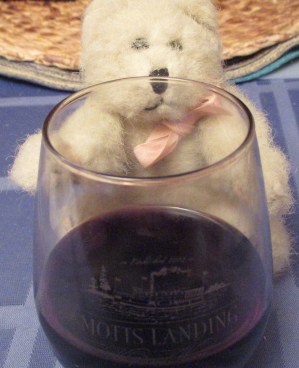
a teddy bear sitting by a forgotten glass of wine

Forgetfulness is also me and my blog. I have been writing elsewhere all week, preparing two manuscripts for a competition. It’s been a long slog: gathering the material, organizing it, structuring it, revising it, polishing it, cutting unwanted material, searching for valid replacements.

Tuesday I had the honor and the pleasure of working with a local high school in their  creative writing program. I am no longer a part of the Writers in Schools Program (WiSP), so this was a freebie. I came, I sat, I talked. And then I drove home again. I answered questions from the students on my life as a writer. It was very interesting for me as some of the questions were sharp and pertinent. How do you deal with writer’s block?   Do you write by hand or on the computer? Where do you get your inspiration? Hopefully my responses were of some interest to the students who gathered to listen. The one question I expected to field was never asked: “How much do you earn as a writer? The answer of course is very little, if anything. I write for pleasure, not for money, and I have never been published by a major press.

According to TWUC, the Writers’ Union of Canada, the average earnings of a writer in Canada are $12,500. Subtract the millionaire big earners (e.g. Margaret Atwood, David Adams Richards, et al) and most writers earn considerably less. Poets are traditionally at the bottom of the pay scale and I am principally a poet. The transition from print to digital also has everyone running in different directions. Personally, I like writing. I don’t like the marketing, advertising, selling of myself and of my books.  In fact, I now self-publish and give my books away. There’s very little money in it, but I enjoy myself and my friends seem to appreciate the gifts I give them.

Unless you are a ‘top draw writer’, working with a large, established company, you are unlikely to earn much money from your creative writing. In fact, many writers make their money from workshops, fellowships, grants, residencies, retreats, and things like that. I took a different direction. I chose to be an academic / teacher / researcher (full time) and a writer on a part-time basis. The academy kept food on the table for my family. The writing was always in addition to the mainline job. Retired now, I can dedicate myself to writing full-time, and that is just what I am doing.

Writing: so many meanings, so many ways to write. I blog, I maintain a journal, I write e-mails, I post to Facebook, I write poems, short stories, and I have written three unpublished (and probably unpublishable) novels. Also on two separate occasions, I have run a weekly sport’s column (athletics and rugby) in local newspapers. I have written academic books, translations, book reviews, peer-reviewed articles, and I have maintained, with the assistance of my beloved, an online bibliography and an online searchable data base. I have also helped edit some fourteen academic journals during my time as an academic. In my editing career I have been an editor, a co-editor, an associate editor, an assistant editor, an editorial assistant, and a book review editor, as well as sitting on the editorial and / or advisory boards of a handful of magazines. I have managed to do this in three languages (English, French, and Spanish). So, what exactly do I say when people ask me “What do you write?”

I am also a fan of the following statement, though I cannot remember where I first heard it. “We are not writers, we are re-writers.” This is certainly true of my editorial roles in academic magazines, for I have done a tremendous amount of rewriting and revisions for the people who have submitted their work to the magazines I was helping. So, there it is, in a nutshell … except for one thing, I have been involved in so many writing experiences, that I have forgotten many of them. Forgetfulness: the theme of today.