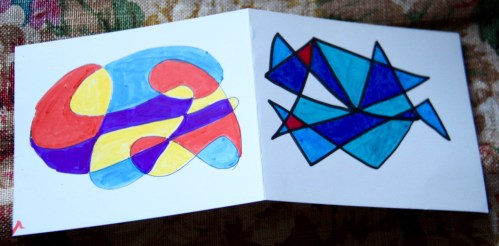
Yellow Bird

IMG_0176

Kingsbrae 5.1.1
5 June 2017

Yellow Bird

Broken-winged, a bird I found,
panicking upon the ground.

I stooped to lift it from the land:
it nestled in my open hand.

A matchstick splint with cotton tied,
a canary cage to rest inside.

With healing done, an open door:
my yellow bird will fly no more.

I take a pencil, draw a tree,
my bird begins to sing for me.

I erase the cage bars, one by one,
paint a lion’s mane of sun.

Now yellow bird sits in his tree,
and sings all day, to inspire me.

Comment: I split the original post into two segments. The first, 5.1.1 is the poem Yellow Bird and the voice recording. The second, numbered Kingsbrae 4.3 Encaustic, contains the summary of the first evening’s artistic discussion.

Metaphor: Wednesday Workshop

img_0177

Metaphor
Wednesday Workshop
26 October 2016
Revised
31 May 2017

Metaphors: What are they? I must be honest: I don’t really know. I don’t understand them. I never have. I probably never will. This morning, I determined to find out what a metaphor really is. So I Googled metaphor and came up with the following definitions.

  1. A metaphor is “a figure of speech in which a term or phrase is applied to something to which it is not literally applicable in order to suggest a resemblance.”
    Well, that is pretty clear, isn’t it?
  2. A metaphor is “something used, or regarded as being used, to represent something else; emblem; symbol.”
    No doubts there.
  3. “Metaphor is a figure of speech which makes an implicit, implied or hidden comparison between two things that are unrelated but share some common characteristics. In other words, a resemblance of two contradictory or different objects is made based on a single or some common characteristics.”
    I know exactly what they mean. Or do I?
  4. “In simple English, when you portray a person, place, thing, or an action as being something else, even though it is not actually that “something else,” you are speaking metaphorically.”
    No misunderstanding here.
  5. “A metaphor is a figure of speech that refers, for rhetorical effect, to one thing by mentioning another thing. It may provide clarity or identify hidden similarities between two ideas. Where a simile compares two items, a metaphor directly equates them, and does not use “like” or “as” as does a simile.”
    Slightly clearer, but not as clear as daylight.

I turn to my blog in search of metaphors that I have created in my poetry and read that “The egg of my skull / shows hairline cracks: / tiny beaks pecking / fine-tuned sparks of song”. “This piece,” Tanya Cliff writes, “offers a unique and beautiful perspective on the theme (of birds).” I think I can do without the dull, dry definitions set out in the definitions above and understand metaphor as “a unique and beautiful perspective”. This functions for me. Thank you, Tanya.

Two more sequences, this time from October Angel: (1) “she gathers her evening gown / and walks among ruined flowers” (Meg Sorick’s choice) and (2) “a snapdragon opens / the frosted forge of its mouth / and sprinkles the sky / with ice-hard shards of fire” (Tanya Cliff’s choice). I can understand the first in terms of “a unique and beautiful perspective” since the picture of the October Angel is clear in my mind. In addition, evening / evening gown / ruined flowers are particularly evocative. The second sequence is much stronger as anyone who has seen the snapdragon flowers braving the ice and frost will testify.

After thinking about these three examples, I think I can now understand metaphor a little bit better. I would now define a metaphor as “a brief verbal sequence that creates a new reality that offers a unique and sometimes beautiful perspective on something that we have long known and accepted but now, thanks to the writer / poet, see in a different light.”

This personal definition allows us to distinguish more easily between dead metaphors and clichés like dead as a door nail or avoid it like the plague while allowing us to enjoy the permutations that spring from the innovation of the true metaphoric sequence. The metaphoric sequence also allows us to distinguish between a two word metaphor and a series of metaphors that are thematically linked.

From my own poetry, ruined flowers would be an example of the first while the longer sequence a snapdragon opens / the frosted forge of its mouth / and sprinkles the sky / with ice-hard shards of fire would be an example of the second. Iterative thematic imagery, a form of sequenced metaphor chains, then links the whole work, be it poem or longer piece, within an associative semantic field of parallel meanings. This also illustrates the idea of differentiating between the inorganic and organic conceit, where the inorganic conceit is the example of a single, independent instance while the organic conceit is woven into the fabric of the oeuvre.

In the WFNB Workshop on Metaphor, held in Saint John on Saturday, 27 May, 2017, we had a two hour, in-depth discussion on this topic. We began the workshop with a meet and greet and ice-breaker. Then we offered a pictorial definition of a metaphor. We generated a series of dead metaphors, to be avoided like the plague, except where we use them to define a character, or make fun of them, or use them in a new fresh light that resurrects them and brings them back to life. This was a great deal of fun. We then indulged in a series of creative writing exercises that focused on the creation of new metaphors. We finished the workshop with a “song of craze” in praise of the joys of metaphors. What a day!

The structure of the workshop was very simple. We had 120 minute (two hours) and broke them into 3 sessions of 20 minutes, a 5 minute break, 2 sessions of 20 minutes, and  a grand finale composed of 3 sessions at 5 minutes each. The twenty minute sessions broke down into 5 minutes writing, 7 minutes small group discussion (4 participants per group), and 8 minutes full room participation. The five minutes writing centered on each person writing to a topic. Each member of the group then shared what they had written with the other group members. This helped develop individual voices (the theme of the conference) and showed how each individual approached a single topic in a multitude of different ways. A representative piece from each group was then chosen and the writer read the creation to those gathered in the full room participation.

As a result, everybody was actively engaged in the thinking, writing, creating, reading, and critiquing process. A considerable number of what I call “writing starts” were made. Hopefully participants will continue to develop these writing starts and develop something from them, long term.

Teddy Bear Tales TBT 1


Empress 048

Oppressive-Possessives
TBT1

 Teddy Bear Tales 1

 “Possessives are oppressive,” my Teddy Bear whispers in my ear. “I’m not your Teddy and you’re neither my owner nor my master. The world exists without you possessing it. It will continue without you. And yes, I hear you, especially when you talk in your sleep. ‘My wife,’ you mutter, ‘my daughter, my flowers, my garden, my lawn, my birds, my bees, my deer, my house, my grounds, my groundhog, my car, my TV, my team, my Teddy.’ Well, permit me to share a secret with you. None of them are yours. You may think you own them, but you don’t.”

“My God …” I sat up in bed and held my Teddy Bear at arm’s length, staring into his button eyes.

“There you go again,” Teddy stared right back at me. “Whatever are you thinking? Those two little words, yours and mine, are a threat to the universe.”

My Favorite Book

img_0196

My Favorite Book

Last night, my writing group threw the table open for discussion on ‘my favorite book’. I listened as each member of the group came up with a title or two and then chose a book that was ‘the favorite’. When my turn came, I was last, they all turned to me, but I remained silent for a long time and then: “I can’t do it,” I said. “I bet it’s got windmills in,” one person remarked, thinking of my propensity of frequently quoting Cervantes’s Don Quixote as a model when literary discussions arise. Indeed, Don Quixote might be my favorite book, but is it?

Let us begin with the concept of book. Is a book something contained between two covers or could it be a series of books? For example, does one choose between The Chronicles of Narnia or must one select The Lion, The Witch, and the Wardrobe over The Silver Chair? Is one free to choose The Lord of the Rings, or must one prefer The Two Towers, say, to The Return of the King? By extension, where exactly does The Hobbit stand, as a book, in book form, in relationship to the later and longer series? Or The Silmarion? Again, can we roll them all together, a series of books under the cover of one book, a favorite book?

The idea of favorite author versus favorite book then surfaced and we discussed Georgette Heyer, John LeCarré, equally loved and loathed, Jane Austen, the Bronte’s, J. K. Rowling, and William Shakespeare. The mention of Shakespeare led us into plays as reading material and plays as performance, and performance as on stage or on film. One of our members loved Shakespeare on film and TV, but didn’t like reading Shakespeare, because it was ‘difficult to read and needed the interpretation of the actor for the meaning to come across’. This same person did not like LeCarré’s books, but was very appreciative of his work on film. Where does George Smiley begin and Alec Guinness end, one asks? How can we separate the character from the actor? Applied to James Bond, who is James Bond? Is he Sean Connery (totally unique and my personal favorite), Roger Moore (better for me in the role of Simon Templar, The Saint), or one of the later and newer actors who have taken over the role? By extension, should James Bond be played by a black actor (why ever not I ask?), and could (oh horror of horrors!), a female actor take over that role (I’d love to see it … “I’m Bond. Jane Bond!”)?

This led us into the art of the narrative and the relationship between book as narrative and film as narrative. Clearly they are two different forms of media, but how do they influence each other? The book obviously comes first. We can talk of the seventeenth century novel, but it is difficult to talk of the seventeenth century film. So, the linear narrative of the book comes first and then that book is turned into a film. However, a film contains its own narratives structures and these include multiple points of view, split screens, flashbacks and time distortions, and a multiplicity of other devices among which the actual scenic impact is of the utmost importance. For most of us, the nineteenth century novel (no radio and no television for entertainment in those days) is long drawn out and very slow moving. We miss the instantaneous impact of screen and TV with the breaks for advertisements and the time to recharge our coffee cups and snacks. This leads us to our own attention spells as readers and our own demands for the instant gratification of a thrill a minute. “Hook them on page one and addict them by page three,” one person commented to many nods from around the table.

But the mention of Don Quixote also takes us into other areas. In this age of bi- and multi-lingualism, do we prefer to read our books in one language rather than in an another? Don Quixote in Spanish or French or English? And which translation? There are some twenty translations of Don Quixote into English. Is one preferable to another? Which is more accurate in the terms of a translation? Which reads more easily in terms of a re-creation in artistic form of the original? Should we prefer an English-English translation to an American-English translation? And where oh where is the Australian, Indian, Pakistani, South African, Canadian, Irish, or Welsh translator who will justify that famous text in his own country’s rendition of what used to be called the King or the Queen’s English?

Don Quixote, according to the great Spanish literary critics, is a book for the three ages of life. Readers should read it when they are young, when they are middle aged, and when they are approaching old age. Why? Because one’s reading and understanding of the book changes as one grows older. If this is true, then can we not expect to have books that we preferred at an earlier age in life, The House at Pooh Corner, for example, or The Wind in the Willows? And what about our early teens (adolescence), our early twenties (university years)? The idea of our being able to choose a ‘favorite book’ becomes less and less clear as we open up our minds to the broader horizon of tastes that change as we age and mature.

You will have noted that, with the exception of Shakespeare, we concentrated on the twin ideas of fiction and narrative, be it in word or on the screen. What about poetry? Five major critics met at the Modern Language Association of America’s meeting held one year in the University of Toronto and held a panel discussion in which they discussed why and how they had been attracted to the foreign language that they had studied. In four of the five cases, it was the poetry of the language, not the theatre or the narrative, that had pulled them in. Last night, we did not discuss poetry.

When we bring poetry to the table, we open a different discussion. We rarely read and appreciate ‘books of poetry’. With a few notable exceptions, it is individual poems and poets that attract our attention, rather than entire books or collections. And what is it about poetry that attracts us? Surely, it is the power, not of situation nor of action, but of language. It is the sheer power of language and the thrill of words that draws us to poetry. Perhaps that is why, in an age of impatience, we have less time for immersion in the magic spell of words and their undercurrents of subtle meanings. As a friend of mine said to me, the day before yesterday, “I started your poetry book, Obisdian’s Edge, but it was too deep for me, too difficult. I gave up on it. I needed something simpler to read.”

Comment: This article should be read in association with an earlier piece in this blog (15 July 2016) on My Top Ten Books.

Hyperbole: Wednesday Workshop

img_0177

Hyperbole

It is no exaggeration to say that Hyperbole is one of the most exciting and fascinating aspects of rhetoric.

At its most basic, hyperbole means exaggeration. When we start to explore the term, however, it means oh so much more.

Looking up synonyms for hyperbole, for example, we find the following: exaggeration, hype, metaphors, overstatement, amplification, coloring, distortion, embellishment, enlargement, magnification, PR, big talk, embroidering, laying it on thick, making a mountain out of a molehill, tall talk.

But let’s not stop there. Merriam Webster offers this as a definition: The representation of something in terms that go beyond the facts. “Enough food to feed a whole army” is a common example of hyperbole. Here are some more suggested synonyms, with a few overlaps: caricature, coloring, elaboration, embellishment, embroidering, embroidery, exaggeration, magnification, overstatement, padding, and stretching. Related words include: amplification, enhancement, fabrication, misrepresentation, fudging, hedging, hype, puffery, plum-mcduffery, and superlative.

The Power Thesaurus suggests that there are over 263 synonyms for hyperbole. It offers 14 pages of them. Here is the start of page one:

exaggeration / image, parallel, flower

overstatement / exaggeration, adornment, coloring

metaphor / exaggeration

embellishment / exaggeration, excess, decoration

distortion / exaggeration

magnification / exaggeration, fancy, line.

We could go on and on and on with this, world without end, secuale seculorum, for ever and ever, and all that, without exaggeration. The point is clear, we have more than enough definitions here to fill several rather large books and clearly, without being too catty about it, it would take at least nine lifetimes to read and understand them all.

Meanwhile, hyperbole possesses an adjective: hyperbolical. This is sometimes confused with the term hyperbolic which in turn is occasionally confused with the term hyperbollocks, as in the saying: “this article is, without embellishment or exaggeration, a load of hyperbollocks.”

Chuck Bowie comments: “Down the road, I hope we get to see your take on how to employ this useful tool without reducing the document to caricature.”

Roger Replies: Thank you for your comment, Chuck. I think that the application of hyperbole to a literary text or an image within a text depends entirely on the individual author. As authors and human beings, even in our daily speech and our interactions with other people, we can and do exaggerate. How we apply hyperbole to our structures and stories and characters is very individual. Clearly there must be a balance between emphasis (potentially good) and over-exaggeration (potentially bad, but with strong potential for parody and comedy), but so much depends on the individual situation. A stylistic analysis of each instance will reveal if the hyperbole is excessive. However, in my opinion, that necessitates the presence of a text, rather than a doctrinal theory about ‘how to do it’. The easiest way might be to analyze a text or two and see how hyperbole functions in specific circumstances. Certainly, as you so rightly note in the above comment, hyperbole can be used for comic purposes, as I have done in my article. Its overuse can both be criticized and parodied. An interesting study, with the seeds of a doctoral thesis planted therein, would be to demonstrate how, in Don Quixote, Cervantes moves from a hyperbolic parody of his character to a truer understanding of the essential dynamics of the main characters’ essential personalities. If I were fifty years younger, I might start that doctoral thesis.  Alas, within the self-imposed parameters of  this blog, there is neither time nor space. We can continue this conversation at our leisure. Thank you for responding.

Algorithms

img_0177

Algorithms
Wednesday Workshop
26 April 2017

I want to begin by confessing that I don’t know what they are. Algorithm: it sounds like a word pulled out of a lexicographer’s top hat or a question from a Grade 9 Spelling Bee.

“May I have the definition?”

“Certainly: it’s ‘a step-by-step procedure for solving a problem or accomplishing some end especially by a computer’ …” (Merriam-Webster).

Before we go any further, please watch this brief, very explicit (self-explaining, sorry) video.

https://www.youtube.com/watch?v=oP3c1h8v2ZQ

So, if I understand the video correctly, an algorithm, applied to literature, is a program that (a) analyses the structure of texts and (b) establishes whether or not a specific text follows the necessary steps or procedures for that text to become (b.1) a best seller or (b.2) an acceptable potential book in which an investor (aka publisher) could or should invest his / her money.

Where does this leave us as writers? We have spoken before about the Guardians at the Gates and the Judges who determine our fate when we enter literary competitions (see below)

https://rogermoorepoet.com/2016/05/31/winning-not-whining/

Suddenly, these Guardians are no longer fallible flesh and blood but infallible wires, nuts, and bolts joined by electronic circuits.

So, we have a story. Right? Right length. Right theme. We think it is good. We submit it to an editorial house. What happens next? Well, it depends. A major house won’t touch it unless put forward by an agent. No agent? It molders to a prolonged, slow, very slow death on someone’s desk. Electronic submission? Wait a minute. Some secretary may read the first five pages and find them good. Then, your submission may be sent to Death by Algorithm.

How is that algorithm prepared? Thousands of best-sellers and classics are fed into the computer program, analyzed, sorted into lines and curves, highs and lows … then your manuscript is fed in. If its computerized profile matches their computerized profile (the algorithm) then BINGO … you may have a foothold on the first rung of the lowest ladder that leads to winning the literary lottery!

Or not.

What can we, as writers, do about this? Absolutely nothing. We must believe in ourselves. We must believe in our writing. We must keep on writing. We must publish where and when we can … and, above all, along with Albert Camus and Sisyphus and his rock, il faut imaginer l’écrivain heureux / we must pretend that, as writers, we are happy.

And that, ladies and gentlemen and others, is a pretty sorry state of affairs and a pretty lousy (but very interesting) piece of translation.

Chaos

Chaos

Chaos

Chaos theory:
it states that we don’t know
what we’re doing and
it wouldn’t really matter
anyway, even if we did,
because life lacks meaning,
chance rules, and Lady Luck
with her lusty locks attached
to her forehead and she,
all bald and hairless
from behind, must be caught
as she arrives, because later
is much too late, and when past,
she’s gone for good and
our good luck’s gone with her,
and we’re left for ever,
sitting there, head in hands,
bemoaning all that milk spilled
before we ever had a chance
to actually taste it.


Three Unities

img_0177

The Three Unities
Wednesday Workshop
19 April 2017

The Three Unities

The Three Classical Unities are those of Time, Place, and Action. They are usually associated with classical theatre. It is worth remembering that, in the sixteenth and seventeenth centuries, when poetry and theatre ruled the artistic world of the west, the novel was relatively undeveloped and narrative form was concentrated in epic poetry. In fact, one of Cervantes’s greatest innovations was to draw a parallel between the modern narrative, as he developed it, and epic poetry. “También la épica puede escribirse en prosa,” he wrote in Don Quixote, I, 47. ‘Epic poetry may also be written in prose.’ Lyric and epic poetry had a different construct to the theatre, so it is really the classic theatre that we are discussing here, rather than poetry and prose, though all forms of creativity benefit from a knowledge and understanding of the three unities. Let us look at these unities one by one.

Unity of Time: The play should take place within a time frame of a day, twenty-four hours. This concentrates the action at the moment of maximum impact, or crisis, when the major decisions are being taken. In order to fill in the background details of what happened before, a confidant is often used, especially in French theatre, and this confidential person, or adviser, assists the main characters in coming to their decisions by providing missing background information.

Unity of Place: The play should take place in the same house, as a minimum, and preferably in the same room of the house. This limits travel, and the wanderings of Odysseus, for example, would be impossible in the classical theatre. This is a restriction that was blown away by epic poetry. The narrative forms also rejected this type of unity as they developed, and contemporary film, with its total mobility really reduces Unity of Place to the realms of history and the Absurd.

Unity of Action: All action within the play should be subordinated to the main plot and the main characters. There should be only one plot, but a minor plot is permitted provided it echoes, mirrors, and reflects upon the main plot. Unity of action is interesting in that, to a certain extent, it has remained with us. Television shows, especially police and crime shows, may have multiple actions, but they all link together to form a pattern of events that are linked within a series of unified patterns. It is these patterns of unified action that so often reveal the criminal.

Unity of Theme: Spanish classical theatre, under the watchful eye of Lope de Vega, broke all the unities as established above, but created a new unity: unity of theme. This, too, has demonstrated its longevity and is still with us. Thematic unity is common to all forms of literature and is a binding thread in poetry and prose, theatre, film, and novel. Unity of theme suggests that beneath the surface movement of the art work, there is a thematic unity, a set of deeper ideas, if you like, that provides links to all the action and thought.

Closely linked to these four unities is what I call Unity of Language. Unity of Language is consistent within characters, the way they speak, the way they use language. It is also consistent within a poem or a book. Sometimes it is based on the concept of Associative Fields according to which each word is surrounded by a series of associations (the Associative Field) that links words to each other at one level and to a central theme at another level. The use of Associative Fields is greatest in poetry and those forms of writing that base themselves on poetical repetition. In fact, the Associative Field may be looked upon as a form of repetition that provides emphasis by repeating a theme while avoiding the repetition of the same word within that theme.

I look on the development of art and culture as akin to the movement of a pendulum on a grandfather clock. On one side, let’s call it the right, the pendulum demands rules, immutable rules, and writers that stick to those rules. On the other side, let’s call it the left, there are no rules and chaos reigns in a creative land where the broken rule is the law of the day.

Classicism, in the sixteenth and seventeenth centuries, was followed by Neo-Classicism, in the Eighteenth Century, and this was an even more stultified form than classicism itself. The Romantic Movement, on the other hand, broke the rules of Classicism and brought energy and freedom to all forms of art. As Victor Hugo said: “J’ai mis un bonnet rouge sur le vieux dictionnaire.” ‘I have place a red [French revolutionary] bonnet on the old dictionary.”  Romanticism is Revolution. In art, we need regular revolutions. The next major revolution is always just around the corner. Or, as the pendulum theory suggests, maybe the next revolution, waiting just around the corner, is a swing of the pendulum back from freedom (Romanticism) to restraint  (Classicism).

Certainly we modern authors may exercise our choices in a way that older authors could not. We can and should be aware of all that has gone before us. Knowing the traditions from which we write allows us to write better and to choose better, taking or rejecting that which we want and that which suits us best in our own artistic endeavours.

Sinister

IMG_0186

Sinister

What the left hand does
when the right hand doesn’t
know what it’s doing
is an attempt to re-pattern
the brain, to slow it down,
as the pencil spider-walks
its wandering way over the page
like my father’s did when,
stroke-stricken in the right hand,
he transferred his pencil to the left
and sought to-re-establish control
over tiny, manageable things,
and yes, he often cut himself
shaving, but he didn’t like beards
so he never gave in and shaved
every day, died fighting,
and did not go gentle,
and neither will I.

Comment: This is a very raw poem, in more senses than one. I fell over on Tuesday, on the back porch. One of the porch nails, forced up by the winter ice, caught in my open-toed sandal and over I went. My head had hit the deck before I even knew I was falling. It wasn’t as bad as the tumble I had when chasing the black bear and trying to photograph it, but this fall left me quite stunned. You can read about the fall HERE. The actual bruising, not the fictional ones, can be found in #3 of that sequence. I wrote the above poem, on Thursday evening, with my left hand, while my right hand was being iced. Funny how we think of one thing while doing another: I had visions of my father, stroke-stricken as I say, trying to write with his left hand. He fought so hard to do just the smallest things. Oh yes, I have a nice bump on my head, too, and as I told the chiropractor when I visited her later that Tuesday afternoon: “I think I have already had my back adjusted once today.” The other thought that comes to me: how slow we are to heal, once we pass a certain age, or, as my good friend Jan the Stoneist says, “an uncertain age.” With that latest fall, I have indeed entered into The Age of Uncertainty.

In Medias Res

img_0177

In Medias Res
Wednesday Workshop
12 April 2017

In medias res is Latin for in the middle of things or in the middle of the story. It is a device from classical literature, going back to Homer, that allows the narrator to start the tale half way through, to return to the beginning to show what has happened leading up to the current situation, then to end the tale in suitable fashion with all the necessary details now in place.

In some ways it’s a bit like the arrival of a pizza from a new pizza home delivery service. You are hungry, you make the phone call, you order the pizza, and then you sit and you wait. The doorbell rings and the dog comes rushing out of nowhere and barks at the delivery man who stands there with his delivery bag in which the pizza nestles comforting and warm. You tell the dog to sit, you hand over the money, with a tip, of course, and the delivery man takes the pizza from the bag and pops it into your hands.

You close the door, walk back into the kitchen, and everyone is there, salivating waiting to see what you’ve bought. You know what kind of pizza it is, because you ordered it. But this is the secret of in medias res: the pizza is there but it’s still a mystery. You don’t really know what the pizza’s like. It may smell nice, it may look great when you open the box, but what’s in it, or rather on it; and how does it taste? These things are as yet unknowable. They are the mysteries that give in medias res its bite.

“Seek and you will find.” But what are you looking for?

You recognize the onions,; then there’s a meatball; ooh, look, some slices of salami and bacon; then there’s red peppers and green peppers; no anchovies (are you old enough to remember that song? RIP J Geils: I remember and still like your music); it’s a high rise pastry and there’s a cream cheese filling in the crust: delicious; oh yes, that subtle sweetness will come from the pieces of pineapple that decorate the pizza. Cheese: there’s plenty of that, three different types by the look of it and the tomato sauce is spicy and delicious.

When you take that first bite, the whole blend explodes in your mouth and the full delights of pizza burst upon you.

And that’s how I think of in medias res: no planning, washing and cutting the ingredients, no cooking, no placing in the oven, no wait as the house fills up with the smell of cooking pizza.

There’s just the pizza itself and the journey backwards to discover how it was made and what conjures up the magic of that first bite.

Beneath the surface of many people’s writing, lie lots mysterious ingredients. Sometimes, you can draw a few of them out and examine them as they flourish in the daylight. Often, they remain as mysteries, unconscious moments that float like lilies upon the surface of the story.

As I write, the sun is shining and the storm that visited us last week has all cleared away. There are deer prints by the bird feeder where the deer came last night and nuzzled for bird food.

The red spark of a squirrel sits by the feeders and four mourning doves crowd together on the balcony. I do not know where they came from and, like the deer, I do not know where they are going, although the deer tracks point to a probable destination.

In medias res: we all live there; we understand it, even if we don’t call t by its classy Latin name; we are intrigued by it; and it often lies at the center of our fascinating world.