Time changed with the clocks and my body clock is no longer in sync with the tick-tock chime that denounces each hour.
Hours that used to wound now threaten to kill. They used to limp along, but now they just rush by and I, who used to run from point to point, now shuffle a step at a time.
Around us, the Covidis thrives and flowers. Wallflowers, violets, we shrink into our homes, board up the windows, refuse to open doors. We communicate by phone, e-mail, messenger, Skype.
Give us enough rope and we’ll survive a little while, fearful, full of anguish, yet also filled with hope.
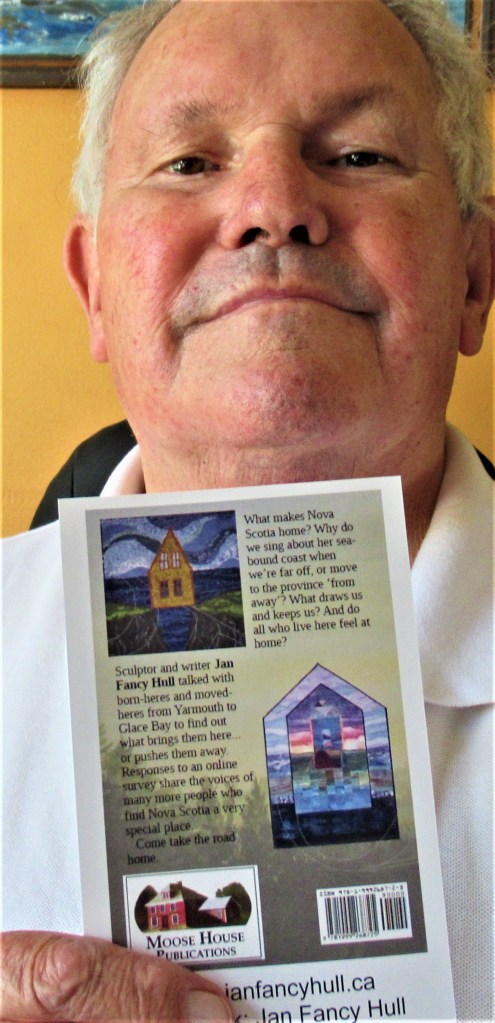
Right from the address on the envelope where you gifted me a knighthood, calling me Sir Roger, I was captivated by this package.
I opened it at the Beaver Pond in Mactaquac and started to read as Clare did her daily walk, widdershins round the pond. Alas, I missed the great blue heron flying. Ditto, the osprey and the kingfisher. I heard all about them later.
Only you, Jan, only you. You are truly unique. Your words jump off the page, lean across the table to me, and offer me bread and wine. I do hope that this book is the first of many. Your words brought tears to my eyes and hope to my heart.
So many themes that touched me deeply. The loss of language and culture: in this case, French and Gaelic, in my own case Welsh, a forbidden language when I was growing up. It is only now, at an advanced age, that I have started to learn it. What memories it brings back.
The sending of indigenous children to residential schools: in my own case, starting at age six, I was sent away to a series of boarding schools and never escaped until I was 18 years old. Good-bye family and culture: hello loneliness and solitude.
The enforcement of religion, top down, with the vicious punishments that accompanied doubt, unbelief, or non-acceptance. The brutal separation from family, with the whole experience of reintegration into a now-become-foreign world, relocation, loss of roots and culture, the difficulties of not belonging to the new communities.
There is a brighter side too, and I will get to that another day. Meanwhile, congratulations on this book, Jan. May it be the first of many and a delight and revelation to all.
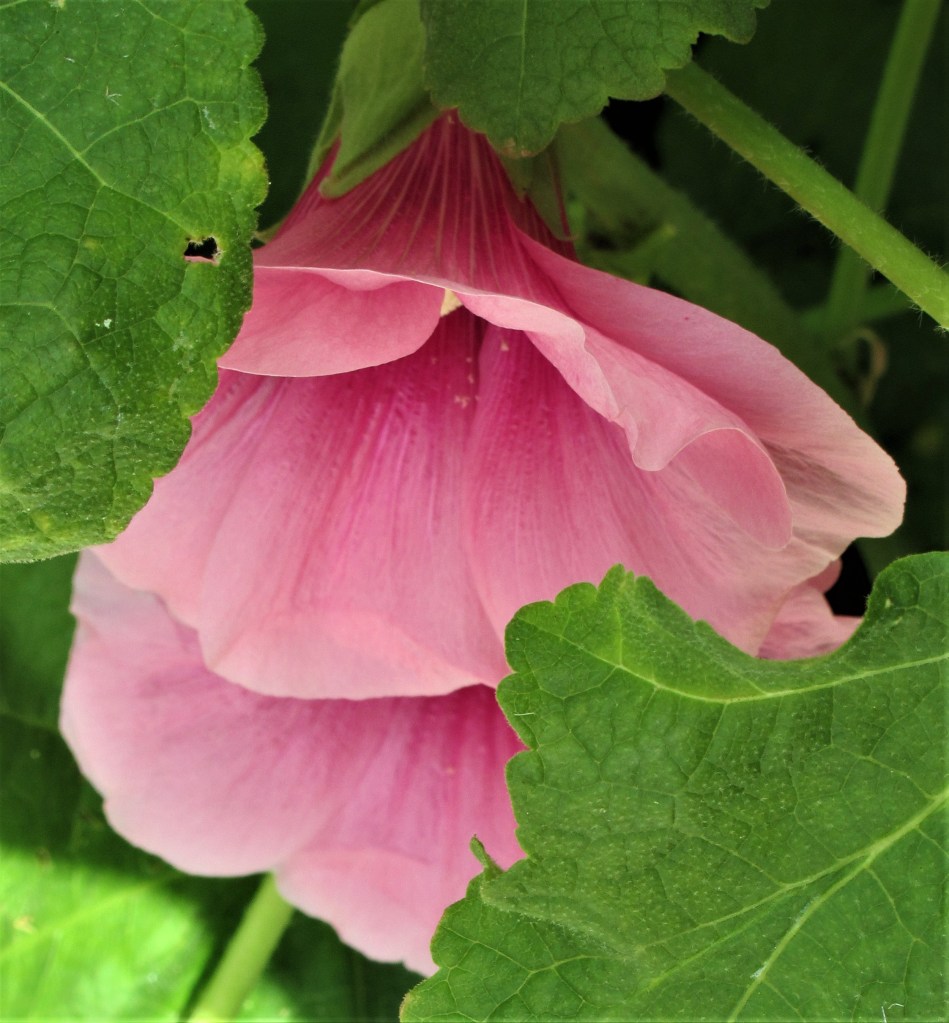
So, the holly hocks are back and this year we have some red ones to go with the lovely yellow ones that reseeded, in a different place, from last year. The red ones are very shy and are hidden away by the back steps where they are very hard to see.
I spy, with my little eye …
The red and green go well together. More a deep, blushing pink, I guess, with very dark centre. You can see the wood of the steps just behind them. I posted this yesterday, incidentally, but the computer munched it and I had to rewrite it today. It has been a slow time for me. The Corona-19 finally got to me, not in the physical sense, but mentally. As a result I have been feeling isolated, trapped, and a little bit depressed. Alas, there are many more like me suffering in today’s world. Luckily, the flowers help. As does the sunshine.
We’re back
Here are the new seeds from last year’s hollyhocks. They are similar in color, but much smaller this first season. They have also shifted location and I have been surprised at how many seedlings have sprouted and started to grow. Next year we may have a bumper crop.
Night Garden
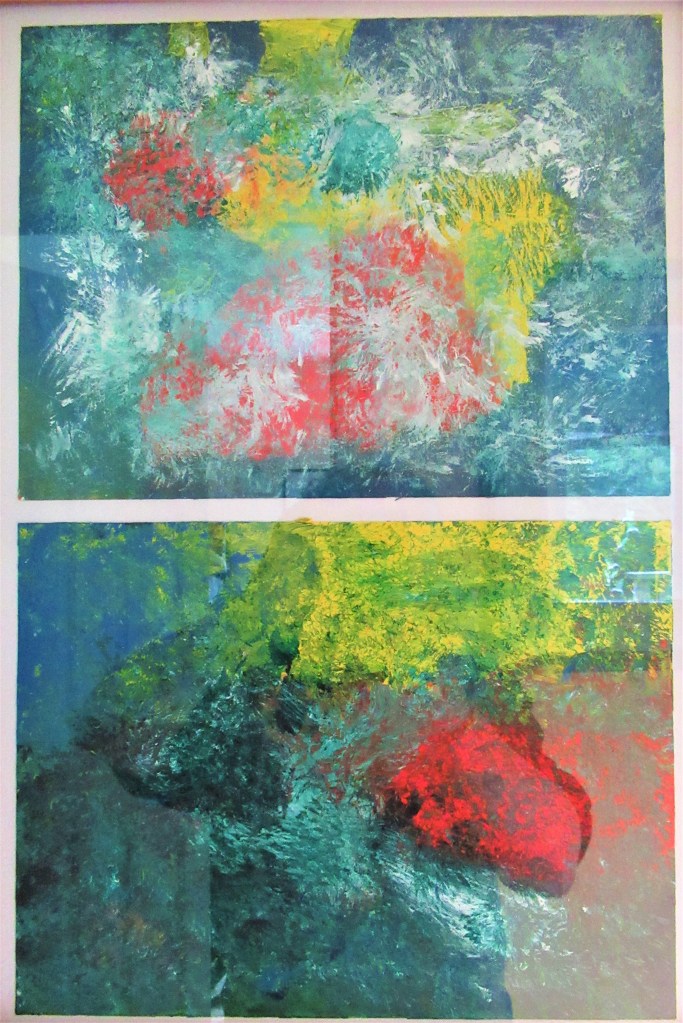
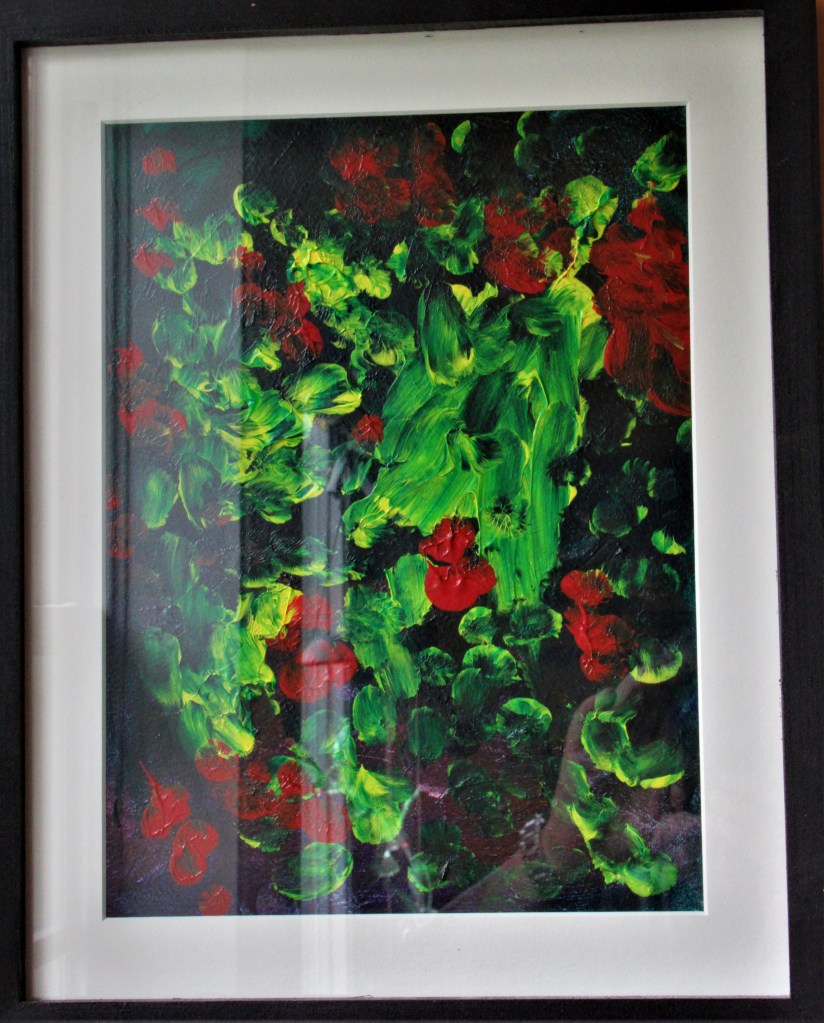
And here we have a painting of the garden at night, flourishing without us, but beneath the stars. “The garden going on without us.” Given the current situation, I prefer the garden going on with us still here to watch it.
“Ah, would some power thegiftie ge us / to see ourselves as others see us.” Robbie Burns, a Scottish Poet.
And sometimes I think the flowers would like to be seen as they see themselves, not as we see them with our imperfect eyes, not with the cataracts of the Elderly Monet, not with the blunted vision of many artists who have stopped, and sniffed, and bent their heads, and wondered at the colors that entered their paint brushes through the nostrils. Vision and reality: the photo versus the objects as we see and sense them. The reality versus our own version of it.
So who is this anonymous artist who delivers these visions to my blog and allows me to glimpse alternate realities that are so different to my realities. I think of Lorna Crozier, The Garden Going on Without Us. I think of Kingsbrae Gardens, at night, when the flowers are alone and talk only to themselves. I think of Monet at Giverny as his vision lessened and his instincts grew. Who are we? What are we? Do we see ourselves as others see us? Do others see what we see? Color, shade, light, hue … El ojo que ves no es ojo porque lo ves, es ojo porque te ve / the eye you see is not an eye because you see it, it is an eye because it sees you (Antonio Machado). Does the man or woman looking out at us from the television set see him or herself as we see them?
The night before last I sat alone in a hotel room. The television screen was much, much wider than it was high. All the facial images were greatly distorted. I didn’t recognize the people I saw, except by their voices. Who will distinguish the reality of the flowers, each by each and one by one, privatim et seriatim? Who will listen to their floral voices and call them by the names they have given themselves, rather than by their horticultural names?
Tell me, what reality do we see when we see the flowers? What reality do the flowers see when they see us? The anonymous painter who painted this picture that Geoff Slater, my anonymous friend, framed so nicely did not see those flowers the way that I saw those flowers. Why not? Why can’t I see like him (or her)? and why can’t she (or he) see like me?
Every trip to Kingsbrae Garden in St. Andrews, New Brunswick, opens my eyes to more beauty. Yesterday, I brought back this painting, Night Garden, and placed it on the wall by the garage door so I would see it regularly when entering and leaving the house. Alas, I caught the reflection from the window in the photo, but the night flowers and their colouring make up for any lapses in my amateur photography.
The painting is neither signed nor dated, so this night artist will have to remain anonymous for now. My friend Geoff Slater framed the painting but my photo does not do justice to the beauty and skill of the frame. My apologies. Alas, I must live with my inadequacies, but at least I am aware of them!
I spent a wonderful day in Kingbrae / KIRA, incidentally, chatting over a glass of wine with some exceptional local visual artists who are spending four weeks (June and July) in day residencies and working out of the artists’ studios at KIRA. Geoff Slater, the Director of Art at KIRA, led the conversations and I joined in, as did Alana, Ann, Simone, Stephanie, and Simone’s visiting friend, Renate. When artists gather at KIRA to discuss their art, the conversation is wide ranging and varies from the intensely personal to universal theories of creativity. Visiting KIRA is an experience like no other and one that I delight in every time I visit.
Summer in Wales is always as I remember it: glorious days of sun and sand and blue skies and warm winds … and especially the sun on the beaches with the water sparkling and little boys and little girls playing cricket on the dry wrinkled sand packed hard when the tide goes out and leaves the land stranded … and uncles and aunties bowl under arm, not over arm, so the little ones could manage to score lots and lots of runs … and I remember us, standing breathless between the wickets, or at the wicket, if there was only one set of stumps, or a picnic basket stood on its side, or three pieces of driftwood, with sea-weed for bails, and what are bails, you ask?
Well, bails are the sea-weed that is draped over the driftwood that stands as stumps. And we guard our stumps with the cricket bat that somebody has brought and we bowl with wet tennis balls, because nobody will risk a red, leather ball on the sands, with the wet tide standing there, waiting for the ball to be hit at it, or into it, and it’s cold, but not that cold, and when uncle hits the ball, right out so sea, someone has to run after it, then dive, and then swim after it, and if it’s real runs you want, then uncle runs two or three quite quickly; then the aunties tell him to stop running so fast or he’ll have a heart … so he slows down and trots four or five; then he walks six and seven; and when you throw the ball back, he’s walking eight or nine; and then the dog intercepts the ball, catches it in his teeth, and starts running around with it in his mouth and everyone is trying to catch the dog except my uncle who is now limping very, very slowly between the wickets, but he’s already up to eleven or twelve; and then the little ones start crying because “It’s not fair!” Loud sniff! Then uncle stops in the middle of the wicket and sits there, waiting for somebody to run him out; except everyone is tired, except the dog, who is tireless and completely energized, and now the centre of attention; and nobody is going to catch him; and finally uncle walks to the wicket and he lifts the piece of seaweed with his bat and everybody appeals, then he’s finally “OUT!” because officially he’s hit his own wicket and that’s illegal and now the game can go on once more, with everyone happy and God’s in his heaven and all’s right with the world …
And the dog has dropped the ball right at the edge of the waves and is barking furiously at the incoming waves as time and tide march up the beach and sweep us and our memories all away.
After I delivered the lecture at London University, as it was back then, I caught the tube and descended at Paddington station. While waiting for the train back to Cardiff, I sat in the station bar and ordered a pint of beer and a Cornish pasty. An older man wearing a sweater and jeans asked if he could join me. I didn’t say ‘yes’ but he sat down anyway and straight away began to talk. I paid no attention to him until he rolled up his sleeve and showed me the collection of scars that ran crisscross, hard and welted, over his left wrist. “Failed attempts,” he said. “But I’ll get it right next time. “I wouldn’t want you to make the same mistakes I did. If you want to kill yourself, you must do it this way,” he reached across the table and picked up the knife I had used to cut my pasty. He pulled out a dirty hanky and wiped the knife in it. Then he laid the blade not cross-wise but parallel to the artery in his wrist. “And you must dig deep, first time, and at a slight angle.” “I’ve got to go,” I told him as a tinny voice came over the Tannoy. “That’s my train.” I stood up, leaving the remains of my pint and my pasty on the table. I got to the door of the station bar and looked back. Then I watched as my table companion finished my pasty and reached across the table to claim the remains of my beer. “Quite the lecture,” I thought. “Good job I didn’t spit in the glass.” Then I realized that both my day’s lectures had been effective, in one way or another.
Don’t look out the window, you don’t want to know what’s lying out there. Don’t look out.
Play ostrich. Place your head in the sand, pretend there’s nothing there to worry you. Pretend you can see the missing PPE, the vanished masks, the surgical gloves, the sanitized hand-wash that everybody needs. Just don’t look out the window. Don’t look out.
Pretend there’s nothing out there. Deny that nearly two million people are ill. Deny that a hundred thousand have died, not in vain, but from ignorance and vanity and a total denial of scientific truth. Just don’t look out the window. Don’t look out.
Just look at these walls that surround you. Smile back at the smiling faces, the nodding heads, the puppet-string politicians who agree with every piece of nonsense that issues, meaningless, from empty mouths. Surround yourself with people who believe what you believe, who think and do like you, fellow narcissists and bullies, cheats and liars, who have deceived and stolen, lied like you, to build enormous fortunes while they have cheated on their wives, gone bankrupt, and borrowed shady money in questionable deals with shabby, foreign banks. Don’t look out the window. Don’t look out.
All those employees know a bum deal when they are on the sharp end of one.
But nobody speaks out and nobody, but nobody, dares open those curtains for fear of seeing that reborn beast, its hour come at last, slouching down the streets. Close your eyes. Don’t look out the window. Don’t look out.
Comment: I rarely comment on political events, let alone write poems about them. That said, I do not consider this poem to be a political statement. For me, the key to the poem can be found in the final five lines beginning with ‘for fear of seeing …’. I have explored inter-textuality before in these pages. I hope the reference to W. B. Yeats’ poem The Second Coming, is clear.








 rogermoorepoet