Poetic Structures

Poetic Structures
Wednesday Workshop
21 July 2021

External Structures

            Roman Armies, men and words, were structured, highly structured. Poetic structure can take many forms: external structure, the sonnet, for example, with its 14 lines and its 4+4+3+3 verse form which can also be 4+4+4+2 or 5+5+4, or 5+4+5 or 2 x 7 or 3+3+3+3+2. I have experimented with all of these sonnet forms, and many more, at one stage or another in The Nature of Art. Milton Acorn, the Governor-General’s Poetry Award Winner for poetry, wrote a book called Jackpine Sonnets. His Jackpine Sonnets are wild and beautiful, growing this way and that, totally individual and out of shape, just like wind-swept jackpines of Tara Manor in St. Andrews on the East Coast of New Brunswick, Canada, where I penned some of these poems.

Internal Structures

            In the same way that poems can be given a formal structure, so can lines. Structure can be external, flowing from line to line in an unbroken sequence, or it can be internal, limited to each line. Some of my poems include stanzas where the individual line flows into the stanza and the result is an amalgamation of both the individual and the whole. Individual lines can be structured by syllable count, 10, 11, 12 or more per line. They can also be structured by stress, the stress of normal speech or the stress of forced rhythm. Structures can have Greek or Latin names, English ones too. Or it can be the structure of simple, everyday speech. Fray Luis de León, (1527-1591) wrote that he counted his syllables when he spoke and he wrote prose and poetry the same way he spoke. Syllables, a strange term nowadays, not understood by all. Try the ‘beat’ of music: “You can’t always get what you want” (Rolling Stones) or “All you need is love,” (Beatles). Simple really, but it is all too easy to complicate these concepts.

Comment: Clearly this is a simplification of what can be an intensely scientific and academic subject. We have only to think of the books of rhetoric, with their long lists of Greek names for the different syllables, long and short, and the different line lengths that run from Iambic Pentameter to Hymns Ancient and Modern. However, the purpose of these thoughts is to simplify and not to complicate. More important, perhaps, rhythm, in one form or another is akin to structure and many of us have an innate sense of verbal rhythm, whether we count our syllables on our fingers, as I do, or count them not, as is the modern trend in some poets. Think daisy petals: she loves me, she loves me not, I count them, I count them not. Yet still the rhythm is there and that, in many ways, is one of the key secrets of our unique poetic voices: we all speak and write in different fashions and that is one of the things that makes us unique.
The Musicality of Words

The Musicality of Words
Wednesday Workshop
Bastille Day
14 July 2021

            The Roman armies marched all over Europe and, as they marched, they sang marching songs, traces of which lingered, along with the Latin language, everywhere they went. Think of the poems in his book as songs, each with its own special rhythm. You can find music in a single word, in a group of words, in a single line. You can hear and feel it too when you follow the punctuation and move with the words across adjoining lines. Unfortunately, far too many of us have become used to slogans and advertisements: three words repeated incessantly, two verses of a song that loop continuously. Many of us have forgotten how to read anything other than newspaper headlines and simple sentences. We have also forgotten how to listen to words, how to gain multiple meanings beyond the simplistic message of slogan, sound byte, scandal, and news. Diversity of meaning is what you learn when you read poetry, for poetry is more, much more, than the delivering of a simple message. To read a poem is to set out on a personal journey of exploration, into your own memories and mind, as mediated by the poet’s words. It is also to explore the vast treasure trove of our personal relationship with our language. Remember: a poetry book is a dream you hold in your hands.

Comment: Words have meaning, but they also have music and the musicality of meaning must never be forgotten for when music an meaning combine, a new set of meanings is formed that depend as much upon the ear as they do upon the decoding mind. This is all a part of what we refer to as the poet’s voice and remember this style of poetry is not to be found in newspaper headlines nor on the radio and television news, scaled down as they are to the lowest common denominators of language.

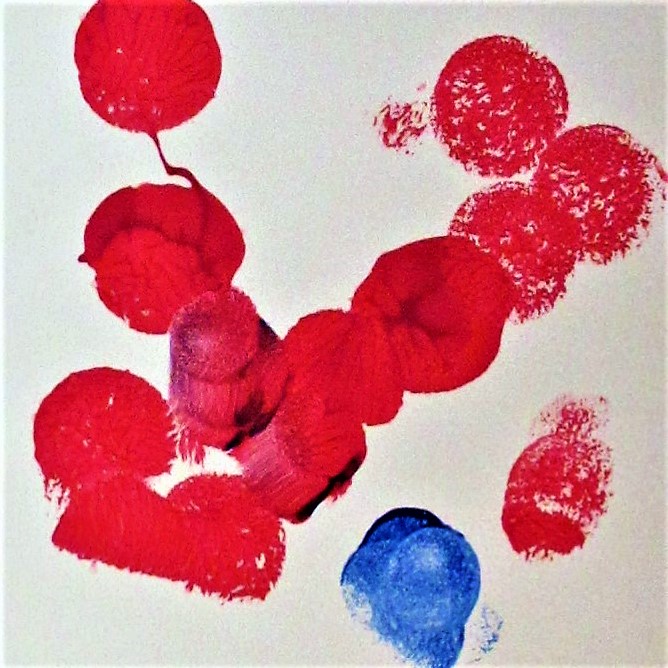
Look carefully at the painting that heads this Wednesday Workshop. Look at the movement and the musicality of linked forms and colors in a still, silent, two-dimensional space. Meaning takes on different meanings and becomes something different when we look at these words of color, these soundless sounds, these rhythmical movements of color. Beauty is in the eye of the beholder. Indeed it is, and in poetry, it is also in the musicality of the words and the flow of the ideas that bind the words and change their meanings.

Terza Rima

Terza Rima
Apologia pro carmina mea

Dear reader who reads my poems: sometimes
I say what I do not mean to write
and write what I don’t mean to say. Rhymes

make things clearer, for I puzzle what I might
say, and plan ahead so an awkward word
will not intrude. Words, birds in flight,

bright as postage stamps across the absurd
white snow of a page or a digital screen.
When I think about it, I assume about a third

of what I say, I really mean. Who has seen
the early morning wind drifting our thought-cloud
across the lawn, moving shadows cast on green

blades of grass, as we think our thoughts aloud,
each thought a pea in a pod, as some we clasp
between finger and thumb while others crowd,

and the loud, uneasy word slips from our grasp
to wound or injure or otherwise to hurt and maim.
It’s not my aim to do this. My word is not an asp

or a viper or a screw to be driven. I lay no claim
to hurt and yet sometimes a word slips sideways
and does not say what I mean it to say. I aim

to please, to tease, to provoke, in so many ways
and yet I often hurt where no hurt is intended.
If I have done you wrong and my word displays
unintended ends, forgive me: let all rifts be mended.

Letters and Words

Sometimes there are no words!

Wednesday Workshop
30 June 2021
Letters and Words

            Words are formed from a combination of letters and sounds. Join them together and they will march like Roman soldiers, in groups of meaning. A cohort, ten words, ten men, commanded by a Decurion. One hundred words, a century, commanded by a Centurion. Six thousand words, a legion with six thousand possible implications attached. I use the image of the Roman Legion because meanings in poetry are Legion and our Western Poetry tradition, of which I am a part, goes back more than two thousand years to Roman times and beyond. Tolle, lege: Latin for take and read. Sortes Virgilianae: fortune telling by chance words drawn, originally, from Virgil’s Aeneid and now from this poetry book. Choose your words and sentences at random. Interpret them as you will.

Associative Fields

            While each word has an individual dictionary meaning, words are much more powerful than the dictionary. Each word is surrounded by a network of associations, called an associative field, and those connections are different for every reader. This means that each word and its associative field have very personal emotional strings attached. When you understand this, you will also understand that each reading, each interpretation, is your own and nobody else’s. This is not a grade school classroom. Here, there are no poetry thought police to tell you that you are wrong, that you are mistaken, that you do not understand what the teacher is telling you.

Take the word ‘grandmother’. The dictionary meaning is clear. Your grandmother is the mother of your father or the mother of your mother. Each of us has, if we are lucky, two grandmothers. Some of us have more than two. The emotional ties between you, as reader, and your own ‘grandmother(s)’ will determine your own personal version of the word’s emotional and poetic tones. Now you must apply these individual meanings to each word you read. Reading poetry in this fashion will allow you to create your own personal world of tone, meaning, associations, and emotions. This is what poetry brings to you, not a handful of information to be scanned for knowledge, but a series of sights, sounds, memories, all personal, that are triggered in your mind by the impact of the poet’s words.

Comment: Wednesday Workshops are my attempt to express some of my ideas and theories on writing in general and on poetry in particular. Hopefully, the will encourage other writers to think about their writing and to deepen their knowledge and understanding of what we do best: think and write. By all means add your own thoughts to what I have written here.

How to read poetry

How to read poetry
A Wednesday Workshop

The Nature of Art and the Art of Nature is a book of poems each one of which celebrates humanity’s relationship both with the natural world and the way that world is recreated by artists in so many different forms. In order to read these poems and receive full value from them, it would help to know how to approach them.

Preparing to Read

First, de-clutter the mind. Poetry cannot be hurried or rushed. Remember, it is better to read one poem a hundred times than to read one hundred poems once. Prepare yourself mentally and physically for your reading. Sit down. Make yourself comfortable. Close your eyes. Concentrate your mind on something you find peaceful: a sail on Passamaquoddy Bay, a rose in Kingsbrae’s Rose Gardens, a butterfly in the Butterfly Garden, or a fine white cotton cloud in a cerulean sky. Breathe in and then breathe out. Now slow your breathing down. Breathe in, count up to four, slowly, breathe out, counting up to six. Breathe in, count up to six, slowly, now breathe out, counting up to eight. Breathe in, counting up to eight, and breathe out, also counting up to eight. How long will you sit there? When your breathing has slowed and your mind is clear, you will be ready to start. You will know when that is.

            Open your eyes. Take your book and begin to read. Don’t start on page one and rush through. Dip in, here and there, find a title or a first line that you like, and read that poem. Read it two or three times. Then move on, randomly to another poem. Select individual lines, phrases, sentences. Savour the words. Roll them around in your mind. Read them to yourself, quietly. Then read them out loud. Try to capture their essence, their rhythms. Taste them, as you would a fine Spanish Manzanilla wine. Select another word, another line, another poem. Seek and you will find some sequence that you like. Return to it often.

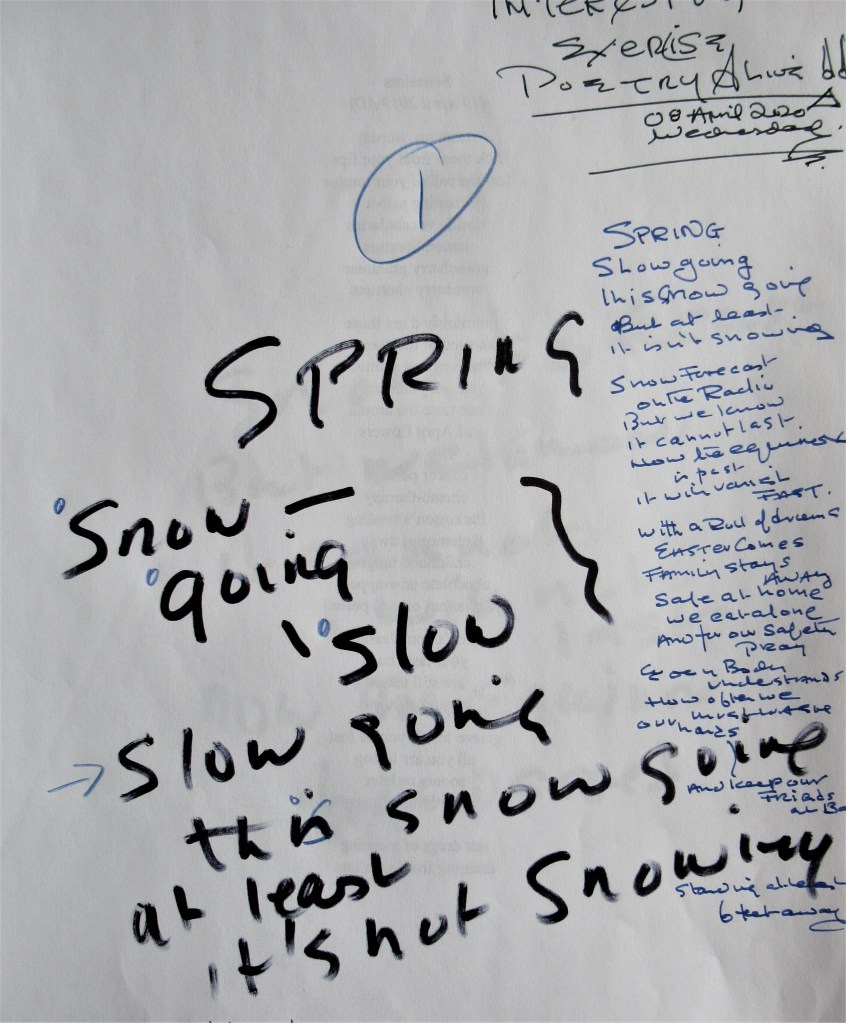
Comment: I will restart my Wednesday Workshops. The Nature of Art, the manuscript on which I am currently working, has an Introduction on The Nature of Poetry. I will put this up in installments. The handwritten opening page comes from an online video on Creativity and Writing Poetry during the Pandemic. This poetry video is the first one in the series. Click here for link. Other workshops on writing can be found by searching Writing Workshops on the Blog search (top right hand corner) or by going to this link Poetic Creativity and Thoughts on Writing

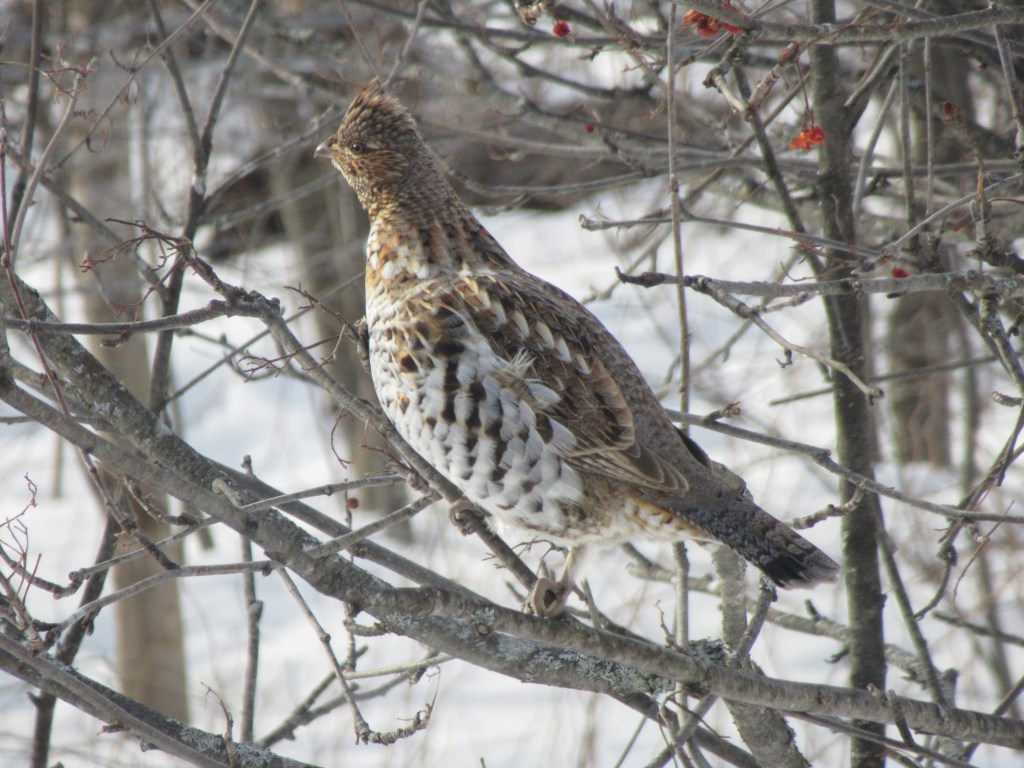
Ruffed Grouse

Ruffed Grouse by Kaitlin Hoyt

Kaitlin Hoyt
(KIRA, May-June, 2021)

She is an oyster, silent at low tide, yet with a host
of pearls waiting inside her, ready to be released.
When set, she will release those pearls herself,
stringing them together, like Chantal’s beads,
into a skein of meaningful, enigmatic moments.

Enigmatic, yes, but, like Elgar’s Enigma Variations,
a Russian Doll puzzle of secrets and intrigue. Comic
book artist, she evolved to graphic designer, then
multi-tasked first to Kinetics, and then to a painter
who reaches out in empathy to the world around her.

For her, all art is linked and communications are key,
on many levels. Visualization. Achievable goals.
A step-by-step process with each step foreseen, planned
beforehand, and each step always taken with an open mind
that accepts the true response, leaving falsehoods behind.

Kinetics, yes, but she is above all a loner. Kayaking.
Hiking. Weight-lifting. Yoga. Meditation. Mindfulness.
Caring. Sharing. She sends me her web page and I am
blown away by her empathy with birds and the natural world,
that world her oyster and her, an oyster in that world.


Comment: This particular bird visited our Mountain Ash in the garden at Island View. Kaitlin saw my photo and asked if she could paint it. I sent it to her, and this is the result. Wild life to Still Life to art and never Nature Morte! Together, Kaitlin and I have preserved forever the surprise visit of this beautiful bird.

Sculptures in the Gardens

Spotify
Remember to scroll down to the appropriate audio episode.

Sculptures in the Gardens

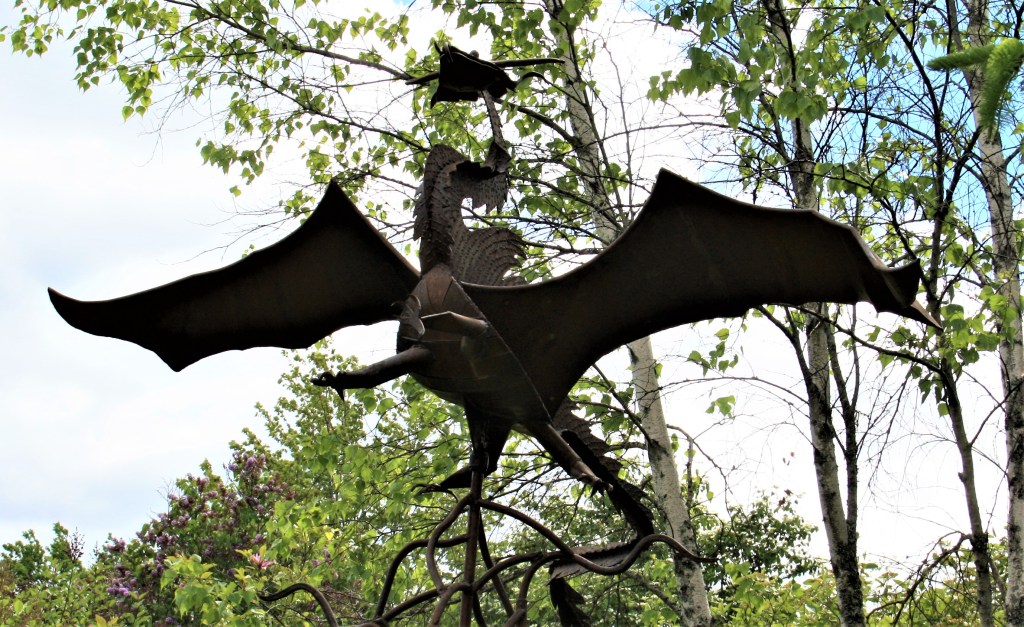
It’s the only sculpture garden in Canada. It may even be
the only one in the world in which the sculptures
shake off their shackles and come alive at night
when the moon hangs heavy in the sky and shifting
shadows prowl beneath Kingsbrae’s trees. Deadly
nightshades, roaming with no thought for the humans
who walk around by day taunting these sculptures,
thinking they are lifeless, mere images set in stone.

Beard not the lion in his den, nor the fox running wild,
nor the chubby bear whose clumsy run belies his speed
and strength. The dragon opens iron wings, but beware
of the hot forge lodged in the snap-dragon’s mouth.


Have you seen the cerulean whale, marooned and ship-
wrecked on these foreign soils? Once upon a time,
in a fairy tale, he roamed the seven seas and plundered
men and ships with abominable ease. Ease and the easel,
plein air paintings, sculpture portraits taken from life
and converted to a ship’s canvas that will never sail.


Ask not who is that bearded man, for he might be the one
Don Juan invited to supper. Ah, the hard rock ship-shock
when with a thunderous knock he arrives, an unexpected
guest, at the coward’s door. And shake not his hand lest
his fearsome grip turn you to stone or drag you down to hell.

Painting a School Outing

Spotify
Remember to scroll down to appropriate audio episode

Painting a School Outing
Beaver Pond, Mactaquac

The yellow of the school bus is easy, but
what colors do you give the rainbow of kids
arcing out through the exit? And how do you
portray their energy, their noise, their origins
when such a variety of accents assaults
your ears and drives the wildlife into silence?

What colors would Rimbaud have given to
their vowels, their consonants, their high-pitched
tones? You can sketch their orderly rows as they snack
on the top-hat magic pulled out of backpacks.
But it’s not so easy to paint the pop of cans,
the scent of chocolate bars, or the crackle of chips
released from packets and popped into mouths.

Running round after lunch, they drive the wild
birds wild with their unorganized games of tag,
their impromptu dances, their three-legged races,
their winners and losers, their joys and sorrows.
Fishing nets are produced from nowhere. Girls,
boys wander to water’s edge in search of prey:
incipient frogs, newts, tadpoles, bullheads, but
how do you paint the wet and wriggle of them?

Try painting this. Whistles sound. Kids regroup.
The bus reloads and goes. Now paint the silence.
Sketch the tranquility of woods, bird-calls back,
of the beaver pond with its lilies stretching their
green necks skywards towards a pale blue sky
where cotton clouds cluster together in celestial
flocks. A pastoral scene, this painter’s paradise.

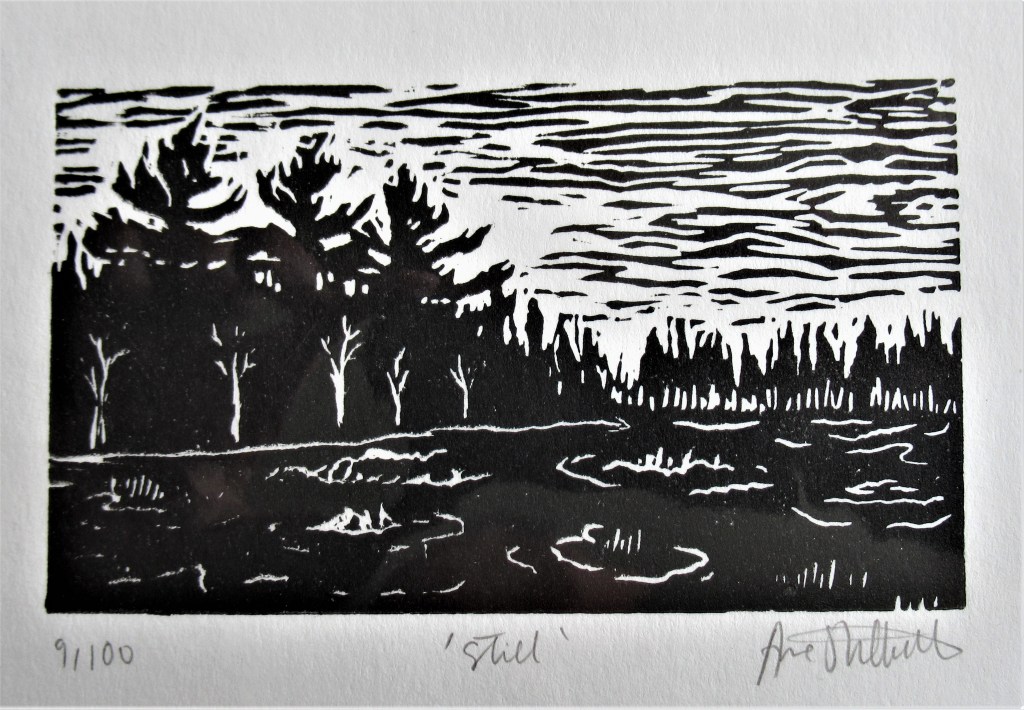
Comment: The woodcut was a gift from my fellow KIRA artist in residence (May-June, 2021), Anne Stillwell-Leblanc. It goes well with this poem about nature, noise, and the absence, then presence, of silence. For those of you who do not know the Beaver Pond at Mactaquac, it is well-worth a visit. My thanks to Anne for her permission to use her art work.

Ginger Marcinkowski

Spotify
Don’t forget to scroll down to appropriate audio episode.

Ginger Marcinkowski
(KIRA, August, 2019)

“My walk each morning, rain or shine,
feathers my black galoshes with dewy grass.
There I would ramble through gated doors
that kept out the world and sealed in
my pen’s work for that day. 

I often found myself sidetracked,
exploring paths that led through flowerbeds,
and up to my favorite sculptures.
I paused to watch my fellow artists
as they focused on chosen subjects
unaware that I was eavesdropping. 

Then silently, I would steal away
along the well-trod path to my studio,
pausing long enough to greet the llamas
and baby goats. If I listen carefully
I can still hear their bleating. 

In wonder, every day, I climbed the steps
of wood that led to my studio, opened
the door, and turned to breathe in my good
fortune. “What a blessed woman you are,”
I would tell myself before taking my place
for hours on end at my desk, each moment,
each stroke of the pen, each letter added
to the growing lines on the page, a gift.”

Comment: I have been writing poems about the KIRA artists as part of my next poetry book, The Nature of Art and the Art of Nature. This is my KIRA2021 project. The Nature of Art is a revision and expansion of a poetry manuscript of the same name that placed second in the WFNB’s Alfred G. Bailey Award (2020). This poem appears in the section entitled Impressions of KIRA Artists. Currently this section contains eleven poems, but it is still under construction. This poem is interesting in that it is a ‘found’ poem, in the sense that Ginger wrote these words to me in an e-mail. I removed them, reordered them, polished them, and sent her back her own poem in her own words. What fun! This should help explain the use of inverted commas at beginning and end, for this poem is spoken in Ginger’s own words.

Cage of Flame

Remember to scroll down to appropriate audio recording.

Cage of Flame

Now you are a river flowing silver beneath the moon. High tide in the salt marsh: your body fills with shadow and light. I dip my hands in dappled water. Twin gulls, they float down stream, then perch on an ice-floe of half-remembered dreams. Eagle with a broken wing, why am I trapped in this cage of flame? When I turn my feathers to the sun, my back is striped with the black and white of a convict’s bars. Awake, I lie anchored by what pale visions fluttering on the horizon? White moths wing their snow storm through the night. A feathered shadow ghosts fingers towards my face. Butterflies stutter against a shuttered window. A candle flickers in the darkness and map in runes the ruins of my heart. Eye of the peacock, can you touch what I see when my eyelids close for the night? The black rock of the midnight sun rolled up the sky. Last night, the planet quivered beneath my body and I felt each footfall of a transient god. When will I be released from my daily bondage?

Oh dear, I no longer know whether I am writing poetry or prose. Maybe I should contact Survey Monkey and have a survey on the subject. Clearly the above is prose because it has no line breaks. But what happens when we do this?

Cage of Flame

Now you are a river flowing
silver beneath the moon.
High tide in the salt marsh:
your body fills with shadow and light.
I dip my hands in dappled water.

Eagle with a broken wing,
why am I trapped in this cage of flame?
When I turn my feathers to the sun,
my back is striped with the black
and white of a convict’s bars.

Awake, I lie anchored by what pale visions
fluttering on the horizon?
White moths wing their snow
storm through the night.
A feathered shadow ghosts
fingers towards my face.
Butterflies stutter against
a shuttered window.
A candle flickers in the darkness
and maps in runes the ruins of my heart.

Eye of the peacock,
can you touch what I see
when my eyelids close for the night?
The black rock of the midnight sun
rolled up the sky.

Last night, the planet quivered
beneath my body and I felt
each footfall of a transient god.
When will I be released
from my daily bondage?

Sure, it’s the same text. But is it? And what happens if we change the line breaks? Does the rhythm stay the same in both cases? It certainly does when I read it, but how about you? Poetry or prose? Tell me if you knows! And what’s the difference anyway if the words roll off your tongue and metaphors, mystery, and magic rule?

Cage of Flame can be found in my poetry collection Though Lovers Be Lost and also in Stars at Elbow and Foot (Selected Poems, 1979-2009). Both are available at this link.