Carved in Stone 53

Carved in Stone
53

Nor do I belong
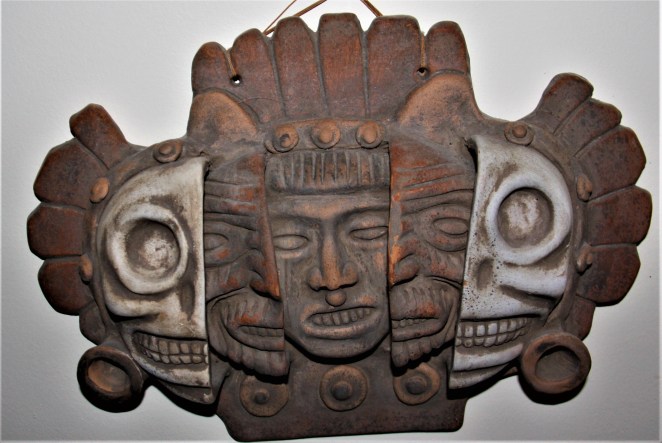
in the Aztec city of Tenochtitlán
with its cruel stone gods.

Built originally
in the middle of a great lake,
it defied all comers, and held
the mighty Cortés at bay.

Human sacrifices, night and day –
what is it that makes some people,
carve and shape the living flesh
of others, as if it were wood or stone?

Who could admire a culture,
based on human sacrifice,
death, blood flowing,
just to keep the sun in the sky,
red at its dawning,
westering in the evening
into a sea of blood.

Commentary:
“Man’s inhumanity to man.” Robbie Burns, if I remember correctly. Thus it was and thus it always will be. Man’s need for space, for room around him. The need to establish himself and his own tribe and oust the other. The need to target the other to prove the weakness of those who do not belong. So many ways to target, including humor and jokes, all pointed at the targeted individual.

“What’s the most dangerous job in Ireland?” – “Riding shotgun on the garbage truck. “The jokes never change, just the targets. For Ireland, substitute England, France, Canada, Wales, Scotland. For a country, substitute a town – Fredericton, Island View, Saint John, London, Cardiff, Dublin, Paris. Okay, so they are cities, not towns, but you know what I mean.

Let’s change the joke. “How do you get the [choose one or more] English, Irish, Scottish, French, Welsh, Germans, Italians, out of your front yard?” “Put your garbage cans in your back yard.” And so it goes on and on. Like old Father Thames, who just keeps rolling along, down to the deep blue sea.

Why, I ask myself, why, why, why, do we have to diminish someone else in order to appear strong ourselves? Is it just human nature? Is it the nature of some people? Do all people behave in the same way? If you have the answers, or any answer, the same instructions as usual, send it to me on the back of a postcard, by dog sled, via the North Pole. And if you’re feeling generous, put a $5 bill in the envelope. It will help me pay the lawyer’s bill for suggesting such outrageous nonsense.

Hallowe’en

Hallowe’en

1

Today is All Hallows Eve.
Tomorrow is Oaxaca’s
Day of the Dead.
The clocks change
the day after tomorrow.

Today, it’s raining,
and rain is a trick when
it forces celebrants off the streets
and town councils vote to change
the traditional date and send
young children out trick and treating
on a dry, warmer night.

But this rain, after drought,
is a Hallowe’en treat.

It brings a promise
that the aquifers will refill
that wells will not run dry,
and above all,
it brings us hope.

2

Around us, fall thrives
and watches and clocks
will soon fall back.

Trees weep for lost leaves.
Flowers that flourished
now wither and perish.

Hollyhocks topple and fall.
Bees’ Balm is abandoned
by butterflies and bees.

3

I expect time
to change with the clocks
and my body clock
will soon be out of sync
with the tick-tock chime
that denounces each hour.

Hours that used to wound
now threaten to kill.
They used to limp along,
but now they just rush by
and I, who used to run
from point to point,
now shuffle a step at a time.

But still I live in hopes to see
the clocks spring forward
once more.


Commentary:

A great poem for Hallowe’en, even if I say so myself, and I haven’t even mentioned the Blue Jays and the Los Angeles Dodgers. Oh, woe is me. Shame and scandal in my poetry.

Game Six of the World Series on Hallowe’en – wow! – well, one team will get a treat and the other will receive a very disappointing trick. I know which team I support, but I don’t know who will win this time around.

Having said that – with substantial rain after drought, everybody in my province is a winner. And who could wish for more than that?

Alone

Alone

the longing
to belong
appears from
nowhere

I want
to lose myself
in something bigger
than myself

religion
can bite like that
church and altar
feast days
incense and candles
confession
repentance
forgiveness
then sin again

I am not religious
not in that sense

nor am I militant
right arm raised
goose-stepping
in a parade
each step in time
with every one else

if that’s the meaning
of belonging
I guess I’ll continue
to dream alone

Commentary:

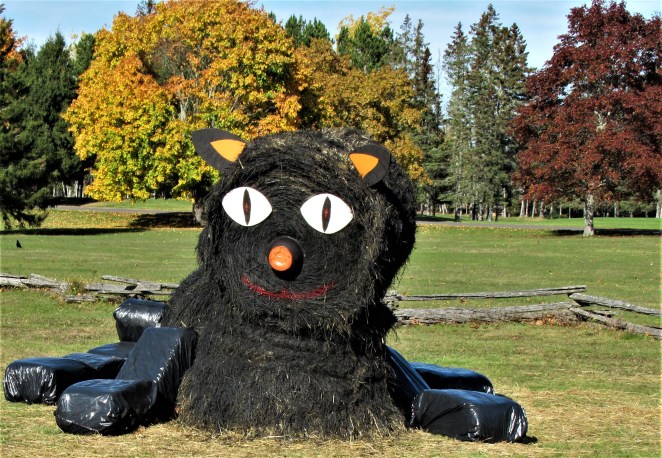
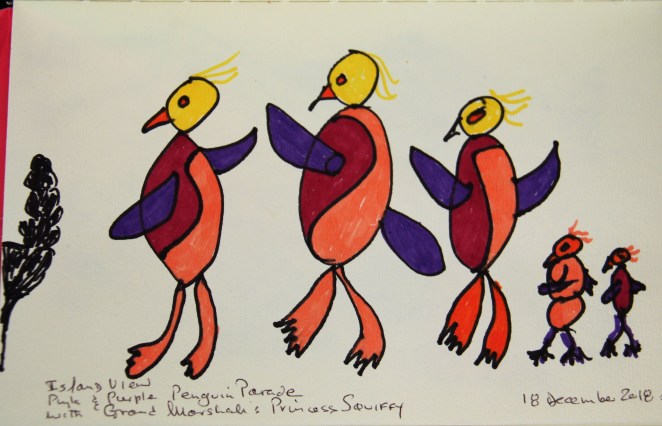
Moo thinks that Princess Squiffy, out at the front of the parade, a solitary cat, all alone and on her own, would be perfect for this poem. I am not so sure. Everybody is so happy, so engaged, except for Princess Squiffy aka Vomit, who is vanishing into the woodwork – about to plan and execute her next act of sabotage, I guess. Yes, Vomit! She’s the one who throws up in my chair.

The meaning of meaning – such a simple phrase, such a complicated philosophical history. How does one ‘belong’? In what ways can one ‘belong’? Does one yearn to belong or long to belong? And what does it mean – to belong? Does my cat belong to me? Does my dog belong to me? Cat and dog are long dead now – so how can they belong to me? And when I am gone, all my belongings will belong to someone else. A strange world, eh? And yet I long to belong in it for as long as possible.

The two most dangerous words in the world – thine and mine. Cervantes wrote that somewhere. For thine and mine are possessives. They teach us to possess things, to claim them as ours. My house, my garden, my trees, my flowers, my lawn. With the drought that has occurred this summer and into the fall, I can no longer say my lawn, my flowers, my garden, for they have all dried up and marched along, privatim et seriatim, – a touch of Kipling there, Storky and Co. if I remember correctly, and I don’t, because I just checked and it’s Stalky not Storky! – into whatever happy gardens dead flowers and gardens inhabit in their after life.

I think one of the most dangerous games ever invented is Monopoly. Make no mistake, I love my Monopoly set – especially the top hat and the flat iron – but what do we learn from Monopoly and from all similar types of game playing and role modelling? Why, to gather everything into our hands hands and possess everything on the Monopoly Board. At least when we play chess, we defeat an opponent by check-mating his / her king. We don’t have to accrue all 31 pieces on our side of the board leaving the poor king alone on the other. Even Fox and Hounds – and that’s an impossible game to win when you’re the fox- doesn’t humiliate anyone in quite that fashion. Ah well, the meaning of the meaning of Monopoly – Happy Canadian Thanksgiving – we can all have a good rant about that one.

Drink up thy Tizer!

Drink up thy Tizer!

I wonder how many people actually remember Tizer, the Appetizer. It used to be sold in grocery stores and corner shops. Don’t forget the Tizer, shrieked the adverts. I hated the stuff – but others loved it. Sweet, sticky, a little bit like dynamic Lucozade – and who remembers that, I ask. The same people as had cod liver oil poured down their throats when they were little children in the United Kingdom. An old and almost forgotten generation with its own traditions. But this post is not about Tizer, it’s about cider. Good old Somerset / Zummer Zett scrumpy.

I met Scrumpy when I went to Bristol University. It was an alternate drink to beer, and many pubs sold cider, in one form or another. A pint of cider – sufficient unto the evening was a pint thereof. After a couple of months, one could manage two pints of Scrumpy. Our drinking competitions including drinking a Yard of Ale. Someone always brought one when we went on a coach trip and we always ended up in a bar, in the middle of nowhere, trying to drain our yards of ale. I remember one lad bravely trying to quaff a yard of cider – scrumpy at that. Honk city – and it had nothing to do with the geese. But it was spectacular.

My own adventures with scrumpy really started in my second year at Bristol. The boarding house I lived in stood close to the Coronation Tap, one of the best cider house in England, if not in Bristol. First night I went in there and asked for a pint of scrumpy the barman suggested I have just a half. In my best Somerset accent, I said no, I’d appreciate a full pint. The barman duly placed it before me. As he did so, the man standing next to me at the bar suddenly woke up from his meditations, poked me in the ribs with a boney finger, and announced “Ah, lad. That’ll put lead in thy pencil.” I looked over at his pint of scrumpy and saw a slice of lemon floating in it. “What’s that lemon doing there,” I asked. “I’m waiting for the cider to eat it,” the man replied. “Better for the scrumpy to eat the lemon than to eat my insides.” Another night, at the Cori Tap, I met an old gaffer who wouldn’t touch scrumpy. I asked him why not and he replied that one night he’d managed to down seventeen pints of scrumpy. “That’s a lot,” I said. “What happened?” “Oi spend three weeks in ‘orspital, in bed, doan I?” He muttered.

In my third year, Hamburg University Athletics Cub arrived by coach to participate in an athletics competition with Bristol. The Cross-Country Club became the Athletics Club, in the summer, and we specialized in distances from 400 > 800 > 1500 > 3000 > 5000 > 10,000 metres. Thirsty work on a hot summer’s day. We took the Hamburg athletes back to our apartment building and spent the Saturday night slurping scrumpy down the Tap. They slept on the floor at our place, and next morning, a Sunday, they went shopping early. When they came back to their coach, they all grinned happily at us, and waved their bottles of Tizer in farewell. I looked around and saw that they had twenty cases of those bottles stored in the bus. “Ve vill have gut trip to Hamburg, no?” I started to laugh and they all joined in, waving their bottles at me. I didn’t have the heart to tell them that Scrumpy came in barrels, not bottles, and that they had not purchased cider at the local stores. Alas, they had bought 20 cases of Tizer the Appetizer. Somehow, in translation, cider had become Tizer – oh the glories of discourse analysis and the meaning of meaning.

Poisoned Pawn

Poisoned Paw

Openings are so important.
They should be magnets
drawing the opposition in,
but sometimes they’re whirl-pools
dragging you down.

You try to hold your breath,
but you must breathe deep, let go,
go with the flow and prepare for
whatever awaits you in the deep.
Down there, it’s a different world.

Light breaks its black and white bishops,
and the knights walk a forked path
when not pinned down. When you lose
do you mourn for the simplicity of draughts,
or Fox and Hounds or do you strive
to establish, once more, your light in the dark,
down there, where no sun shines.

You are the glow-worm,
glowing where no light glows.
You are the line, the sinker, the hook,
the bait, the temptation that encourages
your opponents to sacrifice their own peace,
 to join you, and together, to swim, or drown.

Commentary:

My family didn’t play much chess. I bought my first chess set when I was ten years old, at Boot’s the Chemist, down by the market, in Swansea. I also bought Harry Golembek’s book The Game of Chess. I still have both the set and the book, seventy years later. Descriptive notation. Absolutely bewildering. I stared at the chart that gave the code names of every square and remained totally confused. I had to look up each square, from its notation, locate it on the chart, then move the piece on my board into the appropriate position. And remember, each side had exactly the same format – QR1, QKt1, QB1, Q1, K1, KB1, KKt1, KR1. Not quite a mirror image as the squares reversed themselves on the other side of the board.

I remember clearly the day that ‘Light broke where no light shone.’ I looked at the maze of numbers, and suddenly the pattern clicked into shape in my mind and I understood the whole idea of descriptive notation. Boundary Knowledge – you cross a boundary after days of bewilderment, and enter a new phase of enlightenment ‘light breaks where no light shines’. When I watched the film, The Poisoned Pawn, I remembered my own learning days in chess. Great fun, that particular opening. Do we take the poisoned pawn, or do we leave it? I will leave you to decide. But remember, it’s not called the poisoned pawn for nothing, damned if you do and damned if you don’t!

I used descriptive notation throughout my school days. I had one particular friend in boarding school who also played chess. We slept in the same dormitory, two beds apart. After lights out, no talking, no reading. Prefects prowled at night to enforce the rules. After lights out, one of us would call out ‘P-K4’ and thus the game started. We weren’t exactly talking, so it wasn’t easy to catch us. Every night, we played the game in our heads. A great memory trainer. Occasionally we managed to finish a game – not often – we were both too wary of Fool’s Mate and the simple early traps! Each day, during one of the school breaks, we would restart the game of the night before, from memory, and then play it to its end. We very rarely forgot the moves we had made and we virtually never disagreed on the board position.

This was totally unlike chess with my family. The grown-ups would all gather round the board. Their object was to distract me, to move pieces when I wasn’t looking, to remove (MY) pieces and leave me in a desperate situation. “‘Knock, knock!’ ‘Who’s that at the door? Go and look.” And off I would go to return to a battlefield that had totally changed its shape and mood. I would carefully reconstruct it, piece by piece, square by square. But I have never forgotten the black looks, the accusations of cheating, the fury of the old ones being beaten by the younger generation. In the end, nobody within the family would play me, unless I gave them a handicap by removing a rook or one of the bishops.

I didn’t discover algebraic notation until I lived first in France, and then in Spain. Algebraic notation. Each of the 64 squares had its own letter and number and, as a result, there was no way to confuse the position of the pieces. Staunton chess sets in England became a variety of different piece shapes on the continent and I often lost games when I forgot that the pawn had one circle, the bishop two, and the queen three, but they all looked like. Many a time I gave up a bishop thinking it was a pawn – oh that poisoned pawn again.

Now, in my dotage, I play chess against the computer. I haven’t played a live opponent for years. But I do have a chess book collection and I have played Fisher’s best games, and Fisher vs Spassky, and I have studied the Russians and how they play and think – very differently from me. And so, in my old age, I sit at the chessboard of my life, and I move the pieces here and there, and remember old friends, and how we shifted across the shifting boards of our days. So many pieces have dropped from life’s chessboard, but a few of us are left, and we move more slowly, but we wander on and on.

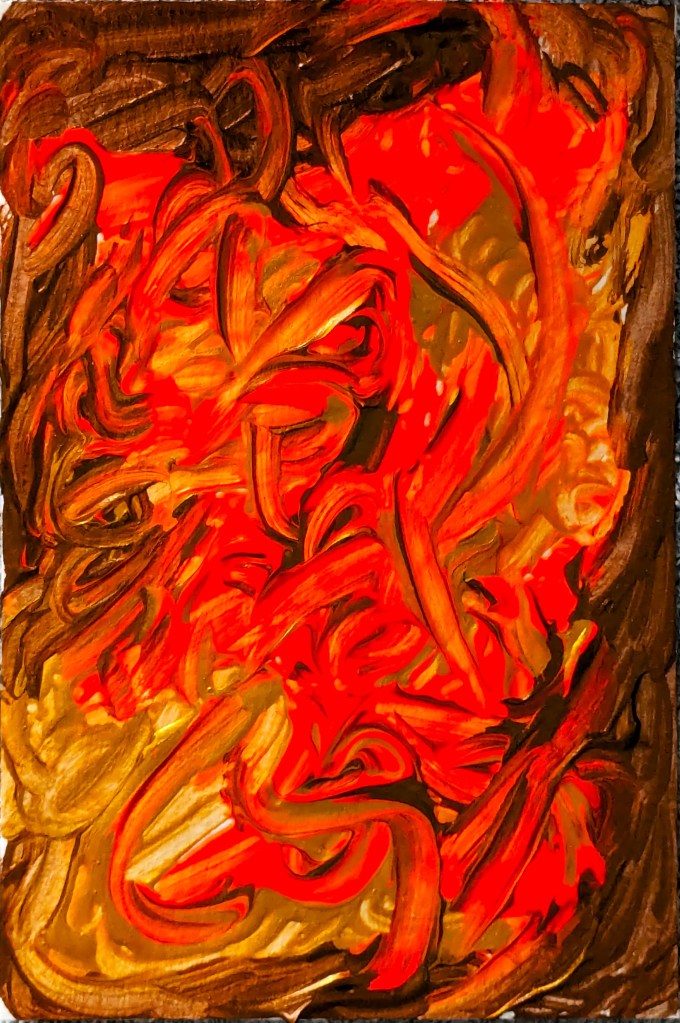
PS Moo, sometimes slow in understanding, offered me several paintings that suggested the aftermath of the Poisoned Prawn. When I explained the basics of chess to him, he said he didn’t have a chess painting he could recommend, so he suggested this painting – the correct way to teach. ‘You can’t teach chess,’ I said, ‘it is so instinctive.’ I took one look at the right way to teach and loved it. Here we go The Right Way to Teach! X – WRONG!

Write about your first crush.

Daily writing prompt
Write about your first crush.

Write about your first crush.

No. No, I can safely say that I have never had that sort of crush, except on a teddy bear or a little poo-pee aka puppy. I guess my first real crush was an orange crush. And no, again, not that orange crush either. I guess I have never been a fan of the Denver Broncos. But, as a child, I loved Orange Crush and Dandelion and Burdock, the former suitable for children and the latter looking remarkably like grown aka groan up beer.

During my time at university, I fell victim to several crushes. One was at the bottom of a collapsed scrum while playing rugby. Never much fun that sort of crush. All those sweaty, smelly bodies. Another came in an attempt to beat the Guinness Book of Records under the achievement – how many people can you get inside an English Telephone Kiosk? This was in the sixties, when England actually had telephone kiosks. If you have never seen a real English telephone kiosk, there’s one down in Kingsbrae Gardens, and I highly recommend a visit to that antiquity – almost as good as the statues in the gardens.

Anyway, one day in rag week, a group of Bristol University students, me among them, started crowding into a telephone kiosk. We entered upright, tried kneeling, others kneeling on our shoulders. We managed about twelve.

Doors open or doors closed? This baby came with no instructions. Poor parents, even more miserable single parents. And they are almost always young women, aren’t they? Come to think of it, maybe we should have invited some female students to join us – much lighter in weight and far less smelly – in the bad sense!

So, we tried a different tactic. If the first measure was a crush, and indeed it was, well, the second measure??? Judge for yourselves. One of us held the door open, the rest of us lay down like logs, feet outside the door, and the newcomers lay down on top of us. Ingenious indeed. But those at the bottom could scarcely breathe. They were the victims of a real crush.

Like the finger in the woodpecker’s hole, we reversed it – feet in, heads out. We got up to twenty-seven students. Then we ran out of student volunteers. Revolting. We asked passers-by to help us. But to no avail. Reversed and removed. Equally revolting. Sent our efforts in, with photos. There was no response. We didn’t make it. I still don’t know what that particular crush record is.

In Cassis-les-Calanques, 1960, I was one of eight people standing in a Citroen Deux Chevaux. That was quite a crush. But, in Santander, Spain, 1970, Clare and I watched 11 people, yes, eleven, get out of a SEAT 600, a 600cc Spanish four-seater car, otherwise known as a bullet / bala, and with about as big an engine as your lawnmower. They exited, one by one, and proceeded to enter the local church for Sunday mass. Can you imagine 11 people riding on your lawnmower?

Maybe that wasn’t a crush at all. Maybe it was just a (Morris) minor miracle.

Boxing Day

They’re not Boxing Gloves – but they could be. Photo by my friend Geoff Slater.

Boxing Day


            By the time I get up, the gloves are really off and the sparring has begun in earnest. I hear angry, raised voices, walk downstairs to the kitchen, and a hush falls on the room. Knife-edge glances slice their menacing ways through the thickening atmosphere.
            Time for boxing: on my left, in the blue corner, my mother, smoking what is probably her second packet of the day. A thin haze of grey smoke escapes from her bruised lips and a cloud of exhaled fumes crowns her head with a murky halo. On my right, in the red corner, my father. White-faced, hungover yet again, truly into the spirits of Christmas. He breathes heavily, like a Boxer Dog in the mid-summer dog-days, snoring and snorting at a bitch in heat. In the middle, my grandfather, the referee. He is keeping the combatants apart, creating a tiny breathing space so the true Spirit of Christmas can disentangle itself from those false Christmas Spirits and bring peace to earth again for at least sixty seconds between each round.
            I look around the heaving, seething, threshing silence of a room where conversation has suddenly ceased. The fire is burning merrily. Beside it, tongs, poker, and small shovel stand to attention. On the hearthstone, the little red brush, with its long handle lies in ambush. This is what my father uses to beat me when he can’t be bothered to take off his leather belt. Scorch marks from the hot coal fire sear the handle and back of the little red brush. I threw it on the fire one day, hoping to see the end of it. Of course, it was rescued from the flames, resurrected, and I got beaten for that act of rebellion too.
            “It’s all your fault!” My father breaks the silence, pointing at me. His red-rimmed eyes blazing with a sudden and renewed anger. He starts to rise, but my grandfather steps between us.
            “Go and see your granny,” grandpa tells me. “She’s in the kitchen. Go now!” He points to the kitchen door.
            I run a gauntlet of staring eyes and go to my gran. As I shut the door behind me, voices rise higher in the room I have just left. Boxing Day, indeed. The gloves are off. The battle has begun again. My grandfather has evacuated me from no-boy’s-land and, for a moment, I am no longer trapped in the mud-filled, cratered, shell-holes between the trenches, the uncut barbed-wire barriers, the poached-egg eyes peering through periscopes and spying on me from the parental and priestly parapets above the wooden duck-boards that line the floor on the far side of the room and keep the enemies’ feet clear of mud and water.

Water

Not Oaxaca, but Avila, with una tromba, a meseta rainstorm, about to descend upon us. And when it descends, there is water, water, everywhere, as you can imagine from the clouds. In Oaxaca, water is precious. Tap water is to be avoided. Bottled water is to be preferred. We used to wash our vegetables in water that was specially chlorinated, also the pots and pans!

Water
Peragua
Water seeks its final solution as it slips from cupped hands.
Does it remember when the earth was without form
and darkness was upon the face of the deep?
The waters under heaven were gathered into one place
and the firmament appeared.

Light was divided from darkness
and with the beginning of light came The Word,
and words, and the world …
… the world of water in which I was carried
until the waters broke
and the life sustaining substance drained away
throwing me from dark to light.

The valley’s parched throat longs for water,
born free, yet everywhere imprisoned:
in chains, in bottles, in tins, in jars, in frozen cubes,
its captive essence staring out with grief filled eyes.

A young boy on a tricycle bears a dozen prison cells,
each with forty captives: forty fresh clean litres of water.
¡Agua!¡Peragua!” he calls. “¡Super Agua!”

He holds out his hand for money
and invites me to pay a ransom,
to set these prisoners free.

Real water yearns to be released,
to be set free from its captivity,
to trickle out of the corner of your mouth,
to drip from your chin,
to seek sanctuary in the ground.

Real water slips through your hair
and leaves you squeaky clean.
It is a mirage of palm trees upon burning sand.

It is the hot sun dragging its blood red tongue across the sky
and panting for water like a great big thirsty dog.

https://rogermoorepoet.com/2016/04/28/water/

Comment: More and more competitions, publishers, and magazines are asking for ‘original material, not previously published, or self-published, even on your own blog.’ So what is a poet to do? Put up fresh material, and it is illegible for entry elsewhere. Recycle and revise old material? Now that might work. Click on the link above for the original version of this post! And yes, it has been previously published on these ages!

Summer in Wales

Summer in Wales
aka
Cricket, lovely cricket!              

Summer in Wales is always as I remember it: glorious days of sun and sand and blue skies and warm winds … and especially the sun on the beaches with the water sparkling and little boys and little girls playing cricket on the dry wrinkled sand packed hard when the tide goes out and leaves the land stranded … and uncles and aunties bowl under arm, not over arm, so the little ones could manage to score lots and lots of runs … and I remember us, standing breathless between the wickets, or at the wicket, if there was only one set of stumps, or a picnic basket stood on its side, or three pieces of driftwood, with sea-weed for bails, and what are bails, you ask?

              Well, bails are the sea-weed that is draped over the driftwood that stands as stumps. And we guard our stumps with the cricket bat that somebody has brought and we bowl with wet tennis balls, because nobody will risk a red, leather ball on the sands, with the wet tide standing there, waiting for the ball to be hit at it, or into it, and it’s cold, but not that cold, and when uncle hits the ball, right out so sea, someone has to run after it, then dive, and then swim after it, and if it’s real runs you want, then uncle runs two or three quite quickly; then the aunties tell him to stop running so fast or he’ll have a heart  … so he slows down and trots four or five; then he walks six and seven; and when you throw the ball back, he’s walking eight or nine; and then the dog intercepts the ball, catches it in his teeth, and starts running around with it in his mouth and everyone is trying to catch the dog except my uncle who is now limping very, very slowly between the wickets, but he’s already up to eleven or twelve; and then the little ones start crying because “It’s not fair!” Loud sniff! Then uncle stops in the middle of the wicket and sits there, waiting for somebody to run him out; except everyone is tired, except the dog, who is tireless and completely energized, and now the centre of attention; and nobody is going to catch him;  and finally uncle walks to the wicket and he lifts the piece of seaweed with his bat and everybody appeals, then he’s finally “OUT!” because officially he’s hit his own wicket and that’s illegal and now the game can go on once more, with everyone happy and God’s in his heaven and all’s right with the world …

And the dog has dropped the ball right at the edge of the waves and is barking furiously at the incoming waves as time and tide march up the beach and sweep us and our memories all away.

Self-Publishing

img_0196


Self-Publishing

Why do we write?

Before we talk about publishing, in any form, we must pose the question: why do we write? As a former academic, my writing was intimately tied to academia. At first, I wrote to pass my exams; then I wrote to pass my courses by handing in essays and potential papers; then, when I was a full-time academic, I wrote for the “publish or perish” world of academia, churning out articles (90) and reviews (70) on topics that were tied to my research projects. My writing, in other words, had a purpose and a direction. I knew why I was writing and I was conscious of the areas and places in which my publications would be acceptable and accepted.

At the same time as I wrote for the academic world, I indulged in creative writing. I have always written poetry. I have always been aware of my vocation as a poet. However, I was also aware that it was very difficult to earn a living as a poet. We’ll talk more about that later. The academy, research, and teaching gave me enough free time to indulge my dream of being a creative writer. It also permitted me to put food on the table and to keep my family warm and comfortable during our cold, Canadian winters.

So, the first question you must ask yourself is: why am I writing? What do I hope to achieve as a writer? Who do I want to read my works? Why do I want to be published? How do I want to be published? Your answer to these questions, and others like them, will determine your relationship to the publishing process.

Traditional Publishing

It isn’t easy to become published in the traditional fashion. In the first place, there are fewer major presses out there, and those that do exist are very large and powerful indeed. They want only the very best work. Not only that, they want the best work that will make them the most money. Good writing isn’t always guaranteed to sell well and thus to make the most money, remember that. In the second place, there are some excellent smaller presses, but they tend to be niche presses tied to a specialized corner of the market. Academia is a niche market. My own area of academia, Spanish Seventeenth Century Literature, is a very small niche market indeed. In order to get published in the traditional manner, a great deal of research into the niche area and the presses that publish therein is needed.

Most major presses will not look at up and coming writers unless they are represented by an agent. Few agents will take on an up and coming writer. This is a chicken and egg conundrum: how do we get the experience to be represented when we need the representation to help get the experience? All writers must solve this problem in their own fashion. There is no easy answer. Novels that have the potential to be turned into films: these will attract an agent and a big press, because that’s where the money is. How many of us are capable of writing them? Short story collections used to be a reasonably safe bet, but it appears that fewer presses and literary magazines are publishing them. Poetry generates little or no money, hence it also belongs to a highly specialized niche market with very small circulation figures. Once these realities are understood, then we can consider the alternatives.

Self-Publishing

 Self-publishing is no longer associated with the so-called Vanity Press, a term used to denigrate it. Not so long ago writers who paid for their writing to be published were considered by many to be ‘poor’ writers, ‘vanity’ writers. This is no longer true and The Writers’ Union of Canada (TWUC) now accepts self-published works as genuine works of literary merit, always provided that they are well-written. The advent of the computer revolution made all forms of writing, printing, and publishing so much easier. The ensuing advances in desk-top publishing allowed anyone to be a published writer and a writer’s life was suddenly that much simpler.

I published two poetry books with traditional presses in 1978 (Last Year in Paradise) and 1986 (Broken Ghosts). In 1990, following the death of my parents, I felt a deep desire to write and to be published once more. I had poems published in small literary reviews and magazines and I had a track record of wins and honorable mentions in writing competitions, but nobody wanted to publish another book of my poetry. I papered my walls with rejections … and I got nowhere. Therefore, in 1990, I started to self-publish.

My first six books were simple: I typed out the poems, ordered them the way I wanted, and took them to the local print shop where, for a small sum of money, the books were printed and saddle-stitched. This was a cheap means of production, so cheap, that I didn’t need to sell the copies so I just gave them away to my friends. Between 1990 and 1996 I published six of these little paperback chapbooks: Idlewood, In the Art Gallery, Daffodils, Secret Gardens, Iberian Interludes, and On Being Welsh. The runs were small, ranging between 100 and 200 copies, and very cheap per copy, often less than a toonie / twony (two dollar coins, after ‘loonies’ one dollar pieces with a loon on the coin).

All the initial work for these books was done by me: writing, selection, typing, and editing. The printers did the rest: copying and binding. In the case of these first self-published books, the covers contained typed titles and the author’s name and nothing more. In 2000, I was very fortunate. I met a genuine editor who agreed to work with me to publish my poetry via a small university print-shop. I wrote the poems and typed the text. My editor, a wonderful lady, then edited the text and prepared it for printing. My beloved (aka my wife) designed the covers for these books. Between 2000 and 2012 we (self-) published six of them: Sun and Moon, Though Lovers Be Lost, Fundy Lines, At the Edge of Obsidian, Obsidian 22, and Monkey Temple. These were genuine paperback books, with an ISBN. They were all limited editions and again I gave them away to my friends.

2008 saw Nashwaak Editions, the book division of the Nashwaak Review, publish Land of Rocks and Saints, a book of poetry that I wrote while in Avila (Spain). Again I funded this printing myself and again I gave it away to my friends and colleagues. I was devastated on several occasions to find signed copies of these books in second hand bookstores, that which I had given away for free had been sold for money. The receivers of free gifts had gained more cash than the books’ writer.

I continued writing and now had several manuscripts that I thought well worth publishing. Armed with a genuine list of publications and prizes and with excellent letters of recommendation from established writers, I again tried the traditional approach. Alas, I got the traditional results. Two small trade presses who agreed to publish my work both went out of business before they could do so. Agents, if they bothered to reply (and most of them didn’t), turned me down. I got to final judging with a famous niche press, but their marketing department said the book wouldn’t sell and they refused to market it … I didn’t know where to turn.

I had for some time been getting e-mails from houses that, for a large sum of money, would publish my new works for me. However, I was by now retired, and didn’t have those ‘large sums of money’. Publishing costs varied from $1500 US to $3500 US to £3000 (sterling). Well, I wasn’t that desperate, especially when I was suddenly subjected to regular e-mails, constant phone calls, and targeted advertising. I got tired of sales reps ringing me up and asking “are you read to go to press now?” There had to be easier and cheaper ways to get published.

2016 saw a major change in my self-publishing. A new friend, now a very close friend, suggested I try CreateSpace on Amazon. He came over one afternoon to give me a demonstration and we had a manuscript up and running that same day. It cost me nothing. I still haven’t sold a copy of that particular book. But it is up and available on Amazon. I buy copies at a relatively cheap rate and, you guessed it, I still give them to my friends. I now have nine titles on Amazon, two new titles* and seven rewrites and expansions. These include Monkey Temple, Bistro*, Though Lovers Be Lost, Sun and Moon, Obsidian’s Edge, Empress of Ireland, All About Angels, Iberian Interludes, and Avila* (my first book of poetry in Spanish).

Marketing is still a problem partly because I just don’t have (nor do I want to have) what it takes to be a salesman. I still give copies of my books to my friends. I guess I’ll never make any money worth speaking about from my creative writing. But that has never worried me: I have never written for money, only for love. I write because I love writing. I publish so I can give copies of my books to those friends who ask for them. I am a poet, whether I want to be or not. I am also condemned to my fate: I am an academic, a writer of poetry and books, and a book self-publisher. I guess I’ll never be a businessman.

Is it all worth the effort? Yes, I think it is. Can (other) people make money from self-publishing? Yes, they can, especially if they are willing to advertise, market, and sell their books at every opportunity. This is something that I just cannot bring myself to do although I know several writers who have been very successful with this aspect of the trade.

Quality Control

Are self-published books capable of being genuine works of art? Indeed they can. Bistro, although being self-published, has just been confirmed as one of three finalists in the New Brunswick Book of the Year Competition (2016-2017). Several of the stories in Bistro were either published separately in literary magazines or were part of larger manuscripts that received recognition in one way or another for the quality of their writing. Parts of several of my other books on Amazon have been published or awarded prizes or honorable mentions in competitions and this gives my creative work a track record of respectability.

I am an academic, trained to assess written work and to maintain quality control on my own written work as well as that of other people. Not everyone is born to be an editor, let alone a self-editor. How do we get to the level of self-editing necessary to be confident in our own quality control? Enter your work in competitions. Submit your work to literary magazines. Take writing workshops online and in person. Consult with other writers and join a good writing group or form one yourself. Be careful of submitting your work to the opinions of your best friends and your family: they will only tell you how good you are. Remember that your granny may be your favorite person, but she is not necessarily your best critic. Seek always the objectivity that allows you to stand back and criticize your own writing from a distance. Seek the opinions of others who are objective and will do the same.

Summary

  1. Think about why you are writing and what you want to achieve with your writing.
  2. Consider the different ways in which you can publish or self-publish and decide which is better for you.
  3. Research your market / niche market as carefully as you can and target the area in which you wish to work.
  4. Writing is a long-term commitment: you must make that commitment and stick with it.
  5. Remember that there is no substitute for high quality writing.
  6. Remember the words of Dewi Sant, St. David, the Patron Saint of Wales: “Keep the faith.”
  7. Don’t give up. Keep moving forward. If you stop writing, you will never achieve your goals or finish that book.