Clepsydra 41 & 42

41

… fire flares on the water
     rivers and lakes blaze
          that sound is a monster
               a dragon descending
                    breathing fire

so swift so powerful
     come sudden
          from nowhere
              yet another disaster
                   with its ravenous roar         

the dragon refuses to move on
     until sated
          but who could satisfy
               that monster
                    destroy its will
                         defeat its power

will Lac Megantic
     ever be the same
          after all these years
               of grief and tears

will fading memories
     be all that remain …


42

… a stillness between words
    tranquil movements
         the world suspended in space
               soundless the night
                    drenched in silent light

 Aurora Borealis
     draws gaudy curtains
          across the night sky

I can hear my heart beat
    as time softly sifts

a celestial hour glass
     this sky filled
          with unimaginable light
               breaking coloured waves

lit up
     with mysterious flowers
          so graceful
               when decked out
                    in light

 the moon returns
     turns into a mirror

          its silver boat
               suspended in space

silent its light
     enlightening
          the heart’s dusky craters

dawn’s silent glory
     will be here soon
          pointing the silent path
               to even more light …

Commentary:

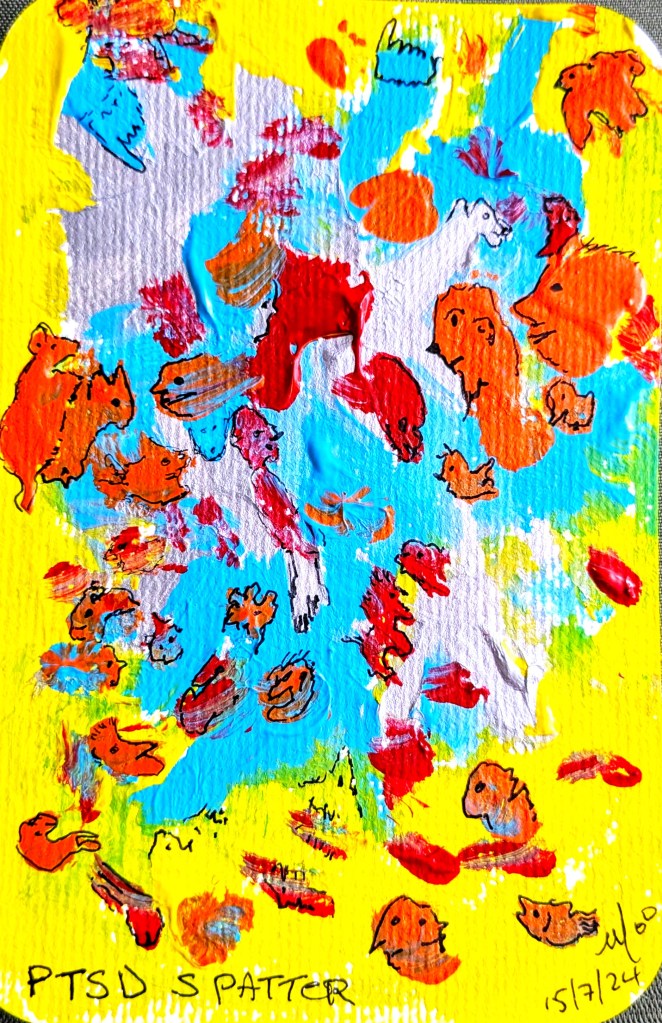
Ten years or so since the disaster at Lake Megantic. I am sure it affected everyone who followed the news, saw the pictures, and bore witness to the power of conflagration. Moo offered me his painting called Burning Birbi. A Birbi is a Koala Bear in one of the Aboriginal Languages. When the fires hit New South Wales, the Eucalyptus Trees started to fire. When in danger, the Birbi climbs the eucalyptus trees, higher and higher, followed, of course, by the fire. A fate inescapable. Just like the Megantic Disaster. Word has it that it could, and should, have been prevented. I cannot (will not) comment on that here. I will just stress the fear that we all have, those of us who live in a drought stricken province (New Brunswick) surrounded by trees.

The closest wildfire to us, in Island View, was about 31 kilometres away. The closest trees are about 30 feet away from the house. Much too close for comfort. Curtains of flame and smoke, rising up to stain the skies. And the smell of burning also inescapable. Stay indoors, I say. Shut the windows. And hope that nothing comes your way!

Fire, controlled, brings heat, warmth, light. The Northern Lights bring spectacular light flooding down from the skies, not rising up. You can almost hear the sky crackling as the light curtains shift and shimmer and dance their way across the horizon. Fire and Fire Light – beautiful when we can control them, but oh-so-destructive when they flame and flare, out of control.

Do not despair. Just remember we need each other, all of us, each one of us. Together we can overcome most things. Isolated and alone, like the lone koala at the top of his tree, it is much, much more difficult to survive. Select your friends carefully. Maintain contact with them. And be there for each other in times of need, for, as we say in Wales – “a friend in need, is a friend in deed.”

Clepsydra 39 & 40

39

… all too soon I too shall move on
     leaving behind me
          fading memories and cloud shadows


yet I recall
     standing beneath the cathedral’s
          great rose window
               on a sunny day
                    my body dressed
                         in a harlequin suit
                              of glistening lights 

in such splendour
     mortal things like words
          cease to flow

I held my breath
     shocked by an enormous presence
          that filled me then
               as it does now
                    with the knowledge
                         that nothing happens in vain …

40


… illumination
     I must find it for myself
  were another to tell me
      where it dwells
            its light would be untrue

only I can strike the match
     ignite the flame
          and trap its warmth
              in my body’s bone cage

when it flowers within me
     I’ll need no candle
          not even in the darkest mine

in Alma, I have seen
     the tide lower
          Fundy fishing boats
               down into the mud

like those boats
     I lack the power
          to resist both time and tide …

Commentary:

I asked Moo for a painting of boats from Fundy, preferably from Alma, lying on their sides at low tide. “Let me see what I am meant to be illustrating,” he said. He read the above excerpt from Clepsydra and told me “You’re navel gazing again. I thought I told you not to do that. Now, have I got a painting for you.” I didn’t dare refuse to post it – he’s had a bad couple of days and it has sharpened his sense of humor – so it’s here it is. Moo calls is – now don’t laugh – Naval Gazing.

“Nothing happens in vain.” So maybe I was predestined to ask Moo for a painting he didn’t have and to end up with one that tickled his fancy. Now that set off a light bulb in my skull. Mr. Dimwitty came to his sense – I have been navel gazing. Naughty, naughty. How many of you remember Mr. Dimwitty, the not too bright schoolmaster on BBC radio? Hold up your hands, and I’ll count them.

Meanwhile, things happen to Moo and me, and like the boats on the Fundy, we lack the power to resist both time and tide. And that’s why we help each other, carry each other along. “We few, we few, we band of brothers.” That was Shakespeare. Nowadays we have to say “we band of siblings.” It pays to be inclusive. Speaking of bands, I saw a man walking down Main Street yesterday, blowing a rubber trumpet. I asked him what he was doing and he told me that he was looking for a rubber band. Joy to the world and help spread the joy. If you don’t like joy, spread Marmite. And if you don’t like Marmite I am sure you’ll love Vegemite. Ma might, but Pa won’t. That’s why it’s not called Pa-mite.

Book of Life

Book of Life

When I lost my place, I tied my hanky in a knot,
to help me remember the number of my page.
Last night I looked in pockets and sleeve, but
I couldn’t remember where I put my hanky.

At midnight the stars dropped liquid fires and they
pooled like letters on the fresh snow of my dreams.

One night I caught some falling stars and I joined them
together, one by one, till they stretched their daisy chain
across the garden. Words grow like flowers in the Spring.

Once I could accelerate the universe. But now I slow
down when I spell my name. There is a circlet of gold
on the sky’s bright brow. What gave these stars the right
to write my future in expanding letters? A satellite moves
in a straight line, north to south and starlight crumbles
in the wake of artificial knowledge spanning the eye ball
of the planet.  Who will repair these broken tunes? Who
will glue these scattered notes back into the piano’s frame?

My tongue stumbles against my teeth and trips on my lip.
A leaf of fire scorches the deep bell sound of my throat.

Commentary:

I looked over my shoulder, backward into time and space, and discovered this poem, penned more than a quarter of a century ago and abandoned in an old folder. Moo tells me he hasn’t painted for some time – I wondered if he was on a rotating striking, like our posties (Canadian for mail men and women), but he assured me that he had been sleeping, not sleep-walking in circles. Anyway, he felt inspired, put paintbrush to postcard and gave new life to my Book of Life. Thank you, Moo.

Do you remember when we used to tie knots in our hankies to remember what we had to do? Paper tissues put an end to that. No point in tying a knot in a soggy tissue, even if you could. And as Francisco de Quevedo told us – no point in looking in your hanky after you’ve used it. No point in searching for diamonds and emeralds, let alone pearls of wisdom, they just won’t be there. Good one, Franky. Of course, he was writing in Spanish, not English and my translation can’t do him justice.

It used to be fun watching the night sky out here in Island View. So clear – the satellites passed overhead and followed different paths from the stars. No Platonic dancing to ethereal music for them. Tone deaf, the lot of them, cutting their own little paths across the night sky. We used to get Northern Lights too, Aurora Borealis. They were always spectacular. Great crackling curtains of light hanging down from the heavens almost to the rooftops. Moo wishes he could paint everything h sees. I wish I could write down in verse every thought I think. If each of us had our wishes fulfilled, we’d have two books of life – one in color and one in black and white!

Memories

Memories

All that remains of you: memories
and these swift-flowing rivers of blood
embodied within my flesh and skin.

A lifeless kite, each word I write,
too heavy to rise. Each sentence,
a wasted movement of lips and tongue.

And you, a black and white snap-shot,
of blooded washing hanging on the barbed
wire fence we grew each day between us.

Today, sunlight streams through stained
glass windows of the house you no longer
inhabit. Dust rises from artificial flowers.

Your poinsettia’s dry silk leaves, now mine,
brush a taut, barren kiss against my face.
I dream of the drowned lying cold on a beach.

Fresh memories pound through my head.
Waves on a rocky shoreline. Each word
a grating grind of shingle and sharp stones.

Commentary:

Moo calls it going Bodmin but the idea comes from Doc Martin and Porthwen. People lose their minds, their directions, and end up ‘going Bodmin’. This means they wander about, lost, on the Bodwin Moor and can’t find their way home. As we age, it happens to many of us. Not only do we go Bodmin, but our memories betray us. Sometimes we remember what we did as children, but forget what we did a few moments ago.

WWI – my grandfather told me all about it. “We’ll hang out our washing on the Siegfried Line, have you any dirty washing mother dear?” Or worse, “If you want to find the Sargent, I know where he is, he’s hanging on the old barbed wire.” Unbroken wire, covered by enemy machine guns, we who die like cattle – such bitter memories. And the French, walking to the front, baaing like lambs being led to the slaughter, decimated, one in ten (10%) being shot for cowardice or insubordination. “If you want the whole battalion, I know where they are, they’re hanging on the old barbed wire.”

And now you must think of the barriers, the fences, that we grow between us, day after day, as we grow old, and older. Artificial flowers, houses we no longer inhabit, dust motes floating in the air through rooms well-remembered, but no longer open to us. “Each word, each memory, a grating grind of shingle and sharp stones.”

Look at them, those lost people, those forgotten faces. You may even recognize one or two of them. Listen – well-remembered voices, bugles calling from sad shires, and every night, a drawing down of blinds.

Raven

Raven

When Raven flies through his trap door in the sky, a light bulb clicks off in my head and I fall into darkness. Is there some safety net before oblivion? Raven’s claws scar crow’s feet on a fingernail moon. His bleak black beak widens the hole in my head and the Easter egg of my skull shows thin blue cracks. Outside my window, the river moves backwards and forwards with the tide. Raven shrugs at cancerous creatures, promising nothing. He soars into clear skies in search of his private exit and extinguishes sun, moon, and stars, plunging our world into blackness. The light on the point picks out a heron, mobbed by a clacking ring of gulls. The sea mist wraps the real world tight in its cloak. Now sea and lighthouse, heron and gulls, are distant things of memory. Raven, shoulders hunched, stands like a stone, an anthracite block hacked out from the coal seam in my mind, hand carved from feathers and my forefathers’ blood.

Commentary:

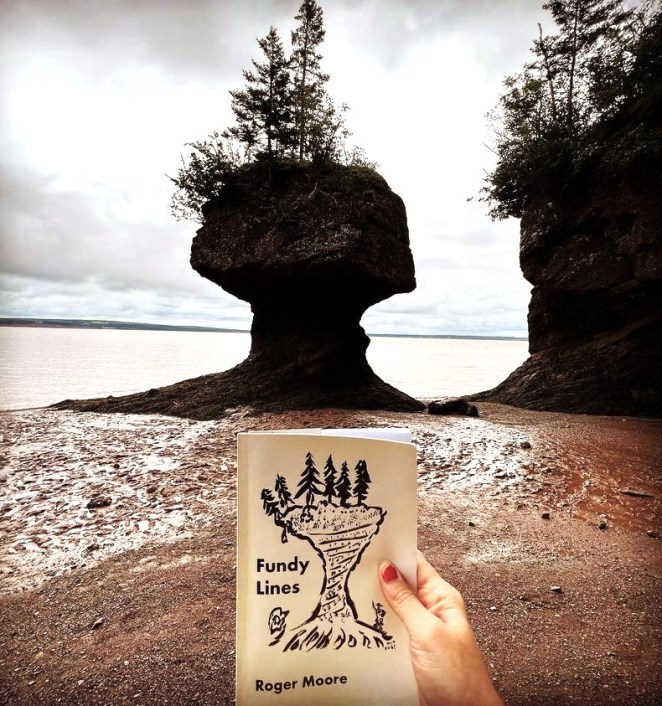
I had forgotten all about this poem in prose. It comes from Fundy Lines, if I remember correctly. Photo credit (below) to one of my former students, an excellent poet herself, who took the trouble to locate the correct rock and then take a photo of book and rock together.


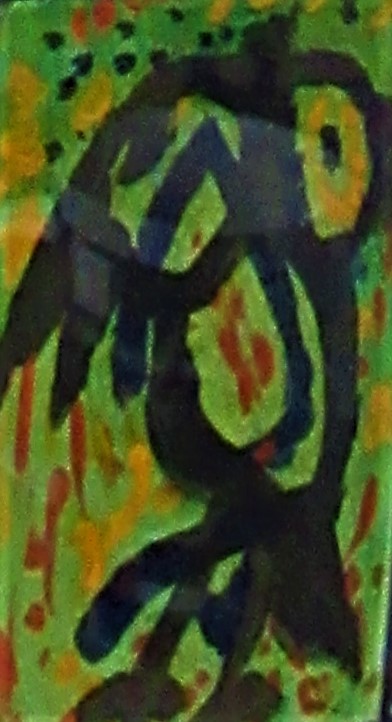
Moo thought his painting of a dark shape that looks a little bit like a bird of ill-omen would be just what this prose poem needed. Maybe he’s right. I trust him with his choice of paintings. Well, most of the time anyway. He can be a bit ‘off’ from time to time, but mostly we form a good team, especially where Surrealism is concerned.

I guess Raven formed part of my Surreal sequences. I really do enjoy Surrealism. The mixing of metaphors, for example, the unexpected meeting of a sewing machine with a carving knife and an umbrella on an operating table. And look what Raven’s up to. He discovers a trap door in the sky. Well, that would be very useful, if we had wings and could fly. Then he turns off the light bulb in my head. I didn’t even know I had one in there. I guess Raven, like coyote and zopilote is a bit of a Trickster. Next he changes into a woodpecker and widens the hole in my skull. Poor old me – avian trepanning – no wonder I have problems! My head becomes an Easter Egg and has cracks in it giving birth to what? Some mad ideas, I guess, pecking their way out into the wonderful world in which Moo and I live in perfect harmony with my beloved and our cat. And look at all those Welsh mining memories – lignite, house coal, steam coal, anthracite, jet – and remember, when the coal comes from the Rhondda down the Merthyr – Taff Vale line, I’ll be there.

It will be a long way from Canada to Taff’s Well. Maybe Raven will be kind and fly me there, through his Island View trap door that has direct access to the trap door just above Castell Coch, the Fairy Castle of my childhood. That would be faster, and easier, than my old two-wheeler Raleigh bicycle with it’s Sturmey-Archer three gear click on the handlebars. I bet Raven can fly faster than I can pedal. And if I could have pedaled as fast as Raven flies, downhill and uphill, I would have been King of the Mountains and an all time winner of the Tour de France. Now that would have been surrealistically surreal, seeing me as a cereal winner, with my snap, crackle, and pop! Not that my dad would have been happy. He never was happy with anything I did!

Cage of Flame

Cage of Flame

Now you are a river
flowing silver beneath the moon.
High tide in the salt marsh:
 your body fills with shadow and light.
 I dip my hands in dappled water.

Twin gulls, they float down stream,
then perch on an ice-floe
of half-remembered dreams.

Eagle with a broken wing,
why am I trapped in this cage of flame?
When I turn my feathers to the sun,
my back is striped
with the black and white
of a convict’s bars.

Awake, I lie anchored
by what pale visions
fluttering on the horizon?

White moths wing their snow
storm through the night.
A feathered shadow ghosts
fingers towards my face.
Butterflies stutter
against a shuttered window.

A candle flickers in the darkness
and maps in runes
the ruins of my heart. Eye of the peacock,
can you touch what I see
when my eyelids close for the night?

The black rock of the midnight sun
rolled up the sky.
Last night, the planet quivered
beneath my body
and I felt each footfall
a transient god.

When will I be released
from my daily bondage?

Commentary:

Moo reminded me that this poem also existed as a prose poem. here it is in prose layout. Think about it and let me know which version you prefer. Is one easier to read than the other? Do the rhythms come through more strongly in one version? Meanwhile, since he hasn’t painted a cage of flame, nor a river flowing silver, he suggested that if I really felt like the poem suggested I might feel like, then All Shook Up – with its warm, colorful flame images, might be just the poem to fit the crime. Better, he said than playing billiards on a cloth untrue, with a twisted cue, and elliptical billiard balls.

I wonder how many people recognize that little tip of the hat to the past glories of English Comic Opera? Since Canada post is on rotating strike – talk about twisted cues and elliptical billiard balls – then send your answers by highly trained snails (snail mail) or dog sled via whatever route still has enough snow for the huskies to haul on. Meanwhile, Ottawa has declared that the Maritime provinces are continuing with their suffering a buffering from lack of rain and severe drought. I do long for that river flowing silver, not to mention high tide in the salt marsh. We need water badly. And the sooner the better. Aquifers, rivers, wells, they all need filling.

Ah, the majestic game of cricket – and how I long for that summer test match curse – Rain Stopped Play. Or as the BBC commentator said on the radio one day – I heard him – “play has been stopped because of piddles on the putch – oh, sorry, I mean puddles on the pitch.” I wonder what Mr. Hugh Jarce would have thought of that. I know he always loved that old cricketing Chestnut – ‘The bowler’s Holding, the batsman’s Willey.” Unlike much wanted rain, it didn’t stop the match, but the commentators who perpetrated that jest laughed so much, the commentary stopped for nearly five minutes. Oh, the things one remembers as one gets old. Now, where did I put my glasses? I wonder if my beloved knows.

Cage of Flame

Now you are a river flowing silver beneath the moon. High tide in the salt marsh: your body fills with shadow and light. I dip my hands in dappled water. Twin gulls, they float down stream, then perch on an ice-floe of half-remembered dreams. Eagle with a broken wing, why am I trapped in this cage of flame? When I turn my feathers to the sun, my back is striped with the black and white of a convict’s bars. Awake, I lie anchored by what pale visions fluttering on the horizon? White moths wing their snow storm through the night. A feathered shadow ghosts fingers towards my face. Butterflies stutter against a shuttered window. A candle flickers in the darkness and map in runes the ruins of my heart. Eye of the peacock, can you touch what I see when my eyelids close for the night? The black rock of the midnight sun rolled up the sky. Last night, the planet quivered beneath my body and I felt each footfall of a transient god. When will I be released from my daily bondage?

Loss

Loss of …

By the time I remembered your name
I had forgotten your face,
and then I couldn’t recall
why I wanted to talk to you
in the first place.

Words and phrases bounce,
water off a duck’s back.

They sparkle like a high tide
rejected by the retriever
as he shakes his coat dry
on emerging from the sea.

This book I read is a word parcel,
a clepsydra of droplets
a rainbow strung with colored beads
each scoring a bull’s eye
on the world’s taut literary hide.

Mapa mundi of forgotten lands,
I trace dark landmarks
on the back of scarred hands
and wonder why I have never visited
faraway places with names
I cannot even pronounce.

Tourist guide to a failing memory,
I track the trails of drifting ships
as their white sails vanish,
blank butterflies from a distant summer,
floating over a darkening horizon.

Commentary:

I notice how my memory fails a little bit, day by day. I mis-spell a word. Forget a telephone number. Have to check a recipe three or four times – was it twenty minutes at 400F or 30 at 350F? Then I wonder how many spoons of sugar I put in my coffee. Worse, I forget whether I have taken all my tablets or not. I line them up in order, take them one by one, and still forget whether I took the last one or not. Oh dear.

I make shopping lists and check each item off as I put it in the cart. Then I check the cart to see if I did put the items in. Impulse buying. I haven’t seen Marmite on the shelves for some time now. So, every time I see it I buy it. Now I have four pots of Marmite in the cupboard. Animal Farm – Marmite good, Vegemite bad. And I can even say that in an Australian accent.

I forget words in English, but suddenly remember them in Welsh, French or Spanish. Then I forget them in the other languages as well. Last night I remembered callos in Spanish but forgot what they were in English. I had to ask my beloved and she reminded me that callos meant tripe. Great. I now knew what they were but I couldn’t remember why I wanted to know what they were in the first place.

This afternoon I looked everywhere for my glasses and then I remembered that I was wearing them. I have a little name tag that I wear when I go out. That way I will at least remember who I am. Now, I have just changed my coat – so where’s my name tag? As for my cell phone, I never call myself on it, so why should I remember the number anyway? I guess that’s it for now. I am sure I had something else I wanted to say, but I can’t remember what it was. Oh dear!

Alone

Alone

the longing
to belong
appears from
nowhere

I want
to lose myself
in something bigger
than myself

religion
can bite like that
church and altar
feast days
incense and candles
confession
repentance
forgiveness
then sin again

I am not religious
not in that sense

nor am I militant
right arm raised
goose-stepping
in a parade
each step in time
with every one else

if that’s the meaning
of belonging
I guess I’ll continue
to dream alone

Commentary:

Moo thinks that Princess Squiffy, out at the front of the parade, a solitary cat, all alone and on her own, would be perfect for this poem. I am not so sure. Everybody is so happy, so engaged, except for Princess Squiffy aka Vomit, who is vanishing into the woodwork – about to plan and execute her next act of sabotage, I guess. Yes, Vomit! She’s the one who throws up in my chair.

The meaning of meaning – such a simple phrase, such a complicated philosophical history. How does one ‘belong’? In what ways can one ‘belong’? Does one yearn to belong or long to belong? And what does it mean – to belong? Does my cat belong to me? Does my dog belong to me? Cat and dog are long dead now – so how can they belong to me? And when I am gone, all my belongings will belong to someone else. A strange world, eh? And yet I long to belong in it for as long as possible.

The two most dangerous words in the world – thine and mine. Cervantes wrote that somewhere. For thine and mine are possessives. They teach us to possess things, to claim them as ours. My house, my garden, my trees, my flowers, my lawn. With the drought that has occurred this summer and into the fall, I can no longer say my lawn, my flowers, my garden, for they have all dried up and marched along, privatim et seriatim, – a touch of Kipling there, Storky and Co. if I remember correctly, and I don’t, because I just checked and it’s Stalky not Storky! – into whatever happy gardens dead flowers and gardens inhabit in their after life.

I think one of the most dangerous games ever invented is Monopoly. Make no mistake, I love my Monopoly set – especially the top hat and the flat iron – but what do we learn from Monopoly and from all similar types of game playing and role modelling? Why, to gather everything into our hands hands and possess everything on the Monopoly Board. At least when we play chess, we defeat an opponent by check-mating his / her king. We don’t have to accrue all 31 pieces on our side of the board leaving the poor king alone on the other. Even Fox and Hounds – and that’s an impossible game to win when you’re the fox- doesn’t humiliate anyone in quite that fashion. Ah well, the meaning of the meaning of Monopoly – Happy Canadian Thanksgiving – we can all have a good rant about that one.

Clepsydra 16-17

Clepsydra 16 & 17
Click on the following link for the previous stanzas
Clepsydra 14 & 15

16

… would this be the beginning
     or the end

men and women
     on the street
          hands out
               fingers splayed
                    panhandling

their eyes
     black holes in empty faces
          not brain dead
               just drained of hope
                    brains deadened
                         by blow after blow

loaf after loaf crisping
     blackening in life’s oven
          fit only for preacher crows
               flitting from tree to tree

descending on garbage day
     to feast on desperate souls
          marooned kerbside
               for garbagemen to find …

17

… no soul allowed
     to weigh more than forty pounds
          each one swaddled
               in a plastic garbage bag
                    that serves
                         as a winding sheet

dust to dust
     to grey-faced ashes
          wound up by brawny arms
               swung flung skywards
                    into the truck

then ferried away
     to that place where crows
          and hunch-backed vultures
               gulls and humped eagles
                    wait for merciless ferries,

they cross into the shadow lands
     who was the one who found me
          who untied the ties that bind
               freed me from my cell
                    the shell of myself
                         and set me free …

Commentary:

Poetry explains itself.
If it doesn’t, it’s inexplicable.

Monkey Visitsthe Chimpanzees’ Tea Party

Monkey Visits
the Chimpanzees’ Tea Party

Dressed to the nines in their gala outfits,
they have come here for the tea party.
Hairy penguins, they waddle back
and forth across the temple,
then lunge for a table with its jumbo shrimp,
smoked salmon, scallops, baked oysters.

Faces slashed from ear to ear
by enormous grins,
“Food’s free!” they say
and stuff themselves
regardless of the consequences.

Serviettes tucked into collars,
they scoff lobster and crab.
Birds of Paradise, subtle delicacies
flown in from half a world away,
decorate the tables.

There is something about them, though,
these chimpanzees,
gripping cup handles
between finger and thumb,
enormously pleased to be the centre of attention,
however clumsily they walk,
in their hired-for-the-occasion,
ill-fitting, black and white penguin suits.

Commentary:

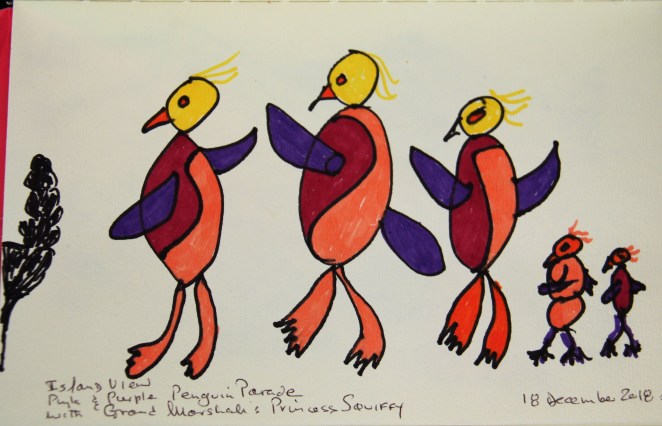
Moo apologizes. He hasn’t painted any chimpanzees, but a long time ago (2018) he drew and colored this cartoon. Pink and Purple Penguin Parade with Grand Marshall, Princess Squiffy. You can just see the end of Princess Squiffy’s tail as she vanishes out of the cartoon, encouraging the Pink and Purple Penguins to follow behind her behind. Oh the joys of leading the parade. Not everybody wants to do it though, many are content not to lead, but just to follow. Perhaps we should have called our cat MacNamara. After all, he was the leader of the band. But I don’t think Princess Squiffy would rather be anything other than what she is – a princess.

This poem, from Monkey Temple (of course / wrth gwrs) reminds me of Parents’ Day at my Boarding School. After several weeks of scarcely edible food, the tide would suddenly turn. Thursday, prime rib roast beef for supper. Friday, roast chicken with all the trimmings. When our parents arrived on the Saturday, all we could talk about was the wonderful food we had been eating for the last two days. Cunning, eh? We all had to dress up for Parents’ Day. Sunday starched collars, collar studs and all, and nice clean Sunday School ties.

Tea on the lawns in summer – unforgettable. A marquee, in case it rained, but otherwise tables laden down with a variety of skillfully cut sandwiches, little triangles, with no crusts, followed by endless helpings of strawberries and cream. The boys served their parents, fleeting back and forth to full the rapidly emptying plates. One boys father, I won’t say whose, devoured 12 bowls of strawberries and cream before the headmaster call the son over and begged him to beg his father not to eat all the strawberries and cream as some other parents’ would like some also.

Griffin Hunting – not a typical public school sport but one in which my school most certainly indulged. Our school symbol – a griffin – woven with gold thread on a dark blue background symbolized for the younger boys the perfection of the Prefects. To Hunt a Griffin was to behave in such a way as to attract the attention of older boys (already Perfect Prefects) and the school masters so that one became a candidate to climb the ladder and become a candidate for Griffin-hood. Some of us, myself included, preferred the anonymity of Robin Hood and were happy in our chosen roles of outlaws in Sherwood Forest and agents provocateurs and anarchists. Not for us the gentle counting of innumerable sheep. We chose rather the perils of after-dark transistor radios and the joys of Radio Luxemburg.

I remember being caught out of bed one night, on my knees, in a corner of the dormitory. All the dorm occupants were squealing and making a terrible noise. This attracted the attention of Perfect Prefect Plod – and in he came, threw the door open, and switched on the light. “You!” he pointed at me. “What do you think you are doing, out of bed?” “I am catching a mouse, Prefect Plod,” I replied. “You are a nasty little liar,” said Prefect Plod. “There are no mice in our nice clean house.” “Oh yes there are,” I replied, and I showed him the little mouse that I had cradled in my hands. “Give that to me,” ordered Prefect Plod. So I did. And the mouse took an instant dislike to him and immediately sunk its sharp little teeth into his thumb. I remember Prefect Plod running out of the dorm screaming “Matron! Matron!” and the little rodent swinging back and forth and hanging grimly on.

Those boarding school days ended 63 years ago. Hard to believe, really, but I still have such vivid memories of them. And of the Perfect Prefects, gripping cup handles between finger and thumb, enormously pleased to be the centre of attention on Parents’ Day, however clumsily they walked, in their spruced up for the occasion, Sunday Suits and Shirts, with their Golden Griffin ties. I always think of the Chimpanzees’ Tea Party when I think of the special performances of that little lot ‘for a Prefect’s lot is not a nappy one, nappy one.’