Jack Pine and Stars

Jack Pine and Stars

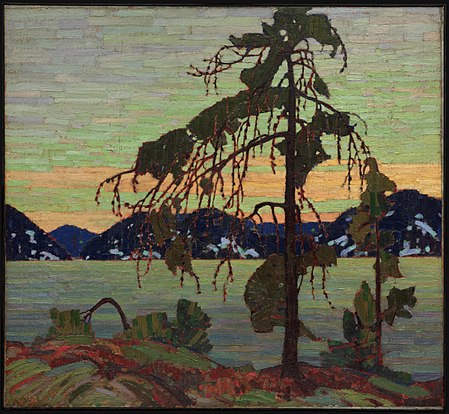
            Sitting on the porch at Tara Manor, measuring the evening shadows as they lengthen and thicken, I study the jack pine’s wild, extravagant growth, the way it reaches out to reject the commonplace of ‘tree’, as Milton Acorn rejected the commonplace of ‘poet’.
            The jack pine grows in radical disorder, sprouting here, there, anywhere the sea wind blows and its capricious nature dictates. Each limb of the jack pine bears a thin layer of salt, borne in from Passamaquoddy Bay by thin fingers of air that sow salt on branches and needles. Broken branches, untidy crows’ nests limb-tangled like grim, bedraggled hair sprout out from on high. Lower down the tree extends a branch, held out towards me like a helping hand.
            Charcoal shadows fill in the gaps between darkening trees. Shy deer emerge, step by cautious step, drifting their sylvan ghosts, delicate, across footpath and lawn. Wrapped in a scarf of peace, I forget the city’s hustle and bustle. Stars poke peepholes in the dark. I try to name each constellation, as it traces its new-to-me path across the indifferent evening sky.
            I look around: more jack pines, no two the same. How could they be? There’ll never be another poet like Milton, another book like his Jack Pine Sonnets, no tale like his own tale told in his own inimitable way.

Once Upon a Time

Once upon a time …

            Once upon a time, there was a man who carried a large round rock upon his back. It was huge and heavy, like the globe that Atlas carried. One day he felt tired, laid that rock upon the beach at Bocabec, waded out into the Bay of Passamaquoddy, and was never seen again. He left the rock there for my friend to find. My friend called it Magic Rock, but what he did with it and thought about it is his tale to tell, not mine. I must tell another story.
            Once upon a time, St. Patrick arrived in Ireland. He celebrated Easter on the hill above Tara, the royal palace of the ancient Irish kings. Then he walked down the hill to their palace and tried to convert them to Christianity. But that is another story, and it is not mine to tell, even though the name of Tara was given to the red and white house of another friend of mine, red and white, like the dogs and cattle of Ireland. But that’s not my story.
            Once upon a time, a rich and powerful man came to St Andrews and built a summer home on the hill above the bay. Later, another friend of mine purchased it, painted it red and white, and turned it into a wonderful home for guests and visitors. I wanted to tell her story, but it’s hers to tell, not mine. I can only tell my own story.
            Once upon a time, my friend who lives on the shore at Holt’s Point, walked on the beach outside his house and found an enormous, metal ball, weighing almost two hundred kilos. It was almost as big as Magic Rock. It lay there, on the shore waiting for some one to find it. My friend went home, drove back to the beach in his truck, winched the ball onto the flatbed, and brought it home. What he did with it is not my tale to tell. I must tell my own story.
            So, what is my story? What tales do I have the right to tell and how shall I begin my tale? Well, once upon a time, in Ty Coch, a red brick house on the Gower Peninsula, in Wales, a little boy was born … and that is my story … but I will not tell it here and now.  Instead, I’ll tell you another tale. But you will have to wait until tomorrow.

Birch

Birch

A birch tree lies on my power lines,
and I am powerless.

No phone, no radio, no tv,
and all because of a snow-laden tree.
Why did this happen to me?

“It’s a day, man, a day.
It’s nothing but a day.”

“Imagine,” says my wife,
“being without power all your life.”

I clench my fist and pump the air.
Nobody sees me. There’s no one to care.

A ghost’s voice echoes in my head:
“Stop moaning, bro, at least you ain’t dead.”

Sun, wind, melting snow.
The lame tree rising, slow.

At last the wires are free.
Power is back again.
I breathe more easily.

Yours

Yours

Yours are the hands that raise me up,
that rescue me from dark depression,
that haul me from life’s whirlpool,
that clench around the jaws that bite,
that save me from the claws that snatch.

Yours are the hands that move the pieces
on the chess board of my days and nights,
that break my breakfast eggs and bread,
that bake my birthday cake and count
the candles that you place and light.

You are the icing on that cake, and yours
is the beauty that strips the scales
from my eyes, then blinds me with light.

A Survivor Lights a Candle

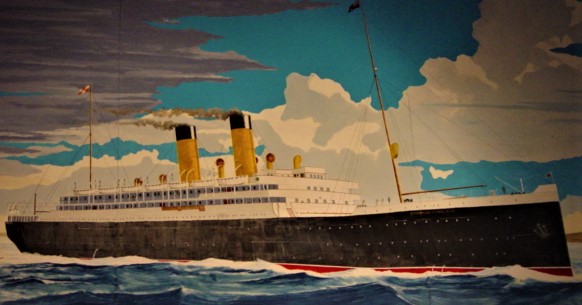
A Survivor from the Empress of Ireland
Lights a Candle During the Old Latin Mass for the Dead
Before the Main Altar at the Sanctuaire Sainte-Anne
Pointe-au-Père

1

I am still afraid of fire:
in principio erat verbum
/ in the beginning was the word.

I am still afraid of the loud voice of the match
scratching its sudden flare,
narrowing my pupils,
enlarging the whites of my eyes:

et lux in tenebris lucet
/ and light shines in darkness.

Booming and blooming,
igniting the soul’s dark night.

Voice of fire:  
et Deus erat verbum
/ and the Word was God.

Flourishing to nourishment,
flames whispering on the flood:
omnia per ipsum facta sunt
/ all things were made by Him.

Wool and water,
this sodden safety blanket;
and what of the cold
plush of pliant teddy bear,
the staring eyes of the doll:

et tenebrae eam non comprehenderunt
/ and the darkness comprehended it not.

2

The lashes of their eyes bound
together with salt water,
they were doused in a silken mist:
hic venit in testimonium
/ this served as a witness.

Still the patterns pierce my sleep,
hauling me from my opaque dreams,
holding my wrists in this sailor’s double clasp:
non erat ille lux
/ he was not the light.

Oh! Curse these dumb waters rising!
“Not a hair on your head shall be harmed!”
he said,
hauling my sister up by her hair
only to find her staring eyes
belonging to the already dead:
et mundus eam non cognovit
/ and the world knew her not.

3

Night waters rising.
The moon raising
its pale thin lantern glow:
et vidimus gloriam ejus
/ and we saw His glory
shining forth
upon the waters’
mirrored face.

Comment: I searched everywhere, but I could not find a copy of my poetry book Empress of Ireland. Nor could I find a file containing the poems. Lost, I searched everywhere yet again and then, on an old USB, I found the text of the chapbook M Press of Ire. The above poem comes from that chapbook. Empress of Ireland is available on KDP / Amazon. I had forgotten how much I loved the sequence.

Memories

Memories

I did the memory test today. It’s hard to believe
that tomorrow I may not know where I am
nor what is the day. Others have passed this way,
none to my knowledge in my family. Sorrow gnaws
the red bone of my heart. The lady at the doctor’s
counter says she is seventy. Her bed-ridden mother,
for whom she seeks medicinal solace is ninety-eight.
Her mind, she says, is as sharp as a needle or a knife,
 or a blade of grass. What dreams, I wonder, flit
through her head at night? Does she recall her child
hood with its pigtails, the first young man she kissed,
church on Sundays, the genders carefully segregated,
driving there in the family horse and cart? Thunder rolls
and shakes my world’s foundations; a storm watch,
followed by storm warnings, walks across my tv screen.
Lightning flashes. Aurora Borealis daubs the night sky
north of Island View with its paint-box palette of light.
Memories, according to the song, are they made of this.
But what is this? Is it these shape-shifting, heart-stopping
curtains of shimmering grace? Or is it those darker
shadows cast by firelight on the smoky walls
of a pre-historic Gower cave where my ancestors gnawed
the half-cooked bones of the aurox and never ever
dreamed of Jung’s racial memories as they communicate
information from the unconscious to the conscious mind.

WFNB

Moo

WFNB

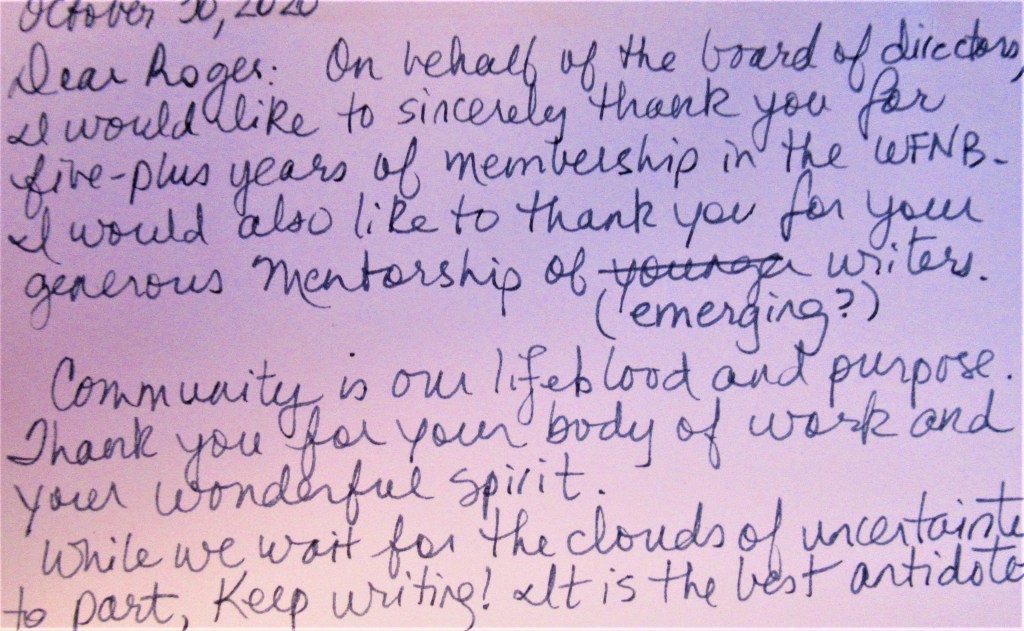
I have been a member of the Writers’ Foundation of New Brunswick for a long, long time. I am not a ‘founding member’, but I think I have been a member since around 1985, and I am sure I was a member in 1986, when Goose Lane Editions, Fredericton, published my second poetry collection, Broken Ghosts. I was most certainly a member in 1989 when my still-unpublished poetry manuscript Still Lives placed first in the Alfred G. Bailey poetry competition.

In the years between 1985-1986-1989 and 2020, I have never received a hand-written communication from any member of the WFNB Board, other than an official communication of one kind or another. Imagine, then, my surprise, when the above postcard, inserted in a hand-addressed envelope, arrived in my mail box yesterday. I was truly amazed and very grateful to the president who wrote these kind words to me. Amidst the panic and the pandemic, it is so nice to be remembered and in such a thoughtful way. Madam President: thank you so much for reaching out to me with this verbal gesture. And yes, you can count on my support for yourself and our Writers’ Federation, I hope for a long, long time to come.

I was in two minds whether to post this or not. However, I wish to emphasize several things: the importance of reaching out, the importance of continuing to believe in ourselves and our creative talents during these difficult times, the necessity of creating alternate communities and of supporting each other as much as possible, the need to avoid total isolation and to maintain human contact in different ways when the physical things — meeting, touching, holding, direct dialog — and the normal activities and relationships of healthy human beings are denied to us, and last, but by no means least, the need to encourage each other and to offer comfort and recognition whenever and wherever possible.

Waiting for inspiration
and
hoping to fly!

Sunday in Wales

To be Welsh on Sunday
(This prose poem should be read out loud, fast, and in a single breath!)

              To be Welsh on Sunday in a dry area of Wales is to wish, for the only time in your life,  that you were English and civilized,  and that you had a car or a bike and could drive or pedal to your heart’s desire, the county next door, wet on Sundays, where the pubs never shut  and the bar is a paradise of elbows in your ribs and the dark liquids flow, not warm, not cold, just right, and family and friends are there beside you  shoulder to shoulder, with the old ones sitting  indoors by the fire in winter or outdoors in summer,  at a picnic table under the trees or beneath an umbrella that says Seven Up and Pepsi (though nobody drinks them) and the umbrella is a sunshade on an evening like this when the sun is still high  and the children tumble on the grass playing  soccer and cricket and it’s “Watch your beer, Da!” as the gymnasts vault over the family dog till it hides beneath the table and snores and twitches until “Time,  Gentlemen, please!” and the nightmare is upon us as the old school bell, ship’s bell, rings out its brass warning and people leave the Travellers’ Rest, the Ffynnon Wen,  The Ty Coch, The Antelope, The Butcher’s, The Deri, The White Rose, The Con Club, the Plough and Harrow,  The Flora, The Woodville, The Pant Mawr, The Cow and Snuffers — God bless them all, I knew them in my prime.

Comment: I wonder how many other ‘serious drinkers’ or ‘amateurs’ remember these pubs and clubs. And, oh yes, there were so many more. The Mexico Fountain, The Tennis Court, The Old Market Tavern, The New Market Tavern, The Load of Hay, all those many colored dragons: green, black, blue … the Three Lamps, the Cricketers, the Villiers Arms, the Birchgrove Arms, the Rose and Shamrock, several Red Dragons, the Church, the Black Swan, I can’t remember how many different Georges, and Kings’ Heads, the Vine Tree, the Sun, the Oak tree, the Penguin, the Naval Volunteer, the Quadrant, the Coronation Tap, the Mauretania, The White Horse, the Black Horse, the Old Grey Mare … so many memories, and all deniable, and I’ll never forget the Wheelbarrow Race (ask me about it), nor Pickety Witch, one of those pubs at which I never stopped!

Survivor

Survivor

Every day, now he’s learning to speak Welsh,
he finds out something new about his childhood.
It’s not the need to talk so much as the necessity
of diving into himself and mining his memories.

Brynhyfryd / Mount Pleasant.
Pen-y-Bont / the End of the Bridge.
Ty Coch / the Red House.

This latter the house in which he was born,
way out of town, by Fairwood Common,
away from the strafing and bombing.
The war generation of his family all born
in the same in-the-country Gower bed.
No room in war-time hospitals
not even for the birth of war babies.

Three of his brothers did not survive
those rough, household births.
He still bears the forceps’ scars
from the moment the doctor
plucked him out, head first,
and hung him up by the heels,
shaking him, bringing him back to life.

He bears other scars as well
from the survivor’s burden of carrying
three dead brothers for seventy long years,
alive and kicking in the womb-warm
crevices of his still beating heart.

Thanks Giving

Thanks Giving

Driving from St. Andrews to Island View,
giving thanks for fall foliage as I pass
fields and forests filled with autumn blushes
blueberry patches brushed with cyan,
violet, sprinkled with primary red.

Trees crowd close, encroach, add yellow
and orange, fresh tonal values at each turn.

Sunlight strokes white touches of pointillistic
beauty through showers of golden leaves.

 Ochre and brown burn shades where pinprick 
black ghosts shadow grays through a gilded tree.

Cubist, this fire-bright, iron-sheeted shed.
Surrealist that rusted tractor, abandoned.
The road’s black thread ties together vivid
impressions of leaves as they tumble and fall.