Dawn at KIRA

Dawn
at
KIRA

1

A fiery wedge, fierce beneath
black-capped clouds, alive
the firmament with light,
breaking its waves over woods,
waters, tranquil the bay, grey,
yellow-streaked, then blue,
the new day dawning,
driving night away,
false shadows fleeing.

2

To rock this new born babe,
to swaddle it in a cloak of cloud,
disguised for a moment its promise,
nature nurturing heart and mind,
filling the flesh with memory’s
instantaneous flash breaking its light
into the dark where no light shone,
fearful, the dream world,
gone now, dwindling, as day light
shafts its arrowed flight.

3

How thoughtful My Lady
 who placed me here,
at this desk,
at this window,
 at this moment of time.

Glorious, this day-break:
words no justice can do
to peace and light,
this early morning,
filtering sunlight
through the waking mind,
relighting the fires
within the heart,
and glory
a word’s throw away
outside this window.
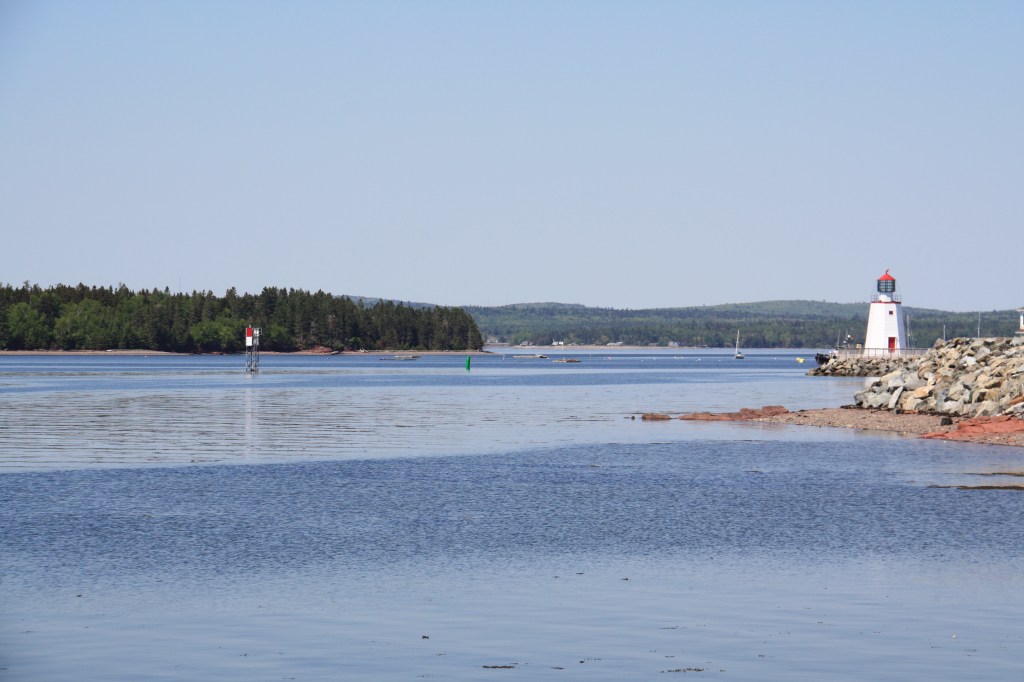
Lighthouse

A lighthouse to light your way, shining to make the night as clear as day and to highlight any obstacles that might stand in your way.

Lighthouse

            Once upon a time that lighthouse on the quay was a young boy who sat within the shadow of his father’s tale. He sensed he would never feel the power of his own words because he didn’t seem to have any on account of the black hole inside him that swallowed everything up. He thought he would never know the joys of creating his own myths, telling his own story. He thought he would never come to grips with storm music, wind and rain, a lost path sought and found. He longed for someone to gift him a rainbow, with or without its pot of gold. He also thought that the fatal shadow, cast upon a child by a father, would always be there.
            One day, the early morning sun knocked on his bedroom window. He drew back the curtains and let in the light. That day, he emerged from the shadow and saw that the world was bright and filled with sunshine. Each morning, he breathed in the sunlight, felt it flow through his body. His heart pumped new blood and he was refreshed by the joy of living, of being himself, of being nobody but himself, unique and wonderful, subject to nobody’s wishes and whims. Gradually he grew into the person he was always destined to be.
            The sun’s rays lit up his face and eyes. Sunshine flourished within him and renewed not only him but all that he touched. Light flooded out like the beam from that other lighthouse, over there, on those rocks, that was put there to help and guide wayfarers and seafarers lest they become lost at sea.
            Lost, he found himself. Found, he centred himself. Joy and hope, belief and knowledge took root under the sun that each day nourished his body, soul, and spirit. Renewed, light flooded from him. He burned like a bonfire or a beacon and became one of those special lights that enlighten the world. He became that lighthouse.

Comment: One of the prose poems from Tales from Tara that slipped in here by accident. I have included it for, and dedicate it to, my good friend and fellow writer, Judy Wearing, to wish her well with health and strength in this new year that is now turning into something special.

Merry Christmas

A forgotten child’s Christmas in Wales.

On the Outside Looking In

As I walked home, it started to snow. Not the pure white fluffy snow of a pretty Merry Christmas card, but the dodgy, slippery mixture of rain, snow, and ice pellets that turned the steep streets of Swansea into ice slides and traps for the elderly. I turned up the collar of my coat, bowed my head, and stuffed my hands into my pockets. Two houses before my own, I stopped in front of our neighbor’s house.
The window shone, a beacon in the gathering dark. I drew closer, pressed my nose against that window and looked in. A Christmas tree, decorated with lights, candles, more decorations, a fire burning on the hearth, two cats curled up warm before the fire, presents beneath the tree, stockings hanging from the mantelpiece. For a moment, my heart unfroze and I felt the spirit of Christmas. Then I thought of my own house. Cold and drafty. No lights, no decorations. No fire. The snowball snuggled back into my chest and refused to melt.
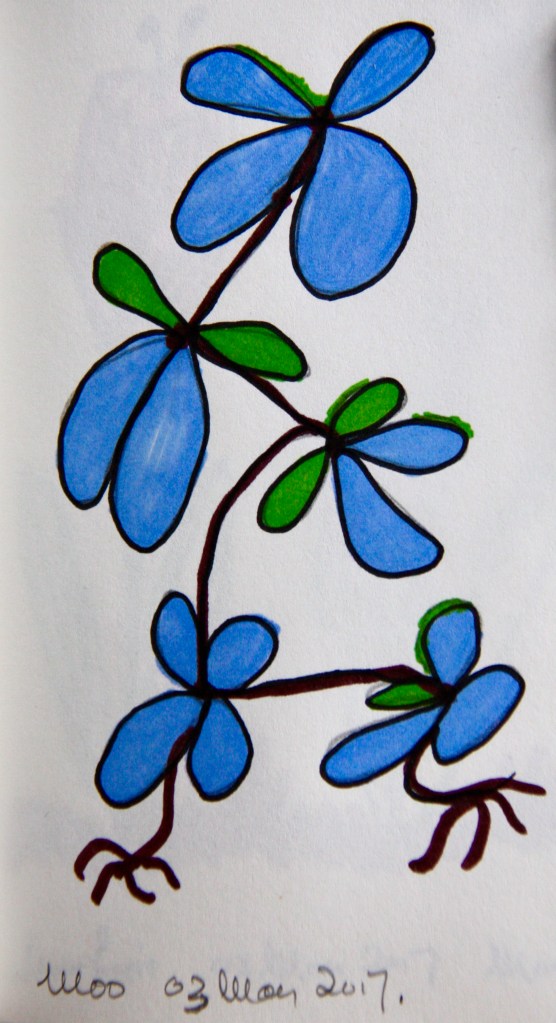
            When I got home, our house stood chill and empty. My parents were out at work and the fire had died. Nothing was ready for Christmas. I sat at the kitchen table, took out my sketch book and began to draw, then color. When my mother came home, I showed her my picture.
            “Very nice,” she said without looking up.
            “But mum, you haven’t really seen it.”
            She stared at the picture again. This time, she saw the Christmas tree and the lights, the cats before the fire, the candles burning on the mantelpiece, the decorations and the presents wrapped and waiting beneath the tree. But she never noticed the little boy standing outside the house in the falling sleet, cold and shivering, peering in through the window.

Comment: Everyone remembers Dylan Thomas’s story A Child’s Christmas in Wales, but not all Welsh Christmases are like that. This is the story of a forgotten child’s Christmas in Wales. It is a story about a latch-key kid, left alone at Christmas to fend for himself. I enclose the drawing he did and I dedicate the story to anyone who is alone this Covid-19 Christmas. Christmas spent on your own is not much fun. Looking through another’s window, from the cold street outside, is not much fun either. So, at this time of year, let us remember those who are lost and lonely, those who need a kindly smile and a helping hand, those who do not have the comfort of family and friends, a warm wood fire, or a cat or a dog to snuggle up to them, to lick them, and to wish them ‘all the best’ in the languages that all animals speak on Christmas Eve, and sometimes into Christmas Day. Phone a friend, nod to a neighbor, and may your Christmas season be filled with joy.

Happy Anniversary

Married 54 years ago today. What a way to celebrate with 3 poems to Clare on QBF. My thanks to Brian Henry and Quick Brown Fox.

Yours

Yours are the hands that raise me up,
that rescue me from dark depression,
that haul me from life’s whirlpool,
that clench around the jaws that bite,
that save me from the claws that snatch.

Yours are the hands that move the pieces
on the chess board of my days and nights,
that break my breakfast eggs and bread,
that bake my birthday cake and count
the candles that you place and light.

You are the icing on that cake, and yours
is the beauty that strips the scales
from my eyes, then blinds me with light.

Comment: what excellent timing: thank you for publishing three of my poems to Clare and on our 54th wedding anniversary too (24 December 2020). An incredible gift and Clare and I both thank you for it, Brian. How to make a memorable day even more memorable. Tonight, when we open the champagne, we will have a glass for you on the table. Much as we would appreciate your presence, the two week quarantine on entering New Brunswick places a blanket over so many invitations and celebrations. That’s why every little helps, and this is so much more than a ‘little’, it is a lot, a very thoughtful lot. So, for Brian, his family, and all my family and friends: tonight we will be alone in our home. But we will raise a glass to absent friends, and we will be together in our hearts. “To absent friends”!!! Here’s the link to Brian’s page.

http://quick-brown-fox-canada.blogspot.com/

R.I.P.

Forget-me-not!

R.I.P.

He was a good man,
and a better friend.
He came over to mow the lawn
and stayed for a beer.
“This is gonna sizzle!”

Some called him uneducated,
no BA, no MA, no LLB,
but he had a golden heart
and a PhD in the school
of life and hard knocks.

I met men like him in Wales,
coal miners in bars,
steel workers on rugby teams,
sheep farmers from the hills
in the big city for the game.

Humble, they were, honest,
hard men, hard working,
intolerant of pretension and fools.
When I went to university,
nineteen and full of ideals,
they pulled me on one side.

“You’re one of us,” they said.
“However high you rise,
don’t lose the common touch.”

I met men like him in Spain,
foot-soldiers from the Civil War,
riflemen, dynamite throwers
with their skills learned
at coal face and quarry.

Machado wrote poems about them:
“Donde hay vino, beben vino;
donde no hay vino,
beben agua de las fuentes.”

Where there is wine,
they drink wine.
Where there is no wine,
they drink water from the fountains.

A good man, an honest man,
an uneducated man, some say,
who taught me more about life
and how to live it
than any university professor.

Comment: I read the obituary of one of my best friends in the newspaper today. He moved away from the neighborhood and we lost touch. But I never forgot him. As I have never forgotten those who shaped me in Wales and Spain. I have forgotten many of their names. But I have never forgotten their faces, nor their words of wisdom. At first, his passing brought a shadow to my life. Then I realized that no, he would not have wanted that. I think now of the good times, the laughter, the joy and, instead of mourning for him, I rejoice in all the goodness he gave me. Rest in peace, my friend. I will forget-you-not.

Heraclitus

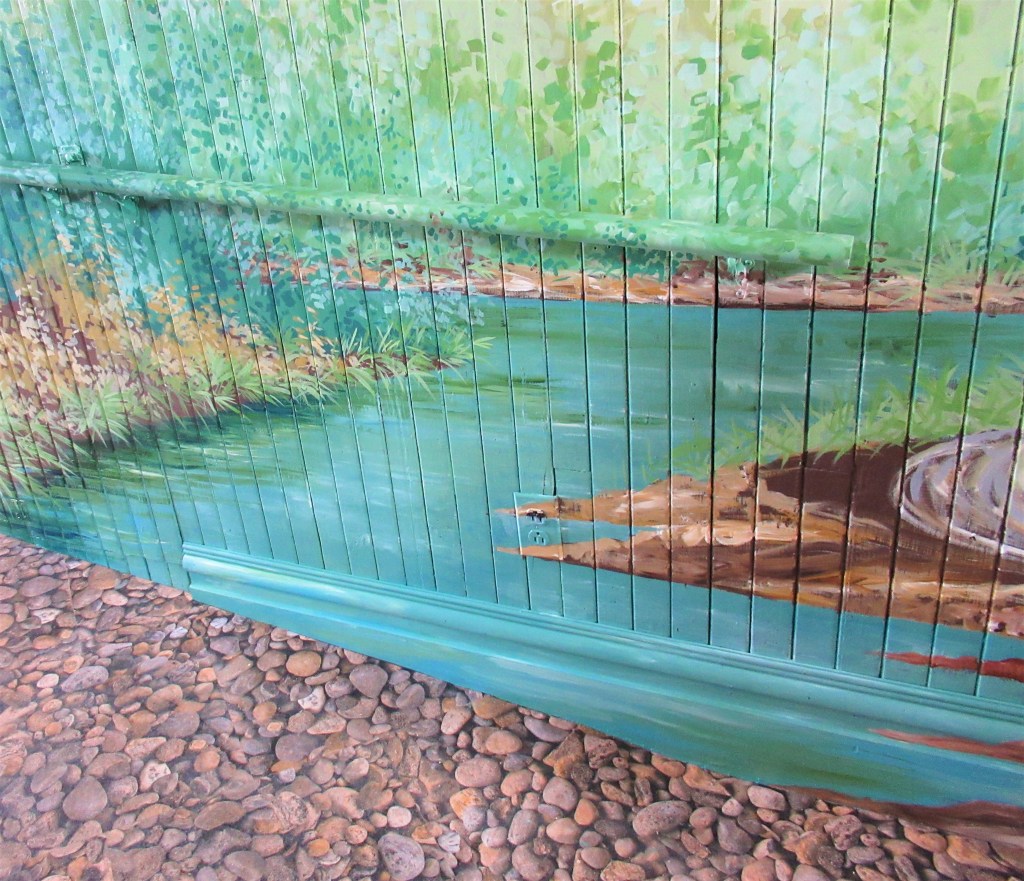
Geoff Slater’s mural at McAdam Railway Station. ‘You cannot step in the same river twice.’ Heraclitus.

Heraclitus

Nothing will ever be
as it was before.

Time, like water,
like these people marching,
constantly flows,
trickling through my fingers,
uncatchable, unstoppable,
 sand filtering through
the hour glass’ waist.

Water flows, currents shift,
rocks wear down,
banks slide and fall.

“You cannot walk
in the same river twice
nor ever attend
the same demonstration.”

Nor can you recapture
that first, fine, careless rapture,
the touch of that first
drop of river water.

Kneeling by the river bank,
like St. Kevin and his Blackbird,
I cannot recall the river’s name.

Comment: I love the reality of the river, its impressionist style of flowing water, impossible without the enormous presence of Claude Monet and his portraits of the Seine. However, what makes the mural, for me, is the brutal reality that breaks into the painting’s unreality. The boards covering the interior wall, the hand rail blended into the painting, the skirting board, the electric socket. I also like the intertextuality: art speaking to poetry, poetry replying to art, the links to Heraclitus, poetry speaking to poetry, the anonymity of the river, and the further poetic links to Robert Browning and Seamus Heaney. I often wonder if readers and viewers pick these things up. Or do they just speed-read, link to their own experiences, and move on with no further thought? You tell me. But what I will tell you is that artists reaches out to art, poets extend their hands to poetry, and our world is an inter-connected maze of thoughts and ideas, linking and unlinking, occurring and re-occurring, lapping like an incoming tide at the fingers and toes we immerse in those amniotic waters, often so long-forgotten, in which our creativity is berthed and from which it is born.

Absence

Absence

My body’s house has many rooms and you, my love,
are present in them all. I glimpse your shadow
in the mirror and your breath brushes my cheek

when I open the door. Where have you gone?
I walk from room to room, but when I seek,
I no longer find and nothing opens when I knock.

Afraid, sometimes, to enter a room, I am sure
you are in there. I hear your footsteps on the stair.
Sometimes your voice breaks the silence

when you whisper my name in the same old way.
How can it be true, my love, that you have gone,
that you have left me here alone? I count the hours,

the days, embracing dust motes to find no solace
in occasional sunbeams and salacious dreams.

The Exact Word

Le mot juste

Searching for le mot juste, 
the exact word that sums it all up, 
catches the essence of the thing 
and holds it in the mind forever.

Think flowers. Think scent. 
Think of the limited ways 
we describe how daffodils
lift and clematis clings.

I look across the breakfast table 
and see my wife of fifty years, 
a teenager reborn, walking into 
that café where we had our first date.

I search my memory and my mind 
for the words to describe that beauty, 
that surge of excitement, 
I still feel when she enters the room:

but find I cannot find le mot juste.

Comment: I shortened this poem from its earlier version. You can click on this link to compare the two versions. I am always puzzled by the dilemma of lengthening or shortening. My thoughts center on the longer and shorter versions of some Raymond Carver stories. Follow the editor’s advice and cut all material down to its essential bones or fill out the skeleton with flesh and blood and expand the creative process further. I also think of the exhortation to ‘stay in the moment’. Anything that takes the reader away from the central experience is superfluous. Experienced writers are aware of that moment and its importance. Writers at my stage are often baffled by it and need to be told yes, this is the moment or no, that is not the moment. I guess the more we write, the more we understand the process. Understand: do we work this out consciously or does it develop in unconscious fashion? Are some people just born with those skills or we must work hard to develop them? Sunt rerum lachrimae: tears are in all things and I guess hard work is all part of the process. As I was told a long time ago: genius is 99% perspiration and 1% inspiration. You have to put in the hard work for that little light bulb to go ‘pop’!

Teddy and the Angels

Teddy and the Angels

Warm in Bed. Cozy. I roll over and the flashlight clipped to my Teddy Bear’s ear drives its hard, metal lump into my face.
            “Are you awake?” Teddy’s soft voice lilts across the pillow.
            “I am now.”
            “Look!” Teddy points with his little leather paw. “The moon: it’s climbing the fir tree.”
            Sure enough, a thin fingernail of gold is perched on a branch. It hides its face among the fir’s darkness and vanishes for a moment.
            “The maple tree has a garland of tiny Christmas lights,” says Teddy, pointing again.
            “Those aren’t Christmas lights, they’re stars.”
            “Spoilsport. Look, that one’s moving. I think it’s an angel.”
            “What time is it, Teddy?”
            “I don’t know.”
            “Here, lend me your flashlight.” I pull him towards me, switch on the torch, and focus its light on my wristwatch. “4:55 AM. That’s the early morning flight from Toronto. It’s a plane.”
            “I’d much rather it was an angel.”
            “Me too.”
            “Can we pretend it’s an angel, a Christmas angel?”
            “Of course we can. But it’s gone now.”
            “Perhaps angels don’t live long when they come to earth.”
            “I think they live for ever. Especially if we believe in them.”
            “Do you believe in angels?”
            “I was taught to believe in my guardian angel.”
            “What’s a guardian angel?”
            “He’s the one who looks after you when you sleep at night.”
            “But you don’t need a guardian angel. You’ve got me.”
            “But you’re a teddy bear, not a guardian bear.”
            “That’s true, but you’ve got Blueberry. He’s your guardian bear. Look at him standing there, on guard, all night long to protect you from the Night-Bumps.”
            “Ah yes, good old Blueberry. I’ve got a busy day today. I need some more sleep.”
            “Okay. Blueberry and I will watch over you. I’ll watch over you. I’ll let you know if any more angels climb the tree.”
            “That would be nice. Now I’m going back to sleep.”
            “Good night. Or should that be ‘good morning’.”
            Some days, when I wake up, I think I have dreamed all of this. Other days, I believe in talking teddy bears and angels. Today, I’m not so sure.

Building Bigger Boxes

IMG_1292 (2).JPG

Building Bigger Boxes

Some of the worst educators I have been unfortunate enough to work with over my undergraduate and graduate years have come up with cliché after cliché in an effort to the sway students into believing that they really are getting an excellent education. One such phrase is the infamous: “We are teaching you to think outside the box.” So, what is their definition of ‘the box‘? Alas, I do not know. They deal in clichés and, by definition, a cliché is a  phrase that both parties (teachers and taught) accept as being meaningful, even though it is often without meaning. It is also a conversation closer, as in ‘it is what it is’. It’s hard to argue with that or to reason your way around it. ‘But it doesn’t have to be!’ rarely cuts the mustard aka mouse-turd.

So, if these teachers are teaching their students how to think outside the box, how are they managing to do so? Why by building bigger boxes inside which each student can be safely taught to think, without asking questions, and without looking for independent answers.

Today’s cartoon has two titles: (1) Brave hearts  escaping, finding meaning outside the bigger boxes and (2) can the true heart escape its coffin in a bigger box? I love the boxes within boxes and the drawers within each boxed segment into which the young, developing mind can be stuffed and crammed. How do we release those hearts? How do we develop those minds? Certainly not by confining them in bigger boxes. In the battle for hearts and minds, how do we set our students free?

It must be done on the student’s terms, each student, one by one, in co-operation with intelligent, meaningful teachers who step away from cliché and commonplace to enter the learner’s world and to themselves learn how to contact each learner at a mental, spiritual, and intellectual level. Only then will teacher and taught be able to speak of true intellectual freedom. Until that happens, be very careful when your child comes home and announces that today, of all days, that child has been taught to think outside the box. “Verily, I say unto you, open the cage door. Let in the sunshine and the light. Set those children free.” But remember, it must be on a  case by case basis, with each individual weighed, assessed, understood, and released to find their own individual way of earning the things they specifically need to know. In true education, one size really doesn’t fit all.

Comment: Another Golden Oldie that suddenly surfaced and, on emerging from the depths, reminded me of another of my callings: that of a teacher of philosophy and a teacher with a philosophy. Retired now, I can no longer help young minds to create and shape themselves. This is doubly true with Covid-19 haunting us, waving at us from the shop-windows, supermarket aisles, and street corners, flapping its wings and trying to fly into our bodies. And remember to distinguish between clichés and things that are not clichés, like ‘Wear a mask’, ‘wash your hands’ (twenty seconds, with soap), and ‘keep a safe social distance’. Do this all the time and hopefully you will avoid thinking inside the bigger box of a six foot pine Covid-19 coffin.