Carved in Stone 72 & 73

Carved in Stone
72

Is this world I create real?
Of course it isn’t.

It exists only in my head,
and on the page,
but perhaps, one day,
you too will see
the things I have seen.

Yet the world I describe
is as unreal as the words
from which it is woven.

73

Heraclitus once wrote
we can never bathe
in the same river twice
.

This is the Catch 22
faced by all poets,
to remember,
and to try to recreate.

Shadow hands on cave walls,
colored pictographs on gesso,
hieroglyphics on papyrus,
ink on paper, raw words,
and in the end,
everything reduced
to these three little letters
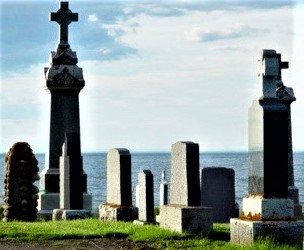
carved in stone –

RIP

Commentary:

If you have read this far, we have walked a long journey together – 73 verses that comment on life and the meaning of life. Hard reading in places, easy in others. I trust you have enjoyed the journey and found some stops and resting points along the way in which to contemplate the ways in which the threads of your own life intermingle with mine.

Throughout this journey, I have tried to use a four step process. (1) Verbal – the poems themselves. (2) Visual – photos that intertwine with the verbal. (3) A Commentary – that goes beyond the verbal and visual and opens up the ideas a little more. (4) A Dialog between myself – the poet – and Moo – the visual artist who has so frequently loaned me his paintings when he thinks they illustrate my words.

It’s been a topsy-turvy journey through what Bakhtin calls a world of carnival, where little is at it seems, and the world is turned upside down. That said, we have a clear choice – to slide down the downside of this life, or to scale the upside, to contemplate, with joy and happiness, the world from those heady heights.

Blessings. Pax amorque.
And thank you for travelling with me.

Carved in Stone 70 & 71

Carved in Stone
70

Where can I survive
in this harsh world
where poetry and ideas
struggle to be free,
a world in which
the great literary myths
have been destroyed?

Where mass media rules,
sensationalizes, lies,
falsifies the power and glory
of words, now used
not to delight and educate,
but to manipulate.

A treacherous world
in which an evil genius rules
and constantly misleads us.

71

An Age, not of Enlightenment,
but of Endarkenment,
this is not the world
in which I want to live.

My chosen world
is that quiet corner,
outside El Rincón
in the Plaza Zurraquín,
by the Mercado Chico,
in Ávila, Spain,
where leaves and confetti
dance to the wind’s tune.

A world of mystery and dream,
personal perhaps,
but well known to
all of those dreamers
who have the eyes to see
and the heart to stand still
and listen.

Commentary:

“There is no earth, no heaven, no extended body, no magnitude, no place and that nonetheless I perceive these things and they seem good to me. And this is the most harrowing possibility of all, that our world is commanded by a deity who deceives humanity and we cannot avoid being misled for there may be systematic deception and then all is lost. And even the most reliable information is dubious, for we may be faced with an evil genius who is deceiving us and then there can be no reassurance in the foundations of our knowledge.” René Descartes (1596-1650).

Cervantes wrote about such times in Don Quixote. Do we see what others see? What is truth and what is fiction? How do we approach and understand authority? What do we believe and why do we believe? Are they windmills or giants, wineskins or warriors, a flock of sheep or an invading army? “Only believe, and thou shalt see” – but what do we believe and why do we believe. “The fault, dear Brutus, lies in ourselves, not in the stars, that we are underlings,” Shakespeare, from one of his many plays.

Carved in Stone 50

Carved in Stone
50

Here, in the castle of my own home,
I sit and write and patiently wait
for the enemy’s superior forces
to arrive and overwhelm me.

But death is not the enemy.
He is the friend
who has walked beside me
every day, since the day
that I was born.

I know him and I trust him,
though I am unaware
of when he will come to call
and I am ignorant of the shape
he will finally take.

Commentary:

Francisco de Quevedo, the 17th Century Spanish Neo-stoic and Metaphysical poet, wrote “the day I was born I took my first step on the path to death.” And so it is, with all of us. Sometimes we are able to choose our paths, sometimes they are forced upon us, sometimes they appear – with choices – and we make our selection and move on.

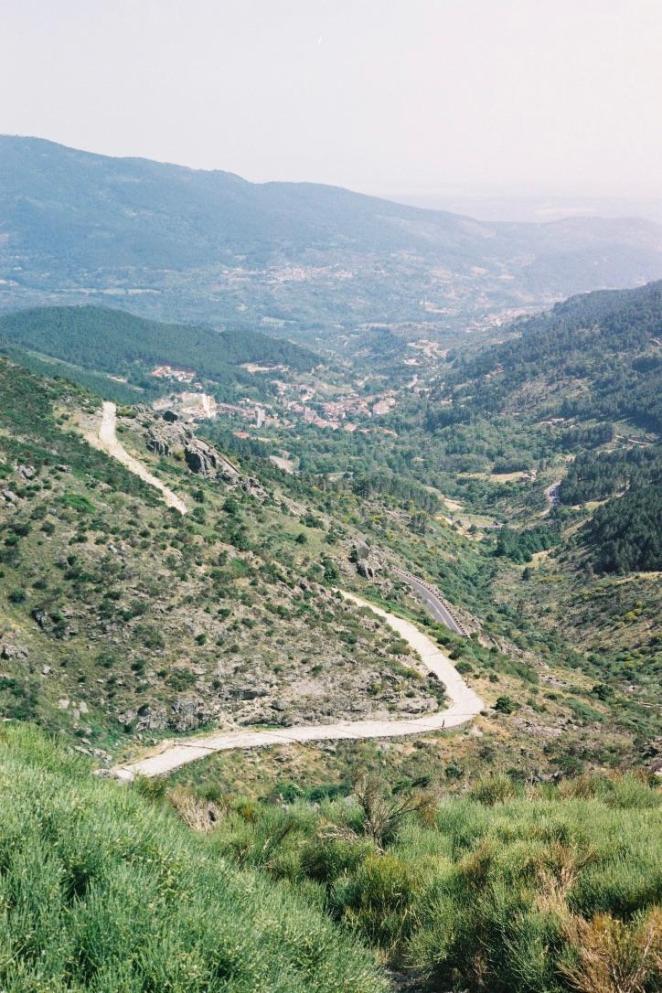
There are so many roads to travel. For Antonio Machado (Spain, Generation of 1898) there is no road. There is only a wake upon the sea – “Caminante, no hay camino, solo hay estela sobre el mar.” We must look back, to see where we have come from and where we have been. But there are many other possible paths, beside that of the sea – gravel paths, cobbled ways, log trucking roads in the Canadian Forest, cattle roads, transhumance roads, winding roads, straight Roman roads, roads that run up hill, down hill, or twist and bend following the paths of rivers.

The picture above shows the old Roman Road that leads to the Puerto del Pico, in the province of Avila. It followed the contours of the hill and formed part of the Ruta de la Plata, the road that took Latin American silver from Seville to the Spanish capital in Madrid. Look carefully and you can see the modern highway that runs parallel to the old Roman road. Nowadays, that older road is used for transhumance, the movement of cattle from the valleys in the winter to the hills in the summer. The same road, the same pass, so many different uses, and the road a wake upon the path of so many lives.

Carved in Stone 18

18

Day-dreams, cloud castles,
châteaux en Espagne.

I climb the castle tower
in Segovia, and watch
Golden Eagles flying
in the air below me.

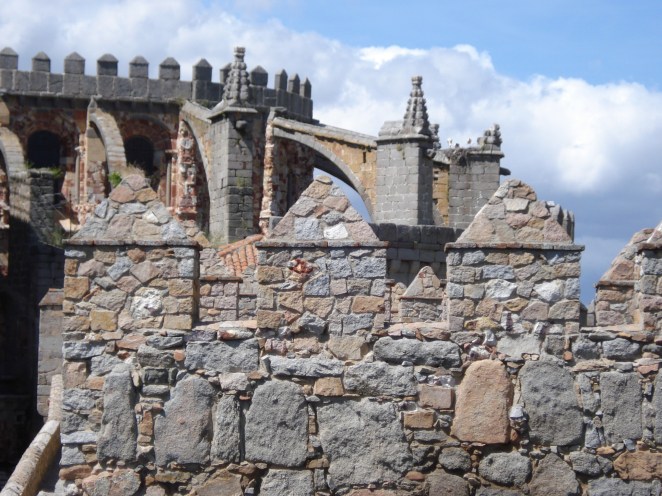
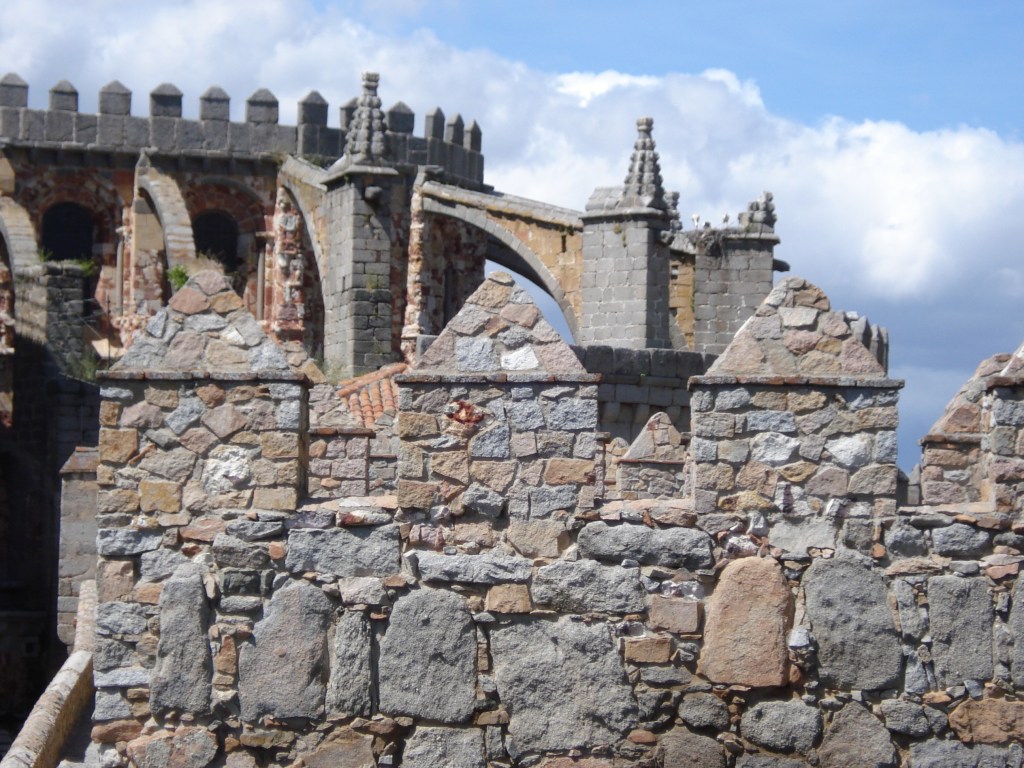
I walk the walls in Avila,
feel the stonework, warm in the sun,
and sense the passing of time
as it slowly gathers,
like clouds in the air
when they foretell a storm.

I trace masonic signatures
on the cathedral’s central façade,
and marvel at the master carvers,
who shaped the statues.


They also created angels
and the praying pay-masters
condemned to kneel there,
seeking forgiveness for their sins,
as flickering candles mark time.

Commentary:

Avila: 3.8 kilometres of walls. 9 entrances. Inside the walls, the old city. I lived for three summers in El Rincon, a Hostal in the city centre just outside the Mercado Chico. I still dream of walking those city streets, visiting the bars each with its different customs and tapas. And I remember the tapas, each bar specializing in something different. The Rincon, a marisqueria, and I learned so much abut sea-food, its transportation, the ways of preparing and cooking it.

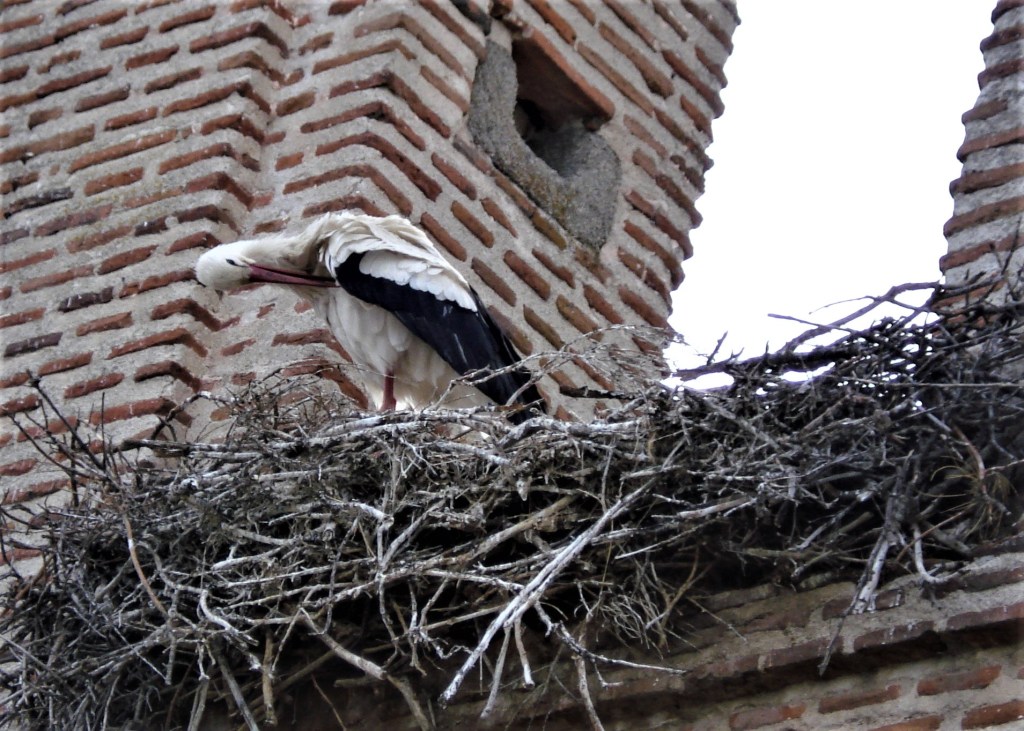
And while in Segovia, you look down at the Golden Eagles, in Avila, an eternity of storks looks down at you. I remember my friend, standing at the door of the Hostal and calling the storks, as they returned from a day in the fields, by the names of the churches in whose towers they built their nests.

I never thought those days would end, but end they did. As all things do. Now I must take a delight in the memories as they walk before me and call me by my name.

Carved in Stone 14 & 15

14


The sun throws shadows
across the cathedral’s face.

Crosses, arrows, stars,
masonic symbols
hammer-and-chiseled
into the granite sea-cliff
of the entrance way,
reveal the signatures
of the master masons
who laboured here.

And not just here,
for they traveled everywhere,
adding their stone signatures
to those of the other workmen
who left a piece of themselves,
carved in stone.

15

In the cathedral
of Santiago de Compostela,
Maese Pedro sculpted
a statue of himself,
a figurine, small,
low down, facing the main altar.

Students rub noses with him
before their exams,
when they look for luck
having forsaken their studies.

Illiterate people
consult these carvings
in the same way the educated
seek knowledge in their books.

16

The Bulls of Guisando,
pre-historic, unweighable,
the bearers of Roman graffiti,
itself two thousand years old.

Commentary:

workmen who left a piece of themselves, carved in stone … I couldn’t find my masonic markings from the cathedral in Avila, so I added the words carved into one of the Bulls of Guisando instead. Amazing how people want to make a little bit of themselves eternal – in the sense that we extend our names, our graffiti, our messages beyond our lifetime and, stones thrown into a pond, who knows how long the ripples from those tiny word-waves will endure?

So, what’s it all about, Alfie? And which Alfie are we referring to, the one who burnt the cakes or the (in)-famous gorilla in Bristol Zoo, who went missing? And how many Alfies are there out there? And why buy an Alfie-Romeo when you can buy a neat tombstone for a much smaller sum of money and have it remind people of you long after you have gone?

Silly questions, really, but this is what poetry is for, to open up the curious mind and to dig warrens for bunny rabbits so that the hunters of curiosities can dig their ways down and find whatever they shall find. But do we ever find what we are looking for when we first start out? Good question. Carve your answers into a piece of rock and leave it by the roadside to see what happens to it. Or else, you can write a message, stick it in a bottle, and send it out to sea to float on the waves. Put my name on it, along with yours, and maybe, one day, it will arrive at my doorstep in Island View and, if I am still here, I will reply to you by the same method.

Carved in Stone 1

My very own hand-carved verraco
Del Rincon (Avila) a Roger

Carved in Stone

1

Behold me here,
filled with a sort of shallow,
hollowed-out wisdom
accumulated over decades
while listening with my eyes
to the words and thoughts
of writers, long-dead.

Imprisoned in book pages,
do they bang their heads
against walls that bind,
or hammer with their fists
at the barred lines
of their printed cages?

These spirits long to break free,
but they choke on library dust
and pollen from verbal flowers
that bloom unseen.

Those old ones avoided
the traps of temporal power,
or, once trapped,
gnawed off a precious limb
to limp into freedom

Commentary:

Carved in Stone is the second dialog (Chronotopos II) in my Bakhtinian Dialogs with my time and my place. Clepsydra is the first Dialog. You can follow it, in its entirety, starting with this first, introductory post.

Reception Theory – I write, you read. Any meaning that you extract from my poetry will depend on your own culture and background. Tolle, Lege – Take and read. Read slowly, and with care.

I am a poet, a dreamer, if you will. These are my dreams. Tread softly on my dreams, for when you enter my world, you mingle your dreams with mine. The result, I hope, will be an interesting intellectual blend of new creativity.

The hand-carved verraco, in the photo above, was given me by my friends in the Rincon (Avila) where I spent four happy and creative summers. Never forgotten. Blessings and pax amorque.

Clepsydra 33

33

… but the light cannot last forever
     so where do I go
          when the door in my head
               slams shut
         
then I know
     I have lost the key
          to my mind’s labyrinth
               I struggle
                    but I realize
                         there’s no escape

Ariadne’s thread
     the one that should lead me
          out of the labyrinth
               turns into a woven web
                     trapping me
                         leading nowhere

the minotaur
     half-bull – half-man
          bellows
               stifles all thoughts

my heart turns to stone
     indigestible
          in the throat’s gorge
               or the stomach’s pit
                    and my mouth’s
                         too dry to spit

in this starless night
     when fear descends with the dark
          a guillotine slices its way
               through muscle and bone
                    to sever all hope

no glow worm
     can worm its way
          into my mind
               to enlighten the path …

Commentary:

“… the minotaur, half-bull, half-man, bellows and stifles all thoughts …” I asked Moo for a painting of a Minotaur, but he didn’t have one. So I pottered about and found this photo of Los Toros de Guisando, a pre-Roman set of sculptures, in the Province of Avila, carved by the Celts. Not exactly a Minotaur, but certainly a set of taurine images that baffle with their size, silence, and presence. Indeed, they conjure up the images of the poem’s next verse ” … stone, indigestible in the throat’s gorge or the stomach’s pit …”

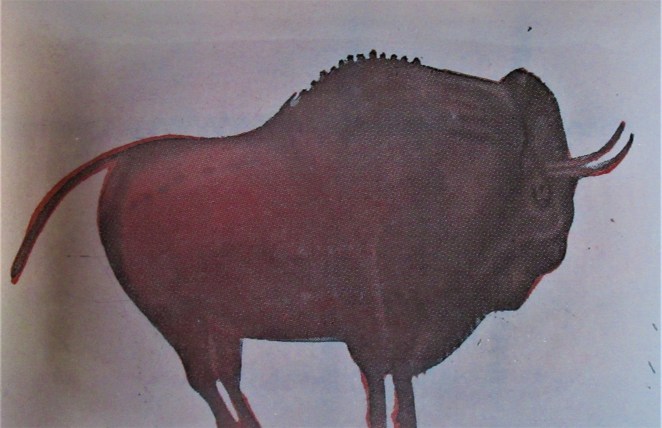
This is the cave painting, circa 5,000 BC of a bull, as found on the wall of the Caves of Altamira. Alas, he cannot bellow. Or should I say, Thank heavens, he can neither bellow nor pursue us. He stands silent on his cave wall. This photo comes from a glass ash tray my father purchased as a souvenir when we visited those caves (circa 1963-65, before they were closed to the public). Intertextuality – this bull as text and the long history of his multiple appearances. Metaphor and magic, mysterious and marvelous.

The idea that “religion is a glow-worm that glows in the darkness” is a metaphorical observation on the nature of faith. Its most famous expression comes from the German philosopher Arthur Schopenhauer. The statement suggests that religion appears most valuable and needed when people are in a state of ignorance, uncertainty, or despair.” Wikipedia – AI Generated. Our poet, that’s me, in case there are any doubts, refers back to this idea when he writes “no glow worm can worm its way into my mind to enlighten the path”. This too links back to the poetry of St. John of the Cross and his references to the dark night of the soul when hope seems lost and we despair of everything. Then we link to Goya’s etching – The Sleep of Reason – “when reason sleeps, monsters are born.”

However dark the night, someone has walked this way before us. We can follow in their footsteps and hope for the dawn. When it arrives, we can rejoice. But never forget the law of circularity, what goes round, comes round. Night will come back, the way will again be dark, but the light will always return once more. Images and symbols, metaphors and mystery, even the unspeakable can be spoken in the ways in which the ancient artists, sculptors, painters, saints, and philosophers have shown us.

Empty Nest

Empty Nest

X marks the spot
where the energy ran out,
the moment when the tide turned
and water ebbed, and refused to flow.

A place… a time…the sudden scent
not of presence, but of absence.
The absence of movement,
noise, of that other body
that once walked the rooms,
opening and shutting doors,
windows, like a robin’s whistle,
a thrush’s trilled song…
gone now, gone, all gone.

We drift through silent sadness,
avoid each other’s eyes,
sit with our heads in our hands
or knit our fingers together
in desperate gestures
that express our emptiness,
the emptiness of an empty nest…

Commentary:

The poem speaks for itself, as a good poem ought to. Even bad poems speak for themselves sometimes. Amazing how empty the house seems when we sit in separate rooms, work at different computers, read in silence, or do the crossword or sudoku, miles away in time and space. And those little feet have gone now – not that they were that little this past visit. But holidays end, child and grandchild depart, the house returns to its former silence, and we are left to contemplate the emptiness of an empty nest.

Clepsydra 23 & 24

23

… gulls on the wharf-side roof
     fishing boats
          returning to port
               white wakes trailing,
                    pointing to where they’ve been

where have I been
     all my life         

where is the wake
     that tracked me to and from
          so many unimportant places

so often have I waited
     for that moment of reunion
          port station airport

birds leaving nest
     only to return
          then leave again
               are not more faithful

sweet brevity of life
     a stone memorial
          on the harbour wall
               raised to all
                    who went to sea
                         and never returned
                              dying in the waves’ embrace …

24

… a watery grave
     no church no candles
          just cold waters sliding shut
               as down to the depths they go
                    

sinking from level to level
     never to rise again
          not till seas run dry
               burnt up by the sun’s candle

even then they’ll walk no more
          with their beloveds
               hand in hand
                    on diminishing land
                         or sea-licked sand …

Commentary:

“Birds leaving nest, only to return, then leave again, are not more faithful.” A lovely photo, from Avila, of storks, bouncing on their nests, waiting for the wind to lift them up aloft. I thought of using sea side photo from PEI, but this image caught my eye, and my words. A verbal – visual link. Not easy to spot, but there, in the sky above them, a parent waits. As soon as one chick takes flight, the watching parent will drop, fly under the fledgling’s wings, and tutor the young bird in the art of soaring and flying. I have spent many a happy hour, just sitting there, watching them.

And here’s the photo from PEI. An osprey, returning to the nest, after a fishing expedition. One hopes for such moments. Then, suddenly, one day, the magic happens, and verbal and visual joining hands in a single moment of magic. And listen to that baby bird, beak open, shrieking, waiting for the parent to arrive. I can still hear the screeching, although we are in the age of silent, but colorful, pictures.

In the picture below, the Grande Réunion – you can see the White Geese gathered at Bic. They return every year, so beautiful. The first time I saw them, I thought they were a drift of late snow. Then they rose from the field, and flew up, into the air. I have often seen snow falling but that was the first time I saw snow actually rising, after it had settled. A memorable moment.

Moments of magic, as I said, and each of them linked – verbal to visual. Silent dialogs with my time and my place, now shared with whoever has ears to hear and eyes to see and an imagination to reconstruct the alternate realities.

Describe a man who has positively impacted your life.

Daily writing prompt
Describe a man who has positively impacted your life.

Describe a man who has positively impacted your life.

Does it have to be a man? Many women have impacted my life in a positive fashion. My Welsh grandmother taught me how to cook. She would stand me on a small stool placed beside the stove and I would watch as she explained what she was doing and why she was doing it. She allowed me to stir the various mixtures, to help beat the eggs, and when she baked, she always gave me a small piece of cake mix or dough so that I could create something for myself and bake it in the oven with the all the other things. It is hard to beat that type of impact. The small stone she threw still sends ripples through my kitchen and that of my daughter and granddaughter.

When I think of kitchens, I think of the many, many kitchens that I visited when living in France, Spain, and Oaxaca, Mexico. In each of them I picked up so many hints and ideas. In Santander, how to make a tortilla espanola / Spanish omelet. Every evening, my first landlady would leave, on the kitchen counter, one egg, one potato, and one onion. That was my supper – but I had to make it myself. I have made Spanish omelets for 60 years now. Some are simple, others combine different ingredients. All come from the kitchens I have visited in Spain.

In France, I learned the Parisian way to scramble eggs. Again, my landlady taught me how to scramble them her way, the only correct way. My scrambled eggs, learned as I was perfecting my knowledge of French language and culture, are still the talk of the table, when I serve them. Oaxaca was a total revelation, as I have said on many occasions, as was Oaxacan cooking. The first thing I learned – how to prepare quesadillas. Alas, there are no offerings of flor de calabaza with wish to garner them, not here in Canada, not that I have seen, anyway. Next came pico de gallo, that inimitable blend of cilantro, onion, jalapeno, tomato, lime, and salt. All of these recipes came, verbally, and practically, from the wonderful women who have enriched my world, as did the bacon and eggs, on a tortilla, with salsa mexicana, and the eggs scrambled in orange juice. And we won’t talk about the chapulines, grass-hoppers fried in garlic, nor the avocado with tuna delicacies.

Of course there have been men as well. Mon, the friend who spent twenty-three years in a Franco jail as a political prisoner, and survived. He built his own boat, powered by an old engine from a bakery that he adapted, and together we fished the Bay of Santander, every Sunday, for three consecutive summers. He taught me the secrets of the bay, where the fish were, where they hid, how they moved with the tides. He would encourage me to jump over the side, in deep water that lifted me up with the surge of the Biscay, under my armpits, and wouldn’t let me back on board until I could name every part of the bote. I became a very quick learner, especially as he was eating the omelet and drinking the wine as I was speaking. It was another incredible enrichment.

 Juanra, from Avila, was another such teacher. He would take me on his Sunday excursions to buy the week’s wine for his hostal-restaurante, and together we would visit La Seca, and other local wine-growing regions. I remember the day he and the lady who owned the vineyard we were visiting baptized me. We stood, thirty five feet underground, beside a wooden barrel, one of twelve in that cellar, that contained 5,000 litres of white wine. Juanra climbed a six foot ladder, and stood beside a tiny feather that acted as a plug to keep air out of the barrel. The lady, who performed the role of high priest, gave me a glass, showed me where to hold it, beneath the spigot, so that the wine would fill it and I could taste and test it. She turned the tap on – but no wine came out – then she held my hand ‘to keep it and the glass steady’. “Ahora / Now!” she gave the command. Juanra withdrew the feather, the wine flowed, and the lady jiggled my arm and soaked me from wrist to elbow, shrieking with a high-pitched laughter that blended with Juanra’s bass guffaw. “Ya te hemos bautizado,” they cried in unison. “Now we have baptized you.” And there I stood, a child of the vineyard and an adopted son of the land.

Just one? Only one? How could you be so cruel? I remember with great fondness one of my rugby coaches. Many of the people who surrounded him thought he was a clown, and told me so behind his back. But he had a certain something – and I wasn’t sure what it was. One day, at a national coaching conference, he took me on one side. “You already know everything that people here can teach you. But, somewhere, there is one piece of gold. You may find it here, or there, or in the bar. But that one piece of gold is what you will take home with you.”

When I coached the provincial junior team, one summer, I invited that coach to visit and to help me coach. We walked onto the field together. “Leave this to me,” he said. I asked him what I could do to help and he said – “Nothing. Just sit in my back pocket. See what I see. keep quiet. Ask questions later.” He started with a warm up game of rugby, which he refereed. “Whenever I blow the whistle three times – like this peep! – peep! – peep! – I want you to stop wherever you are. Don’t move until I tell you to.”

Then followed the most wonderful master coaching session I have ever witnessed. A ruck – peep! – peep! – peep! – – “Who was first to arrive?” No answer. he pointed. “You were. What did you do? Why did you do it?” This went on and on – scrums, lineouts, kick-offs, penalties, 25 yard drop outs – we weren’t metric yet. “Peep! – peep! – peep! – What did you do? Why did you do it? What else could you have done? Why didn’t you do that?”

They had called him a clown, the ones with the papers, and the coaching certificates, and the education, behind his back, and to them he was clown. But to me, he was a master coach. He taught me how to look, to listen, to see, to ask questions, and never to judge anyone until I had walked in a person’s shoes, or sat in their back pocket, not just for a mile, but for a whole wonderful weekend. He had a wonderful sense of humor and the clown left everyone laughing. Clown? He might have been the Prince of Clowns, but I have never forgotten what he taught me, nor how he taught it.