Surrounded by beauty, a magical paradise trapped for a moment in a sunlit mirror, the past laid out before me, the thought, word, deed of a painted reality, of painted realities really, visions leaving the mind only to be caught in line, color, shape, and paint, and frozen in time, each one date-stamped, and placed here, there, everywhere on wall after wall, until I am surrounded, breathless, within this circular vista of visions filled with inherent beauty.
On days like these, the center must hold, but not just hold, it must writhe and strive to live longer, be stronger, to hold together so that the periphery understands that it too is at the center of an extended web of life that contains us all, you and me, past and future generations, in a great chain of being alive and knowing that yes, we are here, we are, at heart, really only one, and totally unique, is spite of the sameness that sometimes surrounds us as time’s spider-web unravels, oh so fast, so slow, and yet still we are here, and still the center holds.
On a sunny morning, the sun lights up my bedroom wall. Each day he arrives earlier and earlier, a minute a day. Now days grow longer, a sure sign that spring is on its way.
As I lie awake, waiting for the sun, I sing my morning sunshine song. It keeps me warm and comforts me. I also count the birds that fly across the garden in search of sunshine and food.
Crows come first. They perch atop the highest trees and watch and wait. Mourning Doves come next and their dawn song is a mourning chorus, “Who-who-who’s next? called from branch to branch. With the sun come Chickadees, Pine Siskins, lazy Blue Jays, Juncos. These are all regulars.
Irregular are my neighbor’s Cardinals, orange and red, American Goldfinches, two small woodpeckers, a Downie and a Hairy, a Nuthatch.
Gone now are the Gray Jays, Gorbies, Whisky Jacks, those ghosts of the woods. Lost too are the Greater Pileated, the flocks of Grosbeaks, Evening, Pine, and Rose-Breasted.
They may come back, but somehow, I doubt it. For now, the Blueness of Jays, the Blackness of Crows, and an unsubtle dawn chorus of Caw-Caw-Caw-Caw-Caw.
Paintings: doors you can walk through, windows that open onto visions of another, more beautiful life. Deeper than the paint, the thoughts and words that formed them, brushed them into life, an ephemeral life, so brief that butterflies seem to last longer and flowers live for all eternity.
Transience and insubstantiality. Change is all around us, we are surrounded by change. But the deepest changes, the ones that affect us most are internal, set deep within us, death’s eggs hatching slowly since the day we were born.
Life is indeed short, and art endures. Carved five thousand years ago, in stone, this magnificent henge, first Wood-henge, then Stonehenge, majestic at the dawn of time, with its sarsen stones, pillars, post-holes, and labyrinths, circling within circles, a frail spider-web of sunlit brilliance.
Lost now, the message, as my own message is lost, covered by paint, though words emerge in the strangest places, allowing us to peer in through windows as long-lost words and worlds whirl out through carved and painted windows and everlasting doors.
Doors First version
Paintings are doors you can walk through, windows that open onto visions of another, sometimes better, life. Deeper than the paint are the thoughts and words that formed them, brushed them into life, an ephemeral life, so brief that butterflies last longer and flowers live for all eternity, or so it seems.
Transience and insubstantiality. Change is all around us, we are surrounded by change. But the deepest changes, the ones that affect us most are internal, set deep within us, death’s eggs hatching slowly since the day we were born.
Life is indeed short, and art endures. Carved five thousand years ago, in stone, this Towie ball with its labyrinths and circles. Lost now, the message, as my own message is lost, covered by paint, though words emerge in the strangest places, allowing us to peer in through windows as long lost words and worlds walk out through carved and painted doors.
The spider plant spins out web after web, all knotted together, then ejected from the central nest.
One landed on my floor the other afternoon with an enormous clunk. A huge new set of offspring and roots ejected and sent on a voyage of discovery to find a new home.
Mala madre / bad mother. Oaxacans have a curious way of naming their plants. I lived in an apartment above a courtyard filled with malas madres.
A Bird of Paradise nested in the same tree, while in the garden a banana plant, in flower, a huge hibiscus, and such a variety of prize poinsettias that I could never get the varieties straight: red, white, cream, single, clotted, and double-crowned.
In the powder room, downstairs, our hibiscus is about to break into winter blooms.
Sider mites crawl all over it. Every day, I hunt them down, squishing them whenever I can.
My daughter calls me cruel and a padre malo.
I say ‘no: it’s them or the hibiscus. You can’t have both.’
Stumps, yes. Firmly planted. Newly arrived at the wicket, I can now take my guard. Last man in with everything to play for.
“Middle and off. Please.” I hold the bat steady, upright, and the man in white nods his head, counts the coins, or stones, he has in his pocket and wonders when he can leave his post and go to tea.
I stand, there, right-handed, and the field adjusts. Then I change hands, keep the same guard, now middle and leg, and stare at the square leg, now a short leg who glares back fiercely.
The man in the white coat tut-tuts in despair. I know he knows this isn’t done. It’s just not cricket. But then, he’s not the one batting on a cloth untrue, with a twisted cue, while the bowlers bowl with elliptical balls.
The field changes over to a left-handed stance. I think about changing over again, but I’m sure there’d be an appeal: wasting time, a nasty crime at this stage of the game, though many do it.
First ball, a long-hop, and I clobber it for four. Three runs to win, four balls to bowl. I block the next ball. The one after is short. I cut it away past gully and call for two. I make it home safe but my partner is run out at the bowler’s end.
We lose by one run. “Serve you right,” says the man in the white coat, racing towards the pavilion for a pee before tea. “That just wasn’t cricket.”
I walk slowly back, stiff upper lip, ramrod straight bat, and no time at all for this sticky dog wicket.
Comment: I wonder how many of my followers will have understood a word of what I have written. Never mind. You can always enjoy the painting. Oh the mysteries of what used to be England’s national game and a wonderful source of metaphor and image. A double-header on the weekend. England vs the West Indies. I wonder if it will be that close?
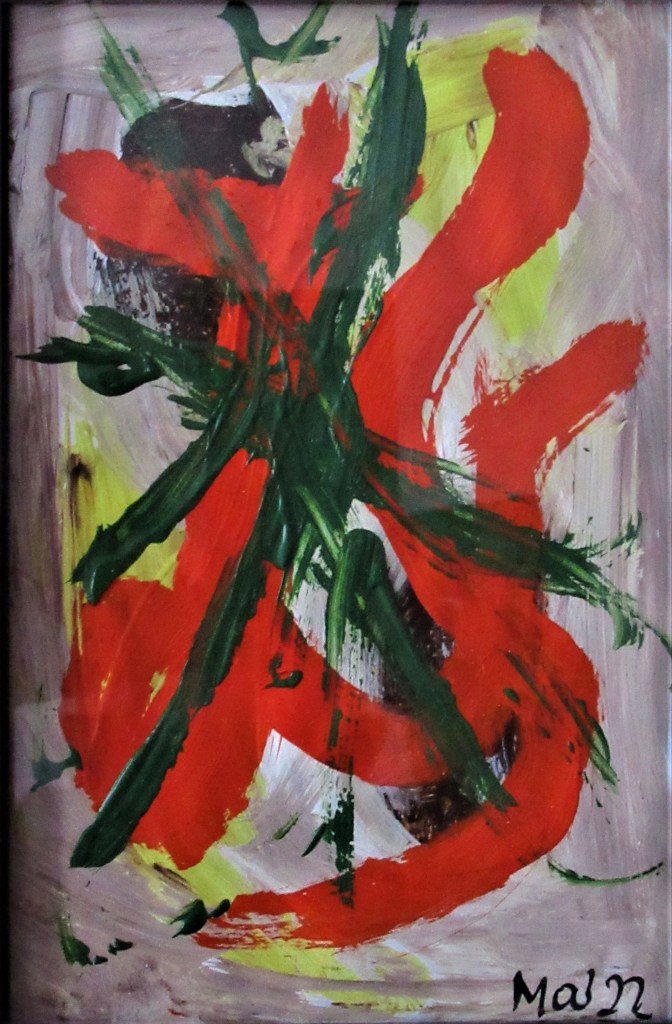
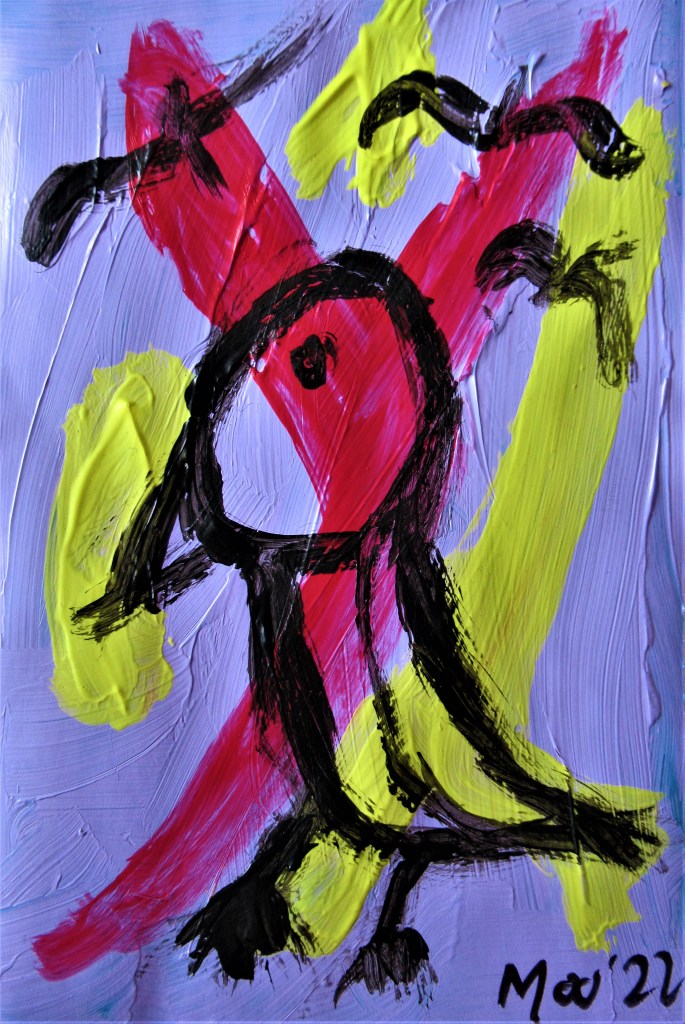
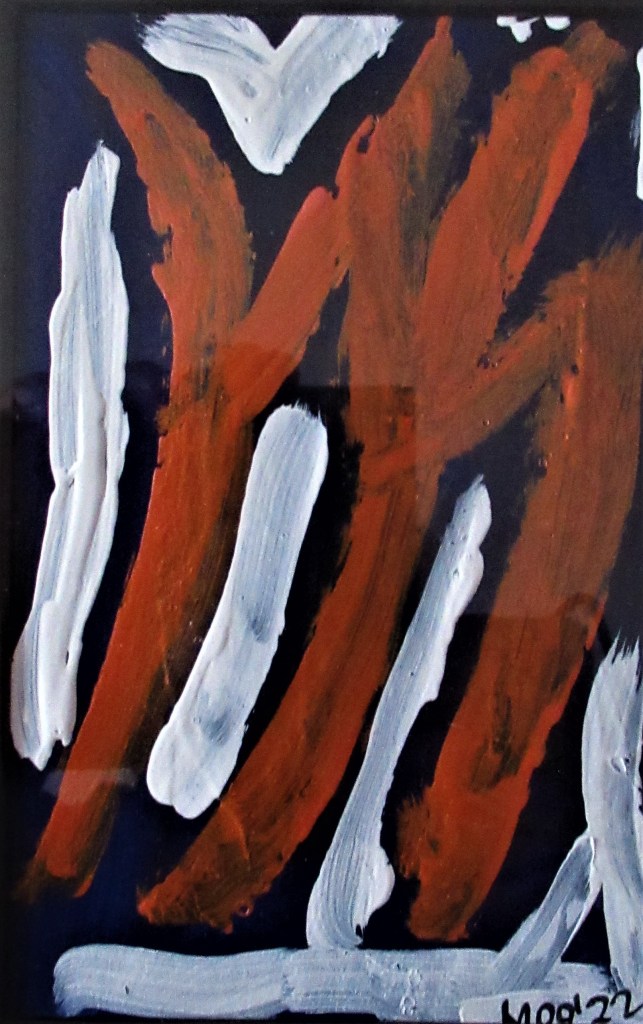
My usual discipline has deserted me and, as a result, I have deserted my blog, abandoned it, gone absent without leave. It’s not that I am not creating: I am. I am just not posting. Mea culpa, mea maxima culpa. I thought that, for a change, I would post some of my Pocket Paintings / Peintures de Poches. Maybe I will be inspired to write verse about them. Maybe not. We’ll see.
Supplication
I raise my hand to heaven in fervent supplication: you sever it at the wrist.
I spread out my arms in despair: you take out a tape and measure me for a tailor-made, hand-crafted cross.
I step on my bathroom scales only to find that they have become the scales of your justice: I mourn every pound I have put on.
Where can I turn for solace when all around I see nothing but sorrow and tears?
Covid bears us all down. An albatross, it hangs around our necks and when we raise a hand, your knife is there to cut it off.
Who are you? What are you? Where are you when we need you? Why are you there judging us like this?
I look up at the sky. By day, a great cyclopean eye winks and blinks and tells me nothing. I look at the sky at night: a silver moon slides silently by.
Orion stalks away to the west. He leaves me restless, breathless, agape at all this beauty that I dare not reach out and grasp.
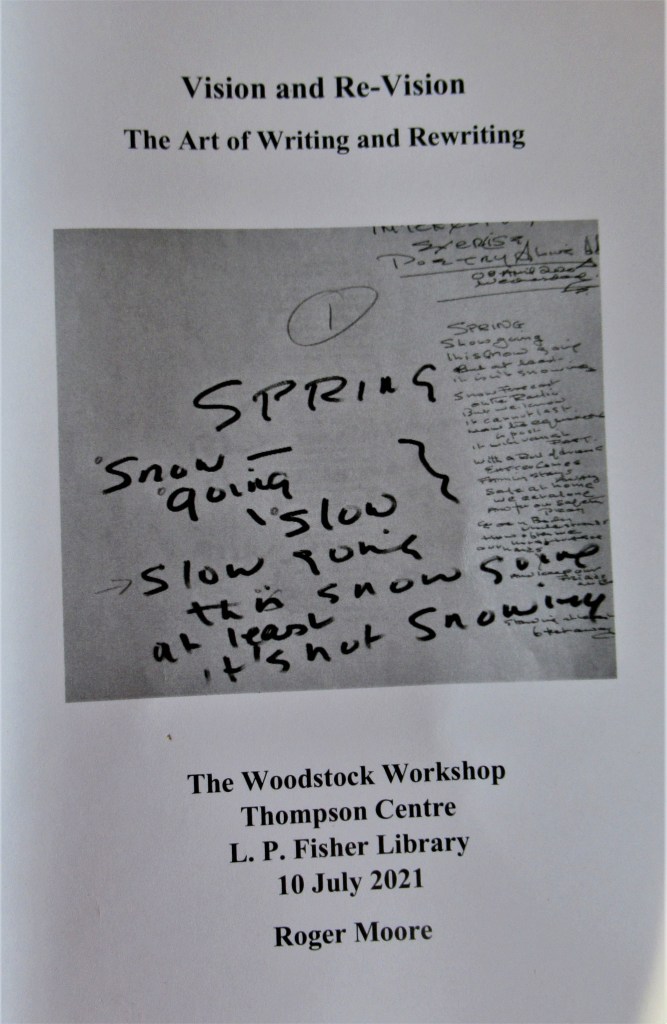
Comments: Limited edition. 40 copies. Self-published and printed by Covey’s, Prospect St., Fredericton. Free to workshop participants (all four of them!) and to anyone who asked for one. I also gave away free copies of my books to all participants as a reward for having the courage to brave Covid – masked and socially distanced – and to listen to me and share my ideas.
Comment: My first publication with Cyberwit.net. A pseudo-autobiography masquerading as a memoir. The original version of On Being Welsh was awarded first place in the D. A. Richards Prose Award (WFNB, 2020). It is available online from Amazon and Cyberwit.net.
Comment: My second publication with Cyberwit.net. allison Calvern helped me select and order these poems and my thanks go out to her for all her hard work. Geoff Slater and Ginger Marcinkowski also read and commented on the poems. Stars at Elbow and Foot covers 30 years of writing poetry, 1979-2009. It took a year or more to pull those thirty years together. It is available online from Amazon and Cyberwit.net.
Comment: My third publication with Cyberwit.net. An early version of The Nature of Art and the Art of Nature placed second in the A. G. Bailey Award for a Poetry Manuscript (WFNB, 2020). I revised it during my second residency at KIRA (May-June, 2021), sharpening the vision and concentrating on the links between one creative form and another. Geoff Slater and Ginger Marcinkowski again read and commented on the poems and Geoff suggested that I write the Prelude: On Reading and Writing Poetry. It is available online from Amazon and Cyberwit.net.
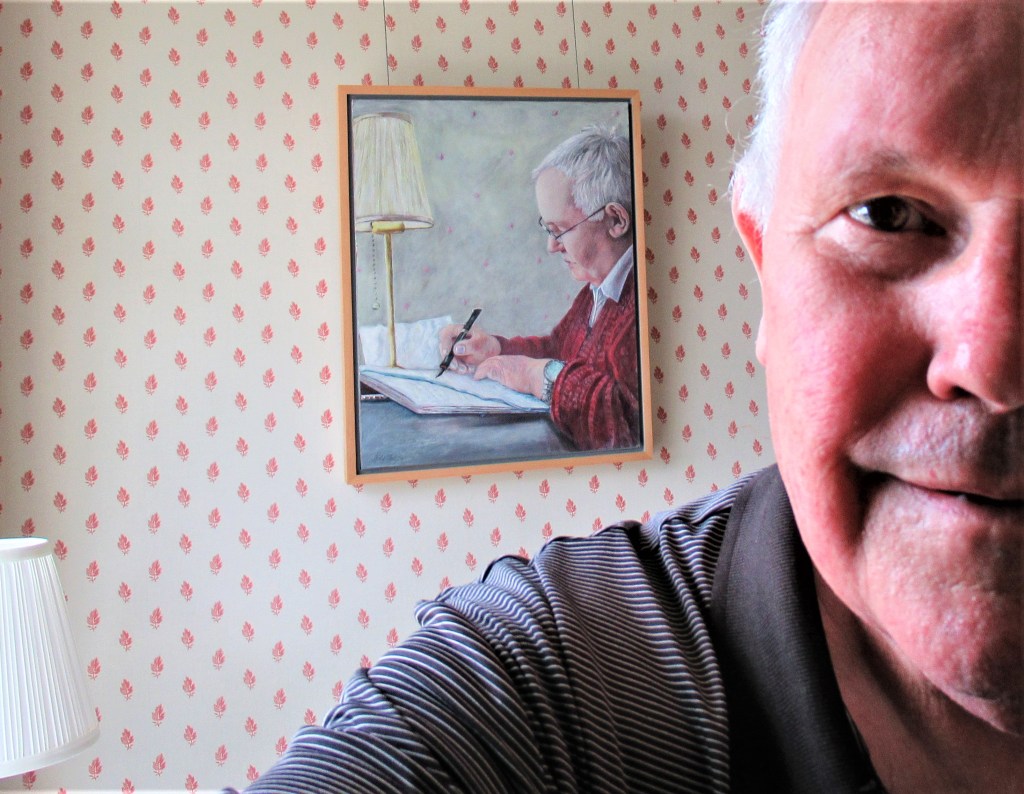
Comment: My fifth book of the year, self-published and printed by Covey’s, Prospect St., Fredericton in a limited edition of 40 copies, once again given free of charge to my creative friends. Patti painted the flower on the poet-painter’s cheek and I thank her for that. Geoff Slater played a large role in my pain–ting and drawing by persuading me that my cartoons were not worthless. John K. Sutherland has long supported my cartoon art, and he encouraged me to ‘leave tangible footprints’ and to get some of my art work into print. I couldn’t have done it without Salvador Dali, though, and that’s my version of his watch going over the waterfall.
Comment: My comments on a year’s work as a creative artist would not be complete without a mention of the Kingsbrae International Residencies for Artists that take in the summer months in St. Andrews, New Brunswick. I received an invitation to attend KIRA in May-June, 2021. I would like to thank Lucinda Flemer and the KIRA support group for their kindness in inviting me back. The creative friendships that I have made with KIRA artists over the years have just been amazing and the whole atmosphere at KIRA is not just inspiring, but awe-inspiring. Just look at this. How could a writer not be inspired.
Dawn from the Red Room at KIRA
I would also like to mention the online workshops that I have taken with Brian Henry, of Quick Brown Fox fame. I attended the Friday morning advanced writers workshops from January to March, and again from September to December. His knowledge, skills, organization, and support are second to none. I have made many wonderfully creative e-friends across e-mail and our Zoom classes. My year’s work would not be complete without a tip of the hat and a great big thank you to BH & QBF.
Final Comment: I am grateful to Jan Hull, Stoneist, for her reminder that today is Old Year’s Day and that the Roman deity, Janus, is a two-faced deity, with one face looking back towards the old year, as I have just done, and the other looking forward to the future, as I am doing right now. All in all, a busy year and a very enjoyable one. Let us hope that next year is also an enjoyable and a very creative one.
Wishing all my followers a wonderful Christmas and let us hope that the New Year brings us some relief from Covid-19 and all the ensuing vicissitudes. Sunny here in Island View and coldish, but not too bad. A tiny sprinkling of snow, so we qualify for a White Christmas – una blanca navidad.
AMGD: The full phrase attributed to St. Ignatius of Loyola, the author of Ejercicios espirituales / Spiritual Exercises and the Founder of the Jesuits, is Ad maiorem Dei gloriam inque hominum salutem or “for the greater glory of God and the salvation of humanity.”
So, to continue with the Latin: Pax Amorque /Peace and Love. My friends: whatever your customs and beliefs, make this Christmas a good one and let us all wish for a Happy New Year.