Clepsydra

Clepsydra

WFNB 2025 BAILEY PRIZE: 3rd Place
Citation

Clepsydra relates a process of identity loss, as time’s passing removes the people closest to the eroding narrator. Its consistent form – the manuscript is one long poem made up of 48 sections of varying length, each of which begins and ends with an ellipsis – provides a framework in which the narrator strives to describe how their sense of self drains away, drop by drop, the way the liquid in a clepsydra (a water clock) marks the passing of time. Amazingly, the poems convey existential dread through remarkably vivid and grounded images of things like “seals basking in sunshine, / knowing themselves, being themselves, / thinking themselves safe, / kings and queens of their seal-dom, / never questioning” (19) and “…an osprey, sudden, the swoop, / turned into a stoop, water shattered, total immersion, then emerging, / lusty thrust of wings, claws clasping, / prey imprisoned” (20). Sense slides in and around the sounds of the words as well as in their dictionary meanings. In Clepsydra the author rigorously plumbs a difficult subject: the loss of subjectivity.

Exhortation

Thank you for the privilege of reading your poetry manuscript, Clepsydra. I was quite taken with all of its virtues: a meaningful concept, carried out in an impressive form which is followed both rigorously and nimbly in each section.

Introduction

     The National Museum of Wales, in Cardiff, had a working Clepsydra that fascinated me. School children could enter free, and every week day, during the school holidays, I would visit the museum and also the Clepsydra.

     I have built the structure of the Clepsydra into the verses of this book. The words flow down, from left to right, just like the waters of the Clepsydra. Sometimes they overflow the line, and sometimes they hold back, just a little. This visual construction fortifies the idea of the ebb and flow of time, water, and memories.

     I first met the poetic image of the Clepsydra in the poetry of Antonio Machado – No temas. Tú no verás caer la última gota que en la clepsidra tiembla. / Never fear. You will not see the fall of the last waterdrop that trembles in the clepsydra. I have, for better or for worse, repeated this theme throughout the poetic dialog.

     I would like to thank the judge, the poet Kathy Mac, for her comments and her excellent suggestions. I have followed most of them in this revision of the original manuscript. My thanks go to all who have read Clepsydra at one time or another.

Clepsydra

1

… time, and my own place
     not this dry museum
          filled with dust

its ghosts, running rampant,
     raging silent
          over ancient artefacts

the clepsydra dreaming
     time like its liquid
          slipping
               through clay fingers
 
runnels of water
     ebbing flowing
          continually running down

earthen-throated
     its hour glass structure
         
each terracotta bowl
     lower than the one before
   
a mini-cataract
      a constant waterfall
            second by second
                    time dwindling away…

Great White Egret

Great White Egret

            The Great White Egret is Yolande Essiembre’s first chapbook of poetry. The title poem offers an image, a white egret, that is central to the whole collection. Summarized in this one poem are the concepts of pantheism, mindfulness, self-questioning, and receiving lessons and inspiration from the natural world that surrounds the narrator and her poetic voice.

            Pantheists often consider the universe, or nature, to be identical to the divinity. In simpler terms, it’s the old Greek idea of Gaia, the world spirit – spiritus mundi, in the Latin of Moncton’s Northrop Frye – that links nature and the divinity. Pantheism can be found in both religious and philosophical contexts, with some branches of pantheism rooted in traditional religious beliefs and others stemming from poetic perspectives. In the case of The Great White Egret, the narrative voice sees nature as an all-embracing poetic concept that makes possible a life, both physical and spiritual, in the immediate present.

            The lessons the narrator receives in the course of observing The Great White Egret are (1) to take one step at a time, (2) to be still, and (3) to be one’s own reflection. This third lesson reaches out to include the cover photograph. Verbal and visual blend when the egret, reflected in the water, parallels the reflection of the poet in the stillness of nature. This is further complicated by the double meaning of reflection as mirror image and of the thought process involved during the observation of the bird. The visual and mental images become reminiscent of the hymn “on the wings of a snow-white dove.”

Part of the beauty of Yolande Essiembre’s poetic meditations lies in the extension of image and metaphor beyond the page and into the mind of the reader where they create a mirror universe of reciprocal reminiscence and creativity. Other poems that reach out in similar fashion to explore the deity manifest within the natural world include A Force of Love in Our Universe, Breath of Life, Glimpses, and In the Sanctuary. This last poem works on the basis of repeated images that stand strong and clear, for example, “Life pressing through a blade of grass. / Leaves shimmering, dancing, waving. / Light flickering, casting shadows.” Life and movement, especially movement – pressing, shimmering, dancing, flickering, casting – create a sense of wonder in the natural setting where the poet finds sanctuary.

            Mindfulness is a mental state achieved by focusing one’s awareness on the present moment, while calmly acknowledging and accepting one’s feelings, thoughts, and bodily sensations. It is often used as a therapeutic technique and can be compared with the yoga techniques which our poet practices. This yoga technique is compounded in the poems where breathing is emphasized, as in Breath of Life, for example, where we read “Who are you breath of life / Who fills my lungs with air”. It can also be found in the poem In Your Presence “In the stillness of the morning / I breathe / I listen / I breathe”.         

This chapbook is more than a mere collection of poems. It is a compendium of personal feelings, inner thoughtfulness, and natural observations. It is the work of a thinker and feeler, in tune with the universe and continually seeking answers to some of life’s most important questions. Reading The Great White Egret, you too may start asking similar questions. More important, you may even find some meaningful answers.

The Great White Egret
Sitting, rocking, gazing upon a lake,
Pondering, reflecting, wondering.
How one can choose purpose over comfort?
How does one remain true to oneself?

On a wing span comes an answer.
A bird, a Great White Egret
Lands at the edge of the water.
Tall, magnificent, breathtaking.

Steps in slow motion, into the lake,
Advances one long leg at a time.
Proud, confident, in no hurry.
My first lesson: “Take one step at a time.”

The bird stops, remains still,
Listens, stretches its long neck,
So still that I hold my breath.
We wait.
Second lesson: “Be still.”

The majestic bird gracefully glides
In the calm clear water.
Its reflection a thing of beauty.
Like a mirror, reflects divinity.
Third lesson: “Be my own reflection.”             

Dark Angel

Dark Angel

He will come to me, the dark angel,
and will meet me face to face.

He will take all that I own,
for my wealth is only temporary:
health, wealth, possessions are all on loan.

My house, my wife, my car,
my daughter, my grand-child,
 my garden, my trees, my flowers,
my poetry, my works of art.
I use the possessive adjective
knowing full well that these things
are only on loan. I will never be able
to preserve and possess them.

I even rent this aching heart,
these ageing, migrant bones,
this death that has walked beside me,
step by step, every day
since the day that I was born.

My death alone is mine.
It belongs to nobody else.
It will be my sole possession.
It will soon be the only thing
I have ever really owned.

Comment:

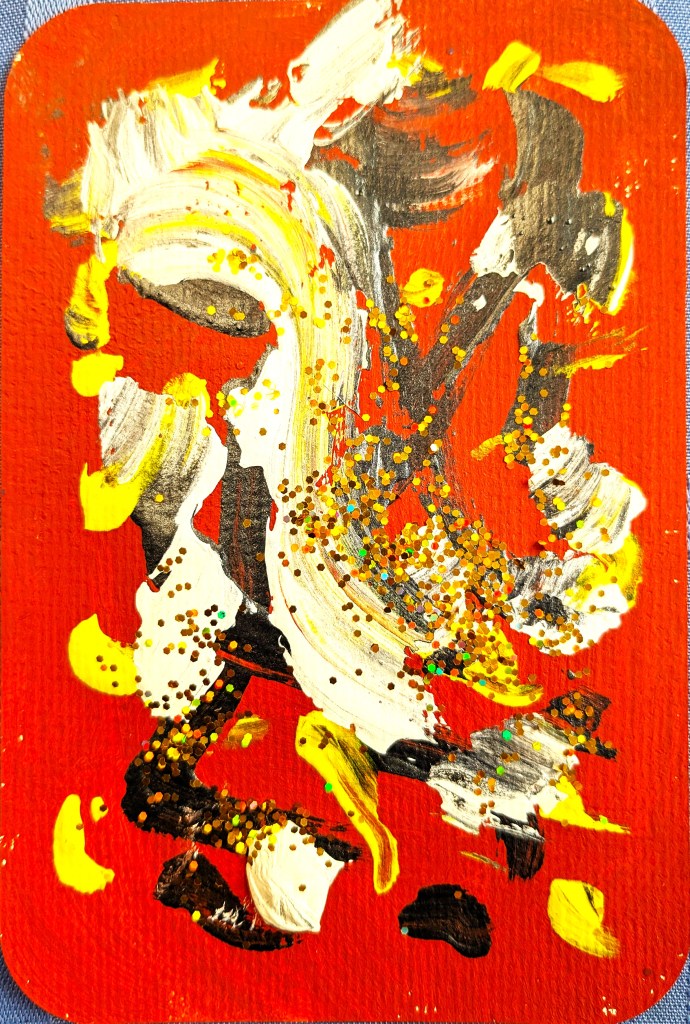
Dark Angel is the third poem in the first sequence (Crystal Liturgy) of my poetry book Septets for the End of Time. The painting, by my friend Moo, expresses his impressions of how he reacts, in paint, to my poem, in words.

“Well,” I said to Moo, “you’ve gone and done it this time. Do you think that painting really represents my poem? I see no darkness in it and certainly no angel.”

Moo gave me a long, strange look. I felt like I was looking in the mirror and seeing parts of my own soul fragmenting and falling away, like scales from my eyes.

“It’s not what the poem says,” he replied. “It’s what I think you feel as you’re writing that poem. I see the tension, the cry from the heart, the struggle to accept, and the realization that, in the end, everything is inevitable and must turn out as it will. That said, more than anything, it is the cry, de profundis, from the depth of your self that I feel. My painting depicts that cry and your suffering.”

“What if it’s not my suffering? What if it’s the suffering of Messiaen and his musicians as they play the soul music that keeps them alive?”

“But surely,” Moo replied, “that’s the whole point. Orde Amoris, according to the recent Pope who has just passed away, is love felt for the person suffering, no matter who he or she is. Pope Francis spoke in praise of the parable of the Good Samaritan. When you see someone suffering at the wayside, you stop and help that person. You don’t just walk on by. Your suffering is my suffering. When I paint your suffering I also paint my own suffering and when you grieve, then I grieve with you.”

“And when that happens, when we all grieve together, we do not grieve alone and in vain.”

“Exactly.”

Crystal Liturgy

Crystal Liturgy

Here, in the abyss,
where song-birds pluck their notes
and send them, feather-light,
floating through the air,
here, you’ll find no vale of tears,
no fears of shadow-hawks,
for all blackness is abandoned
in the interests of sunlight and song.

Here, the crystal liturgy surges,
upwards from the rejoicing heart,
ever upwards, into the realms of light,
where color and sound alike
brim over with the joy that, yes,
brings release to head and heart.

Here, seven-stringed rainbows reign,
the everlasting harp is tuned and plucked,
and an eternity of music cements
the foundations of earth and sky.

Here, the master musician conducts
his celestial choir, their voices rising,
higher and higher, until they reach
the highest sphere, and song and voice
inspire, then expire, passing from our eyes
and ears into unbounded realms of light.

Here, the seven trumpets will sound
their furious dance, a dance that will announce
the end of this singer, the end of his song,
but never the end of song itself.

Comment:

Crystal Liturgy is the first poem in the first sequence of my poetry book Septets for the End of Time. My friend Moo, the painter, supplies the paintings for the book covers. He and I have decided to hold a dialog on our views of how the painting and the poem relate to each other. Hopefully, we will continue this dialog throughout Septets for the End of Time.

“I have tried to join the ideas of sound, light, song, and voice to the idea of the Platonic Universe, where the planets dance to the music of the spheres. I wrote these poems listening to Messiaen’s Quartet for the End of Time. I allowed the music to flow through me and I responded, in words, to the images that came from the sounds, and the silences, of the music.”

“I see no sorrows here, no woes,” Moo told me. “I only see the the joy of light and existence. The shadows have been dispersed, and my painting contains a generous helping of sunshine and light. I find it very suitable for this particular poem. My painting’s starburst of energy enhances the poem’s sense of movement, strength, and light. It also contains the message that all will be well.”

Empty Nest

Empty Nest

Who are they, these ghosts who flit into my life
and leave me foundering in treacherous waters
as I search for enlightenment and meaning?
Why do they return, revenants, to disturb
my peace and quiet, and to trouble my sleep?

I watch them wandering through the coal mines
of my mind, while yellow canaries twitter rage
from their cages. Oh, praise the blind pit ponies
whose blinkered eyes will never see the light.

They are so lonely, so distant, so lost in deep-down
galleries that I no longer know them.
Memory’s fish-hook cannot snag them,
cannot haul them back into daylight reality
far from night’s net of silvery dreams.

A place… a time…the sudden scent not of presence,
but of absence. The absence of movement,
noise, of that other body that once walked the rooms,
floors, opening and shutting doors, windows, a robin’s
whistle, a thrush’s trilled song… gone now, gone, all gone.

We drift through silent sadness, avoid each other’s eyes,
sit with our heads in our hands or knit our fingers together
in desperate gestures that express our emptiness,
the emptiness of an empty nest…

Comment:
So many people, leaving, drifting on, out, and away, so many empty nests left behind. Why do I grieve, when I know that this is the natural path of life? And for whom do I grieve, for myself, or for them? I do not know. I only know that when that last visitor leaves the party and the door finally closes, the walls close in and I am left alone in this emptiest of nests.

To sleep, perchance to dream. And that is when they return, those broken ghosts who visit me at night and fill my empty head with memories, some happy, some beautiful, some ugly, and some of them sad. They fly, tiny silent birds, when the first rays of the sun, hit my window and awaken me. But they endow my day with memories – each morning marked by the rawness of a nightmare, or the sweetness of a midsummer night’s dream.

Where did my mojo go-go?

Where did my mojo go-go?

Wow! My first post since January 8, 2025. What on earth has happened to me? Good question – I just don’t know.

Today’s painting, from the last day of 2024, is taken from The Idylls of the King, Tennyson. “The olde order changeth lest one good custom should corrupt the world.”

This quote is used in my Old Boys magazine at the end of each school year when the students leave the college and go out into the real world. This happened to me in 1962 – 63 years ago. Certainly I changed, and for the better, without the college. Whether the college changed or not, in my absence, I really don’t know. I suppose it did. It became co-educational, quite the thing for a boys’ boarding school. It expanded into larger grounds. It tore down at least two of the old houses, including the one in which I boarded for four years. I read about these things, but I have only been back on one or two occasions, so I don’t really know. And living in Canada, I rarely see any old boys from the school. They don’t cross the pond to visit me.

I receive the old school magazine regularly, by e-mail. However, I no longer recognize faces or places, unless the places are totally unchanged since I was there. And not many of them are. The most important page for me has become the obituaries, and I study with care those who have passed on before me and those who remain. I grieve when I see the names of old friends. But I grieve even more when I see the names of people so much younger than me falling by the wayside.

As for that mojo of mine, well, I guess that writing on a regular basis has become more and more difficult. “Don’t sit with your head in your hands thinking of time past,” says the Spanish poet. Yet time past seems preferable, in many ways, to time future. I am beginning to feel a bit like a pin-cushion, on account of all the needles now being stuck into me. Perhaps that’s where all my mojo went? Still, for anyone interested, I am still here. Still happy. I am working on my latest novel and I have two books of poetry waiting to be published. So maybe my mojo hasn’t done a bunk, just my blog mojo! I shall have to kick start it. Or maybe I’ll get that little yellow duck who wears blue gumboots to stand on a brick and give me a hearty booted boost. Yup! That should do the trick.

And so, in the words of Dylan Thomas, “I’ll take a bow, and say ‘good-bye’ but just for now.

What is your mission?

Daily writing prompt
What is your mission?

What is your mission?

Let us begin, as usual, by asking, what do we mean by ‘mission’? Here are some examples of the meaning of mission. (a) an important assignment carried out for political, religious, or commercial purposes, typically involving travel. (b) the vocation or calling of a religious organization, especially a Christian one, to go out into the world and spread its faith. (c) any important task or duty that is assigned, allotted, or self-imposed. (d) an important goal or purpose that is accompanied by strong conviction; a calling or vocation.

I can happily dismiss (a) and (b) from the start. I do not consider an assignment to be a mission, not in my case anyway. I am not one to wander the world, good book in hand, heart on sleeve, convincing people to believe what I believe. That said, I can work with (c) and (d) because, as a life-long teacher, who was offered, at various time, an array of other jobs, I am happy to say that I was a teacher by vocation, by calling. Teaching was my mission. My mission was accomplished.

I taught, in Canada, from 1966 to 2009. Then I reached retirement age. On June 30, 2009, I was a teacher. On July 1, 2009, I was nothing. The shock was enormous. It took me a long time to recover and discover that no, my life was not over, and yes, I had many other things to do. Thankfully they all involved teaching, in one way or another. I used my teaching / research experience to sit on the editorial boards of various learned journals. I even edited a couple of them. I also translated, usually from Spanish to English, and worked with the translations of other people. I also wrote articles on teaching and on creativity.

Creativity gradually took me over. I offered workshops on prose and poetry, wrote and edited books, penned introductions for other writers, and even published some books by other people, usually my family or close friends.

There was never much money in teaching or in creative writing. I always did it for love – love of the subject, love of learning, love of the students, love of watching them grow and develop. When I work one-on-one with another writer, or with a small group of writers, that love is still there. Alas, as I grow older (much older!), I feel the ability to motivate slipping away. The will, the vocation if you like, is still there, but body and mind are growing weak, and that, my friends, is the saddest thing of all.

Dark Angel

He will come to me, the dark angel,
and will meet me face to face.

He will take all that I own,
for my wealth is only temporary:
health, wealth, possessions are all on loan.

My house, my wife, my car,
my daughter, my grand-child,
 my garden, my trees, my flowers,
my poetry, my works of art.
I use the possessive adjective
knowing full well that these things
are only on loan. I will never be able
to preserve and possess them.

I even rent this aching heart,
these ageing, migrant bones,
this death that has walked beside me,
step by step, every day
since the day that I was born.

My death alone is mine.
It belongs to nobody else.
It will be my sole possession.
It will soon be the only thing
I have ever really owned.

Comment:

Dark Angel is from my poetry book – Septets for the End of Time / Poems for the end of Time. The lead painting in today’s blog is by my friend, Moo, and he calls it Storm-Me.

When are you most happy?

Daily writing prompt
When are you most happy?

When are you most happy?

What on earth does that mean? When? Are we talking time of day, or time of night? Are we talking a season of the year? Are we talking mood swings – happy now, oh dear, mood swing, not happy now? Are we talking Hen Wen, the magic white pig at the feeding trough? “I am at my happiest, oink-oink, when I am eating a big burger from …” – and here you name your favorite burger outlet. None of that Hen Wen nonsense applies, of course, if you are vegetarian, vegan, or have an allergy to burgers or buns!

I can tell you when I am least happy – 7:30 am, on a wet, damp, cold, icy, snowy winter morning, when I have to get up, get dressed, and go out in the mush and the slush to have an early morning blood test – no food or drink for 12 hours – at the local hospital. Last time I did that, I couldn’t find a parking spot, and drove round and around until eventually one opened up, as far away as possible from the hospital of course. No, I was not a happy camper on that occasion. Especially when I slipped on the ice, returning to my car, and then found someone had driven into my side while I was parked there. Oh, that made me so happy and so jolly, I laughed until I cried. [I do hope you can recognize sarcasm when you see it.]

So, let us reverse the question and reframe it by saying that I am perfectly happy when the things that make me miserable do not happen. No fender-bender in the ice and snow – I am a happy man. Caught speeding or jumping a red light – totally by accident, of course, – and the man in blue asks me for my license, sees that it’s my birthday, and lets me drive away with a verbal warning and a jovial ‘happy birthday”! Ah yes, reverse psychology, that sort of thing does make me happy.

So, above all, it’s the little things in life that go right, and not wrong, that make me happy. This morning’s boiled egg, boiled to perfection – not too hard, not too soft. My coffee a perfect blend designed to bring joy and happiness. Marmalade on blue cheese, the Welsh equivalent of Chinese sweet and sour – oh yes, and actually making someone laugh or smile when they read this nonsense I write. Even Hen Wen grunts with joy – oink! oink! – at that one. So if you have enjoyed this post, please take the time to send me an oink or two, and I will be happy. Thanking you in advance is, yours sincerely, Hen ‘oink!’ Wen ‘oink!’ Wink, ‘oink!’

What are you doing this evening?

Daily writing prompt
What are you doing this evening?

What are you doing this evening?

This evening, I am thinking about how September is the month in which academics, thinkers, and philosophers, as well as everyday people, can be reborn. I wrote this article 25 years ago. Re-reading it now, I am amazed by its clairvoyance. Here are my thoughts from way back then.

“September Renaissance: The Annual Adventure of (Re)Creating the Individual.”

This address was delivered to faculty at MOUNT ALLISON UNIVERSITY on 07 September 1999. It is a revision (and an extension) of the adress I delivered to students at St. Thomas University during the inaugural speech delivered to the incoming class of students by the winner of the St. Thomas University Excellence in Teaching Award.

Tomorrow, 08 September, 1999, is a very special day for me, and I would like to share my Special Day with all of you.

“A Special Day?” you think. “It must be his birthday.”

But no, it’s not my birthday. Could it be my Saint’s Day then? If we were in class, and you were all students, I would see some puzzled faces. A hand would be raised: “Please Dr. Moore, what’s a Saint’s Day?”

I would smile at the student brave enough to ask that question. “Good question!” I would say. “When one person asks a question, class, there are twenty people in the room, perhaps more, who wanted to ask that question, but did not raise their hands because they were afraid to do so. Never be afraid to ask questions. Question everything. Question everyone. Ask questions all the time. That, in part, is what you are here for: to ask questions and to learn to ask the right questions.”

So: what is a Saint’s Day? Well, in Spain, people often have two celebrations a year: their birth day and their Saint’s Day. Their birthday is, of course, the day they are born; their Saint’s Day is the Feast Day of the Saint after whom they are named. That was a good question, class, and you have gained a little knowledge! But No! It is not my Saint’s Day.

Why is today such a special occasion for me? Again, if this were a classroom I might, at this stage, do one of several things:

  • I might divide you into groups and ask you to discuss the question;
  • I might turn on a video;
  • I might access the classroom computer and show you a multi-media presentation;
  • I might give you a lecture or a talk or a question and answer session, much as I am now doing;
  • I might send you to the library to find out the answer for yourselves;
  • I might send you to the computer room to surf the net in search of an answer;
  • I might ask you to work together on an interactive listserve and let others help you access the information;
  • I might send you home early with reading material for the next class;
  • I might send you home to watch a specific television program;
  • I might set you the question as a Problem Based Learning Group Research Project (written answers on my desk, tomorrow, by 3:15 pm!);
  • I might ask you to write your essay in a journal page or in a researched essay (due in six weeks time, with annotated bibliography!);
  • I might ask you to tap in to your subconscious and freewrite around the question for fifteen minutes;
  • I might tell you to do some thinking and asking around, because that specific question will be on the final examination;
  • I might ask you to design a poster or your own multi-media presentation demonstrating the meaning of the question and several possible answers …


… Clearly, there is no right or wrong approach and there are many ways of dealing with what is, on the surface, a relatively simple question. You are using many of these approaches in your own classes here at Mount Allison University and I do not presume to tell you that one way is right and another wrong. So much depends on the shifting relationships between teacher, learner, class size, class maturity, work capacity, research resources, and subject matter. At Mount Allison you have a national reputation for the excellence of your students and of your faculty. You have proved over a long period of time your ability to distinguish between the more important questions and the correct research and investigation procedures; above all, you know how to choose those that are most suitable to you and to your own students.

Since this is NOT a classroom, since you are not my students, and since I would have great difficulty in dividing you up into small groups so that you could discuss why tomorrow is such an important day for me, I will provide you with the required answer: TOMORROW, September 8, 1999, is my RE-BIRTH-Day! Tomorrow, I celebrate the day of my RE-BIRTH. Thirty-three years ago tomorrow, I was RE-BORN.

Permit me to share with you the matter of my RE-BIRTH!

It came about like this: On September 8, 1966, I got up at 4:00 am, ate a light breakfast, packed my suitcases into my father’s car, and headed for Heathrow Airport, London. There I boarded BOAC Flight 1040 and at 3:00 pm that afternoon I landed in Toronto, Ontario, Canada. By 3:15 pm, I was passing through Canadian Customs and Immigration and by 3:30 pm, I was RE-BORN as a Canadian.

This RE-BIRTH was not an easy process. It took me a long time to learn to act, think, and speak like a Canadian. It also took me a long time to realize that while the Canadian within me was growing stronger every day, other parts of me, even when they were rigorously maintained, were beginning to die. Thus, at the same time as I celebrate my RE-BIRTH as a Canadian, I mourn the gradual passing away of my Welshness, the slow disappearance of my Welsh family, the fading of my Welsh friends, some of whom I have not seen in more than thirty years.

Yes! I was RE-BORN 33 years ago tomorrow. But this is not the only RE-BIRTH that I have undertaken. There have been many other rebirths:

  • 28 years ago, I emigrated from Ontario and was RE-BORN as a New Brunswicker;
  • 27 years ago, I left the University of New Brunswick and was RE-BORN as a St. Thomas University professor;
  • 24 years ago, I was RE-BORN when I graduated with my PhD and was officially no longer a student;
  • 5 years ago, when I visited the Dominican Republic, I was RE-BORN as a conscious critic of certain neo-colonial policies and attitudes towards Developing Countries; in the DR, incidentally, I was also held up at gun-point — and surviving THAT little incident certainly guaranteed an instant RE-BIRTH which I celebrated in the closest bar!
  • 4 years ago, in December 1995, I was RE-BORN as a pseudo Professor of Education when I visited Oaxaca, Mexico, as part of what was later to be called the St. Thomas University – University of New Brunswick – Universidad Autónoma Benito Juárez de Oaxaca Faculty Exchange Program;
  • And tomorrow, on September 8, 1999, as I celebrate the 33rd anniversary of my being RE-BORN as a Canadian, I am in fact in the process of being RE-BORN yet again.


I will explain how in a moment. Meanwhile let me say that along with the pain and struggle for RE-BIRTH come various things:

  • PRIDE: in the fact that I, along with everyone else in this room, can achieve RE-BIRTH;
  • HUMILITY: in the knowledge of how fortunate I am, together with all of you gathered here in this room today, to be counted among those who are still capable of RECREATING their lives and of being RE-BORN;
  • RESPONSIBILITY: in the knowledge that when we are RE-BORN a new set of duties falls upon our shoulders;
  • ENERGY AND ENTHUSIASM: in the knowledge that I, like every one of you, am capable of sharing the secret of my RE-BIRTH with the students who come to my office and my class almost every day in search of the new selves which they wish to create for themselves.


This summer, to prepare myself for this Fall’s RE-BIRTH, I did the following:

• I revised all my courses;
• I attended the University of New Brunswick Multi-Media Institute for three weeks and completed my Certificate of Multi-Media Studies;
• I reconstructed, with the aid of Clare (without whom I would not be here today, but perhaps I’ll tell you more about that later), my web page;
• I (re)commenced my annual summer reading program to update my thinking.

I say all this to assure you that I know as well as you do that knowledge is not a solitary, self-contained unit which, once attained, stays with us forever. Knowledge is an ongoing process; learning is a lifetime commitment; you, as faculty, teach at Mount Allison University, as I teach at St. Thomas University, not just to earn a salary, but to continue a life-long commitment to teaching and learning. If you are like me, you love the sheer process of teaching and learning; you love the contact with young, developing minds.

I try always, as I am sure you do, to encourage my students to start their life studies with us at St. Thomas and to continue their life studies when they leave university. We do not say “Learn for four years and then you can stop learning for you will have all the knowledge you will need for the rest of your lives.” At least, I hope we don’t.

And it is the same thing for us, as faculty. For we, as faculty, are actively involved in our own ongoing research and scholarship, some of which we publish and some of which we use in our classes; research moreover, without which the knowledge we share with our students would be a dead package, taken from our notes, and handed over without thought or revision, or consideration, to the next generation, much as certain forms of knowledge were handed to me when I was an undergraduate by some of the teachers de cuyos nombres no quiero acordarme / by teachers whose names I do not wish to recall, to borrow the famous words with which Cervantes opened perhaps the world’s greatest novel: Don Quijote de la Mancha.


So what did I read this summer?

Amongst other things, I read about the RENAISSANCE — the RE-BIRTH of Western Civilization in the 15th and 16th Centuries; I also read about the REFORMATION that came about as a direct result of the challenges and questions posed by the RENAISSANCE; and I read about the COUNTER-REFORMATION that sprang up as a reaction to and dialogue with that first REFORMATION.

I also realized, not for the first time, the similarities between our own age and that of the RENAISSANCE. The RENAISSANCE, as Marshall MacLuhan pointed out in The Gutenberg Galaxy, was a time of new ideas and new technology; in addition, a radical change occurred in the paradigm of man’s learning and thinking. The known world was expanding with the voyages of discovery that set out to East and to West. Man’s view of the universe changed with the various discoveries in optics that allowed us to see objects in space larger and in more detail than ever before. This led, of course, to the concept of the heliocentric universe, where human beings were displaced, away from the centre of creation; a new concept for the Church, and one that they fought against bitterly at the time.

In the same period the printing press had an enormous influence on the dissemination of knowledge, and totally changed peoples’ ways of disseminating, creating, receiving and perceiving written information. It is very difficult for us to understand, even today — perhaps especially today — the impact of the printed word on a semi-literate society in which, again according to Cervantes, groups of people would gather in the evenings to have books read out loud to them by the one or two people in the village who could read. Walter Ong has described this process to us in Orality and Literacy, another book which I (re)read this summer. Suffice to say, that for us, as a television generation, it is difficult to understand the initial impact of radio upon our parents and grandparents. For the new generations of students emerging today, it is difficult to imagine life without the instant communication of television, telephone, email, and computer.

In many ways, the impact of print must have been similar to the impact of the electronic technological revolution which we are going through today. And one thing I know for certain, after completing my Certificate in MultiMedia Studies: none of us are aware, nor will we be fully aware for a long time yet, of the full impact of the electronic technological revolution upon the hearts, souls, intelligence, and minds (not to speak of the wrists and eyes) of those who use it and of those who are now growing up, many of whom know no other way of accessing information.

The paradigm of knowledge and technical skill is still changing and developing explosively; as a result, we are still unaware of exactly what can be achieved by the new media. Take computer chess, for example. Chessmaster 2000 had approximately 150 games programmed into its chess library; Chessmaster 4000 not only has 1500 games programmed in, but also presents us with games in which Karpov commentates in digital audio his own moves in his own matches!

Yet, in spite of this tremendous rate of progress, few of us who follow Chess would have dreamed that Deep Blue, programmed by a gentleman from Clare’s home town of Bournemouth, would thrash Karpov, the world chess champion from the Soviet Union, only a year or two down the road. Nor can we understand the extremely rapid progress that leads us in a matter of months, to see the memory banks in a pc clone expand from 1 gig of memory to 4 gigs of memory, to 6 gigs of memory, to the 10.6 gigs of memory that Dell is advertising in its latest computer sales. In some ways, it is like the 10, or 12, or 14 zeros that are now following the initial figures in the MEXICAN FOBAPROA SCANDAL: so many zeros that the concept of the magnitude of the debt is beyond the understanding of most of us.

In our day, then, as in the Renaissance, the paradigm of knowledge is expanding explosively. Knowledge in the Renaissance evolved so quickly that few individuals were capable of grasping the full meaning of the REVOLUTION, the RENAISSANCE, the REBIRTH which they were observing and in which they were involved. In fact, the RENAISSANCE BATTLE OF THE BOOKS or the continuing discussions between the ANCIENTS AND MODERNS were very similar in many regards to some of the discussions regarding the FUTURE OF EDUCATION that we are holding in all the Atlantic Provinces Universities right now. Authority or Innovation? The old ways or the new? Technology or Tradition? Whatever side we come down upon, these discussions are good for us all for they mean we are alive and thinking and that our knowledge is not a dead but a living thing.

This summer, I also (re)read Mikhail Bakhtin; I believe with him, that human beings can live in a DIALOGISTIC RELATIONSHIP WITH THEIR CHRONOTOPOS — that is to say, in less Bakhtinian language, that people can hold a dialogue with their time and their space, a dialogue which can bring about change, new directions, new commitments, in short, a RE-BIRTH.

And now, from Dialogue to Drama: Wayne C. Booth, in Freedom and the Individual (the Oxford University Amnesty International Lectures of 1992) wrote that we are all individuals, writing the drama of our own lives; each student’s entrance to Mount Allison University, in Wayne Boothian Theory, is a chance for that student to begin his or her play again; all students can rewrite their roles and their characters; as we can rewrite our lives and our roles. In short, each one of you can, like me, be RE-BORN. And believe me: September is the month in which this ANNUAL REBIRTH can and should take place.

I also read several books on the THEORY OF TIME: sidereal time, atomic time, linear time, instantaneous or contemporaneous time … many of the courses I teach at St. Thomas University are based on linear time: each term, they progress steadily from Day 1 to Day 36; however, our lives as teachers and learners are also based on seasonal or cyclical time. For teacher and student, the learning and teaching cycle begins anew every September; this is the time of the SEPTEMBER RENAISSANCE or RE-BIRTH. September then is the month for us ALL to be RE-BORN.

In some ways, the most important books I read this summer were all written on or about don Francisco de Quevedo. These books no longer have a single author. We are no longer dealing with one person’s ideas. Thus, although Pablo Jauraldo Pou’s name adorns the edition of the latest and best biography of don Francisco de Quevedo, Quevedo’s life has actually been researched by an extensive team of scholars, students, and friends, so large, that only the most important dozen or so can be acknowledged. The same is true of James O. Crosby’s edition of the Sueños, or of Ignacio Arellano and Lia Schwartz Lerner’s edition of the metaphysical poetry, or of Crosby and Jauralde’s edition of Quevedo y su familia en setecientos documentos notoriales, a compendium of legal documents concerning the Quevedo family which runs from 1572 to 1724.

In fact, when a single author, not a member of a team, writes on Quevedo nowadays, it is to offer a study of just a small portion of the author’s work. In this fashion, Josette Riandière de la Roche’s Nouveaux documents quévédiens: Une famille à Madrid au temps de Philippe II deals with a very short time period and only a selected aspect of the life of the poet. In similar fashion, Santiago Fernández Mosquera’s La poesía amorosa de Quevedo: disposición y estilo desde CANTA SOLA A LISI deals with only one aspect of Quevedo’s poetry, that of the love poems seen in the light of the sonnet sequence to Lisi.

TEAMWORK: it is becoming more and more necessary to work as a member of a team in order to keep up with the knowledge explosion with which we are confronted. I once said, tongue in cheek, that a TIER 2 CIDA GRANT APPLICATION demands the construction of a team. You need

  • a reader who specializes in how to read the AUCC / CIDA guidelines as they change from year to year;
  • an interpreter who specializes in what the current buzzwords are in government circles actually mean and how to use them in your documents;
  • an accountant who specializes in cash flow, international money transfer, and book balancing;
  • a manager who specializes in Results Based Management or whatever form of management system is the current government buzz word;
  • this manager must also have organizational skills to link the various parts of the application to the Results Based Management that is currently demanded by AUCC/CIDA.

Further, the manager must have people skills in order to hold the team together when things are going badly or well, for triumph and disaster, as we well know although both impostors are ever present when applying for Grants from Government Sources; you also need

  • a writer who specializes in writing up the final text so that it will convince the granting authorities that you, the applicant, another often forgotten member of the team, actually knows what you are doing;
  • finally you need what I call a people person or a wheeler – dealer who will get out there and make the appropriate contacts and find out who are the current movers and shakers and who will actually give you the internal promotion that your CIDA GRANT needs if the application is to be successful.

I would also suggest, perhaps not totally tongue in cheek, that a similar team approach to the writing of SSHRCC GRANTS FOR THE HUMANITIES would not be a bad idea.

TEAMWORK: As I said earlier, I completed my Certificate in MultiMedia Studies at the University of New Brunswick this summer. One of the things that I learned was the importance of teamwork in computing.

In our first SCENARIO FOR A CASE STUDY this summer, for example, we were required to design and build a commercial web site. Of course one person can build a website, and a pretty good one at that. But the studio team which we were given consisted of

  • a graphic artist,
  • a sound engineer,
  • a creative director,
  • a computer tech,
  • a multimedia specialist,
  • a photographer,
  • a specialist in digital photography,
  • a graphics designer, and
  • a colour specialist.

We did not have digital video capacity and were forced to contract digital video out. Costing was also a major part of the exercise: how many people, how many tasks, what order for the tasks, how many hours, how much time, how much money! I repeat: the new paradigms of knowledge that are developing around us will be demanding more and more teamwork from us.

I will end this brief presentation by reminding you that this fall, on Saturday October the Sixteenth, 1999, to be precise, the Atlantic Teaching Showcase will be coming to St. Thomas University, Fredericton. I hope to see some of you in St. Thomas, at that meeting. I am, as many of you know, the Chair of the Atlantic Association of Universities Teaching Showcase for this year.

However, I have not arranged the Showcase on my own. On the contrary: I have gathered a team of faculty and together we are working towards the Teaching Showcase. In fact, I have one person looking after finances, another looking after registration, another building a website, another looking after catering, another looking after audio visual equipment, another booking rooms, another organizing the program, another recruiting and organizing student help. We have planned and arranged the program between about eight of us.

An exercise in teamwork, no less.

I know that in all that I have said so far today, here at Mount Allison University, I am talking to people who know as much as I do, or more, about all these things: REBIRTH, RENAISSANCE, TEAM WORK, COLLABORATION. For a very long time, I have been impressed by the quality of Mount Allison’s teachers and by the quality of Mount Allison’s students.

In five weeks’ time, at the Atlantic Association of Universities Teaching Showcase, there will be a session entitled “WORKING TOGETHER: MODELS OF COLLABORATION INSIDE AND OUTSIDE THE CLASSROOM.” This particular session is a perfect example of the type of teamwork I have been talking about today. The session was presented to me in its entirety as a proposal for a single session incorporating 4 papers and some interactive discussion. The session will have a 90 minute slot and I very much hope to be present for what promises to be an exciting time. The session currently consists of a series of four papers, as follows:

  • “Mixing media: High Theory, Low Culture (or Inviting Popular Culture into the Classroom”;
  • “Collaborating with Students: Sharing Power over Syllabus Design”;
  • “Interdisciplinary Collaborative Project: A Model”;
  • “Beyond Discipline: Facilitating Collaborative Student Research”.

The session organizers are all associated with Mount Allison University and I would like to congratulate Professors Pat Saunders-Evans, Deborah Wills, Robert Lapp, Jeff and Ausra Burns on the hard work they have put in to an excellent integrated proposal.

Imitation, they say, is the best form of flattery. I have stood here today and spoken to you and you have kindly listened to my words. Tomorrow, I will spend part of my RE-BIRTH-DAY with you, here at Mount Allison. I have been invited to attend your Learning and Teaching Development Workshops, and I hope to take back to St. Thomas University some of the excellent ideas on which you are working here on campus. You are nationally and internationally recognized leaders in your field. Tomorrow, it will be my turn to listen to, and learn from, you!

Thank you for inviting me here.
And thank you for listening.

If you were going to open up a shop, what would you sell?

Daily writing prompt
If you were going to open up a shop, what would you sell?

If you were going to open up a shop, what would you sell?

That is a very hard question to answer. I think of all the material things that everyone else can think of, but I do not want to sell commonplace things – antique furniture, paintings, books, stamps, groceries – I could go on and on, but I will resist the temptation to do so.

When I lived in Santander, Spain, the local wines were sometimes called ‘sol embotellado‘ / bottled sunshine. I wouldn’t want to open a wine shop, but I would love to bottle the essence of a warm sunny summer day and – why should I sell it? I wouldn’t. I would give it away, free of charge, to all the needy people, inner city boys and girls, the impoverished, those who live in the streets and sleep in doorways or under bridges at night. Oh the joy and happiness that would come when they opened their bottle of summer sunshine and felt the warm fresh air gather around them so they could breathe it in.

But why stop there? I would also give away ‘essence of butterflies’, that special feeling that comes on the colored wings of a butterfly and combines with the joy of flowers and the gift of taking flight. How special that would be. But sell it? It is much too valuable to sell. Put a dollar, Euro, yen, rupee, or sterling price upon it, and all its powers would vanish, like fairy dreams fading away.

Fairy dreams – yes, I would offer them as well to those who needed them. And not the sort that fade away, but those fairy dreams that suspend us in the wondrous beauty of their ethereal light. And I would bottle hope, and self-belief, and the power to change oneself from what one is to what one is destined to be. And I would add essence of self-knowledge and powder of Davey Lamp light that would enable the seekers to seek in the darkest corners of their souls and find that elusive inner self, and bring it out from the darkness. And I would stock fragrant filaments of firefly that would also allow my customers to enlighten that darkest of nights, the dark night of the soul. And a map of hidden foot paths that would allow the wanderer to wander and never get lost.

How about an elixir of happiness and joy? A quintessence of rainbows, perhaps? Or a magic lantern that would shine out from heart and eyes and enlighten the soul friends of those lucky souls who were able to locate and enter my shop of conditioners, vital vitamins, and soul magic for all those lost and lonely people. And there, that mirror on the wall – look in it, gaze deep into your own eyes, and maybe, just maybe, you will find my shop.

And “What will your shop be called?”, you ask. Look into your heart and you may find the answer engraved therein. It will be called The Gift Shop of Hope Restored. I look forward to welcoming you when you open the door and step in.