Carved in Stone 63

Carved in Stone
63

Words descend, soft and peaceful.
They brush my mind
with the hushed touch
of a grey jay’s soundless wings.

Yet the grey jays have gone,
vanished along with the grosbeaks,
evening, pine, and rose breasted.

Words can hardly express what I feel
in this diminishing world
when I inhale color and light.

Dawn bursts into bloom,
and the indoor hyacinth starts,
once more, to blossom.

Its immanent beauty
fills me with a warmth
that disperses night’s shadows,
taking away all sense of gloom.

Commentary:

The indoor hyacinth starts, once more, to blossom. Its immanent beauty fills me with a warmth that disperses night’s shadows, taking away all sense of gloom. Indeed it does. Once upon a time, it became infested with little bugs and was reduced to one leaf. Clare worked with it, spoke to it, cajoled it, and bit by bit it came back to life. Now it lives in the front porch in summer and returns to the house, southern aspect, in winter, to flourish when least we expect it.

Hyacinth, Jamaica in Spanish. And nothing more delicious than the miel de jamaica that one is offered in Oaxaca, fruit juice squeezed from the hyacinth flowers. “My wife has gone to the West Indies.” “Jamaica?” “No, she went of her own accord.” Humor flows and the hyacinth flowers, and I spend my winter hours sitting and watching my indoor flowers.

Yet the grey jays have gone, vanished along with the grosbeaks, evening, pine, and rose breasted. They used to flock on the picnic tables but as the weather warmed, they went further north. I remember when 64 mourning doves perched on the power lines. Now, we have two or three who look lonely in the garden and sound even lonelier. Words can hardly express what I feel in this diminishing world when I inhale color and light, but long for the passerines’ morning and evening flight.

But, in spite of all that, sad as it is, the hyacinth’s immanent beauty fills me with a warmth
that disperses night’s shadows, taking away all sense of gloom.

Daffodils

Daffodils

Winter’s chill lingers well into spring.
I buy daffodils to encourage the sun
to return and shine in the kitchen.
Tight-clenched fists their buds,
they sit on the table and I wait
for them to open.

For ten long days the daffodils
endured, bringing to vase and breakfast-
table stored up sunshine and the silky
softness of their golden gift.

Their scent grew stronger as they
gathered strength from the sugar
we placed in their water, but now
they have withered and their day is done.

Dry and shriveled they stand paper-
thin and brown, crisp to the touch.
They hang their heads as their time
runs out and death weighs them down.

Commentary:

A sad poem, really, for a wet, damp, dark, chilly day that begs for some light and warmth. And what warmth and light daffodils bring. Not to mention their delicate scent that lingers long in the nostril, faint, but intoxicating. For ten long days the daffodils endured. This was a joy in itself. Sometimes cut flowers wither so quickly. But ten days … wow! And they do indeed bring to vase and breakfast-table stored up sunshine and the silky softness of their golden gift.

Their scent grew stronger as they gathered strength from the sugar we placed in their water. Indeed it did. And the sugar itself enhanced their ability to linger on. A little Somerset trick that, all the way from Zummer Zet where the cider apples grow. And no, you can’t have real cider without real cider apples from real cider apple trees. But never forget Sally the Sozzled Sow – she got into the storage shed and drank about five gallons of the stuff. It was all over the newspapers. She got loose and knocked the milk churns over and rolled them in the clover. The corn was half cut at the time, and so was she.

Dry and shriveled they stand paper-thin and brown, crisp to the touch. So sad when this starts to happen. Then one day, they just fade away. And then they hang their heads as their time runs out and death weighs them down. Sad, really, as I said at the start – but we must never forget the joy and light and happiness they bring us when they are in their prime.

Carved in Stone 58

Carved in Stone
58

Modern shamans
roam the pyramid’s flat top,
looking for its energy point,
not knowing that, seated,
peacefully in silence,
that power will seek them out.

The more they seek,
the less they find,
yet that power seeks me out,
because I no longer seek it.
Is that the secret of creativity?

Commentary:

A long time ago my judo instructor taught me the following –

“The more you strive,
you cannot grasp it,
the hand cannot hold it,
nor the mind exceed it.
When you no longer seek it,
it is with you.”

It was the same with the St. John Ambulance course that I took. The instructor told us that we might not remember now exactly what we were doing, but if the occasion arose, everything we were practicing now would appear before us and we would just do it, knowing exactly what to do. A rugby coach, I saw and met and solves several such injuries on the field of play. Something took me over and I did what I had to do.

I still don’t know how or why. But it is the same with creativity. “When you no longer seek it, it is with you.”

Just breathe deep and believe.


Carved in Stone

Carved in Stone

28

The man who cannot cry
is dry indeed,
his inner space
a wasteland without rain.

Who can now walk forty days
in a desert wilderness,
without water?

Where is that crystal fountain,
with its healing streams
flowing from the rock,
its waters flowing through us,
bringing us tears of sorrow
and tears of joy.

Water and words –
they drift through me
and shadowed waves move,
shifting shape in the changing light.

29

A rising moon,
shimmers over the bay.
It reveals the path
that leads me back
to my primal waters.

Oh, salt flow of tears,
salty the waters
of the baptismal font
washing away all stain of sin.

Immersion in water,
a new start, a new life,
and all the soul-sweet eternities
of water and the word.

Commentary:

Water – such an important commodity, and filled with so much symbolism, religious and otherwise. And our bodies, on average, are composed of 60% water. We can survive for three days without water, if we are lucky. How precious it is. How much we depend on it.

The Bay of Santander, so beautiful beneath the moon. And I remember the full moon’s circle touching a rocky triangle as it rose above Peña Cabarga. Oh, the night life of the fish as they rose in the bay and basked in the moonlight. How often was I tempted to walk out along that moon path and walk the waves to Somo and Pedreña on the far side of the bay.

Immersion in water, a new start, a new life, and all the soul-sweet eternities of water and the word. Total immersion, then, not just in languages, but also in water. Where would we be without those life-long commitments, not to mention the crystal fountain whence the healing streams do flow?

Carved in Stone 23 & 24

Carved in Stone

23

It isn’t true that art
lives longer than life,
for all too often art and artist
are destroyed together.

Words, all words,
and words emerge
from the silence of blood,
bone, and stone, breaking
that silence the day they are born,
and the word once spoken
cannot be recalled.

24

Here, among the ruins of my life,
I have learned how to be alone,
how to sink into silence,
how to smother at birth
that world of words,
and that world, still-born,
becomes a lost world
whirled on the silent wind that fans
the unborn fires within.

I sit here
brushed by a tadpole’s solitude
as it swims through the sultry silence
of blood, bone, and stone,
into its own metamorphosis.

The wind that blows unspoken words
tugs at the spider web of my mind
twisting and untwisting
its frayed, fragmented ends.

Commentary:

The fragility of life. The single puff that turns the dandelion into a dandelion clock. The multiple puffs that dowse the candles on the birthday cake. And then, one day, there are no more candles, no more cakes, just the heart ache of multiple absences, family and friends all gone and each of us alone with our individual loneliness.

That’s when we finally turn in and seek the inner roads that lead us to ourselves. The selves that were, the selves that are, the selves that always will be. Crack the walnut – inside is the map of a brain – your brain? If it is you will have found yourself in this labyrinth. But if it is the brain of another, you must not give up, you must seek yourself, walnut after walnut.

And when you go to the library, you must check book after book, because one day, if you are lucky, you will find the book of your life and it will tell you who you were, what you are, and what you will always be.

Carved in Stone 12

12

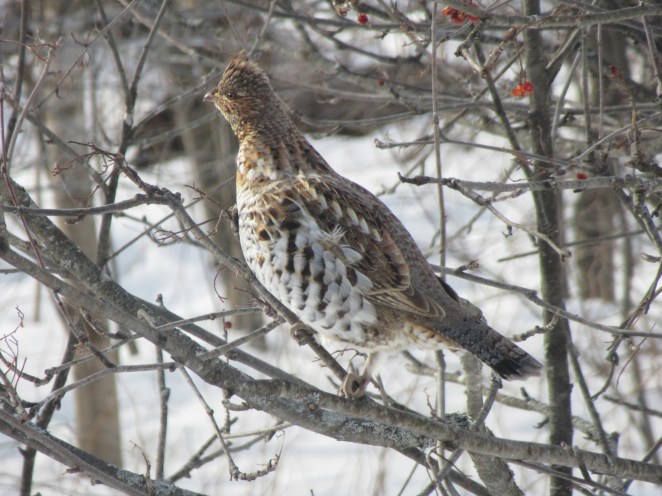
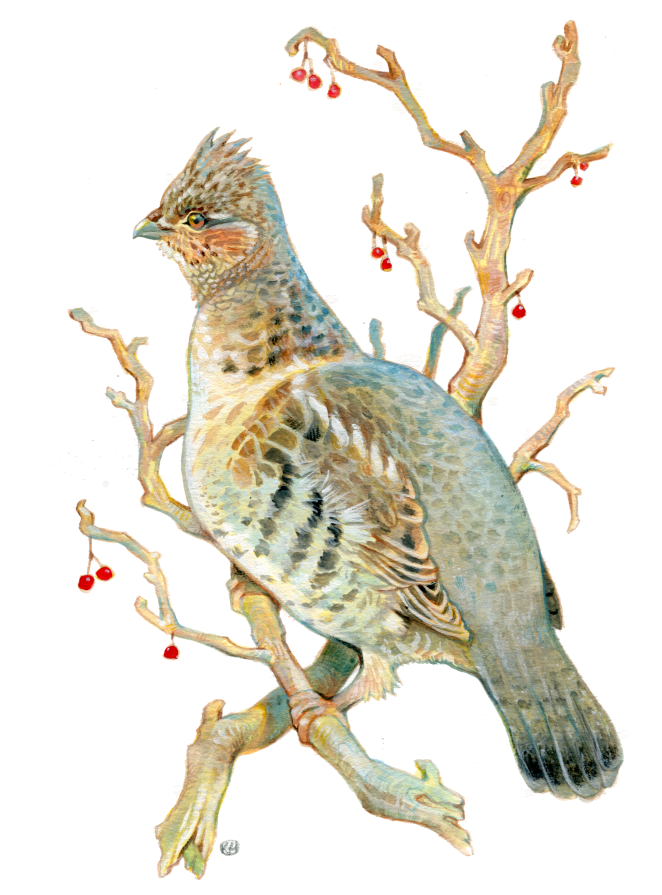
A Ruffed Grouse sought refuge
among the berries
of the Mountain Ash.

I shot him,
not with a gun,
but with a camera.

Intertextuality –
a friend borrowed the photo,
turned it into elegant brush strokes,
and now the painting
hangs on my wall,
opposite the tree
where once he sat.


A still-life
face to face with its reality
as early morning dew
forms on spider webs,
hammock-strung
between grass-blades,
bending in the wind.

And what if the spell breaks
and I can no longer see the fine seeds
of the dandelion clock kissed away
by the lisping lips of time?

What is life?
Is it just an illusion?

Commentary:

I shot him, not with a gun, but with a camera. Interesting. I have never seen the need to take the life of living creatures, except in cases of absolute necessity. And no, I have never killed, let alone for fun or sport. Shooting with a camera, that’s my ideal, and when a friend and fellow KIRA artist likes the photo and offers to paint it … well, that leads us into the nature of intertextuality, where reality becomes photo, becomes painting, becomes a text, and you, dear reader, are contemplating all those moments that join us.

The fine seeds of the dandelion clock kissed away by the lisping lips of time. This image comes from my walks in the Welsh countryside around Brandy Cove, Gower, with my paternal grandmother. “What time is it Nana?” I can still see her, bending down, plucking a dandelion, and holding it out for me to blow the seeds away – one puff, one o’clock, two puffs, two o’clock. I recall the seeds, drifting away on the summer breeze. “The Good Lord loved those dandelions,” she once told me. “That’s why He planted them everywhere.”

What will happen when the wells run dry and water runs out and there are no more dandelion seeds? How long will it be before I can no longer see them? Vis brevis, ars longa. The answer to my questions – I care, but I really don’t know.

Clepsydra 51 & 52

51

… and thus I sit in silence
     while unspoken words
          echo through
               my empty skull

I cannot produce
     the grit that oysters use
          to smoothly shape
               the pearl of great price
                    that radiates with light

the word
     once spoken
          can never be recalled

word magic
     water magic
          liquid trickling
               from cup to earthen cup

time slowly dripping away
     filtering through my fingers

flickering and dying,
      and the snuffed candle flame
          absent now
               and everywhere
                    the pain of its absence …

52

… and me like so many others
     caught up in time’s dance
          a shadow among other shadows
               moving on the cave wall
                    while the fire flickers

I try to hold them
     as they flit by
          but they vanish
               drifting like dreams
                    half-glimpsed
                         in early morning light

dancers and dance
     must fail and fade away
          when the music ends

I recall snippets of song
     that fan the unborn fires within

what am I
     but a tadpole
          swimming bravely
                into my next metamorphosis

the dancers hold hands
     and sing, oranges and lemons
          as they circle under the arch

“Here comes a candle
     to light you to bed

and here comes a chopper
     to chop off your head

 and when will that be
     ring the bells out at Battersea

I do not know
booms the great Bell of Bow” …

Commentary:

And here ends Clepsydra. One sentence, one poem, 52 sequences. Time, frozen in the writer’s mind, the passing of time, measuring time, internal time, external time, sidereal time, historical time … all linked through memories … personal, cultural, literary, family, events … all tied up with what Miguel de Unamuno called intra-historia, those deep, very personal little histories, that lead us away from great historical events into the minds of the observers, the witnesses, the readers, all with their interior monologue and their own mindfulness.

For those of you who have chosen to walk this road with me, I offer you my gratitude. I do hope you have enjoyed – if not the whole journey, then selected parts of it that may have touched you, or amused you, or aroused your interest. Pax amorque.

Clepsydra 27

Clepsydra 27

… the museum closes its doors
     inside the clepsydra murmurs
          on and on

evening falls from the sky
     in great cataracts of light
          stars flare like candles

who will see
     that last drop of water
          trembling at
               the clepsydra’s edge,

who will snuff out
     that last flickering
          flame of my life
               as the final verses
                    of the children’s song
                         loom closer

Here comes a candle
     to light you to bed.
          And here comes a chopper
               to chop of your head…

Commentary:

Moo got it right this time – “evening falls from the sky in great cataracts of light, stars flare like candles …” Lovely painting of a star ‘flaring like a candle’ against the evening sky. I think he called the painting Affirmation. Yup, he’s nodding his head, and he has his eyes wide open. He’s not dropping off into one of those drowsy moments of old age. Too early in the morning to do ‘noddy’ I say. Oh-oh, there he goes. It’s Billy Cotton Band Show Time … “Wakey-wakey!” Now how many of you remember the Billy Cotton Band Show on BBC Radio on Sunday afternoons, just as people are dropping off to sleep after the enormous Sunday dinner and dessert? Hands up if you’re over eighty and remember that. Oh dear. Not a good idea. Moo’s hand’s gone up and he’s still got his eyes shut. Ah well, appearances aren’t everything.

And look at that comma after – the clepsydra’s edge, (line 10) -. The one that got away. There’s always one that gets away, no matter how hard we try – and try we do. Clepsydra is meant to be a single sentence, with no punctuation other than an ellipsis at the beginning and end of each sequence. And what have we here? A common or garden comma, growing like a large, spring dent-de-lion / dandelion in the middle of a patch of flowery images and metaphors. Out, out fowl spot! What bird was that? A Flying MacBeth just dropped something on my windshield. ‘What a foul fowl was that fellow,’ said the soccer referee pointing to the penalty spot. A round spot with a whale of a tail.

“Any questions?” I asked my students at the end of class one day. A brave young lad raised his hand. “I have a question, sir?” [I liked it when they called me, sir. It happened about once or twice a year. I always knew something drastic was about to happen when I received a knighthood.] “Ask away,” I replied. “What the heck are you on? I’d love to have some of that. Can you give me some, sir!” Two knighthoods in one day. I’ll be a KG next, instead of an RG. I bet you don’t get that joke! Answers by snail mail and dog sled, please!

Butterflies

Butterflies
Miguel de Unamuno

… butterflies … temporal forms … fluttering …
existing for one sweet day … they perch … spread
their wings … fan us with their beauty … flourish …
catch our attention … then caught by a gust
tear their wings on a thorn … and perish … blink
your eye and they are gone … yet reborn … they
cluster and gather in dusty ditches …
congregate on bees’ balm … smother Black-Eyed
Susan and Cape Daisy … shimmer in shade …
butterflies by day … fireflies by night …
terrestrial stars floating in their forest
firmament … dark tamarack … black oak … bird’s
eye maple … silver birch … impermanence
surrounds us … dances beneath stars … sings with
robins … echoes the owl’s haunting cry …
eternity held briefly in our hands …
then escaping like water or sand … black
words on white paper capturing nothing …
… my dialog … my time … my place … butterflies …

Note: “La poesía da permanencia a las formas temporales del ser / Poetry gives permanence to the temporal forms of the self.” Miguel de Unamuno (1864-1936)

The temporal forms of the self – and so much today is unsettled, changing, insubstantial. I have often wondered how one makes time stop. Is it even possible to do so? Time and tide wait for no man. And why should they? Fray Luis de León – “Con paso silencioso, el cielo vueltas dando, las horas del vivir le va hurtando.” / With silent step, the ever-turning sky, steals away life’s hours. Or Fancisco de Quevedo – “Que sin saber ni cómo, ni adónde, la edad y la salud se hayan huído. Falta la vida, asiste lo vivido, y no hay calamidad que no me ronde.” Without me knowing how or where, age and health have fled. Life is lacking, past life flew by, and there isn’t a calamity that doesn’t hound me.

Ars longa, vis brevis – art endures, life flies by. My translations are freer than usual today, but I too feel like being creative in my own language. So, if we can’t slow time down, what can we do? We can create – poems, paintings, photos. We can read – and translate from one language to another. We can, like butterflies, perch on flowers and enjoy our brief days in the sun. Mindfulness – we can make the most of each moment by living it thoroughly and well. Carpe diem – we can seize each moment of every day and live it to its full measure. And, above all, we can write and read poetry – because, as Unamuno says – Poetry gives permanence to the temporal forms of the self.

Why do you blog?

Why do you blog?

Good question. And there’s no easy answer. I guess, in my case, that my computer and my teaching (I have been retired for 16 years) were closely linked. I used programs like Blackboard and WebCT to teach hybrid courses, online and in the classroom. The online factors – chat groups, info sharing, course analysis – backed up the in-class material and gave students a space in what was, back then, late 20th Century, a new, but rapidly developing teaching space and style.

I found the development of a web page allowed me to preserve course notes, to construct class material, to allow students to access material (in their own time and space) and many found this useful. I also encouraged students to build their own web pages (and this was in the twentieth century, remember!). I also told them that they would probably, long term, find the web page building more important than the material that I was teaching them, for my material, like that of many other teachers, had a limited shelf life, and was not carved in stone and everlasting. This was particularly true as rapidly changing times, methodologies, and students – often from different cultures and with different styles of learning and levels of knowledge – spelled the end of the single course outline imposed, top down, on all members of the class.

When I retired from teaching, I kept the web pages I had built. Then, some five or six years after retirement, I decided to start a blog, rather than just have a webpage. Now, blogging has become a habit. Not an incurable one – just this year I missed four months ‘blog time and space’ on this web page / blog of mine.

But is this web page of mine a blog? Not really. I don’t sell anything on it, rather I give my books away to friends who wish to read them. I don’t charge for accessing my ideas, my thoughts, my creativity, my poetry, my photos, my paintings, my philosophy. My oh my, look at all those ‘my -s’!

At this point in time I am wondering whether to continue blogging or not. I have been approached by many people who wish to enrich themselves by enriching my webpage so I can then enrich myself. But I neither want nor need that. Rather, I follow the philosophy of Miguel de Unamuno, the great Spanish philosopher. “If I can reach out and help just one person,” he said, “I will not have lived in vain. And I guess that’s why I blog – to reach out on the off-chance that one or two of my words will touch someone in a meaningful fashion and help them to understand the world a little bit better and even, maybe, to help reshape their lives.