Survivor

Survivor

Every day, now he’s learning to speak Welsh,
he finds out something new about his childhood.
It’s not the need to talk so much as the necessity
of diving into himself and mining his memories.

Brynhyfryd / Mount Pleasant.
Pen-y-Bont / the End of the Bridge.
Ty Coch / the Red House.

This latter the house in which he was born,
way out of town, by Fairwood Common,
away from the strafing and bombing.
The war generation of his family all born
in the same in-the-country Gower bed.
No room in war-time hospitals
not even for the birth of war babies.

Three of his brothers did not survive
those rough, household births.
He still bears the forceps’ scars
from the moment the doctor
plucked him out, head first,
and hung him up by the heels,
shaking him, bringing him back to life.

He bears other scars as well
from the survivor’s burden of carrying
three dead brothers for seventy long years,
alive and kicking in the womb-warm
crevices of his still beating heart.

Thanks Giving

Thanks Giving

Driving from St. Andrews to Island View,
giving thanks for fall foliage as I pass
fields and forests filled with autumn blushes
blueberry patches brushed with cyan,
violet, sprinkled with primary red.

Trees crowd close, encroach, add yellow
and orange, fresh tonal values at each turn.

Sunlight strokes white touches of pointillistic
beauty through showers of golden leaves.

 Ochre and brown burn shades where pinprick 
black ghosts shadow grays through a gilded tree.

Cubist, this fire-bright, iron-sheeted shed.
Surrealist that rusted tractor, abandoned.
The road’s black thread ties together vivid
impressions of leaves as they tumble and fall. 

Monkey’s Clockwork Universe

Monkey’s Clockwork Universe

Some days, monkey winds himself up
like a clockwork mouse.
Other days he rolls over and over
with a key in his back
like a clockwork cat.

Monkey is growing old and forgetful.
He forgets where he has hidden the key,
pats his pockets, and slows right down
before he eventually finds it
and winds himself up again.

One day, monkey leaves the key
between his shoulder blades
in the middle of his back.
All day long, the temple monkeys
play with the key,
turning it round and round,
and winding monkey’s clockwork,
tighter and tighter,
until suddenly, one day,
the mainspring breaks
and monkey slumps at the table:

no energy, no strength, no stars,
no planets, no moon at night,
the sun broken fatally down,
the clockwork of his universe
sapped, and snapped.

Striations

There are striations in my heart, so deep, a lizard could lie there, unseen, and wait for tomorrow’s sun. Timeless, the worm at the apple’s core waiting for its world to end. Seculae seculorum: the centuries rushing headlong. Matins: wide-eyed this owl hooting in the face of day. Somewhere, I remember a table spread for two. Breakfast. An open door. “Where are you going, dear?” Something bright has fled the world. The sun unfurls shadows. The blood whirls stars around the body. “It has gone.” she said. “The magic. I no longer tremble at your touch.” The silver birch wades at dawn’s bright edge. Somewhere, tight lips, a blaze of anger, a challenge spat in the wind’s taut face. High-pitched the rabbit’s grief in its silver snare. The midnight moon deep in a trance. If only I could kick away this death’s head, this sow’s bladder, this full moon drifting high in a cloudless sky.

Comment: This is the prose version, from Fundy Lines (2002). The prose version was based on an extract from a longer poem that first appeared in Though Lovers Be Lost (2000). Though Lovers Be Lost is also available on Amazon and Kindle.

Impressions

Impressions
Early Morning Mass

A single sunbeam:
sharp blade of a heliocentric sword,
it shatters the chapel’s dark.

Fragmented light
speckles white-washed walls.

The priest’s face:
a pallid lily truncated
in the dawn’s pearly light.

A wanderer kneels and prays.
A halo of sunshine
runs a ring around her head.

Her flesh now clutches
a statue’s marble hand.

Her pilgrim palm
presses into granite
forcing warm fingers
into cold stone.

Her veins
weave a warm spell
over frosted rock.

Comment: Revisiting and revising some earlier poems. The early version can be found here. The original poem comes from the collection Obsidian’s Edge, which can be found on Amazon.

Lost

Lost

My body’s house has many rooms and you, my love,
are present in them all. I glimpse your shadow
in the mirror and your breath brushes my cheek

when I open the door. Where have you gone?
I walk from room to room, but when I seek,
I no longer find and nothing opens when I knock.

Afraid, sometimes, to enter a room, I am sure
you are in there. I hear your footsteps on the stair.
Sometimes your voice breaks the silence

when you whisper my name in the same old way.
How can it be true, my love, that you have gone,
that you have left me here alone? I count the hours,

the days, embracing dust motes to find no solace
in salacious sunbeams and my occasional dreams.

Comment: Another golden oldie, polished, rewritten, and revised. Today is Clare’s birthday and fifty-five years ago today we got engaged, on her birthday, in Santander, Spain. I wrote this poem a couple of years ago when she was visiting our daughter and grand-daughter in Ottawa and I was left alone to look after the house. I will be including this poem in my new collection, All About Ageing … in an age of pandemic, on which I am currently working.

My vision of absence and of the bereaved wandering, lost, the house the couple once shared, is sharpened in this age of pandemic in which we live. My heart goes out to all those who have suffered short term or long term effects from the pandemic. My premonitions and visions, my memories and dreams, reach out especially to those who have lost loved ones and who live in the daily reality of that loss.

“¡Qué será, será!”

“¡Qué será, será!”

In one room in my head
my mother’s mother
sits with me on her knee
at the kitchen table
playing patience.

Elsewhere, I stand on a stool
beside my father’s mother
helping her to mix the cake
she will later bake
in the coal-fired oven
of the black, cast iron stove.

My mother’s father
sits before the television.
He leans back in the chair,
raises his foot so he can’t see
the adverts on the screen,
and puts his fingers in his ears.

My father’s father lies in bed,
downstairs, in the middle room.
His dog lies beside him,
licking his hand.
We all wait for the death
that has haunted him
since he was gassed
in World War One.

Clare sits at the computer,
following the figures
that track the pandemic.
I sit here watching her,
humming softly to myself:
“¡Qué será, será!”


Don’t Look Out

Don’t Look Out the Window

Don’t look out the window, you don’t want to
know what’s lying out there. Don’t look out.

Play ostrich. Place your head in the sand,
pretend there’s nothing there to worry you.
Pretend you can see the missing PPE,
the vanished masks, the surgical gloves,
the sanitized hand-wash that everybody needs.
Just don’t look out the window. Don’t look out.

Pretend there’s nothing out there. Deny that
nearly two million people are ill.
Deny that a hundred thousand have died,
not in vain, but from ignorance and vanity
 and a total denial of scientific truth.
Just don’t look out the window. Don’t look out.

Just look at these walls that surround you.
Smile back at the smiling faces, the nodding heads,
the puppet-string politicians who agree with
every piece of nonsense that issues, meaningless,
from empty mouths. Surround yourself with people
who believe what you believe, who think and do like you,
fellow narcissists and bullies, cheats and liars,
who have deceived and stolen, lied like you, to build
enormous fortunes while they have cheated on
their wives, gone bankrupt, and borrowed shady money
in questionable deals with shabby, foreign banks.
Don’t look out the window. Don’t look out.

All those employees know a bum deal
when they are on the sharp end of one.

But nobody speaks out and nobody,
but nobody, dares open those curtains
for fear of seeing that reborn beast,
its hour come at last,
slouching down the streets.
Close your eyes. Don’t look out the window.
Don’t look out.

Comment: I rarely comment on political events, let alone write poems about them. That said, I do not consider this poem to be a political statement. For me, the key to the poem can be found in the final five lines beginning with ‘for fear of seeing …’. I have explored inter-textuality before in these pages. I hope the reference to W. B. Yeats’ poem The Second Coming, is clear.

Forget-me-not

Forget-me-not

sitting in the kitchen
crouching by the coal fire
hands quite warm
back quite cold
checking the windows
peeling back the curtains
blackout curtains
frayed and old
looking at raindrops
sliding down the windows
chill greasy raindrops
grey and cold

wondering who wants me
wondering who loves me
wanting my teddy bear
longing for my pussy cat
wanting my little dog
longing for his tail wag
so much missing
my nose so cold

now I am seventy
everything has changed
changed town and country
changed clime and weather
everything is different
nothing is the same
longing for my childhood
longing for my home land
watching the ocean
that comes rolling in

ocean of waters
ocean of memories
ocean of people
now long departed

Comment: Rhythm is everything here. I have just re-read The Sing-song of Old Man Kangaroo from Just So Stories (Rudyard Kipling). My mum and dad gave me copy when I was seven years old. Did they really think I could read it and understand it at that age? Whatever! The rhythms have stayed with me all my life and today I tried to reproduce them. My soul and my fingers danced as I thought of old man kangaroo and how he lost so much to gain so much. And what of the Elephant’s Child with his insatiable curiosity? I lost so much when I came here to Canada but I gained so much from this wonderful country. I tore my world apart then put it back together. How to explain it? It may not be explicable.

My Grandfather’s Chair

18581930_1306791786107970_4016640231053970709_n

My Grandfather’s Chair
For Margie Goldsmith

“Write about that chair,” Margie said,
and I wondered what was in her head.
How can I write about that chair
when those who sat in it are not there.

Before the coal fire my grandfather sat,
snoring away, on his lap slept the cat.
At three years old, I climbed that chair,
and blew on the bald spot in his hair.

So many things we no longer know:
my grandpa did the same thing, years ago,
and years before that, his own grandad
did just the same to make his old man mad.

Now I, in my turn, when I drink deep,
like to sit in that chair for a little sleep,
and my grand daughter, there’s no grandson,
climbs up that chair, as others have done,

and sees the bald spot in my hair
and blows and blows as I snooze there.
The years roll back and I see the smiles
of generations woken by a young child’s wiles.

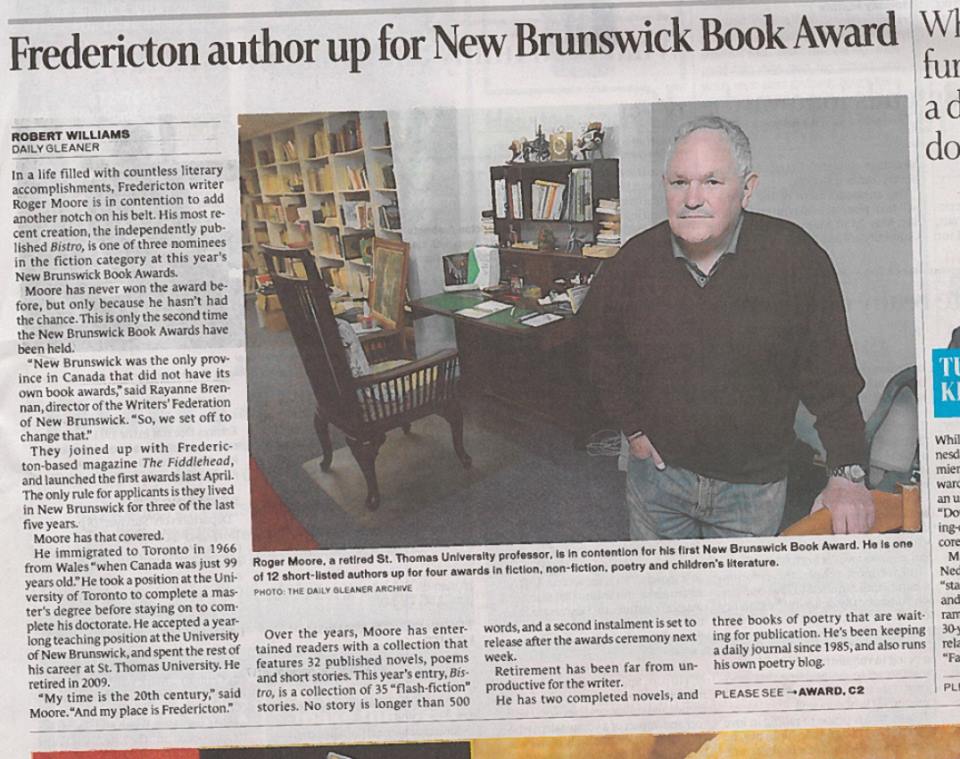
Comment: Talking the other day, I mentioned my grandfather’s chair, the only piece of furniture rescued from my parents’ house, and Margie said I had to write a poem about it. So, last night I did. The result is something very different from what I normally write. This is what in Spanish is called an occasional poem and it celebrates a specific occasion, a specific set of circumstances. Thus, it is written under different rules, rhyme, rhythm, stanzas. It is always an adventure to write something suggested by someone else. Poems like this cross the boundary between poetry of play (which this is) and occasionally enter the realm of poetry that expresses the authenticity of being which, to a certain extent is present in this poem too. The above photo, from our local newspaper, The Daily Gleaner, is the only one I have of the chair which resides in the basement where I keep my books. The article is an old one (2017), but the photo is nice!